Search This Blog

Sunday, January 21, 2024

Container shipping market outlook for 2024

 Container shipping is under pressure from large amounts of new capacity coming into the fleet, however, events in the Red Sea are boosting spot rates at least in the short-term.

In the second part of our 2024 shipping market outlook series we are focusing on the container sector with Maritime Strategies International (MSI) analyst Daniel Richards. Speaking to the Seatrade Maritime Podcast Richards says the headline takeaway is that container shipping will struggle with overcapacity in 2024.

How bad is overcapacity going to be in 2024?

“There are different ways that you can model demand and supply in the container industry., but across the models that ourselves and others use, in general, the balance between demand supply next year in 2024 is expected to be among the worst years seen over recent decades,” Richards says.

On the demand side last year saw a slight contraction for the third time in the last four years while the supply side grew at 8%. In 2024 demand is expected to rebound with MSI expecting 4% growth. “However, supply growth is still going to be north of 7% year-over-year and its cumulative impact of new deliveries far outpacing removals in the fleet, and the ability of liner services to absorb them, it is going to lead to probably major problems about where your capacity in 2024.”

Volume of newbuilding orders last year

For the year as whole 1.9 million teu of new capacity was ordered although there was a significant slowdown in the second half of the year. “There are still some rumours out there, but some relatively sizable orders and there is going to be continued ordering as some carriers feel the need to start placing orders for alternatively fueled vessels,” he explains.

Red Sea disruption

The interview was recorded in the latter part of December 2023 and the Red Sea security situation and its impact has been a fast moving one in the weeks that followed. At the time Richards commented : “You're starting to see some diversions away from the Red Sea major carriers announcing that they're pausing transit through the Red Sea, but we don't yet know yet how long that will last and how long that disruption will go on for.”

Panama Canal restrictions

While Richards notes some service diversions by container lines, he does not see a huge impact from the waterway’s restrictions on the sector. “But in general, the sort of global aggregate impact of the Panama Canal doesn't seem that significant. A relatively small number of container ships transmitted every year, and the Suez routing or around the Cape of Good Hope remains an alternative,” he says.

Container freight rates

At the time of the interview spot freight rates were down to levels at the eve of the pandemic, while broader average freight rates sat at levels slightly above the period prior to the pandemic.

Richards explains: “We'd expect a broadly similar picture over the course of next year as at the time of writing. It's probably likely that there'll be some possibly temporary, and possibly more durable spike in short term freight rates because of the situation in the Red Sea. But that isn't going to affect every trade and it isn't necessarily going to affect the freight rates tied to the volumes carriers move under contract.”

https://www.seatrade-maritime.com/containers/container-shipping-market-outlook-2024

Cancer Cases Expected To Hit Record High In 2024; Potential Causes

 by Marina Zhang via The Epoch Times (emphasis ours),

In a report published on Jan. 17, the American Cancer Society (ACS) estimated that new cancer cases will surpass 2 million in 2024, hitting a record high.

While the risk of dying from cancer has declined, cancer incidence has been rising for six of the most common cancers: breast, prostate, endometrial, pancreatic, kidney, and melanoma.

The new estimates represent a 2 percent increase from the ACS’s 2023 estimates.

“Overall cancer incidence is stable in men and increases slightly by 0.1 percent per year in women. The number of cancer cases increases each year mostly because of the aging and growth of the population,” Rebecca L. Siegel, lead author of the report, cancer epidemiologist, and senior scientific director of surveillance research at the American Cancer Society, told The Epoch Times.

Prostate cancer is the most rapidly increasing—by 3 percent per year—mostly due to advanced-stage disease diagnosis,” Ms. Siegel added.

The report found that cancers have also been increasing in younger people, specifically colorectal cancer in those under 55 and cervical cancer in women aged 30 to 44. Oral cancers associated with the human papillomavirus (HPV) and liver cancer in women have also increased.

ACS’s estimation was based on case numbers reported from 2006 to 2020 in all 50 states. There is currently no available data on real-life cancer cases past 2020.

“Modeled counts were then projected forward 4 years based on the most recent 4-year average annual percent change,” the authors wrote in the report.

This means that the new facts and figures on 2024 “do not have information on possible COVID virus- or vaccine-related effects on cancer incidence,” Dr. Harvey Risch, professor emeritus in epidemiology at Yale University, with particular interests in cancer, told The Epoch Times.

Dr. Risch said that ACS’s estimations for 2024 may be reliable “as long as nothing much is happening in the population.”

But with COVID-19 and its mass vaccine rollouts coming out at the end of 2020, “relying on the older data to estimate recent incidence would not be reliable,” he said.

Though the projection included 2020 data, the report is modeled on 15 years of data, so 2020’s impact on the report’s trajectory would be “highly drowned out” and mostly insignificant, Dr. Risch suggested.

“It would be useful to examine the 2020 data separately,” he said. He has analyzed the 2020 publicly available surveillance, epidemiology, and end results (SEER) data, which are also included in the ACS’s report.

There is a deficit for 2020 of about 11 percent, which likely reflects the March–May lockdown effects that the ACS discusses as to how they accounted for that,” he explained.

The ACS researchers acknowledged that their report currently does not reflect possible changes impacted by the pandemic.

“Researchers have not yet analyzed the potentially myriad ways in which the pandemic affected these cancer statistics,” the ACS wrote in their media report.

“When data is available, researchers expect that the public health crisis of COVID-19 will be found to have delayed diagnoses and led to worse outcomes and more deaths. But it will take many years to parse out those effects,” they concluded.

Reasons for the Increase in Cancer Cases

While the rise in cancer cases could be partially due to overdiagnosis, the authors said that increased cancer screening is an unlikely cause.

Take colorectal cancer, for example.

“People born after the 1950s have higher risk for many cancers, most notably colorectal cancer. We know it is not more screening because the death rate for colorectal cancer is increasing in this population as well as the incidence rate,” Ms. Siegel said.

If the uptick is due to more screening, there should be a greater decline in the death rate.

The obesity epidemic likely contributes but does not fully explain the trend, she added.

“There is much research in this area, but some hypotheses include changes in diet like more processed food, changes in the gut microbiome, overuse of antibiotics, and microplastic exposure.”

Stress and changes in sexual behavior could also be a factor, according to Epoch Times columnist and infectious disease specialist Dr. Yuhong Dong. She highlighted the increase in cervical and oral cancers, which may be traced back to HPV.

“In recent decades, there is an emerging trend that people tend to be engaged in sexual activity at a young age and have multiple sexual partners, which can increase the likelihood of HPV infection,” she said.

“It is well-recognized that HPV is a carcinogenic virus. The role of HPV in causing cancer is primarily due to its cancer-inducing proteins. These proteins break down the body’s tumor-fighting mechanisms, leading to rapid and uncontrolled cell multiplication.”

Recently, more emerging evidence also suggests HPV is linked to both prostate and thyroid cancer.

COVID-19 and Vaccines

While the ACS data do not show any effects of COVID-19 and its vaccines, there are concerns that “frequent use of the COVID-19 vaccine could also be detrimental to our cellular genes and make them vulnerable to cancer,” Dr. Dong said.

The recent detection of the SV40 promoter/enhancer gene in the COVID-19 mRNA vaccines has also led some cancer experts to express concerns about potential cancer interactions.

Dr. Wafik El-Deiry, the director of the cancer center at Brown University, wrote on the social media platform X, formerly known as Twitter, that while “the SV40 promoter is not the potent cancer causing element T-antigen of the SV40 virus,” he is concerned that the spike proteins produced from the virus and the vaccine may exert effects on other common cancer-enhancing pathways.

Studies have suggested that the spike protein may be able to interact with a well-known protein responsible for preventing cancer in the body called p53. If the p53 gene and its proteins get suppressed, the body may be at a greater risk of cancer.

“As a p53 researcher I wanted to study the spike protein more and it’s [sic] effects on p53, proposed it in 2020 but did not have sufficient resources,” Dr. El-Deiry wrote.

https://www.zerohedge.com/political/cancer-cases-expected-hit-record-high-2024-experts-explain-potential-causes

Saturday, January 20, 2024

Michigan prepares to open Pandora’s box on surrogacy

 By John M. Grondelski

Michigan’s legislature is back in session.  Among the bills that may be fast-tracked is a package to allow baby-buying and selling — i.e., “commercial surrogacy” — in the Great Lakes State.  The package was rammed through the lower chamber by a two-vote margin last Fall and may soon appear on the Senate calendar. 

In the effort to bring commercial surrogacy to Michigan, there are more questions than answers.  Since the legislation redefining what “parent” means was ramrodded through the lower house in 16 days, from introduction to final passage (56-53), I guess sponsor Samantha Steckloff is Michigan’s Nancy Pelosi: just “pass the bill so you can find out what’s in it.” 

Fool me once, shame on you; fool me twice, shame on me.

Can a minor be a surrogate?  On the surface of Steckloff’s bill, no.  HB5207 stipulates the surrogate be 21 or older.  But many of the same folks who want to bring you commercial baby sales were the ones who advocated in 2022 for abortion on demand as a fundamental “right” under Article I, §28 of the Michigan Constitution.  That “right” is absolute and unqualified: the “fundamental right to reproductive freedom” is not age-limited.  Nor does it restrict that right to self-exercise: if you want to reproduce for others, that’s arguably your “choice.”  Even if the age limit stays in Steckloff’s bill, will it be found constitutional?

In any event, if you are the parent of an unemancipated minor, don’t expect to have any consent or even notification role if your daughter decides to be a surrogate.  At best, she will be consulting with a Planned Parenthood or ACLU lawyer to wipe out this bill’s nominal barriers, not you.

Michigan law since 1988 makes arranging a surrogacy contract with an unemancipated minor or a developmentally disabled female a felony punishable by a $50,000 fine and/or five years in jail (Michigan Penal Code, §722.857).  In the current push to legalize commercial surrogacy, the Michigan lower house November 9 repealed that ban, 56-53.  If promoters of commercial surrogacy were serious about their age and medical requirements for surrogates, why did they repeal the penalties?  Writing supposed limits into law while removing any penalty for violating them is talking out of both sides of one’s mouth.  So is the public policy of Michigan to discourage minors and developmentally disabled women from being surrogates...or not?

Why are we not hearing about this?

Let me suggest that one reason we are not hearing about it is that it would publicize various dirty little secrets of Michigan Democrats.  Section 722.903 of the Michigan Penal Code prohibits performing an abortion on a minor child without parental consent.  Michigan Democrats have tactically avoided outright attempts to repeal that requirement, aware of the political firestorm it could ignite, one that could consume the rest of their agenda and their legislative majority.  It’s generally assumed they hope quietly to repeal the law in the post-November lame duck session or let a state court do their work for them by declaring the ban unconstitutional under the new state “right to reproductive freedom.”  So let’s go through the kabuki theater of pretending there are age limits in place that either a late night in Lansing or some state judge (who contributes to and/or represented Planned Parenthood) will eliminate.  The honest truth is that, in the end, you should expect that minors will one day be able to be surrogates absent parental consent in Michigan. 

What about the developmentally disabled?  Since developmentally disabled persons can become parents, there’s no doubt an argument will be made that impairing their right to contract as paid surrogates would constitute “discrimination” against them and their agency.  Never mind that most developmentally disabled persons are not so financially secure, and that the monetary incentives could be appealing.  Never mind that the power dynamics between the average developmentally disabled person and the average person able to hire a surrogacy lawyer are mismatched in favor of the latter.  Never mind that — in contrast to egg donors — inasmuch as the surrogate is basically treated as an animate incubator adding nothing to the genetic heritage of the child, there would be less hesitation about using them.  Never mind that, given the dynamics of the surrogacy relationship, the likely purpose of the “medical evaluation” and the “mental health consultation” Steckloff’s bill requires of surrogates more likely will focus on whether she will successfully deliver the ordered goods (the baby).  Any fair-minded person would recognize how rife the potential for exploitation appears to be.  We’ll politely leave aside the ethically relevant question of determining capacity for informed consent.  We’ll just skate past all that by insisting you are “discriminating” by even asking the questions.

Finally, while it seems macabre, it should be noted: what about “dead” surrogates?  Because perinatal medicine involves two patients — mother and child — there have been instances where a mother’s injuries have caused her to be declared brain-dead but whose physiological functioning was artificially maintained (e.g., by ventilator) to enable her baby to reach viability and thus be delivered.  (Before some people start donning their Handmaid costumes, note that this has also happened when fathers and families want to at least give the baby a chance at life).  Just as we currently allow people to donate organs upon death (and sustain the donor’s body by artificial life support prior to the organ’s harvesting), would there be any prohibition on donating a woman’s body for use as a surrogate?  Granted, temporary life support is technologically less daunting than sustaining a pregnancy, but if there is opportunity, who are we to stand in the way of “medical progress”?  U of M has a quality medical school, and research in this field would be highly lucrative. 

This is not fantasy.  Anna Smajdor of the University of Oslo (Norway) published an article in 2022 advocating “whole body gestational surrogacy” involving physiologically sustained brain dead women.  Bioethicists have already debated whether parents can harvest a deceased child’s gametes to produce grandchildren.  Posthumously obtained gametes could also help increase supply of limited “raw material” to help surrogates have “the babies they so much want.”  Do state laws even envision such scenarios? 

Using the “dead enough” (to borrow Dr. George Mychaskiw’s phrase term describing those whose organs we covet) as surrogates would really reduce labor costs, a grotesque marriage of altruistic surrogacy to commercial availability. 

One can sympathize with those who want children.  But buying a baby — or the “parts” to make and deliver one — pose profound questions about our humanity.  Commercial surrogacy, which puts a heavy financial incentive on the scale, distorts the discussion.  But the bottom line remains: does Michigan want surrogates — paid or unpaid — who are minors, developmentally disabled, or maybe even dead?

https://www.americanthinker.com/blog/2024/01/michigan_prepares_to_open_pandoras_box_on_surrogacy.html

Trump in Manchester NH


Campaign 2024

Fmr. Pres. Trump Campaigns in Manchester, NH

Former U.S. president and 2024 Republican presidential candidate Donald Trump campaigned in Manchester, New Hampshire, three days before the first-in-the-nation primary

 https://www.c-span.org/video/?533075-1/fmr-pres-trump-campaigns-manchester-nh

Johns Hopkins Says Gun-Control Will Prevent Second Civil War

 by Gun Owners of America,

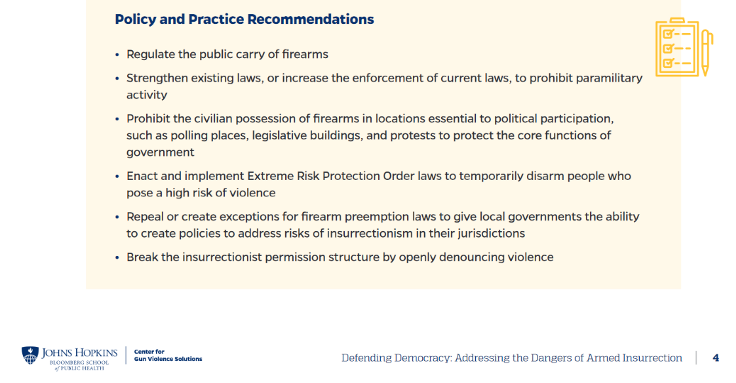
A new study published by Johns Hopkins own Bloomberg School for Public Health outlines the action items on the billionaire-funded gun control lobby's wish list and makes the claim that those specific gun control provisions are crucial to stopping an armed insurrection in the United States.

The policy recommendations made by the study include regulating the public carry of firearms, prohibiting "paramilitary" activity, enacting unconstitutional red flag laws that remove due process, and finally (and maybe most sinisterly) repealing state-level preemption laws.

The study's authors are all gun control lobby veterans. A quick glance at their LinkedIn pages revealed a work history within gun control groups before starting at Johns Hopkins.

In the study, the authors reference a study titled "Views of American Democracy and Society and Support for Political Violence." Conducted in 2022, the study features a statistic that half (50.1%) of survey participants agreed that "in the next few years there will a be a civil war in the United States." This statistic is featured prominently within the Johns Hopkins study.

The solutions proposed by the study are currently gun control priorities from the anti-gun lobby, particularly the repeal of state-level preemption laws. For those unfamiliar, state preemption laws say that local governments cannot impose regulations on firearms tighter than State law. This helps to stop a web of inconsistent laws in States where some counties may disagree with State law.

For example, take this recent case in Maryland, in Maryland Shall Issue Inc, et al v. Montgomery County, where the court threw out a local gun restriction because of Maryland's preemption law.

But because local laws are easier to change than State law, gun control groups like Giffords and Everytown have sought out State lawmakers to convince them to overturn their preemption laws.

In 2021, Giffords convinced Colorado to overturn its state preemption law, which allowed the city of Boulder to pass its own assault weapons ban later.

In an article from governing.com about the overturn of the preemption law, Allison Anderman, senior counsel for the Giffords Law Center, was reported to have spoken with other states about overturning their laws and that the discussions were still "in the early stages."

It seems as though gun control groups are so frustrated at not being able to pass laws through Congress that they've started looking to local jurisdictions to pass their legislative priorities. Interestingly, this strategy mirrors the Soros district-attorney campaigns.

Johns Hopkins' study looks to increase the legitimacy of these preemption overturn policies and, therefore, make them more appealing to state lawmakers to pass.

Gun Owners of America stands ready to fight the anti-gun lobby, whether on the federal, state, or local level.

https://www.zerohedge.com/political/johns-hopkins-says-gun-control-will-prevent-second-civil-war

NY should worry about Gavin Newsom’s funding health care for illegal migrants in Cal.

 California is now providing full health insurance, free, to all low-income undocumented immigrants.   

Full scope Medi-Cal, called Medicaid in other states, covers primary and preventive care, specialists, prescription drugs and other services.

Previously, immigrants without legal status were eligible only for restricted scope Medi-Cal, which provided benefits for such things as emergency room visits and pregnancy-related care.  

But effective January 1, 2024, all low-income California residents, regardless of immigration status, are eligible for the same taxpayer-funded, safety-net health insurance program on which 14 million Californians already rely.   

Yes, you read that right.

One-third of the population of California lives in poverty, or close to it.  

State lawmakers extended full health insurance to undocumented immigrants incrementally.

Beginning in 2016, full scope Medi-Cal benefits were granted to children up to age 19, regardless of immigration status, as long as they met the other eligibility criteria.

That was expanded to young adults through age 25 in 2020. Two years later, the policy was expanded again to include anyone age 50 or older.

California Gov. Gavin Newsom told reporters that he would not consider pulling back the expansion of Medi-Cal to undocumented immigrants, declaring, “It’s a fundamental right.”  AP

And on January 1 of this year, the missing group, adults age 26 through 49, became entitled to exactly the same all-inclusive Medi-Cal benefits available to low-income citizens and legal residents of California. 

State officials said the latest addition will add an estimated 700,000 people to the rolls and will cost an extra $3.1 billion per year.  

In truth, no one has any idea how many people will be added to the rolls, or what it will cost.  

Medi-Cal is an entitlement program. Everyone who meets the eligibility requirements is entitled to enroll in it, and then they’re entitled to have Medi-Cal cover the cost of whatever healthcare services they need.  

California officials said the move will add an estimated 700,000 people to the Medi-Cal rolls and cost an extra $3.1 billion per year.  But the cost cannot truly be predicted.Joebeth Terriquez/EPA-EFE/Shutterstock

The latest expansion of benefits was approved by the legislature in 2022 in Senate Bill 184, an omnibus budget “trailer” bill rushed through the legislature in a matter of days.

Trailer bills are a California budget gimmick that evades the usual committee process where policies can be more thoughtfully considered.  

If lawmakers had taken the time to read the bill, this sentence might have jumped out at them: “The federal Medicaid program prohibits payment to a state for medical assistance furnished to an alien who is not lawfully admitted for permanent residence or otherwise permanently residing in the United States under color of law.”  

That means California will not receive federal matching funds to help pay for the extension of full scope Medi-Cal benefits to undocumented immigrants.

The cost of this new entitlement is on California taxpayers.  

The 14 million Californians already on Medi-Cal face long waits, and often long travel times, for medical appointments. An influx of Medi-Cal eligible migrants will only add to that.AFP via Getty Images

Now, however, the state’s finances are deep in the red. Gov. Gavin Newsom insisted at his recent budget presentation that the projected shortfall is “only” $38 billion, not the $68 billion estimated by the nonpartisan Legislative Analyst’s Office.

The LAO stood by its numbers, tactfully responding that the governor was being “optimistic.”  

Newsom told reporters that he would not consider pulling back the expansion of Medi-Cal to undocumented immigrants, declaring, “It’s a fundamental right.”  

It’s not, of course.

Health care is a service.

There can’t be a right to anything that’s provided by other people.  

New York should beware following in Newsom’s footsteps: As of January 1, 2024, all low-income undocumented immigrants in the state are eligible for full Medicaid if they are at least 65 years old. AP

The 14 million Californians already on Medi-Cal face long waits, and often long travel times, for medical appointments.

One reason is that Medi-Cal reimbursements to providers are notoriously low, around 70% of what Medicare pays for the same service.

As a result, doctors limit the number of Medi-Cal patients they will accept, if they accept them at all.

Reimbursements are below the cost of providing the care.  

In 2015, groups representing California Latinos filed a civil rights complaint with the U.S. Department of Health and Human Services alleging that long wait times for care had resulted in lower survival rates for cancer patients on Medi-Cal.

Then in 2017, the Mexican American Legal Defense and Educational Fund (MALDEF) sued the California Department of Health Care Services, charging that low reimbursements were causing Medi-Cal patients to have substantially worse access to health care than Californians who had different insurance, which violates the law.  

MALDEF’s lawsuit pointed out that the federal Medicaid act requires that reimbursement rates to health care providers must be “adequate to enlist providers for the level of care and services…available to the general population” and that medical care must “be provided with reasonable promptness to all eligible individuals.”  

The situation will only get worse now that Medi-Cal enrollment is open to the whole world.  

New York may be on the same path.

As of January 1, 2024, all low-income undocumented immigrants in the state are eligible for full Medicaid if they are at least 65 years old. 

Given what Americans are paying for health insurance, maybe we should go out and come in again. 

Susan Shelley is a columnist and editorial writer for the Southern California News Group and VP of Communications for the Howard Jarvis Taxpayers Association. 

https://nypost.com/2024/01/20/opinion/california-funding-health-care-for-illegal-migrants-is-dangerous/