Search This Blog

Tuesday, January 23, 2024

Intuitive Surgical beats views

Late Tuesday, Intuitive Surgical (ISRG) reported adjusted earnings of $1.60 per share on $1.93 billion in fourth-quarter sales. ISRG stock yo-yoed in after-hours trades.

On average, analysts polled by FactSet expected the robotic surgery behemoth to report adjusted profit of $1.48 a share on $1.89 billion in sales. Earlier this month, the company preannounced $1.93 billion in December-quarter sales.

In the year-earlier period, Intuitive Surgical earned $1.23 a share on $1.74 billion in sales.

Intuitive Surgical didn't provide an earnings or sales outlook for 2024, but previously said it expects procedures using its da Vinci robotic system to climb 13% to 16% this year. ISRG stock analysts forecasted $6.42 earnings per share and $8.08 billion in sales. They also forecast procedure growth of 14.8%.

https://www.investors.com/news/technology/isrg-stock-intuitive-surgical-earnings-q4-2023/

Inari started at Buy by Needham

 Target $72

https://finviz.com/quote.ashx?t=NARI&p=d

Even Intentional Weight Loss Linked With Cancer

 As anyone who has been through medical training will tell you, some little scenes just stick with you. I had been seeing a patient in our resident clinic in West Philly for a couple of years. She was in her mid-60s with diabetes and hypertension and a distant smoking history. She was overweight and had been trying to improve her diet and lose weight since I started seeing her. One day she came in and was delighted to report that she had finally started shedding some pounds — about 15 in the past 2 months.

I enthusiastically told my preceptor that my careful dietary counseling had finally done the job. She looked through the chart for a moment and asked, "Is she up to date on her cancer screening?" A workup revealed adenocarcinoma of the lung. The patient did well, actually, but the story stuck with me.

The textbooks call it "unintentional weight loss," often in big, scary letters, and every doctor will go just a bit pale if a patient tells them that, despite efforts not to, they are losing weight. But true unintentional weight loss is not that common. After all, most of us are at least half-heartedly trying to lose weight all the time. Should doctors be worried when we are successful?

A new study suggests that perhaps they should. We're talking about this study, appearing in JAMA, which combined participants from two long-running observational cohorts: 120,000 women from the Nurses' Health Study, and 50,000 men from the Health Professionals Follow-Up Study. (These cohorts started in the 1970s and 1980s, so we'll give them a pass on the gender-specific study designs.)

The rationale of enrolling healthcare providers in these cohort studies is that they would be reliable witnesses of their own health status. If a nurse or doctor says they have pancreatic cancer, it's likely that they truly have pancreatic cancer. Detailed health surveys were distributed to the participants every other year, and the average follow-up was more than a decade.
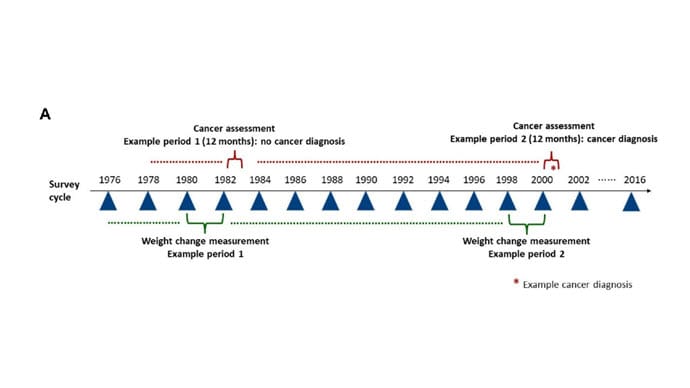
Participants recorded their weight — as an aside, a nested study found that self-reported rate was extremely well correlated with professionally measured weight — and whether they had received a cancer diagnosis since the last survey.

This allowed researchers to look at the phenomenon described above. Would weight loss precede a new diagnosis of cancer? And, more interestingly, would intentional weight loss precede a new diagnosis of cancer.

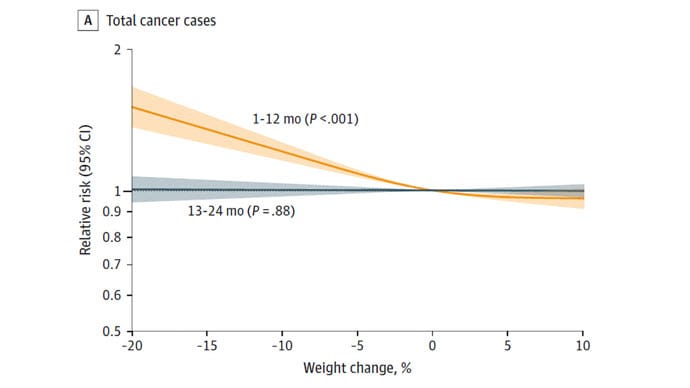
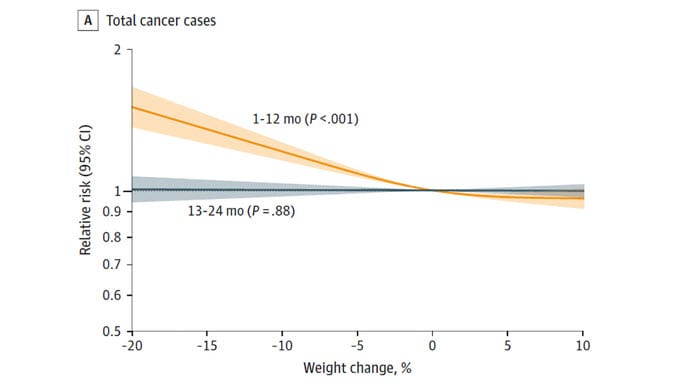
I don't think it will surprise you to hear that individuals in the highest category of weight loss, those who lost more than 10% of their body weight over a 2-year period, had a larger risk of being diagnosed with cancer in the next year. That's the yellow line in this graph. In fact, they had about a 40% higher risk than those who did not lose weight.
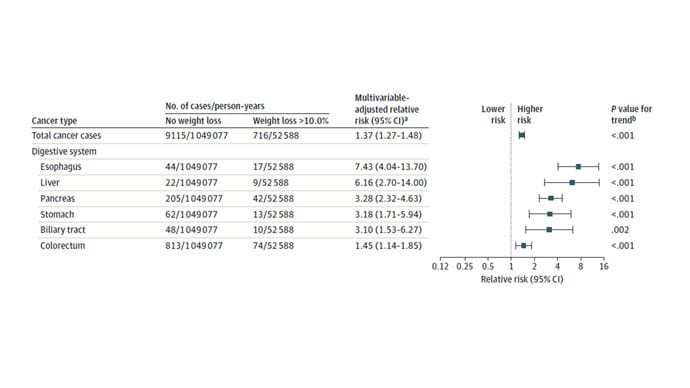
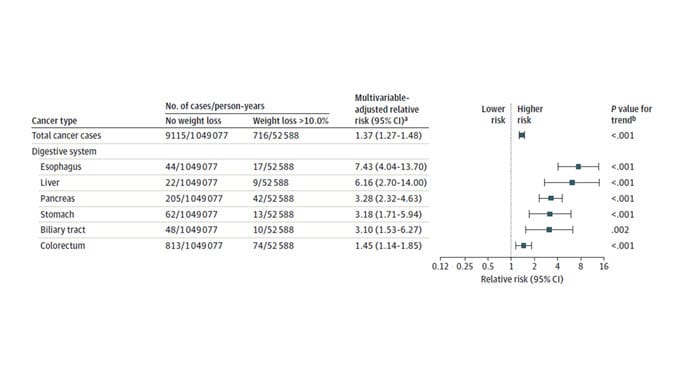
Increased risk was found across multiple cancer types, though cancers of the gastrointestinal tract, not surprisingly, were most strongly associated with antecedent weight loss.
What about intentionality of weight loss? Unfortunately, the surveys did not ask participants whether they were trying to lose weight. Rather, the surveys asked about exercise and dietary habits. The researchers leveraged these responses to create three categories of participants: those who seemed to be trying to lose weight (defined as people who had increased their exercise and dietary quality); those who didn't seem to be trying to lose weight (they changed neither exercise nor dietary behaviors); and a middle group, which changed one or the other of these behaviors but not both.

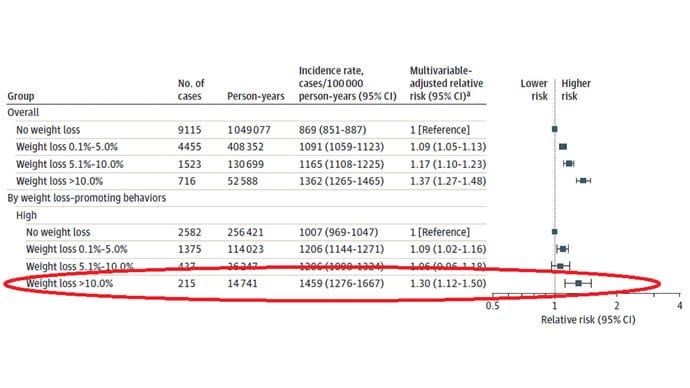
Let's look at those who really seemed to be trying to lose weight. Over 2 years, they got more exercise and improved their diet.

If they succeeded in losing 10% or more of their body weight, they still had a higher risk for cancer than those who had not lost weight — about 30% higher, which is not that different from the 40% increased risk when you include those folks who weren't changing their lifestyle.
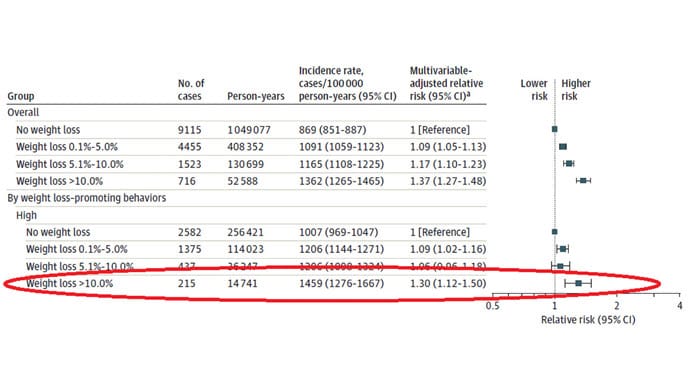
This is why this study is important. The classic teaching is that unintentional weight loss is a bad thing and needs a workup. That's fine. But we live in a world where perhaps the majority of people are, at any given time, trying to lose weight. The truth is that losing weight only with lifestyle modifications — exercise and diet — is actually really hard. So "success" could be a sign that something else is going on.

We need to be careful here. I am not by any means trying to say that people who have successfully lost weight have cancer. Both of the following statements can be true:

Significant weight loss, whether intentional or not, is associated with a higher risk for cancer.

and

Most people with significant weight loss will not have cancer.

Both of these can be true because cancer is, fortunately, rare. Of people who lose weight, the vast majority will lose weight because they are engaging in healthier behaviors. A small number may lose weight because something else is wrong. It's just hard to tell the two apart.

Out of the nearly 200,000 people in this study, only around 16,000 developed cancer during follow-up. Again, although the chance of having cancer is slightly higher if someone has experienced weight loss, the chance is still very low.

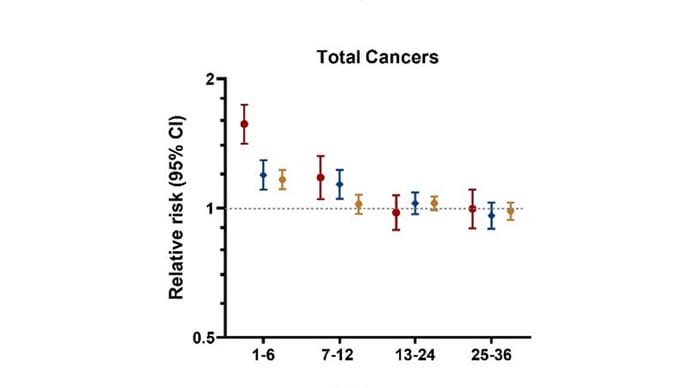
We also need to avoid suggesting that weight loss causes cancer. Some people lose weight because of an existing, as of yet undiagnosed cancer and its metabolic effects. This is borne out if you look at the risk of being diagnosed with cancer as you move further away from the interval of weight loss.
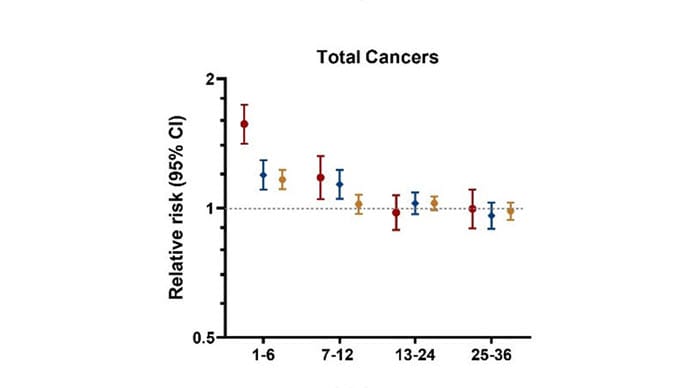
The further you get from the year of that 10% weight loss, the less likely you are to be diagnosed with cancer. Most of these cancers are diagnosed within a year of losing weight. In other words, if you're reading this and getting worried that you lost weight 10 years ago, you're probably out of the woods. That was, most likely, just you getting healthier.

Last thing: We have methods for weight loss now that are way more effective than diet or exercise. I'm looking at you, Ozempic. But aside from the weight loss wonder drugs, we have surgery and other interventions. This study did not capture any of that data. Ozempic wasn't even on the market during this study, so we can't say anything about the relationship between weight loss and cancer among people using nonlifestyle mechanisms to lose weight.

It's a complicated system. But the clinically actionable point here is to notice if patients have lost weight. If they've lost it without trying, further workup is reasonable. If they've lost it but were trying to lose it, tell them "good job." And consider a workup anyway.

F. Perry Wilson, MD, MSCE, is an associate professor of medicine and public health and director of Yale's Clinical and Translational Research Accelerator. His science communication work can be found in the Huffington Post, on NPR, and here on Medscape. He tweets @fperrywilson and his bookHow Medicine Works and When It Doesn'tis available now.

https://www.medscape.com/viewarticle/999788

Many Patients Maintain Weight Loss a Year After Stopping Semaglutide and Liraglutide

 Kersten Bartelt, RNChris Mast, MDJoe Deckert, PhD

Matthew Gracianette, MDBrendan Joyce

Key Findings

  • Two-thirds of patients are able to maintain weight loss achieved while on semaglutide or liraglutide even a year after discontinuing the medication.  
  • However, a portion of patients who stop taking either medication experience weight regain, with 18.7% of liraglutide users and 17.7% of semaglutide users regaining all the weight they had lost or more. 

In a previous study, we demonstrated that patients using the recommended weight loss dose of semaglutide for 60 weeks achieved weight loss of 8-11% of their initial body weight.1 However, clinical trials have shown weight gain after discontinuation of semaglutide.2,3 Because of this, we aimed to further investigate the effects on weight after discontinuing semaglutide or liraglutide. 

We studied 20,274 patients who were prescribed semaglutide and successfully lost at least five pounds while on the medication. We aimed to assess their weight change one year after discontinuation. We found that 17.7% of these patients regained all the weight they had lost or even exceeded their initial weight. However, a majority (56.2%) of patients either remained around the same weight they were at when stopping the medication or continued to lose additional weight. 

Similarly, we studied 17,733 patients prescribed liraglutide who achieved a weight loss of at least five pounds while on the medication. Among this group, 18.7% experienced complete weight regain or surpassed their initial weight. However, 55.7% of these patients either remained around the weight they were at when stopping the medication or continued to lose additional weight. 

These data come from Cosmos, a collaboration of 236 Epic health systems representing more than 227 million patient records from 1,301 hospitals and more than 28,600 clinics from all 50 states and Lebanon. This study was completed by two teams that worked independently, each composed of a clinician and research scientists. The two teams came to similar conclusions. 

https://epicresearch.org/articles/many-patients-maintain-weight-loss-a-year-after-stopping-semaglutide-and-liraglutide

Boosters do not work in people who have had COVID

 Observational studies for boosters are biased. Typically, they are biased towards the healthy vaccinee effect, i.e. people who get boosted are otherwise healthier than those who do not. So much of the “booster effect” is actually just being healthier.

That’s why some analyses have reported that boosters lower all cause mortality (95%!) or the unvaccinated have more car accidents and other such implausible things. A good peer review would have stopped these papers, but, peer review doesn’t work well in times of runaway groupthink.

So when an observational study shows that boosters DO NOT REDUCE COVID-19 DEATHS in people who already had COVID that occurs despite the bias to find a benefit. It probably means the obvious: once you have COVID, you have natural immunity against severe outcomes, and further doses are illogical.

Let’s take a look at the paper.

This paper is a population based observational analysis of boosting, but restricted to people who had COVID. Austria has pretty good records and pretty good testing, but not perfect.

First these authors actually report, all cause death, and it is lower in boosted groups. They write, “All-cause mortality data indicate modest healthy vaccinee bias.”

This is in contrast with NEJM’s Israeli authors who omitted all cause mortality data in their paper. They only reported it in a letter, and it clearly showed massive bias. Omitting all cause mortality data in a booster paper is a methodological sin. It is dishonest. All papers on vaccine effectiveness should include all cause mortality and falsification endpoints, such as car accidents.

Next, the authors confirm what we have known— that boosters transiently lower the risk of testing positive, “we observed a small rVE of a fourth vaccine dose with evidence for rapidly waning immunity and reversal of this effect in 2023.”

But be clear: this is a nothing burger. Its such a minuscule and transient effect it cannot justify a vaccine program, and its is like pouring a cup of water on your lawn when the forest fire approaches.

Even the authors know this includes infections of uncertain harm, “positive laboratory tests for SARS-CoV-2 with unclear and prob-ably no adverse consequences for most individuals (even for hospitalized patients) in an endemic phase”

Finally, the authors note the big finding, “we did not observe a significant rVE [vaccine effect] of a fourth vaccine dose for COVID-19 deaths during a time with already very low absolute risk for this outcome.”

And, “No individual younger than 40 years died due to COVID-19. “

In other words, COVID is over when you have COVID. Most of us have had COVID. That’s why my pledge from a prior post was correct.

Finally, the authors put their results in context, “Similarly, data from Qatar suggest that natural immunity confers a very strong protection against severe COVID-19 with no evidence of waning immunity, a conclusion that is supported by a systematic re-view and meta-analyses”

Here is how the authors conclude, “The lack of effectiveness of the fourth vaccination during 2023 in our study is, however, consistent with the notion of rapidly waning immunity by this second, mainly bivalent, booster. Finally, our findings do not apply to previously uninfected individuals, a population group that is vanishingly small by late 2023.”

And in my words: the US FDA and CDC are engaging in a reckless public health campaign to boost people— even babies, children and young men— who already had COVID. They have no good data that this makes those kids better off, or anyone else. Boosting someone who had infection is already implausible.

These data— despite a bias to find a false benefit— find no benefit. FDA and CDC officials should consider resignation if they cannot regulate in accordance with evidence based medicine. Pfizer has 100 billion reasons to run randomized trials, and FDA must demand those studies.

Check out my video

My conclusion: Boosters do not work if you have had COVID. They are net harmful (due to AEs at time of injection).


Vinay Prasad, Hematology Oncology Medicine Health Policy Epidemiology Professor


https://www.drvinayprasad.com/p/boosters-do-not-work-in-people-who

REMEMBERING MAO’S CARNIVAL OF HATE

 Red Memory:

The Afterlives of China’s Cultural Revolution
by tania branigan
w.w. norton, 304 pages, $29.95

At a 1979 White House dinner, actress Shirley MacLaine told Deng Xiaoping, China’s new leader and the guest of honor that evening, about a Chinese scientist she had met. He said that he’d been happier and more productive when he worked on a Chinese farm. Deng cut her short: “He lied. That was what he had to say at the time.” Deng spent three years working in a tractor factory during the Cultural Revolution, and he refused to romanticize it. The memoirs of Cultural Revolution survivors written in the 1980s echo Deng’s view that it was a brutal and pointless experiment.

Today, there is widespread nostalgia in China for the Cultural Revolution. President Xi Jinping has reflected positively on the time he spent exiled in the remote town of Liangjiahe in Shaanxi province, living in a cave, hauling coal carts, carrying manure, building dikes, enduring bitter winters, flea bites, and hunger. This experience, Xi claims, bonded him with China’s common people and prepared him to be an empathetic ruler. Liangjiahe is now a “red tourist” attraction where students can visit Xi’s old home and admire the well he built.

Xi’s glamorization of the Cultural Revolution is reflected in Beijing’s chic dining scene. In Red Classics Restaurant, for example, waitresses in Red Guard uniforms serve meat and vegetables in plain style to invoke an era of stark living. You can have a fully themed wedding in this restaurant, posing for photos in matching Mao suits on a tractor parked in one corner.

In her new book, Red Memory, Tania Branigan describes the clashing memories of the Cultural Revolution. Those who suffered under the brutality of the Red Guard describe an infernal decade when Mao turned his murderous paranoia on his own people, leading them to tear each other to pieces. Children denounced their parents, and students murdered their teachers. In Mao’s campaign against the four “olds” (Old Ideas, Old Culture, Old Customs, and Old Habits), traditional Chinese culture and morality became targets for destruction.

But Branigan also tells stories of people who are nostalgic for a time when life was more austere and when people lived for a cause other than individualism and materialism. Some former Red Guards have set up a bookstore and website called Utopia. Others organize trips to North Korea to admire society as it should be, or set up rural communes for students. One Utopia co-founder, a professor, made headlines for slapping an eighty-year-old “traitor” who had dared to criticize Mao.

Red Memory is full of chilling stories of brutality and betrayal. Fang Zhongmou witnessed the torture and beating of her husband by adolescent Red Guards. She endured years of interrogations at her workplace because her father had been a landowner. One night in 1970, while doing laundry at home, she launched into a tirade against Mao. Her son told her, “If you go against my dear Chairman Mao, I will smash your dog head in.” He reported her to officials. After two months of violent “struggle sessions,” Fang was executed. The son grew up to be a guilt-ridden adult who agonizes over his mother’s gravesite.

Song Binbin was eighteen when she viciously denounced her school’s deputy principal, Bian Zhongyun. Bian had told the students that they should run out of the building in the event of an earthquake. Because she did not instruct the students to take Mao portraits with them, Red Guards hunted her down and beat her to death with nailed clubs. As the Cultural Revolution swept China, beatings and executions became increasingly baroque. Students poured boiling water over teachers' heads and made them swallow excrement, crawl over embers, drink ink and glue, and beat one another.

Branigan writes that foreigners sometimes summon Lord of the Flies when they talk about the Cultural Revolution, but “the carnival of violence and hate—young girls remorselessly stalking their Piggy,” was worse than fiction. It happened not on a desert island but in the midst of a civilization founded on reverence for scholars and elders.

Branigan concludes her book with a meditation on how the suppressed memories of the Cultural Revolution haunt a society that has never had a proper reckoning with the horrors of its past. The Cultural Revolution is barely mentioned in Chinese textbooks. At the National Museum in Beijing, one photograph and three lines of text commemorate the revolution. There is no mention of the mobs of Red Guards who killed artists, teachers, and class enemies; the scholars who hanged themselves or the party veterans who jumped out of windows. Following Mao’s death there was a brief spate of “scar literature” that honestly recounted the events of the period. But under Xi Jinping, China has constructed a wall of censorship. Victims and perpetrators alike are living with their trauma in silence.

Branigan gathered the interviews for her book between 2008 and 2015, when she was a reporter for the Guardian in China. She writes that she could not have conducted such interviews today. In the past decade, China’s surveillance state has come down hard on those who wish to remember a past the party wants to forget. Websites where survivors could openly discuss the Cultural Revolution have been shut down. This is all part of Xi Jinping’s crackdown on what he calls “historical nihilism,” a dystopian phrase that means believing historical narratives that stray from the official Communist party narrative.

What happens to a society where painful memories are not allowed to be aired or shared? Today’s China is a land of raw suffering and need, driven by impulses it cannot understand. “You turned the pages of a paper and counted the crises,” Branigan writes. “Eighteen people walked by as a two-year-old, run down by a truck, lay dying in the street. Children died when a kindergarten owner laced yogurt with poison to smear a competitor. There was a spate of knife attacks on schools.” Collective traumatization demands collective meaning and a common attempt to work through the loss and humiliation of the past.

A topic that Branigan mentions briefly, but inadequately, is the extraordinary return of religion that is sweeping China. The Communist party’s inability to meet the psychic needs of its people has led to an explosion of religious observance. The country now has perhaps 100 million Christians in both officially recognized and underground house churches. There are more than 20 million Chinese Muslims. There is a surge of people practicing traditional Chinese religions, often in exotic manifestations. Anarchic and menacing religious cults are popping up in the countryside.

While Han Pingzhao, both a victim and a perpetrator of violence during the Cultural Revolution, was being held in a black jail, he remembered passages that he had read in a discarded Bible. Han turned his back on vengeance and embraced teachings that seemed to be the antithesis of Maoism. “Love is very simple,” he told Branigan. “Accepting guilt—that is hard, God is justice and honesty. If you believe in God, there is a conscience in your heart.” In the last seventy years, the Chinese Communist party has embarked on countless experiments that have left its subjects exhausted, cynical, and demoralized. Perhaps Han Pingzhao has discovered an antidote to the malaise that afflicts so many of his fellow survivors.

Robert Carle was a professor of theology at The King’s College in Manhattan from 1999 to 2023. He has contributed to the Wall Street JournalSocietyHuman Rights ReviewPublic Discourse, and more.

https://www.firstthings.com/web-exclusives/2024/01/remembering-maos-carnival-of-hate

Court dismisses Jordan Peterson's request to challenge order he undergo media training

 Ontario's highest court has rejected an attempt by psychologist Jordan Peterson to challenge a regulatory body's order that he undergo social media training or potentially lose his licence to practise.

A spokesperson for the Court of Appeal for Ontario says that a panel of judges has decided to not grant Peterson leave to appeal an August 2023 divisional court ruling that affirmed that the College of Psychologists of Ontario could order him to undergo training on professionalism in public statements.

"I can confirm the Court of Appeal did not grant leave to file fresh evidence," Jason Gennaro said in an email to The Canadian Press on Wednesday.

"The panel does not provide reasons for its decisions."

Gennaro said Peterson, who is a retired University of Toronto psychology professor, filed his request to appeal the previous court ruling last September and judges made their decision on Tuesday.

Peterson said Wednesday that there are now no legal avenues he can take to challenge the college's decision to send him "to re-education camp," adding his "war" with the college has "barely started.

"I want the entire current crop of minions at the College of Psychologists to publicly apologize and then resign — en masse," he said on X, the social media platform formerly known as Twitter.

"They want me to undergo re-education, which they know will take up my time and fail in any case, so they can undermine my reputation and take my licence away anyway."

Online commentary generated complaints

Peterson rose to prominence through his polarizing YouTube videos critiquing liberal culture and since at least 2018, the governing body of Ontario's psychologists — of which Peterson has been a registered member since 1999 despite having stopped seeing patients in 2017 — has received complaints regarding Peterson's comments.

The college's complaints committee has said that some of Peterson's online commentary on a range of issues, from gender transition to climate change, posed a moderate risk of harm to the public and undermined public trust in the profession of psychology.

Justice Paul Schabas wrote in the court's August decision that the college's order that Peterson undergo a program on professionalism in public statements balanced its mandate to regulate the profession, "is not disciplinary and does not prevent Dr. Peterson from expressing himself on controversial topics."

Peterson had said his statements were not made in his capacity as a clinical psychologist, but instead were "off-duty opinions" — an argument the court rejected.

The college's committee previously noted that during an appearance on The Joe Rogan Experience podcast, Peterson identified himself as a clinical psychologist before demeaning a former client.

The college's ethics code requires members to use respectful language and not engage in "unjust discrimination."

https://www.cbc.ca/news/canada/toronto/jordan-peterson-court-challenge-rejection-1.7086681