Search This Blog

Thursday, April 11, 2024

Why big Medicare Advantage insurers may root for Biden to lose in 2024

 Insurance giants have a bigger stake in this year’s presidential election after recent moves by the Biden administration cut into the profitability of Medicare Advantage plans.

In the last week, the Centers for Medicare and Medicaid Services delivered consecutive blows to the industry that offers these private-sector Medicare alternatives, denting insurance stocks and pulling down estimates of future earnings.

Insurers will get paid less than expected next year for providing these plans, while, at the same time, they must abide by new, and probably costlier, regulations. Other key changes rolling out over the next three years could also nick their bottom lines.

The industry expects a second term for President Joe Biden would bring more of the same at a time when the youngest baby boomers become Medicare-eligible and more of the older ones seek healthcare services.

"Do I wanna say it's a historic level of regulations? If it's not, it's got to be close to it," Whit Mayo, an analyst with Leerink Partners, told Yahoo Finance. "Biden is no friend to the industry right now."

'A major change'

The new regulations have come hard and fast in the last year.

Last week, the government said it would increase its payments to Medicare Advantage (MA) insurers by 3.7% in 2025. That’s "marginally worse" than the earlier, proposed rate, Mayo said, and “inconsistent with almost any historic precedent.”

It also caught the industry by surprise because many expected CMS to incorporate the uptick in healthcare service volumes in the fourth quarter.

A few days later, CMS finalized other rules around health equity, behavioral healthcare services, and supplemental benefits that would require more action from insurers.

The agency also established new rules on how much insurers can compensate a broker selling Medicare Advantage plans to ensure seniors are steered into plans that best meet their needs — not into ones that are most profitable.

“CMS does not want an agent to have preference over any plan based on commissions…so this is a major change,” Mayo said.

These efforts are weighing down insurer stocks.

Year to date, shares of Humana (HUM) — which has the largest exposure with MA accounts making up 77% of its total revenue — are down 30%.

The stock of UnitedHealthcare (UNH) has also declined nearly 13% since the beginning of the year. MA accounts make up 31% of UnitedHealthcare's total revenue, according to Ann Hynes, managing director at Mizuho Americas.

In a note last week to investors, Hynes estimated the 3.7% increase in the MA payment rate could be a 2% and 4% "headwind" for UnitedHealthcare’s 2025 earnings, a 2% to 6% drag on both CVS Healthcare Corp.’s (CVS) and Centene Corp.’s (CNC) profits, and an 8% anchor on Humana’s bottom line.

One of the three "key upcoming catalysts" for Humana’s stock, Hynes wrote, is “the 2024 Presidential election.”

On the horizon

More change is on its way under the Biden administration’s CMS that could also upend insurance profits.

The agency recently put out a new patient risk coding model. Each patient receives a risk score based on the number and severity of their health conditions. The unhealthier the patient, the more money CMS pays the insurers.

Under the new model, risk scores will overall likely decline, meaning fewer dollars will flow to insurers. How much exactly? The model, which will be fully phased in 2025, is expected to save Medicare $11 billion this year, per CMS estimates. Next year, it will likely be more.

How Medicare Advantage plans are rated by CMS is also changing.

CMS ranks each plan annually using a one-to-five-star scale, with five being the best, based on a variety of metrics. The idea is to reward plans that provide quality care with reimbursement and bonuses, while cracking down on mediocre plans by reducing CMS payments and restricting their marketing.

Over the next three years, CMS plans to increase or decrease the weighting of some measures, eliminate others, and add a health equity index to the ranking. Insurers work hard to maintain at least a four-star rating on their plans to get a 5% quality bonus, which, by law, must be invested into plan benefits.

"That's what gives you a competitive advantage in the market," Mayo said.

Insurers also remain under pressure from increasingly vocal healthcare providers, which are dropping some Medicare Advantage plans due to too many denials, delays, and refusals to pay for care that Original Medicare would usually cover.

October surprise, anyone?

Under Donald Trump, those changes may not be carried out.

"I think the perception among the investment community is that under a Trump administration, the environment would be more favorable,” Mayo said. “Just not as much regulation, maybe even roll [some] back."

It may be seniors — historically one of the most reliable voting blocs — who may get the last word.

Mayo expects insurers will readjust some of the MA benefits so they can grow — or at least hold — their margins in light of the recent changes, a reversal of the yearslong cycle of "massive" investment in these perks.

Extras like a supplemental grocery benefit could be eliminated for next year, while the share that patients pay out of pocket for services such as dental or vision care could increase.

Seniors will see those reductions in benefits or increases in co-insurance during Medicare’s annual open enrollment period, when they choose their health insurance for next year. Open enrollment kicks off Oct. 15, less than a month before the presidential election on Nov. 5.

That means the 33 million Americans now enrolled in Medicare Advantage plans, making up over half of Medicare-eligible adults, may get mad after their plan drops benefits that enticed them to sign up in the first place.

They may carry that anger into the voting booth. That may be what insurers are hoping for.

https://finance.yahoo.com/news/why-big-medicare-advantage-insurers-may-root-for-biden-to-lose-in-2024-080028510.html

UnitedHealth Chair, Executives Sold $102 Million in Stock Before US Probe Became Public

 UnitedHealth Group Inc. Chairman Stephen Hemsley and three senior executives netted a combined $101.5 million from stock sales made over four months leading up to when the public became aware of a federal antitrust investigation.

The sales occurred between Oct. 16, a week after the largest health insurer in the US reportedly received notice of the Justice Department probe, and Feb. 26, the day before Bloomberg News and others published stories about the investigation. The stock dropped after the investigation was widely reported.

There’s no indication that the trades were executed according to scheduled trading plans in filings related to the transactions. UnitedHealth said officers and directors must get clearance to trade shares, and that trading is limited to certain windows that often open after earnings reports. The trades in question were approved, a spokesperson said. The company reported third-quarter earnings on Oct. 13.

Typically a company’s general counsel would declare a blackout period barring trading in light of a sensitive investigation, according to John C. Coffee Jr., a corporate governance expert at Columbia Law School. “Apparently, this did not happen” at UnitedHealth, he said in an email.

The DOJ is reviewing whether UnitedHealth’s acquisitions have consolidated its position in some markets in a way that violates antitrust laws, according to a person familiar with the probe who asked not to be identified discussing a nonpublic investigation. The agency has reportedly been looking at potential monopolies in the managed-care industry since at least mid-2023.

UnitedHealth hasn’t explicitly acknowledged the probe and declined to say when Hemsley and the others were informed of it. When asked about the trades, a spokesperson for the insurer said “these directors and officers followed our protocols and received approval from the company.”

The Case For Owning Treasuries Is Evaporating

 Authored by Simon White, Bloomberg macro strategist,

Contrarians will love this column as it will show there is still no smoking gun for a recession in the US.

They might see that as proof then that one must be imminent and yields are going much lower. But contrarianism for its own sake is rarely a good investment strategy.

With low recession risk, there is no need to own Treasuries for those that don’t have to, and with increasingly entrenched inflation, there is little reason not to short them.

Investors have been hesitant to short bonds, but the diminishing risk of a near-term NBER-defined downturn and Wednesday’s stronger-than-expected CPI data, the fourth in a row, should squash any lingering doubts.

No imminent recession removes (for now) the need to own bonds for protection.

Yields look too low, especially as rising inflation risks mean investors will become increasingly reluctant to fund the US government without a bigger margin of safety.

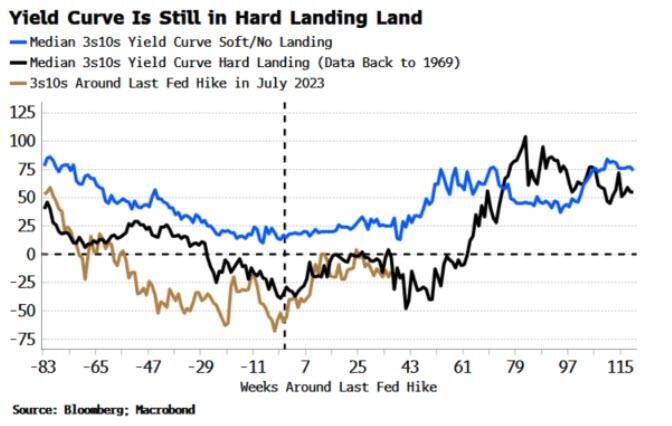
Further, the yield curve should begin to steepen again. As the chart shows, in either a hard or soft/no-landing scenario, the curve has historically started to steepen at this stage after the last Fed hike. (More rate hikes will likely be on the table at some point, although not until after the election.)

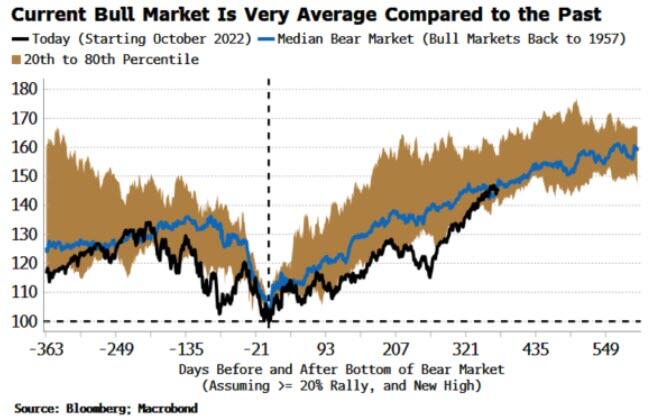
No near-term recession also removes (again, for now) typically the single-biggest risk that stocks face. The current bull market, perhaps surprisingly, is only performing in line with the average historical bull market. That means (despite some near-term risks, e.g. from momentum) the bull trend should remain intact. As Wednesday’s CPI data showed us though, the path is now likely to be bumpier as the market adjusts to the potential of higher real yields.

An agnostic, data-led approach to markets is best. That showed in the fourth quarter of last year that an NBER recession was less likely than so over the next 3-6 months (reversing my call from earlier that year that a near-term recession was on the cards). Based on this framework, a recession remains unlikely over the coming 3-6 months.

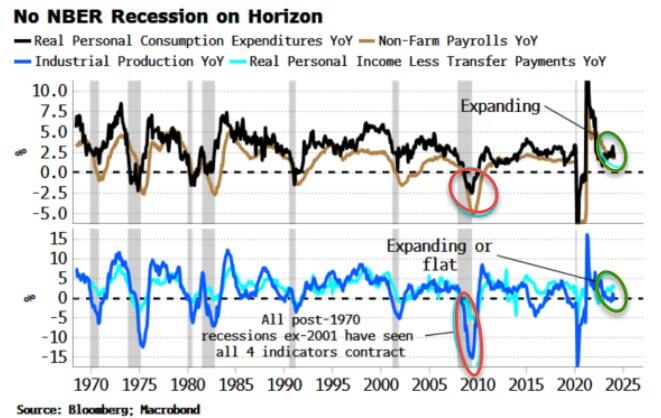
NBER recession dating is not an exact science, but the research body identifies the four key variables it uses in its assessment:

  • Industrial production

  • Payrolls

  • Real personal income expenditure (PCE)

  • Real personal income net of transfer payments

In every post-1970 recession all four of these were contracting on an annual basis (apart from 2001 where three out of the four were contracting). Currently three of the four are still expanding at about the same rate they were six months ago, while industrial production is essentially flat, also unchanged from last year.

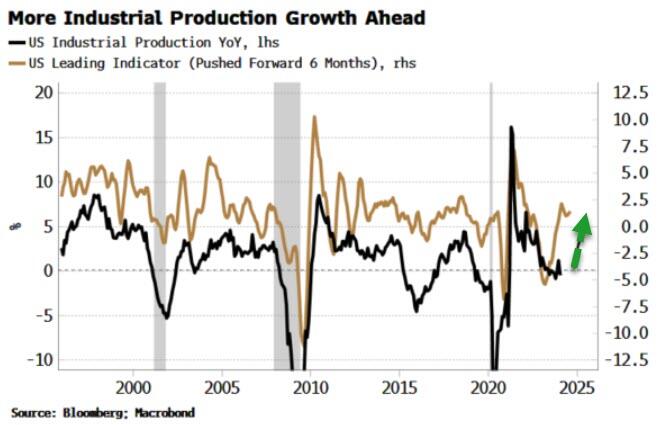
NBER recession-dating happens often long after the fact. On top of that, the four indicators above are all coincident-to-lagging. But leading indicators show that each one is projected to remain supported over the next six months. (One should never base a view on only one leading index, but for each case there is more than one supportive indicator. For brevity though, I’ve only shown one for each here.)

The US leading indicator expects industrial production to pick up.

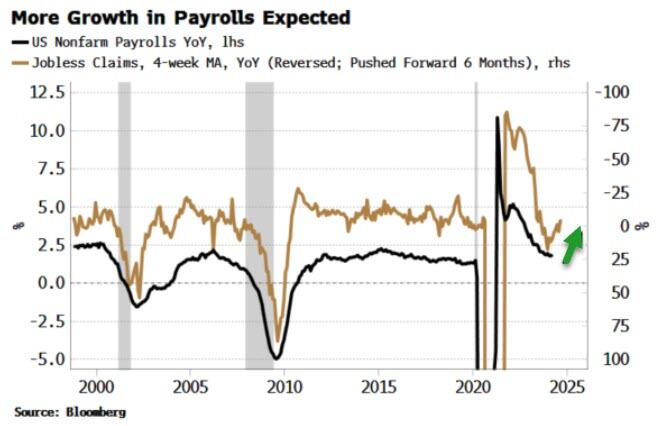
The fall in claims anticipates more payroll growth.

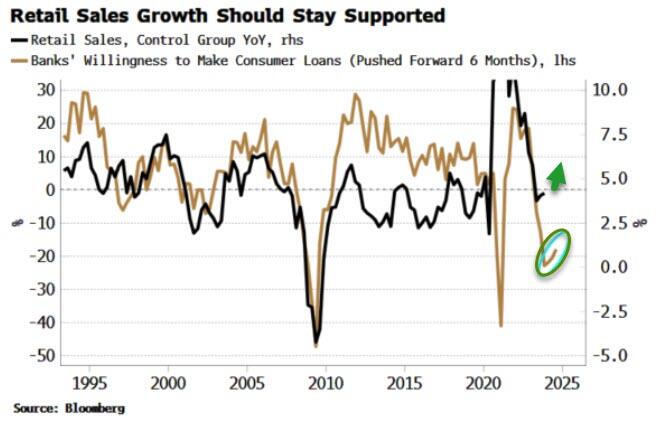
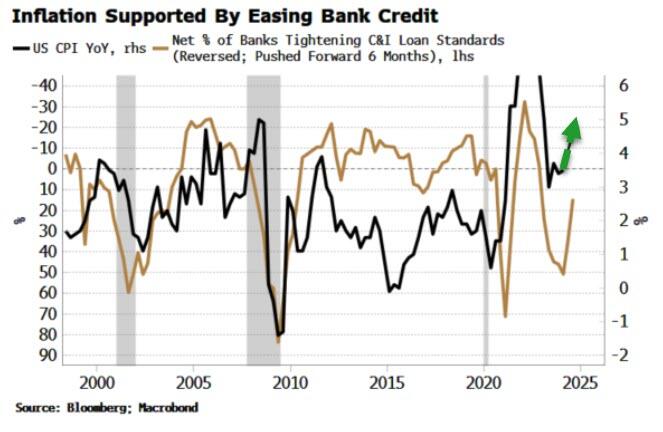
Easing bank credit should help retail sales and personal consumption stay supported.

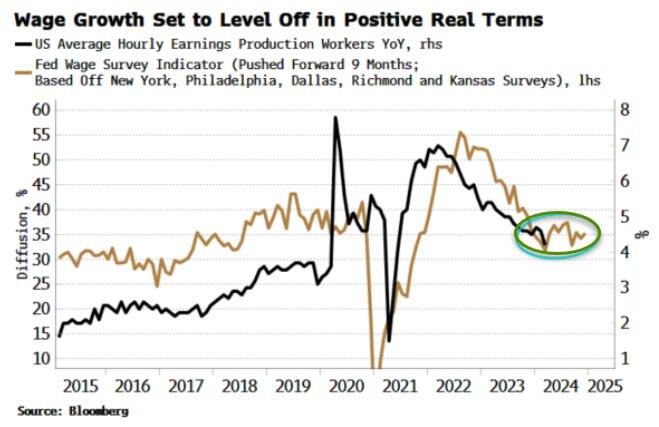
And Fed wage survey indicators expect steady wage growth, which is currently positive in real terms.

There are bones one could pick with this. The jobs market overall is showing some potential signs of weakening, such as the rise in part-time employment and the fall in the quits rate. Household employment is diverging negatively from payrolls, and the number of US states with a rising unemployment rate is increasing, But the effects of unaccounted for immigration are potentially biasing the household survey weaker, and the strength of the labor market probably lies somewhere in between it and the payroll survey.

There are other data points that may give pause for concern, such as the rise in loan delinquencies due to unemployment, or some of the details in the latest NFIB small business survey. But picking and choosing data points to support a recession thesis without any systematic process that incorporates the strength of their relationship to recessions, by how much they lead them by, and how noisy they are, is not a robust one.

The data in totality is not currently supportive of a near-term NBER recession. Furthermore, rapid downward revisions in the four key data points are less likely (although not impossible) when leading data - chosen such that it is minimally revised and therefore itself not subject to future sizable changes - is turning up as it is today.

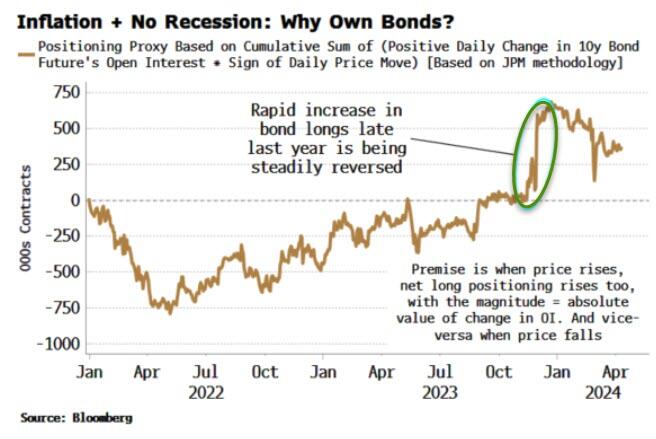
Bond positioning - based on the bond future proxy in the chart below - likely got a lot longer late last year when perceived recession risk was rising (even though, as discussed above, the risk was low). But if a recession continues to look off the cards for the next 3-6 months, there is less reason for multi-asset managers and their like to own bonds.

That’s even more the case now that it’s evident inflation is not going anywhere soon. Moreover, leading indicators, such as the easing in bank credit, show inflation should soon start rising again.

Owning bonds, unless you have to or in an extreme geopolitical-driven flight to safety situation, is an increasingly suboptimal proposition in this environment, while shorting them looks more and more attractive.

There will be dip buyers now that yields have hit 4.5% (although in a sign the wind may be changing, demand at Wednesday’s 10-year auction was terrible), but that level will likely prove to be low with nominal GDP rising at an annual pace of 5.9%. The contrarian trade is still for higher yields, but probably not for much longer.

https://www.zerohedge.com/markets/case-owning-treasuries-evaporating

STERIS to Sell Dental Segment to an affiliate of Peak Rock Capital


  • Transaction expected to close in STERIS’s first quarter of fiscal 2025
  • Divestiture allows STERIS to focus on Customers within core markets
  • Proceeds primarily to be used to repay debt

Arvinas, Novartis to Develop, Commercialize Protein Degrader to Treat Prostate Cancer


  • Arvinas to receive a $150 million upfront payment for the license of ARV-766 and the sale of Arvinas’ preclinical AR-V7 program, with the potential under the License Agreement for up to $1.01 billion in development, regulatory, and commercial milestones, as well as tiered royalties
  • Novartis to be responsible for worldwide clinical development and commercialization of ARV-766
  • Partnership expected to accelerate and broaden the development of ARV-766 as a potential first-in-class treatment option for patients with prostate cancer

Athira Preclinical Data Highlights Fosgonimeton Treatment in Models of Alzheimer’s

 Fosgonimeton counteracts mechanisms of amyloid-beta (Aβ)-driven toxicity and demonstrates neuroprotection in preclinical models of Alzheimer’s disease

 Athira Pharma, Inc. (NASDAQ: ATHA), a late clinical-stage biopharmaceutical company focused on developing small molecules to restore neuronal health and slow neurodegeneration, today announced the publication of preclinical data supporting the therapeutic potential of fosgonimeton in Alzheimer’s disease. The original research article, “Fosgonimeton Attenuates Amyloid-Beta Toxicity in Preclinical Models of Alzheimer’s Disease,” authored by Reda, S., et al., was published in the peer-reviewed journal, Neurotherapeutics. Fosgonimeton is a potentially first-in-class, once daily, subcutaneously administered small molecule drug candidate designed to enhance the neurotrophic hepatocyte growth factor (HGF) system, and is in development for neurodegenerative disorders, including Alzheimer’s disease.

https://www.biospace.com/article/releases/athira-pharma-announces-publication-of-preclinical-data-highlighting-fosgonimeton-treatment-in-models-of-alzheimer-s-disease/

Lipocine Positive LPCN 2401 Clinical Results Show Improved Body Composition in Obesity


  • LPCN 2401 treatment resulted in statistically significant body composition improvement in men
    • Increased lean mass (LM) by 4.4% and decreased fat mass (FM) by 6.7%
    • Reduced android fat (AF) by 4.1% and increased bone mineral content (BMC) by 2.8%
  • Well-tolerated, adverse events (AEs) similar to placebo
  • Potential for use in combination with incretin mimetics (GLP-1/GIP agonists and/or post GLP-1/GIP agonist) or as a monotherapy post discontinuation
  • Conference call and webcast at 8.30 a.m. ET today

Lipocine management will host a conference call and webcast with slides beginning at 8:30 a.m. Eastern Time today to discuss the Phase 2 clinical study results and answer questions. To participate via telephone, please dial 1-877-451-6152 or 1-201-389-0879 (ex-U.S. toll dial-in number) using the conference ID 13745946.

Participants can also click the Call me™ link, https://callme.viavid.com/viavid/?callme=true&passcode=13738729&h=true&info=company&r=true&B=6 for instant telephone access to the event. The Call me™ link will be made active 15 minutes prior to scheduled start time.

The webcast is available to view here and also at www.lipocine.com. It will be available for replay for 180 days.

https://www.biospace.com/article/releases/lipocine-announces-positive-lpcn-2401-clinical-results-showing-improved-body-composition-in-participants-with-obesity/