Google staffers wearing traditional Arab headscarves barged into the California office of the company’s top cloud executive, while other workers staged a sit-in at the company’s headquarters in New York City toprotest the tech giant’s ties to the Israeli government on Tuesday.
The pro-Palestinian employees, part of a group called “No Tech for Apartheid,” used social media accounts on X and Twitch to post images and live video of their takeover of the Sunnyvale, Calif.-based office of Thomas Kurian, the CEO of Google Cloud.
The activist workers read statements denouncing the company over its contract with the Israel government, which the group accuses of carrying out a “genocide” in its bombing campaign in the Gaza Strip — following the Hamas massacre of Israelis on Oct. 7.
Pro-Palestinian Google employees took over the office of Google Cloud CEO Thomas Kurian on Tuesday.Twitch/notech4apartheid
They demanded that Google cancel its participation in “Project Nimbus” — a $1.2 billion contract with Israel that involves Google Cloud as well as Amazon Web Services.
Another group of protesters were seen occupying the 10th floor of Google offices in the Chelsea section of Manhattan as part of a protest that also extended to the company’s offices in Seattle for what it called “No Tech for Genocide Day of Action.”
The Post has sought comment from Google.
The orchestrated sit-in comes on the heels of a Google software engineer publicly berating one of the company’s Israel-based executives during a tech conference in Manhattan last month.
Google fired the worker.
It is not clear what actions the company will take after the mass revolt inside its own walls.
Kurian’s office is based in Google Cloud headquarters in Sunnyvale, Calif. Kurian is seen above in May 2023.AP
The activists appear to have also scribbled some pro-Palestinian slogans and statements on Kurian’s bulletin board — accusing the company of “harassment, bullying and censorship” of Arab and Muslim employees.
Project Nimbus was originally announced in April 2021, but the eruption of hostilities between Israel and Gaza has brought the issue to the fore.
Tech employees at both Amazon and Google have voiced concerns that the technology could be used by Israel’s military against Palestinians.
Several of the firms have cracked down on chat discussions about the conflict that have played out on internal messaging boards — where the exchanges have reportedly gotten heated and contentious.
Long term extension of the Phase 2 VISIONARY-MS clinical trial of CNM-Au8 demonstrated significant evidence of repair and remyelination across multiple paraclinical endpoints (change from original baseline, p<0.05)
Significantly improved clinical outcomes associated with long-term daily oral CNM-Au8® 30 mg treatment (change from original baseline; p<0.05)
Long-term CNM-Au8 treatment, encompassing up to three years, was well-tolerated; no significant safety findings were observed
First Phase 2 clinical MS trial of a non-immunomodulatory drug to meet a clinical outcome of improved function supporting remyelination and reparative effects
SELARSDI is approved for both adult and pediatric indications and is the second biosimilar approved under the strategic partnership between Alvotech and Teva
SELARSDI is expected to be marketed in the U.S. on or after February 21, 2025, following a settlement agreement with Johnson & Johnson, the manufacturer of Stelara
SELARSDI was developed and is manufactured by Alvotech using murine cell (Sp2/0) and a continuous perfusion process, which are the same type of cells and process used for the production of Stelara
A Republican lawmaker is urging theFederal Trade Commissionto probe the China-based parent company of fast fashion retailer Temu over its alleged ties to the Chinese Communist Party.
Rep. Brian Mast, R-Fla., on Tuesday sent a letter to the FTC calling out PDD Holdings Inc. and its subsidiaries, Pinduoduo and Temu, for "harmful business practices here in the United States." The letter urges the FTC to investigate after a pair of class action lawsuits were filed over concerns about the Temu app and data privacy.
"Whether it’s Tiktok or Temu, behind these friendly English words hide three nefarious letters — CCP," Mast told FOX Business in a statement. "We need to be clear, if you’re a company operating within the U.S., you don’t get to hide your links to the Chinese Communist Party. That’s why I’m asking the FTC to probe Temu’s parent company for their links to the CCP and their questionable business practices."
Temu is an e-commerce site launched in 2022 that offers goods shipped from China at heavily discounted prices. The company made headlines earlier this year with a pair of $7 million Super Bowl ads that encouraged American customers to "shop like a billionaire," which was part of a $3 billion marketing push to compete with U.S. companies like Amazon.
The ads prompted several members of Congress to call out Temu’s data practices and links to forced labor in China.
Mast's letter cites a pair of class-action lawsuits in Illinois and New York that allege the company deceptively collected customer data through permissions that allowed it to access Bluetooth and Wi-Fi network information as well as biometric data, and that it failed to adequately safeguard that data.
He urges the FTC to question Temu about any financial benefits the company has received from the CCP to subsidize its marketing efforts in the U.S. and to raise questions about how the company handles data security.
Temu did not immediately respond to a request for comment. The company has previously denied that it failed to properly secure customer data in response to the lawsuits.
The House Select Committee on the Strategic Competition between the U.S. and the Chinese Communist Party has investigated links between Temu and Shein, another China-based e-commerce platform, and products made with forced labor from Uyghurs and other persecuted ethnic minorities in China's Xinjiang province.
In June 2023, the committee released an interim report that found that Temu and Shein have exploited U.S. de minimis provisions to evade customs enforcement. De minimis rules allow nearly all of their products valued under $800 to enter the U.S. uninspected and free from duties that most American clothing brands pay. It also found that Temu lacks a system for ensuring compliance with the Uyghur Forced Labor Prevention Act.
The U.S. and several other countries have accused China of committing genocide against the Uyghurs and other Muslim minority groups in Xinjiang. The Chinese Communist Party has engaged in the mass detention of Uyghurs in "reeducation camps" and forced them to work in factories. The CCP denies those allegations, claiming those camps are for "vocational training."
Mast encourages the FTC to probe Temu's "business nexus" with the Xinjiang province, citing the company's own admission that it "does not expressly prohibit third-party sellers from selling their products based on their origin in the Xinjiang Autonomous Region."
He asks the FTC to refer Temu to the U.S. Department of Homeland Security if the company is found to be in violation of federal law.
Mexico’s effort to keep genetically modified corn out of the country is triggering a trade dispute with the United States and Canada that could affect the future of agriculture.
The trade dispute hinges on a key question: whether genetically modified (GM) corn poses a threat to human health.
U.S. trade representatives argue it does not and wants to force GM corn into Mexico. Given that GM seed is used in 90 percent of U.S. crops, the dispute could have far-reaching effects should Mexico win. Beyond the U.S. agricultural sector, it could damage the German and Chinese companies that make and sell those seeds.
The Epoch Times has reached out to Bayer, the company that bought seed giant Monsanto, and Chinese state-owned Syngenta, but has yet to get a response.
A Battle Over Biotechnology
Corn has fed previous trade battles between Mexico and the United States, with Mexican producers previously protesting the North American Free Trade Agreement (NAFTA) for allowing American corn in without restriction. In the latest chapter, Mexico issued a presidential decree in February 2023 that bans GM corn in tortillas and dough and signaled the country’s intention to gradually replace GM corn in all animal and human foods.
Mexicans march in Mexico City on Jan. 31, 2008, in a march of hundreds of corn producers protesting against the NAFTA (North American Free Trade Agreement), which liberates maize imports from the United States since Jan. 1. Corn has been a point of contention between Mexico and the United States. (LUIS ACOSTA/AFP via Getty Images)
Canada, which is deeply integrated into U.S. and Mexican agricultural trade, and the United States both opposed the ban.
Mexico has kept genetically modified corn from being grown within its borders for 25 years in an effort to protect both citizen health and ancient strains of maize.Corn is a staple crop eaten in 89 percent of Mexican meals.
The United States has largely disregarded health concerns arising from GM crops and has spent the past year working to prove Mexico’s 2023 decree violates the United States-Mexico-Canada Agreement (USMCA).
The restrictions, originally slated to go into effect this year, set off a disagreement now in the hands of a USMCA trade panel after Mexico and the United States failed to resolve it through negotiations.
The United States contends that there’s no scientific evidence that GM corn is unsafe to eat, a claim Mexico refutes. Mexico says the United States hasn’t presented any evidence of GM corn’s long-term safety, particularly when eaten at high levels.
Corn consumption is ten times higher in Mexico, raising concerns among its medical and governmental leaders about research linking GM crops to health issues.
Clashing Visions and the Future of Agriculture
The trade disagreement highlights clashing ideological values and interests. Mexico has concerns for public health and Indigenous maize. The United States aims to protect American farmers, food security, and the future of agricultural biotechnology.
Ultimately, the three-member USMCA panel has to sort through the arguments, science, and finer points of Indigenous legal rights to make a decision. Lucy Sharratt, coordinator of the Canadian Biotechnology Action Network, said the ruling could generate cultural and environmental shockwaves.
“If the panel pays attention to the science, they should come to the same conclusion as the Mexican government. If they’re swayed by politics and the power behind the technology, it’s going to be difficult for them to see the reality of the science,” she told The Epoch Times. “This is a hugely significant decision the panel has before them.”
The Canadian Biotechnology Action Network, a group that raises education about the genetic engineering of food, was originally invited to share its opinion with the trade tribunal, but the offer was rescinded at the request of the U.S. and Canadian governments.
Mexico’s Case
Mexico filed a 200-page response to the U.S. trade violation complaint, which many observers say fulfilled the onus of its argument. It offered 66 articles in peer-reviewed journals pointing to GM corn’s associated health risks including increased damage to organs, cancer, antibiotic resistance, and reduced nutritional content.
Mexico’s decree also included a ban on glyphosate originally intended to go into effect on April 1, but the government pushed back that date while researching alternatives available in suitable quantities.
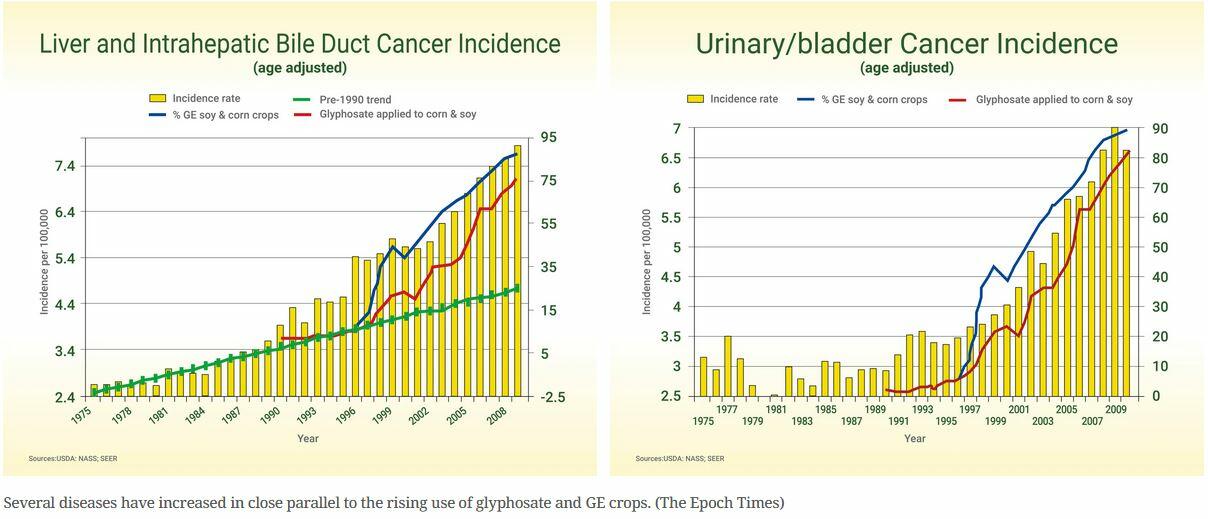
GM corn is tightly wed to glyphosate, the key ingredient in RoundUp and other herbicides. That’s because one of the most prominent traits in GM corn is resistance to glyphosate, the main ingredient in RoundUp. Monsanto, the German firm making most of the GM corn grown in the United States, calls the corn “Roundup Ready.” A rise in the use of glyphosate closely paralleled the rise in use of GM corn seed.
Additionally, Mexico’s report included 74 studies and papers on the risks of glyphosate, pointing to research documenting residues found on GM corn and concerns that the volume of corn Mexicans eat creates the need for a different safety standard. Mexico’s decree isn’t an outright trade ban but it does create the need for suitable replacements for both GM corn and glyphosate.
Though the language is vague, the decree calls for agricultural groups to offer input to Mexican agencies on how to design, promote, and implement alternatives to glyphosate.
The Glyphosate Issue
Glyphosate has become an important topic of research, and studies now suggest it has several potential consequences on human physiology.
A 2014 study published in the Journal of Organic Systems looked at two decades of information on the rising rates of chronic diseases and their association with glyphosate use. Correlation doesn’t prove causation, but graph after graph of epidemiological data of 22 diseases reveal sharp increases that coincide with the accelerating use of glyphosate.
The study found highly significant correlations between glyphosate applications and hypertension, stroke, diabetes prevalence and incidence, obesity, Alzheimer’s, autism, multiple sclerosis, inflammatory bowel disease, several types of cancer, intestinal infections, and more. Researchers used the Pearson correlation coefficient, the most common way to measure correlation.
Additionally, Roundup Ready corn and soy in the U.S. were also found to have highly significant correlations with many of the same diseases. The authors concluded that the results warrant additional research on these relationships.
Research done in Mexico has found glyphosate in the urine of children and adults, as well as evidence of it in industrial and native foods.
Unsatisfied With the Science
Mexico has objected to some of the research the United States was citing during negotiations, including sources that were not peer-reviewed, over a decade old, or funded by biotech companies. Mexico also raised concerns about the lack of long-term studies on humans eating GM corn, according to Timothy A. Wise, senior advisor for the Institute of Agriculture and Trade Policy (IATP).
Ultragenyx Pharmaceuticalon Mondayprovided a Phase I/II updatefor its investigational antisense oligonucleotide GTX-102, demonstrating substantial symptomatic improvement in patients with the rare genetic disorder Angelman syndrome.
The California biotech did not provide specific data in its announcement but said that patients in its dose-escalation cohorts saw “rapid and clinically significant improvement” in cognition after 170 days, compared with natural history data. These patients also demonstrated strong behavioral, sleep, hyperactivity, gross motor and receptive communication improvements after GTX-102 treatment, the company announced.
Ultragenyx CMO Eric Crombez in a statement that these interim data show “that treatment with GTX-102 resulted in rapid, multi-domain improvements that continued throughout maintenance dosing,” which in turn could have a “meaningful impact on patients and their families.” Some children have been able to start eating on their own and communicate with their families, Crombez noted.
“Our next step is an end of Phase II meeting with the FDA and interactions with other health authorities to enable timely initiation of a Phase III pivotal study,” Crombez added.
Despite these positive findings, Ultragenyx’s shares fell 7% on Monday, according to Seeking Alpha.
Much of the investors’ apprehension could be due to GTX-102’s safety profile. In the Phase I/II study, Ultragenyx documented three cases of lower extremity weakness, which were deemed serious adverse events and related to the study treatment. All instances were quickly resolved and the patients remain on GTX-102 treatment with no new safety signals.
The FDA has also been notified of these safety events but has so far raised no issues or asked for other actions, according to Ultragenyx.
Angelman syndrome is a rare and neurogenetic disorder caused by a loss-of-function mutation in the maternal allele of the UBE3A gene, which under normal circumstances produces an enzyme that tags other proteins for destruction. Symptoms include cognitive, motor and balance impairment, as well as debilitating seizures. Patients also typically develop anxiety and difficulties sleeping.
GTX-102, an intrathecal investigational antisense oligonucleotide, works by targeting and blocking the expression of the UBE3A-AS gene, which otherwise produces a protein that silences the paternal copy of UBE3A. Nonclinical studies have shown that this mechanism of action reactivates UBE3A expression in neurons, leading to neurological improvements.
Ultragenyx is facing competition in the Angelman syndrome space from Ionis, which is developing its own antisense treatment ION582. Like GTX-102, Ionis’ candidate un-silences the paternal copy of the UBE3A gene to reactivate the production of the protein in neurons. ION582 won the FDA’s Orphan Drug and Rare Pediatric Disease designations in June 2022.
Novartison MondayannouncedPhase III trial results for its potential multibillion-dollar drug Fabhalta (iptacopan), linking the molecule to improvements in kidney disease patients as it races toward accelerated approval.
The Swiss drugmaker said the Phase III study met its pre-specified interim analysis primary endpoint in October 2023. However, while Novartis said IgA nephropathy (IgAN) patients had a statistically significant and clinically meaningful reduction in proteinuria—the medical term for a high level of protein in urine— after taking Fabhalta, it kept the numbers to itself.
Monday, the company finally shared the figures behind the hit on the primary endpoint, revealing that patients treated with Fabhalta had a 38.3% proteinuria reduction at nine months compared to placebo. The 518 patients enrolled in the study received Fabhalta or placebo in addition to supportive care.
Novartis filed for accelerated FDA approval using the data and was accepted for priority review. The drug developer has yet to share the deadline for the approval decision but the six-month timeline for priority review suggests the FDA will rule on the application in the second half of 2024.
So far, the Phase III study has linked Fabhalta to reduced proteinuria without confirming the therapy has a positive effect on kidney function. In recent years, the FDA has granted accelerated approval of IgAN drugs from Calliditas Therapeutics and Travere Therapeutics based on proteinuria data. Researchers have found a strong relationship between proteinuria and loss of kidney function.
Travere brought Filspari (sparsentan) to market in IgAN after linking the treatment to a 45% proteinuria reduction at week 36, compared to a 15% decline in the irbesartan control group. The FDA authorized Calliditas’ Tarpeyo after reviewing the results of a study that found it reduced proteinuria by 34% over nine months, versus a 5% decline in the placebo arm.
Novartis’ Phase III study remains blinded as the company gathers data on its second primary endpoint, which is looking at a measure of kidney function over 24 months. The company expects to complete the trial and get data on the second primary endpoint in 2025.
Accelerated approval in IgAN is part of a plan that Novartis said could lead to multibillion-dollar sales of Fabhalta. The FDA approved the drug in adults with paroxysmal nocturnal hemoglobinuria in December 2023 but Novartis CEO Vas Narasimhan told investors to expect “a modest ramp” in the indication on an earnings call in January 2024. Narasimhan predicted “very strong uptake” of the medicine in IgAN and C3 glomerulopathy, an progressive kidney disease in which Novartis has reported Phase III data.
Fabhalta is part of a broader push to treat IgAN. Novartis acquired the endothelin receptor antagonist atrasentan and anti-APRIL antibody zigakibart in its $3.2 billion takeover of Chinook Therapeutics. Both candidates are in Phase III.