Search This Blog

Thursday, May 2, 2024

Bird flu likely circulated in US cows for four months before diagnosis -paper

 Bird flu likely circulated in U.S. dairy cows on a limited basis for about four months before federal officials confirmed the disease that has now spread to nine states, according to a new federally funded research paper.

The U.S. Department of Agriculture reported the first-ever H5N1 virus infection in a dairy cow in Texas on March 25, following reports of decreased milk yields in multiple states.

The USDA has said it believes wild birds, which can carry the virus, introduced H5N1 to cattle. The outbreak then expanded as cows were shipped to other states, according to the paper released on Wednesday that was funded by USDA, Centers for Disease Control and Prevention and the National Institute of Allergy and Infectious Diseases.

"Data support a single introduction event from wild bird origin virus into cattle, likely followed by limited local circulation for approximately four months prior to confirmation by USDA," the paper said.

A team of academic scientists led by University of Arizona evolutionary biologist Michael Worobey pieced together raw genetic sequences released by USDA on April 21 without dates or locations and concluded a week ago that a single transmission event occurred in late 2023.

Scientists have criticized USDA for not releasing details of the data that would allow academic researchers around the world to trace the evolution of the virus.

One person, a Texas farm worker, has tested positive for H5N1 in the current outbreak, though the only symptom was conjunctivitis, believed to be caused by contact with cow milk. The CDC has said the general public faces a low risk for infection.

Bird flu has long been on the list of viruses with pandemic potential, and any expansion to a new mammal species is concerning to scientists.

Carol Cardona, a bird flu expert at the University of Minnesota, said the virus was able to spread during the four months it was undetected.

"By the time it was recognized, we were beyond our ability to contain the outbreak," she said.

Veterinarians observed dairy cattle displaying unexplained reductions in milk production and changes in milk quality, along with reduced feed consumption, starting in January, according to the paper. It was published an open-access preprint

server for the biological sciences called bioRxivon.

Members of USDA's network of laboratories that monitors for diseases identified influenza A virus, which includes bird flu, in milk and nasal swabs from cows at a Texas dairy, the paper said, without specifying a date.

They forwarded samples to USDA's National Veterinary Services Laboratories, which respond to animal-health emergencies, for testing as epidemiologic investigations continued elsewhere, the paper said.

USDA did not immediately respond to a request for comment.

"Overall, it's wonderful that these data have been shared," virologist Angela Rasmussen of the University of Saskatchewan's Vaccine and Infectious Disease Organization, who worked on sequencing the virus with Worobey, said in a post on X.

https://www.marketscreener.com/news/latest/Bird-flu-likely-circulated-in-US-cows-for-four-months-before-diagnosis-paper-46610664/

"Sticky Inflation" Mentions On Earnings Calls Hits New High As Big Brands Warn About Buckling Consumers

On Wednesday, Fed Chairman Jerome Powell dismissed the idea that the economy could slide into "stagflation" despite multiple warning signs of a slowing economy and inflation reaccelerating higher. 

"I was around for stagflation, and it was 10% unemployment, it was high-single-digit inflation," Powell said, noting, "Right now we have 3% growth, which is pretty solid growth, I would, say by any measure, and we have inflation running under 3%." 

Powell then claimed he didn't see "stag" or the "flation" anywhere. 

However, Powell has been very wrong before. He missed the initial surge in inflation in the months following the virus pandemic after the government helicopter dropped trillions of dollars on the economy. More recently, Powell prematurely pivoted on the interest rate hiking cycle before having to backtrack. 

Meanwhile, America's largest companies are warning consumers are buckling due to the weight of inflation. This comes amid the failure of Bidenomics, where a new Gallup poll has shown a parabolic surge in households complaining about inflation-related financial problems. 

On Wednesday, Starbucks logged the largest single-day crash since early Covid, nearly exceeding the 16.2% level that would've made it the worst drawdown since the Dot Com bust. The reason is simple: Earnings were a complete disaster as misses were reported across the board due to headwinds of a "cautious consumer." 

Earlier in the week, McDonald's CEO Chris Kempczinski warned the burger chain faced "broad-based consumer pressures persist around the world." 

"Consumers continue to be even more discriminating with every dollar that they spend as they faced elevated prices in their day-to-day spending," Kempczinski said. 

Clearly, a $15 Big Mac combo meal is too expensive for many working poor folks. Plus, the food quality is junk. 

Moving on to the 3M Company, the maker of Scotch tape and Post-it Notes, top executives told analysts during an earnings call that it "continued seeing softness in consumer discretionary spend." 

As for Newell Brands, the owner of Rubbermaid, Yankee Candle, Coleman, Paper Mate, and many others, warned, "Consumers continuing to carefully manage their discretionary spend as the cumulative impact of inflation on food, energy and housing cost has outpaced wage growth." 

Looking at Bloomberg data, the term "sticky inflation" has surged to a record 17 mentions in earnings calls. Other topics on the rise include "inflation" and "interest rates" and "labor costs." 

But don't worry, Powell has glanced over the mounting stagflation threat because it's an election year... 

https://www.zerohedge.com/markets/sticky-inflation-mentions-earnings-calls-hits-new-high-big-brands-warn-about-buckling

Amgen expects data from weight-loss drug trial later this year

 Shares of Amgen rally 11% after Q1 earnings

Shares of Amgen Inc. rallied more than 11% in the extended session Thursday after the drugmaker posted adjusted earnings above expectations and said that plans for further trials for its weight-loss drug are proceeding apace.

Amgen said that it expects data from an ongoing phase 2 study of MariTide, an injectable weight-loss drug, late in the year. The drugmaker said that plans for a "comprehensive" phase 3 program remain on track.

Amgen (AMGN) lost $113 million, or 21 cents a share, in the quarter, contrasting with earnings of $2.8 billion, or $5.28 a share, in the first quarter of 2023.

It pinned the loss on higher operating expenses, including those related to its acquisition of Horizon Therapeutics. The acquisition, which ran against regulatory hurdles, was completed in October.

Adjusted for one-time items, Amgen earned $3.96 a share, above expectations of $3.88 a share, according to FactSet.

The drugmaker's revenue rose 22% to $7.45 billion, meeting the FactSet consensus. Product sales were up 22%.

Sales of Repatha, Amgen's cholesterol drug, increased 33% year over year to $517 million, the company said. Its Prolia osteoporosis drug generated sales of $999 million in the quarter, up 8% year-over-year.

https://www.morningstar.com/news/marketwatch/20240502869/amgen-expects-data-from-weight-loss-drug-trial-later-this-year

Whistleblower on How "New Knowledge" Cybersecurity Firm Created Disinformation In US Election

 by Paul D. Thacker via The Disinformation Chronicle,

Some of the shine on the disinformation industry has gone dull in recent years, as many misinformation experts having been caught trafficking in misinformation themselves, or exposed for their ties to intelligence agencies. This should not come as a shock.

It’s a basic tenet of “mirror politics” and practitioners of propaganda to accuse others of the very same actions they plan to commit.

In late 2018, the New York Times and Washington Post reported on a leaked document discussing a secret project by Democratic Party operatives that falsely accused Republican candidate Roy Moore of support by Russians, while he was running in a tight race for the Senate in Alabama. The scheme linked the Moore campaign to thousands of Russian accounts on Twitter and drew national media attention.

We orchestrated an elaborate ‘false flag’ operation that planted the idea that the Moore campaign was amplified on social media by a Russian botnet,” the New York Times reported that the leaked documents stated.

The documents linked a relatively unknown company called New Knowledge to the Alabama disinformation campaign, although New Knowledge’s chief executive Jonathon Morgan said the company was not involved, and he worked on “Project Birmingham” in his personal capacity. Morgan also reached out at the time to Renee DiResta, a self-styled expert on disinformation, who told the New York Times she disagreed with such tactics, and later joined New Knowledge sometime, but only after Project Birmingham ended.

New Knowledge later changed names to Yonder, while DiResta joined Stanford University as an expert in disinformation. However, New Knowledge could not stop landing in the media spotlight.

In early 2023, journalist Matt Taibbi released a “Twitter Files” drop about “Hamilton 68,” a public dashboard created by New Knowledge. Hamiton 68 tracked hundreds of Twitter accounts to monitor the spread of purported pro-Russian propaganda online, but screenshots of emails sent by former Twitter executive, Yoel Roth, voiced alarm that the dashboard was creating, not tracking disinformation.

“I think we need to just call this out on the bullshit it is,” Roth wrote.

The “Hamilton 68” dashboard had spurred dozens of stories in major media outlets that accused conservatives of trafficking in Russian disinformation, but when Twitter looked into the dashboard’s accuracy, they found it was garbage in, garbage out.

Former FBI counterintelligence official Clint Watts headed the Hamilton 68 dashboard and Jonathon Morgan of New Knowledge had helped to build it, along with J.M. Berger at the Alliance for Securing Democracy (ASD), housed by the German Marshall Fund.

“No evidence to support the statement that the dashboard is a finger on the pulse of Russian information ops,” one Twitter official wrote of Hamilton 68.

The internal Twitter emails were so damaging that the Washington Post later posted corrections to multiple stories that reported on Hamilton 68 and its findings.

But every story about disinformation elites caught creating disinformation contains critical missing facts and minor elements of disinformation planted by the very experts being exposed. New Knowledge is no different.

Starting a month ago, I began discussing what the media got wrong about New Knowledge and Hamilton 68 with Betsy Dupuis, a former New Knowledge employee who worked on Hamilton 68. Dupuis tells me she was fired from New Knowledge after expressing misgivings upon discovering the company that branded itself  “the world’s first platform for defending online communities from social media manipulation” was itself engaging in blatant social media manipulation.

To back up her claims, Dupuis provided internal documents and photos from her time at New Knowledge, as well as screenshots of texts messages. Some of those we are publishing today.

New Knowledge poached Dupuis from another company and set her to work improving the Hamilton 68 dashboard, which was planned as a product for groups aligned with the Democratic Party. The development was underwritten with a year of funding by the Center for American Progress, a think tank and lobby shop run by party political operatives.

Dupuis says she enjoyed her work updating Hamilton 68, but she became concerned when people in the office discussed the “Alabama Project” and she began wondering if this had anything to do with Roy Moore, a Republican candidate running for Senate. When she had joined the company, Jonathon Morgan had assured her that New Knowledge would only monitor, never create disinformation.

But then several former employees from the National Security Agency (NSA) joined New Knowledge.

Out for company drinks, former NSA employees explained to Dupuis how agencies get around federal laws that ban the U.S. government from spying on and censoring Americans: they contract with companies like New Knowledge to do their dirty work. By the time New Knowledge announced they had secured a Department of Defense contract to create automated disinformation, Dupuis had had enough.

She met with Jonathon Morgan to discuss her concerns and was fired days later.

Speaking with me from her home in Austin, Dupuis says that neither Jonathon Morgan, nor Stanford’s Renee DiResta have come clean with journalists about what happened in Alabama to create disinformation during an American election. But she says she is tired of being scared and the time has come for her to speak up. “Silence doesn’t buy you safety, Dupuis says. “People will still come after you because of what you know.”

“I just kept quiet, until now, because I didn’t want to be accused of spreading a conspiracy theory,” Dupuis tells The DisInformation Chronicle. “After I was fired, I was just like, ‘You know what? This is so crazy. Nobody's ever going to believe me. I'm never going to talk about this again.’”

Jonathon Morgan did not return multiple requests for comment sent to his current job and personal cell phone number. This interview has been condensed and edited for clarity.

*  *  *

THACKER: What caused you to get fired at New Knowledge?

DUPUIS: When they hired me, they said that we would never do disinformation. And I felt the grounds I'd been hired on had been violated. So I went to Jonathon Morgan, who was the CEO. I had a good relationship with him, or at least I thought I did.

I told Jonathon, “Hey, this is unethical. I'm concerned about this.”

I knew there were other people who were also concerned, very disturbed about what was going on, but I didn't bring them up.

I told Jonathon, “You said we would track disinformation, but we wouldn't do disinformation.”

And he told me, “If we don't do it, somebody else will.”

Which sounds like a very classic James Bond villain. What a great way of revealing your evil plan.

THACKER: This conversation happens on a Friday, night. Then what happens to you on Monday?

DUPUIS: Well, I went home, and at this point, I really didn't want to work there anymore. I had already been talking to friends about this, and I went out to the lake with a friend.

I got a message from Sandeep Verma that I needed to come in at—I think it was 8 a.m.—which is really early in tech time. This was very confusing, so I asked if they wanted to do it remote, but I was told I needed to come in early on Monday.

They had hired this really young women to be, I think it was VP of Marketing, but also HR. She was a nepo baby: her parents had given her a bunch of money to start a fashion line that failed. And now she's an executive at my tech company.

She and Sandeep are there, and Sandeep… I don't know, he was trying to look really positive, but he looked sad also.

He said, “We're letting you go. We no longer need the position. We're going to give you a month severance if you sign this NDA.” I had to sign the NDA right there on the spot, before I left, or else I wouldn’t get severance.

I told him, “I left another job to come to this company.” He said he knew, and then I signed it and left. If they want to come after me for doing this interview, I was coerced to sign the NDA.

I felt pressured to sign it. I didn't really have a choice because of how insane things were. What am I supposed to do? Not take the severance, and not be allowed to collect unemployment because I refused to sign their agreement and then maybe tell people that there's a conspiracy going on.

THACKER: Right?

DUPUIS: What happened was so crazy. Things that people would not believe is true.

DUPUIS: I'm mid-thirties, so that puts me smack dab in the middle of millennial territory, and I grew up with internet. I was one of those kids that learned to make their own web pages and interact with the internet even before Myspace.

THACKER: When I started at UC Davis in 1994, that was the first year that University of California students were required to have an email. I learned how to type having discussions on a UC Davis chat group.

When people started to come out with this idea, about seven years back, that they had discovered there was “disinformation” on the internet, I was like, “Wait, I've been on the internet for decades. From the very beginning I saw people behave like assholes and throw crap up on the internet.”

DUPUIS: Well, there was this progression from “Do not use anything from the internet for any paper; it has to be from Ebsco or Britannica. Some trusted encyclopedia.”

You were supposed to vet sources. Now with Gen Z kids, they don't even know what plagiarism is.

THACKER: So you started off at around age ten. You're on the computer, but it was still kind of a thing for weird dudes in the basement.

DUPUIS: I kept it kind of a secret, and then MySpace came out when I was in high school. But the internet was still for nerds. I gave up pursuing a career in programing because my parents had read a bunch of articles in newspapers saying that the internet was a fad.

THACKER: But you still got involved.

DUPUIS: I got into photography in high school, and I started shooting for iStockphoto which was an early internet start-up in online stock photography. Before them, you had to order a stock photo catalog.

I was doing work for them when I was teenager making like $1,000 a month, which for a high school kid is a hell of a lot of money. I could rent an apartment $300 at the time. I thought this is going to be my job. And then the stock market crashed in 2007 and everything went away.

So, I went to college and studied art, and when I graduated the market still really sucked.

I went to go visit some friends during South by Southwest—the big music festival in Austin—to see about jobs and opportunities in 2012.

I was like, “I’m moving here.” I was kind of homeless for about a year, worked for a few random start-ups, and became part of this industry.

THACKER: But then you land your dream job at New Knowledge.

DUPUIS: I would not say it was a dream job. I was really skeptical of this company to begin with.

THACKER: You’re this young woman working in the tech industry in Austin. Why New Knowledge?

DUPUIS: I was at an oil and gas data analytics company that owned some old data sets which are very valuable. My title was software engineer, but I was working mostly as a designer, building the front end of the software. I was designing a dashboard that allowed you to build reports and interface with their data. It wasn't super advanced stuff.

It was fine, but then New Knowledge reached out to me on Angel List and, when I met with them, they were immediately ready to hire me.

I think New Knowledge was interested in me because, “Oh, you can do some of the programing, but then you can also know how data works and can do the data visualization stuff.”

I think that's what I was qualified to do for New Knowledge, but I wasn't really qualified to do this disinformation stuff.

THACKER: Did you research them to find out what they were all about?

DUPUIS: I'd never heard of them before and the politics they were involved in. My way of looking into politics was going on Facebook and subscribing to every spectrum of political ideology: Democrat, Republican, Libertarian, Green Party, whatever. I just read whatever because I wanted to see what everybody was thinking.

Politics was not a big deal to me, but I would casually absorb things. I knew that Russian disinformation was in the news, and stuff about Trump.

THACKER: Of course, you knew about Russian disinformation and Trump, because that's all the media wrote about for four years.

DUPUIS: Yes. But it wasn’t something I really followed. I just wanted to have intelligent conversations about what was in the news.

New Knowledge told me they do all this stuff with disinformation. Jonathon had some State Department role under the Obama administration. Sandy was a friend from high school or something from their time in Houston. He was the Chief Technical Officer (CTO.) I guess you know how that works, right?

THACKER: Well, no. From what I understand about the tech industry, people get these jobs they’re not really qualified for, but they know someone, or have some weird skill that nobody else has in the office. The programming guy who likes talking to people can suddenly become head of marketing.

I get the sense that titles are very nebulous in tech start-ups.

DUPUIS: Sandy had a degree, and I think he was serious about being a tech guy. But I don't think he had the work experience to be a CTO. But that's often the case at start-ups.

They told me about their funding and trying to get all these contracts with companies that were doing this disinformation thing. I had a vague idea about this stuff from what I was reading about Trump and just from being online for so long.

People make stuff up.

But they said they were going to build this AI tool and I was kind of skeptical.

I previously worked at a company that had done some AI thing back in 2013. A lot of times people tell you they have artificial intelligence to do some chore, but it’s really just a bunch of humans doing all the work. Which is really expensive.

Eventually, you get found out

THACKER: There’s a lot of nonsense and pretense in tech. Amazon dropped their "Just Walk Out" AI technology which automated what you bought. It was really just 1,000 workers in India acting as remote cashiers.

DUPUIS: These companies pretend to have computer automated intelligence, but it's a sham. Real people do the work it because they don't know how to make software good enough to automate the task.

So I was a little bit skeptical of that, but they had all these PhDs so maybe they could make it work. I asked, “Hey, will you guys ever want to do disinformation?”

And they said, “No, it's completely against our ethics.” I also asked if they were only going to point out disinformation whenever Republicans do it, or when both sides do it.

And they said, “We're bipartisan. In fact, we have Republicans that we've worked with for a long time.”

THACKER: How was their business set up? Who was funding them?

DUPUIS: DARPA. Jonathon had gotten his seed money from DARPA, and he had actually been through several iterations of trying to get the company off the ground. Apparently, a whole other set of co-founders had left the company. I can’t remember why.

He had a podcast called Partially Derivative and some nonprofit organization called Data for Democracy.

There was a weird thing with people in the office, people that weren't in the office, people working as contractors. Some of the contractors had this aura around them. The same as what I've heard of Renee DiResta: “We're just really passionate about disinformation!”

One contractor was just involved in building scrapers.

THACKER: Explain what scraping means. I think it means an automated system to go out and collect or scrape data off the internet, instead of doing it manually.

DUPUIS: Instead of having a person go and copy/paste everything from a website, you use a computer that collects all the data.

I knew someone who had a scraping company that the State Department, FBI and other agencies use, and they could have saved a lot of money using him. Instead, they hired this contractor to learn how to scrape Twitter.

Twitter kept denying New Knowledge access to scrape, because it costs them money when you’re pulling too much data, and they didn't have an established partnership. New Knowledge was using a lot of their bandwidth.

THACKER: Tell me about working on the Hamilton 68 disinformation dashboard.

DUPUIS: We eventually had a meeting with J.M. Berger with the German Marshall Fund. There were other people on the Zoom, but the German Marshall Fund had done this dashboard and I was supposed to redesign it.

It was ugly and looked like a programmer designed it. I was supposed to repackage it into a better dashboard and allow them to sell that as a product. They were going to sell it to the Center for American Progress.

THACKER: Just to let readers know, the Center for American Progress (CAP) is a Democratic Party think tank and lobby shop. They're most famous for being the ones who basically ran Hillary Clinton's campaign in 2016. Simon Clark is a former member of CAP who now chairs the Center for Countering Digital Hate, a bogus “disinformation group” that works closely with the Biden Administration.

According to your notes from the time, the lead on this dashboard redesign at CAP was Casey Michel, who worked at their news site, Think Progress. Another was Andrew Weisburd, who was working at the German Marshall Fund and is now at Microsoft’s Threat Context.
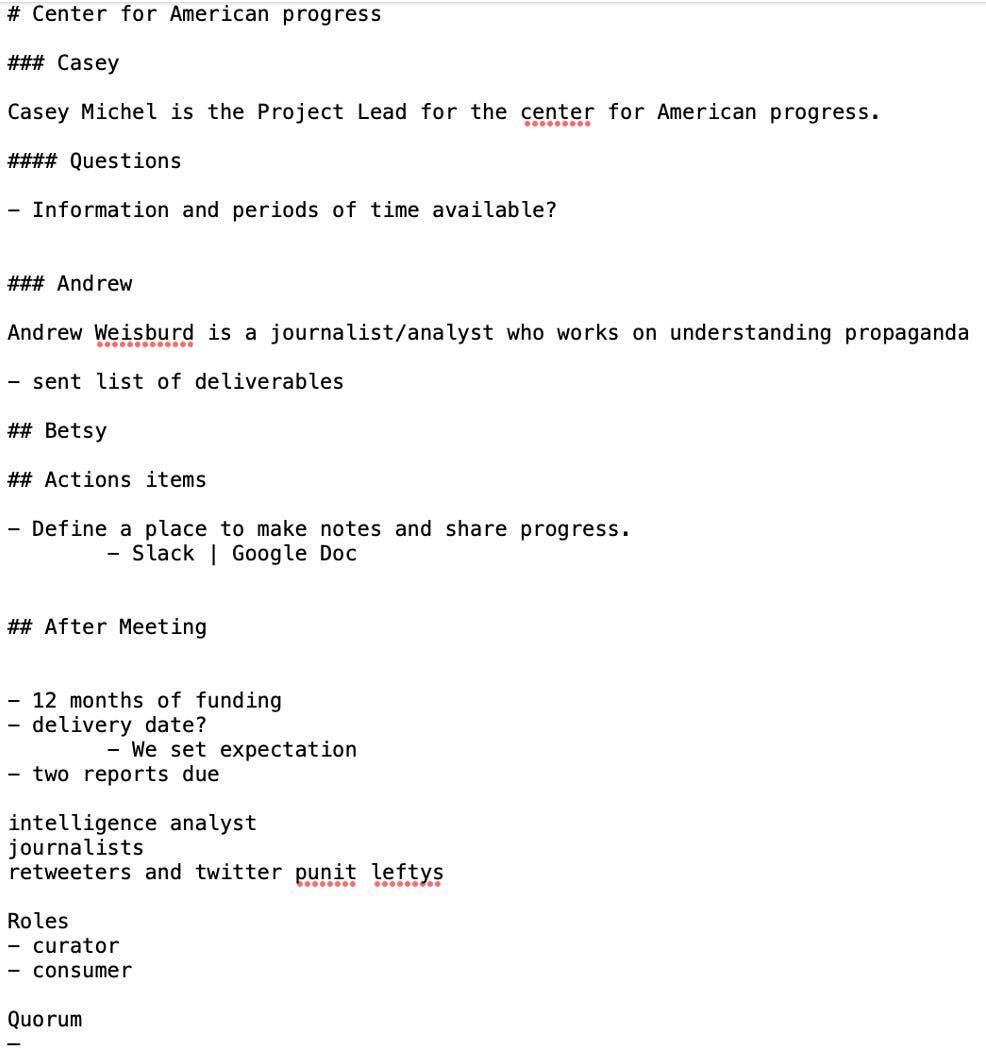
And in the dashboard deliverables you were given, it says that J.M. Berger, who also had ties to the Brookings Institute, was developing the communities or lists of people to track.

What did the German Marshall Fund want you to make better?

DUPUIS: The dashboard was called Hamilton 68 because it had something to do with Alexander Hamilton, some paper he wrote, or something esoteric. You know how people name something after some esoteric fact to make it sound important?

THACKER: Right.

DUPUIS: The German Marshall Fund owned Hamilton 68, which was something Jonathon Morgan had built for them. I think with his previous business partners.
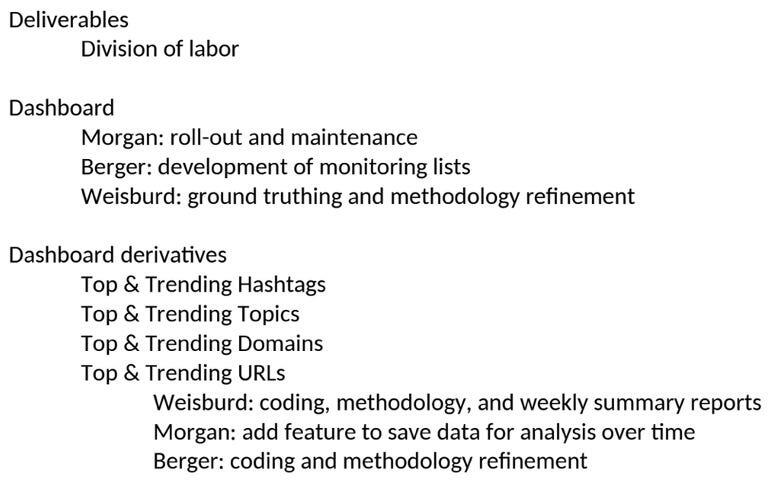
J.M. Berger was there because he was somehow involved with the Center for American Progress getting their own version. They were going to launch it on Think Progress, which was CAP’s news organization, but is now defunct.

I wrote specifically in my notes that Center for American Progress was giving us 12 months of funding. I don't know what that meant in terms of actual money.

THACKER: I’m gonna guess that Center for American Progress won’t tell me how much funding they were putting out for this. (The Center for American Progress did not respond to questions asking how much money they provided to upgrade Hamiltion 68 and whether they still use the system.)

DUPUIS: My job was to take Hamilton 68 and repackage it with a better design. I think I did a good job of it.
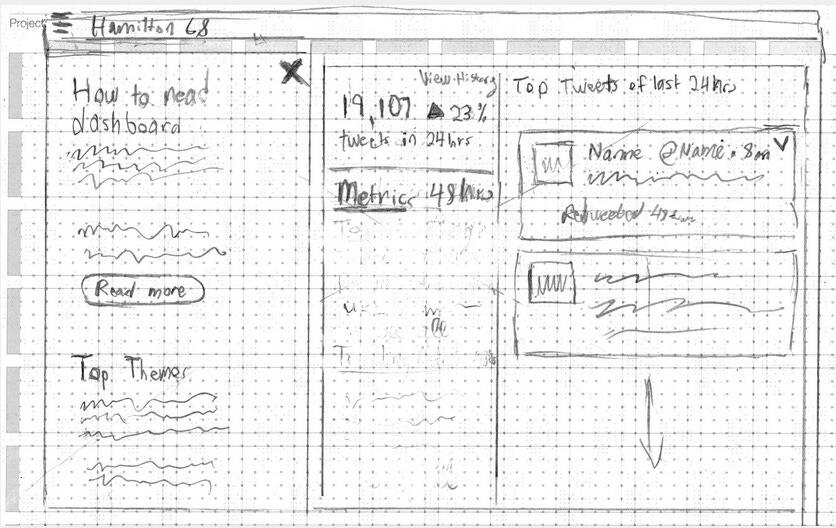
THACKER: What did this upgraded Hamilton 68 allow them to do?

DUPUIS: They could observe emerging trends on Twitter, trending hashtags, trending topics and track what people were linking to.

https://www.zerohedge.com/political/whistleblower-reveals-how-new-knowledge-cybersecurity-firm-created-disinformation

Arrowhead Pharmaceuticals Earns $50 Million Milestone from Royalty Pharma

 Arrowhead Pharmaceuticals, Inc. (NASDAQ: ARWR) today announced a $50 million milestone payment was received from Royalty Pharma plc (NASDAQ: RPRX). This milestone was triggered after the completion of enrollment of the Phase 3 OCEAN(a) - Outcomes Trial of olpasiran, being conducted by Amgen (NASDAQ: AMGN). Pursuant to its 2016 agreement with Amgen and 2022 agreement with Royalty Pharma, Arrowhead is further eligible to receive up to an additional $375 million from Amgen and $110 million from Royalty Pharma in aggregate development, regulatory, and sales milestone payments associated with olpasiran.

https://www.businesswire.com/news/home/20240502387280/en/

Daszak grilled on the Hill

 The appearance of virology researcher Peter Daszak, PhD, whose organization worked with the Wuhan Institute of Virology (WIV) to study bat coronaviruses, drew the expected tough questions from House Republicans at a hearing Wednesday, but Democrats weren't letting Daszak off the hook either.

"Today we'll hear from both sides that there are serious concerns about EcoHealth Alliance's failure to comply with reporting requirements for federal grantees -- concerns that draw into question whether you, Dr. Daszak, sought to deliberately mislead regulators at NIH and NIAID [the National Institute of Allergy and Infectious Diseases]," Rep. Raul Ruiz, MD, (D-Calif.) ranking member of the House Oversight and Accountability Select Subcommittee on the Coronavirus Pandemic, said at a hearing featuring Daszak as the lone witness. "We will also examine whether Dr. Daszak, beyond his obligations as an employee of a federally funded grantee, acted with integrity in his engagement with the possibility that COVID-19 resulted from a research-related incident."

Rep. Debbie Dingell (D-Mich.) asked Daszak, who is president of the EcoHealth Alliance, about why he appeared to mislead the Defense Advanced Research Projects Agency (DARPA) in relation to the Wuhan lab's potential participation when his organization submitted a grant application -- which was never funded -- for proposed coronavirus research to be done in cooperation with the University of North Carolina. "That kind of raises some questions for me," she said. "Why did you even entertain the thought of minimizing and apparently omitting the extent of Wuhan's involvement?"

Daszak denied he had done that. "I talked to the DARPA staff right at the beginning ... and asked them straight up in an email chain, 'Is it OK to propose this, to work with colleagues in China on coronaviruses from China?'" he said. "They said, 'Yes.' So there was no intent to hide any China involvement. They're in the proposal.

Dingell remained unconvinced. "My Democratic colleagues and I want to emphasize the importance of transparency," she said. "We believe in a full accounting of facts, and I believe we have been very fair with you ... But to the extent you've considered misrepresenting facts, or done so, we will consider that a very serious mistake."

Subcommittee chair Rep. Brad Wenstrup, DPM (R-Ohio), highlighted some of the conclusions of an interim report published Wednesdayopens in a new tab or window on the issue by the subcommittee's majority members. "We have found that EcoHealth was nearly 2 years late in submitting a routine progress report to NIH, that EcoHealth failed to report, as required, a potentially dangerous experiment conducted at the Wuhan Institute of Virology, that EcoHealth used taxpayer dollars to facilitate risky gain-of-function research, and that Dr. Daszak omitted a material fact regarding his access to unanalyzed virus samples and sequences at the WIV in his successful effort to have his grant reinstated by NIH," he said in his opening statement.

In addition, he said, "Dr. Daszak has been less than cooperative with the Select Subcommittee, he has been slow to produce requested documents, and has regularly played semantics with the definition of gain-of-function research, even in his previous testimony." Generally, "gain-of-function"opens in a new tab or window refers to research involving a genetic mutation in an organism -- such as a virus -- that confers a new or enhanced ability upon it.

Gain-of-function research was the focus of questions from Rep. Nicole Malliotakis (R-N.Y.) "EcoHealth Alliance never has, and did not do, gain-of-function research, by definition," Daszak said in response to her question.

"Are you aware of the Wuhan lab conducting that type of research?" Malliotakis said. "No," Daszak replied. When she asked him why his organization decided to work with the Wuhan lab, he replied, "If you want to work with a foreign country to find the next potential risk of a pandemic, you have to work with labs in those countries. We looked at labs across China; the [Wuhan lab] is the premier viral research [lab] in China" and has a "very good biosafety level." He estimated that in total, his organization has received about $60-$64 million in government funding since the start of the pandemic.

Several subcommittee members tried to focus on the future. "It's critical we understand what went wrong at NIAID and EcoHealth's relationship with Wuhan," said Rep. Morgan Griffith (R-Va.). "My hope is that when we're finished we have a package of legislative proposals and other recommendations on biosafety and biosecurity. I increasingly think that means taking final approval authority for these experiments away from NIAID ... in favor of an independent entity."

"In my opinion [NIAID and EcoHealth] were grossly negligent," Griffith said, adding that NIAID continues to fund EcoHealth's research "to this very day. Even after COVID-19, at NIAID, it's business as usual. It's absurd and it's got to change."

Dingell had a different take. She urged her colleagues to focus on how to protect Americans from future pandemics. "Sowing distrust in the scientific community is not the best way to accomplish this goal," Dingell said. "While I agree that the EcoHealth Alliance proved to be careless and imprecise with federal funding ... this does not mean we should throw out the baby with the bathwater. NIH and NIAID serve important functions in medical and scientific research ... They've done good work in the past and we want that good work to continue in the future."

"Throughout this investigation, my Republican colleagues have been trying to cast blame for the COVID-19 pandemic on [former NIH director Francis] Collins and [former NIAID director Anthony] Fauci ... contrary to the evidence," she added. "We should be holding today's witness accountable ... but this should not distract us from our ultimate goal: future pandemic preparedness."

https://www.medpagetoday.com/infectiousdisease/covid19/109920

'FDA Says Products Like Cottage Cheese, Formula Are Safe'

 Additional preliminary testing by the FDA has found that retail milk products such as cottage cheese and sour cream don't contain any viable H5N1 avian influenza virus, officials said during a press briefing.

Results announced last weekopens in a new tab or window from 96 products found retail milk samples didn't have any viable virus, and these additional results from 201 retail milk products showed no viable virus, either, Donald Prater, DVM, acting director of FDA's Center for Food Safety and Applied Nutrition, said during the briefing.

The agency also tested retail powdered infant formula and powdered milk products marketed as toddler formula, and there were no viral fragments on PCR testing, so additional testing for culturable virus weren't necessary, Prater said.

"These additional preliminary results further affirm the safety of the U.S. commercial milk supply," Prater said, adding that the agency is "continuing to identify additional products that we may test."

He reiterated the agency's stark warning against consuming raw milk and raw milk products: "We continue to strongly advise against the consumption of ... milk that has not been pasteurized, and recommend that industry does not manufacture or sell raw milk or raw milk products made with milk from cows showing symptoms of illness, including those infected with avian influenza viruses or exposed to those infected with avian influenza viruses," he said.

Last week, the agency announced on a symposium held by the Association of State and Territorial Health Officialsopens in a new tab or window that preliminary results from analysis of the 96 retail milk samples found one in five had viral fragments of H5N1, and the preponderance of these samples came from areas with known infections among dairy cattle herds.

The agency also previously reported that there was no culturable virus in that batch of samples.

Demetre Daskalakis, MD, MPH, director of CDC's National Center for Immunization and Respiratory Diseases, said more than 100 people have been monitored for symptoms and about 25 have been tested. Still only one personopens in a new tab or window has tested positive for H5N1 during this outbreak among dairy cattle.

Daskalakis did not know how many people exposed to infected cattle reported having conjunctivitis.

He added that the agency developed updated interim guidanceopens in a new tab or window for various groups of workers, which was recently expanded to people who work in slaughterhouses.

The agency also developed interim guidance for veterinarians handling catsopens in a new tab or window potentially exposed to the virus, as well as for prevention, monitoring, and public health investigationsopens in a new tab or window.

Two existing H5 candidate vaccineopens in a new tab or window viruses tailored to the strain involved in the current outbreak, 2.3.4.4b, are available to manufacturers and can be used to make vaccine if needed, Daskalakis said. A representative from the HHS Administration for Strategic Preparedness and Response said one of those candidate vaccines is now in early clinical trials, being evaluated for safety and immunogenicity by two manufacturers.

Available influenza antiviralsopens in a new tab or window also appear to work against the virus picked up from the Texas human case, Daskalakis said.

CDC plans to conduct serologic studies in farm workers but the agency is "waiting for the appropriate time and place to be able to launch them," he added.

Rosemary Sifford, DVM, chief veterinary officer at the U.S. Department of Agriculture (USDA), said there's no evidence of virus in any beef herds at this time.

José Emilio Esteban, PhD, under secretary for food safety at the USDA, said the agency is "confident the meat supply is safe," but is conducting three sampling efforts to be sure. Those include analysis of retail samples of ground beef; beef muscle samples from culled dairy cows; and cooking studies to ensure cooking would kill the virus should it exist in the meat.

"We're pretty sure that the meat supply is safe," he said. "We're doing this to enhance our scientific knowledge."

Sifford said evidence points to a single spillover eventopens in a new tab or window in the Texas panhandle, from wild birds into dairy cattle. Animals from those herds moving to herds in other states led to the initial movement of the virus, she said, adding that these animals being moved were asymptomatic.

Also, spread occurred through movement of equipment or other items between herds, she said.

The virus also moved from those cattle herds into other poultry flocks, Sifford said.

In the affected dairy herds, about 10% of the cows had symptoms, she said. These animals return to their previous levels of production after they recover, which takes about 2 weeks, she said. There's been little or no associated mortality, she added.

As of press time, 36 dairy cattle herds in nine statesopens in a new tab or window have tested positive for H5N1.

"At this time, our focus is on identifying the currently affected herds and being able to work with them to eradicate the virus from the herd," Sifford said. "But we do have plans to do some serologic testing to try to understand the overall scope, including previously infected herds."

https://www.medpagetoday.com/infectiousdisease/uritheflu/109921