Search This Blog

Tuesday, November 5, 2024

Ukraine Announces First Direct Clashes With North Korean Troops

 The US and South Korea now say many thousands of North Korean troops are on the front lines, potentially engaging Ukrainian forces, with most of them located in Russia's Kursk oblast, which has been under Ukrainian troop presence since the August cross-border offensive.

"More than 10,000 North Korean soldiers are currently in Russia, and we assess that a significant portion of them are deployed to front-line areas, including Kursk," spokesman for South Korea's defense ministry, Jeon Ha-kyou, told a briefing.

Getty Images

The Pentagon has said the same with spokesman Pat Ryder having stated Monday, "All indications are that they will provide some type of combat or combat support capability." He added: "We would fully expect that the Ukrainians would do what they need to do to defend themselves and their personnel."

The US administration has continued to warn that these foreign troops are "legitimate military targets" if they are found inside Ukraine and enter the fight.

Kiev has taken the allegations a step further, saying that already there's been an exchange of fire between Ukrainian and North Korean troops. But it reportedly happened inside Russia.

"Ukrainian officials said on Monday that their forces had fired at North Korean soldiers in combat for the first time since their deployment by Russia to its western Kursk region," FT writes of the new development.

The publication is calling the alleged instance "the first direct intervention by a foreign army since Russia’s full-scale invasion" as well as constituting an expansion of "what was already the largest land war in Europe since the second world war."

"The first military units of the DPRK [Democratic People’s Republic of Korea] have already come under fire in Kursk," Andriy Kovalenko, Ukraine’s high-ranking 'counter-disinformation' official, announced on Telegram. Another top intelligence official said the same but did not provide or confirm any details of the alleged clash.

Ukraine's foreign minister Andrii Sybiha has urged his visiting German counterpart Annalena Baerbock on the "need for decisive action" in response to North Korea's presence in the conflict.

"We urge Europe to realize that the DPRK troops are now carrying [out] an aggressive war in Europe against a sovereign European state," Sybiha told a press conference.

The Russian and North Korean governments have still not overtly or definitively confirmed the large deployment - especially not inside Ukraine - but have have strongly hinted at it, pointing to the defense pact inked between Presidents Putin and Kim Jong Un in Pyongyang this past summer.

President Zelensky has meanwhile been using the issue to demand that the US and NATO lift all restrictions on use of Western supplied long-range missiles against Russian territory. But the Western allies have not been responsive to the issue.

https://www.zerohedge.com/geopolitical/ukraine-announces-first-direct-clash-north-korean-troops

Brookfield Seeks More Information on Grifols Related-Party Deals

 Brookfield Asset Management is awaiting information from Grifols SA about related-party transactions as it seeks to complete its due diligence on the business, according to a person familiar with the matter.That’s a key item among several pending issues that have slowed Brookfield’s process of assessing the value of Grifols ahead of a potential takeover bid, the person said, asking not to be identified discussing private information. The New York-based asset manager is still pursuing a deal and is confident it has a path to fund a transaction, the person said.

Brookfield said in July that it was interested in taking the Spanish drugmaker private along with its founding family, which owns more than a third of the firm. It has already requested more time for the due diligence, Bloomberg News reported in September.

Grifols is due to report its third-quarter results on Nov. 7. Representatives for Brookfield and Grifols declined to comment.

Transactions between Grifols and Scranton Enterprises BV, its second largest shareholder, were at the heart of accusations made against the Barcelona-based company by short seller Gotham City Research in January. The allegations centered on the sale of two businesses to Scranton — a vehicle controlled by former executives, some Grifols family members and Tomas Daga, a long-time board member. Though Scranton owns the two businesses, Grifols consolidated their profits in its own accounts, saying it had control over them.

Grifols has denied wrongdoing and is suing Gotham in a New York court.

In the aftermath of the short seller report, which wiped more than $3 billion off Grifols’s market value, then-Chief Executive Officer and Chairman Thomas Glanzmann pledged to abandon any deals with related parties.

The short seller accusations heightened scrutiny on Grifols’ accounting, and the company said in July that it had overstated the value of its stake in Shanghai RAAS Blood Products Co., confirming an earlier report by Bloomberg News. The company also said it had restated figures relating to its joint venture with ImmunoTek, which resulted in reductions of net income for 2022, 2023 and the first half of 2024.

https://finance.yahoo.com/news/brookfield-seeks-more-information-grifols-170223012.html

Medicine is becoming more corrupt

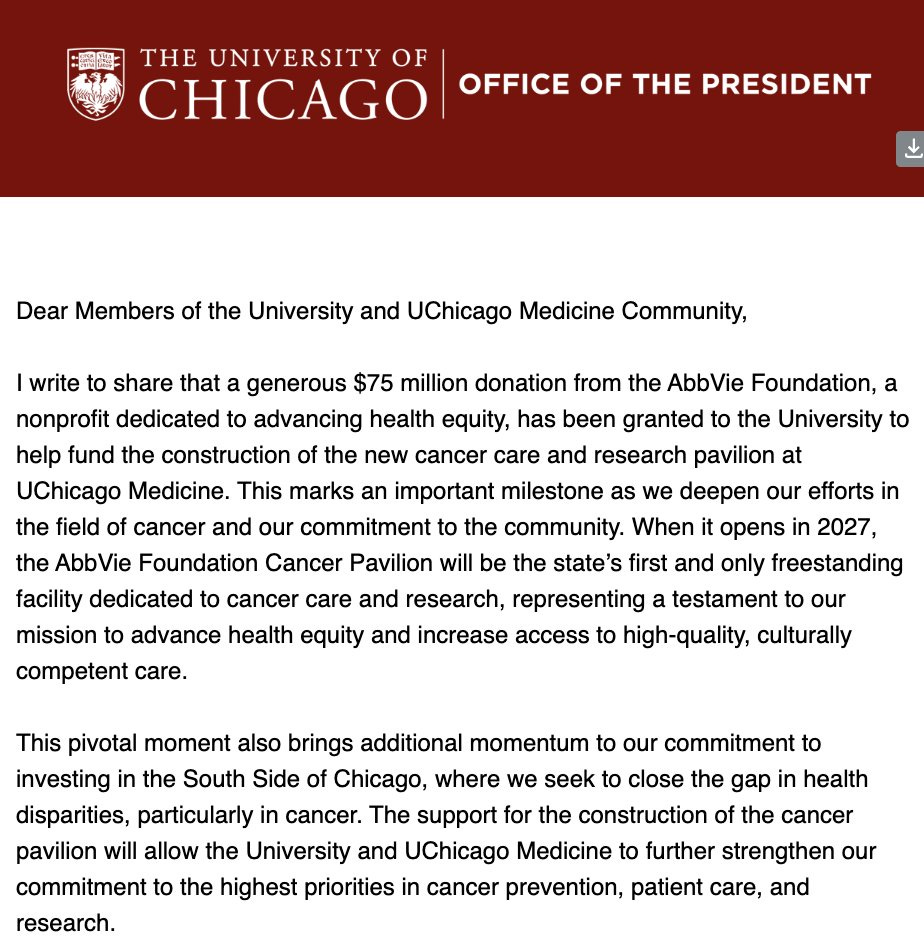
 Recently, the University of Chicago— my alma matter— announced that their cancer center would be called the Abbvie cancer center after a 75 million dollar donation. Here is the press release.

Image

They have the audacity to claim that this move will advance ‘equity’ and ‘culturally competent’ care. To a certain audience, these woke buzzwords justify anything. The truth is money like this will almost surely be spent on catering to the wealthy clients and the University of Chicago has very little interest in the tens of thousands of underserved black residents who are <5 miles from campus. Never has, never will.

Forget the buzzwords, let us focus on what has happened. A historical and venerable university has further prostituted itself to pharma. It is the Abbvie cancer center. What if you are a professor at the Abbvie cancer center and you think Venetoclax is overused (an Abbvie drug), are you free to write papers on that topic? Is there not inherently tacit discouragement?

The reason why many countries have declined is corruption. In some places, university positions can be obtained by bribes. Kickbacks can be given to ensure trials enroll on time. The US, and its institutions have historically risen above corruption, and that has led to greatness. Now it seems that corruption re-enters.

Should an academic university have buildings on campus named after Pharma? Should it have a cancer center, named for Pharma? Why not cut out the middle man? Can Pharma just directly acquire a university?

Already, many cancer centers work by taking tens of millions from Pharma to run trials. At the end of the trial, there is often extra cash. This money creates slush funds that keeps universities running. Universities prostitute themselves to get more trials. They invest in CRCs and IRBs and infrastructure to ensure they provide a good service to pharma. This is what leaders are incentivized to chase.

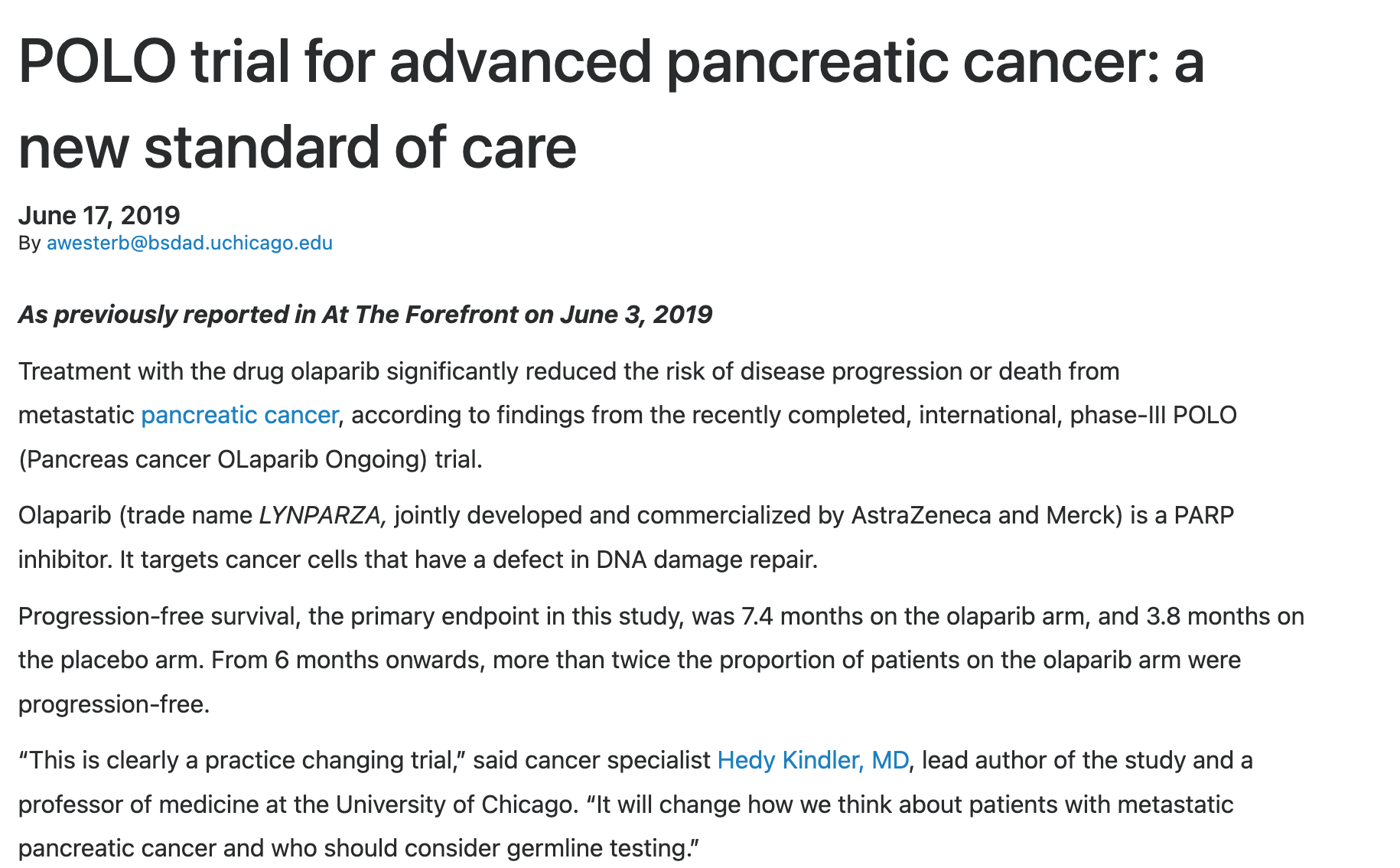
Many of these trials are unethical. The POLO trial, a famously unethical study that gave placebo to the control arm, was run at the University of Chicago. The university put out a dishonest press release, furthering AZ’s interest.

This is what universities have become. CME companies that work for Pharma. Professors have become Pharma-shills. Running bad trials, and being incapable of thinking critically about research, is de rigueur. Make no mistake, this is a form of corruption. This is the corporatization and prostitution of academia.

The administrators who decide it is OK to name the UofC cancer center the Abbvie cancer center are transient actors. They aren’t the brightest minds or most reflective thinkers. They want to maximize their career opportunities and don’t believe in the transcendent and eternal principles of the academy. I worry that their continued pursuit of corporate money will erode their institutions. I worry that they do not even understand what corruption is.

Finally, it does not escape me that the University of Chicago is not only a prostitute, but a cheap one at that: 75 million for a cancer center is not even that much in the grand scheme of university giving.


https://www.drvinayprasad.com/p/medicine-is-becoming-more-corrupt

Biden spent billions to delay Medicare premiums spike, protect Harris campaign

 Democrats were confronted earlier this year with a terrifying reality: a cap on out-of-pocket costs for patients to limit Medicare drug spending passed as part of Biden’s signature Inflation Reduction Act was set to spike premiums for millions of senior citizens just weeks before the 2024 presidential election. 

To avoid the political catastrophe of presiding over major premium increases in the middle of a closely contested election, the Biden-Harris administration used its authority to reroute appropriated funding to subsidize the premiums for seniors until after the election. 

The administration’s $5 billion budget gimmick kicked the proverbial can down the road, but only adds to the estimated possible $20 billion in additional spending over three years to cover up the unintended consequences of one of the Biden-Harris administration's signature laws. 

While they free Democratic nominee Kamala Harris to tout the caps in her key economic plan for the middle class, the subsidies will cost taxpayers and seniors in the long run. 

“They created a new program that's going to send billions to health insurance companies… to temporarily offset the premium increases,” Rebecca Weber, the CEO of the Association for Mature American Citizens (AMAC) told the John Solomon Reports podcast. 

“One could really say that they're buying, you know, off big insurance companies right before an election. And taxpayers, this is important, that people understanding it, taxpayers are footing the bill today, seniors will pay the price tomorrow,” she added. 

Medicare Part D premiums were slated to increase in October at the beginning of open enrollment following pressure on insurance companies generated by the Inflation Reduction Act’s caps on drug prices—one of the Biden-Harris Administration’s signature legislative initiatives. 

This could have spelled political disaster for Democrats and their nominee, who bragged that she cast the tie-breaking vote on the legislation. 

But the administration swooped in to prevent the catastrophe. The Centers for Medicare and Medicaid Services announced in July a new program to stabilize the premiums, called a demonstration. This program would shell out a total of approximately $5 billion in subsidies for insurance companies to cover the costs of capping prices and other effects of the Inflation Reduction Act.  

Before the subsidies, the price cap plan was already set to balloon federal spending after the Congressional Budget Office found the Inflation Reduction Act’s financial impacts were underestimated. 

The analysis, requested by Republican critics of the administration’s plans, said the changes made to Medicare by the act would likely cause the new average plan bid for standard Part D coverage to increase by a whopping 179% for 2025 without intervention.

“CBO expects that the additional plan costs reflected in those bids will result in an increase in federal spending of $10 billion to $20 billion in calendar year 2025, compared with our earlier projections,” the CBO said. 

The CBO Report:

But, the new subsidy would work to counteract premium increases at the expense of further raising the costs of the Inflation Reduction Act changes. 

The motives of the Biden-Harris administration seemed clear when their plan was announced this summer. 

“Biden admin to spend billions to blunt spike in Medicare drug premiums,” one Politico headline read. “The move to protect some older Americans from higher costs would come just ahead of the election.”

The move sparked criticism from Republicans. “One of @POTUS’ signature domestic achievements is set to cause a significant spike in Medicare premiums for millions of Americans just ahead of the Nov. election,” GOP Senator Bill Cassidy, R-La., posted to X. “Now, his admin is preparing to dole out billions of dollars to private insurance companies…”

But the Harris has faced little scrutiny for the move and continues to campaign delivering the tie-breaking vote that passed the Inflation Reduction Act and the price caps it contained. With the premium crisis averted, the subsidy plan freed Kamala Harris’ campaign to tout her administration’s efforts to lower prescription drug costs and preserve Medicare. 

“Vice President Harris, along with President Biden, took on Big Pharma and won,” the Harris campaign’s “A New Way Forward for the Middle Class” reads. "They lowered out-of-pocket drug costs for millions of seniors by passing the Inflation Reduction Act, which allowed Medicare to negotiate drug prices with big pharmaceutical companies for the first time ever and placed a $2,000 cap on all out-of-pocket drug expenses.” 

Harris’ plan conveniently ignores the ballooning deficits associated with the Inflation Reduction Act’s changes to Medicare—a cost that will be borne by future taxpayers—and papers over the administration’s subsidy gimmick to stave off price increases in the short term. 

All the while, Harris has promised to “protect Social Security and Medicare against relentless attacks from Donald Trump and his extreme allies” and “will strengthen these programs for the long haul.”

But, experts say seniors have been the real losers of the Biden-Harris administration’s tampering with Medicare and unchecked federal spending. 

“Seniors have been the biggest losers of all from Biden's inflationary policies, because they've lost money,” economist and former Trump advisor Stephen Moore told the John Solomon Reports podcast. 

“Who is the biggest victim of inflation? Well, it's always people living on a fixed income with lifetime savings, and all of a sudden, those lifetime savings are worth 20% less than they were, you know, when Biden came into office, their 401 K plans have been hit, and bonds have not done very well either.” Moore said. 

“And then you add to that…they’ve been robbing money from Medicare, which is only going to accelerate the date when at which you know that Medicare runs out of money,” he added. 

https://justthenews.com/politics-policy/elections/biden-harris-administration-spent-big-tamp-down-medicare-prices-right

AstraZeneca sheds GBP15 billion of market cap as weight-loss-pill data underwhelms investors

 Analysts said there's not enough data yet to support efficacy differentiation

AstraZeneca PLC shed GBP15 billion of market capitalization on Tuesday, after investors were underwhelmed by early data from a trial of a weight-loss pill.

The company (UK:AZN) said its lead product candidate AZD5004 achieved weight loss of 5.8% in Type 2 diabetes patients after four weeks with no serious side effects in a Phase 1 trial.

The U.K.-based company released the data at Obesity Week, an event organized by the Obesity Society, taking place in San Antonio, Texas this week. AstraZeneca also released data on its injectable weight-loss drug AZN6234.

Cantor said the data on the oral version was hard to compare to competitors, as participants in the trial were required to fast for 14 hours-10 hours before dosing and four hours after. That led to higher-than-expected placebo response across all efficacy endpoints and makes comparison with other oral versions challenging.

"There is a lot of variability on weight loss across dosing arms with lower doses performing similarly (or even worse!) than placebo," analyst Prakhar Agrawal wrote in a note to clients. "Our conclusion is that for now, there is not enough data to support efficacy differentiation."

JPMorgan analyst James Gordon agreed and said the small patient numbers and short treatment duration, and the fact the drug was tested on diabetic patients and not obese ones, made it hard to compare to others.

AstraZeneca suggested the potential for AZN5004 to achieve greater weight loss in future trials, once tested on obese patients and when used for longer, Gordon wrote in a note to clients. The company is also planning to test higher doses than the 50 mg maximum in the Phase 1 trial, he wrote.

AZM5004 also produced one case of liver enzyme elevation and one QTc prolongation, a condition where the heart-rate corrected Q% interval is longer than normal.

The news comes a day after Viking Therapeutics Inc. released data on its oral weight-loss drug VK2735, showing obese adults taking the highest dosage of 100 mg had an average weight loss of 8.2% from baseline over a four-week period. The 100 mg dose also produced weight loss of up to 6.8% compared with placebo.

That stock soared early in the day before falling back as investors considered the growing competition in the space. Viking's stock (VKTX) was up 3% on Tuesday and has gained more than 250% in the year to date.

AstraZeneca and Viking's injectable and oral treatments use the same mechanism as Novo Nordisk's (DK:NOVO.B) Wegovy and Ozempic and Eli Lilly's (LLY) Mounjaro, mimicking the effects of GLP-1, a gut hormone that can help control blood-sugar levels and reduce appetite. GLP stands for glucagon-like peptide.

https://www.morningstar.com/news/marketwatch/20241105141/astrazeneca-sheds-gbp15-billion-of-market-cap-as-weight-loss-pill-data-underwhelms-investors

Hims & Hers to launch a generic for Novo’s older GLP-1

 Hims & Hers Health (NYSE:HIMS) is gearing up to launch an off-patent version of Novo Nordisk's (NVO) (OTCPK:NONOF) older GLP-1 weight loss therapy liraglutide in 2025, CEO of the telehealth platform Andrew Dudum has said.

"We plan to bring liraglutide, the first generic GLP-1 in the market, to the platform in 2025," Dudum said, referring to the injectable, marketed as Victoza and Saxenda for diabetes and obesity, respectively.

In the first half of 2024, Liraglutide added DKK 8.3B ($1.2B) to the Danish drugmaker with a ~22% YoY drop ahead of its loss of market exclusivity this year as part of the company's older GLP-1 portfolio. 

"We have already confirmed a core supplier for this addition, and over the next few months, expect to finish completing test and batch validation as well as confirming certificates of authenticity," Dudum, HIMS' co-founder, added.

His comments came at the company's earnings call after the San Francisco, California-based healthtech exceeded Street forecasts with its Q3 2024 financials and raised its full-year outlook, sending its stock sharply higher in the post-market.

In May, Hims & Hers (NYSE:HIMS) launched compounded versions of Novo Nordisk's (NVO) popular weight loss therapy semaglutide marketed as Wegovy at a sharp discount.

https://www.msn.com/en-us/money/savingandinvesting/hims-hers-to-launch-a-generic-for-novo-s-older-glp-1/ar-AA1txEcJ

Verve Q3, Pipeline Progress

 Seven participants across two cohorts dosed in the Heart-2 Phase 1b clinical trial of VERVE-102 targeting PCSK9; Initial data planned for the first half of 2025

First participant dosed in the Pulse-1 Phase 1b clinical trial of VERVE-201 targeting ANGPTL3; Regulatory clearances in Australia, Canada, and the U.K.

Cash, cash equivalents, and marketable securities of $539.9 million; cash runway through 2026

https://www.globenewswire.com/news-release/2024/11/05/2974785/0/en/Verve-Therapeutics-Announces-Pipeline-Progress-and-Reports-Third-Quarter-2024-Financial-Results.html