Search This Blog

Monday, May 5, 2025

What DOGE Ought To Do With Social Security

 Throughout early 2025, Americans have been subjected to a barrage of reports on events surrounding Social Security. Many accounts have centered on attempts by the Department of Government Efficiency (DOGE) to access Social Security data. Competing narratives reflect the fears of opposite wings of the U.S. political spectrum: on the right, that DOGE is uncovering massive fraud within the Social Security system, and on the left, that DOGE is the spearhead of a right-wing conspiracy to dismantle the program. Neither of these narratives is anchored in reality. In this charged environment, we would do well to step back and recall salient facts about Social Security, and about the reforms needed to preserve its solvency.

DOGE is correct in asserting that no meaningful reform of federal finances can occur unless the largest, fastest-growing benefit programs of Social Security, Medicare and Medicaid are rendered more efficient. Unfortunately, DOGE erred badly out of the gate when approaching these systems, circulating groundless claims that Social Security was paying benefits in the names of tens of millions of people born more than 150 years ago. The claim turned out to be based on a data file of individuals for whom the Social Security Administration (SSA) lacked death information. That file contained nearly 400 million entries, whereas currently there are about 70 million people receiving Social Security benefits. Hence, right off the bat, DOGE should have understood that at least 82% of that data couldn’t have anything to do with current benefit payments.

Since then, DOGE staff has been making the media rounds with unsubstantiated claims about illegal immigrants using Social Security numbers to vote and draw benefits. These various claims have fostered misperceptions that Social Security’s large financing shortfall is driven primarily by fraud, and implied not only that Social Security can remain solvent without any changes to legal benefits, but that we can even afford to give seniors an additional tax break. None of this is true.

Neither have DOGE’s critics been scrupulously factual. Many have hauled out the old trope that DOGE’s attention to Social Security is part of a right-wing plot to destroy or privatize the program. This line of attack has been aimed at conservative reformers for decades. While some politicians back in 1935 were hostile to FDR’s initial efforts to establish Social Security, since then even the most conservative Republicans have generally supported the program, typically differing with Democrats only over the rate at which benefits and tax burdens should grow. Even Social Security’s most loyal friends understand that reforms to mitigate cost growth are sometimes necessary to sustain the program.

Nor is there any reason to believe Elon Musk or his colleagues wish to “privatize” Social Security and profit from administering it. While in the past, some conservatives such as President George W. Bush proposed incorporating a personal savings component into Social Security, even he favored continued administration of the system “by the government.” Progressive Democrats’ stereotype of Republicans plotting to take away everyone’s Social Security benefits lacks a factual basis, especially now when President Trump has positioned himself against even the moderation of benefit growth necessary to keep the system afloat.

If the current conversation surrounding DOGE and Social Security isn’t the one we should be having, what is? If I had the opportunity to speak with DOGE officials about Social Security from the standpoint of government efficiency, the following is what I would say.

Little Fraud and Abuse, but Plenty of Waste

Public policy debates in Washington often invoke references to “waste, fraud and abuse.” While they’re commonly intoned in a single breath, these are three different things, and they have very different levels of relevance to making Social Security more efficient and financially sound.

Social Security currently has a financing shortfall equal to about 25% of all future benefit claims. To maintain Social Security in the form Americans are accustomed to, lawmakers must enact cost savings equal to that amount, a magnitude that far exceeds any previously legislated solvency rescue. Such levels of savings cannot be achieved merely by reducing “waste” in the sense of administrative bloat. Social Security’s total administrative expenses are about 0.5% of all program expenditures. Were we to not merely reduce, but actually eliminate, everyone and everything associated with administering Social Security (a practical impossibility), we’d still have 98% of the shortfall to fix.

We simply cannot make meaningful headway on Social Security’s financing problems by terminating staff or cutting administrative overhead. In some cases, staff cuts may even be counterproductive and result in more spending. Former SSA official Mark Warshawsky finds that the specific downsizing moves pursued by DOGE would have effects “inconsistent with DOGE’s stated purpose to improve efficiency and reduce government spending.”

Likewise, improved policing of fraud is unlikely to make a qualitative difference in Social Security’s finances. There are certainly federal programs where improper payments make up a significant share of expenditures—such as Medicaid, where the evidence indicates that many of those receiving benefits are not legally eligible. That’s not true of Social Security, largely due to its simplicity. Since participation is practically universal, and benefit eligibility is generally a function of age rather than income, it’s a lot easier for SSA to keep track of who should be receiving benefits.

Social Security payments to those over 100 years of age number about 44,000—roughly what one would expect, given that about 86,000 Americans are over 100 years old. Moreover, payments automatically stop, with only unusual exceptions, once an individual reaches age 115. Warshawsky notes that SSA’s incomplete “death master file” certainly limits the government’s ability to detect and correct fraud in these payments. But we’re talking here about 0.06% of all beneficiaries, not nearly enough to make a significant difference in the tough choices required to preserve Social Security’s solvency.

Waste, on the other hand, is a problem—though not in the sense of administrative bloat. Rather, Social Security’s growing costs include many payments that serve no intentional policy consensus. These payments are perfectly legal, indeed mandated under current law, but they are wasteful. DOGE could perform a valuable public service if it called attention to ways in which rising Social Security spending runs counter to bipartisan policy goals, and inspired legislation to fix these problems.

Indeed, because Social Security spending is currently growing at a faster rate than our national economic output, it cannot be financed within a stable tax rate unless its growth rate is moderated. Trying to maintain system solvency without moderating cost growth would simply mean that tax rates must perpetually increase. Containing cost growth without harming program participants requires greater efficiency. DOGE could usefully identify these problems, even if only legislators can correct them.

Better Targeted Spending

Social Security is the largest, most popular and most successful federal income security program. It provides income support to American households when a primary earner permanently leaves the workforce due to old age (retirement) or disability. Workers finance Social Security by paying payroll taxes, and while they don’t exactly enjoy it, they broadly accept the necessity of doing so—an acceptance that speaks to Social Security’s exceptional success. This success can only continue as long as lawmakers remain willing to do in the future what they have done in the past—namely, align the program’s benefit promises with the amounts workers’ payroll taxes can finance.

Because Social Security for the most part works as intended—providing income when households need it most, and redistributing income from better-off households to less-well-off households—many people assume that the program must be accomplishing more when its benefits and costs grow larger, and that hardship would be inflicted if its costs were lessened. This is a mistaken belief. As an income transfer program, Social Security is at best a zero-sum game: No individual can gain net income through it unless another individual loses at least as much. As it turns out, some of the program’s current income redistribution runs counter to national goals and intentions, and scaling it back would lower costs, extend solvency and improve system fairness.

Consider, for example, Social Security’s nonworking spouse benefit, which equals half the primary household worker’s benefit. Its intention is good: to recognize the value of stay-at-home work, including the tangible actuarial benefit of parenting the taxpayers of the future. However, it is inefficiently designed and regressive in its effects, subtracting income from households with less and giving it to households with more. Consider, for example, a working single mother with career average indexed earnings equal to the federal minimum wage ($15,080 per year). Paying payroll taxes for her entire working life, she would be entitled to a full old-age benefit of $13,358 annually if she became benefit-eligible this year.

By contrast, a nonworking spouse who pays no payroll taxes, has no children, marries the highest of high earners and becomes benefit-eligible this year, would be entitled to a nonworking spouse benefit of $23,777 annually. The system thus provides a windfall to those who “marry rich” that is far greater than what many working parents earn with their payroll taxes. For this reason, reformers like those at the Brookings Institution have proposed eliminating the nonworking spouse benefit altogether. Even if legislation doesn’t go that far, certainly the benefits of nonworking, nontaxpaying spouses should not exceed what full-time workers receive after paying payroll taxes over a full career.

Other inefficiencies arise from Social Security’s antiquated benefit formula. Benefits are computed as a function of one’s average taxable (indexed) wages in one’s highest 35 earnings years. Because benefits are based on a lifetime earnings average, the system doesn’t differentiate between workers with dramatically different earnings patterns. For example, it can’t tell the difference between someone who averages $50,000 in taxable earnings throughout 30 years of covered work, and someone who averages $150,000 in taxable earnings in 10 years of covered work.

This is a problem, because Social Security’s formula is designed to pay far more generous returns to lower-income workers. Someone who earns $150,000 a year in 10 years of work isn’t a low-income person; they’re a person with substantial earnings who just hasn’t worked very often. But the current system pays them an unintended windfall because it misconstrues them as being a lower-income worker.

In fact, Social Security’s benefit formula is so inefficient that the majority of individuals it describes as “very low income” workers with 20 years of earnings aren’t likely to be low-income workers at all. 30% are foreign-born, meaning they may have several years of substantial earnings abroad that the system just doesn’t see. Another 14% have state or local pensions the system doesn’t track. A further 26% inhabit a household with a higher-income earner. Even taking into account overlaps between these categories, only 37% of all such beneficiaries have the income limitations Social Security implicitly assumes they do, yet the system gives them more generous returns as though they did.

This situation is exacerbated by the recent enactment of the misnamed Social Security Fairness Act (SSFA), which grants additional Social Security benefits, for which they didn’t pay, to individuals with state or local government pensions. The SSFA repealed the Windfall Elimination Provision, which was designed to prevent Social Security from treating higher-income workers with state pensions as though they were lower-income workers. It also repealed the Government Pension Offset, which means that many state and local employees with their own earnings and pensions will now get Social Security nonworking spouse benefits too. These payments are clearly inappropriate, and a worthy subject of dissection by DOGE.

Another problem is that some generations are taking more out of Social Security than they contributed (plus interest), forcing other generations to give more to the system than they get back. This happened most dramatically with the first generation of Social Security beneficiaries, who received benefits funded mostly by subsequent generations rather than by themselves. This means that to keep Social Security solvent, the rest of us must make a net contribution to solvency, and the task of lawmakers is to spread around these financing burdens as fairly as possible.

Unfortunately, that’s not happening under current law. Baby boomers and Gen Xers are worsening the solvency problem by receiving benefits that exceed what their contributions (plus interest) can fund. For example, in part because participants born from 1954 to 1985 are taking out more than they put in, Social Security can now only afford to pay a medium-earning, two-earner couple born in 2004 85 cents for every tax dollar they contribute. DOGE would serve the public by analyzing these excess payments currently scheduled for middle-aged Americans and recommending ways to constrain them.

Finally, there is the problematic engine driving excess Social Security cost growth: the automatic indexation of benefits written into current law. Currently, Social Security benefits are indexed to increase from one cohort to the next with growth in the national Average Wage Index. The intent is that beneficiaries’ incomes grow as fast as those of workers. But the current formula grows too rapidly and overshoots that target. Benefit claim ages have barely moved, while Americans are living and collecting benefits for much longer and birth rates are dropping.

As a result of these factors, workers’ costs to finance Social Security benefits are rising faster than their wage incomes, causing their standard of living to decline relative to those of Social Security beneficiaries. This doesn’t make policy sense. A government income program such as Social Security ought to become more affordable as American workers earn more. The fact that it doesn’t is an unintended problem, exactly the sort of thing a commission devoted to government efficiency should examine.

There is relatively little fraud, abuse or improper payment in Social Security, but that doesn’t mean there isn’t inefficiency and waste. Just as with our healthcare system, many payments are perfectly legal but nevertheless cost-increasing and wasteful. How Social Security should spend money is a subjective value judgment, but it’s a review that must be undertaken if Social Security is to be made as efficient as it needs to be.


Charles Blahous holds the J. Fish and Lillian F. Smith Chair at the Mercatus Center, and previously served as a public trustee for Social Security and Medicare as well as Deputy Director of the National Economic Council.


https://www.discoursemagazine.com/p/what-doge-ought-to-do-with-social

Trump Can Pocket Easy Win by Safeguarding America’s Pharmaceutical Supply Chain

 Last week witnessed the 100th day of the new Trump administration, with myriad early successes on everything from border security to military recruitment.  That helps explain the unprecedented upturn in Americans telling pollsters that the nation is on the “right track” since January’s presidential transition.  

As we now transition to the Trump administration’s second 100 days, it possesses an ideal opportunity to pocket a win by protecting America’s pharmaceutical supply chain in a way that benefits American consumers.  

The golden opportunity in question is a Department of Commerce (DOC) investigation of the pharmaceutical sector under Section 232 of the Trade Expansion Act of 1962.  

In its essence, Section 232 allows presidential administrations to investigate and correct import dynamics that potentially threaten U.S. national security.  Accordingly, it constitutes a powerful trade and national security tool, and the investigation provides a timely opportunity to make our healthcare system more secure, more resilient, and ultimately more cost-efficient for consumers if conducted in a wise and strategically sound manner.  

After all, as we learned the hard way throughout the COVID pandemic, global supply chain disruptions can strain access to critical goods and services, including lifesaving medicines.  Few people need be reminded, therefore, about the importance of remaining vigilant in protecting our ability to secure access to items like pharmaceuticals necessary for our well-being.  

Moreover, it’s undeniable that portions of America’s pharmaceutical supply chain in particular remain vulnerable, especially in areas of overreliance on unfriendly sources of certain active pharmaceutical ingredients (APIs) and finished drugs.  

China, in particular, exploits its manufacturing power and command-and-control economic regime to dominate vital upstream sources.  Its overtly anti-American economic model, outright theft of intellectual property (IP), and deliberate domination of pharmaceutical ingredients constitute a genuine threat, and the Trump administration will not and should not allow it to weaponize supply chains to maintain a chokehold over Americans’ pharmaceutical lifeline.  

Section 232 offers a potentially pivotal tool in that endeavor.  

In addressing those legitimate challenges, however, solutions employing Section 232 mustn’t reflexively punish critical allies and trade partners in ways that would undermine rather than strengthen pharmaceutical supply chains.  The current DOC review should instead encourage domestic capacity expansion where possible, and reinforce and expand cooperation with friendly nations – nations that not only share our values in protecting IP and product safety standards, but whose own pharmaceutical sectors play an indispensable role in delivering safe and effective medicine to Americans.  

That is not a contradictory approach.  We can use Section 232 to strengthen domestic resilience while avoiding undermining America’s important global partnerships, while simultaneously reducing our dependency upon hostile actors like China.  Indeed, those goals are mutually reinforcing.  

Here’s why.  America accounts for an astonishing two-thirds of all new drugs introduced to the world, and most of the lifesaving medicines on which American consumers rely are manufactured domestically.  Those domestic manufacturers, however, source many of their ingredients from allied locales like Switzerland, Ireland, the United Kingdom, and elsewhere within the European Union.  For example, one-third of the ingredients of pharmaceuticals used by American consumers are sourced from the E.U.  Because those supply chains are deeply entrenched and would require years to remake, domestic manufacturers can’t simply start sourcing those ingredients and medicines from domestic suppliers, regardless of price.  

Consequently, unless Section 232 actions are employed adeptly, they could conceivably end up increasing costs for American consumers, undermining the sustainability of federal healthcare programs like Medicare, and reducing our access to important medicines.  

Therefore, the Trump administration should pursue a targeted, partnership-driven approach rather than one that might erroneously treat all overseas supply partnerships as Section 232 threats.  

That means focusing Section 232 enforcement actions on adversarial nations like China through tailored trade remedies and industrial adjustments.  It also means solidifying trade and regulatory engagement with reliable allies like Ireland or Switzerland to create a resilient supply chain on which we can depend in future moments of crisis.  We must also use the Section 232 investigation to promote greater transparency and accountability in pharmaceutical supply sourcing, and incentivize domestic production of key pharmaceutical ingredients and finished drugs via tax credits, regulatory streamlining, and public-private partnerships.  

Used wisely, the Trump administration can use Section 232 to set the foundation for a pharmaceutical supply chain that is stronger, more secure, and less prone to single points of failure or disruption by adversaries like China.  Our national security and the well-being of American consumers depend upon it.  

Timothy H. Lee is Senior Vice President of legal and public affairs at the Center for Individual Freedom

https://amac.us/newsline/society/trump-can-pocket-easy-win-by-safeguarding-americas-pharmaceutical-supply-chain/

Would Work Requirements Cut Medicaid Costs?

 Congressional Republicans are currently looking to slow the growth of federal Medicaid spending, which has surged from $161 billion to $616 billion over the past two decades.  Although only 17% of Americans support reducing Medicaid spending; 62% support requiring most adults to work in order to gain eligibility.  But, while work requirements command broad appeal among legislators, they are unlikely to greatly reduce the program’s costs.

Work requirements are generally sought as a way to mitigate the program’s work disincentives.  Medicaid’s expansion to able-bodied adults under the 2010 Affordable Care Act provides comprehensive healthcare benefits (worth an average of $7,711 in 2023), which individuals would lose if they earned more than $20,120 – about the level of someone working full time at the minimum wage in most states. 

In 2017, when the House of Representatives sought to permit states to condition Medicaid benefits for “nondisabled, nonelderly, nonpregnant adults” on individuals’ “participation in work activities”; companion legislation was blocked in the Senate.  But the first Trump administration approved 13 waivers for states to implement similar work requirements.  These typically required Medicaid beneficiaries to dedicate 80 hours per month to work, volunteer activity, full-time education, or job training, while exempting those who were disabled, pregnant, medically frail, or personal caregivers.  But such Medicaid work requirements were struck down by the courts for all states except Georgia (which used non-ACA expansion funding).

Scholars at the liberal Center for Budget and Policy Priorities argue that “work requirements have no upside.”  Noting that only 6,500 out of 240,000 potentially eligible for the program in Georgia enrolled, they suggest that the burden of compliance pushes people off benefits without increasing work.

People can’t live solely from healthcare benefits the way they can from cash.  In some circumstances, providing medical care to those with serious health problems might actually help them return to work.  The work disincentives resulting from Medicaid’s means test might also be mitigated by the ACA’s subsidies for those with higher incomes to purchase health insurance. 

To assess the effect of Medicaid work requirements, Harvard economists examined Arkansas’s requirement for beneficiaries aged 30 to 49, which was in effect from 2018 to 2019.  They found a 13.2 percentage point reduction in enrollment relative to other age groups, and a 7.1 point increase in the percentage of that cohort who were uninsured – even though 95% of those effected by work requirements satisfied them or should have qualified for an exemption.  The study found little impact on employment levels – with the target population averaging 17.1 hours of work per week in Arkansas, compared with 18.2 hours in other similar states.

Influenced by the Harvard study, the Congressional Budget Office estimate that permitting Medicaid work requirements nationwide would reduce Medicaid enrollment by 0.6 million and federal spending by $109 billion over 10 years.  But CBO contrasts the minimal impact on employment of Medicaid work requirements with substantial increases in employment experienced following welfare reform, which established similar requirements for cash benefits in the Temporary Assistance for Needy Families program.

However, the increased employment associated with TANF might be misleading.  Welfare reform did not simply apply work requirements to TANF cash benefits, but largely shifted that program’s funding away from means-tested cash benefits to employment support services.  The number of beneficiaries of cash benefits fell by 85%, with many states now spending close to nothing on them. 

TANF’s bigger lesson may be about how federalism distorts work requirements.  Under block grants, TANF imposed only loose work targets, which states could easily satisfy by sanctioning token employment arrangements.  Those states who desired to maintain the status quo ante, and hand out welfare benefits with little regard to work, could easily do so.  The statutory work requirements proposed for Medicaid would be entirely optional – and impose no obligations on states at all.

That likely explains why the proposal has faced less political push-back than other proposed cuts to Medicaid.  It should also call into question the idea that work requirements would reduce federal spending.  CBO’s estimate was based on the economic effects of work requirements implemented as in Arkansas.  But it does not incorporate an assessment of the political question of whether other states will respond to a change in federal law by seeking to emulate Arkansas.

In fact, even where states choose to implement arduous Medicaid work requirements, this may not generate substantial savings for federal taxpayers.  The federal government currently provides $9 for every $1 that states spend on Medicaid services for beneficiaries under the ACA’s expansion of the program.  Rather than reducing states’ desire to take full advantage of an extraordinarily lucrative arrangement, work requirements may just make it easier for states to concentrate those funds on preferred constituents.  In some cases, they might actually increase the program’s cost – by making it easier for red states to justify expanding the program’s eligibility to able-bodied adults, where they had previously chosen against doing so.

In practice, Medicaid work requirements are likely to be very loose, and to do little either to save taxpayers money or to oblige people to assume full-time employment.  Time limits on eligibility would likely do a better job of deterring undue dependence on public funds by those who are able to work, while also providing more support for the receipt of medical care by those who have temporarily fallen on hard times.  

Chris Pope is a senior fellow at the Manhattan Institute.

https://www.realclearpolicy.com/articles/2025/05/05/would_work_requirements_cut_medicaid_costs_1108128.html

Obamacare Is an Increasingly Bad Bargain for Young People

 A cursory review of public sentiment portrays the Affordable Care Act (ACA) as a triumph of social policy, with nearly two-thirds of Americans holding a favorable view of the 2010 healthcare law. This popularity rests on a precarious foundation, as the ACA’s sustainability is undermined by fragile structural and financial mechanisms. Just like Medicare, beneath its widespread acclaim lies a contentious and unsustainable undercurrent.  

ACA and Medicare, by design, impose a disproportionate burden on younger generations.  

The ACA’s risk-pooling mechanisms and individual mandate require younger, healthier individuals to subsidize older, high-risk populations, inflating premiums for those with limited financial resources. Medicare’s payroll tax structure intensifies this inequity, extracting funds from young workers to sustain a program facing looming insolvency risks. According to the Medicare Trustees’ 2024 Report, the Hospital Insurance Trust Fund is projected to be depleted by 2036.

This intergenerational transfer prioritizes immediate social benefits over long-term fiscal sustainability, potentially jeopardizing future benefits for younger cohorts. Such dynamics raise critical questions about distributive justice, challenging the fairness of policies that burden the young to support current beneficiaries while offering uncertain returns. 

The Flawed Formation 

Pragmatic politics necessitates negotiation and maneuvering among competing interests, and the adoption of the ACA was no exception. Lobbying groups representing healthcare interests spent $263 million in the first half of 2009 to shape the legislation, according to OpenSecrets

Older generations wielded significant political influence during this process. Older, sicker patients consume more healthcare, while younger, healthier individuals are essential for insurers to balance risk pools — paying premiums without incurring substantial medical costs.  

The Peterson-KFF Health System Tracker reports that in 2021, individuals aged 55 and over accounted for 56 percent of total health spending, despite comprising only 31 percent of the population, while those under 35 represented 44 percent of the population but only 21 percent of spending. Per capita, older adults (65+) spent $11,300 annually, compared to $2,000 for ages 5–17 and $4,500 for ages 18–34, per Medical Expenditure Panel Survey (MEPS) data. 

This disparity was a focal point during the ACA’s formation, and younger generations bore the brunt of the outcome. Insurance lobbyists advocated for a 5:1 premium ratio between older (high-usage) and younger (low-usage) clients, reflecting actuarial costs. The American Association of Retired Persons (AARP) pushed for a 2:1 ratio to protect older enrollees, and the final compromise, set at 3:1 under Section 1201 of the ACA, capped older enrollees’ premiums at three times those of younger ones. 

The younger generation lost the political battle. 

The established ratio deviates from fairness. A 2016 American Academy of Actuaries study notes that the 3:1 age band compresses pricing, forcing younger enrollees to pay premiums exceeding their expected healthcare utilization. For example, a healthy 25-year-old with minimal medical needs might pay a premium far outsizing their spend. This effectively subsidizes the insurance coverage of a 60-year-old with multiple comorbidities.  

The ACA’s Medicaid Mirage: A Numbers Game with Hidden Costs 

The ACA is often praised for reducing the uninsured rate, with 20-24 million gaining coverage from 2010 to 2016. But a portion of this achievement stems from Medicaid expansion, raising questions about the quality and sustainability of the care provided. A reliance on Medicaid distorts the ACA’s success, burdens the system and patients with subpar care, and shifts costs onto younger taxpayers, challenging its equitable promise. 

The KFF noted 91 million total Medicaid enrollees in 2022, up from 57 million in 2010. Medicaid expanded enrollment by 21.3 million people in 2024. One in five people now use Medicaid as their primary program for health insurance. This is expensive, and Medicaid — funded mostly by federal and state taxes from working-age Americans — is putting a growing strain on state budgets.

California, for example, is estimated to spend $42 billion on Medi-Cal (Medicaid) in 2025-2026. This is a $4.5 billion increase over the previous budget. The state just had to take out a $3.44 billion loan to cover Medicaid expenses for a month. 

This is not financially sustainable. 

This Medicaid approach is doubly problematic for patients due to the program’s structural deficiencies in delivering access to quality care. Medicaid’s low reimbursement rates — averaging 70 percent of Medicare’s, per CMS — deter provider participation. Medicaid patients have a 1.6-fold lower likelihood in successfully scheduling a primary care appointment and a 3.3-fold lower likelihood in successfully scheduling a specialty appointment when compared with private insurance.

Critics might argue that Medicaid expansion addresses unmet needs, and there is merit to some of those claims. But these gains are overshadowed by access barriers and fiscal unsustainability. Significant opportunity costs are left unmet. 

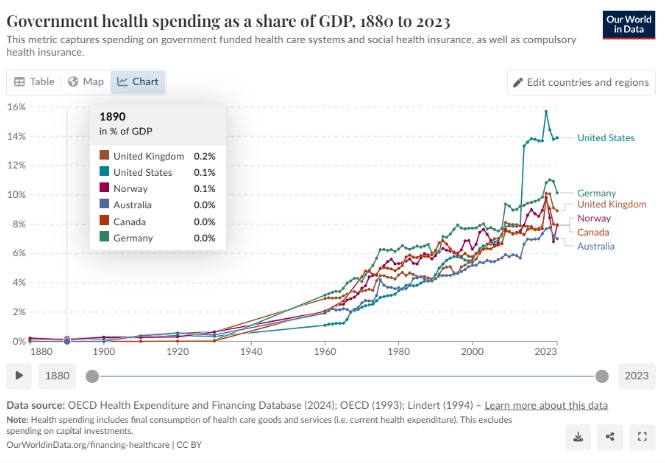
Image Credit: Our World in Data

Intergenerational Inequity: The Fragile Fiscal Future of the ACA and Medicare 

The notion of a social contract suggests that generational taxation burdens balance over time, but a critical question persists: will promised benefits endure for future generations? This concern impacts both the ACA and Medicare, both of which impose significant costs on younger cohorts while ignoring solvency and long-term viability risks. 

Medicare beneficiaries often receive benefits far exceeding their contributions, creating a fiscal imbalance. The Urban Institute estimates that a 2025 retiree, contributing $87,000 in payroll taxes over their career will receive $274,000 in Medicare benefits (inflation-adjusted). Low-income beneficiaries, contributing minimal taxes, benefit significantly. An aging population, sluggish birth rate, and rising costs may force benefit cuts or tax hikes, and possible diminishing returns for future contributors. 

The ACA’s fiscal framework similarly relies on subsidies and taxes under pressure. The Congressional Budget Office forecasts $1 trillion in marketplace subsidies over the next decade, driven by rising premiums and enrollment. The ACA has been able to shield the true cost of insurance by offering premium tax credits. These tax credits create artificial demand and support for the ACA by cloaking the true cost of insurance. These tax credits are available to incomes between 100 percent and 400 percent of the federal poverty level. 

Without tax subsidies, the average family of four would pay $27,025 for health insurance in 2024. If these expire in 2025, as they are set to do, the CBO projects 2.2 million will lose coverage in 2026. Premiums would increase 4.3 percent in 2026, and an estimated 7.9 percent in 2027. To put this in context, for those earning 400 percent of the poverty level, premiums could increase by approximately $2,900 per person each year.The ACA and Medicare’s insolvency risks undermine their equitable vision.

Younger generations, taxed heavily today, may inherit a hollowed-out system unable to deliver care. Without reforms, this trajectory betrays the cohort sustaining it, raising profound concerns about distributive justice. The ACA’s ambition was not its downfall; its disregard for economic principles will be. Subsidies without supply-side reforms (e.g., increasing physicians or lowering drug costs) inflate demand against constrained resources. Mandates without flexibility stifle markets. Moral hazard without cost containment will break the system that’s profiting insurance companies over physicians and patients.

Richard Menger MD MPA is an academic neurosurgeon and a graduate of the Harvard Kennedy School of Government. He focuses on complex spinal deformity and scoliosis surgery performing over 350 operations a year.  He is a lead editor of the textbook Economics, Business, Policy of Neurosurgery.  He is currently the Chief of Complex Spine Surgery at the University of South Alabama and is on the faculty of the neurosurgery and political science departments. He is a healthcare contributor to Forbes.

https://thedailyeconomy.org/article/why-obamacare-is-an-increasingly-bad-bargain-for-young-people/

US FDA to convene expert panel for Capricor Therapeutics' DMD cell therapy

 Capricor Therapeutics said on Monday the U.S. Food and Drug Administration (FDA) plans to convene a panel of outside experts before deciding on the company's cell therapy for a heart condition related to Duchenne muscular dystrophy (DMD).

Shares of the drug developer fell nearly 15% to $10.11 in morning trade.

The company is seeking full approval for its experimental cell therapy, deramiocel, as a potential treatment for patients diagnosed with Duchenne muscular dystrophy cardiomyopathy.

"We believe today's share weakness is unwarranted," H.C. Wainwright analyst Joseph Pantginis said, adding the opportunity to present at the meeting is "likely to strengthen the therapy's petition".

The heart muscle disease is a leading cause of death among patients with DMD, a condition characterized by progressive skeletal and heart muscle weakness.

The FDA is set to decide on the therapy by August 31, although the official date for the advisory panel meeting is yet to be set.

In March, the company said that the FDA had not indicated whether an advisory committee would be necessary but said that it had been actively preparing for one.

https://www.marketscreener.com/quote/stock/CAPRICOR-THERAPEUTICS-INC-59394636/news/US-FDA-to-convene-expert-panel-for-Capricor-Therapeutics-DMD-cell-therapy-49827917/

US offers $1,000 stipend to encourage migrants to self-deport

 The Trump administration has announced plans to offer a $1,000 stipend and travel assistance to migrants who choose to voluntarily leave the U.S. This information was disclosed by the Department of Homeland Security (DHS) on Monday.

The DHS stated that the stipend and potential airfare for migrants who voluntarily depart would be less costly than an actual deportation. The average cost of arresting, detaining, and deporting an individual without legal status is currently about $17,000, the agency reported.

Homeland Security Secretary Kristi Noem, in a statement, encouraged those in the country illegally to consider this option. She said, "If you are here illegally, self-deportation is the best, safest and most cost-effective way to leave the United States to avoid arrest." The new initiative aims to provide an alternative path for migrants, while also reducing costs associated with deportation procedures.

https://www.investing.com/news/stock-market-news/dhs-offers-1000-stipend-and-travel-aid-for-migrants-to-leave-voluntarily-93CH-4022447

Hochul’s sneaky MTA tax hike is a job-killing train wreck

 Gov. Hochul’s latest job-killing tax hike, like the subway it funds, will mostly run beneath the surface. 

The state-controlled, perennially cash-strapped transit authority is still hunting for ways to fund its $68 billion five-year capital plan.

In the recently agreed-upon state budget, Gov. Hochul and lawmakers have obliged by hiking a tax charged to employers on most downstate payrolls, the Payroll Mobility Tax. 

Introduced in 2009 in response to that year’s MTA funding crisis, the PMT has become an important and fast-growing part of the agency’s budget.

Its expansion stems largely from its obscurity: Absent from workers’ pay stubs, it carries far less risk of political blowback than a direct income levy would pose.

But it’s a tax on their income all the same, reliably raking in billions the agency uses to float bonds that finance capital projects. 

This isn’t the first time Hochul has turned to the PMT to mend the MTA’s shortfalls.

Two years ago, when the top PMT rate was 0.34%, she spiked it to 0.60% for city employers. (It was left unchanged in the downstate suburban counties — Rockland, Dutchess, Westchester, Nassau and Suffolk.)

That brought in another $1.1 billion a year to the MTA, for a grand total of around $3.1 billion in 2024. 

Thanks to Albany’s latest deal, companies in the city with payrolls of $10 million or more will see their rates go from 0.6% to 0.895% — a 49% increase, and roughly 2½ times what it was just two years ago.  

Don’t be fooled by the small percentages — it adds up.

A city firm with a $10 million payroll paid $34,000 in PMT before the 2023 budget deal, pays $60,000 today, and will soon pay $89,500.

In just two years, that difference is the price of an entry-level job. And it’s on top of the myriad other taxes New York’s employers shoulder. 

The rate for similarly sized suburban firms will rise to 0.635%, almost double what they’re paying now. 

All told, the hike will generate an additional $1.4 billion for the MTA annually — about triple the estimated $500 million coming in from congestion pricing this calendar year.

This marks the fourth time in 15 years that Albany has stepped in to give the beleaguered MTA new or increased funding sources. 

In September, Hochul told big business leaders, “I want you to stay here and I want you to grow. I want you to be successful.”

With this move, they can see through the rhetoric. Albany wants them around, sure — to fill the state’s various budget holes. 

Hochul has promised time and again that she won’t raise taxes. The truth is, she won’t raise taxes that voters see.

But just because a tax is politically convenient doesn’t mean it won’t hurt the economy. 

Tax something, and you get less of it. A tax on jobs will mean fewer of them. 

Larger firms — the ones with the most capability and flexibility — will automate, hire more out-of-state remote workers, and expand operations elsewhere.

Over the last five years, Gotham lost 125,000 residents and $14 billion in income to Florida, the Citizens Budget Commission found.

Placing more of the burden on large companies only makes the MTA more vulnerable whenever one of them closes shop in New York. 

The PMT rate increase won’t just affect tech titans, big banks, and white-shoe law firms: Companies in labor-intensive industries like supermarkets, hotels, medical services and Broadway will take a hit. 

Expect more self-checkouts and ordering kiosks, and an even larger rule-skirting underground economy. 

As a gesture of relief for smaller firms, those with payrolls under $1.75 million will see their rate cut in half — essentially, back to 2023 levels.  

But that could have an adverse effect: Small but growing companies might hold off on raises and hire more contractors to stay within the much lower small-business PMT rate, crimping downstate hiring. 

And even with all this fresh cash, the MTA is still $3 billion short of its capital goal.

MTA chief Janno Lieber says he’ll find the savings, but until the transport-worker unions give him some productivity concessions, he’s likely going to come up short. 

If the MTA is going to squeeze more out of New York’s businesses, it should at least deliver riders and residents good value for its capital spending.

Besides overhauling decades-old procurement practices and labor agreements, that means prioritizing what’s most important: reliable, predictable service.

Replacing archaic signals and upgrading electrical facilities should take precedence over snazzy station upgrades and electric buses. 

But if Albany keeps refilling the MTA’s coffers no matter what, hardworking New Yorkers will keep footing the bill for the same old broken system. 

John Ketcham is director of cities and a legal policy fellow at the Manhattan Institute. 

https://nypost.com/2025/05/04/opinion/hochuls-sneaky-mta-tax-hike-is-a-job-killing-train-wreck/