Search This Blog

Wednesday, June 11, 2025

Nutrition Education for Doctors

 By Katie Suleta, DHSc, MPH 

RFK Jr. has unveiled a new demand for medical schools–that they offer more nutritional training than they currently do. As we’ve come to expect from him, this demand demonstrates his lack of knowledge about how healthcare works, the health professions, and the actual concerns about food.

Generated by AI

There's almost no medical schools that have nutrition courses, and so [aspiring physicians] are taught how to treat illnesses with drugs but not how to treat them with food or to keep people healthy so they don't need the drugs.

One of the things that we'll do over the next year is to announce that medical schools that don't have those programs are not going to be eligible for our funding, and that we will withhold funds from those who don't implement those kinds of courses." 

Secretary Robert Kennedy, Jr. 

This didn't come out of left field. MAHA seems to believe that diet is the root cause of just about every illness that we suffer. However, this demand actually predates MAHA. In 2022, Congress adopted a resolution calling for nutrition education for medical trainees. 

“Expressing the sense of the House of Representatives that the United States recognizes the mounting personal and financial burden of diet-related disease in the United States and calls on medical schools, graduate medical education programs, and other health professional training programs to provide meaningful physician and health professional education on nutrition and diet.”

Food As Medicine

There are two separate movements that believe that food is medicine. One is MAHA and all those aligned with them (e.g., functional medicine, wellness, and food influencers). The other is working to ensure access to food and grocery stores, e.g., money and transportation. These are distinctly different perspectives on the concept of food as medicine, and it is essential to distinguish them from one another.

MAHA and their minions believe that clean eating/organic/whole foods/not-ultraprocessed foods, whatever the buzz phrase du jour is, will cure us of just about all of our ailments. Never mind that for a diet to change our health, people must 1) have money to buy enough food, and 2) have access to a grocery store. Those are not givens in the United States. 

In 2023, 13.5% of households in the United States experienced food insecurity - a lack of reliable access to a sufficient quantity of affordable, healthy food. For the food-insecure, diet is often not at the top of mind; a compromise between basic needs must be considered, as decisions must be made between food, medicine, heat, water, and other essentials.

“Even with perfect, universal access to food retailers, millions of Americans would not be able to afford enough food, or enough of the kinds of food, to meet their household’s needs. In the case of food, demand is suppressed among lower-income households. Low-income households spend less than a third of what high-income households spend on food each year, yet food expenditures account for a disproportionate share (36%) of their disposable income.” 

– Caroline George and Adie Tomer, 2021

The current “Big Beautiful Bill” proposes deep cuts to the Supplemental Nutrition Assistance Program (SNAP), including eliminating funding for SNAP-Ed, which provides nutrition education to low-income people. It's more than a bit strange that RFK Jr. would be calling for “more education in nutrition” for some (physicians), while the administration is actively attempting to cut nutrition assistance and education for the people with a demonstrated need. If food is medicine, why wouldn't we want to ensure that people are educated in how to select and prepare healthy food, and have access to it?

Understanding Care Providers

Much has been said about physicians and their paltry knowledge of nutrition. However, this overlooks the role of physicians as leaders of healthcare teams. Given the complexity of healthcare and its attendant bureaucracy, we can’t and shouldn't expect one person to have all the knowledge necessary to make a complete care team, which is why we have multiple types of providers who specialize in different areas. 

Physicians have specialties, and we don’t expect them to know much outside of their specialty. For example, I would not expect a pulmonologist to know much about resetting broken bones. That’s not what they do. However, if you present to a pulmonologist with a broken bone, they could tell you that you need to consult with an orthopedist. Physicians tend to have sufficient knowledge of the specialties within medicine to make informed referrals. However, they often lack in-depth knowledge of the rest of the healthcare team's specialties. 

What if instead of a nutrition class, we trained physicians to understand the basics of what other healthcare professionals and practitioners do? For example, many physicians are not aware of the difference between a nutritionist and a registered dietitian. Many physicians make referrals for nutrition and dietetics expertise, but it seems relevant that they should know how to find a qualified professional in the field. Hello, registered dietitians! 

What if we simply relied on the experts we already have who specialize in nutrition and dietetics and work in healthcare? Why wouldn’t we lean on these nutrition professionals instead of asking even more from our physicians? At some point, we’re expecting too much of them. Before making blanket statements about how physicians should know more, it seems relevant to have a genuine appreciation for what physicians undergo in training, as well as the experiences of other healthcare professionals, such as registered dietitians, and how care teams are intended to function. 

Physicians would benefit from knowing more about nutrition in general. However, the real problem is food insecurity in the United States, and education and financial assistance to the food-insecure are currently on the chopping block. Proposing that physicians, already overburdened and in short supply, are somehow responsible for fixing this systemic problem misses the point entirely. We already have individuals, registered dietitians, whose entire job is to be experts in nutrition and dietetics, to help educate and navigate individuals through the consumer end of the food chain. We are underutilizing this profession; physicians are no longer our one-stop shop for care.

 “...I don't think people should be taking advice, medical advice, from me.” 

- Secretary Robert Kennedy, Jr. 

There are good-faith conversations to be had about what should or should not be required in medical training. However, those conversations are best left to people working in medical training who understand the competing priorities that physicians-in-training experience. RFK Jr.'s proposed solution is irrelevant to our actual problems and avoids engaging with the real challenges that food as medicine presents.

https://www.acsh.org/news/2025/06/11/nutrition-education-doctors-49545

The Media Beast Targets the Reform

 by Jeffrey Tucker

The National Institutes of Health emerged from the Covid era as among the most disreputable of all the agencies, a partner with the CDC. It was the home of Anthony Fauci, plus his wife, who was in charge of ethics. 

Pausing for derisive laughter…

Moving on, the agency has a $47 billion budget and shared patents with Pharma companies that themselves are on the rocks due to grim results of countless drugs, among them the magic Covid shot that proved ineffective and dangerous. 

There is poetry in how the scholar called a “fringe epidemiologist” by the previous agency heads is now in charge. His name is Jayanta Bhattacharya, previously a quietly productive professor at Stanford University with specializations in medical services and economics. He joined the ranks of the dissidents of lockdowns, masks, and vaccine mandates, and was smeared the world over for it. 

Fast forward five years and he is now charged with fixing up the agency that smeared him, and restoring trust. His actions in the first weeks and months have been an inspiration. He has been transparent, scrupulous, principled, and unbelievably hard-working. Yes, he has cancelled contracts (among with routine torture of animals) and been part of reductions in employment (consistent with normal budgetary concerns). 

By way of background, please understand that career civil servants have long been socialized with a habit backed by plenty of evidence. That habit is to ignore all political appointees. They are temporary, but the staff, which possess all institutional knowledge, persists over many elections. That’s the presumption because that’s how it has always been. 

Until now. Until Jay got to NIH. 

Changing anything within a government agency always risks blowback. Sure enough, a gaggle of disgruntled workers, a few hundred at most out of 18,000, maybe 1%, while ignoring all the people who are thrilled, turned in a declaration of protest. Called the Bethesda Declaration, in a protest-like homage to the Great Barrington Declaration, it is haughty, overwrought, packed with self-important plural pronouns, filled with inaccuracies, and driven by one single purpose: to keep getting paid. 

The high-dudgeon gibberish was easy to dismiss when it was released at 8:00 am ET, June 9, 2025. Surely it will have no traction at all. But then 8:01 am came and the mainstream media started an amplification campaign. It grew and grew to a dozen, then two dozen stories, almost all identical. This crescendoed until noon when the big guns came out, namely the New York Times

For proof, have a look: 

All within hours of release of the document in question, plus countless printings of all of them in every conceivable venue called the Mainstream Media. It’s hard to imagine what more blanket coverage would look like. 

All of this was clearly coordinated, likely for weeks from the time that Jay took office. It was unfurled via the legacy media with the intention of creating shock and awe, amplifying the kvetching voices of a few at the expense of the obvious fury of the many that put Jay in that position to clean house. 

Consider how the deck is stacked. All of this happened blitzkrieg-style within minutes and unfolding over hours, as those of us in the know watched with amazement at how the machinery runs in real time. 

Brownstone fellow and science reporter Maryanne Demasi watched with the rest of us and scrambled to get a statement from HHS and Jay. This was midnight her time in Australia. By 2:00 am, she posted her story. For most of the day, she had the only balanced story available. 

That’s when it struck me. The incumbent powers have the entire mainstream media in their pocket. They plot and scream and unleash media bombs at will, reliably anticipating that hundreds and thousands of venues will pick up their message in order to shape the public mind. 

We are over here as several dozen observers. We work for this cause out of passion and dedication. We have Substacks, X accounts, some websites, and so on, but no strong connections to legacy media. We cannot place timed articles in the New York Times and Washington Post. We cannot blast a spin over thousands of local and regional newspapers. 

We do what we can but we are outnumbered one million or more to one. 

A few hours after Maryanne’s piece came out, NIH and HHS released a statement. It was picked up by a networked group dedicated to this issue. In the end, the truth-tellers rely entirely on Substack, X, and the podcasting network. But as we scramble, the other side blankets the world and NPR prepares its broadcasts. 

People talk of the decline of mainstream news but it’s still enormously powerful and continues to shape major swaths of the public mind. 

By mid-afternoon, the cause of getting contrary views out seemed hopeless. Then something remarkable happened. HHS head Robert F. Kennedy, Jr. fired all 17 members of the Advisory Committee of Immunization Practices on grounds that most had conflicts of interest, i.e. funded by the very companies they purportedly oversee. 

A video of a 2018 meeting made the rounds. It’s a complete scandal. 

What RFK did, fully within his powers, was the right thing to do. Meanwhile, the very same news outlets that had hoped to dominate the day with anti-Jay coverage had to pivot to hating on RFK. The Bethesda Declaration got lost in the static of other coverage. 

It gets better. Late in the day, Jay dropped a remarkable 4.5-hour podcast on all aspects of science, the last five years, plus his outlook and reforms. You cannot fake your way through 4.5 hours. It is a tour de force and reveals the fullness of his mind and work. 

The point: this is an uphill struggle. The forces allied against change are mighty. We have seen firsthand the way it operates. What we call “the state” is really a word for industrial interests, allied with captured agencies staffed by permanent employees, backed by shadowy military arms that operated under classified cover, working in tandem with a controlled media, and given scientific cover by academic shills. 

How do you escape from such a thicket? We are finding out now. 

https://brownstone.org/articles/the-media-beast-targets-the-reform/

US warns against attending UN conference on Israel-Palestinian two-state solution

 U.S. President Donald Trump's administration is discouraging governments around the world from attending a United Nations conference next week in New York on a possible two-state solution between Israel and the Palestinians.

The cable, sent on June 10, says countries which take "anti-Israel actions" on the heels of the conference will be viewed as acting in opposition to U.S. foreign policy interests and could face diplomatic consequences from the U.S.

It adds that Washington would oppose any steps that would unilaterally recognise a conjectural Palestinian state.

The U.S. State Department did not immediately respond to a request for comment.

https://www.aol.com/news/exclusive-us-warns-against-attending-160358955.html

Amazon Announces 3 AI-Powered Innovations To Get Packages To Customers Faster

 Amazon has unveiled three groundbreaking AI innovations that create real-world value for our customers, employees, and delivery partners. The new advancements—which include Wellspring, a generative AI mapping technology; an AI-powered demand forecasting model that’s powering Amazon’s supply chain; and new agentic AI capabilities for robotics—represent Amazon's continued investment in cutting-edge, practical AI applications that solve real-world logistics challenges.

While these systems work behind the scenes, customers will certainly experience their benefits: more accurate delivery locations, faster shipping options, and improved availability of the products they want, when they want them.

Here’s a look at what we’re developing:

Generative AI mapping: Wellspring

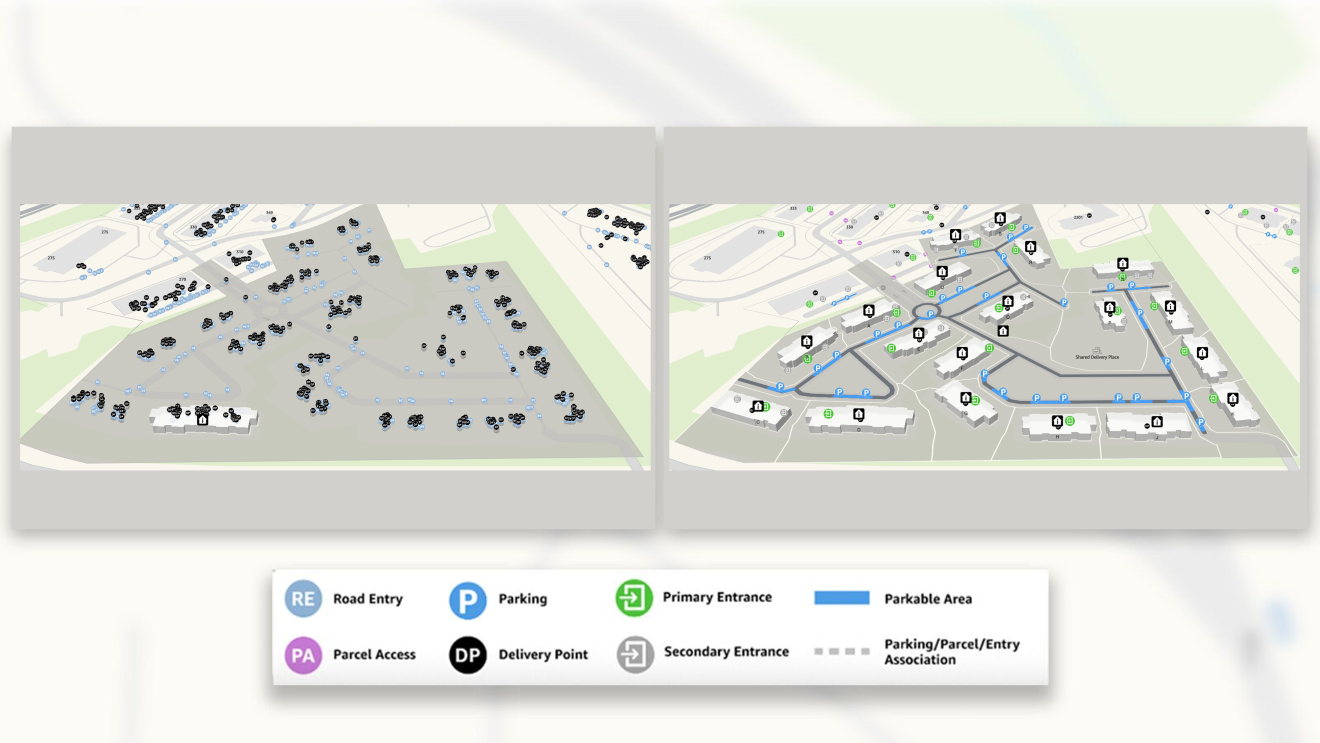
Map on the left displays all delivery location geocodes where Amazon delivery drivers were asked to drop off packages. Map on the right displays where to drop off Amazon delivery packages by mail room entrance.Before (left): All locations of where to deliver packages, based on delivery history and geographic coordinates. After (right): AI-powered technology that accurately identifies entrances, parking spots, and individual units within an apartment complex and displays shared delivery locations.
Wellspring is an initiative to improve delivery accuracy for customers. Powered by generative AI, this new system harnesses data from dozens of sources, including satellite imagery, road networks, building footprints, customer instructions, information from prior deliveries, and street imagery, to create a comprehensive delivery solution for millions of locations. This technology helps drivers better navigate complex and varied environments—like multi-building apartment complexes or brand-new neighborhoods that don't yet appear on navigation apps—so they're able to deliver packages to customers where they want them.
With Wellspring, we're able to better identify which apartment numbers correspond to a specific building in an apartment complex, which parking spots and entrance points provide the most convenient route for package drop-off, and the location of a shared mailroom—supporting drivers in navigating diverse delivery landscapes. Before Wellspring and generative AI technology, we were not able to leverage the wide range of locational information that helps us create a better understanding and depiction of the physical world for delivery partners.
When we started testing Wellspring in the U.S. in October 2024, the results were significant—the system mapped over 2.8 million apartment addresses to their corresponding buildings across more than 14,000 complexes, while also identifying convenient parking locations at 4 million addresses. Earlier, this view of the physical world would have taken us years to understand. The technology also detects building entrances and mailroom locations by analyzing proof-of-delivery photos and location data from past deliveries. These improvements help drivers navigate unique environments with greater confidence, ensuring packages arrive where customers expect them.
Amazon’s supply chain has a new foundational AI forecasting model designed to predict what customers will want, where they’ll want it, and when—for hundreds of millions of products per day. While our previous systems used sales history to guide inventory planning decisions, this foundation model adds time-bound data like weather patterns and holiday schedules to place the right products in the right locations more accurately.
By analyzing regional differences—like sunscreen sales in Cape Cod, Massachusetts, in the summer months, or ski goggles in Boulder, Colorado, during peak ski season—we’re able to accurately and efficiently cater to the different needs of the communities we serve. These forecasts have contributed to a 10% improvement in long-term national forecasts for deal events, and a 20% improvement in regional forecasts for millions of popular items, boosting productivity and shrinking our network’s carbon footprint.
The technology’s benefits are tangible: Packages arrive faster (sometimes same-day instead of within two days), delivery partners travel fewer miles, traffic is reduced, carbon emissions decrease, and carbon emissions are avoided. Operations networks in the U.S., Canada, Mexico, and Brazil are already using this technology, with future expansion coming soon.

China puts six-month limit on its ease of rare-earth export licenses

 China is putting a six-month limit on rare-earth export licenses for U.S. automakers and manufacturers, The Wall Street Journal reported on Wednesday citing people familiar with the matter.

https://ca.finance.yahoo.com/news/china-puts-six-month-limit-161039268.html

Bessent Predicts US Budget Deficit Nearing 7% This Year

 Treasury Secretary Scott Bessent said the US is suffering from "the biggest blow out for the deficit in history," and blamed Democrats for the current tax year budget deficit coming in between 6.5% and 6.7%. Bessent spoke during an exchange with Rep. Richard Neal, a Democrat from Massachusetts, before the House Ways and Means Committee on Wednesday.

https://finance.yahoo.com/video/bessent-predicts-us-budget-deficit-153911080.html

Capricor cited in FDA plant inspection


  • U.S. FDA successfully completed Pre-License Inspection; Company expects facility will meet all requirements to support licensure
  • Advisory Committee meeting scheduled for July 30, 2025
  • Mid-cycle meeting recently completed with no significant issues or major deficiencies; late-cycle meeting planned for mid-July
  • Biologics License Application remains under priority review with PDUFA target action date of August 31, 2025

Capricor Therapeutics (NASDAQ: CAPR), a biotechnology company developing transformative cell and exosome-based therapeutics for the treatment of rare diseases, today announced the successful completion of the U.S. Food and Drug Administration’s (FDA) Pre-License Inspection (PLI) of its San Diego manufacturing facility for Deramiocel, the Company’s lead cell therapy candidate with a Biologics License Application (BLA) under FDA review for potential approval in the treatment of Duchenne Muscular Dystrophy (DMD). The inspection concluded with a Form 483 containing several observations. The Company has submitted its responses to the FDA, none of which required material changes to the cGMP process or facility. The observations were primarily related to routine quality systems and documentation practices. The Company is confident that the facility will meet the necessary requirements to support product licensure and, pending approval, commercial launch.

“This inspection outcome is a major regulatory milestone, particularly in a field where standards are exceptionally high,” said Linda Marbán, Ph.D., Capricor’s Chief Executive Officer. “It reflects the strength of our manufacturing capabilities and positions us well as we advance toward potential approval. With the FDA Advisory Committee meeting now scheduled, we look forward to the opportunity to present the totality of evidence supporting the approval of Deramiocel for the treatment of Duchenne muscular dystrophy. With all key review activities progressing on track, we remain focused on delivering this much-needed therapy to the Duchenne community.”

The FDA informed Capricor of its intent to hold the Advisory Committee meeting on July 30, 2025, although that date is pending confirmation by the FDA. At the time of the mid-cycle review, no significant issues or major deficiencies were noted. A late-cycle meeting is planned for mid-July 2025. The BLA for Deramiocel remains under priority review with a Prescription Drug User Fee Act (PDUFA) action date of August 31, 2025.

https://www.globenewswire.com/news-release/2025/06/11/3097631/0/en/Capricor-Therapeutics-Announces-Key-Regulatory-Updates-for-its-Duchenne-Muscular-Dystrophy-Program.html