Search This Blog

Tuesday, March 3, 2026

China Panics, Urges Ceasefire To Reopen Strait Of Hormuz As Beijing Is Addicted To Cheap Iranian Crude

Chinese Foreign Ministry spokeswoman Mao Ning said at Tuesday's regular press briefing in Beijing that all parties in the Iran conflict must ensure the safe transit of commercial shipping through the critical maritime energy chokepoint of the Strait of Hormuz.

"China urges all parties to immediately cease military operations, avoid escalating tensions, and safeguard the safety of navigation in the Strait of Hormuz," spokeswoman Ning said.

We've briefed readers that China is heavily exposed to cheap Iranian crude exports. About 80% of Iran's oil exports - about 1.6 million barrels per day - go to China.

This means Beijing will do everything in its power to preserve this lifeline and remove any blockage in Hormuz.

And this. 

Chinese officials have reportedly been pressing Iran not to disrupt tanker traffic, damage Qatari gas exports, or hit major export hubs, according to Bloomberg.

The latest AIS shipping tracking data via Bloomberg shows the Strait of Hormuz remains paralyzed, with Iran's Revolutionary Guards commander threatening fire and destruction to any ship that transits the narrow waterway.

Our latest reporting shows that a day after a reported Iranian drone strike forced Saudi Arabia's largest oil refinery offline, there are numerous reports of drone strikes on critical Gulf energy infrastructure on Tuesday morning (read report).

We highly recommend that readers review a report titled "The Iran Question Is All About China" to better understand that this conflict extends well beyond Iran.

Looking ahead, top U.S. and Chinese trade negotiators are expected to meet in mid-March, according to Bloomberg, ahead of a planned Trump-Xi summit later this month. Trump's moves against Venezuela and now Iran can be viewed as an effort to tighten pressure on two of Beijing's cheap crude supplies before those talks (that's if those talks don't get canceled).

https://www.zerohedge.com/geopolitical/china-panics-urges-ceasefire-reopen-strait-hormuz-beijing-addicted-cheap-iranian-crude

US B-2 Bombers Belatedly Authorized To Use British Bases To Hit Deep Inside Iran

 In the modern era Britain has always been America's junior partner when it comes to launching Middle East wars, and so in the opening days of Trump's Operation Epic Fury targeting Iran, there was anger in Washington as the Starmer government appeared to waffle and was fence sitting.

However by Monday and Tuesday, the United Kingdom is as expected now aligning directly with Washington, having belatedly authorized the use of British military bases to support American operations targeting Iran's missile capabilities.

Illustrative file image: Google Earth/Reddit

Prime Minister Keir Starmer approved the request after a 24-hour legal review, granting Washington access to UK bases for what he called a "specific and limited defensive purpose."

"The only way to stop the threat is to destroy the missiles at source, in their storage depots or the launchers which are used to fire the missiles," Starmer said in a social media statement. "The U.S. has requested permission to use British bases for that specific and limited defensive purpose. We have taken the decision to accept this request."

The bases will likely be used for US B-2 bombers to reach deep inside Iran. In the opening waves of attacks Saturday, these same B-2s were flying all the way from airbases in the US mainland.

Starmer likely got political cover in the fact that regional bases where British troops are stationed have come under Iran's intense retaliatory strikes.

This included a drone strike late Sunday on the Royal Air Force base at Akrotiri in Cyprus, which may have actually been launched by Iran-allied Hezbollah in Lebanon.

Starmer was apparently worried about the 'legal status' of the US-led operation, but now the British government has definitively stated the action is "solely focused on ending the threat of air and missile attacks against regional allies unlawfully attacked by Iran and who have not been involved in hostilities from the outset."

Still, London is taking pains to say this "does not signal the U.K. having any wider involvement in the broader ongoing conflict between the U.S., Israel, and Iran."

President Trump has wanted much more direct involvement in military action by Britain:

But like with other regional wars of the past couple decades it's likely only a matter of time before Britain jumps in more fully into the conflict. The Brits have been involved in everything from Afghanistan to Iraq to Libya to Syria in recent years, especially going to back to the chummy Blair-Bush days just after 9/11.

https://www.zerohedge.com/military/us-b-2-bombers-belatedly-authorized-use-british-bases-hit-deep-inside-iran

Regime Change Will Not Be Easy: Tehran's Goal Is To Survive By Any Means Necessary

 By Molly Schwartz, cross-asset macro strategist at Rabobank

My Circus! My Monkeys!

Europe was hit with the first strike to its energy supply chain after the Russian invasion of Ukraine and had to start diversifying its inflows from elsewhere. Now that Middle Eastern LNG is losing reliability, Europe might have to get involved just to keep the lights on.

While the EU and UK would probably be more than happy to spectate from the proverbial “monitoring chair,” they may not have a choice. TTF prices reached highs of - €48.95/MWh yesterday—the highest since February of 2025- and are up more than 20% today. 
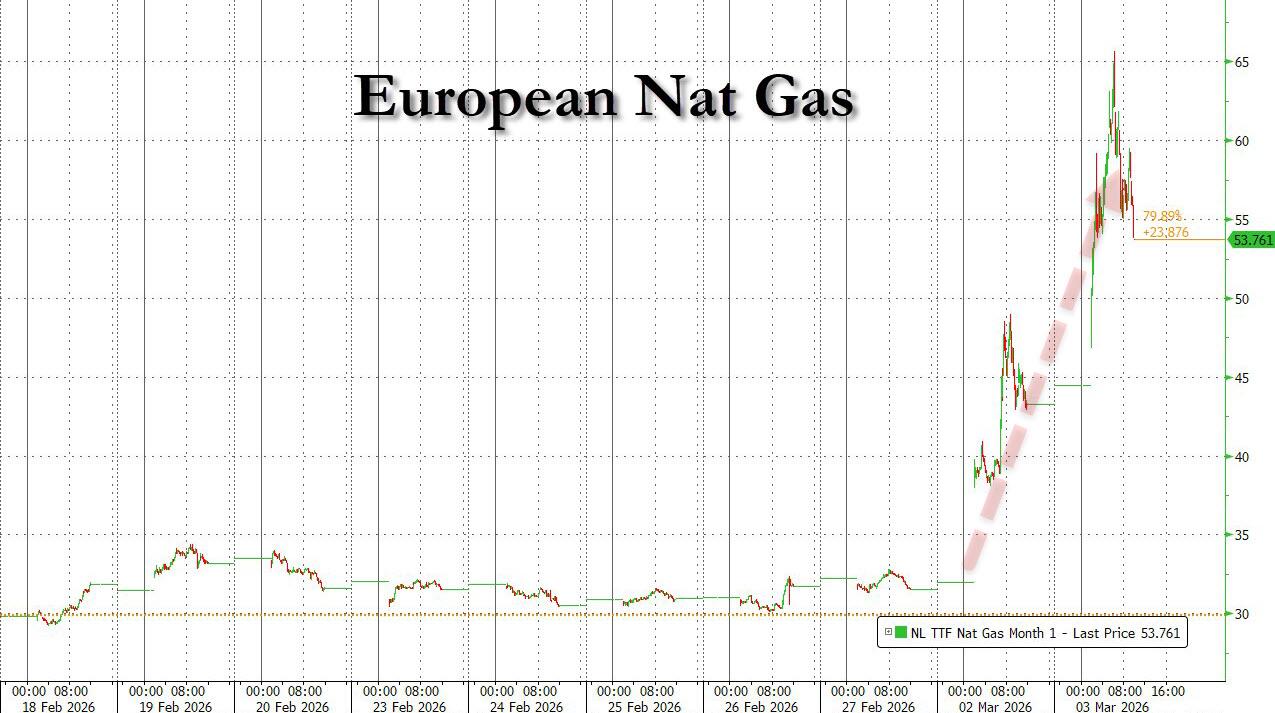
QatarEnergy announced that it has ceased production of LNG and associated products due to the recent escalation. Our Energy Strategists, Florence Schmit and Joe DeLaura, note that we could see prices return to 2022 levels should Qatar be taken out of the LNG equation entirely (easily back to €100/MWh). Read more here.

This puts the entire European energy complex at risk and might be just the incentive needed for Europe to get out of the monitoring chair and into the ring.

France24 reports that “France, Germany, UK ready to take ‘defensive action’ against Iran.” As the EU touts commitments to increase defense spending and build up its military capabilities, Rabobank Global Strategist Michael Every has mused, “why have all these war planes sitting on the tarmac not doing anything?”

A little farther south, the Gulf Cooperation Council (GCC) is considering its own involvement. Omani foreign minister Badr Albusaidi said on X that “neither the interests of the United States nor the cause of global peace are well served by this. I urge the United States not to get sucked in further. This is not your war.” But the GCC has made it clear that they don’t want it to be their war either. Threats to the economies of the Gulf are not just about energy—this also impacts their budding tourism and hospitality industries as few want to vacation in an active warzone. The UAE and Qatar have reportedly been lobbying allies to end this war as soon as possible.

Meanwhile, in a statement, the Saudi Ministry of Foreign Affairs affirmed “its full solidarity with and unwavering support for the brotherly countries, and its readiness to place all its capabilities at their disposal in support of any measures they may undertake. It also warns of the grave consequence resulting from the continued violation of states’ sovereignty and the principles of international law.” As much as the GCC may want to stay out of it (or, at least as far out of it as they can when their territory is being striked by Iranian drones), the Saudis, at least, are prepared to escalate further.

Trump and Hegseth have not shown any signs of backing down just yet. Early yesterday morning, Hegseth affirmed that “Iran is not a regime change war, but the regime did change,” and that the war will be finished “on America-first conditions.” What those conditions are is still TBD. And the ambiguity of those conditions still leaves us with the question of what constitutes a win.

Hegseth and Rubio would tell you that the aim is the same as last time—to set back Iran’s nuclear proliferation program. But as we saw recently, it doesn’t take Iran very long before they can start to rebuild capacity. The best way to cut off nuclear proliferation is to cut off the head, and that necessitates regime change.

However, as noted in yesterday’s installment, regime change will not be easy. The goal of Tehran is to survive by any means necessary. Even if the regime is rendered a shell of what it once was, but manages to hang on by a thread, then the US has failed. While Trump has announced that this military operation could take weeks and Hegseth rejected the idea that this would be another endless war to echo Iraq and Afghanistan, this may still be a much longer ride than expected.

Yesterday’s stellar performance of USD also exemplified how calls of “Sell America” in recent months were shortsighted. While USD has not been behaving as a safe-haven traditionally would, given the dramatic USD sell-off in H1 2025, we have long argued that this was more about positioning—a repricing of EUR/USD in the aftermath of European announcement of defense spending, and rising USD hedge ratios from foreign investors—than it was a loss of USD’s safe haven status. Indeed, recent price action makes it clear that when the going gets rough, investors still flee  to the warm embrace of greenback liquidity.

Still, other US assets have not felt the love. The inflationary risks posed by an extensive war with Iran are at front of mind for investors, especially as analysts keep a watchful eye on the strait of Hormuz. Even though the Fed prefers to look at core inflation, which strips out direct energy costs, energy is an input into everything, including core goods and services. While inflation is already above the 2% target, and the lagged effects of tariffs are starting to put pressure on core goods, the additional price increases posed by turning the major oil exporter of the world into a warzone may put the Fed in a tricky position. US 2 year and 10 year Treasury yields moved in parallel, closing the day up 11bp, which is the greatest single day move since the US-Iranian skirmish last June.

https://www.zerohedge.com/political/regime-change-will-not-be-easy-tehrans-goal-survive-any-means-necessary

Harrow lead product misses 4 views


Harrow gets FDA clearance of IND for Phase 3 TRIESENCE trial to treat ocular inflammation and pain after cataract surgery

  • FDA IND clearance supports a planned Phase 3 TRIESENCE trial aimed at expanding its label after cataract surgery
  • Q4 2025 revenue reached a record $89.1M, up 33% YoY, while EPS $0.17 (-29% YoY) and revenue miss estimates
  • Q4 2025 net income was $6.6M, corresponding to diluted EPS of $0.17
  • Company guides 2026 revenue to $350–$365M and Adjusted EBITDA to $80–$100M

Nuvation Q4 revenue jumps 633% on rapid IBTROZI ramp, late‑line mix tempers near‑term sales


Runway secure to profitability

  • Q4 2025 revenue was $41.9M, up 633% YoY, beating estimates, with $15.7M from U.S. IBTROZI.
  • Full‑year 2025 revenue reached $62.9M, including $24.7M from IBTROZI U.S. product sales.
  • IBTROZI treated 432 new U.S. patients in 2025, 216 in Q4, outpacing prior TKIs ~6x.
  • Mixed quarter with strong IBTROZI uptake but revenue lagging patient growth from heavy late‑line use, fast discontinuations, delaying operating leverage.
  • Revenue per patient is currently depressed as most use is third‑line plus, driving fast discontinuations.

Theravance end program after Phase 3 CYPRESS trial fails primary endpoint, launches strategic review


  • Phase 3 CYPRESS trial of ampreloxetine failed to meet its primary endpoint, leading management to terminate the program.
  • Company will conduct an accelerated strategic review that may include a sale of the company.
  • Theravance plans major restructuring aimed at cutting costs by about 60%.

Edesa CEO insider purchase fueled 37.51% intraday surge amid Phase 3 trial momentum


Edesa Biotech's CEO, Pardeep Nijhawan, bought 50,571 shares on March 2, 2026, for approximately $98,896, alongside a 10,016-share RSU grant, signaling executive confidence following February 24 positive Phase 3 data for paridiprubart showing 27% lower 28-day mortality in ARDS patients. A Zacks Small Cap Research report on March 2 further highlighted these strengthened results, including benefits in non-ventilated patients and subgroups like pneumonia cases. High early volume exceeded 5 million shares, amplifying the move in regular trading hours as traders reacted to the fresh insider activity and reaffirmed trial implications. Based on available reports.


https://finviz.com/quote.ashx?t=EDSA&p=d