Search This Blog

Sunday, April 12, 2026

UK says it will not join US blockade of Strait of Hormuz - CBS


The United Kingdom will not be involved in a US blockade of the Strait of Hormuz, CBS reported citing a source familiar with the matter.

“We continue to support freedom of navigation and the opening of the Strait of Hormuz, which is urgently needed to support the global economy and the cost of living back home,” a UK government spokesperson told CBS News.

“The Strait of Hormuz must not be subject to tolling. We are urgently working with France and other partners to put together a wide coalition to protect freedom of navigation,” the spokesperson added.

https://www.iranintl.com/en/liveblog/202604067622

Trump Considering Resuming Limited Strikes on Iran – WSJ


President Donald Trump is considering resuming limited military strikes on Iran following the collapse of US-Iran talks, the Wall Street Journal reported, citing officials and people familiar with the deliberations.

According to the report, the option under discussion would involve targeted strikes rather than a broader military campaign, aimed at increasing pressure on Tehran.

The deliberations come after marathon negotiations between Washington and Tehran ended without a deal, despite raising hopes that the talks could produce a framework to de-escalate the war.

The report said the White House is weighing military steps alongside other pressure measures, including a planned US naval blockade targeting maritime traffic linked to Iranian ports.

https://www.iranintl.com/en/liveblog/202604067622

Massachusetts Dems Advance Bill To Limit How Far You Can Drive In Your Own Car

 by Steve Watson via Modernity.news,

Massachusetts lawmakers are barreling ahead with a bill that would force the state to slash the total miles residents drive, all under the banner of cutting greenhouse gas emissions.

The proposal, Senate Bill S.2246, doesn’t slap a hard cap on your daily commute… yet – but it orders the Massachusetts Department of Transportation (MassDOT) to set binding goals for reducing statewide vehicle miles traveled (VMT). It also creates a new government council tasked with pushing people onto public transit whether they like it or not.

A local Boston report highlights the move:

“The bill proposed in Massachusetts would limit how far you can drive in your own car. So lawmakers say it would help reduce the state’s greenhouse gas emissions. Now, while no specific mileage limit was listed, the bill would require MassDOT to set goals to reduce the number of statewide driving miles. It would also establish a new council to find ways to make public transportation more accessible for residents. Now, critics say A cap on personal vehicle miles would directly impact those in rural parts of the state.”

The committee gave it a favorable 4-1 vote and shipped it to the Senate Ways and Means Committee, keeping the radical plan alive on Beacon Hill.

This isn’t some fringe idea cooked up in isolation. It’s part of a broader push to ration mobility under the twin excuses of “climate” and “equity.” Similar thinking powers the 15-minute city concept – the urban planning fad sold as “convenience” but designed to make driving anywhere outside your little neighborhood a bureaucratic nightmare.

Need to visit family across town or haul supplies for a business? Too bad. The goal is fewer cars, fewer miles, and more dependence on government-run transit that’s already unreliable and crime-ridden in blue cities.

Europe is already testing the waters with energy rationing talk amid ongoing crises. Officials have floated work-from-home mandates, driving restrictions, and even limits on flying or heating homes to meet net-zero targets.

Massachusetts Democrats are importing that same top-down control in America, where rural families, tradespeople, and anyone not lucky enough to live in a walkable Boston enclave get punished hardest.

Supporters dress it up as “aligning transportation plans with emissions goals.” The bill’s own text demands the state develop a “reasonable pathway” to cut VMT through everything from denser development to parking restrictions and tech-enabled tracking. Critics rightly call it what it is: a precursor to surveillance, fees, or outright limits on how far your personal vehicle can go.

This is the same crowd that cheered COVID lockdowns while elites jetted off to climate conferences. Now they’re eyeing your car as the next target. Rural Massachusetts residents already face long drives for work, groceries, and medical care. Forcing them onto broken public buses or trains isn’t “progress” – it’s punishment for not living the approved urban lifestyle.

This creeping surveillance state is an affront to freedom, including the personal freedom to drive where you want, when you want, in the vehicle you choose.

Massachusetts Democrats just proved again why voters are fleeing blue strongholds for red states that still respect individual liberty. If this passes, expect more families packing up and heading to places where the government doesn’t treat your car like public property. The fight against these soft tyrannies is on.

https://www.zerohedge.com/political/massachusetts-dems-advance-bill-limit-how-far-you-can-drive-your-own-car

"Create A Crisis": American Association Of University Professors Sponsors Anti-ICE Campaign

 by Jonathan Turley,

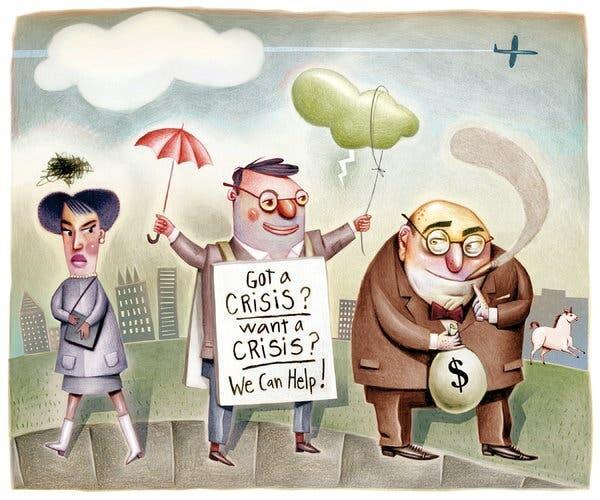
“Create a crisis.”

That call is made in a new campaign sponsored by the American Association of University Professors to force “colleges to drop their contracts with ICE’s key corporate enablers.”

Despite years of criticism over the purging of faculty ranks of conservatives and libertarians, university professors continue to double down on far-left ideology that is now an orthodoxy in higher education.

I previously wrote about the AAUP’s ideological shift in my book, The Indispensable Right: Free Speech in an Age of Rage. After that book, the AAUP then selected Todd Wolfson, a far-left activist, as its new president.

Wolfson ran on the pledge to make AAUP a “fighting organization” for social change.

After his selection, Wolfson has called Trump supporters “fascists” and demanded boycotts of Israel.

Given that history, it was little surprise to see the AAUP’s sponsorship of this campaign, as reported by the College Fix.

The campaign is also funded by  Coefficient Giving, associated with liberal billionaire Dustin Moskovitz and his wife Cari Tuna. They have been criticized for reportedly funding groups pushing defund police and other radical agendas.

AAUP joined this campaign with Young Democratic Socialists of America, Sunrise Movement, and the Workplace Justice Lab at Rutgers University. It includes a toolkit instructing students to “create a crisis for university admin through an escalating campaign.”
The campaign seeks to organize to combat the “Trump regime” and its “terrorism”: “When students and workers join together in action, we can force our schools to stop funding and normalizing ICE collaborators and take down the whole regime.”

They are targeting companies such as Enterprise, Flock, ICE Air Carriers, Hilton, and Target.

The campaign states further that “ICE, and the Trump regime generally, cannot function without the consent and collaboration of the business world. Breaking companies from ICE is the central axis for generating enough leverage to stop the regime’s terrorization campaign.”

So university professors are funding a campaign that actively seeks to create a crisis on campuses. It takes a position as an organization that immigration enforcement is a form of terrorism. The silence among faculty is deafening. Rather than objecting that the AAUP should focus on issues related to academic freedom and protections for its members, there have been virtually no objections to the organization’s ideological agenda.

It is evidence of the new orthodoxy in higher education and the refusal of administrators and faculty to make any meaningful change in their intolerance for opposing views.

Many departments no longer have a single Republican faculty member in this academic echo chamber.

A Georgetown study found that only 9% of law school professors at the top 50 law schools identify as conservative — almost identical to the percentage of Trump voters in the new poll.

There is little evidence that faculty members are interested in changing this culture or creating greater diversity at schools.  In places like North Carolina State University, a study found that Democrats outnumbered Republicans 20 to 1.

Yale University has finally achieved the academic version of Nirvana, a state of perfect peace and enlightenment. A recent study found that the faculty had finally purged every Republican donor from its ranks.

According to a recent report from the Buckley Institute, there is now not a single Republican found across 27 of 43 departments at Yale University. In a nation roughly evenly divided between Republicans and Democrats (with a slight advantage to the GOP), only 3 percent are Republicans across all Yale departments.

The hostility to opposing views is impacting our students. A new study offers additional data on this problem, showing that almost 90% of students misrepresent their views in class and on assignments to satisfy faculty by adopting more liberal views.

In the meantime, the small number of dissenting faculty have no real voice, particularly among legal academics. I have previously written about the similar liberal agenda of the American Bar Association despite plunging membership among lawyers. The ABA now represents just 17 percent of the bar.

The AAUP currently has only 44,000 to 45,00 members. There are an estimated 1.5 million university and college professors in the United States. Both the ABA and AAUP have become captive to the most ideological elements of their membership. That agenda has overwhelmed the original apolitical mission of these groups.

This orthodoxy will continue until donors refuse to support universities that do not take meaningful action to restore diversity in the faculty ranks. The AAUP’s radical agenda is only the latest example of how higher education remains a hardened ideological silo. These faculty members have shown again and again that they are unwilling to change this culture.

Only donors can force reform by cutting off their contributions or directing them to schools with a proven commitment to intellectual diversity.

https://www.zerohedge.com/political/create-crisis-american-association-university-professors-sponsors-anti-ice-campaign

U.S. to Blockade Ships Entering or Exiting Iranian Ports

TAMPA, Fla. — U.S. Central Command (CENTCOM) forces will begin implementing a blockade of all maritime traffic entering and exiting Iranian ports on April 13 at 10 a.m. ET, in accordance with the President’s proclamation.
The blockade will be enforced impartially against vessels of all nations entering or departing Iranian ports and coastal areas, including all Iranian ports on the Arabian Gulf and Gulf of Oman. CENTCOM forces will not impede freedom of navigation for vessels transiting the Strait of Hormuz to and from non-Iranian ports.
Additional information will be provided to commercial mariners through a formal notice prior to the start of the blockade. All mariners are advised to monitor Notice to Mariners broadcasts and contact U.S. naval forces on bridge-to-bridge channel 16 when operating in the Gulf of Oman and Strait of Hormuz approaches.

https://x.com/CENTCOM/status/2043432050921718194

Wall Street trading desks poised for $40B quarter amid geopolitical turmoil

 Major U.S. banks are on track to post more than $40 billion in trading revenue for the first quarter, as heightened geopolitical tensions helped drive sharp movements across financial markets, the Financial Times reported Sunday.

Institutions including JPMorgan Chase (JPM), Goldman Sachs (GS), Morgan Stanley (MS), Citigroup (C) and Bank of America (BAC) are expected to report their strongest combined quarterly trading performance in more than a decade, based on analyst estimates.

Forecasts suggest the group’s trading income will rise roughly 13% compared with the same period last year, even against a backdrop of already elevated volatility in early 2025 driven by policies under Donald Trump.

Middle East, Venezuela hot spots

Market turbulence intensified further in the latest quarter, fueled by conflict in the Middle East and U.S. military actions tied to Venezuela, which triggered large swings in commodities, equities and currencies. Analysts say such conditions tend to boost trading activity, as clients reposition portfolios and hedge risks.

The unrest contributed to a surge in oil prices alongside declines in equities, raising concerns that higher energy costs could stoke inflation and weigh on global growth. Recent data shows the conflict has indeed driven energy-led price pressures and market uncertainty.

Within trading divisions, equities are expected to deliver the strongest gains, outpacing fixed income, currencies and commodities. Analysts project equity trading revenue growth in the mid-teens percentage range, compared with high-single to low-double-digit increases for FICC businesses.

At the same time, banks are benefiting from structural shifts made after the 2008 financial crisis. Trading desks today are less focused on taking large directional bets and more oriented toward facilitating client activity and providing liquidity, which allows them to capitalize on periods of elevated volatility.

Investment banking divisions are also likely to show improvement. Fee income from advisory and underwriting is projected to rise by more than 10% across the major banks, supported by a rebound in dealmaking. Increased financing tied to artificial intelligence projects and a more accommodating regulatory environment have helped revive activity after a prolonged slowdown.

Volatility’s consequences

Even so, the outlook is not without risks. Analysts warn that sustained geopolitical instability could dampen capital markets activity, particularly in equities, where volatile conditions may discourage companies from pursuing initial public offerings or other listings, the FT reported.

Overall, profits at the largest banks are expected to increase by around 7%, with firms more heavily exposed to trading and investment banking, such as Goldman Sachs (GS) and Morgan Stanley (MS), likely to see the biggest gains.

Earnings season is set to begin with Goldman Sachs (GS), followed by J.P. Morgan (JPM) and Citigroup (C), with Morgan Stanley (MS) and Bank of America (BAC) reporting shortly thereafter.

Investors will also be watching banks’ exposure to private credit markets, where recent fund outflows have raised concerns about asset quality. Lending to hedge funds and private capital firms has expanded significantly in recent years, offering higher returns but also introducing new risks in a more uncertain environment.

https://www.msn.com/en-us/money/savingandinvesting/wall-street-trading-desks-poised-for-40b-quarter-amid-geopolitical-turmoil/ar-AA20HVef

Prediction markets surge, but Wall Street giants remain on sidelines

 Trading in prediction markets is booming, with platforms like Polymarket (POLYMARKET) and Kalshi (KALSHI) handling billions of dollars in weekly wagers tied to everything from sports to geopolitics, Bloomberg News reported Sunday.

Despite the rapid growth, major trading firms such as Citadel Securities, IMC Trading and Hudson River Trading have largely stayed out. Regulatory uncertainty and relatively small market size are part of the hesitation, but structural challenges also play a role.

Unlike traditional markets, event-based contracts lack an underlying asset, making it difficult for traders to hedge risk using standard strategies. As one researcher cited by Bloomberg News said, “Unlike options or futures markets, event contracts do not reference an underlying spot asset that permits mechanical hedging.”

This limitation forces participants to take direct bets on outcomes, more akin to insurance or credit underwriting than conventional market-making. Without effective hedging tools, firms often rely on wider spreads to manage risk. In some cases, these margins far exceed those seen in traditional financial markets.

While some firms, including Susquehanna International Group, have begun exploring the space, leveraging experience in sports betting, the broader industry appears to be waiting for more mature risk-transfer mechanisms before committing significant capital.

https://www.msn.com/en-us/money/companies/prediction-markets-surge-but-wall-street-giants-remain-on-sidelines/ar-AA20IIo9