Search This Blog

Saturday, May 2, 2026

Mob of teens storms Times Square Scientology church amid viral ‘speed running’ trend

 A mob of rowdy teens stormed a Big Apple Scientology church Saturday afternoon, trashing the property and injuring a security guard amid a nationwide rash of similar viral social media stunts, police and sources said.

About 50 unruly youths barreled through a locked side door of the Church of Scientology of New York — which sits just off Times Square on West 46th Street — at around 4:24 p.m., damaging the premises while worshipers and visitors were attending a seminar, according to cops, police sources and the church.

They also kicked a 30-year-old man, believed to be a security guard, who was walloped in the leg and sustained minor injuries.

About 50 unruly teens barreled through the side door of the Church of Scientology of New York at 227 West 46th Street Saturday afternoon.Kevin C. Downs for NY Post

The rampaging teens — whose act resembled the “speed running” trend that has seen similar invasions at Scientology locations in Los Angeles — also hurled a racial slur at another staffer, the church said.

“I saw about possibly about 50 kids with masks and hoodies. All races, black, whites, Asians, running,” said George Shannon, 58, a guard at the near-by Lunt-Fontanne Theater.

“They were running and laughing. They were breaking up the chairs and tables and throwing books on the ground, vandalizing the church.”

While police did not address a motive for the attack, The Church of Scientology International, based in Los Angeles, said that they believe it is part of the recent viral trend

“Some online have referred to these incidents as ‘speed running.’ In reality, they involve organized trespasses into religious and public information facilities for social media attention,” the church said.

“A group of individuals forced their way into the Church of Scientology New York, broke a locked door to gain entry, and rushed into the building,” the church added.

The rowdy mob damaged the premises and kicked a 30-year-old man believed to be a security guard.o1ivierr, /TikTok

“The disruption endangered staff, parishioners and visitors, including individuals attending a seminar at the time. This was not a peaceful visit or lawful protested. It was a coordinated act involving forced entry, property damage, and physical aggression inside a house of worship.”

The rabble-rousers later fled the building in all directions, police said.

No arrests have been made as the investigation continues.

The Midtown incident mirrors the bizarre new TikTok trend dubbed “Scientology speed running” — which uses a video game term to describe groups of thrill-seeking influencers and troublemakers filming themselves charging into properties owned or tied to the Church of Scientology since early April.

The Midtown incident comes amid a bizarre new TikTok trend — dubbed “Scientology speed running.”o1ivierr, /TikTok
The reckless social media craze has seen thrill-seeking influencers and troublemakers filming themselves charging into properties owned or tied to the Church of Scientology since early April — as seen here in California.@versacericka/TikTok

The reckless social media craze, erupting across Los Angeles, has sparked security fears for the church, which teaches followers that humans are immortal spiritual beings called “thetans” with limitless power.

The religion, founded in the 1950s by science fiction author L. Ron Hubbard, is built on a system of beliefs, teachings, and rituals focused on spiritual betterment, with his book “Dianetics: The Modern Science of Mental Health” serving as its foundational text.

Hollywood has long fueled the church’s visibility, largely due to high-profile members like actors Tom Cruise and John Travolta, who have served as its most recognizable public supporters.

Hollywood has long fueled the church’s visibility, largely due to high-profile members like actors Tom Cruise and John Travolta.AP

Other well-known members of the church have included actresses Elisabeth Moss, Catherine Bell, Jenna Elfman, and Nancy Cartwright, best known as the voice of Bart Simpson on “The Simpsons.”

The church said it is cooperating with the NYPD as its investigation in Saturday’s incident continues.

“Church facilities are peaceful spaces designed to welcome parishioners, visitors and members of the public,” the statement said.

“Turning them into targets for viral stunts is not journalism, protest or civic activity. It is trespass, harassment, and disruption of religious spaces. The Church welcomes lawful visitors. It does not welcome individuals forcing entry, damaging property … or targeting religious facilities for online attention.”

Shannon said he was disgusted by the scene of lawlessness.

“Honestly, I feel this is the responsibility of the city council and the Mayor,” he said. “The lack of rules and regulations. So people in New York City feel and do whatever they want to do. 
That’s why these kids wasn’t even scared.”

https://nypost.com/2026/05/02/us-news/mob-of-rowdy-teens-storm-nyc-scientology-church-amid-viral-speed-running-trend/

Alliance Fracture Is Now Global

 by Gregory Copley via The Epoch Times,

Western focus was, in 2026, on whether U.S. President Donald Trump would fulfill his threat to withdraw the United States from NATO. Eastern and Southern focus was on whether the Shanghai Cooperation Organization and the BRICS alliance were even functioning.

In the U.S.–NATO standoff, it may take more complex political maneuvering for Trump to achieve a breakup of the alliance. Certainly, he could withdraw the U.S. military from European basing, but Congress in 2023 approved legislation that would prevent any president from withdrawing the United States from NATO without approval from the Senate or an act of Congress. The measure, spearheaded by Sens. Tim Kaine (D-Va.) and, ironically, Marco Rubio (R-Fla.)—now Trump’s secretary of state—was included in the annual National Defense Authorization Act signed by President Joe Biden.

It may be more feasible for Trump to have the United States leave aspects of the military component of the North Atlantic Alliance, as French President Charles de Gaulle did in withdrawing from the NATO integrated military command structure—but not the North Atlantic Alliance—in 1967. Other members of NATO may themselves go beyond that to abandon NATO in order to form a new alliance, but that is a separate issue.

Of real, but as yet unexplored, interest is that other alliances have been forced to the sidelines because Trump initiatives, and time, have rendered them ineffective.

Among the most important of these are the Shanghai Cooperation Organization (SCO) and BRICS. Secondarily, the informal Quad alliance against China—of India, the United States, Japan, and Australia—is quietly becoming less tight.

The SCO, which emerged in 2001 from the 1996 Shanghai Five security arrangement, now has 10 member states, most of which harbor suspicions about other members of the SCO. It was meant to contain a mutual security clause to require members to support other members under attack from outside. SCO membership includes Iran, and that clause has proven to be unenforceable as the wars against Iran continue. So the SCO is now effectively inoperable, except as a showcase with an expensive bureaucracy.

Similarly, BRICS—which began as a working group of Brazil, Russia, India, China, and South Africa—was designed to circumvent U.S. domination of global trade systems by finding alternatives to trading using the U.S. dollar. The BRICS membership had expanded by 2026 to 10 states, adding Egypt, Ethiopia, Iran, Saudi Arabia, and the United Arab Emirates. But it failed to shake the United States’ ability to control and sustain a global sanctions regime against political leaders who used the U.S. dollar in ways deemed inimical to U.S. interests.

BRICS achieved some new trading modalities that avoided the use of the U.S. dollar, but this did little to weaken the U.S. currency, or strengthen the currencies of BRICS members. But that was to be expected. This journal, as early as 2008, was discussing the end of the globalist, multinational framework of financing the international logistics chain based on the U.S. dollar. It discussed a return to bilateralism of trading methodologies, including barter and countertrade, which had, even in the 1970s, been a normal practice.

The past year-plus has seen the promoters of BRICS—as a defensive mechanism against the United States—becoming incapable of creating a new trade finance system. A proposed BRICS currency has come to naught; the currency of China has weakened to the point that it is hardly tradeable. And so on.

At what point is the Trump administration prepared to push for the complete breakdown of “opposing currencies,” not just of the BRICS states’ proposed new currency, but even of the euro and sterling?

Has all of this saved and bolstered the U.S. dollar? By default, yes; there is still no viable alternative to the use of the U.S. currency for major world trade.

But is Trump yet through with his plans to diminish, and perhaps totally dispense with, the United Nations? He has certainly hit key aspects of the U.N. that were heavily dependent on U.S. taxpayer contributions. The U.N. itself has been making itself less relevant and less forceful; it has taken an extremely polarizing, leftist position on many international issues and, at the same time, has been disregarded by the United States and other powers.

This, in turn, has made it less useful to Beijing, which entered the U.N. on Oct. 25, 1971, displacing the original founding member, the Republic of China, also known as Taiwan. China then began a sustained campaign to use U.N. agencies for political influence. So some of Trump’s anti-U.N. activities were clearly designed as moves against China.

What is the impact of the diminishing role of the U.N.? It has become less trusted as an instrument to impartially mediate interstate conflicts, and this makes its International Criminal Court (ICC)—to which the United States is not a signatory—also less trusted. The attempt to use the ICC as a key body to create “international law” out of thin air has now become discredited, or less of an influence. The World Trade Organization is also increasingly disregarded, as are regional bodies, such as ECOWAS in West Africa, and the Organization of American States.

So to what extent was the “rules-based world order” a creature of this utopianist U.N. thinking, or was it merely a reflection of a pax Americana?

If Trump wished to move heavily against the U.N., his best timing might be before the U.S. midterm congressional elections in November. But could he make it stick?

https://www.zerohedge.com/geopolitical/alliance-fracture-now-global

DOJ Releases Report Alleging Anti-Christian Bias Under Biden

 by Savannah Halsey Pointer via The Epoch Times,

The Department of Justice (DOJ) on April 30 released a 500-page report detailing alleged anti-Christian bias on the part of the Biden administration.

According to the report by the DOJ’s Task Force to Eradicate Anti-Christian Bias, the former administration’s prosecutions, policies, and practices constituted bias throughout multiple agencies, in accordance with the administration’s priorities.

The task force is chaired by Acting Attorney General Todd Blanche.

“No American should live in fear that the federal government will punish them for their faith,” Blanche said. “As our report lays out, the Biden Administration’s actions devastated the lives of many Christian Americans.”

Around 200 pages of the report are dedicated to the actions of more than 17 federal agencies that uncovered alleged religious discrimination. The investigation included a review of internal discussions and case files, as well as prosecutorial decisions.

There were details of a since-retracted 2023 FBI memo on “radical traditionalist” Catholics, which cited the Southern Poverty Law Center.

The review also listed Biden-era regulations on abortion, contraception, gender, and human sexuality, among other issues that pitted the government against religious groups.

The report also makes note of the Biden administration’s reading of the 2019 Supreme Court ruling in Bostock v. Clayton County, which led to decisions that were based on what the Trump administration report called “sex-based discrimination in federally funded schools and sports.”

According to the DOJ report, the previous administration used the FBI, IRS, Department of Education, Department of Health and Human Services, and other agencies to monitor, investigate, and apply pressure to various Christian groups at a federal level.

The current DOJ’s task force was formed in accordance with President Donald Trump’s Feb. 6, 2025, executive order titled Eradicating Anti-Christian Bias.

The president ordered multiple agencies to investigate what he called an “egregious pattern of targeting peaceful Christians, while ignoring violent, anti-Christian offenses.”

Conflicting Response

This is a “very different Department of Justice ... than the previous administration,” said Neama Rahmani, a former federal prosecutor and president of West Coast Trial Lawyers.

“The conclusion in the report, at least from an enforcement perspective, was that ... federal law was disproportionately used to prosecute pro-life and other Christians under the Biden administration,” he told The Epoch Times.

However, Rahmani, who worked at the DOJ from 2009 to 2012, said that while policies change, he has not seen a “systematic bias for or against” any one religious group.

“I don’t necessarily see ... [that] Christian activists in this country are receiving more prison time for violent acts, as opposed to, you know, Muslim or other religious groups.”

According to Andrea Picciotti-Bayer, director of the Conscience Project, the report “calls out the brazen assault against religious freedom by the former administration for what it was: a failure of constitutional and statutory duty.”

Picciotti-Bayer said in an emailed statement that the Biden administration disregarded “fundamental guarantees” in the First Amendment and federal civil rights law, and treated “sincere religious objections as obstacles to overcome, prosecuting peaceful prayer, trampling on parental rights and steamrolling conscience rights.”

The Interfaith Alliance, however, which states its mission is to “challenge Christian nationalism and religious extremism,” responded to the DOJ report, saying their group has “consistently opposed the work of this ‘task force.’” It accused the DOJ of trying to “undermine Americans’ religious freedom and First Amendment rights.”

The alliance called the task force’s report a “political stunt designed to promote the lie that American Christians are a persecuted group, while providing justification to target anyone deemed out of step with their Christian nationalist agenda.”

Previous Report

This report comes just weeks after an 800-page report from the department, detailing the “weaponization” of the Freedom of Access to Clinic Entrances (FACE) Act, which called out alleged prosecutorial problems, surveillance activities undertaken by pro-abortion groups, and failures to comply with federal law.

Biden’s DOJ did not enforce the law evenly, according to the April 14 report.

The task force under the Biden administration treated pro-life groups differently from pro-abortion groups, outlining disproportionate coordination with pro-abortion groups that, according to the report, indicated bias and prosecutorial overreach.

In her statement, Picciotti-Bayer said, “Religious freedom isn’t a courtesy the government extends—it’s a legal check on what government can do. It’s refreshing to see that recognized today.”

https://www.zerohedge.com/political/doj-releases-report-alleging-anti-christian-bias-under-biden

Avoid “Lifestyle Creep” at All Costs

 by Adam Sharp

Even before this energy price spike, affordability was a growing problem. A structural, long-term trend.

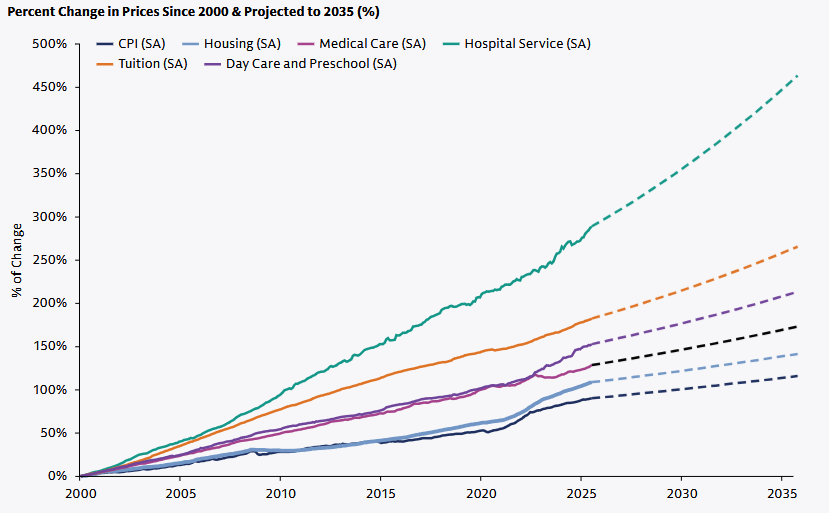
The chart below, via Goldman Sachs, shows how costs have risen in the U.S. since 2000. The dotted lines represent projections out to 2035.

image 1

Source: Goldman Sachs

Hospital services are up nearly 300% in 26 years. Tuition more than 165%. Daycare costs up 150%. And these are based on government statistics, which always undercount true inflation.

There are fluctuations, but the pattern is clear. Steadily higher.

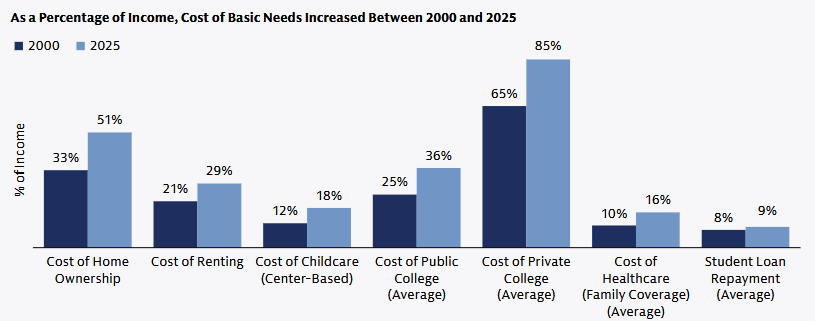
As a percentage of income, these items are eating up a bigger piece of the pie.

image 2

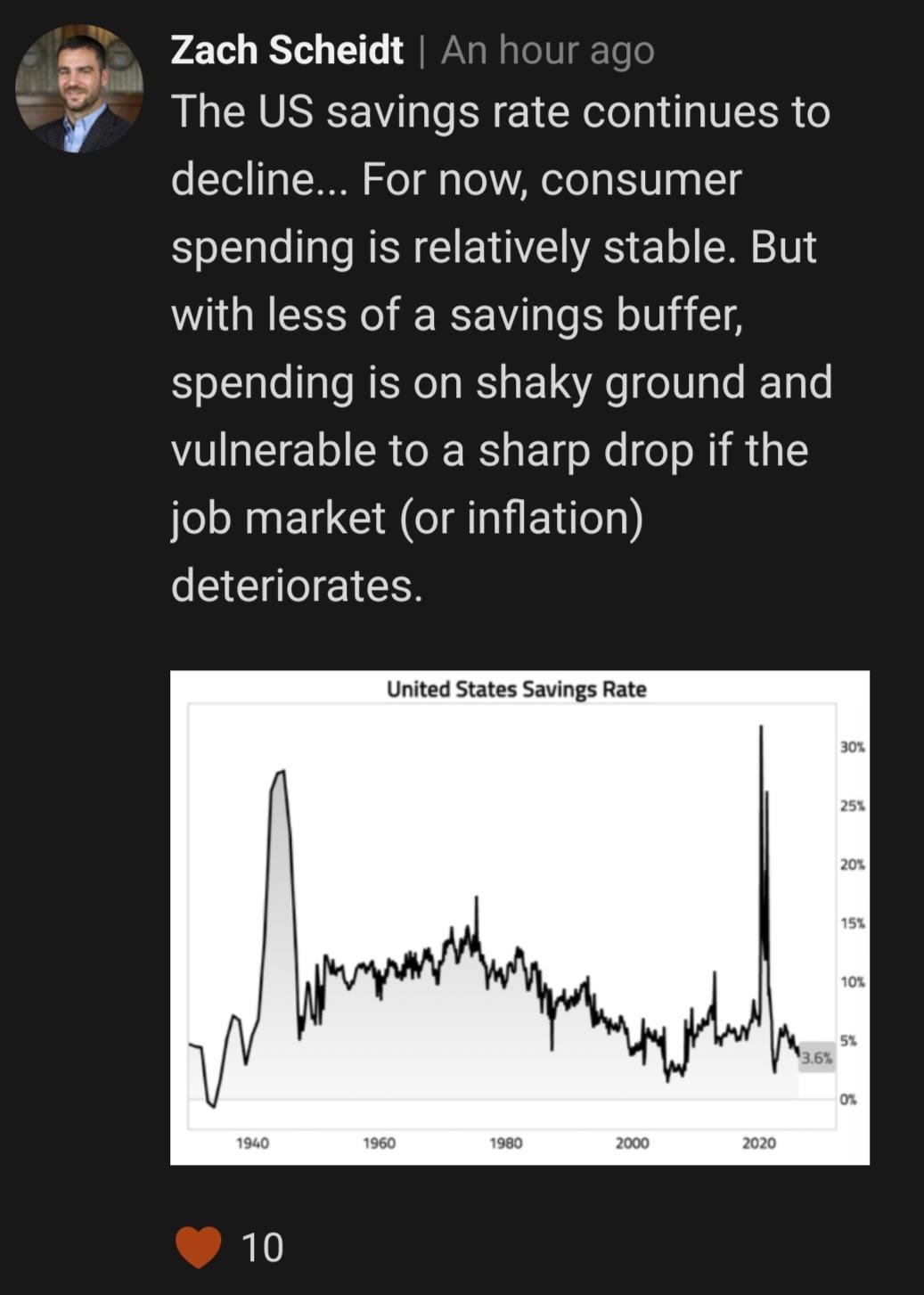
It’s affecting Americans across the board. As our colleague Zach Scheidt recently highlighted in our app’s Daily Feed, the savings rate recently dropped to 3.6%.

image 3

Download the free Paradigm Press app here.

Americans are saving less, and more people are living paycheck to paycheck.

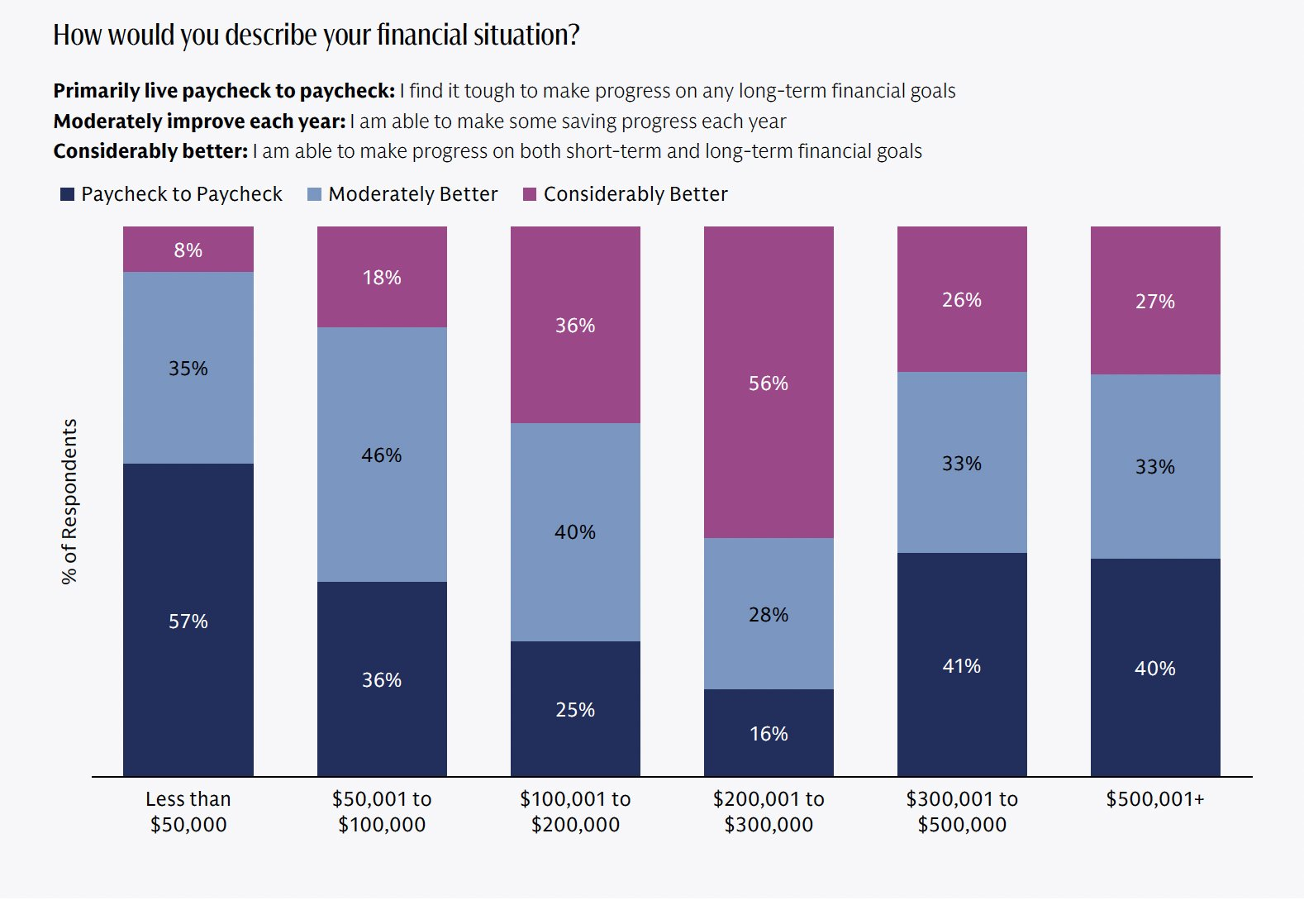
A shocking example of this comes from that same Goldman Sachs report. The firm’s survey showed that 41% of households making more than $300,000 per year consider themselves “paycheck to paycheck”.

image 4

Source: Goldman Sachs

Shockingly, 40% of those making more than $500,000 per year also report living paycheck to paycheck.

Look, much of this comes down to inflationary factors we can’t control. But if you’re making more than $300,000 or $500,000 per year, and not saving, that’s… not ideal.

Lifestyle Creep

This phenomenon is known as “lifestyle creep”. In other words, as we make more money, we spend more.

Too many people get a raise or bonus and spend it on expensive vacations, optional home renovations, or a new car, rather than investing it.

Most of us are guilty of this to some extent. But if you’re reading this newsletter, that means you’re actively looking to become a more effective investor.

And in today’s pricey world, being better at investing means spending less.

Driving your car until it dies. Cancelling that cable package and switching to a cheaper streaming service. Moving your money out of that big bank that pays 0.03% on savings and getting a better yield. Keeping those older appliances and fixtures. Ditching expensive meals out and cooking great food at home for less.

A lot of it boils down to not falling into status traps. We need to look at living beneath our means as a superpower. That’s the first step.

And then there’s the investment angle…

Adapt, Survive, Thrive

I understand saving and investing isn’t easy in this environment. Costs are rising and the job market stinks.

For those who are already retired, finding attractive income investments is also a challenge. The S&P 500’s dividend yield is down to a paltry 1.1%. Stocks have done well of course, but yields are tiny at current levels.

Treasuries could perform well over the next few years, especially if the Federal Reserve is forced to cut rates and restart QE. But after that, inflation is likely to outpace bond yields. And there’s always a chance rates rise significantly (and Treasury prices fall) before the Fed is forced to act.

During such times, having exposure to alternative investments is important. This is why we here at Paradigm have been focused on these ideas.

Gold, silver, miners, oil, and other natural resources. These themes have all beat the S&P 500 handily over the past few years. And most investors owned very little of them. But if you were a member of Jim Rickards’ services over that time, you did.

Our goal is to continue helping you find solid and profitable ideas for these crazy times. But in order to take full advantage of them, some need to take that first step – and spend less.

https://dailyreckoning.com/avoid-lifestyle-creep-at-all-costs/

Russia downs drones headed for Moscow

 Moscow Mayor Sergey Sobyanin said that air defenses destroyed two drones flying toward the Russian capital, amid the ongoing conflict with Ukraine.

Emergency services were activated to deal with debris that could pose a danger to civilians, he wrote on the Russian social media network Max. Earlier during the night, local time, flight restrictions were imposed at Moscow's Vnukovo and Sheremetyevo Airports.

Ukrainian drone incursions in Russian airspace also caused air traffic disruptions in other parts of the country.

https://breakingthenews.net/Article/Russia-downs-drones-headed-for-Moscow/66204700

First US Integrated Humanoid Robot Factory To Build 100,000 NEO Robots By 2027

 by Neetika Walter via Interesting Engineering,

U.S.-based robotics firm 1X has started full-scale production of its humanoid robot NEO at a new manufacturing facility in Hayward, California.

The factory marks a key step toward commercializing general-purpose humanoid robots designed for home use. The company says the robots are built to safely operate alongside humans and assist with everyday tasks such as mobility support, light household activity, and routine interaction.

NEO robot units working at the NEO Factory in Hayward, California.1X on YouTube

Spanning 58,000 square feet, the facility currently employs more than 200 workers and is expected to expand further as production scales. It has the capacity to produce up to 10,000 robots annually, with plans to increase output beyond 100,000 units by 2027. The setup is designed for rapid iteration as hardware and AI systems evolve.

The company has already seen strong early demand. It said its first-year production capacity of over 10,000 units sold out within five days of launch in October, signaling early commercial interest in humanoid home robotics.

Full-stack manufacturing push

A key feature of the factory is its vertically integrated production model. 1X designs and manufactures core components in-house, including motors, batteries, sensors, structures, and transmission systems.

This approach allows the company to control the entire production process, from raw material handling to final assembly. It also reduces reliance on external suppliers and supports faster iteration cycles, especially for hardware upgrades and safety improvements.

We’re building the world’s safest, most reliable humanoid robots—right here in Hayward, California,” said Vikram Kothari, VP of Manufacturing & Hardware.

The company says its setup includes automated motor manufacturing lines and systems that handle precision tasks such as copper coil winding. This level of integration is aimed at improving reliability, reducing production bottlenecks, and scaling manufacturing efficiently without outsourcing key subsystems.

Robots produced at the facility are currently being routed to internal testing, validation, and research environments. Customer shipments are expected to begin in 2026, starting with early access users before wider rollout.

AI brains power robots

Each NEO robot is powered by NVIDIA’s Jetson Thor computing platform, which serves as the system’s onboard processing unit.

The platform enables real-time AI inference directly on the robot, allowing it to perform perception, reasoning, navigation, and decision-making tasks without depending heavily on cloud infrastructure. This improves response time and reduces latency in real-world environments.

1X is also using NVIDIA’s Isaac simulation tools to train its robots in virtual environments. These simulations allow large-scale reinforcement learning and help improve robot behavior before deployment in physical homes.

Humanoid robots require high-performance, real-time AI inference and continuous training and testing in simulation for safe and reliable operation,” said Deepu Talla, vice president of robotics and edge AI at NVIDIA.

CEO Bernt Børnich said the factory signals a shift from concept to execution. “Production is happening now, and American consumers will be among the first in the world to welcome NEO into their homes.”

NEO will be offered through an early access program priced at $20,000, with a subscription option starting at $499 per month. The company plans to sell the robots directly through its online platform.

1X says building robots at scale in the United States will allow faster delivery, localized support, and quicker product improvements based on user feedback. The company also aims to reduce supply chain risks by keeping core manufacturing domestic.

https://www.zerohedge.com/ai/first-us-integrated-humanoid-robot-factory-build-100000-neo-robots-2027

Medicare portal database exposed Social Security numbers: Reports

 The Centers for Medicare and Medicaid Services (CMS) unintentionally published Social Security data for at least 100 health providers, according to multiple outlets. 

The department took down its National Provider Directory after The Washington Post flagged the information to CMS officials. The webpage serves to connect seniors with healthcare professionals, and it includes data about more than 7 million providers. 

The Hill has reached out to CMS for comment. 

A CMS spokesperson told the Post that the issue stems from providers entering their Social Security data in the incorrect place on the form. 

“The agency has taken steps to address it promptly and reinforce safeguards around data submission and validation,” CMS said in a statement to the outlet. 

Since the directory’s launch last year, there have been several issues with the information included in this database, including misidentifying the healthcare plans covered under certain providers. 

The project is part of a broader effort led by the acting administrator of the Department of Government Efficiency (DOGE), Amy Gleason, to connect the public with healthcare providers. 

Oregon’s Democratic senators, Jeff Merkley and Ron Wyden, wrote to CMS Administrator Mehmet Oz last November that they were “deeply concerned” about reports of “erroneous, conflicting, and duplicative information” included in this database.  

“While we appreciate CMS’s stated intent to help enrollees more easily navigate and choose a Medicare Advantage (MA) plan, we are concerned that this rushed rollout will mislead millions of seniors as they compare plans, and may cause seniors and people with disabilities to incur medical bills they reasonably believed would be covered,” the senators wrote. 

Merkley is the ranking member on the Senate Budget Committee, and Wyden is the top Democrat on the Senate Finance Committee. 

The Trump administration previously came under fire from Democrats after DOGE reportedly stored Social Security data in an unsecured cloud server. A whistleblower with the Social Security Administration said this move put “over 300 million Americans” at a greater risk of identity theft. 

Wyden called the whistleblower report “a clear example of how the Trump administration is playing fast and loose with Americans’ most sensitive personal information.”  

“Trump and DOGE’s reckless treatment of Social Security data jeopardizes the financial security and personal safety of every single American,” Wyden wrote in a statement last summer.

https://thehill.com/policy/healthcare/5860959-cms-publishes-social-security-data/