Search This Blog

Tuesday, May 8, 2018

House panel advances major VA reform bill

A House panel on Tuesday advanced a massive reform package for the Department of Veterans Affairs (VA) that would overhaul access to private sector care outside the VA health system.
The legislation, called the VA Mission Act, advanced through the House Veterans’ Affairs Committee by a 20-2 vote, a key first step to get the bill to President Trump for a signature before the end of the month.
The bill would expand the number of veterans who are eligible to see private sector health specialists, as well as entitle veterans enrolled in the VA system to see a private doctor twice a year without a copay.
It also contains $5.2 billion to keep the Veterans Choice Program funded until the new system can be implemented. Without action, the program will run out of money by May 31.
The Choice program was meant as a temporary fix following the 2014 VA wait-time scandal. It allows some veterans to see private doctors, but only in cases where they have to wait more than 30 days for an appointment or drive more than 40 miles to a facility.
President Trump has urged swift movement on the legislation to overhaul access to private sector care, and last week urged lawmakers to pass it by Memorial Day.
Democrats on the House Veterans’ Affairs Committee were mostly receptive to the changes in the updated version of the VA bill, but ranking member Tim Walz (D-Minn.) and Rep. Mark Takano (D-Calif.) ultimately voted against the legislation.
Walz said the White House forced committee leaders to reject Democratic proposals, such as a yearly review of the ability to send veterans to private care. Walz also wanted to exempt the funding for the Choice program from potential sequestration cuts.
The legislation “lacks a sustainable source of funding to ensure that care is provided and protected in the long-term,” Walz said in a statement.
A spokesman for House Minority Leader Nancy Pelosi (D-Calif.) didn’t respond to a request for comment on the new version of the legislation.
The bill moves the current Choice funding account from mandatory spending to discretionary spending, but doesn’t protect it from automatic sequestration cuts when the legislation takes effect.
Trump has been pressuring Congress to support the bill despite fallout surrounding his decision to fire David Shulkin, who led the VA for about a year before he exited the administration in March.
Ronny Jackson, the White House physician whom Trump tapped as Shulkin’s replacement, was forced to withdraw his name from consideration to lead the VA.
Jackson battled allegations that he improperly distributed prescription drugs, was drunk on duty and created a hostile work environment before dropping out of consideration last month.
The VA reform bill was originally negotiated as part of the massive government spending bill Congress passed in March. But it was ultimately stripped out before passage after last-minute objections by House Democrats, who were concerned that the community care provisions pushed the VA too far toward privatization.
Tensions over privatization played a key role in the dismissal of Shulkin, who alleged that officials in the administration were pushing hard for privatization and that he was fired when he got in their way.


Auris Medical Gets Europe OK to Launch Another Phase 3 Trial For Inner Ear Med

Shares of Switzerland-based Auris Medical Holding AG shot up nearly 10 percent Monday after the company announced it received clearance to begin a new Phase III trial for AM-111, the company’s investigational treatment for acute inner ear hearing loss.
Auris said it requested Scientific Advice (protocol assistance) from the Committee for Medicinal Products for Human Use (CHMP) of the European Medicines Agency (EMA) as it looks to advance AM-111 in a second Phase III trial. The company made the request following a November 2017 report that AM-111 did not meet primary endpoints in its HEALOS study. While the primary endpoint of that trial was not met, the company did attempt to put a positive spin on things by pointing to efficacy in a subpopulation. BioSpace reported last year that the company noted “statistically and clinically significant treatment effects in the profound hearing loss subpopulation.” On Monday the company said a post-hoc analysis showed AM-111 delivered a clinically meaningful and nominally significant improvement in hearing for those who took a lower dose, in comparison to placebo. Auris said those patients were initially completely deaf or almost deaf in the affected ear and “normally would have faced a particularly poor prognosis for hearing recovery.”
The EMA reviewed Auris’ proposed concept for a single pivotal trial, which will build on the design and outcome of the HEALOS trial. Auris said the EMA endorsed the trial design and protocols. Additionally, the EMA did provide “important guidance on the regulatory path forward” for AM-111, as well as the maintenance of AM-111’s orphan drug designation.  Last year AM-11 also received Fast Track status from the U.S. Food and Drug Administration.
AM-111 has the active ingredient brimapitide and is being developed in a biocompatible gel formulation for the treatment of acute sensorineural hearing loss with a single-dose administration into the middle ear. AM-111 is designed to inhibit the JNK stress kinase. By blocking JNK, AM-111 protects stress-injured cochlear cells and helps to prevent or reduce chronic hearing loss.
Thomas Meyer, Auris Medical’s chief executive officer, said the company appreciates the EMA’s “thorough and very helpful comments and guidance for our AM-111.”
“We are very pleased to see the design for the single pivotal phase 3 trial validated and to have the path towards market approval in Europe mapped out. We now look forward to discussing the path forward also with the FDA, for which we intend to request a Type C meeting shortly,” Meyer said in a statement.
Auris said Monday that it will provide an update on its AM-111 plans as part of a general strategy update on May 15, which will be released alongside its first quarter financial reports.
The news was certainly a relief for the company and its investors following a blow the company received earlier this year when its late-stage tinnitus drug AM-101 failed to meet endpoints in a Phase III trial for the second time. In March the company announced AM-101 (Keyzilen) failed to meet its primary efficacy endpoint of a statistically significant improvement in the Tinnitus Functional Score after 84 days of treatment. That was the second time AM-101 failed at the late stage. In 2016 the therapy failed to show statistically significant changes in tinnitus loudness and tinnitus burden compared to placebo.

Biotech Companies Continue to Shake Up Leadership

There have been a number of leadership changes in biotech companies over the last week. BioSpace has put together a list of new c-suite level hires and position changes.
Adverum Biotechnologies — Leone Patterson, chief financial officer at California-based Adverum Biotechnologies, has taken over the role of interim-chief executive officer following the dismissal of Amber Salzman. Last week the company announced that Salzman and the board “mutually agreed” to part ways. Salzman had been based on the east coast and was commuting weekly to California. In its announcement the company said Adverum, which recently transformed into a clinical-stage company, would best be served by “a chief executive officer based out of company headquarters.”
In addition to the departure of Salzman, Adverum said Athena Countouriotis, the company’s chief medical officer, resigned. Linda Neuman, head of clinical development, will serve as Adverum’s interim chief medical officer.
LogicBio Therapeutics – Cambridge, Mass.-based LogicBio added two senior executives this month. Sandra Poole, the former head of Technical operations and commercial development at ImmunoGen Inc., was tapped to serve as chief operating officer of the genetic medicine company and Paul Herzich, formerly director of clinical gene therapy manufacturing at Bamboo Therapeutics, was named senior director of manufacturing.
Rubius Therapeutics – Cellular therapy company Rubius Therapeutics added Jonathan R. Symonds, the director of HSBC Holdings, to its board of directors last week. Symonds is no stranger to the biotech community. From September 2009 to January 2014 he served as the chief financial officer of Novartis AG. He is currently chairman of Proteus Digital Health and a director of Genomics England plc, a government organization leading a genomics project.
Acadia Pharmaceuticals – San Diego-based Acadia Pharmaceuticals named Elena Ridloff to its newly-created position of senior vice president of Investor Relations. In this role, Ridloff will oversee investor and financial communications activities. Most recently Ridloff served as head of investor relations at Alexion Pharmaceuticals.  Prior to her time at Alexion Ridloff was chief executive officer and managing member of BIOVISIO, an independent life sciences consulting firm.
C4 Therapeutics — Andrew Phillips, the chief scientific officer of Massachusetts-based C4 Therapeutics, has been named president and chief executive officer of the small molecule drugmaker. Phillips has been serving in the role of president since 2016, the company said in its announcement. Stewart Fisher replaced Phillips as chief scientific officer.
CytRx Corporation – California-based CytRx tapped Eric L. Curtis as its new president and chief operating officer. Most recently Curtis has served as a consultant to a number of life science companies, including CytRx. He served as president of U.S. Commercial at Aegerion Pharmaceuticals and also served as head of at Bayer Healthcare’s Rare Disease/Cardiopulmonary Business Unit.
Caribou Biosciences — Timothy F. Herpin has been named the first chief business officer at California-based Caribou Biosciences. In the role Herpin will lead the company’s strategic partnerships, licensing agreements, and other value creation opportunities. Herpin came to CRISPR genome editing company Caribou from AstraZeneca where he served as head of Transactions.
Flexion Therapeutics – Massachusetts-based Flexion Therapeutics tapped David Arkowitz as the company’s chief financial officer. Before Flexion Arkowitz served as chief operating officer and CFO at Visterra, Inc., where he oversaw finance, business development, corporate planning, and other functions. Throughout his career, Arkowitz has served in a number of roles in the pharmaceutical business across multiple companies, including Mascoma CorporationAMAG Pharmaceuticals and Idenix Pharmaceuticals.

Student debt just hit $1.5 trillion

America’s student loan problem just surpassed a depressing milestone.
Outstanding student debt reached $1.521 trillion in the first quarter of 2018, according to the Federal Reserve, hitting $1.5 trillion for the first time. Though the marker is somewhat arbitrary, it offers a reminder of how quickly student debt has grown—jumping from about $600 billion 10 years ago to more than $1.5 trillion today—and that the factors fueling the increase aren’t likely to disappear any time soon.
“People pay attention to milestones,” said Mark Kantrowitz, a financial aid expert. When student debt surpassed $1 trillion in 2012, “it definitely caused a shift in coverage of student loans in the news media,” he said. In theory, that helps raise awareness of the issue for student advocates, lawmakers and, in particular, borrowers when considering what college to attend. But Kantrowitz added, “What’s more important is the impact on individual borrowers.”
Terrence Horan/MarketWatch
One in six graduates have debt that exceeds their income
And they are feeling it. College graduates leave school with about $37,000 in debt on average, according to Kantrowitz’s data, a sum that can be bearable for many, given that the average starting salary for a new college graduate last year hovered around $50,000. But a large share—as many as one in six college graduates, Kantrowitz estimates—will leave school with debt that exceeds their income. That will make it challenging for those borrowers to pay off their loans on a standard 10-year repayment plan, he said.
But the borrowers likely suffering the most from our increasingly debt-reliant college finance system are the students who leave school with debt, but no degree or a degree worth little in the labor market. Economists and advocates have pointed to the for-profit college industry, which has been accused of using inflated job placement and graduation rates to lure borrowers to take on debt, as a major source of these borrowers’ challenges.
Why does student debt continue to tick up?
For one, student debt has a slower repayment trajectory than credit-card or auto-loan debt because it is repaid over decades instead of months or years, Kantrowitz said. And even once some borrowers retire this debt, it’s refreshed by a new cohort of borrowers, fueling growth. Consumer advocates have also argued that student loan companies don’t do enough to work in borrowers’ best interest and actually make loan repayment harder than necessary.
But the amount students borrow is also growing. Rising college costs and stagnant wages combined with state and federal disinvestment in higher education have made students and families more reliant on debt to fund a college education, Kantrowitz said. “It’s shifting the burden of paying for college from the government to the families,” he said. Americans hit a separate debt milestone in 2017, when credit card debt cleared the $1.021 trillion mark.
Wonder how we got to over $1 trillion in student debt? Watch this.

Supernus Pharma Reports Q1 Earnings Per Share $0.49

SUPERNUS ANNOUNCES FIRST QUARTER 2018 FINANCIAL RESULTS AND RECORD QUARTERLY REVENUE

* Q1 REVENUE $90.4 MILLION VERSUS I/B/E/S VIEW $85 MILLION

* Q1 EARNINGS PER SHARE VIEW $0.33 — THOMSON REUTERS I/B/E/S
* SUPERNUS – FOR 2018, REITERATES ITS PRIOR GUIDANCE FOR NET PRODUCT SALES, RESEARCH AND DEVELOPMENT EXPENSES
* SUPERNUS – FOR 2018, ALSO REITERATES ITS PRIOR GUIDANCE FOR OPERATING EARNINGS

Arrowhead target doubled by Piper after earnings

Arrowhead price target raised to $11 from $5.50 at Piper Jaffray. Piper Jaffray analyst Edward Tenthoff raised his price target on Arrowhead Pharmaceuticals to $11 and kept his Overweight rating after the company’s Q2 results. The analyst notes that after initiating Phase 1 studies of ARO-HBV and ARO-AAT, the company’s interim data is now potentially expected at AASLD in November. Tenthoff models a higher price target on Arrowhead to reflect is added pipeline value.

10 New Genetic Tests Reach the Market Each Day

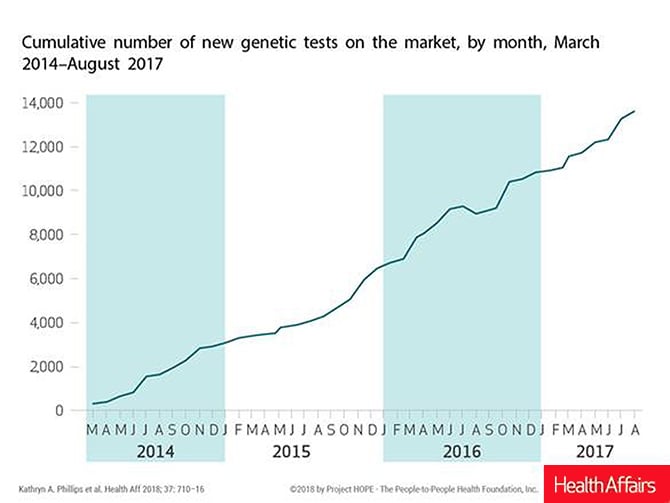
Approximately 75,000 genetic tests are currently on the market and on average 10 more are added each day, according to an analysis published May 7 in Health Affairs.
The number of clinical genetic tests has increased rapidly as DNA sequencing costs have plummeted. Such tests have become the standard of care for pregnant women and for many people with cancer. However, little empirical evidence has tracked the availability of types of genetic tests and commercial payer spending. The data that do exist are either dated and/or focus on one specific test, such as breast cancer risk.
To get an “overview of the testing landscape,” Kathryn Phillips, PhD, a professor of health economics and health services research in the Department of Clinical Pharmacy at the University of California San Francisco, and colleagues studied data from Concert Genetics, a health information technology company. Specifically, they analyzed the test catalog database, which includes data from public websites, and the genetic testing claims database, looking for genetic tests covered by private insurance between 2014 and 2017.
The databases classified tests as prenatal, hereditary cancer, oncology diagnostics and treatment, biochemical, pharmacogenetic, noncancer hematology, human leukocyte antigen typing, neurologic, gastroenterologic, identity and forensics, disease risk, cardiologic, and pediatric and rare diseases.
The investigation focused on multigene products, which range in coverage from mutation panels for specific diseases to multianalyte assays, to noninvasive prenatal tests (NIPTs) and whole-exome and whole-genome sequencing. The whole-genome tests include karyotypes, sequencing, and microarray tests that detect insertions and deletions.
The genetic testing claims database includes 1.7 million payer claims over the testing period. The study covered 257 laboratories.
The investigation found approximately 75,000 genetic tests on the market, with 10,000 unique test types among them. Fourteen percent of the tests were multigene panels. These included 9311 multianalyte assays, 85 NIPTs, 122 whole-exome sequencing tests, and 873 whole-genome sequencing tests.
Since March 2014, nearly 14,000 tests have been added, which works out to an average rate of about 10 per day, 2 or 3 of which assess more than one gene. On average, each month sees 2 new exome sequencing tests and 2 new NIPT products.
According to the genetic testing claims database, prenatal tests (NIPTs and carrier screening) accounted for 33% to 43% of spending on genetic tests, and hereditary cancer tests for about 30%.
Despite the onslaught of TV ads for new mutation-targeted cancer drugs and media coverage of matching patient to drug under the precision-medicine umbrella, spending on oncology diagnostics and treatment accounted for just 10% of spending, and pharmacogenetic testing accounted for less than 5%.
Most claims were for multigene tests, either marketed as a panel or grouped as single-gene tests for a shared indication. Meanwhile, spending on standalone single-gene tests decreased. The sharp increase in NIPT isn’t surprising, given its improved safety over more invasive prenatal tests, such as amniocentesis and chorionic villus sampling.
The researchers conclude that commercial insurance coverage for genetic test panels is “variable and limited,” raising concerns that many patients may be paying or asked to pay out-of-pocket. Part of the problem may be that of “too much information”: Is an exome sequence necessary if a neurologic gene panel would cover a patient’s symptoms?
Another complication is the fragmented nature of the genetic testing market, which is bifurcating into those that provide high-volume tests, such as NIPT, and those with more specialized products, the researchers suggest.
Regulation is also a concern. “The rapid influx of tests and the fact that many genetic tests are lab-developed tests that do not require FDA [US Food and Drug Administration] approval create regulatory and coverage policy challenges,” the researchers write. They note that it is concerning that some tests are regulated and some not, which might affect access.
The researchers call for “better evidence on the number, types, and quality of tests,” citing several examples of existing restrictions on available information: the voluntary nature of the National Institutes of Health’s Genetic Testing Registry; restricted populations behind some databases, such as Medicare; dated information; and intellectual property concerns. Electronic health records and medical coding will have to catch up with the outpouring of new genetic tests, they argue.
“Our results fill a critical gap in the existing literature and can serve as a baseline assessment for investigators and policy makers who are interested in examining the growth of the industry over time,” the researchers conclude.
Limitations of the study were not including indications for taking tests, in-house genetic tests, and tests not covered by insurance or denied claims, all of which add up to an underestimate of genetic test use.
Phillips is a consultant to Illumina and has consulted with Counsyl. One coauthor is an employee of Concert Genetics, and another is a consultant to Illumina.
Health Aff. 2017;37:710-716. Abstract