Search This Blog

Saturday, December 22, 2018

FDA Warms To Considering Legal Cannabis Ingredients In Food


The signing of the Farm Bill into law Thursday — with a provision that legalizes industrial hemp — has kickstarted a debate concerning the legality of cannabis ingredients in food and drinks.
Congress has called for a status quo position with respect to the FDA’s regulatory role in cannabis and cannabis-derived compounds, giving the agency the latitude to provide regulatory pathways for products containing cannabis and cannabis-derived compounds, FDA Commissioner Scott Gottlieb said in a statement.
The agency reiterated that cannabis and cannabis-derived products claiming therapeutic benefits should go through the regular drug approval process before being introduced to interstate commerce.
As of now cannabinoid, or CBD, and tetrahydrocannabinol, or THC, which are active ingredients in FDA-approved drugs, cannot be part of food, or sold as, or in, dietary supplements, according to the FDA. This is in line with the requirement FDA applies across the board to food products containing substances that are ingredients in any drug.

Changing Perceptions Of Cannabis Products

In a new development, the FDA conceded that there are pathways available for those who are looking to introduce these products into interstate commerce, both as part of a human or animal drug or as an ingredient in food products.
“The FDA will continue to take steps to make the pathways for the lawful marketing of these products more efficient,” Gottlieb said.
A case in point is GW Pharmaceuticals PLC- ADR GWPH 7.51%‘s Epidiolex, which the FDA approved for treating seizures associated with two rare and severe forms of epilepsy.

FDA Considers Food, Dietary Allowances

Gottlieb kept the door open for the possibility of issuing a regulation allowing the use of cannabis-derived compounds in a food or dietary supplement. The FDA is taking new steps to evaluate whether it should pursue such a process, he said. “However, the FDA would only consider doing so if the agency were able to determine that all other requirements in the FD&C Act are met, including those required for food additives or new dietary ingredients.”

Marked Safe

The FDA said it has advanced the lawful marketing of some foods derived from parts of the hemp plant that may not contain CBD or THC, with hemp seeds, hemp seed protein and hemp seed oil being the three ingredients that are marked as safe. The agency said it will hold public meeting of all stakeholders to deliberate and mobilize information and views related to safety of such products.
“We’re committed to pursuing an efficient regulatory framework for allowing product developers that meet the requirements under our authorities to lawfully market these types of products,” Gottlieb said in the statement.

Honda’s Sound Sitter lulls fussy children with engine noises


Honda
Plenty of parents have turned to car rides in order to calm fussy babies and Honda has now developed a gadget based on that concept. But instead of bringing the baby to the car, Honda’s Sound Sitter brings the car to the baby. The company tried out the sounds of 37 different car engines, including various Civic models, Accords and Integras, ultimately determining that the sound of the NSX engine was most effective when it came to soothing babies. And when researchers tried it out on newborns — aged six months to 1.5 years old — 11 out of 12 seemed to experience comfort while seven showed reduced heart rates.
On its website, Honda explains that the induced comfort may be because the low frequencies of the engine sounds are comparable to what babies hear in the womb.
Honda packaged the NSX engine sound into a red, car-shaped plush toy and recently let parents try it out an event. The company, however, doesn’t have plans to produce the toy, but it has made the sounds of three engines — the NSX, the Integra Type R and the S2000 — available online.
Honda isn’t the only car company to try its hand at calming children. Last year, Ford showed off a baby crib prototype that mimics the experience of a car ride. It plays muffled engine noises, has LEDs that simulate street lights and generates movements similar to those felt when riding in a car. Additionally, other companies, like Snoo, have mimicked womb sounds to comfort young children as well.

IBM fingernail sensor tracks health through your grip


IBM Lab
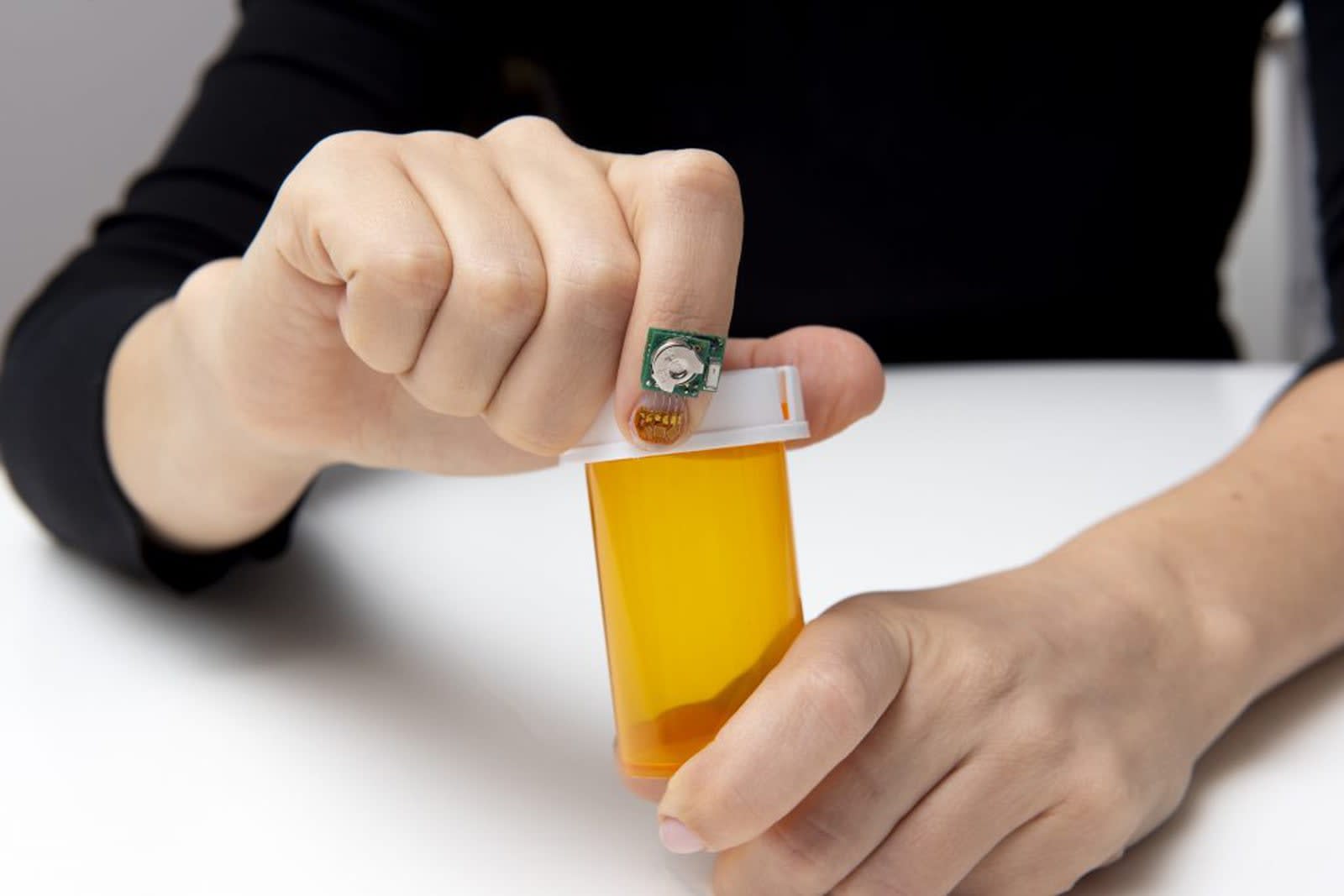
The strength of your grip can frequently be a good indicator of your health, and not just for clearly linked diseases like Parkinson’s — it can gauge your cognitive abilities and even your heart health. To that end, IBM has developed a fingernail sensor that can detect your grip strength and use AI to provide insights. The device uses an array of strain gauges to detect the deformation of your nail as you grab objects, with enough subtlety to detect tasks like opening a pill bottle, turning a key or even writing with your finger.
From there, the sensor sends its data to a smartwatch (in this case an Apple Watch) where the AI kicks in. Machine learning on the watch can detect various signs of Parkinson’s, such as tremors, bradykinesia (slow starts to voluntary movement) and dyskinesia (reduced voluntary movements). IBM added that it can use a neural network to accurately detect finger-written digits, which could help identify health issues associated with cognitive functions and motor skills.
While the sensor was initially developed with Parkinson’s in mind, IBM clearly sees a range of uses that could include detect the development of numerous diseases as well as the effectiveness of treatments meant to slow those conditions. It has also served as the foundation of a communication device for quadriplegics. There’s no mention of when this sensor could become a practical reality, but it at least makes sense. Skin sensors are frequently problematic for older people, whose hands and arms might be relatively fragile. A nail sensor would sit on a relatively safe area where you don’t have to worry so much about removal or a loose fit.

Drug testing at work ‘new don’t ask, don’t tell’


One of the largest U.S. drug-testing laboratories has analyzed its millions of urine drug test results by industry for the first time, and found the two industries with the highest rate of positive test results for marijuana were also two that have to deal with consumers.
Some 5.3 percent of tests given to retail trade workers, and 4.7 percent of those given to health care and social assistance workers came back positive, according to an analysis by Quest Diagnostics.

The analysis, which comes from examining more than 10 million test results that are part of the lab company’s Drug Testing Index, found that five of 16 industries saw double-digit increases in the rate of positive test results between 2015 and 2017.
They included not only retail but transportation and warehousing, finance and insurance and wholesale trade, showing an increase in positive test results at a time when more states are loosening restrictions on pot use and more companies are said to be loosening drug testing restrictions amid low unemployment.
Barry Sample, the senior director of science and technology for Quest Diagnostics Employer Solutions, said the results of the new analysis did not surprise him.
“We’ve been reporting year-over-year increases of the positivity rates for almost all three of these illicit drug classes,” he said, referring to marijuana, cocaine and methamphetamines. “As we break it out by industry we’re seeing a number of industries with those same results.”
Still, the rate of growth stood out. The retail industry, for instance, saw a 43 percent increase in positive test results for cocaine between 2015 and 2017, Quest’s analysis showed. And eight sectors saw at least 20 percent increases in positive marijuana test results over the same period, as more states loosened laws restricting the drug.
“Clearly I think that there are likely some attitudinal changes with respect to marijuana, which may be driving some of the increases we’re seeing,” he said.
Sample said, however, that it would be a mistake to attribute the rise entirely to statute changes. Even in states with relaxed laws, he said, the rate of of change in positive test results was often on par with the national average.
Before movie-driven images of a stoned store clerk come to mind, it’s important to note such data doesn’t necessarily measure current impairment. The test results measure use of the drug, not necessarily use of the drug at work, and with pot, in particular, the drug’s byproducts can stay in a person’s system and be detected even weeks after use.
But some labor lawyers say the legalization of marijuana use — 10 states and Washington, District of Columbia, allow for recreational use of pot, while 33 states and the District have legalized it for medical use — is having a big effect on how employers view employee use of the drug.
“What I see employers doing is evaluating the positions, asking ‘is this really a safety-sensitive position?’ ” said Erin McLaughlin, a labor and employment lawyer with Buchanan, Ingersoll & Rooney based in Pittsburgh, Pennsylvania. “If it’s not, then there are more employers who are taking the position ‘let’s not test for marijuana.’ ”
She believes the tight labor market is also clearly playing a role. “Absolutely, I think in positions where there is a labor shortage right now and employers are looking for candidates for jobs that don’t have safety-sensitive issues or aren’t federally regulated [to require testing], I definitely think employers are eliminating drug testing as a whole when it comes to hiring applicants,” she said.
She pointed to the construction industry, where there are big labor shortages, and said she’d seen it with some retail clients. “Quite frankly, for jobs like a cashier, a sales associate — many of them don’t do drug testing at all, especially considering the labor shortage.”
James Reidy, a labor and employment lawyer with Sheehan Phinney in New Hampshire, said he’s seeing similar responses.
“A lot of companies are recognizing if I drug test at the post-offer, pre-employment position, I’m going to lose out on people,” he said.
As perceptions shift and legal use of marijuana becomes more common, he said, “it’s really become the new ‘don’t ask, don’t tell,’ ” with many employers preferring not to know about an employee’s use. “If he’s got a positive drug test, and you knew,” Reidy said of an employee later who might later have a safety accident, “it’s in your system.”
Quest’s Sample said the lab company’s attrition rate of employers ending drug tests with the company has actually been showing decreases, that volume is not down, and that in states where recreational use is allowed, they were only seeing minor drops in the percentage of employers who included marijuana in their panel of drug tests.
But he said his data was not able to detail whether some employers may be shifting which groups of new candidates or employees they test, and that what employers do with the test results after they have them may be shifting. “The economy is robust and people are still hiring,” he said. “It’s harder to find qualified candidates and those employers may be opting to change how they view a positive test for marijuana.”

Why Gene Therapy Is More Cost Effective Than Biogen’s Approved Drug


An experimental gene therapy from Novartis (NVS) will be more cost effective than Biogen (BIIB) and Ionis Pharmaceuticals‘ (IONS) treatment for a muscle-wasting disease, experts said this week.
Biogen and Ionis grabbed approval for Spinraza in late 2016. So far, it’s the only drug on the market in the U.S. to treat spinal muscular atrophy, a genetic disease of the nerves that control muscles. But Novartis is hoping to follow in 2019 with its gene therapy called Zolgensma.
If priced at the $2 million mark, Zolgensma is more cost effective than Spinraza, experts with the Institute for Clinical and Economic Review said in a report late Thursday.
“These findings could offer support for Novartis in pricing and access negotiations for Zolgensma ahead of the 2019 estimated approval,” Leerink analyst Geoffrey Porges said in a report to clients on Friday.

Can Gene Therapy Reduce Cost Over Time?

The report measures disease burden over time. It uses a metric called a quality-adjusted life year. One quality-adjusted life year is equal to one year of life in perfect health.
Novartis acquired Zolgensma in an $8.7 billion takeover of AveXis earlier this year. The company suggests its gene therapy could yield 13.3 quality-adjusted life years in patients who show symptoms in the first six months of life, known as type 1.
Zolgensma “could be priced to $4 million to $5 million based on the relationship of 10-year cost of approved drugs for ultrarare diseases and their corresponding incremental quality-adjusted life years gained,” Porges said.
Gene therapy is meant to be administered just one time, which would cut the cost of chronic treatment over time. But the ICER report suggests Zolgensma would provide just 11.33 quality-adjusted life years at a placeholder price of $2 million.
Porges estimates Novartis’ gene therapy will net $1.57 million per patient across all types of spinal muscular atrophy. This is equivalent to five years of Spinraza net pricing.

Spinraza Costs Add Up Over Time

ICER estimated the real-world cost of Spinraza would equal $11.94 million to gain 21.54 years of perfect health. This would be in patients who don’t yet show the symptoms. This group benefits the most in that Spinraza could prevent their symptoms.
At this measure, Spinraza costs $728,000 for each additional year of perfect health. The report didn’t offer a similar look for Zolgensma. But at $2 million, Zolgensma would cost $247,000 per added quality-adjusted life year in patients who show symptoms as newborns.
The report suggests a one-time drug as effective as Spinraza would cost $161,000 per added year of perfect health. That’s a nearly 80% discount to Spinraza in presymptomatic patients, Porges said.
“The high cost/quality-adjusted life year of Spinraza in type 1 spinal muscular atrophy patients offers Novartis bargaining power with payers if the company can argue Spinraza use could be reduced or eliminated to offset total costs,” he said.

As US obesity rates soar, new weight loss drugs are in the offing that offer hope


  • The average American is nearing the medical definition of obesity, according to new data from the Centers for Disease Control.
  • As many as six new drugs to combat obesity may hit the market in the coming years and improve heart health as well as provide weight-loss benefits.
  • There are more than 97 million people with obesity in the U.S., and that number is set to increase by nearly 3 percent annually on average.
  • Not enough doctors treat obesity as a disease that requires drugs, and too few insurers offer coverage.
The average American is getting shorter and fatter, and on the verge of matching the medical definition for obesity, according to a report this week from the Centers for Disease Control. The six new drugs to treat obesity set to release in the U.S. by 2026 can’t come soon enough. These weight-loss drugs could improve drastically upon current medication and have the potential to spur a major leap forward in treating obesity as a disease.
“Y’all better buckle up because things are about to change. The world is about to change,” said Dr. Harold Bays, the medical director and president for the Louisville Metabolic and Atherosclerosis Research Center who has served as an investigator for more than 500 clinical trials over the last 30 years. “We’ve got a ways to go, but I think the future looks tons brighter now than it ever has.”
But a big problem remains — not enough doctors treat obesity as a disease, and even those who do cannot prescribe drugs to all but their wealthiest patients, with few insurers, and no government insurance program, offering coverage.
In general, the way obesity medication works is either by affecting the brain or the gut. It can work on your brain to make you feel less hungry, on your intestines and gut to make you digest food more slowly, or some combination of the two. The effect is relatively simple: the drugs help people lose weight.
Potential breakthroughs include obesity drugs that shift from daily to weekly administration, a switch from injections to pills, and targeting more receptors in the body for greater effect. The main focus of obesity drugs in the pipeline currently are called GLP-1R receptor agonists, which work in the brain to regulate hunger. They mimic the GLP-1 hormone by binding to GLP-1 receptors and stimulating insulin release, which reduces blood sugar (important to diabetes treatment) and also act on the stomach, brain, pancreas, and liver to increase feelings of fullness. At different doses, GLP-1R receptor drugs can be used to treat diabetes or obesity.
Saxenda, made by the pharma company Novo Nordisk, is one of a handful of successes and the only drug in the GLP-1R category currently on the market. Newer medications in the pipeline from pharmaceutical giants including Novo Nordisk, AstraZeneca, and Sanofi would improve on the current drugs like Saxenda by making delivery more convenient, effective or potentially safe.
The link between obesity drugs and heart health
The most important potential breakthrough is the possibility of helping patients’ hearts. In recent years, medicine has made huge leaps in crafting drugs to treat metabolic diseases like high cholesterol or diabetes, Bays said. At first, some criticized drugs such as those for diabetes as only narrowly affecting blood sugar, but not actually improving people’s lives. Within the last few years, those diabetes and cholesterol drugs became not just more safe and well-tolerated, but they had the advance of dramatically improving cardiovascular health for people taking it. Those advancements led to optimism for the future of obesity medication based on drugs first developed for diabetes.
In recent rounds of research, doctors hoped to find that weight loss drugs could do their jobs without increasing the risk of heart disease in patients, he said, but obesity drugs based on a current biological agent in the GLP-1R class, called semaglutide, have been shown to actually dramatically decrease the risk of heart disease, Bays said. In other words, the drugs would go way beyond weight loss and help the overall health and lives of patients, not just their waistbands. Bays’ research site has received a research grant from Novo Nordisk in the last year, although neither he nor the center own stock or patents.
Other obesity experts agree that the improvement in heart health may be the most critical factor in the treatment of obesity with drugs. Caroline Apovine, an expert in obesity and diabetes at the Boston University School of Medicine, said the new Novo Nordisk semaglutide drug is “the one we are really waiting to get” and it offers weight loss potential almost double that of any drug on the market. Apovine has done consulting work for Novo Nordisk.
Maybe it is just too hard for the public and health care providers and insurers to come to grips with the fact that obesity is a disease, and scientists are thinking if we can’t go straight at the problem, how else can we improve these people’s health? Everyone is on board with heart health.
Claudia Fox
EXPERT IN PEDIATRIC OBESITY AT THE UNIVERSITY OF MINNESOTA
The Novo Nordisk drug is in phase 3 trials, with a projected approval in 2022, a company spokesman said. Results from a phase 2 study earlier this year revealed that adults with obesity treated with semaglutide 0.4 mg administered once-daily via injections lost up to 13.8 percent of their body weight after 52 weeks.
“The Novo Nordisk semaglutide is the game changer,” said Claudia Fox, an expert in pediatric obesity at the University of Minnesota. Fox said it has been difficult for obesity experts to gain acceptance for the idea that obesity is a disease and deserves to be treated as a disease on its own. “Maybe it is just too hard for the public and health care providers and insurers to come to grips with the fact that obesity is a disease, and scientists are thinking if we can’t go straight at the problem, how else can we improve these people’s health? Everyone is on board with heart health,” Fox said.
The United States has one of the highest obesity rates of any country in the world, and the Center for Disease Control estimates that its average annual medical cost is about $172 billion in today’s dollars. A recent report on the obesity drug market from GlobalData estimated that there are more than 97 million people with obesity in the U.S., and that number is set to increase by nearly 3 percent annually on average. Obesity can be devastating to a patient’s’ quality of life, and it can lead to diabetes or heart disease, the No. 1 killer in the world.
Costs are high and insurance coverage skimpy
Saxenda and Nalpropion Pharmaceuticals’ Contrave, among the other obesity drugs in the handful on the market, work by activating hormones in your brain that regulate your appetite. Saxenda has a black box warning because there’s been thyroid tumors observed in rodent studies, and they have side effects ranging from pancreas inflammation, kidney disease or increased heart rate, but because the GLP-1R drugs are based on naturally occurring hormones made by the body and have been used in diabetes medications for years, doctors who specialize in obesity consider the drugs to have a reasonable safety profile.
Despite Saxenda’s success, multiple experts agreed that obesity medication is still vastly underused due to the cost and lack of insurance coverage, and misunderstood by doctors. The drugs could be helping far more people than they are, they said.
Saxenda can cost as much as $1,000 a month, and Contrave as much as $200.
“My patients are paying for it,” Apovine said. She said more insurers are starting to offer coverage — as of January some Blue Cross Blue Shield plans and Harvard Pilgrim will add coverage — but not the government programs, which are the most important.
“I’ve been able to prescribe Saxenda to some of my wealthier patients with good insurance, but people who really need it are usually lower socioeconomic status. The only one in game is Novo because they have diabetes drugs that are covered so they can afford to get Saxenda out there. But who is going to pay $1,000 a month or even $200 a month for Contrave unless you are rich? And Contrave’s maker went bankrupt.”
Contrave was developed by Orexigen Therapeutics, which recently declared bankruptcy, and has been marketed in conjunction with Valeant Pharmaceuticals, which changed its name to Bausch Health earlier this year after a series of high-profile financial and regulatory stumbles.
“Both private and public insurers do not routinely cover most weight loss medications,” said Dr. Fatima Cody Stanford, an obesity specialist, expert and Harvard University instructor. They often cover weight loss surgery (gastric bypass), she said, but not medication or even nutritional therapy.Until obstacles like coverage, education and weight bias are dealt with, she said the full potential for positive public health impact by the upcoming obesity drugs will never be met.
A Novo Nordisk spokesman said “We recognize there are many people who do not have affordable access to obesity prescriptions, which is why we are actively working with U.S. employers to expand access and break down barriers to care.”
The company does offer discounts on Saxenda and co-pay reductions for patients eligible for coverage which can reach a maximum benefit of $200 per monthly prescription. He added that there are prescriptions every day for anti-obesity medications that go through all major insurance companies in the U.S., but it is the employer who decides whether to make these medications available to their employees, and even as surveys show two-thirds of employers recognizing obesity as a disease, that has not led to a significant increase in coverage for obesity treatments.
Novo Nordisk also collaborates with organizations such as the Obesity Care Advocacy Network (OCAN) to pass legislation such as the Passing the Treat and Reduce Obesity Act (TROA), which would provide Medicare beneficiaries and their health care providers with access to weight management counselling and allow for coverage of FDA-approved therapeutics.
Weight bias is a factor
Weight bias — blaming people who are obese for having the disease — also is a factor.
Primary care physicians often speak with patients who have obesity and tell them to eat less and exercise more, then that fails, said Dr. Fatima Cody Stanford, an obesity specialist, expert and Harvard University instructor. Then when the patient returns, the doctor just repeats the advice rather than treating it as a disease.
“People say ‘oh they’re just lazy or slothful’” about patients who have obesity, Stanford said, but no one would say that about patients with cancer or depression. For some reason, she said, people blame those with obesity for their disease, and many don’t support medication because they see it as an “easy way out.”
“We would never tell someone with diabetes who comes in with high blood sugar, ‘Well, eat less and exercise more!’ we’d treat their diabetes,” Stanford said. Lifestyle changes are important and she recommends them to her patients, she said, but it’s not enough by itself to treat people in many cases.
“Right now I see a barrier. These biases that are so strongly held continue to perpetuate so these patients don’t get the treatment they need and they deserve,” Stanford said.
Fox said it is not only doctors and insurers, but the patients and their families who have the bias and say, “I want to do it the natural way.”
“We need to be thinking of it as a chronic condition, one you will need to manage for your whole life,” Fox said, but she explained that when a doctor tells a patient and their family this, “you can see the gloom on the family’s face, or they just don’t believe you. … Five years later that person is 100 pounds heavier. It doesn’t go away.”
Even when doctors do prescribe obesity medication, Stanford said, it’s often with the goal of losing weight in the short term and then stopping to take the drug. This is wrong, she said, as those drugs are designed for people who will continue to take the medication indefinitely to lose the weight and keep it off.
Apovine said the idea that a weight-loss drug is for short-term use is science of the 1950s, but it persists.
“There are only a handful of us in this field, led by George Blackburn’s work, that in the past few decades recognized obesity is a disease that needs to be treated,” Apovine said. “We have finally starting to see some movement.”
There is now an obesity medication certification program that has over 6,000 doctors and hopefully will soon be recognized by the  American Board of Medical Specialties, she said.
“Eventually, we have to get to a tipping point, just like with addiction and alcoholism and depression. We don’t consider those a moral failing now. We have to stop with the stigma of obesity,” Apovine said. “We still look at a person walking down the street and say ‘glutton’ — eat less and exercise more. Once the perception of obesity is disease, everything will fall into place.”

Hedge Funds Are Buying Emergent Biosolutions


Insider Monkey has processed numerous 13F filings of hedge funds and famous investors to create an extensive database of hedge fund holdings. The 13F filings show the hedge funds and investors’ positions as of the end of the third quarter. You can find write-ups about an individual hedge fund’s trades on numerous financial news websites. However, in this article we will take a look at their collective moves and analyze what the smart money thinks of Emergent Biosolutions Inc (NYSE:EBS) based on that data.
Is Emergent Biosolutions Inc (NYSE:EBS) ready to rally soon? Money managers are taking a bullish view. The number of long hedge fund bets rose by 4 recently. Our calculations also showed that EBS isn’t among the 30 most popular stocks among hedge funds. EBS was in 16 hedge funds’ portfolios at the end of the third quarter of 2018. There were 12 hedge funds in our database with EBS positions at the end of the previous quarter.
In the financial world there are a large number of tools investors have at their disposal to grade stocks. A pair of the most under-the-radar tools are hedge fund and insider trading indicators. We have shown that, historically, those who follow the top picks of the best fund managers can outperform the broader indices by a solid amount. Insider Monkey’s flagship best performing hedge funds strategy returned 6.3% year to date (through December 3rd) and outperformed the market even though it draws its stock picks among small-cap stocks. This strategy also outperformed the market by 18 percentage points since its inception (see the details here). That’s why we believe hedge fund sentiment is a useful indicator that investors should pay attention to.
Let’s view the fresh hedge fund action encompassing Emergent Biosolutions Inc (NYSE:EBS).

How are hedge funds trading Emergent Biosolutions Inc (NYSE:EBS)?

Heading into the fourth quarter of 2018, a total of 16 of the hedge funds tracked by Insider Monkey were long this stock, a change of 33% from one quarter earlier. On the other hand, there were a total of 13 hedge funds with a bullish position in EBS at the beginning of this year. So, let’s see which hedge funds were among the top holders of the stock and which hedge funds were making big moves.
EBS_dec2018
More specifically, Renaissance Technologies was the largest shareholder of Emergent Biosolutions Inc (NYSE:EBS), with a stake worth $123.2 million reported as of the end of September. Trailing Renaissance Technologies was GLG Partners, which amassed a stake valued at $38.2 million. Fisher Asset Management, AQR Capital Management, and D E Shaw were also very fond of the stock, giving the stock large weights in their portfolios.
Now, key money managers were leading the bulls’ herd. Sio Capital, managed by Michael Castor, assembled the largest position in Emergent Biosolutions Inc (NYSE:EBS). Sio Capital had $2.8 million invested in the company at the end of the quarter. Matthew Hulsizer’s PEAK6 Capital Management also made a $0.7 million investment in the stock during the quarter. The other funds with new positions in the stock are Matthew Hulsizer’s PEAK6 Capital Management, Roger Ibbotson’s Zebra Capital Management, and Gavin Saitowitz and Cisco J. del Valle’s Springbok Capital.