Tuesday, January 22, 2019
Conmed reports Q4 adjusted EPS 73c, consensus 72c
Conmed reports Q4 adjusted EPS 73c, consensus 72c Reports Q4 revenue $242.4M, consensus $228.8M.
https://thefly.com/landingPageNews.php?id=2851877

Unity Biotechnology expands ongoing UBX0101 Phase 1 study
Unity Biotechnology announced further expansion of the Phase 1 study of UBX0101 in patients with moderate to severe osteoarthritis of the knee with a cohort of an additional 24 patients at the highest evaluated dose, or Part B. Part B is intended to supplement the initial Phase 1 trial, or Part A, by further evaluating the impact of UBX0101 on specific pro-inflammatory and extracellular matrix modifying factors within the Senescence-Associated Secretory Phenotype.
https://thefly.com/landingPageNews.php?id=2851893
Emerging markets drugs worth $3B could be next on Takeda’s chopping board
Looking to trade in some assets outside Japan to fund its $58 billion takeover of Shire, Takeda is reportedly eyeing a sale of some emerging-market drugs it gained in another acquisition eight years ago.
The Japanese pharma is weighing the sale of some emerging markets products that could fetch about $3 billion, Bloomberg reported, citing people familiar with the matter. The talks are too early to draw any conclusion on the fate of specific drugs, the report said.
Takeda acquired these drugs—prescription and over-the-counter included—in its $14 billion buyout of Swiss drugmaker Nycomed in 2011. But lately, emerging markets haven’t been doing the company much good.
For the two quarters ended Sept. 30, Takeda grew sales in emerging markets by only 2.4%. That’s the lowest growth rate among all of Takeda’s geographic regions, excluding currency fluctuations and one-time changes. Taking those into account, the portfolio declined 6.6% to 126.7 billion Japanese yen ($1.16 billion). In fact, without the double-digit growth posted in China, its emerging markets decline would be even worse.
And Takeda is scouting around for assets to sell. With the Shire deal, Takeda landed a spot among the world’s 10 largest biopharma firms, but at the same time took on an additional $31 billion in debt—one of the risks cited by some buyout opponents.
To help fill that debt hole, CEO Christophe Weber has laid out plans to cut jobs in a bid to save $1.4 billion per year, and he’s also looking to unload $10 billion in assets.
So far, some Shire drugs potentially worth $4 billion to $5 billion, including dry eye therapy Xiidra, have reportedly made its for-sale list. The company has also promised to sell inflammatory bowel disease candidate SHP647 to allay EU antitrust concerns about an overlap with Takeda’s own bowel drug Entyvio. While its European OTC business could also be jettisoned, during an investor briefing in January, Weber affirmed his commitment to Takeda’s Japan-based OTC business.
In addition to those products, Takeda has unveiled a plan to shutter its Chicago-area U.S. headquarters and relocate its U.S. operations closer to Shire’s in the Boston region. And after a move to its new global headquarters in Tokyo, it’s aiming to collect around $540 million by selling its legacy Osaka estate. Meanwhile, it has returned its majority stake in a Chinese joint venture to partner Shanghai Pharma for $280 million.
Monday, January 21, 2019
Korean court suspends regulator’s disciplinary action v. Samsung BioLogics
A South Korean court has suspended the financial regulator’s disciplinary action against Samsung BioLogics Co Ltd for allegedly breaching accounting rules, an official at the Seoul Administrative Court said on Tuesday.
In November, the Financial Services Commission (FSC) said the biotech arm of Samsung Group intentionally breached accounting rules ahead of its 2016 listing. It called for the firm’s chief executive officer and chief finance officer to be fired, imposed fines, and requested the firm correct its balance sheet.
Samsung BioLogics filed an administrative lawsuit at the Seoul Administrative Court to nullify the watchdog’s findings and sought an injunction to halt any disciplinary action until the court rules on the matter.
“The court concluded that an immediate sanction on the company could lead to irreparable damage when its violation of accounting standards has yet to be proven in court,” the court official said, declining to be identified due to the sensitivity of the matter.
The FSC in a statement said it will review details of the court’s ruling and plan whether to immediately file an appeal.
Samsung BioLogics, which has denied wrongdoing, confirmed the court’s decision to suspend any sanctions.
“The court’s decision is fortunate. We will do our best to prove the legitimacy of the company’s handling of accounting,” a Samsung official said by telephone.
Samsung must now await the outcome of the prosecutors’ investigation, the timing of which is unknown.
Samsung BioLogics’ head office was raided by South Korean prosecutors last month as part of a criminal probe into alleged accounting fraud after the financial regulator filed a complaint.
Shares of Samsung BioLogics were suspended following the regulator’s findings, and resumed trading in December after the bourse decided the company was qualified to remain listed.
Imbruvica flop puts pressure on pancreatic pipeline
Investors were reminded again last week of what a tough nut pancreatic cancer is to crack. The phase III failure of Abbvie’s Imbruvica in first-line metastatic disease has set up a nervous wait for other pancreatic projects due to yield pivotal data this year. One of the most eagerly awaited readouts involves the Polo trial of Astrazeneca/Merck & Co’s Lynparza in a maintenance setting, but there are a surprising number of projects in late-stage development given the intractable nature of this disease. Not all of these have had a smooth ride: in November Halozyme’s pivotal trial was delayed to the fourth quarter of 2019. And there are still no results from a phase III study of Orient Europharma/Nanocarrier’s nanoparticle-bound chemo Nanoplatin, which had been due to complete last year. After the Tyme Technologies debacle on Friday, companies will be keen for some good news – not least Lilly, whose acquisition of Armo Biosciences was largely based on the potential of pegilodecakin in pancreatic cancer. Data in this setting are expected in 2020, but an earlier lung cancer readout, due later this year, could give hints on the project’s efficacy.
| SELECTED UPCOMING PHASE III PANCREATIC CANCER TRIALS | |||
|---|---|---|---|
| Project | Company | Trial ID | Outcome |
| Imbruvica | Abbvie/Johnson & Johnson | NCT02436668 (Resolve) | Failed |
| Abraxane | Celgene | NCT01964430 (Apact) | Results expected early 2019 |
| Lynparza | Astrazeneca/Merck & Co | NCT02184195 (Polo) | Results expected H1 2019 |
| Glufosfamide | Eleison | NCT01954992 | Primary completion Jun 2019 |
| PEGPH20 | Halozyme Therapeutics | NCT02715804 | OS readout delayed to Q4 2019 |
| AM0010 (pegilodecakin) | Lilly | NCT02923921 (Sequoia) | Results expected 2020 |
| Napabucasin | Sumitomo Dainippon | NCT02993731 | Primary completion Dec 2020 |
| Gemzar | Unicancer consortium | NCT02539537 (Neopan) | Primary completion pushed out to Mar 2021 |
| Masican (masitinib) | AB Science | 20013-002293-41 | N/A |
| Pamrevlumab | Fibrogen | TBC | Phase III due to start early 2019 |
| Nanoplatin (demplatin pegraglumer) | Orient Europharma/Nanocarrier | NCT02043288 | Status unknown on CT.gov |
| Source: EvaluatePharma, Clinicaltrials.gov | |||
How concussions may contribute to seizures
Researchers have identified a cellular response to repeated concussions that may contribute to seizures in mice like those observed following traumatic brain injury in humans. The study, published in JNeurosci, establishes a new animal model that could help improve our understanding of post-traumatic epilepsy.
Stefanie Robel, Oleksii Shandra and colleagues induced mild traumatic brain injury in mice to mimic blows to the head that result in human concussions. A unique population of astrocytes responded to these injuries and the researchers observed spontaneous recurrent seizures in some mice within one month. These results highlight the role of astrocytes in the development of epilepsy following the most common type of traumatic brain injury in humans.
The Spleen in Drug Metabolism
The spleen is a soft, spongy organ located in the upper left part of the abdomen, just beneath the diaphragm. It is the largest lymphoid organ and is equipped with an intriguing microanatomy.
The spleen is surrounded by a connective tissue capsule made up of collagen, reticular fibers, and smooth muscle cells. From the capsule, strands of connective tissue, termed trabeculae, extend into the pulp region of the spleen. Splenic pulp, also called the splenic parenchyma, is divided into two functionally distinct regions: red pulp and white pulp.
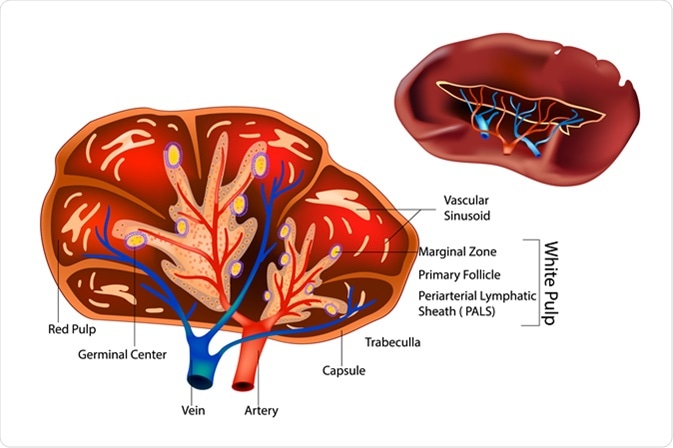
Structure of the Spleen. Image Credit: Sakurra / Shutterstock
Red pulp comprised of:
- Sinusoids and splenic cords – Consists of reticular cells and fibers, which are filled with blood
- Marginal zone – A border between the white pulp and red pulp; consists of numerous macrophages
White pulp comprised of:
- Nodules – called Malpighian corpuscles, which contains lymphoid follicles
- B-lymphocytes and T-lymphocytes
The elaborate tissue structure of the spleen links the organ to the liver by means of the portal vein system.
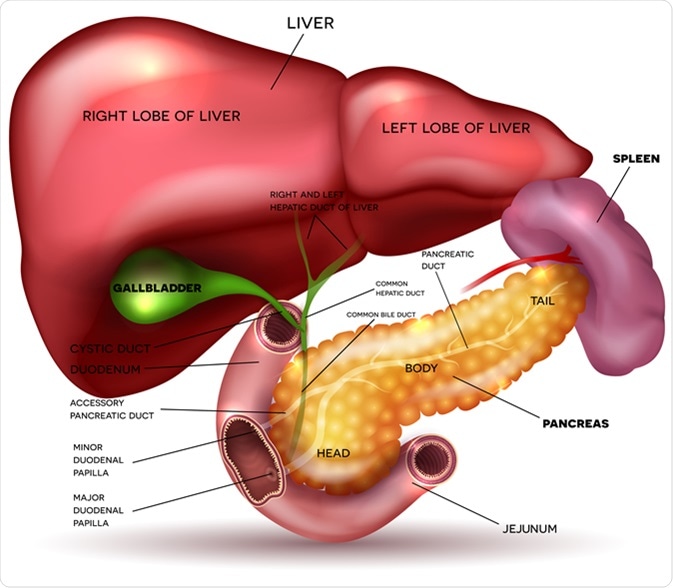
Liver, pancreas, gallbladder and spleen. Image Credit: Tefi / Shutterstock
What is the Physiologic Role of the Spleen?
- Monitoring of the immune system
- Filtration of aged and diseased red blood cells
- Creation of blood cells from hematopoietic stem cells
- Regulation of blood volume
Spleen in Drug Metabolism
As evident from its structural characteristics, the spleen is highly permeable to blood-borne molecules. The splenic parenchyma acts as a distribution platform for numerous drugs that are excluded from other major sites of drug metabolism either due to their large size or their charge. The microanatomy of the spleen makes new generation drugs such as monoclonal antibodies, nanoparticles, and liposomes accessible to the splenic parenchyma.
The amount of drug that enters the parenchyma depends on splenic blood flow. The spleen has a very high blood flow, which makes it one of the most highly perfused organs; However, due to its small weight, the spleen receives only 4.8 ± 1.5% of the total cardiac output. This, in turn, reduces the overall impact of the spleen in the management of drug distribution inside the body.
After the blood enters the spleen, it can perfuse through the white pulp via the marginal zone or break into the red pulp and reach the splenic cords.
Processing of Classical Drugs
Blood-borne drugs are usually directed to the white pulp region of the spleen where they are exposed to lymphocytes and macrophages, the major cells present in the white pulp. Interactions between drugs and these cells have been associated with therapeutic activity, toxicity and elimination.
Macrophages are targets for drugs such as fluoroquinolones and clofazimine, whereas drugs cyclosporine and saquinavir-ritonavir work in conjunction with lymphocytes.
Drugs transporters, such as concentrative nucleoside transporter and monocarboxylate transporter, play a key role in intracellular transport of drugs that target macrophages. Various drug-metabolizing enzymes, such as those belonging to the cytochrome P450 family, are also expressed by macrophages and lymphocytes.
Disposition of New Generation Drugs
New generation drugs such as monoclonal antibodies, nanoparticles, and liposomes are disposed of by different mechanisms such as
- Internalization of opsonized small particles
- Capture by marginal zone macrophages
- Internalization by red pulp macrophages
Monoclonal antibodies have a high molecular weight and are highly polar molecules. They penetrate the splenic parenchyma by way of convection.
Splenic macrophages and internalization of opsonized particles are the mechanisms responsible for the uptake of nanoparticle.
Another interesting mechanism for nanoparticle disposition includes the formation of a protein corona which is recognized by scavenger receptors, and ultimately clearance via the reticuloendothelial system.
Nanoparticles with particles larger than 100–200 nm are unable to cross the endothelial slit of splenic sinuses. These are thus filtered and retained in the red pulp of the spleen. With time, the macrophages present in the red pulp internalize the particles and destroy them.
The spleen is often referred to as the neglected organ. However, its emerging role in the metabolism of numerous drugs, particularly the new generation drugs, warrants more research to better understand its role in pharmacokinetics.
Sources
- https://www.ncbi.nlm.nih.gov/pmc/articles/PMC5486072/
- https://www.ncbi.nlm.nih.gov/pubmed/16056254/
- translational-medicine.biomedcentral.com/…/s12967-017-1214-8
- https://www.ncbi.nlm.nih.gov/pubmed/8108677/
- https://www.ncbi.nlm.nih.gov/pubmed/3652639/
- https://www.ncbi.nlm.nih.gov/pubmed/15492020/
- https://www.ncbi.nlm.nih.gov/pmc/articles/PMC3181438/
Subscribe to:
Posts (Atom)