Search This Blog

Friday, December 20, 2019

Analyst action, Dec. 20

Change Healthcare (NASDAQ:CHNG) initiated with Outperform rating and $18 (23% upside) price target at Raymond James.
Health Catalyst (NASDAQ:HCAT) initiated with Strong Buy rating and $46 (52% upside) price target at Raymond James.
HealthStream (NASDAQ:HSTM) initiated with Market Perform rating at Raymond James.
Immunomedics (NASDAQ:IMMU) initiated with Buy rating and $26 (30% upside) price target at BofA Global Research.
Marinus Pharmaceuticals (NASDAQ:MRNS) initiated with Outperform rating and $6 (400% upside) price target at Oppenheimer.
Medical Properties Trust (NYSE:MPW) initiated with Buy rating and $25 (23% upside) price target at Mizuho Securities.
Omega Healthcare Investors (NYSE:OHI) initiated with Buy rating and $50 (21% upside) price target at Mizuho.
Phreesia (NYSE:PHR) initiated with Outperform rating and $33 (27% upside) price target at Raymond James.
Physicians Realty Trust (NYSE:DOC) initiated with Buy rating and $20 (7% upside) price target at Mizuho.

Thursday, December 19, 2019

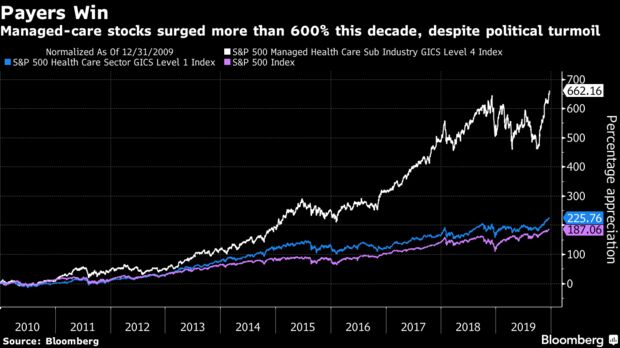
Managed Care’s 600% Rally Defies a Decade of Turmoil in Health-Care Market

You wouldn’t know it from looking at this year’s chart, but health insurers have been the industry’s most successful trade over the past decade.
The S&P 500 Managed Care Index, which houses five of America’s largest payers of medical services, has surged more than 600% since late 2009. The benchmark outperformed the S&P 500 by more than threefold over that time. The next best performance in health care is life sciences, as the S&P 500 Life Sciences Tools & Services Industry Index is up about 400% over the past 10 years, according to data compiled by Bloomberg.
Managed-care stocks surged more than 600% this decade, despite political turmoil
The managed-care gauge’s best performer this decade has been Centene Corp., which soared 1075%, followed by UnitedHealth Group Inc. The stock, which has a 63% weight in benchmark, has rallied 868% during the same period.
Several factors have bolstered the fortunes of health insurance stocks. The Affordable Care Act took full effect in late 2013, opening access to new markets such as Medicaid expansion and the public exchanges. After several rocky years, insurers finally found a way to make money in the ACA marketplace.
Another big market has been Medicare Advantage, a private version of the U.S. government program for the elderly. As the population ages, more retirees are opting for such plans over traditional Medicare.
While insurer stocks were volatile earlier this year, they’ve staged a rapid comeback in recent months. The S&P 500 Managed Care Index has gained 35% since late September, on track for its largest quarterly gain since Bloomberg started tracking the data in 1994. The benchmark is up 19% for the year, reversing losses as steep as 13% back in April.
The sector is facing a tough outlook next year with uncertainty looming ahead of the U.S. presidential election. Yet despite the potential turmoil, Goldman analyst Stephen Tanal said managed-care stocks can still “work.” His analysis this week found that sell-offs were typically followed by outperformance in the last six elections excluding 2008. The S&P Managed Care Index rose an average 29% in election years, outperforming the broader market, he said.

Roche, Rheos to collaborate for next-gen immunometabolism research

Rheos Medicines has sealed a near $800 million biobucks deal with Swiss major Roche to seek out and develop new meds for autoimmune and inflammatory diseases.
Rheos’ work is focused on what it calls metabolism-tuning therapies and is targeting autoimmune disease and cancer via metabolic pathways in immune cells that are linked to disease and “re-tuning” the immune responses that go awry in those diseases.
Under the deal, cancer giant Roche will gain an “exclusive research effort” to seek out new drugs in immunometabolism using this platform that “modify the fate or function of certain human immune cells.”

For its part, Rheos will also be responsible for drug discovery efforts under the collab. Roche gets an option to exclusively license a “defined number of programs” coming out of the deal.
The financials break down like this: There is a fairly small $42.5 million upfront from Roche in cash, with $90 million also tacked on for “specified research and preclinical development milestones as well as option fees.”
The largest part, of course, is backloaded: $660 million is all tied into biobucks, and the caveats that brings. On top of this, “for those products for which Rheos and Roche could share development and commercial rights Rheos will be entitled to additional financial compensation within the U.S. and ex- U.S. commensurate with the share of its financial investment in development and commercialization.”
“We are thrilled to be leveraging our expertise in human immune cell metabolism in partnership with Roche,” said Barbara Fox, the new CEO at Rheos.
“We believe that our team’s deep experience in immunology and cellular metabolism along with our unique approach have the potential to unlock a new frontier in precision medicine for immune mediated disease. This partnership will help to accelerate the translation of insights in immunometabolism to the development of groundbreaking therapeutics for patients with autoimmune and inflammatory diseases.”

Fox became the startup’s chief just a few months back, coming off her former company Tilos Therapeutics’ $773 million sale to Merck,
She takes over from interim CEO Abbie Celniker, Ph.D., a partner at Third Rock Ventures, which launched Rheos with $60 million in March 2018. Celniker ceded the reins last September when Third Rock poached Dr. Sanjay Keswani from Roche, but took them up again this July when Keswani headed to Annexon Biosciences to become its chief medical officer.
“We are excited to partner with Rheos and look forward to the development of a novel class of therapeutics for patients with autoimmune and inflammatory disease,” added Gijs van den Brink, senior vice president and global head of immunology, infectious diseases and ophthalmology at Roche Pharma Early Research and Development.
“We believe Rheos’ proprietary platform and expertise in immunometabolism is a strong complement to Roche’s expertise in autoimmunity and inflammation and in developing and commercializing innovative therapies.”

UMass Memorial to launch telemedicine program for opioid addiction

UMass Memorial Hospital will roll out a new program that allows physicians to evaluate patients with substance use disorder using telemedicine technology, according to WFXT.
The program enables patients who have been admitted to their local hospital for opioid overdose to have a face-to-face, virtual consultation with a UMass Memorial addiction specialist.
The patient can communicate with the physician using video technology on a smartphone or tablet; the UMass Memorial specialist can provide the patient with resources or medication to help the patient avoid using opioids.
UMass Memorial Hospital’s opioid task force received a $200,000 grant for the program, which will kick off next month, according to the report.

Medicare reimbursement down a third for hip, knee joint procedures: study

Average physician reimbursement for all hip and knee joint procedures fell more than 30 percent in the past 20 years, according to a study published in The Journal of Arthroplasty.
For the study, researchers evaluated trends in Medicare reimbursement rates from 2000-19 for hip and knee arthroplasty procedures. The authors queried the American Academy of Orthopedic Surgeons coding reference to uncover which CPT codes were most frequently used to document adult hip and knee reconstruction. They paired the codes with physician payment data from CMS.
On average, physician reimbursement fell by 31.9 percent for all hip joint procedures in the study period and 33.3 percent for all knee joint procedures. The researchers also found primary total hip arthroplasty physician fees fell by 37.1 percent in the study period, with primary total knee arthroplasty fees falling 40.6 percent.
“Throughout the study period, physician reimbursement decreased for all knee and hip arthroplasty procedures. Increased awareness and consideration of these trends will be important for policy-makers, hospitals, and surgeons to assure equitable access to quality hip and knee arthroplasty care in the United States,” the authors concluded.

FDA warns Conformis for failing to meet sterilization standards

The FDA sent a warning letter to Conformis, a Billerica, Mass.-based devicemaker specializing in knee implants, citing sterilization issues with the company’s knee replacement systems, according to MedTech Dive.
The letter, dated Dec. 10, said the FDA had previously alerted Conformis to the sterilization issues, but Conformis had failed to establish procedures to correct and prevent the issues from happening again.
The issues relate to Conformis’ vaporized hydrogen peroxide sterilizers, which the FDA said have failed to properly sterilize products in several instances.
Conformis said in a U.S. Securities and Exchange Commission filing that it uses the sterilizers as a secondary sterilization method in limited circumstances and on a small number of its products.
Conformis also said in the filing that the FDA did not say the sterility of Conformis’ products were compromised. The company said it is working to address the issues and it doesn’t expect them to cause an interruption in manufacturing, distribution or its new product launch schedule.
Conformis said it has been planning to replace the sterilizers and has submitted a request for approval from the FDA for a new sterilization unit, but the FDA said the request from Conformis does not resolve the agency’s immediate concern of assuring the sterility of its devices.
The FDA gave Conformis 15 days to respond, telling how it plans to prevent the recurrence of the violations and to provide evidence its sterilizers can pass validation under routine operating conditions, according to MedTech Dive.

Large study links sustained weight loss to reduced breast cancer risk

A large new study finds that women who lost weight after age 50 and kept it off had a lower risk of breast cancer than women whose weight remained stable, helping answer a vexing question in cancer prevention. The reduction in risk increased with the amount of weight lost and was specific to women not using postmenopausal hormones. The study appears in JNCI.
In the United States, more than two in three adult women are overweight or obese. And while high body mass index (BMI) is an established risk factor for postmenopausal breast cancer, there has not been adequate evidence to determine if that risk is reversible by losing excess weight.
To learn more, investigators from the American Cancer Society, Harvard T.H. Chan School of Public Health, and others used the Pooling Project of Prospective Studies of Diet and Cancer (DCPP) to estimate the association of sustained weight loss in middle or later adulthood on subsequent breast cancer risk. Their analysis included more than 180,000 women aged 50 and older from ten prospective studies. The new analysis is the first with a large enough sample size to examine the important question of whether sustained weight loss can impact breast cancer risk with statistical precision. Weight was assessed three times over approximately 10 years: at study enrollment; after about five years; then again about four years later.
The results showed women with sustained weight loss had a lower risk of breast cancer than women whose weight remained stable, and the larger the amount of sustained weight loss, the lower was the risk of breast cancer. Women who lost 2 to 4.5 kg (about 4.4 to 10 lbs.) had a 13% lower risk (HR= 0.87, 95% CI: 0.77-0.99) than women with stable weight. Women who lost 4.5 to 9 kg (10- 20 lbs.) had a 16% lower risk (HR=0.84, 95% CI: 0.73-0.96). Women who lost 9 kg or more (20+ lbs.) had a 26% lower risk (HR=0.74, 95% CI: 0.58-0.94).
In addition, women who lost 9 kg or more and gained some (but not all) of the weight back had a lower risk of breast cancer compared with those whose weight remained stable (HR=0.77, 95% CI: 0.62-0.97).
“Our results suggest that even a modest amount of sustained weight loss is associated with lower breast cancer risk for women over 50,” said Lauren Teras, PhD, lead author of the study. “These findings may be a strong motivator for the two-thirds of American women who are overweight to lose some of that weight. Even if you gain weight after age 50, it is not too late to lower your risk of breast cancer.”

Story Source:
Materials provided by American Cancer SocietyNote: Content may be edited for style and length.

Journal Reference:
  1. Lauren R Teras, Alpa V Patel, Molin Wang, Shiaw-Shyuan Yaun, Kristin Anderson, Roderick Brathwaite, Bette J Caan, Yu Chen, Avonne E Connor, A Heather Eliassen, Susan M Gapstur, Mia M Gaudet, Jeanine M Genkinger, Graham G Giles, I-Min Lee, Roger L Milne, Kim Robien, Norie Sawada, Howard D Sesso, Meir J Stampfer, Rulla M Tamimi, Cynthia A Thomson, Shoichiro Tsugane, Kala Visvanathan, Walter C Willett, Anne Zeleniuch-Jacquotte, Stephanie A Smith-Warner. Sustained weight loss and risk of breast cancer in women ≥50 years: a pooled analysis of prospective dataJNCI: Journal of the National Cancer Institute, 2019; DOI: 10.1093/jnci/djz226