Search This Blog

Saturday, December 21, 2019

Overspill of fat shown to cause Type 2 Diabetes

For the first time, scientists have been able to observe people developing Type 2 diabetes – and confirmed that fat over-spills from the liver into the pancreas, triggering the chronic condition.
The research, led by Professor Roy Taylor at Newcastle University, UK, is published in the academic journal, Cell Metabolism.
The study involved a group of people from Tyneside who previously had Type 2 diabetes but had lost weight and successfully reversed the condition as part of the DiRECT trial, which was funded by Diabetes UK and led by Professors Roy Taylor and Mike Lean (Glasgow University).
The majority remained non-diabetic for the rest of the two year study, however, a small group went on to re-gain the weight and re-developed Type 2 diabetes.
Professor Roy Taylor, from the Newcastle University Institute of Translational and Clinical Research, explained what the advanced scanning techniques and blood monitoring revealed.
He said: “We saw that when a person accumulates too much fat, which should be stored under the skin, then it has to go elsewhere in the body. The amount that can be stored under the skin varies from person to person, indicating a ‘personal fat threshold’ above which fat can cause mischief.
“When fat cannot be safely stored under the skin, it is then stored inside the liver, and over-spills to the rest of the body including the pancreas. This ‘clogs up’ the pancreas, switching off the genes which direct how insulin should effectively be produced, and this causes Type 2 diabetes.”
This research by Professor Taylor confirms his Twin Cycle Hypothesis – that Type 2 diabetes is caused by excess fat actually within both the liver and pancreas, and especially that this process is reversible.
Body of research
This latest paper builds on previous Newcastle studies supported by Diabetes UK showing exactly why Type 2 diabetes can be reversed back to normal glucose control. Those studies led to the large DiRECT trial which showed that Primary Care staff can achieve remission of Type 2 diabetes by using a low calorie diet with support to maintain the weight loss.
A quarter of participants achieved a staggering 15 kg or more weight loss, and of these, almost nine out of 10 people put their Type 2 diabetes into remission. After two years, more than one third of the group had been free of diabetes and off all diabetes medication for at least two years.
In 2020, this approach to management of short duration Type 2 diabetes is to be piloted in the NHS in up to 5,000 people across England, and a similar programme is being rolled out in Scotland.
Professor Taylor adds: “This means we can now see Type 2 diabetes as a simple condition where the individual has accumulated more fat than they can cope with.
“Importantly this means that through diet and persistence, patients are able to lose the fat and potentially reverse their diabetes. The sooner this is done after diagnosis, the more likely it is that remission can be achieved.”
The team are continuing work to establish what may affect an individual’s personal threshold and are supporting the roll out of the NHS Initiatives in both England and Scotland. ‘Life Without Diabetes – The definitive guide to understanding and reversing your Type 2 diabetes’ by Professor Roy Taylor will be published by Short Books on 26th December 2019.
###
Reference: Hepatic Lipoprotein Export and Remission of Human Type 2 Diabetes after Weight Loss. Cell Metabolismhttps://www.cell.com/cell-metabolism/fulltext/S1550-4131(19)30662-X

Does Medicaid managed care impact obstetrical care and birth outcomes?

A new study shows that among a set of disadvantaged women, Medicaid managed care reduces the women’s access to high-quality hospital services during pregnancy and delivery and was associated with worse birth outcomes, worse prenatal care, and a higher risk of inappropriate gestational weight gain. The specific results and their implications are reported in a study published in Journal of Women’s Health, a peer-reviewed publication from Mary Ann Liebert, Inc., publishers. Click here to read the full-text article on the Journal of Women’s Health website through January 20, 2020.
Ji Yan, PhD, Appalachian State University, Boone, NC, was the author of the article entitled “The Impact of Medicaid Managed Care on Obstetrical Care and Birth Outcomes: A Case Study.” Dr. Yan based his findings on a dataset of disadvantaged women who had singleton births over a 10-year period, resulting in more than 78,300 mother-infant observations. The Medicaid managed care program under which these women received health care achieved cost savings by reducing the use of some high-tech obstetrical services and limiting access to high-quality hospital services. There was a price to pay, however, in maternal health care utilization and infant well-being.
Susan G. Kornstein, MD, Editor-in-Chief of Journal of Women’s Health and Executive Director of the Virginia Commonwealth University Institute for Women’s Health, Richmond, VA, states: “This study emphasizes the need to be cautious in designing and implementing lower cost managed care programs for low-income obstetrical patients, as it demonstrates the possible negative outcomes for both mothers and their infants.”

New Setbacks for Former Hahnemann Residents

In July, we reported that Hahnemann University Hospital in Philadelphia, a teaching hospital for Drexel University, would be shutting down, leaving 570 interns and residents in limbo. Here’s what happened in the aftermath.
Most were able to relocate, but now they’re potentially facing another severe setback: Hahnemann’s owner doesn’t want to pay for the “tail” malpractice insurance that covers residents’ time at the hospital after they’ve moved on.
The coverage is important because claims are often filed years after an incident happens. Residents may have to dig into their own pockets to buy a policy and be protected.
David Aizenberg, MD, who was the director of Hahnemann’s internal medicine residency program until it ended, said some residents have been quoted as high as $70,000 for a one-time payment.
“That’s more than what they make in a year,” Aizenberg told MedPage Today, adding that many states require uninterrupted insurance coverage for licensure. “If they don’t purchase their own coverage, that may potentially disqualify them from their new position.”
In denying that coverage, parent company Philadelphia Academic Health System (PAHS) — which had filed for Chapter 11 bankruptcy — now faces serious difficulties of its own. On Dec. 17, bankruptcy judge Kevin Gross ordered it to file for Chapter 7 instead, unless PAHS can persuade the court otherwise.
“The debtors appear to have failed to maintain appropriate insurance for physicians they employed, which would give rise to conversion pursuant to 11 U.S.C.,” Gross wrote in his order, as reported by Philadelphia public radio station WHYY. Chapter 11 requires that organizations keep up their insurance coverage.
“The owners are smart enough to understand that if this case is converted, there might be a greater likelihood that they will get sued for things they did before bankruptcy,” Jonathan Lipson, who teaches bankruptcy law at Temple University, told WHYY.
The move provides the residents with greater leverage for negotiations, Aizenberg said.
Other Changes
And Hahnemann isn’t the only entity in litigation related to the closure: seven physicians losing their jobs are suing Drexel University for breach of contract.
The doctors argue that Drexel failed to give them enough notice that they were being terminated. The university wants to end their employment on Jan. 14, 2020, but the lawsuit alleges that can’t be done until the end of the academic year, or in this case, June 30, 2020, under their current contracts.
They also allege that Drexel mismanaged the transition of patient care, making it more difficult for the doctors to take patients to their new practices.
The physicians are seeking full payment plus damages. Their lawsuit was filed Dec. 9 in Philadelphia Common Pleas Court.
Also, the Pennsylvania Department of Health officially revoked Hahnemann’s license in November, saying a closure survey determined it no longer meets the statutory definition of a hospital.
And Drexel University and Tower Health now officially co-own St. Christopher’s Hospital for Children, another PAHS facility included in the bankruptcy filing.
Hahnemann was a 170-year old safety net hospital that served Philadelphia’s low-income and most vulnerable patients. Thousands of those patients will now have to find new primary care doctors in the area.
“Our internal medicine residents did a great job taking care of this underserved population,” Aizenberg said. “You take away 120-something residents who saw patients in that clinic, that’s thousands of patients who lose where they were getting care. That’s been pretty sad to see.”

Rite Aid CEO: Turnaround ‘Will Take Some Time’

Rite Aid’s chief executive officer acknowledged the drugstore chain’s turnaround “will take some time” as the company executes a new strategy in the coming months that includes investments into its pharmacy benefit manager.
Though it’s just four months in the reign of Heyward Donigan, the new chief executive officer said Thursday the drugstore chain’s outlook is improving even as Rite Aid, like other drugstore chains, continues to face reimbursement pressures for prescription drugs.
In the drugstore chain’s third quarter ended Nov. 30, Rite Aid reported net income of $52.3 million, or 98 cents per share, compared to a $17 million loss in the year-ago quarter, the company reported Thursday. Meanwhile, revenues from continuing operations for the quarter were flat at $5.46 billion compared to  $5.45 billion in the year-ago quarter.
While she’s been CEO for just four months, Donigan wants to emphasize the company’s pharmacy benefit manager (PBM), EnvisionRxOptions, when negotiating deals with employers and health insurance companies.
Rite Aid’s PBM will remain independent at a time when larger PBMs are now owned by health insurance companies. Last year, Cigna bought the PBM Express Scripts while Anthem this year is rolling out its own PBM, IngenioRx and the nation’s largest health insurer, UnitedHealth Group, owns OptumRx.
“EnvisionRxOptions is one of our most important assets,” Donigan said in an hour-long call Thursday morning to discuss company earnings. “We are bullish on its growth potential.”
Donigan said Rite Aid is streamlining costs at EnvisionRxOptions and earlier this week eliminated the CEO position and promoted an internal executive to run the PBM. Dan Robson, who has most recently been president of Robson of EnvisionRxOptions’ subsidiary, MedTrakRx, “will lead all aspects of EnvisionRxOptions operations,” the company said earlier this week.
Rite Aid said it is growing its Medicare part D drug benefit enrollment and has added 140,000 new seniors to those plans effective in January 2020 following the recently completed open enrollment period.
Donigan, a longtime healthcare executive, earlier this year replaced the embattled John Standley as Rite Aid CEO. Standley was blamed for two failed mergers and a battered share price of the U.S. drugstore chain.
Before Donigan arrived in August, Rite Aid was amid a series of efforts to boost sales, hiring new executives and signing new marketing and business deals. Rite Aid has more than 2,400 stores in 18 states.

Cigna’s Express Scripts, Big Blue Cross PBM In Major Deal To Tame Drug Costs

Cigna’s Express Scripts pharmacy benefit management unit and a PBM owned by 18 Blue Cross and Blue Shield plans have joined forces to tame drug costs for a massive client list that covers 100 million people.
In an announcement Thursday nightExpress Scripts and Prime Therapeutics said their new three-year collaboration is “designed to deliver more affordable care for clients and their members by enhancing pharmacy networks and pharmaceutical manufacturer value.” The collaboration will allow Prime’s member Blue Cross health plans to gain leverage through Express Scripts’ buying clout and large pharmacy network.
The collaboration could put pressure on drug makers that are already under fire for rising prescription costs at a time the pharmaceutical industry is already taking heat and facing bipartisan legislation wending its way through Congress that appears to have the support of the Trump administration. PBMs are the middlemen between drug makers and patients when it comes to purchasing drugs in bulk and leveraging their buying clout to negotiate better discounts for consumers and employers on prescription drugs.
Prime is owned by 18 Blue Cross and Blue Shield Plans, including Florida Blue and Health Care Service Corp., which owns Blues plans in Illinois, Texas, Oklahoma, New Mexico and Montana.  Combined, Prime provides PBM services to more than 28 million people. Meanwhile, Express Scripts said it has more than 3,000 clients and 75 million customer relationships.
“Both companies will continue to work independently with pharmaceutical manufacturers—Express Scripts handling negotiations for drugs on the pharmacy benefit, and each company separately managing certain relationships on the medical benefit and value-based contracting,” the companies said in a joint statement. Financial terms of the collaboration weren’t disclosed.
The deal comes amid an industry shakeup that includes consolidation of PBMs with big health plans. The nation’s second largest health insurer Anthem, which owns 14 Blue Cross and Blue Shield plans, is rolling out its own PBM called IngenioRx. Meanwhile, CVS Health, which owns the Caremark PBM, is gaining market share following its acquisition last year of Aetna, the nation’s third-largest health insurer. And UnitedHealth Group, the nation’s largest health insurer, owns the OptumRx PBM, which is also growing rapidly.
“As health care costs continue to grow at an unsustainable pace, improving the value we deliver in health care is critical,” Prime Therapeutics chief executive Ken Paulus said in a statement Thursday evening. ”This collaboration will improve outcomes while still maintaining flexibility and transparency to the clients we proudly serve.”
Cigna’s Express Scripts said the collaboration “will have an immaterial impact to adjusted income from operations in 2020 with a more positive contribution beginning in 2021.”
“Our agreement reinforces our position as a health services partner of choice for health plans, employers, government and other payers seeking the most value for their investments in health care,” Express Scripts president Tim Wentworth said. “This collaboration allows both Prime and Express Scripts to leverage our capabilities to deliver more affordable health care.”

Show ‘Em the Money: Paying Patients to Shop for Affordable Medical Care

After three months of physical therapy, her doctor told her that it was time to get an MRI. She had already paid off her annual deductible, meaning the imaging test would “only” cost her the $150 co-pay. An imaging center near where she worked charged $1500 for the test. Just two miles away, another facility would have just charged only $900 for the same test. She arranged to go to the more convenient location knowing the difference in price would be picked up by her insurance company.
Until…!
She found out she was eligible for a rewards program. She called a rewards advice line and found out that if she chose the less expensive imaging center, her insurance company would send her a check for $400. She’d make money on the deal!
I’ve been describing the kind of program that insurers are increasingly turning to in an effort to incentivize patients to be price sensitive when receiving blood tests, imaging exams, or common procedures. It’s one of the consumer oriented innovations I explore in Sick to Debt (currently ranked one of the top five books authored by people with the last name Ubel).
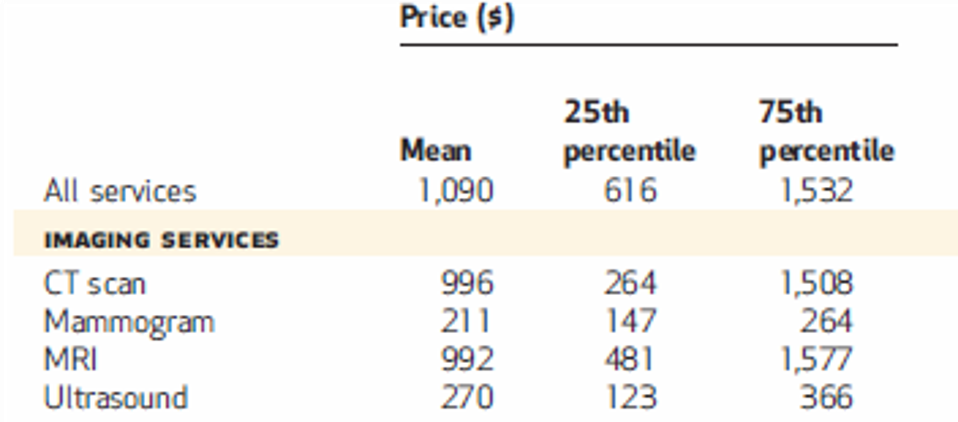
In this case, companies liked Vitals Smartshopper are partnering with insurers to reward patients who choose low-cost alternatives. One such partnership involved Healthcare Services Corps (HCSC), an amalgamation of Blue Cross/Blue Shields plans in the Midwest and Southwest. HSCS opened up the rewards program to more than 250,000 people. The rewards covered a wide range of tests and procedures, all of which were offered at a wide range of prices. Here’s a glance at that price variation based on a study published in Health Affairs:
Pretty crazy variation. A fourth of CT scans are less than $264 and a fourth are more than $1500. Insane.
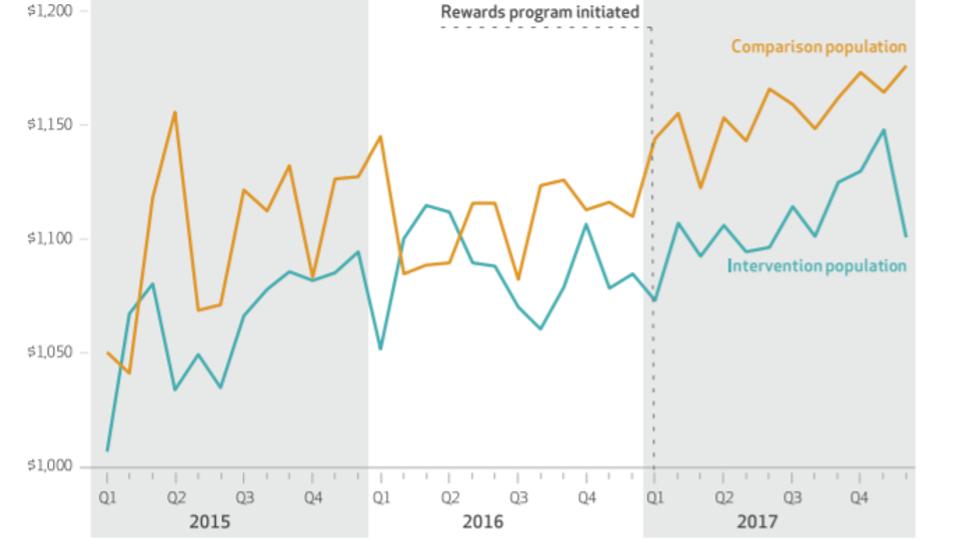
I’m not privy to exactly what HCSC and Vitals Smartshopper did to advertise the program. I do know that most people who received tests and procedures did not shop around for low-priced providers. Less than 9% either called the rewards advice line or logged into the insurer’s price transparency tool. Even with these small numbers, however, the insurer reduced its expenditures by more than $2 million (I have no idea what Vital Smartshopper charged for its work, all of which would have come out of those savings.)
Here is a picture of the average price of eligible procedures before and after the rewards program went into effect, compared to an insured population that didn’t begin the program until 2018.
I like where this program is headed. But I have a few thoughts about how such programs need to evolve.
First, we need to make sure reports from these tests make it into providers’ EHRs regardless of where patients go. It is great to save money on MRIs, but not if the doctors ordering those tests can’t access the images.
Second, such programs should carefully monitor quality of care. I expect that most low-cost providers/testers offer excellent quality. But the rewards program should be designed to weed out low-quality sites, if or when we feel confident we can answer that question. (That’s a whole other tangle of challenges.)
Third, we need to market the heck out of these programs. Instead of 9% of people accessing the program, I’d like to see 99% doing so. Ok that number is unrealistically high. But even if 1 in 3 patients shopped for prices, I’d expect a quick shift in providers’ pricing strategy, as high-priced sites scramble to keep their customers.
Fourth, I’d like to see more employers demand such programs from insurers. If employers demand smarter insurance, with things like reference pricing and value-based insurance design as well as this rewards program, the healthcare marketplace will be forced to respond.
It should never be up to patients alone, as “consumers,” to combat high healthcare prices. Nevertheless, rewards programs like this deserve a role in broader efforts to constrain healthcare spending.

Medical Device Tax Is History After Trump Signs Repeal

The medical device industry hailed President Trump’s signing into law a bipartisan federal spending package that brings in an end to a tax the medical technology industry has been fighting against for the last decade.
The 2.3% tax on medical device sales that is part of the Affordable Care Act has already been on temporary hiatus since the beginning of 2016, but was scheduled to return at the end of this year if Congress didn’t eliminate the tax or put it on hiatus once again.
Medical device makers feared a major hit to their bottom lines, research budgets and jobs if Congress didn’t end or at least shelve the tax before the end of the year. A report released earlier this month from the Tax Foundation shows a return of the medical device tax would “would result in a decline of 21,390 full-time equivalent jobs and a reduction in GDP of $1.7 billion.”
This time, however, the medical device industry and its supporters finally got their dream legislation package that repealed the tax. The Democratic-controlled U.S. House of Representatives repealed the legislation followed by similar action by the U.S. Senate earlier this week. Trump signed the legislation Friday night.
“This is a great day for American patients, American jobs, and American innovation: The medical device tax is officially history,” Scott Whitaker CEO of The Advanced Medical Technology Association (AdvaMed) said of the device tax’s repeal as part of the fiscal 2020 appropriations legislation. AdvaMed represents hundreds of medical device makers, including Abbott Laboratories, Johnson & Johnson, Medtronic and Stryker as well as small firms and startups.
Before it was put on hiatus, the IRS collected between $1 billion and $2 billion a year in 2013, 2014 and 2015. But Congress continued to provide the industry with a temporary fix usually as budgets or spending packages were being negotiated at the end of the year or near the end of a Congressional session.
“With the end of this burdensome tax, the U.S. medtech industry can do what it does better than anyone else in the world: develop life-changing innovations that save and improve patients’ lives, and create high-paying, high-tech jobs to keep the American economy booming,” Whitaker said.