Search This Blog

Wednesday, March 4, 2020

‘It’s like you have a hand again’: An ultra-precise mind-controlled prosthetic

In a major advance in mind-controlled prosthetics for amputees, University of Michigan researchers have tapped faint, latent signals from arm nerves and amplified them to enable real-time, intuitive, finger-level control of a robotic hand.
To achieve this, the researchers developed a way to tame temperamental nerve endings, separate thick nerve bundles into smaller fibers that enable more , and amplify the signals coming through those nerves. The approach involves tiny muscle grafts and machine learning algorithms borrowed from the brain-machine interface field.
“This is the biggest advance in motor control for people with amputations in many years,” said Paul Cederna, who is the Robert Oneal Collegiate Professor of Plastic Surgery at the U-M Medical School, as well as a professor of biomedical engineering.
“We have developed a technique to provide individual finger control of prosthetic devices using the nerves in a patient’s residual limb. With it, we have been able to provide some of the most advanced prosthetic control that the world has seen.”
Cederna co-leads the research with Cindy Chestek, associate professor of biomedical engineering at the U-M College of Engineering. In a paper published March 4 in Science Translational Medicine, they describe results with four study participants using the Mobius Bionics LUKE arm.
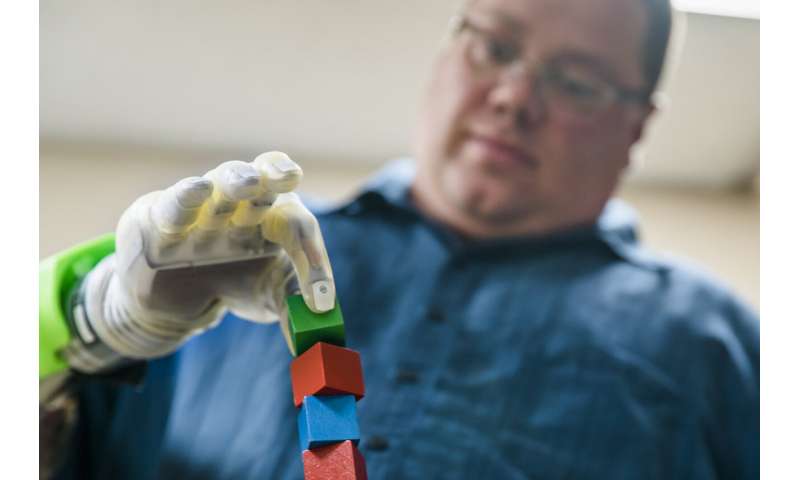
'It's like you have a hand again': An ultra-precise mind-controlled prosthetic
Joe Hamilton, a participant in the University of Michigan RPNI study, naturally uses his mind to control a DEKA prosthetic hand to pinch a small zipper on a hand development testing platform. Credit: Evan Dougherty/University of Michigan Engineering
Intuitive prosthetic control works on the first try
“You can make a prosthetic hand do a lot of things, but that doesn’t mean that the person is intuitively controlling it. The difference is when it works on the first try just by thinking about it, and that’s what our approach offers,” Chestek said. “This worked the very first time we tried it. There’s no learning for the participants. All of the learning happens in our algorithms. That’s different from other approaches.”
While study participants aren’t yet allowed to take the arm home, in the lab, they were able to pick up blocks with a pincer grasp; move their thumb in a continuous motion, rather than have to choose from two positions; lift spherically shaped objects; and even play in a version of Rock, Paper, Scissors called Rock, Paper, Pliers.
“It’s like you have a hand again,” said study participant Joe Hamilton, who lost his arm in a fireworks accident in 2013. “You can pretty much do anything you can do with a real hand with that hand. It brings you back to a sense of normalcy.”
Turning a tiny muscle graft into a nerve signal amplifier
One of the biggest hurdles in mind-controlled prosthetics is tapping into a strong and stable nerve signal to feed the bionic limb. Some research groups—those working in the brain-machine interface field—go all the way to the primary source, the brain. This is necessary when working with people who are paralyzed. But it’s invasive and high-risk.
For people with amputations, —the network that fans out from the brain and spinal cord—have been interesting, but they hadn’t yet led to a long-term solution for a couple of reasons: The nerve signals they carry are small. And other approaches to picking up those signals involved probes that eavesdropped by force. These “nails in nerves,” as researchers sometimes refer to them, lead to scar tissue, which muddles that already faint signal over time.
The U-M team came up with a better way. They wrapped tiny muscle grafts around the nerve endings in the participants’ arms. These “regenerative peripheral nerve interfaces,” or RPNIs, offer severed nerves new tissue to latch on to. This prevents the growth of nerve masses called neuromas that lead to phantom limb pain. And it gives the nerves a megaphone. The muscle grafts amplify the nerve signals. Two patients had electrodes implanted in their muscle grafts, and the electrodes were able to record these nerve signals and pass them on to a prosthetic hand in real time.
“To my knowledge, we’ve seen the largest voltage recorded from a nerve compared to all previous results,” Chestek said. “In previous approaches, you might get 5 microvolts or 50 microvolts—very very small signals. We’ve seen the first ever millivolt signals.
“So now we can access the signals associated with individual thumb movement, multidegree of freedom thumb movement, individual fingers. This opens up a whole new world for people who are upper limb prosthesis users.”
And their interface has already lasted years. Others degrade within months due to scar tissue.
The future of prosthetics research and industry
The findings also open up new possibilities for the field, said Chestek, whose expertise is on real-time machine learning algorithms to translate neural signals into movement intent.
“What we found is now the nerve signals are good enough to apply the whole world of things we learned in brain control algorithms to nerve control,” she said.
The approach generates signals for finer movements than what today’s prosthetic hands are capable of.
“Other research groups have contributed to this as well, but we’ve leapfrogged the capabilities of the prosthetic hands that are currently available. I think this is strong motivation for further developments from prosthetic hand companies,” said Philip Vu, a research fellow in biomedical engineering and first author of the paper.
A clinical trial is ongoing. The team is looking for participants.
“So many times, the things we do in a research lab add to the knowledge in the field, but you never actually get a chance to see how that impacts a person,” Cederna said. “When you can sit and watch one person with a device do something that was unthinkable 10 years ago, it is so gratifying. I’m so happy for our participants, and even more happy for all the people in the future that this will help.”
Added Chestek, “It’s going to be a ways from here, but we’re not going to stop working on this until we can completely restore able-bodied hand movements. That’s the dream of neuroprosthetics.”
The paper is titled, “A regenerative peripheral interface allows control of an artificial in upper limb amputees.”

Explore further
Leg amputees feel and use nerve-stimulating leg prosthesis as a real limb

More information: P.P. Vu el al., “A regenerative peripheral nerve interface allows real-time control of an artificial hand in upper limb amputees,” Science Translational Medicine (2020). stm.sciencemag.org/lookup/doi/ … scitranslmed.aay2857


Doctors try 1st CRISPR editing in the body for blindness

Scientists say they have used the gene editing tool CRISPR inside someone’s body for the first time, a new frontier for efforts to operate on DNA, the chemical code of life, to treat diseases.
A patient recently had it done at the Casey Eye Institute at Oregon Health & Science University in Portland for an inherited form of blindness, the companies that make the treatment announced Wednesday. They would not give details on the patient or when the surgery occurred.
It may take up to a month to see if it worked to restore vision. If the first few attempts seem safe, doctors plan to test it on 18 children and adults.
“We literally have the potential to take people who are essentially blind and make them see,” said Charles Albright, chief scientific officer at Editas Medicine, the Cambridge, Massachusetts-based company developing the treatment with Dublin-based Allergan. “We think it could open up a whole new set of medicines to go in and change your DNA.”
Dr. Jason Comander, an eye surgeon at Massachusetts Eye and Ear in Boston, another hospital that plans to enroll patients in the study, said it marks “a new era in medicine” using a technology that “makes editing DNA much easier and much more effective.”
Doctors first tried in-the-body gene editing in 2017 for a different inherited disease using a tool called zinc fingers. Many scientists believe CRISPR is a much easier tool for locating and cutting DNA at a specific spot, so interest in the new research is very high.
The people in this study have Leber congenital amaurosis, caused by a that keeps the body from making a protein needed to convert light into signals to the brain, which enables sight. They’re often born with little vision and can lose even that within a few years.
Scientists can’t treat it with standard gene therapy—supplying a replacement gene—because the one needed is too big to fit inside the disabled viruses that are used to ferry it into .
So they’re aiming to edit, or delete the mutation by making two cuts on either side of it. The hope is that the ends of DNA will reconnect and allow the gene to work as it should.
It’s done in an hour-long surgery under general anesthesia. Through a tube the width of a hair, doctors drip three drops of fluid containing the gene editing machinery just beneath the retina, the lining at the back of the eye that contains the light-sensing cells.
“Once the cell is edited, it’s permanent and that cell will persist hopefully for the life of the patient,” because these cells don’t divide, said one study leader not involved in this first case, Dr. Eric Pierce at Massachusetts Eye and Ear.
Doctors try 1st CRISPR editing in the body for blindness
Charles Albright, executive vice president and chief scientific officer at Editas Medicine, a genome-editing company, in Cambridge, Mass., walks through the company’s office on Jan. 8, 2020. “We literally have the potential to take people who are essentially blind and make them see,” said Albright, whose company is developing a gene editing treatment for blindness with Dublin-based Allergan. “We think it could open up a whole new set of medicines to go in and change your DNA.” (AP Photo/Rodrique Ngowi)
Doctors think they need to fix one tenth to one third of the cells to restore vision. In , scientists were able to correct half of the cells with the treatment, Albright said.
The eye surgery itself poses little risk, doctors say. Infections and bleeding are relatively rare complications.
One of the biggest potential risks from gene editing is that CRISPR could make unintended changes in other genes, but the companies have done a lot to minimize that and to ensure that the treatment cuts only where it’s intended to, Pierce said. He has consulted for Editas and helped test a gene therapy, Luxturna, that’s sold for a different type of inherited blindness.
Some independent experts were optimistic about the new study.
“The gene editing approach is really exciting. We need technology that will be able to deal with problems like these large ,” said Dr. Jean Bennett, a University of Pennsylvania researcher who helped test Luxturna at the Children’s Hospital of Philadelphia.
In one day, she had three calls from families seeking solutions to inherited blindness.
“It’s a terrible disease,” she said. “Right now they have nothing.”
Dr. Kiran Musunuru, another gene editing expert at the University of Pennsylvania, said the treatment seems likely to work, based on tests in , mice and monkeys.
The gene editing tool stays in the eye and does not travel to other parts of the body, so “if something goes wrong, the chance of harm is very small,” he said. “It makes for a good first step for doing gene editing in the body.”
Although the new study is the first to use CRISPR to edit a gene inside the body, another company, Sangamo Therapeutics, has been testing zinc finger gene editing to treat metabolic diseases.
Other scientists are using CRISPR to edit cells outside the body to try to treat cancer, sickle cell and some other diseases.
All of these studies have been done in the open, with government regulators’ approval, unlike a Chinese scientist’s work that brought international scorn in 2018. He Jiankui used CRISPR to edit embryos at the time of conception to try to make them resistant to infection with the AIDS virus. Changes to embryos’ DNA can pass to future generations, unlike the work being done now in adults to treat diseases.
https://medicalxpress.com/news/2020-03-doctors-1st-crispr-body.html

Wave of IPOs file in spite of market turmoil

A wave of IPOs submitted initial filings over the past week, despite the stock market having its worst week since 2008.
Most filed on Friday, meaning they will be able to launch as soon as Monday, March 16, and schedule IPOs for the last week of March. During periods of high volatility, companies often need to price at a steep discount. These latest filers are either willing to take a price cut, are optimistic about the market, or are optimistic about how the market will react to them.
Healthcare benefits management software platform Accolade (ACCD) filed to raise $100 million. Backed by a16z, Accolade is unprofitable (-33% adj. EBITDA), though recent health benefits IPO Progyny (PGNY) has outperformed since its offering.
ORIC Pharmaceuticals (ORIC), a Phase 1 oncology biotech, filed to raise $86 million. The San Francisco-based company’s lead product candidate, ORIC-101, is a small molecule therapy designed to make prostate cancer therapies more effective. Interim data from ORIC-101’s Phase 1b trial is expected by the 1H21.
Pulmonary medical device maker Pulmonx (LUNG) also filed to raise $86 million. Backed by Boston Scientific, the company received pre-market approval for its severe emphysema treatment device, the Zyphyr Valve, in 2018. As a result of commercialization, 2019 sales grew 63% to $33 million (-55% EBITDA margin).
NLS Pharamceutics (NLSP), a biotech developing therapies for CNS and sleep disorders, filed to raise $40 million. The Swiss company is led by biotech industry veterans. Biotechs have done well recently, and another biotech targeting CNS disorders, Passage Bio (PASG), has traded up since its IPO last week.
Relevant Profiles: ACCD, ORIC, LUNG, NLSP, PASG
https://www.renaissancecapital.com/IPO-Center/News/67552/Wave-of-IPOs-file-in-spite-of-market-turmoil

Scandal-hit NMC Health booted out in FTSE 100 reshuffle

Following months of turbulent trading, NMC Health is all set to lose its spot on the prestigious FTSE 100.
It will be expelled from the blue-chip index this month in the next reshuffle, which is based on last night’s prices.
FTSE Russell conducts a reshuffle every quarter to ensure major indices contain the biggest firms by market value.
NMC has had a stunning fall from grace, losing around two-thirds of its value following questions raised by US short-seller Muddy Waters about the private hospital group’s financial health.
Companies already in the FTSE 100 must at least be in the 110 biggest firms on the London Stock Exchange’s Main Market to stay, while a company can be promoted if it rises to 90th place or higher.
NMC shares, which are suspended from trading, were worth 938.4p last night, valuing it at £2billion and making it, roughly, the 176th biggest firm.
https://www.thisismoney.co.uk/money/markets/article-8071483/MARKET-REPORT-NMC-Health-booted-FTSE-100-reshuffle.html

Align Tech to buy dental software maker Exocad for €376M

Align Technology (NASDAQ:ALGN) agrees to acquire privately-held Exocad Global Holdings for €376M ($418.7M) in cash.
Exocad sells computer aided design and manufacturing software to dental labs and dental practices in more than 150 countries.
Align Tech says Exocad broadens its digital platform “by addressing restorative needs in our end-to-end digital platform that facilitate ortho-restorative and comprehensive dentistry and accelerates adoption of Invisalign treatment among the more than 300 million potential patients worldwide.”
https://seekingalpha.com/news/3548826-align-tech-to-buy-dental-software-maker-exocad-for-376m

Ocular Therapeutix +9% as Piper hikes target

Ocular Therapeutix (NASDAQ:OCUL) is up 8.6% after hours, adding on to a 32.4% gain today, after a healthy price target bump from Piper Sandler.
Shares jumped on high volume today after its quarterly results and encouraging data on an eye implant.
Piper raised its target to $11 from a previous $7; that now implies 52% upside from the closing price of $7.23.
https://seekingalpha.com/news/3548837-ocular-therapeutixplus-9-piper-hikes-target

Precision BioSciences +3.2% on bullish Stifel start

Precision BioSciences (NASDAQ:DTIL) is up 3.2% postmarket after an initiation at Buy by Stifel.
Analyst Benjamin Burnett set a price target of $21, implying 159% upside from the $8.11 close.
https://seekingalpha.com/news/3548839-precision-biosciencesplus-3_2-on-bullish-stifel-start