Fast Retailing Co. will start selling washable and fast-drying face
masks at its Uniqlo stores in Japan on Friday for customers seeking
suitable face gear for the hot summer amid lingering concerns about
coronavirus infection.
The company said Monday it will sell a pack of three masks, made of
the same material as its Airism underwear products, for 990 yen ($9.30).
The masks will be available in three sizes — small, medium and large —
and can be bought at domestic Uniqlo outlets and online.
Purchases will be limited to one pack per size per person, the
operator of Uniqlo casual clothing store chain said, adding it plans to
manufacture 500,000 packs a week.
The company also said it plans to offer the masks at Uniqlo stores overseas.
The new mask, which has three-layers and includes a filter, is able
to maintain its basic efficacy even after being washed 20 times, the
company said.
Five days after Easter, the sound of helicopters hovering above Imperial County’s largest hospital was deafening.
There wasn’t enough room for a sudden influx of COVID-19 patients at
El Centro Regional Medical Center. So new patients had to be transferred
to hospitals hundreds of miles away. Helicopters circled overhead while
waiting for the hospital’s only heliport to open up.
Judy Cruz, director of the emergency department, described the scene
that day like something out of the 1979 war movie “Apocalypse Now.”
“Never had I seen helicopters flying out here like it’s Vietnam,” she said.
Below those helicopters, patients were screened inside military-grade
medical tents set up in the hospital’s parking lot to handle the
overflow. Inside the hospital, roughly 50 percent of all in-patients
have COVID-19. The intensive care unit on the second floor has been
unofficially renamed the COVID wing.
More than 200 COVID-19 patients have been transferred out of Imperial
County, a rural community bordered by Arizona and Mexico that has the
highest per capita rate of COVID-19 cases in California.
At first, they went to San Diego County or Palm Springs. But now
patients are being transferred to Santa Barbara, San Francisco and
Sacramento, county officials said.
The hospital saw similar surges after Mother’s Day and Memorial Day.
Cruz is already scheduling extra staff for the next holiday.
“I know it’s just going to surge after Father’s Day,” she said.
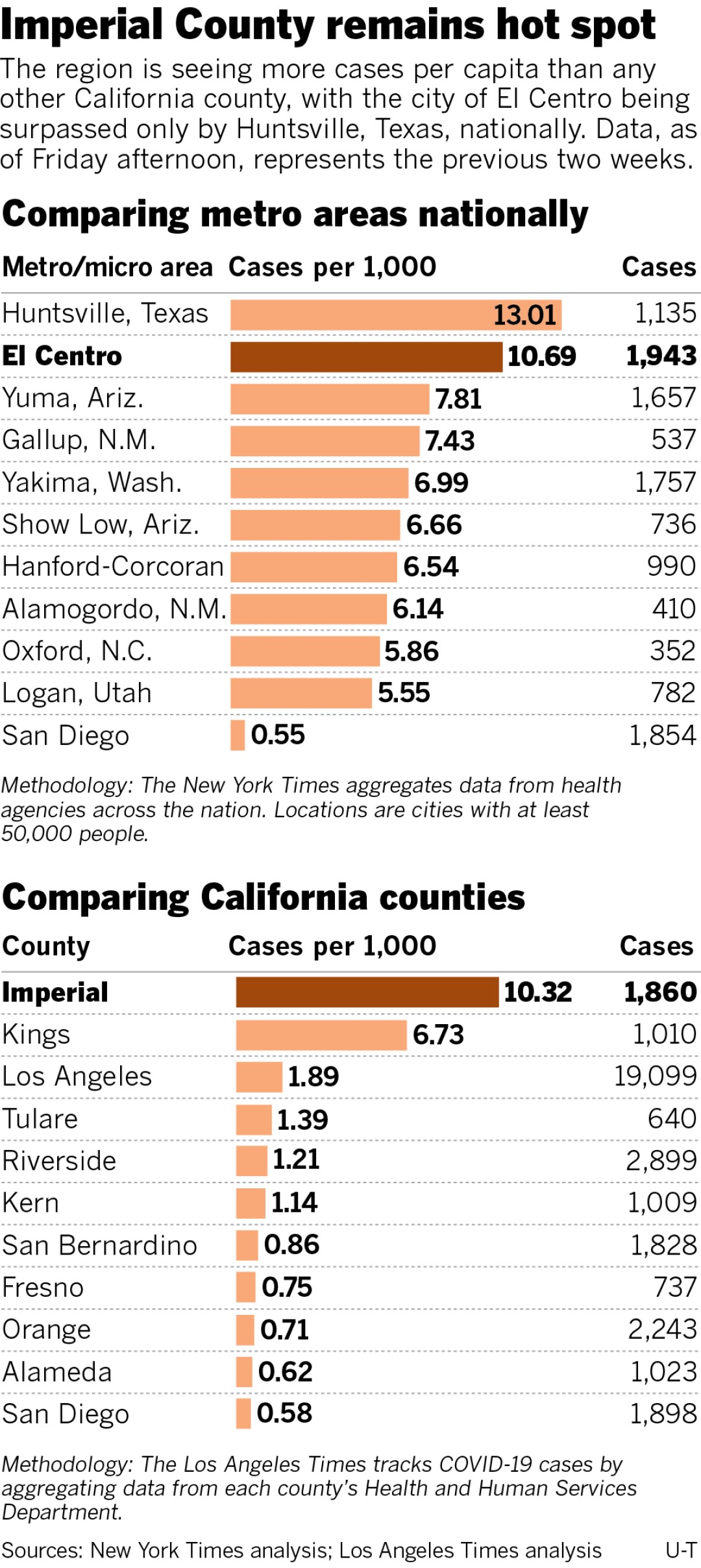
Over the last 14 days, the county’s rate was 1,078 per 100,000 people.
The county with the second-highest rate, Kings County, had 655 per
100,000. And Tulare County, which is third on the list, has a rate of
138 per 100,000, according to data compiled by the Los Angeles Times. In San Diego, the rate is 56 per 100,000.
A community divided
Despite those grim statistics – or possibly because of them – a recent push by local business associations and the county Board of Supervisors to reopen Imperial County’s economy has divided the community.
Imperial County meets all but one of the state’s benchmarks to ease
pandemic restrictions. And it is a long way off from meeting that mark.
The state requires counties to have seven consecutive days in which 8
percent or fewer of all COVID-19 tests come back positive. Currently,
roughly 24 percent of all tests in Imperial County are coming back
positive, three times higher than the state benchmark.
Realizing the county won’t be able to meet this benchmark any time
soon, the Board of Supervisors sent a letter to Gov. Gavin Newsom asking
for local control.
Another letter, this one submitted by local business associations and
cities, asks the governor to allow counties to make their own
determinations regarding reopening instead of being beholden to the
state’s one-size-fits-all approach.
Luis Plancarte, county chairman, said part of the reason behind
wanting to reopen is that every region around Imperial County already
has.
“If you look at neighboring areas, whether it is Mexico, Yuma,
Riverside or San Diego counties, they’ve already to a certain degree
opened up restaurants – with controls and social distancing,” he said
Monday during a press conference. “We have seen a considerable amount of
our community members who have gone out to those areas to either dine
or recreate in other forms.”
Reopening locally, Plancarte said, could reduce the number of people
leaving the county and would therefore lower exposure to the
coronavirus.
Plancarte’s comments predated news out of Arizona that saw a surge in
COVID-19 cases after the governor there lifted stay-at-home orders.
To be clear, the Board of Supervisors’ letter didn’t ask for Imperial County to reopen immediately.
Tony Rouhotas, the county’s chief executive officer, clarified that
it only asked for local control and that any decision the county takes
on reopening would be with the approval of the county health officer.
“We asked for local control; we didn’t ask for everything to be wide open,” he said.
Too soon to reopen
Hundreds of people throughout Imperial County believe reopening the economy too soon would put more people’s lives in danger.
More than 1,350 residents have signed a petition asking the governor to ignore the request of the officials elected to represent the community’s interests.
The petition, started by the IV Nex-Gen Equity & Justice Coalition,
also asks the state for more resources, including economic relief, to
help Imperial County get through this crisis.
Instead of starting to reopen the county, the petition asks county
officials to prioritize, “advocating for community resources to get our
infection rate down, and expanded economic relief and relief awareness
for workers and businesses.”
“Reopening must happen only when it is safe to do so, or else we are
accepting unnecessary deaths in our community,” the petition states.
Carmina Ramirez and James Taylor, two of the members behind the
petition, live close enough to the hospital that they often hear the
cacophony of ambulances and helicopters carrying COVID-19 patients.
Ramirez, who lost one relative to COVID-19, said the Board of
Supervisors’ letter makes it seem like elected officials are
prioritizing businesses over people – even if the reopening is done
under the guidance of county health officials.
“It goes back to what’s more important, people or business,” she said.
Taylor, who has asthma and only leaves the house to buy groceries, put it more bluntly.
“If I’m an elected official, I would rather be responsible for a business closing than someone dying,” he said.
When Taylor began tracking the county’s COVID-19 case rate a couple
of weeks ago, it was around 470 per 100,000. Even then, that rate
alarmed him and he began to speak out about it on social media. On the
day the Board of Supervisors sent the letter to Newsom, the rate had
jumped to over 1,000.
“In the face of this elevated rate, I thought it was crazy for them to be doing that,” he said.
There are other things politicians can do to help local businesses, Taylor added.
Elected officials under pressure from business associations know that
Imperial County has been among California’s poorest for decades. Even
during booming markets, people struggle to make ends meet. According to the latest census figures,
21 percent of Imperial County residents live in poverty. Per capita
income for 2018 was $17,000 and household median income – that is for a
family of four – was $45,000.
Economic losses mounting
In El Centro, where 40 percent of the city’s general fund revenues
come from sales tax, Mayor Efrain Silva hears about business closures on
a daily basis.
Silva attended two public funerals in El Centro this week. Monday was
for a police officer and Tuesday was for an X-ray technician. Both died
of COVID-19 and both died outside of Imperial County because they had
been transferred to other hospitals.
“It’s been a difficult 48 hours for me personally,” Silva said Wednesday.
The mayor of El Centro supports the county Board of Supervisors.
Forcing businesses to remain shut would cause greater harm in an already
disadvantaged community.
“I am of the opinion that we should try to open our economy as soon
as possible because there is just absolutely no way that we can sustain
the personal and economic losses in our community,” he said.
Any reopening, he said, should be done methodically and with the approval of county health officials, he added.
Silva has already heard from several businesses that simply won’t
reopen. Because Imperial County is nowhere close to meeting the state’s
benchmark for starting to reopen, he fears more businesses will follow.
“My fear is – getting back to that 8 percent – my fear is that we are
not going to get there. Not any time soon,” he said. “Can businesses
afford to remain closed another two or three or four months? I don’t
think so.”
Cross-border tensions
The mayor recognizes this issue is dividing the community – in more ways than one.
One of the reasons attributed to the surge in COVID-19 cases is
Imperial County’s proximity to Mexicali, a metropolis of more than one
million people.
Mexicali has one of the highest cases of COVID-19 cases in Mexico.
More than 3,100 people have been infected and 497 have died, according
to data from the state of Baja California.
There are about 250,000 U.S. citizens and residents living in Baja
California. And every day, thousands of them cross the border to work in
Imperial County, Silva said.
This kind of cross-border travel has been a staple of border
communities for centuries. But it is now viewed under a suspicious lens
during the pandemic. Each side blames the other for spreading the
coronavirus.
“Some people think that they may have picked it up over there and are
bringing it here,” Silva said. “Mexicali people feel the opposite way,
that we took it over there.”
Silva said some constituents have asked him to close the border,
apparently unaware of the fact that the mayor of El Centro does not have
the jurisdiction over federal immigration policy.
It is true that U.S. citizens who live in Mexico are being admitted
to Imperial County hospitals at much higher rates than normal.
At El Centro Regional Medical Center, staff see 10 patients from
Mexico every day and nine of them are there because of COVID-19.
Underlying conditions
But Imperial County’s proximity to the border isn’t the only reason
behind the surging COVID-19 rates. Academics and activists in the region
point to a laundry list of circumstances that predate the pandemic.
“I can tell you there’s hypertension, there’s poor air pollution,
there’s cancers, there’s asthma, there’s diabetes, there’s countless
things people here are exposed to,” said David Olmedo, an environmental
health activist with Comite Civico del Valle.
The organization set up 40 air pollution monitors throughout the
county – including a couple south of the border – and found that
pollution levels far exceed federal standards.
“They are exposed to the environment,” Olmedo went on. “Exposed to
pesticide, exposed to contaminated water, exposed to the heat, there’s
the fact that we don’t have the most complete medical services here so
people travel to San Diego for specialized care or the fact that a lot
of people would just rather go to Mexicali.”
Olmedo sees these factors play out in different ways throughout the day.
For example, every morning before dawn hundreds of farmworkers cross
the border to work. They cross at 3 and 4 in the morning to avoid long
border wait times but don’t begin work until a few hours later. So,
while they wait to work, they wait outside in the streets with no access
to public restrooms and no masks.
All of their lives, farmworkers have been told that pesticides and
heat could kill them. But it hasn’t, so when they are told about the
coronavirus, they don’t take it seriously.
“Of course they think COVID is going to be just another virus they
can fight off; they’ve fought off everything else,” Olemdo said.
Because COVID-19 attacks the respiratory system, high levels of air pollution in Imperial County are particularly concerning.
“Exposure to air pollution impairs lung function and it puts people
behind the eight ball when facing the coronavirus,” said Vijay Limaye,
an epidemiologist specializing in air pollution at the National
Resources Defense Council.
A preliminary study from environmental health experts at Harvard
University looked at the link between long-term exposure to certain air
pollutants and coronavirus death rates. The study, which is currently
being peer reviewed, adjusted for factors such as population density and
smoking rates to try to isolate the effect of air pollution.
Researchers found that April’s data showed that even small increase
in certain pollutants – specifically invisible fine particulate matter
categorized as PM 2.5 – were associated with an 8 percent increase in
death rates.
“In Imperial County, I think that finding takes on a whole new
light,” Limaye said. “That county’s PM 2.5 pollution exceeds federal
limits.”
All of these different factors contribute to the high number of cases in the county.
To help deal with the influx, staff are getting help from the
National Guard and a federal team made up of nurses from all over the
county. Those nurses are typically deployed to disaster zones, like
Haiti after the earthquake. But now they are in El Centro during the
pandemic.
The added staff is vital. They help take some of the pressure off
from the day-to-day staff, who have been working nonstop for about a
month.
Many employees at New York City hedge funds and other investment
firms are now scattered around the region, working from home. Some view
that as an opportunity to avoid a New York City tax, tax specialists
say.
The city’s 4% unincorporated business tax raises about $2 billion a
year for the city by taxing investment-fund managers, law firms and
other individually owned businesses, based on the portion of sales or
services performed within the city.
As employees sheltered at homes in the Hamptons or in the suburbs, a
group of hedge funds and other investment-management firms have begun
using apps to track where their New York-based employees are working day
to day. Their goal is to show that a large portion of the fees paid to
investment managers were for services performed outside the city and
therefore not subject to the city tax.
The city is already forecasting a $359 million decline in collections
of the unincorporated business tax compared with the $2.14 billion in
last year’s budget, without taking into account actions of companies
looking to shift accounting of sales outside the city.
“We are concerned about the potential impact of the shift of
employees out of the city and will adjust upcoming forecasts if it
becomes a trend that affects city revenue,” said Laura Feyer, a
spokeswoman for the mayor. “Meanwhile, we will continue to make
responsible budget choices and advocate for federal government support.”
In the past four weeks, a dozen investment-management companies, with
a total of $1.2 trillion in assets under management, have signed up to
electronically document employee locations based on cell-tower,
global-positioning and wireless data, said Nishant Mittal, co-founder of
Monaeo, an app used by companies and individuals to document residency
for tax purposes. Monaeo was acquired in March by Topia, a company that
helps companies manage global business travel and employee mobility.
He said about half were hedge-fund managers and the others were managers of other investment vehicles.
Driving the push, he said, was the expectation by the firms that many
employees will continue to work from home even after offices are
allowed to reopen in the next few weeks.
“We believe that in the new world people will be comfortable working
from home,” even after New York City fully reopens, he said. “Even if
that is only one to two days a week, that is going to make the tax
savings worthwhile from an asset manager perspective.
Here is how it works for a hedge fund with $50 billion in assets.
Typically, fund managers are paid 2% of assets each year plus 20% of
investment gain. The 2% fee works out to an unincorporated business tax
of $40 million on a gain of $1 billion at the city’s 4% rate.
If all employees could show they worked outside the city during just
the past three months that would result in a $10 million savings for the
investment managers — and a $10 million loss to the city.
“UBT uses the standard of where the services are performed,” said
Timothy Noonan, a law partner at Hodgson Russ LLP who specializes in
litigation on New York City and New York state residency rules. “If the
services are performed by all the analysts in their vacation property in
the Hamptons or New Jersey, those services would not be allocated to
New York City.”
Many wealthy individuals are also looking for ways to take advantage
of the pandemic by limiting the days they spend in New York and turning
their vacation homes into their main residence. But under complex rules
in place, the city and state routinely challenges and audits many such
shifts.
A taxpayer who continues to work for a New York company but moves out
of state has to show the change was made for the convenience of the
employer, said Robert Willens, a tax and accounting consultant who
publishes a tax newsletter.
The state hasn’t indicated whether it views people working at home
because of the virus as working there for the convenience of the
employer.
But the rules of the UBT are simpler and clearer. Beginning in 2009,
the city began switching from a complicated formula based on three
factors — payroll, property and receipts — to a simpler test based on
sales alone.
A city study based on 2014 tax receipts found that finance and real
estate accounted for 42% of tax liability under the tax, but only 19.5%
of taxpayers. Legal services accounted for 28%, followed by professional
services with 17%.
Mr. Mittal said that law firms, accounting firms and other partnerships could take advantage of the same provision as well.
“It applies to everybody,” he said. “The finance people are the first
ones to figure it out. They are very savvy when taxes on a billion
dollars in gross receipts is at stake.” https://www.marketscreener.com/news/New-York-Hedge-Fund-Traders-Aim-to-Avoid-City-Tax-by-WFH–30769489/?countview=0
There is the necessity to quickly find therapeutic options to treat novel SARS-CoV2
Azithromycin has demonstrated to have antiviral and
immunomodulatory effects, which could be effective in the
hyper-inflammatory syndrome caused by SARS-CoV2
Azithromycin has also shown clinical efficacy in respiratory distress syndrome and in viral infections
Preliminary results regarding the efficacy of the combination of azithromycin and hydroxychloroquine in COVID-19 are conflicting
There are some concerns regarding the association of azithromycin and hydroxychloroquine because of Qt prolongation
Further studies have to be performed to investigate
safety and efficacy of azithromycin and the combination with
hydroxychloroquine in COVID-19
Abstract
The emergence of the new disease COVID-19, is posing
the challenge of seeking effective therapies. Since the most severe
clinical manifestation of COVID-19 appeared to be a severe acute
respiratory syndrome, azithromycin has been proposed as a potential
treatment.
Azithromycin is known to have immunomodulating and
antiviral properties. In vitro studies have demonstrated the capacity of
azithromycin to reduce production of pro-inflammatory cytokines such as
IL-8, IL-6, TNF alpha, reduce oxidative stress and modulate T-helper
functions. At the same time there are multiple clinical evidences of the
role of azithromycin in acute respiratory distress syndrome and against
MERS. Some preliminary evidences have demonstrated controversial
results regarding efficacy of azithromycin in combination with
hydroxychloroquine in COVID-19. Firstly, a French trial demonstrated
100% of virological negativization of six patients treated with
azithromycin plus hydroxychloroquine vs 57.1% of patients treated with
only hydroxychloroquine and 12.5% of the control group (p<0.05). On
the other hand, another case series revealed no efficacy at all on
eleven patients treated with same combination and doses.
Furthermore, there are some concerns regarding the
association of azithromycin and hydroxychloroquine because of the
potential Qt prolongation. In fact, both drugs have this as
potential side effect and evidences regarding the safety use of this
combination are controversial.
Despite the necessity to quickly find solutions for
COVID-19, extreme caution must be used in evaluating the risk-benefit
balance. However, based on preclinical and clinical evidences and some
preliminary results in COVID-19, azithromycin could have a potential in
the fight against this new disease.
Japanese Foreign Minister Toshimitsu Motegi said on Monday it was not
true the government had decided to ease an entry ban, which was
implemented to prevent the spread of the new coronavirus, for people
from certain countries.
The Yomiuri daily reported last week that Japan may restart business
trips to and from Australia, New Zealand, Vietnam and Thailand in the
next few months.
The government is examining ways to ease entry bans, taking into
consideration various factors comprehensively, and would ease
restrictions in stages if it decided to do so, Motegi told parliament.
Motegi has agreed with his counterparts from Vietnam, Australia and
New Zealand to discuses the possibility of re-allowing travel to those
who need it, he said. https://www.reuters.com/article/us-health-coronavirus-japan/japan-hasnt-decided-to-ease-entry-ban-foreign-minister-says-idUSKBN23M076
Covid-19’s economic implications will unfold for decades. The virus
will pass; people will go to baseball games and concerts again. But
economic policy will change in ways that will affect our lives for
generations. Presidential economic advisor Peter Navarro is advocating a
“Buy American” executive order
that would force federal agencies to buy American-made versions of some
medical and pharmaceutical equipment, drugs, and vaccines. One
justification for this proposal is the oft-cited statistic
that 80 percent of drugs in America come from China. Given that the
government is a primary purchaser of drugs, Navarro’s order would force
the pharmaceutical industry to restructure the way it manufactures and
distributes its products.
Even if that order doesn’t come to fruition, changes in how we source
drugs are probably inevitable. New York governor Andrew Cuomo uses his
daily updates to call for bringing more medical-supply manufacturing
back to America, to promote resilience. Economists and commentators, once unabashed champions of globalization, are rethinking our reliance on foreign suppliers in all industries.
The question is presented as a trade-off between resilience—the
ability to withstand a big, unpredictable shock—and efficiency, getting
stuff as cheaply and quickly as possible. Americans have just
experienced shortages of many goods, especially medical supplies, so
it’s tempting to argue that we should focus on resilience. But a “Buy
American” drug program does not promote resilience.
First, like it or not, beating Covid-19 will require international
cooperation. The best scientists and drug makers in each country are
working on treatments and vaccines. Making these treatments or vaccines
available to as many people as possible will require goods, knowledge, supplies, and chemicals from around the world.
Buy American would not just slow progress on Covid-19; pharmaceutical
companies would be left scrambling to produce other critical drugs, like
insulin.
Even as a longer-term strategy, a Buy American program would make us
less resilient. First, the 80 percent figure of drugs coming from China is false.
In fact, about 60 percent of American pharmaceutical spending is on
domestically produced drugs, though strictly speaking, American-made is
hard to define, because many intermediate inputs come from abroad.
Diversification is less risky than concentrating all your supply from
one place, even if it’s your own country. If something happens to
disrupt your domestic supply chain, like a disease outbreak, major
earthquake, or war, then sourcing from multiple, less affected countries
means less risk. Our supply chain is highly diversified and includes
150 countries; relying on one country is risky. Less trade would also
make drugs more expensive and increase health-care costs.
It’s possible, and even wise, to promote more domestic drug
manufacturing to improve efficiency and resiliency. But a major reason
why drugs aren’t made in America is tax and regulatory policy that makes
it prohibitively expensive to do so. Part of the executive order would
lessen FDA regulations and hold foreign suppliers to the same standard.
But instead of a Buy American policy, the U.S. should remove such
distortions and create a natural incentive to make more drugs here. With
increased investment and technical innovation, it may even become more
profitable and efficient to do so. Allison Schrager is a senior fellow at Manhattan Institute. https://www.city-journal.org/buy-american-drug-manufacturing
The Orange Dot, better known as Headspace, has closed on $47.7 million in equity funding, according to a filing with the U.S. Securities and Exchange Commission.
I reached out to the mindfulness and meditation startup for more
information and it confirmed that the financing is an extension to a
Series C that closed in February. Indeed, the filing comes nearly
exactly four months after Headspace secured $93 million in a Series C
round that we reported on here. That financing included $53 million in equity and $40 million in debt.
This latest infusion brings Santa Monica, California-based Headspace’s total venture and debt raised
since its inception in 2010 (Was it really founded a decade ago?!) to
about $216 million, according to Crunchbase data. The company declined
to disclose at what valuation the Series C was raised.
In an email statement, Headspace said: “We had always planned an
extension of our Series C. This extension is now complete and was led by
existing investors, adding $47.7 million to the $53 million raised in
February, bringing the total equity funding to $100.7 million for our
Series C.”
All Series A, B, and C lead investors participated, according to the company. Some of those backers include Blisce/,Waverley Capital,Times Bridge (the global investments and partnerships arm of The Times Group of India), The Chernin Group, Spectrum Equity and Advancit Capital.
To rise above the hype around meditation, Headspace claims to be “the
most science-backed digital mindfulness product in the market.” As an
example of that, the company said in February it was conducting over 70
clinical research studies with institutions such as Carnegie Mellon University and Stanford University.
Over the years, it’s branched out from its consumer app into
different product lines including “Headspace for Work,” its B2B segment
that counts Starbucks, Adobe, Hyatt and GE
among its 600 enterprise customers. It’s also offering “Headspace
Health,” an effort to integrate mindfulness into health care. In
general, the company says its goal is to help users apply mindfulness to
improve their health via content around stress, anxiety, sleep, focus
and other things.
Growth
Since its founding, Headspace said as of February it had experienced
over 62 million downloads in 190 countries and had more than 2 million
paid subscribers. No word yet on if it’s seen a spike in users due to
the COVID-19 pandemic.
In addition to growing its direct-to-consumer business, Headspace
said it will continue to invest in its Headspace for Work segment, which
has seen its revenue double year over year from 2017 to 2018 and most
recently in 2019. It also plans to continue putting money into its
health care segment.
In 2019, the company launched localized versions of the app in French and German, and appointed former Apple executive Renate Nyborg
as head of its European division to lead expansion in that region. Also
last year, Headspace launched in Latin America with versions in Spanish
and Brazilian Portuguese. It expanded into Asia through strategic
relationships with partners such as The Times of India. In February, the
company said it planned to use its new capital in part to continue
expanding internationally.
Of course, Headspace is not alone in the meditation app space. Last year, Calm announced the close of an $88 million Series B round that propelled it into unicorn status with a $1 billion valuation. In July, it announced a $27 million extension to that round.