Search This Blog

Monday, June 29, 2020

Covid, cancer hijack same human cell parts to spread: Cancer drugs may aid

Most antivirals in use today target parts of an invading virus itself. Unfortunately, SARS-CoV-2—the virus that causes COVID-19—has proven hard to kill. But viruses rely on cellular mechanisms in human cells to help them spread, so it should be possible to change an aspect of a person’s body to prevent that and slow down the virus enough to allow the immune system to fight the invader off.
I am a quantitative biologist, and my lab built a map of how the coronavirus uses human cells. We used that map to find already existing drugs that could be repurposed to fight COVID-19 and have been working with an international group of researchers called the QBI Coronavirus Research Group to see if the drugs we identified showed any promise. Many have.
For years, researchers have suspected that kinases—biological control switches that viruses use to take over cells – could be targeted to fight infections. Over the last few months, we built a second, more detailed map looking specifically for the kinases that the coronavirus is hijacking.
Using this map, we identified a few already existing cancer drugs which alter the function of the kinases that SARS-CoV-2 hijacks, and began testing them in coronavirus-infected cells. The results of these early tests are promising enough that we are working with some groups and have already begun human clinical trials.
Kinases in disease and as drug targets
Kinases are proteins found in every cell of our body. There are 518 human kinases, and they act as major control hubs for virtually all processes in the body. They are able to add a small marker—a process called phosphorylation—to other proteins and thus change how, if and when a phosphorylated protein can do its work.
For example, if a cell is preparing to grow—say to heal a cut on your finger—specific kinases will turn on and start telling proteins involved in cell growth what to do. Many cancers are caused by overactive kinases leading to uncontrolled cell growth, and drugs that slow kinases down can be highly effective at treating cancer.
Kinases are central players in cellular function as well as in most diseases, so researchers and pharmaceutical companies have studied them in great detail.
Kinases are also fairly easy to target with drugs because of how they add phosphorylation markers to proteins. Researchers have developed a huge number of drugs, particularly cancer drugs, that work by essentially throwing a wrench into the mechanics of specific kinases in order to stop cell growth.
So what does this have to do with the coronavirus? Well, viruses and cancer actually have more in common than you might think. Cancer is essentially a malfunctioning of cellular machinery that causes runaway cell growth.
Viruses also change the function of cellular machinery—albeit on purpose—but instead of causing cell growth, the machinery is repurposed to produce more viruses. Not surprisingly, viruses take control over many kinases to do this.
Coronavirus at the controls
This idea—that SARS-CoV-2 is using kinases to hijack cellular machinery—is why we wanted to build a map of every kinase that is taken over by the coronavirus. Any virus–kinase interaction could be a potential target for drugs.
To do this, we first infected green monkey cells—which are fairly good surrogates for human cells when it comes to virus infection – with SARS-CoV-2. We then ground up these infected cells and used a device called a mass spectrometer to see which proteins were phosphorylated in these infected cells. We then did the same thing with healthy cells.
It is impossible to actually see which kinases are activated at any time, but since each kinase can attach phosphorylation markers to only a few specific proteins, researchers can look at the phosphorylated proteins to determine what kinases are active at any time.
We made two lists: one list of phosphorylated proteins in healthy cells and one list of phosphorylated proteins in infected cells. We then compared the two, and by looking at the differences between the infected and uninfected lists, we were able to determine which kinases the coronavirus uses to reproduce.
Because researchers still don’t fully understand what all 518 human kinases do, we were able to look for effects in only 97 of the ones we know most about. But that turned out to be more than enough. Of those 97 kinases, we found 49 that the virus affects.
Some of the more interesting ones include Casein Kinase 2, which is involved in controlling how a cell is shaped. We also identified several kinases that work together in what is called the p38/MAPK signaling pathway. This pathway responds to and controls our body’s inflammation reaction. It is possible these kinases could be involved in the cytokine storm—a dangerous immune system overreaction—that some patients with severe COVID-19 experience.
While identifying the kinases involved in SARS-CoV-2 replication, we were also able to learn a lot about how the virus changes our bodies. For example, CK2 becomes much more active during the course of coronavirus infection and causes the growth of little tubes that extend from the surface of the cell. Under a microscope, it looks as if the cell has a full head of hair. We think SARS-CoV-2 might be using these long cell outgrowths – called filopodia – as viral highways to get new viruses closer to neighboring cells, thereby making infection easier.
Kinases inhibitors in the lab and clinical trials
Learning more about the virus’s function is interesting for a biologist like me and could be useful down the road, but the ultimate goal of our project was to find drugs to treat COVID-19.
Once we knew which kinases SARS-CoV-2 uses to replicate and the proteins they change, we looked through a database of around 250 kinase-inhibiting drugs to see if any of them targeted the kinases used by the virus. To increase our chances, we also looked for drugs that hit some of the proteins the kinases act on. And sure enough, we found some.
There are 87 existing drugs that change the kinase-controlled pathways used by the coronavirus. Most of these drugs are already approved for human use or are currently in clinical trials to treat cancer, and could be quickly repurposed to treat COVID-19 patients.
With these leads, our collaborators in New York and Paris tested the effect of 68 of those drugs on cells infected with SARS-CoV-2. Several of these were effective in killing the virus in cells. A few that we are especially excited about—silmitasertib, gilteritinib, ralimetinib, apilimod and dinaciclib—are either approved for treatment, in clinical testing or under preclinical development for various diseases.
Silmitasertib stops Casein Kinase 2, the kinase that causes cells to grow the virus spreading filopodia tubes. As soon as the company that makes silmitasertib heard this news, they announced that they wanted to test the drug against COVID-19 in the clinic.
Drugs hitting kinase pathways have been on the radar of researchers as potential powerful antivirals for years, but none have come to fruition. By looking to this new area of drug applications and using our new mapping approach, our team has added dozens of drugs to the growing list of potential tools to help fight this pandemic.
It is still too early to say whether any of these will work to treat COVID-19 in patients, but the more chances we have, the better.

Existing drugs can prevent Covid virus from hijacking cells

An international team of researchers has analyzed how SARS-CoV-2, the virus that causes COVID-19, hijacks the proteins in its target cells. The research, published in the journal Cell, shows how the virus shifts the cell’s activity to promote its own replication and to infect nearby cells. The scientists also identified seven clinically approved drugs that could disrupt these mechanisms, and recommend that these drugs be immediately tested in clinical trials.
The collaboration included researchers at EMBL’s European Bioinformatics Institute (EMBL-EBI), the Quantitative Biosciences Institute’s Coronavirus Research Group in the School of Pharmacy at University of California San Francisco (UCSF), the Howard Hughes Medical Institute, the Institut Pasteur, and the Excellence Cluster CIBSS of the University of Freiburg.
Viruses are unable to replicate and spread on their own: they need an organism—their host—to carry, replicate, and transmit them to further hosts. To facilitate this process, viruses need to take control of their host cell’s machinery and manipulate it to produce new viral particles. Sometimes, this hijacking interferes with the activity of the host’s enzymes and other proteins.
Once a protein is produced, enzymes can change its activity by making chemical modifications to its structure. For example, phosphorylation—the addition of a phosphoryl group to a protein by a type of enzyme called a —plays a pivotal role in the regulation of many cell processes, including cell-to-cell communication, cell growth, and cell death. By altering phosphorylation patterns in the host’s proteins, a virus can potentially promote its own transmission to other cells and, eventually, other hosts.
The scientists used , a tool to analyze the properties of a sample by measuring the mass of its molecules and molecular fragments, to evaluate all host and viral proteins that showed changes in phosphorylation after SARS-CoV-2 infection. They found that 12% of the host proteins that interact with the virus were modified. The researchers also identified the kinases that are most likely to regulate these modifications. Kinases are potential targets for drugs to stop the activity of the virus and treat COVID-19.
The extraordinary behavior of infected cells
“The virus prevents human cells from dividing, maintaining them at a particular point in the cell cycle. This provides the virus with a relatively stable and adequate environment to keep replicating,” explains Pedro Beltrao, Group Leader at EMBL-EBI.
SARS-CoV-2 not only impacts cell division, but also cell shape. One of the key findings from the study is that infected cells exhibit long, branched, arm-like extensions, or filopodia. These structures may help the virus reach nearby in the body and advance the infection, but further study is warranted.
“The distinct visualization of the extensive branching of the filopodia once again elucidates how understanding the biology of virus-host interaction can illuminate possible points of intervention in the disease,” says Nevan Krogan, Director of the Quantitative Biosciences Institute at UCSF and Senior Investigator at Gladstone Institutes.
Old drugs, new treatments
“Kinases possess certain structural features that make them good drug targets. Drugs have already been developed to target some of the kinases we identified, so we urge clinical researchers to test the antiviral effects of these drugs in their trials,” says Beltrao.
In some patients, COVID-19 causes an overreaction of the immune system, leading to inflammation. An ideal treatment would relieve these exaggerated inflammatory symptoms while stopping the replication of the . Existing drugs targeting the activity of kinases may be the solution to both problems.
The researchers identified dozens of drugs approved by the Food and Drug Administration (FDA) or ongoing that target the kinases of interest. Seven of these compounds, primarily anticancer and inflammatory disease compounds, demonstrated potent antiviral activity in laboratory experiments.
“Our data-driven approach for discovery has identified a new set of drugs that have great potential to fight COVID-19, either by themselves or in combination with other drugs, and we are excited to see if they will help end this pandemic,” says Krogan.
“We expect to build upon this work by testing many other while identifying both the underlying pathways and additional potential therapeutics that may intervene in COVID-19 effectively,” says Kevan Shokat, Professor in the Department of Cellular and Molecular Pharmacology at UCSF.

Explore further

More information: Mehdi Bouhaddou et al, The Global Phosphorylation Landscape of SARS-CoV-2 Infection, Cell (2020). DOI: 10.1016/j.cell.2020.06.034

After patients die, FDA clamps hold on Astellas gene therapy trial

June 29, 2020

A second patient has died after receiving Audentes Therapeutics’ gene therapy against a rare genetic neuromuscular disorder. Audentes, which Astellas Pharma acquired for $3 billion, has dropped plans to file for approval imminently and paused a clinical trial while it reviews the situation.
In May, Audentes told patient groups that a person with X-linked myotubular myopathy (XLMTM) had died after receiving AT132, a gene therapy that uses an AAV8 vector to deliver a working copy of the myotubularin 1 gene. The patient, one of three older individuals to receive the higher dose of AT132, died from sepsis.
Now, Audentes has shared details of a second death. The patient was another one of the three older individuals to receive the higher dose of AT132. Preliminary reports show the two patients followed a similar clinical course in the weeks before they died.

The second patient to die suffered from progressive liver disease in the four to six weeks after being dosed with AT132. The liver disease, which was characterized by excess bilirubin in the blood, didn’t respond to standard treatment. Despite receiving “aggressive medical treatment,” the patient died of bacterial infection and sepsis.
Audentes has seen similar serious adverse events (SAEs) in the three older patients who received the higher doses of AT132. The patients were of a “heavier weight.” As AT132 is dosed per kilogram, the heavier people will have received a bigger viral load. Some research suggests systemic administration of high doses of adeno-associated virus (AAV) vectors directly damages liver cells and causes inflammation.
None of the six patients who received the lower dose experienced liver SAEs, despite four of them having a history of hepatobiliary disease. Audentes has years of follow-up on its lower-dose cohort of XLMTM patients.
The SAEs prompted Audentes to halt dosing prior to the deaths. Later, talks with the FDA led to the trial being put on clinical hold.
An investigation into the SAEs is ongoing. The findings will inform the development plan, but some things are already clear. Audentes has abandoned its long-held plans to file for approval around the middle of 2020. It is unclear when Audentes will be in a position to file for approval.
The timing of the filing is relevant to Astellas, which paid $3 billion for Audentes despite the biotech only having AT132, a gene therapy targeting a tiny patient population, in the clinic. Astellas saw value in Audentes’ other assets, too, leading it to put the biotech’s early-stage pipeline and manufacturing capabilities at the heart of a new genetic regulation unit.
Those assets could enable Astellas to make the Audentes acquisition pay even if AT132 fails. Yet, it is also possible the problems faced by AT132 will affect other high-dose AAV gene therapies, potentially denting the prospects of Audentes’ other assets and candidates in development at other companies.

RedHill Biopharma to start late-stage study in UK for opaganib for Covid-19

RedHill Biopharma (RDHL -6.5%announces that the UK Medicines & Healthcare products Regulatory Agency (MHRA) has approved the Company’s clinical trial application to commence a Phase 2/3 study evaluating opaganib in patients hospitalized with severe SARS-CoV-2 infection (the cause of COVID-19) and pneumonia.
The multi-center, randomized, double-blind, parallel-arm, placebo-controlled Phase 2/3 study will enroll up to 270 patients, with primary endpoint of proportion of patients requiring intubation and mechanical ventilation by Day 14.
Futility only interim analysis will be conducted by an independent data safety monitoring board when ~100 subjects have been evaluated for the primary endpoint.
In parallel, RedHill commenced enrollment for a randomized, double-blind, placebo-controlled Phase 2a study with opaganib in the US; the study will enroll up to 40 patients with severe COVID-19 pneumonia requiring hospitalization and supplemental oxygen.

3 Reasons Why Median Age of Reported COVID Infections Is Dropping

The median age of new cases is dropping in some areas, but what does that mean? I see three possible explanations, and not all are good. Here is what we can look for in the numbers to figure out what is happening.

More Testing

As we do more testing in the community, we are able to capture more mild or even asymptomatic infections. In the early days of the epidemic, testing was reserved only for the sickest individuals. As older adults are more likely to have severe disease, the median age of cases skewed older. Since then, testing has become more accessible. Some workplaces even implement routine testing of employees. This means that we are detecting more infections in younger adults that we previously would have missed. As we uncover more mild infections with more testing, the median age can decline even with no change in the underlying epidemic.
If median age of new cases drops only because of more testing, we expect a few things:
  • An increase in the number of cases detected across all age groups
  • Test positivity to drop in all age groups
  • With an increase in workplace testing, test positivity will drop the most in working-age adults, as many of those tested will be negative
  • No change in hospitalizations because the underlying epidemic has not grown

Older People Are Better Protected

If the elderly are able to better protect themselves from infection, median age of new cases could drop with no change in testing. For example, COVID-19 has disproportionately affected nursing homes. Where efforts to protect nursing home residents are successful at preventing new outbreaks, the median age of cases could decline.
If the drop in median age of new cases is driven only by better protection of the elderly, we expect:
  • A drop in the number of new cases in the elderly
  • A drop in test positivity that is greatest among the elderly
  • A drop in hospitalizations, observed after a lag

Young People Are Being Infected More

The first two scenarios are good outcomes, as more testing and better protection of the elderly are desirable. This last explanation is the not-good one. It means that young people are being infected even more than before. This could occur if there are many bar, nightclub, or workplace outbreaks. As economies reopen, many young people are going back to jobs where they cannot socially distance.

If median age drops only because young people are being infected more, we expect:
  • Numbers of new cases in young people to rise
  • Test positivity to increase in young people
  • More young people being hospitalized, observed after a lag
Besides the fact that young people can face unknown long-term outcomes of infection, they can also inadvertently spread the virus to their communities. So the median age could start to creep back up if the virus spreads from young people out to their coworkers, family members, and neighbors. The more virus circulating in the community, the harder it will be for people to stay protected.
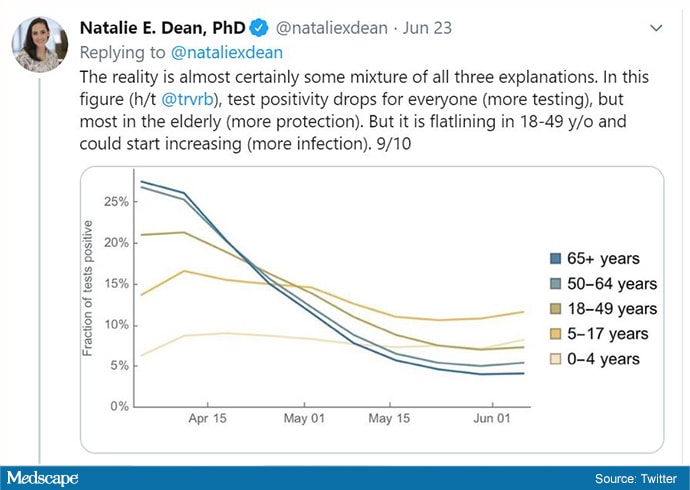
The reality is almost certainly some mixture of all three explanations and will vary from location to location. We can examine this graph using CDC’s COVIDView data on overall US trends in test positivity over time, broken out by age group. With the exception of children 0-4 years, test positivity drops for everyone (explanation 1: more testing). This drop is most substantial in the elderly (explanation 2: elderly are more cautious). But test positivity is flatlining in 18- to 49-year-olds and could start increasing as we see more outbreaks across the country (explanation 3: more infections in young people).
Test positivity in varying age groups from April 1, 2020, to June 1, 2020. (Source: Trevor Bedford, PhD, Department of Epidemiology, University of Washington)
These data represent the United States, but we are better served by looking state by state or even at smaller geographic scales. Different areas may be experiencing different changes. We can use high-quality, age-stratified data on testing, cases, and hospitalizations to distinguish between these potential scenarios.
Natalie Dean, PhD, is an assistant professor of biostatistics at the University of Florida in Gainesville. She specializes in emerging infectious diseases and vaccine study design.