Håkan Björklund steps down as chairman of Qiagen’s (QGEN +1.3%) supervisory board and is succeeded by Lawrence A. Rosen, about a week after its proposed acquisition by Thermo Fisher failed.
“As the leadership and composition of the supervisory board changes, and also in light of the recent outcome of the proposed acquisition by Thermo Fisher, the supervisory board wants to express its full commitment to Qiagen pursuing a growth strategy focused on execution and greater value creation,” said in a statement.
Björklund also steps down as a member of the supervisory board and won’t stand for re-election at the company’s next annual meeting planned for June 2021.
As a result, the number of supervisory directors is reduced to six.
More than one hundred vaccines against SARS-CoV-2 have been developed and some of them have entered clinical trials, but the latest results revealed that these vaccines still face great challenges. Here, we developed a novel cell-based gp96-Ig-secreting chimeric vaccine which is composed of two viral antigens, the RBD of spike protein, and a truncated nucleocapsid protein that could induce epitope-specific cytotoxic T lymphocytes but low antibody response. Syrian hamsters immunized with the cell-based vaccine produced high level of SARS-CoV-2 specific NAbs and specific T cell immunity which could eliminate RBD-truncated N-expressing cells, without the induction of antibody against N protein and other observed toxicity. This study provides a proof of concept for clinical testing of this safe, effective and cost-effective vaccine against SARS-CoV2 infection.
Scientists at Johns Hopkins Medicine, experimenting with a small number of human cell samples, report that the “hook” of cells used by SARS-CoV-2 to latch onto and infect cells is up to 700 times more prevalent in the olfactory supporting cells lining the inside of the upper part of the nose than in the lining cells of the rest of the nose and windpipe that leads to the lungs. These supporting cells are necessary for the function/development of odor-sensing cells.
The findings, from a preliminary study of cells lining both the nose and trachea, could advance the search for the best target for topical or local antiviral drugs to treat COVID-19, and offers further clues into why people with the virus sometimes lose their sense of smell.
“Loss of the sense of smell is associated with COVID-19, generally in the absence of other nasal symptoms, and our research may advance the search for a definitive reason for how and why that happens, and where we might best direct some treatments,” says Andrew Lane, M.D., professor of otolaryngology–head and neck surgery, and director of the Division of Rhinology and Skull Base Surgery at the Johns Hopkins University School of Medicine.
Lane’s medical practice focuses on people with nasal and sinus problems, who oftentimes, he says, lose their sense of smell — a condition called anosmia.
Scientists have known that SARS-CoV-2 latches on to a biological hook on the surface of many types of human cells, called an angiotensin-converting enzyme 2 receptor (ACE2). The receptor reels in essential molecules.
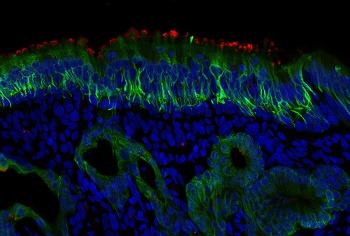
Red stain is ACE2. The green probe is staining CK18, which is found in supporting cells and mucus glands. Credit: Photo by Mengfei Chen
In a bid to explore the ACE2 link to COVID-19 in more detail, Lane, Mengfei Chen, Ph.D., a research associate in Lane’s lab at the Johns Hopkins University School of Medicine, and others on his team took a close look at ACE2 levels in nasal tissue specimens from 19 adult men and women with chronic rhinosinusitis (inflammation of nasal tissue) and in tissues from a control group of four people who had nasal surgeries for issues other than sinusitis.
The researchers also studied tissue samples of the trachea from seven people who underwent surgery for abnormal narrowing of the trachea.
Cells from children were not examined for this study, in part because they tend to have low ACE2 levels in the cells lining the nose, which may contribute to generally less severe illness among children infected with the SARS-CoV-2 virus. None of the study participants had been diagnosed with COVID-19.
The scientists used a high-resolution imaging technique called confocal microscopy to produce very sharp images of cells lining the nasal and tracheal airways. They used fluorescent stains to identify ACE2 receptors.
They found high levels of ACE2 among nasal cells that give structural support called sustentacular cells. These cells are located in an area called the olfactory neuroepithelium, where odor-sensing neurons are found. The researchers say this area of the nose may be particularly vulnerable to infection and might be the only infected site even when there are no symptoms. Because of this, they urge people to wear masks and wear them correctly.
For the study, depending on the biopsy sample, cells in the olfactory neuroepithelium had a 200-fold to 700-fold increase in ACE 2 proteins compared with other samples from the nose and trachea. Because the cells with high levels of ACE2 are associated with odor sensing, the researchers suggest that infection of these cells may be the reason some people with COVID-19 experience loss of smell.
Two of seven trachea specimens had low levels of ACE2 receptors, and the amount of those receptors was similar between study participants with and without chronic rhinosinusitus.
Because the cells lining the nose may prove to be a key entry point for SARS-CoV-2, Lane says there may be ways to target those particular cells with topical antiviral drugs or other therapies directly to that area.
The FDA has tentatively approved Teva Pharmaceutical Industries’ (TEVA -0.5%) generic pirfenidone for the treatment of idiopathic (cause unknown) pulmonary fibrosis.
Tentative approval means that the company’s application met the standards for approval but patent issues need to be resolved before full approval is granted.
Results from a Phase 3 clinical trial evaluating Gilead Sciences’ (GILD -0.1%) Veklury (remdesivir) in hospitalized COVID-19 patients with confirmed severe acute respiratory syndrome (ARDS) and moderate pneumonia showed a potential treatment benefit compared to standard-of-care (SOC) treatment. The results were just published online in JAMA Network.
The 596-subject study tested five-day and 10-day courses of the antiviral, dosed intravenously at 200 mg on day 1 followed by 100 mg/day thereafter.
The primary endpoint was clinical status on day 11 as measured by a seven-point ordinal scale called Odds for Ratio for Improvement (the higher the number, the better the status; 1=death, 7=not hospitalized). Each day, the worst score from the previous day was recorded.
On day 11, patients receiving the five-day course of remdesivir showed statistically significantly higher odds of a better clinical status distribution compared to SOC (p=0.02), a trend that implied improved outcomes, but the clinical importance of the parameter is uncertain according to the authors.
The clinical status distribution on day 11 between the 10-day course of remdesivir and SOC was not statistically significant (p=0.18).
US biotech BioMarin has hit back with a filing for a rare disease drug, after suffering what was described by analysts as a “major setback” when the FDA rejected its gene therapy for haemophilia A.
California-based BioMarin said the US filing for vosoritide in achondroplasia could lead to the first treatment for children with achondroplasia, the most common form of disproportionate short stature in humans.
This follows a European filing last week for the once daily injection of the analogue of C-type natriuretic peptide, although the company gave no details about a possible FDA decision date.
But the achondroplasia filing came the day after an unexpected FDA rejection for BioMarin’s haemophilia A gene therapy Roctavian (valoctocogene roxaparvovec), which analysts estimate will delay approval by around two years.
BioMarin previously agreed with the FDA on a data package necessary to support approval, but the company said the regulator has introduced a new recommendation for two years of safety and efficacy data.
This data could be generated by the ongoing phase 3 GENEr8-1 trial which uses annualised bleeding rate as a primary endpoint.
The company said the new recommendation was not raised at any time during development or review.
There was no FDA inspection at its manufacturing facility for Roctavian, suggesting the regulator knew a rejection in a Complete Response Letter was due.
However a team of analysts from Jefferies said that EU regulators had given the manufacturing facility a clean bill of health should the product get approval on the other side of the Atlantic.
Describing the rejection as a “major regulatory setback” a team of analysts from Jefferies led by Eun Yang said a worst-case scenario where both drugs are rejected could reduce sales by 25% compared with previous estimates.
BioMarin already markets seven rare disease drugs and has seen its PARP inhibitor Talzenna (talazoparib), developed in partnership with Pfizer’s Medivation unit, get approval in the US and Europe.
It also has three other gene therapies in its pipeline for phenylketonuria, hereditary angioedema, and hypertrophic cardiomyopathy.
Several pharma giants—including Merck, Novartis, Eli Lilly and Pfizer—have just lost procurement deals in China under the country’s new bidding system.
The drugmakers lost out to domestic producers, which in some cases undercut prices for established medicines by more than 90%, according to Jiemian. Among the drugs to lose contracts were Eli Lilly schizophrenia medicine Zyprexa and Pfizer’s Viagra, the publication said.
This week’s bidding in Shanghai was the third round under a procurement program launched in 2018 aimed at saving billions of dollars. On Thursday, domestic and global companies bid for contracts on 56 medicines.
Initially, the program focused on purchasing medicines for 11 cities in China. It has since expanded nationwide, threatening an important market for many Big Pharma players.
Companies such as AstraZeneca, Sanofi and Eli Lilly have managed to keep business under the aggressive procurement program, but they had to live with major discounts.
The latest results underscore that large pharma companies are making a “strategic retreat from some of their older drugs,” in China, ICBC International Research analyst Zhang Jialin said, as quoted by Bloomberg; instead, they’re focusing on growing market share for newer medicines.
It’s not a completely unforeseen shift, though. Pfizer’s established drugs business started showing a decline in China back in April 2019. At the time, Wolfe Research analyst Tim Anderson wondered whether the decline was the “canary in the coalmine” for the rest of the industry, which has been relying on the lucrative China market for revenue growth.