Outset Medical, which provides a hemodialysis system for kidney diseases, filed on Friday with the SEC to raise up to $100 million in an initial public offering.
The company’s Tablo Hemodialysis System is designed as a single enterprise solution that can be utilized across the continuum of care. To date, the company has focused primarily on the acute care setting, for which Tablo was cleared in 2014. It is in the early stages of commercializing in the home market, for which the device was cleared in March 2020.
The San Jose, CA-based company was founded in 2003 and booked $29 million in sales for the 12 months ended June 30, 2020. It plans to list on the Nasdaq under the symbol OM. BofA Securities, Morgan Stanley, Goldman Sachs, SVB Leerink and Stifel are the joint bookrunners on the deal. No pricing terms were disclosed. Relevant Profile: OM
The United States on Friday closed lanes at select ports of entry at the border with Mexico and will conduct more secondary checks in a bid to limit non-essential travel and the spread of coronavirus, a U.S. Customs and Border Protection official said.
Non-essential travel has been restricted at the border for several months, but has mostly been applied to Mexican citizens. The new measures appeared to be aimed at U.S. citizens and legal residents living in Mexico.
“The vast majority of cross-border travel by U.S. citizens and lawful permanent residents is for purposes that are not deemed essential,” El Paso CBP spokesman Roger Maier said.
The head of the Centers for Disease Control and Prevention (CDC) said Friday that teachers don’t need to be formally recognized as “critical workers,” a designation that would potentially exempt them from COVID-19 quarantine requirements.
“I think they didn’t need to be formally recognized as critical infrastructure workers, because in fact, I think we all know they are,” Robert Redfield said during a call with reporters.
New guidance from the Department of Homeland Security issued earlier this week classifies teachers as “critical infrastructure workers,” which means they are advised to keep working even if they have been exposed to the coronavirus, as long as they are asymptomatic.
President Trump has been adamant that schools reopen for in-person classes this fall, and classifying teachers as essential workers could help keep that option on the table in states seeing spikes of cases.
However, Redfield said he did not think teachers should remain in the classroom if they have been exposed to a COVID-19 infection.
“CDC has tried to provide guidance, to have that individual basically removed and then isolated from the classroom, do the appropriate contact tracing in conjunction with the local guidance of the local health department and the appropriate disinfection,” he said.
Teachers deserve to know they are working in a safe environment, he added.
“In order for schools to reopen, we have to have the confidence of teachers that it’s safe for them to go back and do their job,” Redfield said. “I do think it’s very important to have a well thought out, step-by-step approach to a single case versus whether there’s multiple cases in the same classroom, whether there’s multiple cases in multiple classrooms, and to work for the schools to then respond to those in a measured way.”
The critical infrastructure guidance on COVID-19 exposure is not a mandate, but there’s concern the label on teachers could be used by school districts as a way to coerce educators into working in unsafe conditions.
Experts have warned for weeks that it will be extremely difficult to safely reopen schools in hot spots, but some districts are still charging ahead — some willingly, others after prodding from state and national leaders.
Schools in Indiana, Louisiana, Oklahoma and Tennessee have shut down, at least temporarily, after finding COVID-19 in their hallways and classrooms.
The clinical trial of a Russian COVID-19 vaccine being developed by the Siberian Vektor research centre is due to be completed in September, the RIA news agency cited Russia’s healthcare watchdog as saying on Friday.
Transmission of COVID-19 from children or adults to other people in Rhode Island childcare programs occurred on only a limited basis, a study by the U.S. Centers for Disease Control and Prevention showed on Friday.
CDC Director Robert Redfield told reporters on a call that the findings indicated that there is a path “to get these childcare programs to reopen, which are very important for our country.”
Many childcare facilities were shut due to fear of infection in such group settings during the coronavirus pandemic, one more complication for getting people back to work in the battered U.S. economy.
Such transmission was found in just four of the 666 childcare programs operating in the state, with 17 people becoming infected, according to the CDC analysis that covered June 1 to July 31.
While only limited transmission was detected in the childcare settings, the pandemic still had a major impact, with 853 children and staff members going into self-quarantine because an infected person had showed up at a facility.
About three-quarters of the 891 childcare programs had been allowed to reopen under CDC guidelines that included reduced enrollment, universal use of masks for adults, daily symptom screening of adults and children, and enhanced cleaning and disinfection.
The COVID-19 transmission in the four programs was identified mainly in the last two weeks of July, when community transmission in Rhode Island had increased, the researchers said.
Pfizer (PFE +0.5%) and BioNTech (BNTX +10.1%) are in talks with the U.S. FDA on how to start testing their COVID-19 vaccine in children, a group that the agency is eager to gather data on, Reuters reports, citing an interview with Bill Gruber, Pfizer’s senior vice president of vaccine clinical research and development.
Vaccines work differently in children than they do in adults. Such tests generally progress in stages, with older adolescents tested first followed by younger adolescents then children.
There are already signs that younger adults have higher rates of reactions, such as sore arms and fevers, to the vaccine than older adults do, Gruber said.
That presents the risk that reactions could increase even more in younger patients. For example, ~75% of adults between 18 and 55 in Pfizer’s most recent trials had fevers after getting the vaccine, most of them mild.
“Younger children — maybe that’s not going to be tolerated. Maybe we’re going to have severe fevers,” he said. “That’s why we’re adopting a very thoughtful, graduated approach. Children are not just small adults.”
The company is submitting safety data to the FDA and developing a testing plan for children, which Gruber expects to start soon.
He also told Reuters that about 19% of the 11,000 people enrolled so far in a 30,000-volunteer U.S. trial for the companies’ COVID-19 vaccine are black or Latino, groups among the hardest by the coronavirus pandemic.
“Between Latinx and Black or African American populations, we’re running at about 19% or so,” Gruber said. “We’re trying to push even higher than that.”
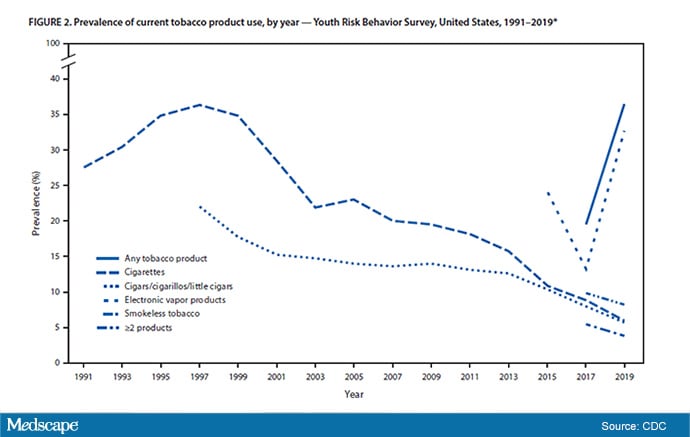
Use of electronic vapor products, or vaping, more than doubled among US high school students from 2017 to 2019 (from 13.2% in 2017 to 32.7% in 2019), a report from the Centers for Disease Control and Prevention (CDC) has found. Current cigarette smoking decreased from 8.8% to 6% during that time, as did cigar smoking (from 8% to 5.7%) and smokeless tobacco use (from 5.5% to 3.8%).
Current use of any tobacco product increased from 19.5% in 2017 to 36.5% in 2019.
“The dramatic increase in electronic vapor product use among high school students has led to increases in overall tobacco product use among U.S. youths, erasing gains made in previous years and leading the U.S. Surgeon General to declare youth e-cigarette use an epidemic in the United States,” the authors write.
“The new youth tobacco use data released today from CDC’s 2019 Youth Risk Behavior Survey confirm that our nation is facing multiple public health crises simultaneously: the COVID-19 pandemic, continued racial health equity disparities, and a youth vaping crisis,” Harold Wimmer, president and CEO of the American Lung Association, said in a statement about the findings.
“The dramatic increase in youth vaping led to a near doubling of overall tobacco product use among high school students, from 19.5% in 2017 to 36.5% in 2019,” he added.
MeLisa R. Creamer, PhD, from the Office on Smoking and Health in the CDC’s National Center for Chronic Disease Prevention and Health Promotion, and colleagues report their findings in an article published online August 20 in Morbidity and Mortality Weekly Report.
The researchers analyzed data from the 1991 to 2019 cycles of the CDC’s biennial national Youth Risk Behavior Survey. The findings, the authors say, are in line with those from other national surveillance systems, including the National Youth Tobacco Survey and Monitoring the Future.
Frequent use (20 or more days during the previous 30 days) of electronic vapor products also increased among current electronic vapor product users (from 25.1% to 32.6%), but frequent cigarette smoking fell, and frequent use of smokeless tobacco or cigars remained the same among users of those products.
The use of two or more tobacco products did not change from 2017 to 2019. “Multiple tobacco product use is associated with substance use disorders and might increase nicotine exposure and risk for nicotine dependence,” the authors explain.
Differences by Demographic Group
Among current vapers, the usual source of obtaining these products differed by age. Those aged 17 years or younger most often said they borrowed them from someone else (42.8%). Among those age 18 or older, 56.4% said they purchased them in a store.
Federal legislation raised the minimum age for tobacco product sales from 18 to 21 years nationwide on December 20, 2019.
Students aged 17 years or younger were more likely to get tobacco products on the internet, give someone else money to purchase them, borrow them from someone else, get them from someone who could buy them legally, or get them another way.
Male students were more likely to report that they use cigarettes, cigars, smokeless tobacco, and two or more tobacco products when compared with female students. The prevalence of tobacco product use was higher among those in 12th grade than among those in 9th grade.
White and Hispanic students had a higher prevalence of current use of electronic vapor products, cigarettes, any tobacco product, and at least two tobacco products when compared with Black students. White students were more likely than Hispanic students to say they used electronic vapor products and any tobacco product.
Youth aged 18 years or older were more likely than students aged 16 or 17 and those aged 15 years or younger to say they currently used cigars. Prevalence rose in each age group for all other individual products, any tobacco product, and multiple tobacco products.
Students who were heterosexual, lesbian, gay, or bisexual were more likely than those who were “not sure” about their sexual identity to report using electronic vapor products. Those who were lesbian, gay, or bisexual were more likely than heterosexual students to currently use cigarettes, cigars, and tobacco products, and multiple tobacco products. Any tobacco product use was more common among lesbian, gay, or bisexual students when compared with students unsure of their sexual identity.
Flavored Tobacco Products Driving Much of Increase
Flavored tobacco products, including flavored vaping devices, are responsible for the sharp rise in their use. From 2016 through 2017, sales of JUUL, “the most commonly sold e-cigarette in the United States since December 2017,” rose approximately 600% (from 2.2 million unit sales to 16.2 million unit sales), the authors write.
By December 2018, three quarters (76%) of the 322.1 million total e-cigarettes sales during that month in the United States were JUUL products. Several factors likely explain the appeal of these products to youths, including exposure through advertising, the availability of desirable flavors, curiosity, and being around friends and other individuals socially who use the products.
“We need look no further for the cause of this spike than the rise of JUUL and now Puff Flow and Vuse, and the continued sale and proliferation of flavored tobacco products, including flavored vaping devices,” Wimmer said.
“The tobacco industry has long used flavored tobacco products as starter products for kids and continues with flavored e-cigarettes today. And these data show that e-cigarette companies, many of which are owned by major tobacco companies, have successfully used Big Tobacco’s playbook to hook another generation of America’s kids,” he continued.
Even infrequent use of tobacco products — in particular, cigarette smoking — is predictive of developing a daily smoking habit, and infrequent use has been associated with nicotine dependence.
“Flavors are known to lure and hook kids to a lifetime of tobacco addiction, and we see this reflected in the continued spike of the amount of youth vaping,” Wimmer explained. “To protect kids, the American Lung Association has long called for menthol cigarettes and all flavored tobacco products, including e-cigarettes, to be removed from the marketplace.
“The Food and Drug Administration (FDA) has a unique opportunity to reverse this spike in youth use, by denying any flavored tobacco product permission to remain on the market when it reviews the applications due to the agency on September 9. In the meantime, our states and communities must act to fill the void left by FDA’s failure to take action by passing state and local laws to prohibit the sale of all flavored tobacco products.”
Limitations of the study include changes in the wording of questions in 2017 that make it impossible to compare data from previous years and “long-term trend analyses for prevalence of smokeless tobacco use, any tobacco product use, and use of two or more tobacco products,” the authors explain.
The question about how students obtained tobacco products only allowed students to select one response, but students may have several sources for obtaining the products and the full scope of their access is unclear.
The findings are part of a larger report on youth risk behavior.
The authors have disclosed no relevant financial relationships.