Search This Blog

Saturday, August 22, 2020

Music stars from Covid-infected states get pass on NYC quarantine for VMAs

When music’s biggest stars descend on New York for the Video Music Awards this week, NYPD cops will show up to check out the shows.

But they won’t be judging the talent. Officers in the NYPD’s TV/Movie unit will see if the performers and their entourages are wearing masks and staying socially distant, city officials told The Post.

Lady Gaga, Ariana Grande Taylor Swift and many others are set to perform at various outdoor locations “with limited or no audience” on Sunday. The show’s original location at Barclays Arena was dropped due to COVID-19 concerns.

“The Mayor’s Office of Media and Entertainment and Citywide Events is working in close coordination with the production to ensure guidelines are being followed,” a City Hall spokesperson said, adding that the NYPD unit will be doing “compliance checks during the production.”

But unlike other travelers, the VMA musicians, singers and dancers won’t have to follow a state rule to quarantine for 14 days if they come to New York from any of 34 states, including California and Florida, with average COVID infection rates exceeding 10 percent.

Under an executive order by Gov. Andrew Cuomo, anyone who violates the quarantine order is subject to a fine up to $10,000 or up to 15 days in jail.

But the state Department of Health has granted the VMAs a semi-exemption to the quarantine rule.

They can “participate in the production of the show,” a spokeswoman for Cuomo said, “but they will only interact with other members of the cast and crew and will quarantine when not working.”

To receive the exemption, the VMAs agreed to police itself with “rigorous safety protocols including testing and screening and compliance checks by a special compliance officer.”

Some celebs are finding other ways to skirt the COVID-19 rules.

Kanye West flew into Teterboro Airport, N.J., on Thursday, then headed into Manhattan, where he pulled over on the West Side Highway to switch vehicles, and visited an art gallery in Chelsea, The Post reported.

Later that day, he headed back through the Lincoln Tunnel to catch another flight.

The quarantine rules do not apply to someone from a restricted state who is “passing through” New York for less than 24 hours, but that’s meant for those stopping at rest stops or on travel layovers.

West’s wife Kim Kardashian and their four kids remained in LA, but it was unclear whether he flew in from California. The rapper’s rep did not answer questions emailed Friday.

Meanwhile, about 415,000 travelers flying or driving into New York since June 25 after visiting one of the  34 restricted states have “voluntarily” filled out health forms as of Friday, state officials said.

The forms ask for the traveler’s home state, their destination, the names, ages and of genders of each of their children, and contact information such as email address and phone numbers, among other data.

“Do you consent to receive daily monitoring messages via text from the New York State Contact Tracing Program?” the form asks.

“If you do not consent to text, you will receive a daily phone call instead,” it adds.

Those who refuse to fill out the form face a summons and a possible $2,000 fine.

Officials cite “nearly 100 percent compliance” so far.

But the forms are also meant to serve as a deterrent to make people to think twice about traveling to restricted states.

Like a speed limit that doesn’t catch all speeders, officials acknowledge, many who violate the 14-day quarantine order may evade detection.

“We’re not expecting to catch every person. We have no way to enforce it on every single person,” one said.

The completed health forms are sent to local health departments to follow up with phone calls and text messages to check on compliance with the 14-day quarantine, which comes with its own set of rules and restrictions. The travelers must not go into public. They must remain distant from others in the same residence, and check their own temperature, among other requirements.

NYC’s “Test and Trace” program, run by the city’s Health + Hospitals, has made more than 200,000 phone calls and texts to the restricted travelers since June 8, including 110,000 who landed in airports, officials told The Post.


The contact tracers have also knocked on 2,000 doors looking for people who didn’t answer the calls and texts, and found about half of them, they said Friday.

“New Yorkers we are reaching indicate that they are safely separating, and appreciate the resources we are offering to support them,” such as food delivery or a free hotel room if needed, a spokesperson said.

The city’s Sheriff’s Office has also stopped 2,197 private vehicles crossing the George Washington, Goethals and Bayonne bridges, the Outerbridge Crossing and the Lincoln and Holland tunnels, a tiny fraction of the cars that enter New York each day. Masks are also distributed.

If drivers say they have spent extended time in a restricted state, they, too, must fill out a traveler health form and self-quarantine for 14 days, officials said.

The checkpoints and required forms have raised some hackles. Staten Island City Councilman Joseph Borelli called the rules “insane.”

“This is an unconstitutional breach of authority. States are added and taken off the (restricted) list a week later. No reasonable person can plan their life around Cuomo’s whims and de Blasio’s desperation,” he griped.

Two or more long-term health conditions linked to a positive COVID-19 test August 22, 2020

The presence of two or more long term health conditions—known as multimorbidity—is linked to a 48% higher risk of a positive COVID-19 test. https://199a9bc107a875410b500bd56142f4aa.safeframe.googlesyndication.com/safeframe/1-0-37/html/container.html

While it is well recognized that the risk of a severe COVID-19 infection is linked to certain long-term health conditions, little is known, so far, about the effects of multimorbidity and polypharmacy (taking multiple medications) on the risk of a serious coronavirus infection.

Now, a new study led by the University of Glasgow and published today in PLOS ONE, is the first to link both multimorbidity and polypharmacy with the risk of having a positive COVID-19 test.

This association was particularly apparent for those with two or more cardiometabolic health conditions such as diabetes and high blood pressure. Researchers found that the presence of two or more such conditions was associated with a 77% higher risk of a positive COVID-19 test.

Those of non-white ethnicity, who also had multimorbidity, had almost three times the risk of a positive COVID-19 test.

Overall, people with multimorbidity who appeared to have the highest risk of COVID-19 infection were from socioeconomically deprived areas, of non-white ethnicity, considered severely obese, and those with reduced renal function.

The researchers believe their findings will have implications for clinical and public health decision making as the SARS-CoV-2 pandemic continues around the world.

Dr. Barbara Nicholl, from the University of Glasgow who led the study, said: “Multimorbidity and polypharmacy are global healthcare challenges in their own right. Our study shows that having a positive COVID-19 test is more common in those living with these health conditions. These results will be important for public health and clinical decisions in the future as we continue to manage the health of those at greatest risk of a severe COVID-19 infection during this pandemic.”

Professor Frances Mair, the University of Glasgow Norie Miller Professor of General Practice and leading expert on multimorbidity, said: “Given the high prevalence of multimorbidity, particularly in older age groups, the more detailed understanding of the associations between these complex health needs and COVID-19, as provided in this study, will improve our understanding of the risks and help us better advise those most vulnerable to severe infection.”

The study is based on UK Biobank data, which is now linked to COVID-19 test results, and included 428,199 adults aged 37-73 at the time of recruitment (2006-2010) across England and Wales.

The study, “Multimorbidity, Polypharmacy, and COVID-19 infection within the UK Biobank Cohort,” is published in PLOS ONE.


More information: Ross McQueenie et al. Multimorbidity, polypharmacy, and COVID-19 infection within the UK Biobank cohort, PLOS ONE (2020). DOI: 10.1371/journal.pone.0238091


Gaps in early Covid surveillance may have led to record US trajectory

As the United States exceeds 5 million reported coronavirus cases—the world’s first country to do so—epidemiologists have pinpointed what helped to set the country on this path. https://8b4d57694a0ba64f678b160ccf4d281d.safeframe.googlesyndication.com/safeframe/1-0-37/html/container.html

Research from the University of Notre Dame estimates that more than 100,000 people were already infected with COVID-19 by early March—when only 1,514 cases and 39 deaths had been officially reported and before a national emergency was declared. The study provides insight into how limited testing and gaps in surveillance during the initial phase of the epidemic resulted in so many cases going undetected. The study was published in the Proceedings of the National Academy of Sciences.

“We weren’t testing enough,” said Alex Perkins, associate professor in the Department of Biological Sciences, an expert in infectious disease epidemiology and population biology and the lead of the study. “The number of unobserved infections appears to be due to very low rates of case detection during a critical time, when the epidemic was really starting to take hold in this country. Part of it was the availability of testing, but another huge part was case definitions and the fact that they were overly restrictive early on.”

According to the Centers for Disease Control and Prevention, the first confirmed case of COVID-19 in the United States was reported in January. Early guidance on identifying possible infection included respiratory symptoms, and travel to Wuhan, China—where an outbreak occurred in December 2019.

“While we were focusing on people coming back from China, we were ignoring people coming from Europe, and actually quite a bit of the initial seeding of the virus into various parts of the United States came from Italy,” Perkins said.

While awareness and concern over COVID-19 grew from January to March, it wasn’t until Feb. 29 that Washington became the first state to declare a state of emergency—closing schools and restaurants and imposing restrictions on large gatherings. By mid-March several states followed, but a lack of a coordinated national response created a number of variables as each state decided for itself how to react to a rising number of cases.

By focusing their analysis on the January to March timeframe, when little to no action had been taken on a wide scale, Perkins and his team were able to incorporate a constant into their models. While other studies provide a sense of how school closures and lockdowns slowed the spread of the virus, looking at transmission for the first three months of the year gave the epidemiologists a clearer picture of how the virus emerged and spread throughout the country so quickly.

“It was such a crucial period in terms of how this situation started,” said Perkins. “We look at the United States now and compare it to other countries like South Korea or Germany, New Zealand or Vietnam, any number of countries who have done a much, much better job controlling transmission. The key differences really come down to the time period we examine in this study. Those countries had adequate surveillance up and running at that time, whereas we show that throughout most of February the United States missed the vast majority of infections that were already out there. This particular timeframe that we focus on is really important for figuring out how we got here in the first place.”

The study used a simulation model beginning on Jan. 1, using data reported by Johns Hopkins University on confirmed cases and deaths, accounting for asymptomatic infections, case fatality rates and local transmission. Perkins and his team first generated an estimate of total infections in the U.S. through March 12. The team then factored in how detection of symptomatic infections changed over time and estimated the number of unobserved infections during this time.

A significant aspect of the analysis is the model’s incorporation of many uncertainties that played out in the early days of the epidemic in the U.S., which Perkins said speaks to the inherent nature of a novel and emerging infectious disease. The number of unobserved and unreported infections also speaks to how critical containment strategies are when battling infectious diseases.

“I think the fact that there were so many infections by the second half of February speaks to the importance of and what we could have done in terms of containment,” said Perkins. “If you think about Ebola or SARS (severe acute respiratory syndrome) or other emerging infectious diseases, there have been cases that show up in the U.S. or other countries where officials move quickly to get ahead of them. They isolate those people, they do contact tracing—and transmission is extinguished. I think a lot of us were hoping that would be the situation with this disease. By the time we got to February, the problem had grown so big, containing the virus wasn’t possible.”

The potential for misdiagnosis and the limitations of surveillance are huge issues across infectious diseases, especially emerging infectious diseases, he added. As illustrated in the COVID-19 study, while public health officials must work quickly to understand how a new virus functions, without appropriate testing or coordinated response strategies the risk grows for infections to go unreported.


More information: “Estimating unobserved SARS-CoV-2 infections in the United States,” Proceedings of the National Academy of Sciences (2020). DOI: 10.1073/pnas.2005476117 , www.pnas.org/content/early/2020/08/20/2005476117


Many animal species may be vulnerable to SARS-CoV-2 infection


Genomic analysis reveals many animal species may be vulnerable to SARS-CoV-2 infection
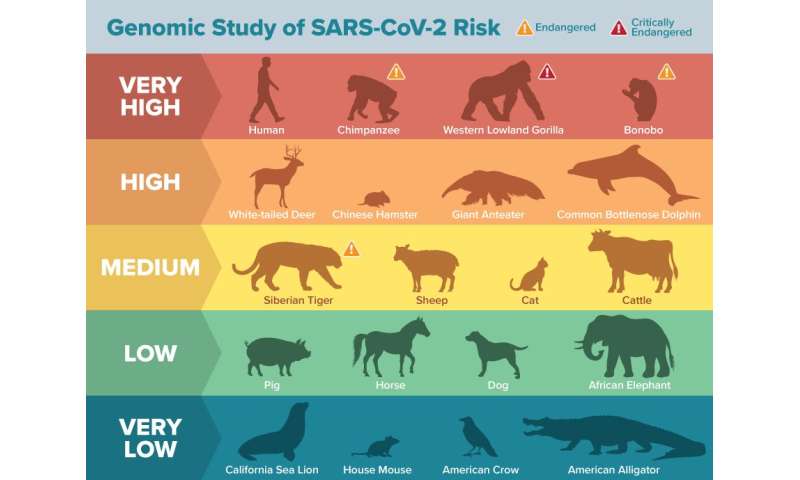
A new genomic study ranks the potential of the SARS-CoV-2 spike protein to bind to the ACE2 receptor site in 410 vertebrate animals. Old World primates and great apes, which have identical amino acids at the binding site as humans, are predicted to have a very high propensity for binding ACE2 and are likely susceptible to SARS-CoV-2 infection. Credit: Matt Verdolivo/UC Davis
Humans are not the only species facing a potential threat from SARS-CoV-2, the novel coronavirus that causes COVID-19, according to a new study from the University of California, Davis.
An international team of scientists used genomic analysis to compare the main cellular receptor for the virus in humans—angiotensin converting enzyme-2, or ACE2—in 410 different species of vertebrates, including birds, fish, amphibians, reptiles and mammals.
ACE2 is normally found on many different types of cells and tissues, including epithelial cells in the nose, mouth and lungs. In humans, 25 amino acids of the ACE2 protein are important for the virus to bind and gain entry into cells.
The researchers used these 25 amino acid sequences of the ACE2 protein, and modeling of its predicted protein structure together with the SARS-CoV-2 spike protein, to evaluate how many of these amino acids are found in the ACE2 protein of the different species.
“Animals with all 25 amino acid residues matching the human protein are predicted to be at the highest risk for contracting SARS-CoV-2 via ACE2,” said Joana Damas, first author for the paper and a postdoctoral research associate at UC Davis. “The risk is predicted to decrease the more the species’ ACE2 binding residues differ from humans.”
About 40 percent of the species potentially susceptible to SARS-CoV-2 are classified as “threatened” by the International Union for Conservation of Nature and may be especially vulnerable to human-to-animal transmission. The study was published Aug. 21 in the Proceedings of the National Academy of Sciences.
“The data provide an important starting point for identifying vulnerable and threatened animal populations at risk of SARS-CoV-2 infection,” said Harris Lewin, lead author for the study and a distinguished professor of evolution and ecology at UC Davis. “We hope it inspires practices that protect both animal and human health during the pandemic.”
Endangered species predicted to be at risk
Several critically endangered primate species, such as the Western lowland gorilla, Sumatran orangutan and Northern white-cheeked gibbon, are predicted to be at very high risk of infection by SARS-CoV-2 via their ACE2 receptor.
Other animals flagged as high risk include marine mammals such as gray whales and bottlenose dolphins, as well as Chinese hamsters.
Domestic animals such as cats, cattle and sheep were found to have a medium risk, and dogs, horses and pigs were found to have low risk for ACE2 binding. How this relates to infection and disease risk needs to be determined by future studies, but for those species that have known infectivity data, the correlation is high.
In documented cases of SARS-COV-2 infection in mink, cats, dogs, hamsters, lions and tigers, the virus may be using ACE2 receptors or they may use receptors other than ACE2 to gain access to host cells. Lower propensity for binding could translate to lower propensity for infection, or lower ability for the infection to spread in an animal or between animals once established.
Because of the potential for animals to contract the novel coronavirus from humans, and vice versa, institutions including the National Zoo and the San Diego Zoo, which both contributed genomic material to the study, have strengthened programs to protect both animals and humans.
“Zoonotic diseases and how to prevent human to animal transmission is not a new challenge to zoos and animal care professionals,” said co-author Klaus-Peter Koepfli, senior research scientist at Smithsonian-Mason School of Conservation and former conservation biologist with the Smithsonian Conservation Biology Institute’s Center for Species Survival and Center for Conservation Genomics. “This new information allows us to focus our efforts and plan accordingly to keep animals and humans safe.”
The authors urge caution against overinterpreting the predicted animal risks based on the computational results, noting the actual risks can only be confirmed with additional experimental data. The list of animals can be found here.
Research has shown that the immediate ancestor of SARS-CoV-2 likely originated in a species of bat. Bats were found to be at very low risk of contracting the novel coronavirus via their ACE2 receptor, which is consistent with actual experimental data.
Whether bats directly transmitted the novel coronavirus directly to humans, or whether it went through an intermediate host, is not yet known, but the study supports the idea that one or more intermediate hosts was involved. The data allow researchers to zero in on which species might have served as an intermediate host in the wild, assisting efforts to control a future outbreak of SARS-CoV-2 infection in human and animal populations.


More information: “Broad host range of SARS-CoV-2 predicted by comparative and structural analysis of ACE2 in vertebrates,” Proceedings of the National Academy of Sciences (2020). DOI: 10.1073/pnas.2010146117 , www.pnas.org/content/early/2020/08/20/2010146117

China giving experimental coronavirus vaccines to high-risk groups since July

China has been giving experimental coronavirus vaccines to groups facing high infection risks since July, a health official told state media.

No vaccine has yet passed final, large-scale trials to prove it is safe and effective enough to protect people from contracting the virus that has led to almost 800,000 deaths worldwide.

The aim is to boost the immunity of specific groups of people, including medical workers and those who work at food markets and in the transportation and service sectors, Zheng Zhongwei, a National Health Commission official, told state TV in an interview aired late on Saturday.

Authorities could consider modestly expanding the emergency use programme to try to prevent possible outbreaks during the autumn and winter, added Zheng, who heads the Chinese government-led team that coordinates state resources for coronavirus vaccine development.

The guidelines for emergency use of potential coronavirus vaccines, approved on June 24 according to Zheng, have not been made public.

State media Global Times reported in June that China had been offering candidate coronavirus vaccines to employees at state-owned firms travelling overseas.

Some countries are sceptical about China’s use of experimental vaccines. Papua New Guinea has denied entry to Chinese nationals who participated in a coronavirus vaccine trial, according to the Australian newspaper.

China’s coronavirus vaccines will be priced close to cost, Zheng said.

“It does not mean that companies cannot make profits,” Zheng said. “Companies should decide on moderate profits, or reasonable profits based on costs.”

A potential coronavirus vaccine being developed by a unit of China National Pharmaceutical Group (Sinopharm) could cost no more than 1,000 yuan ($144) for two shots, Sinopharm chairman Liu Jingzhen told state media last week.

“[The price] will definitely be lower than what Liu said,” Zheng said.