Search This Blog

Sunday, October 4, 2020

MS med inhibits coronavirus—at least in a test tube

An antiviral medication which effectively inhibits replication of the coronavirus causing the COVID-19 and, at the same time, fights the immune reaction that is killing COVID-19 patients around the world. 

This is the hope of a group of researchers headed by Christian Kanstrup Holm and David Olagnier who are behind a newly-published new study in the journal Nature Communications. The study shows that a drug called dimethyl fumarate (DMF), which is approved for the treatment of multiple sclerosis patients, inhibits the growth of a range of viruses in the body's cells and that this includes the coronavirus (SARS-CoV2) - at least when the researchers test it in a .

"As we're doing basic research, we obviously don't know whether the drug works on infections in humans, and it's up to the infectious disease experts to test for this. However, I have to say that I'm very optimistic," says Christian Kanstrup Holm, who, like his colleague David Olagnier, is associate professor at the Department of Biomedicine at Aarhus University, Denmark.

The current research results have been underway for a while now. When the pandemic struck, Christian Kanstrup Holm and his colleagues were in the process of testing the effects of a drug which was virtually identical with a particular sclerosis medicine, namely a substance called 4-octyl-itaconate, which is used on e.g. the , smallpox () and , and which is also known to lead to fetal defects—all as part of the hunt for a broad spectrum antiviral medication. And their testing succeeded beyond expectations.

"Then the coronavirus suddenly appeared, which we therefore also tested, and saw an enormous effect. The number of duplications that the coronavirus makes of itself in the body's cells were simply drastically reduced," explains Christian Kanstrup Holm.

"At the same time, the drug inhibited the immune reaction or inflammatory condition that constitutes a large portion of the actual threat for coronavirus patients. People don't just die of the virus in itself, but also of the inflammation that occurs in the lungs," he says.

When the research group saw the encouraging results with 4-octyl-itaconate, they repeated the tests with a corresponding approved product, dimethyl fumarate (DMF), which showed virtually the same inhibitory effect.

This means that the effect of (DMF) can be tested on corona patients 'here and now', if clinicians in Denmark or abroad—and the company that holds the patent—are prepared to test it in human trials.

"You can really save a lot of time when you're testing a medication that has already been approved and tested in another context," says Christian Kanstrup Holm with reference to the statutory phases involved in getting a medication approved from scratch.

"I'd really likely to be attached to this type of clinical trial if there are infectious disease researchers who assess that the result is worth proceeding with. As a basic researcher, I have neither access to patients, nor am I qualified to conduct clinical testing," he adds.


Explore further

Experimental antiviral drug to be tested against new coronavirus

More information: David Olagnier et al, SARS-CoV2-mediated suppression of NRF2-signaling reveals potent antiviral and anti-inflammatory activity of 4-octyl-itaconate and dimethyl fumarate, Nature Communications (2020). DOI: 10.1038/s41467-020-18764-3
https://medicalxpress.com/news/2020-10-medicine-multiple-sclerosis-patients-inhibits.html

Small part of human antibody can work for both prevention and therapy of COVID-19

One small part of a human antibody has the potential to work as a drug for both prevention and therapy of COVID-19
This antibody adopts a Y-shape. The arms of the Y make up the part of the antibody that binds to the target. Credit: Alfred Pasieka/Science Photo Library

Although a vaccine could be the ultimate solution to curb the COVID-19 pandemic and stop future ones, it will not be 100% effective. If it is anything like the flu vaccine, it will most likely be slightly more than 50% effective

What is important to recognize is that a vaccine can protect but cannot treat an already infected person. In contrast, drugs including laboratory-made antibodies (Y-shaped proteins that can help fight a foreign substance) can do both—protect and treat. This is why currently many companies are developing antibodies for prevention and therapy of COVID-19. Physicians would inject patients with these antibodies, which would immediately recognize and inactivate the . Such a therapy would bridge the lag until the patient's immune system was able to produce enough of its own antibodies; some patients with weak immune system may never produce antibodies to fight the virus.

I am an antibody engineer and infectious-disease scientist interested in using the smallest part of the antibody—called a —as therapeutics for emerging viruses, including SARS-CoV-2. Domains combine some advantages of small molecule drugs and large standard antibody . My colleagues and I have now engineered such an antibody-like molecule that both blocks and treats SARS-CoV-2 infection in animals studies and is now a promising candidate for . This research has been published in the journal Cell.

Antibodies as drugs versus small molecules as drugs

An antibody works by recognizing and binding to the disease-causing virus. When the antibody attaches to the spike protein of SARS-CoV-2, the spike is blocked from its lock-and-key interaction with the ACE2 protein on human cells. My colleagues and I are trying to develop drug molecules that mimic a body's natural antibody response, blocking the spike protein from infecting the cell, replicating and causing disease.

Small drug molecules can penetrate tissue very well and can be administered conveniently as pills. However, because of the size, these small molecules are not highly specific and can bind to many human proteins and cause side effects.

One small part of a human antibody has the potential to work as a drug for both prevention and therapy of COVID-19
The spike proteins on the outer surface of the virus allow the SARS-CoV-2 virus to infect human cells. Credit: Viktoriia Ilina/iStock/Getty Images Plus

Large biological drug molecules, including naturally occurring antibodies, by contrast, do not penetrate tissue very well. Antibody treatments must also be administered intravenously in a doctor's office. The advantage is that antibodies are highly specific. They do not interfere with other human proteins and rarely cause side effects.

The challenge is combining the specificity of large native with those of small-molecule drugs that can penetrate tissues. An approach that my colleagues and I are testing is to take the domain, which is responsible for specifically binding to the target, like a virus, and just use this part of the antibody as a drug to block the spike protein of the virus from infecting cells.

How do we discover new antibody therapeutics?

At the University of Pittsburgh Center for Antibody Therapeutics, we developed a methodology that allowed us to discover stable human antibody domains that can bind with great strength and specificity to other molecules, including viral proteins.

The first step was to identify antibody genes from many humans, then separate those that encode just the antibody domains of interest—so-called "variable domains." Then my colleagues and I created a collection containing more than 100 billion antibody domains with different specificity. This means that we have instructions for more than 100 billion little antibody fragments, one of which we hoped would bind tightly to the spike protein of the coronavirus.

By using a process called panning (as in the Western movies where gold hunters use pans to separate gold particles from sand), in just one week we separated the weak-binding or nonbinding domains from those that bound to the target—in this case the SARS-CoV-2 spike protein.

One small part of a human antibody has the potential to work as a drug for both prevention and therapy of COVID-19
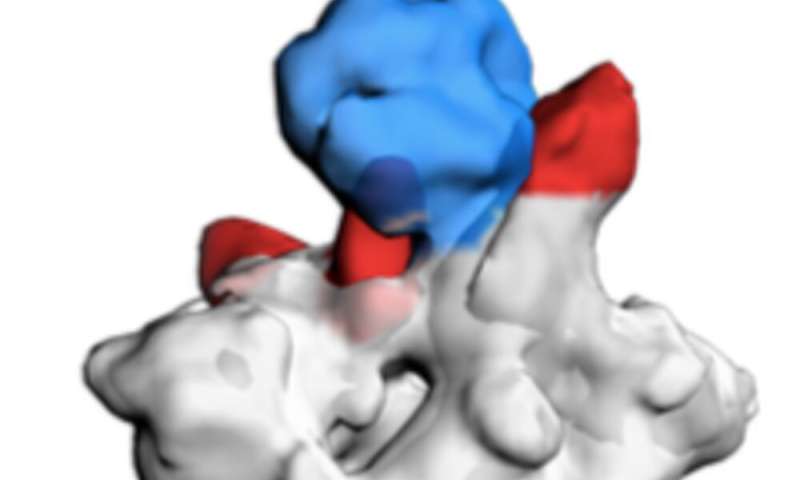
A model of the SARS-CoV-2 spike protein. The three red regions reveal the area occupied by the ab8 antibody domain. Credit: Li W et al. Cell 2020, CC BY-SA

Finding and testing antibody domains to treat COVID-19

By using as bait a small portion of the SARS-CoV-2 spike protein—called the receptor binding domain, which is key for binding to and infecting human cells—we "fished" in our very large collection of antibody domains and identified one that we call ab8, which binds strongly and specifically to the spike protein.

To increase the binding strength of ab8 and ensure it stays in the blood for a long time, we added a fragment of the antibody called Fc. This increased the size of the molecule but still it was smaller than the full-size antibody.

An antibody has a better chance of penetrating tissue the smaller it is. An antibody domain, which is about one-tenth the size of an antibody, is able to penetrate tissues and access areas where a virus is doing significant damage, like the lung.

Before we could determine whether ab8 was an effective drug we had to test it against live SARS-CoV-2 virus in living animals. Such experiments can only be done in special facilities called Biosafety Level 3 laboratories.

One small part of a human antibody has the potential to work as a drug for both prevention and therapy of COVID-19
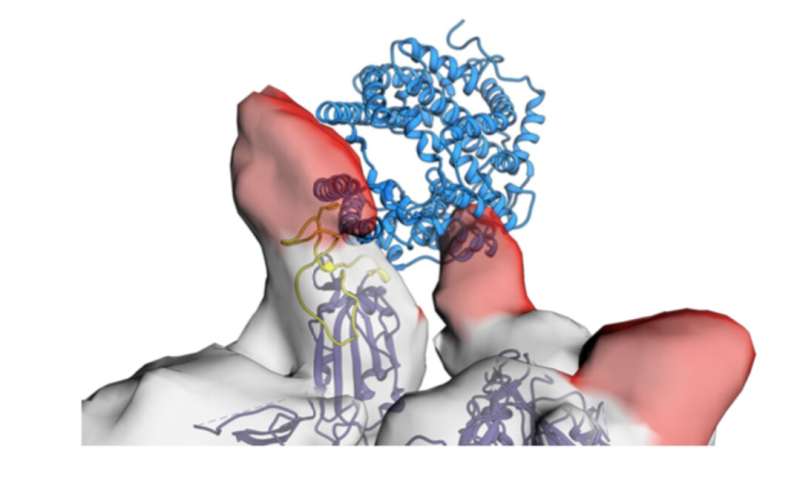
A detailed image showing the site where the ACE2 protein binds to the spike protein which allows the virus to enter the cell. The ab8 molecule blocks this interaction and protects the cell. Credit: Li W et al. Cell 2020, CC BY-SA

Taking ab8 from the lab to life

Ultimately I hope that this tiny ab8 antibody domain could be mass-produced and then injected into people to either prevent infection—by binding to a spike protein of an invading before it infected a human cell—or to reduce the severity of COVID-19 once they were sick.

Our collaborators at the University of Texas Medical Branch in Galveston were the first to show that ab8 was exceptionally powerful at neutralizing SARS-CoV-2 when tested on infected cells in the laboratory.

Our collaborators at the University of North Carolina confirmed these results and then showed that even tiny quantities of ab8—as little as 50 micrograms per mouse—dramatically reduced the virus tenfold. (One microgram is one-millionth of a gram.) And, at higher doses, the virus was completely blocked from infecting cells.

Our colleagues at the University of Saskatchewan tested ab8 in larger animals: hamsters. They infected the hamsters with SARS-CoV-2 and then administered the drug. Ab8 reduced the virus in the hamsters dramatically.

Finally, our collaborators at the University of British Columbia used sophisticated electron microscope-based methods to visualize and understand how exactly ab8 neutralizes and blocks the virus. The images revealed that it does so by binding to exactly the same location on the viral spike used to attach to and gain entry into a human cell. This means that ab8 is functioning as a decoy receptor.

I cannot emphasize enough the collaborative nature of this research that led to the discovery of the therapeutic and preventive properties of ab8, which suggested that the molecule could be also be highly effective and safe in humans.

-- Dimiter Stanchev Dimitrov

https://medicalxpress.com/news/2020-10-small-human-antibody-potential-drug.html

Cardiac arrest common among COVID-19 patients in ICU: study

Critically ill COVID-19 patients commonly experience cardiac arrest and their outcomes after cardiopulmonary resuscitation tend to be poor, a new study shows.

The study, published in The BMJ, includes data for more than 5,000 COVID-19 patients at 68 U.S. hospitals. The patients had been admitted to the intensive care unit.

Researchers found 14 percent suffered a cardiac arrest within two weeks of being admitted to the ICU. They also found older patients, Black patients and those at hospitals with fewer ICU beds were more likely to experience cardiac arrest.

The study shows 57.1 percent of patients received CPR, including a third of patients older than 80. Only 12 percent of the patients who received CPR survived.

https://www.beckershospitalreview.com/cardiology/cardiac-arrest-common-among-covid-19-patients-in-icu-study-shows.html

11 COVID-19 cases linked to presidential debate at Cleveland Clinic

The city of Cleveland released a statement Friday that 11 cases of COVID-19 are linked to planning and set-up for the Sept. 29 presidential debate. The Cleveland Clinic, which hosted the event, specified that the 11 people never accessed the debate hall.

"It's important to clarify the 11 people who tested positive never accessed the debate hall," Cleveland Clinic said in a statement. "These individuals were either members of the media or were scheduled to work logistics/set-up in the days prior to the event. Individuals did not receive credentials or tickets to enter the debate hall until they had a negative test, and all were advised to isolate while they awaited their test results."

The Cleveland Department of Public Health is engaged in the contract tracing process. It notes that the majority of cases are out-of-state residents. 

Neither the city nor Cleveland Clinic specified who is among the 11 people linked to the debate who have tested positive. President Donald Trump, first lady Melania Trump and presidential adviser Hope Hicks — each of whom has tested positive for COVID-19 — traveled to Cleveland for the debate. 

In addition to hosting the debate, Cleveland Clinic advised the Commission on Presidential Debates on requirements to maintain a safe environment that aligned with CDC guidelines, — including social distancing, hand sanitizing, temperature checks and masking. 

"Individuals traveling with both candidates, including the candidates themselves, had been tested and tested negative by their respective campaigns," according to the health system’s statement. "Based on what we know about the virus and the safety measures we had in place, we believe there is low risk of exposure to our guests. Out of an abundance of caution, we are reaching out to our guests to address any questions and concerns."

Cleveland Clinic hosted the candidates at its Health Education Campus, which is a joint project between the clinic and Case Western Reserve University that opened in 2019 and includes a 477,000-square-foot pavilion. The space housed rows of socially distanced chairs that seated a few dozen people, including the candidates’ wives, members of the campaigns, hosts, health and security officials and journalists, according to Politico

https://www.beckershospitalreview.com/public-health/11-covid-19-cases-linked-to-presidential-debate-at-cleveland-clinic.html

American Renal Associates to be acquired by Nautic Partners for $853M

  • American Renal Associates (NYSE:ARA) to be acquired by Innovative Renal Care, an affiliate of Nautic Partners in an all-cash transaction for an aggregate enterprise valuation of ~$853M.
  • ARA shareholders will receive $11.50 per share in cash, representing an approximate premium of 66% from the last closing price.
  • “I have decided to delay my previously announced retirement in order to guide the Company through this transaction and into its next stage. Nautic is a firm with significant healthcare expertise and we are excited by their support as we engage with members of the IRC team for the next chapter of our Company’s growth -- drawing on our deep relationships with our physician partners and our talented staff to continue providing excellent care to end-stage renal disease patients across the U.S. We also want to thank Centerbridge Partners for their thoughtful support over these past 10 years.” said CEO and Chairman Joe Carlucci.
  • Shares +65% PM
  • Press Release
  • Quick look at the company financials and its escalating revenue figures here.
  • https://seekingalpha.com/news/3619380-american-renal-associatesplus-65-on-acquisition-nautic-partners-for-853m

Covid-19 Vaccine Deployment Would Give Global Economy a Lift Next Year

Gaining a vaccine to help contain the novel coronavirus would provide a big boost to the global economy in 2021, but the initial geographic distribution of that benefit will likely depend on which vaccine candidate works first.

Public health officials around the world increasingly believe at least one of the vaccines now in the later stages of testing will become usable. They say it's possible one or more will be available for a small number of vulnerable people by the end of this year, spreading out to more of the population over 2021. And economists are increasingly factoring that rollout into their forecasts.

A group of researchers affiliated with the Center for Global Development estimate that there is a 50% probability a vaccine safe and effective enough to be approved by a stringent regulator will be available by April 2021, with an 85% probability of that happening by the end of the year. However, manufacturing challenges mean it's unlikely enough doses to cover the world's population will be available before September 2023.

However, it is unlikely effective vaccines will become available everywhere at the same time. In the rush to develop a vaccine, several governments have helped fund research and development and signed up for early delivery of a specified number of doses. None have secured access to all of the front-runners, and the initial economic impact will depend on which one crosses the threshold first.

This means certain nations and regions are better positioned than others to gain initially from specific vaccines. Rich countries with the money to spend on agreements with a number of vaccine developers -- while knowing some may fail -- are set to receive a larger boost than most developing economies, which will likely gain access to successful vaccines later.

According to the World Health Organization, there are 170 vaccine candidates in development, with 26 being tested on humans. Eight of those are close to completing the final phase of testing, with some of those likely becoming usable in 2021.

According to Deutsche Bank analysts, the candidate with the widest potential distribution is under development at the U.K.'s Oxford University in cooperation with pharmaceuticals maker AstraZeneca PLC.

"The Oxford/AstraZeneca vaccine is the consensus front-runner, with most governments around the world having secured significant quantities," the Deutsche Bank analysts wrote in a note to clients. "If it were successfully rolled out, its benefits would be distributed quite symmetrically across regions."

Other vaccines would likely have a more geographically limited impact, at least initially. While the U.K. has signed agreements with the largest number of vaccine developers, it hasn't done so with Moderna Inc. Should that company succeed, North America would likely get a head start. The same is true to a lesser extent of a vaccine being developed by Pfizer Inc. and German partner BioNTech SE, although that partnership also has agreements with a number of European governments.

There are other candidates that might leave the U.S. on the sidelines. China is home to half the eight candidates in final testing, and their success would be more advantageous for the world's second-largest economy and a number of developing economies than for the U.S. and Europe. Should Chinese firm Sinovac Biotech SVA.O succeed, for example, it would be particularly good news for Indonesia's economy, since the government has placed most of its faith in that candidate.

Widespread vaccination is key to the global economy's return to more normal patterns of activity. It should be a particular boon for activities requiring close physical proximity, such as public transportation, live entertainment and restaurant dining. It would also enable many workers to return to office buildings, reviving cities stilled by the pandemic.

The International Monetary Fund has warned that uneven access to vaccines will hold back the global economic recovery, and indeed slow it down even for those countries with access to successful vaccines. That's a view shared by other international bodies.

"Vaccine nationalism will only perpetuate the disease and prolong the global recovery," said Tedros Adhanom Ghebreyesus, the WHO's director-general.

That doesn't mean those countries that aren't first in line to roll out the successful vaccines will be entirely bypassed by the economic recovery. The mere prospect of a vaccine eventually becoming available will likely boost business and consumer confidence, particularly in sectors such as tourism.

The Organization for Economic Cooperation and Development assumes a vaccine will only become available for widespread deployment at the end of next year. In that context, it expects the global economy to grow 5% in 2021, after shrinking 4.5% this year. But if "there were signs" deployment was set to be more rapid, the research body estimates the global economy could grow 7%, which would be a big jump.

The scale of the economic boost also will depend on people's willingness to be vaccinated. In many rich countries, skepticism about vaccines and their side effects has grown over recent decades. Those concerns may be heightened by the fact that the development and testing of the coronavirus vaccines is taking place much more quickly than normal.

A Pew Research Center survey of 10,093 Americans conducted Sept. 8-13 found that just 51% would definitely or probably get vaccinated, down from 72% in May. Experts in containing viruses estimate a vaccination rate of around 60% to 70% is necessary for success, so this likely would be insufficient to contain the virus. 

https://www.marketscreener.com/news/latest/Covid-19-Vaccine-Deployment-Would-Give-Global-Economy-a-Lift-Next-Year--31475959/