Search This Blog

Saturday, January 16, 2021

Could too much time between doses drive coronavirus to outwit vaccines?

 Paul Bieniasz didn’t mince words in a sarcastic New Year’s Day statement he tweeted. If he wanted to create a new, vaccine-resisting version of the pandemic coronavirus, the Rockefeller University virologist wrote, “having developed a remarkable two-dose vaccine, [I’d] … ADMINISTER IT TO MILLIONS OF PEOPLE – BUT DELAY THE SECOND DOSE. … If we let immunity wane for a little while, say 4 to 12 weeks, we just might hit the sweet spot”—and create a virus that could foil the vaccine.

Bieniasz was reacting to the United Kingdom’s 30 December 2020 decision to allow up to 12 weeks between doses of two authorized vaccines, rather than the 3 or 4 weeks tested in the vaccines’ clinical trials. Desperate to tame a massive surge in cases and alarmed by the spread of a new, more contagious variant of the virus, U.K. vaccine experts were aiming to quickly get at least some protection into the arms of as many people as possible.

In a similar tactic to stretch scarce vaccine supplies, on Monday Russia revealed it would test its two-dose Sputnik V vaccine to see whether just one dose—“Sputnik Light”—would be efficacious. And yesterday, the Trump administration announced it would no longer withhold 50% of the available vaccine supply in the United States to ensure timely second doses.

But Bieniasz and other virologists worry that extending the dosing interval might result in millions of people with only partial immunity as they wait for their second dose—a potential breeding ground for vaccine-resistant mutations. “If we end up with everybody just getting one dose with no doses available for a timely boost, that would in my opinion, be a problem,” says Florian Krammer, a virologist at the Icahn School of Medicine at Mount Sinai.

Experts don’t agree, however, on how big of a risk a long delay between doses poses, especially when weighed against the current out-of-control spread of the pandemic coronavirus, SARS-CoV-2, in many places. “It’s carnage out there,” says Andrew Read, an evolutionary microbiologist at Pennsylvania State University, University Park. “Twice as many people with partial immunity has got to be better than full immunity in half of them.”

Yet the record case counts also create an exceptional milieu—with untold billions of viral replications occurring every second—for mutations to arise as the virus makes errors in copying its genetic alphabet. One viral variant, first spotted in South Africa, has evolved two mutations that block the effectiveness of antibodies used to treat COVID-19, raising the specter that they could also block vaccine-induced antibodies. 

One of those mutations reduced by 10-fold or more the ability of antibodies from some recovered COVID-19 patients to neutralize viruses expressing the coronavirus spike protein, according to a recent preprint by Jesse Bloom and Allison Greaney of the Fred Hutchinson Cancer Research Center and their colleagues.

Virologists worry lengthening the dosing interval from, say, 3 weeks to 3 months, could speed the emergence of such mutants by creating a pool of subimmune people who have enough antibodies to slow the virus and avoid developing symptoms—but not enough to wipe it out. Those people might incubate viruses with mutations that allow them to dodge vaccine-induced antibodies—for example, by changing the amino acid sequence at a site where antibodies previously bound, preventing the virus from invading cells and replicating. Because most COVID-19 vaccines generate immunity to just one protein, the spike protein on the virus’ surface, the new vaccines might be easier for mutant viruses to evade than other vaccines that evoke broader immunity, Read notes.

Some data support the possibility that partial immunity could spawn new variants. For example, a case study published recently in The New England Journal of Medicine reported how, in a prolonged, ultimately fatal case of SARS-CoV-2 in an immunocompromised man, the virus kept mutating at a rapid rate compared with virus circulating in the general population.

But evolutionary biologists who use computer modeling to generate scenarios of viral “escape” from vaccines say there aren’t enough data yet to compute this still-hypothetical risk, and any single mutation is unlikely to send vaccine effectiveness plummeting. Bloom notes that “even [the] worst mutations” seen so far only partially eroded the effectiveness of antibodies from recovered patients’ blood.

“Most people I know who do dynamical modeling in public health and evolution think [vaccine escape] is a secondary … concern. That it’s more important just to immunize broadly right now. I’m in that camp,” says Sarah Cobey, an epidemiologist and evolutionary biologist at the University of Chicago.

Historically, few viruses have managed to evolve resistance to vaccines, with the notable exception of seasonal influenza, which evolves so rapidly on its own—without vaccine pressure—that it requires a newly designed vaccine every year. The poliovirus mutates much more rapidly than the new coronavirus, yet polio vaccines remain highly effective. The measles virus mutates about twice every million times it replicates. But the virus cannot end run its highly effective vaccine, made from live, attenuated virus, according to a preprint published in October 2020, in part because the vaccine arouses such a broad array of antibodies that no single mutation has much impact.

If over time the novel coronavirus does mutate significantly, researchers can update the vaccines, says Lucy Van Dorp, a computational geneticist at University College London. She notes that the messenger RNA vaccines made by Pfizer and Moderna “are very well suited to updates.” The chief executive of BioNTech, which first developed Pfizer’s vaccine, recently told The Financial Times that “we could manufacture a new vaccine within 6 weeks.”

Still, scientists would like to resolve their theoretical debate with data. Lab studies are examining how well antibodies from vaccinated people neutralize various strains of the virus. And data expected soon from late-stage vaccine trials in South Africa, which began before the concerning new strain appeared in that country, should illuminate that strain’s ability to escape these vaccines.

In the meantime, a live experiment in lengthening the dose interval is underway in the United Kingdom. Bieniasz says he can’t say with any certainty whether vaccine-resisting viral strains will result. “But if that was my goal this is how I would do it.”

https://www.sciencemag.org/news/2021/01/could-too-much-time-between-doses-drive-coronavirus-outwit-vaccines

More infectious covid variants could make things much worse

As horrific as the U.S. Covid-19 outbreak looks right now, it is almost certainly about to get worse.

They’ve raced through South Africa, the United Kingdom, and, increasingly, elsewhere, and now, new, more infectious variants of the coronavirus have gained toeholds in the United States. If they take off here — which, with their transmission advantages, they will, unless Americans rapidly put a brake on their spread — it will detonate something of a bomb in the already deep, deep hole the country must dig out of to end the crisis.

In other countries, scientists fear the variants will reignite outbreaks in places where the virus has already been tamped down. But in the U.S. — which averaged more than 250,000 new infections every day in the last week and where more than 4,000 people are dying some days from Covid-19 — the variants could accelerate what’s already exponential spread in certain areas, and make reining in the U.S. epidemic all the more difficult.

“I’m very, very concerned that we’ve now gone from a virus that we could control to a virus that we really can’t, unless we do something very dramatic,” said Kristian Andersen, an infectious diseases expert at Scripps Research Institute.

A spike in infections — on top of the existing caseloads — could force hospital leaders to consider how to surge capacity, staff, and resources — and weigh what happens if they have too many patients to care for. It could force schools to close again or delay plans to reopen. The variants are also ramping up the pressure on the country’s sputtering vaccine rollout, to try to protect more people and snuff out transmission before the variants become dominant.

Epidemiologists stress the country still has a chance to contain the variants before they become widespread, but only if public health authorities can keep ahead of them. It would require an expansion of testing and genomic sequencing to identify where the variants are starting to spread, and prioritizing contact tracing and quarantining programs to sever chains of transmission. Americans would need to redouble their efforts to wear masks, physical distance, and avoid gatherings. It would be no small feat: The variants loom at a time when health departments are exhausted and stretched thin, and many people are weary of Covid-19 precautions.

Just as the arrival of vaccines was providing a light at the end of a tunnel, “this is like a last-minute twist that creates more problems,” said Northeastern University’s Alessandro Vespignani, who models how emerging diseases spread.

SARS-CoV-2, the coronavirus that causes Covid-19, has been mutating throughout the pandemic, just like any virus. But at least two variants have set off global alarms in recent weeks because of a building body of evidence that they are more contagious than earlier forms of the virus. One, called 501Y.V2 or B.1.351, was first identified in South Africa and has since been found in a dozen or so other countries. The other, B.1.1.7, was first seen in the U.K. and is in more than 30 other countries. The latter is drawing more attention in the U.S. now as more states confirm cases — Indiana, Maryland, and Connecticut among them in this last week — but experts caution B.1.351 could very likely be here as well and could pose just as much of a threat, as could some other emerging variant.

covid_uk_ireland
The chart shows the dramatic increase in new Covid-19 cases in the U.K. and in Ireland, where the B.1.1.7 variant has taken off.SCREENSHOT VIA OUR WORLD IN DATA

The variants at this point do not seem to cause more or less severe cases of Covid-19. But that belies how dangerous a more transmissible variant is, said Maia Majumder, a computational epidemiologist at Boston Children’s Hospital.

“Even if B.1.1.7 (or some other more transmissible variant) isn’t any more likely to cause severe disease or death, we may see a larger volume of deaths in its presence simply because there will likely be more infections than there would be without it,” she wrote in an email.

Ayan Sen, the chair of critical care medicine at the Mayo Clinic in Arizona — which has already had to surge care to handle its current Covid-19 patient load — said it was hard to predict what impact the variants could have on hospitals. But if they led to another increase in patients above where the health system was now, it would require building out more ICU space, and “it would certainly affect patients who need care for reasons other than Covid — surgery, or cancer. It has a domino effect.”

It could also precipitate further considerations about triaging care. “We’re hoping for the best so we don’t have to make decisions about the scarce allocation of resources,” Sen said. “It’s really challenging for us as clinicians who want to do their best for all their patients, when they have to make decisions like that.”

If there was already an urgency to vaccinate people as widely and quickly as possible, the arrival of the variants adds accelerant. In order to bring the U.S. epidemic to a close, the population needs to develop what’s known as herd immunity — and based on transmission dynamics, getting to that point with a faster-spreading virus will require even more people to be vaccinated.

Epidemiologists hope that enhanced mitigation efforts — whether targeted at coronavirus transmission generally or the variants more specifically — could buy the country time to expand its vaccine campaigns before the variants gain too much territory.

“We’re basically in this race, because if we reach herd immunity before B.1.1.7 becomes responsible for a majority of cases, then B.1.1.7 might never become responsible for a majority of cases,” said Brooks Miner, an evolutionary ecologist at Ithaca College.

The U.S. has a notoriously spotty genomic surveillance network for different viral variants, and already, it feels like wherever researchers look for at least B.1.1.7, they’re finding it. Still, experts say that for now, based on available sequencing data, it is still causing just a fraction of new cases. They want to make sure it stays that way.

When more transmissible variants get imported into a country, they don’t immediately take over. It can take weeks or months for them to build up to levels where the impact of their infectiousness starts to be felt, and for them to box out other forms of the virus by spreading faster.

Scientists in the U.K., for example, identified the country had a fast-spreading variant in December, but looked back and noticed B.1.1.7 first appeared in their sequencing data in September. In Ireland, where transmission is among the highest in the world now, B.1.1.7 accounted for 8.6% of sequenced cases one week, then 12.8% the following week, then 24.9%. Now it’s making up roughly half of cases.

Such data suggest that if countries respond quickly, they can hem in the variants before they take off. But there are at least two challenges for the U.S. Because the coronavirus is spreading so easily here in general, more transmissible variants that arrive will “find fertile ground to transmit and generate a lot of cases and eventually replace” older variants, Vespignani said.

Plus, because of the lack of surveillance, it’s not totally clear where in the building-up process the variants are in this country.

“We don’t know what our current position is,” said infectious diseases epidemiologist Caitlin Rivers of the Johns Hopkins Center for Health Security. “Are we on Week 1, or are we on Week 6 and we just haven’t noticed?”

Just how infectious the variants are isn’t totally clear; it can be difficult to disentangle what factors — viral evolution, easing of mitigation policies, people gathering — are contributing to new cases. But some estimates have pegged B.1.1.7 to be 30% to 50% more transmissible than other forms of SARS-2.

The virus still transmits the same way — with people “shedding” it as they breathe or talk or laugh or sing, and others inhaling it into their noses or throats — so at the individual level, the precautions people should take are what UCSF epidemiologist Kirsten Bibbins-Domingo called “all the unglamorous things we have to do, like mask and separate.” It’s not certain whether quick, essential errands pose a greater risk to people because of the variants, and if so, to what extent, but some experts have started calling for the public to wear more masks that are more protective than cloth coverings.

It’s at the population level that the higher transmissibility rate becomes clear. If, say, 60% of people wearing masks could keep a brake on transmission of earlier forms of the virus, then perhaps 80% of people now need to wear masks to have the same benefit. Data from the U.K. show that 15% of contacts of people who had B.1.1.7 contracted the virus, versus 10% of contacts of people with other forms of the virus.

“The rates of transmission are going to be significantly more challenging to contain if we see more widespread proliferation of B.1.1.7,” said Mark Ghaly, the health secretary in California, which has already ordered people in some regions to largely stay at home because local outbreaks have threatened hospital capacity.

In the U.K., B.1.1.7 continued to spread while much of the country was under restrictive policies, with nonessential shops closed and people told to avoid mixing with other households. It resulted in case numbers that threatened hospital capacity, so the country instituted an even stricter lockdown this month. While it remains early, some data show cases in the country are starting to trickle down.

But what that signals is it may take the most extreme policies to rein in the variants if they’re given a chance to run rampant, at a time when U.S. politicians and the public seem done with new restrictions.

s scientists watch the variants build up in other countries, they see it as a preview of what could happen in this country without further action. In a way, it’s reminiscent of how the U.S. dawdled as the initial wave of Covid-19 cases surged into the country last year, not absorbing that a virus that tore through China and then Italy was on its way to doing the same in the U.S.

“I do see some parallels with this point last year,” Rivers said. “We knew there was a concerning situation abroad, and it was fairly easy to imagine it would be relevant to us, and we didn’t lean in at that point.” Seeing the variants drive up cases in other countries, Rivers said, “I worry we can expect the same challenges here.”

https://www.statnews.com/2021/01/14/more-infectious-variants-could-make-things-much-worse/

Why Has Israel Succeeded At COVID Vaccination?

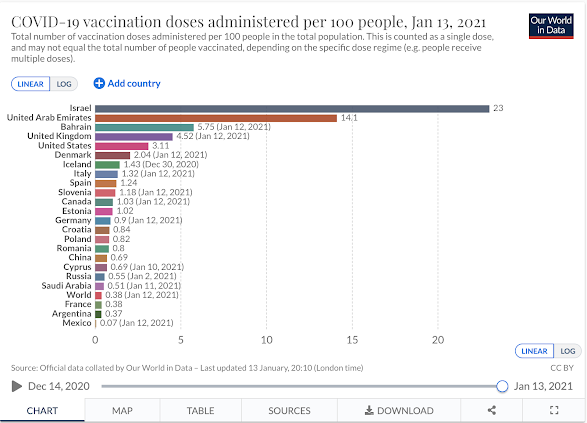
 Israel has pulled ahead of much in the world in its rate of vaccinating its citizens - with roughly 1% of the entire population vaccinated per day and over 23% of the country vaccinated in the first few weeks. The country hopes to have the entire population over age 16 vaccinated for COVID by end of March.

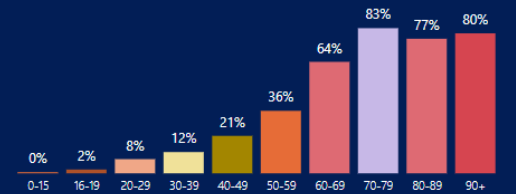
Israel focused on first vaccinating people by age group (and then comorbidity) with the idea that if you vaccinate the 20% of the country that represent 95% of the deaths, you can avoid deaths from COVID.


% of Israeli population within a certain age vaccinated by 1/13/21. Chart via Segal Eran


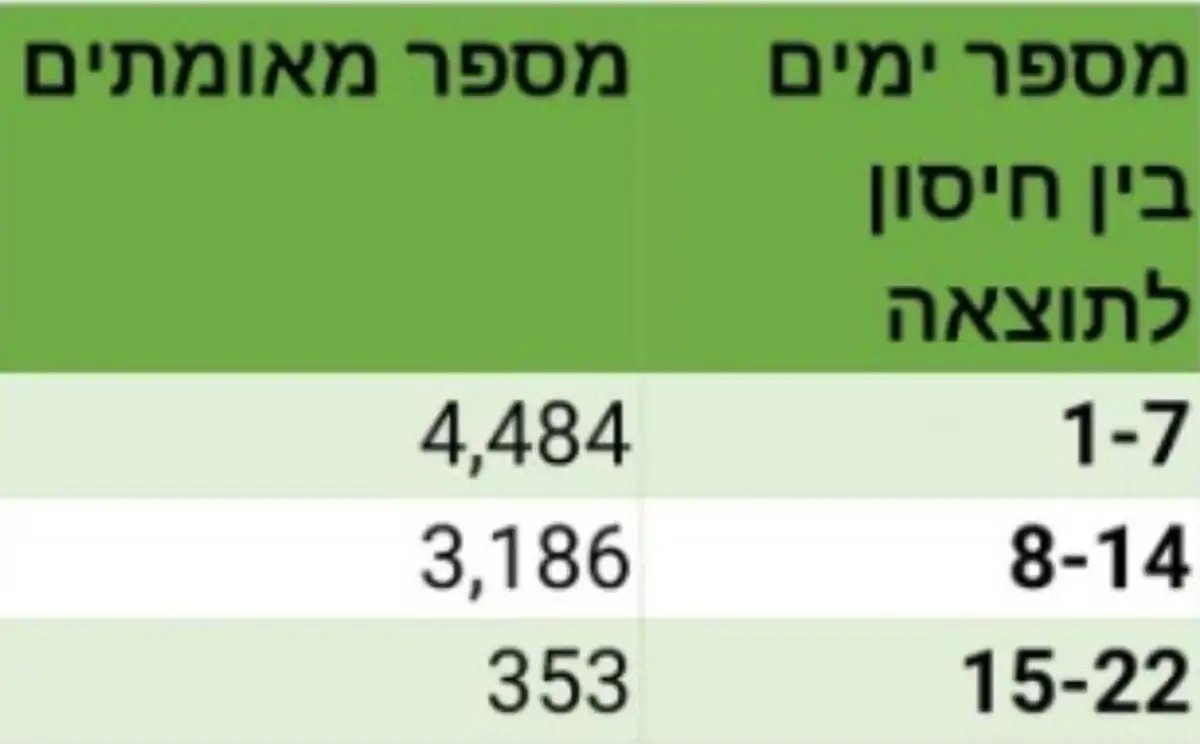
Early data is starting to suggest Israel’s approach is working. For example, in a cohort of 200,000 people vaccinated in Israel, there was a 12X drop in COVID cases by day15-22 of a single dose of Pfizer/BioNTech vaccine.


The right hand column below is day since first shot to result. The left hand side is # positive for COVID.


In parallel much of the rest of the world has been slower on rolling out vaccination with UAE as an exception. 


After speaking to a number of members of the Israeli public health community involved with COVID, the following picture emerges on why Israel has been so successful:


1. Focus on simplicity & pragmatism. 

The biggest takeaway is a focus on simplicity and pragmatism. For example, the criteria for vaccination are simple - you are either a healthcare worker (including nursing homes & assisted living facilities), or you are tiered by age (and later comorbidity). 


Healthcare workers have been shown to spread COVID and other diseases within hospitals (known as “nosocomial transmission” and a key aspect of SARS and MERS - two other coronavirus based diseases), while older people are most vulnerable to hospitalization and death from COVID.


Having age-based tiers makes it easy to know who should show up and who is eligible, and removes a big burden on enforcement. 


This simplicity and pragmatism extends further. For example, in the USA the roll out of vaccination in California to healthcare workers was slowed by complex tiering within healthcare workers themselves based on how much patient facing time each type of workers has.


In contrast, the Israelis I spoke to said “We vaccinate an entire workplace. We assume everyone will eventually be vaccinated so we found it easier to just show up and vaccinate every single person who works at a hospital. We do not care if they are doctors or administrators or whatever - it is easier to just vaccinate everyone”. 


Many countries and states have been too focused on “fairness” and “equity” so have frozen their vaccination efforts in place, or put in place large fines for “misused virus”. Remember - everyone will eventually get vaccinated. The more shots in arms, the better, with an emphasis on the old and comorbid. And also remember, we are in the middle of a “once in a century pandemic”- it is more important to move fast to save lives than to create and enforce complex rules. However, it turns out these complex rules are not needed - there are simple criteria for who will get sick and die of COVID per below.


2. Vaccinate the people who will die.

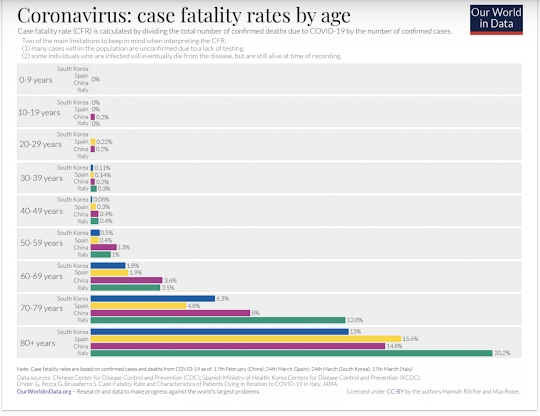
The biggest risk factor for death and hospitalization from COVID is age. Age outweighs comorbidities in some cases by as much as 30-fold. A handful of comorbidities matter, but age dominates.

Simple math suggests that vaccinating roughly 20-25% of the population would prevent 95% of COVID deaths in many western countries. So, pragmatically, the Israelis focused on vaccinating that high-risk 20% of their population first. This has mapped to age-based tiers (and a handful of comorbidities) which simplify vaccination roll outs. They also vaccinated healthcare workers and long term care facilities first.


Many of the calls in the US for “ethics and equity” in vaccination seem to be politically motivated versus science based. Complex, multi-tier criteria that prioritize young “essential” workers over 70-year olds, who are much higher risk of dying of COVID, means more people will die as we wait to get to the 20-25% of the population who actually matter in terms of risk of hospitalization and death. There is little logic in vaccinating 30-50% of the population (depending on your definition of "essential workers") and then 20% of high risk people (50-70% of the entire population between them!!) to protect 20% of the population who contribute 95% of COVID deaths. It is much easier to focus on the 20-25% who are actually at risk first. It seems unlikely it is ethical, or equitable, to let people die for your “ethics & equity framework”.


The science is clear - vaccinate the elderly, then people aged 16+ with certain comorbidities and you will see COVID deaths plummet. (Side note, the CDC finally updated their criteria to 65+ while this document was being written). We should all honor the role essential workers have played in keeping the country and world open. One way to honor this is to protect their elderly and sick family members from dying of COVID - by vaccinating their at-risk family members first. After the people with highest risk of death are vaccinated, the subset of essential workers who did not fall under those demographics can be vaccinated next. For example, Israel started this week vaccinating 55-year olds and up, as well as all teachers.


The nice aspect of this approach is you do not need to vaccinate that large of a population before you see a big impact and can potentially reopen. If fewer people will die of COVID (once vaccinated) then other common diseases like flu going forward, a country or state can reopen with many lives saved.


Here is Israel’s prediction on what to expect in terms of deaths:


3. Create as many endpoints to vaccinate out of as possible.

The Israelis I spoke to emphasized their focus on opening as many vaccination clinics and centers as possible. They mentioned that when a hospital set up a vaccination program, every possible clinic in the hospital was also opened for vaccination.


Similarly, parks, schools, and other public spaces have been converted into places people can go to be vaccinated.


Israel has also opened some “mega centers” for vaccination, per the picture below.

Some cities like San Diego have recently followed suit after feeling stymied by State and Federal government:


4. Don’t waste vaccine.

Remember, everyone will eventually be vaccinated. Throwing a scarce vaccine in the trash is an enormous waste. Rather than waste vaccines, the Israelis have two mechanisms for overflow. First, anyone can wait in line by a vaccination center starting at 7pm and if there is vaccine left over, be vaccinated. Second, if no one is waiting in line nurses or other vaccinators will go out into the street looking for people to vaccinate (and then schedule their next appointment for the second dose on the spot). There is a famous story of nurses coming out of a clinic and spotting a pizza delivery person. “Hey pizza guy want a vaccine!!” they yelled to call him over and then vaccinated him.


5. Success begets success.

Israel has been incredibly transparent on data around the vaccination program - with everything from dashboards showing vaccines used per day, % of population by age vaccinated etc. to a Telegram channel from the Ministry of Health with daily data dumps to whomever signs up.


One general tenet of life is “success begets success”. By vaccinating rapidly the pharma companies approved in Israel (Pfizer and Moderna) have continued to prioritize the company for more vaccine as capacity comes online. While Israel originally expected a gap in deliveries and temporarily running out of vaccine in January, that gap has now been bridged via new pharma deals.


The US could consider doing something similar - allocate more vaccines to the states that are actually using it. Hold back vaccine from states that are not moving quickly until they move fast enough to use it.


Remember - we do not need to vaccinate everyone to have a big effect. If we vaccinate 20% of the population it might be possible to still drop deaths 95%, which is the primary goal of the COVID shelter-in-place, social distancing, and vaccination efforts.


Factors that are mentioned but seem overweighted (AKA excuses).

There are a lot of reasons (perhaps a better word is “excuses”) that are made for why Israel is succeeding while others are not. This includes things like:


a. Small population and geography. 

Israel is a country of 9 million people. The argument is its small size makes it easier to vaccinate. The reality is that many countries the same size or half the size of Israel are doing a much worse job of vaccinating their populations including Denmark (5 million), Norway (5.3 million), Netherlands (18 million) and others. Similarly, States like New Jersey (population of ~9 million) are far behind Israel as well. If size were the only constraint, we would see more success elsewhere.


b. HMO/healthcare centralization.

The Israeli population is largely covered by 4 HMOs - with the largest, Clalit, covering roughly 50% of the population. Centralization of healthcare services undoubtedly matters in decision making speed and administration. However, as reminder the fragmented US system vaccinates 50% of its entire population age 2 and up for flu every single year - and does so in a matter of weeks. The primary obstacles in the US seem to have less to do with centralization and more with complex criteria and fears of scarcity of vaccines driving even more scarcity.


c . It must be the Israeli military coordinating all this!

The Israeli military is not coordinating the population’s vaccination. It is driven by a combination of the Ministry of Health, the HMOs, and some private companies that have been contracted for a subset of the logistics. This is all do-able in the USA too.


d. Israel is a wealthy country! That must be why! Or they spend more on healthcare!

Israel GDP per person is lower than the USA overall as well as lower than states of the same size like New Jersey. The country also spends around 7% of GDP annually on healthcare - roughly one-third what the USA spends.


e. The culture is different!

Israel has more in common with the US than one might guess. There is a fractured, contentious political system. A number of healthcare workers were going to refuse the vaccine - until they were told they would be placed on administrative leave if they refused it. A meaningful subset of the population ignored their second lockdown.


The USA can do it too!

Every year the United States vaccinates 50% of its entire population over the course of a few weeks for the flu. In past outbreaks the country has also been fast to move. For example, in 1947 the city of New York vaccinated 5 million people in 2 weeks to combat a smallpox outbreak.


If needed, the country can move fast. In order to do so, it should:

(1) Simplify criteria. Make vaccination age-based (and include healthcare workers and assisted living facilities). Be pragmatic. Vaccinate the whole hospital versus quibbling on the order in which staff get it. Remember - everyone will eventually be vaccinated. The two goals are to stop deaths and then to build herd immunity - in that order.

(2) Focus on the people who will actually die of COVID, not politics. 20-25% of the population vaccinated may drop deaths 95%. The CDC is finally moving in this direction, but should focus on age-based and then co-morbidity based tiering versus other factors. “Fairness” falls out naturally if everyone is vaccinated in the next few months and everyone’s family members’ lives are saved, versus taking an entire year with incremental disease and deaths.

(3) Open as many vaccination points as possible as fast as possible

A simple model is that anywhere that administered the flu vaccine can be used to vaccinate for COVID. Or, augment the pop-up testing centers with vaccination services. These stations can be staffed by healthcare workers from the clinics being used, as well as pharmacists (trained in flu vaccination), dentists and others.

(4) Don’t waste vaccine. If there is excess left over, use it on anyone so we can build herd immunity faster. 

(5) Optional - reward success. If a city,region, or state moves extra fast at vaccination - give them more. Reward the communities that vaccinate quickly and create competition and a leaderboard to get it done.


We finally have a vaccine. Many people are now dying unnecessarily due to a lack of delivery. The Israel model suggests a clear way to move forward. Let’s get it done.


http://blog.eladgil.com/2021/01/israel-has-pulled-ahead-of-much-in.html

Big Tech backs plan for digital Covid vaccination passport

 A digital Covid vaccination passport is being jointly developed by a group of health and technology companies who anticipate that governments, airlines and other firms will soon start asking people for proof that they have been inoculated.

A coalition known as the Vaccination Credential Initiative — which includes MicrosoftSalesforce and Oracle, as well as U.S. health care non-profit Mayo Clinic — was announced on Thursday.

The VCI said it wants to develop technology that enables individuals to obtain an encrypted digital copy of their immunization credentials that can be stored in a digital wallet of their choice, such as the Apple Wallet or Google Pay. It suggested that anyone without a smartphone could receive paper printed with QR codes containing verifiable credentials.

The coalition said it will also try to develop new standards for confirming whether a person has or hasn’t been inoculated against the virus. Previously, citizens have used vaccination booklets to keep track of their travel vaccines but authorities rarely ask to see them.

“The goal of the Vaccination Credential Initiative is to empower individuals with digital access to their vaccination records,” said Paul Meyer, CEO of non-profit The Commons Project, which is a member of the coalition, in a statement.

He added that the technology should allow people “to safely return to travel, work, school, and life, while protecting their data privacy.”

Bill Patterson, an executive vice president and general manager at enterprise software firm Salesforce, said his company wants to help organizations “customize all aspects of the vaccination management lifecycle and integrate closely with other coalition members’ offerings, which will help us all get back to public life.”

“With a single platform to help deliver safe and continuous operations and deepen trust with customers and employees, this coalition will be crucial to support public health and wellbeing,” Patterson added.

Microsoft did not immediately respond to CNBC’s request for comment.

Vaccine divides opinion

While many people can’t wait to protect themselves from the virus, some are adamant that they won’t get the jab, leaving populations divided into those that have been vaccinated and those that haven’t. In the U.K., one in five say they are unlikely to get the vaccine, according to YouGov research published in November, citing a variety of different reasons.

Millions of people around the world still don’t want to be vaccinated, according to opinion polls. Some fear needles, some believe in unsubstantiated conspiracy theories and some are worried about potential side effects. Others just don’t think getting vaccinated is necessary and would rather risk catching Covid.

As a result of the differing views, a debate could start to emerge in 2021. Should any restrictions be imposed on people who choose not to get vaccinated, given they can catch and spread the virus?

It’s a tricky subject but governments are already looking at introducing systems that would enable authorities, and possibly businesses, to tell if a person has had a Covid vaccine or not.

In December it emerged that Los Angeles County plans to let Covid vaccine recipients store proof of immunization in the Apple Wallet on their iPhone, which can also store tickets and boarding passes in digital form. Officials say it will first be used to remind people to get their second shot of the vaccine but it could, eventually, be used to gain access to concert venues or airline flights.

China has launched a health code app that shows whether a person is symptom-free in order to check into a hotel or use the subway. In Chile, citizens that have recovered from the coronavirus have been issued with “virus free” certificates.

On Dec. 28, Spain’s Health Minister Salvador Illa said the country will create a registry to show who has refused to be vaccinated and that the database could be shared across Europe.

Elsewhere, the CEO of Delta Air Lines, Ed Bastian, said in April that immunity passports could be used to help fliers feel more confident in their personal safety while traveling.

A spokesperson for Ryanair said “vaccination won’t be a requirement when flying Ryanair” when CNBC asked if it would ever prevent non-vaccinated people from flying on its aircraft. British Airways, Qantas, and easyJet did not respond to CNBC’s request for comment.

Isra Black, a lecturer in law at the University of York, and Lisa Forsberg, a postdoctoral fellow at the University of Oxford who researches medical ethics, told CNBC that it “isn’t easy to say whether it would be ethically permissible for a state to impose restrictions” on people who refuse a jab.

The academics said in a joint statement via email that the answer will depend on factors like vaccine supply, the level of vaccination in the population, the nature of the restrictions on vaccine refusers, and how the restrictions are operationalized.

“We might think that there are strong, albeit not necessarily decisive, reasons in favor of some limitation on regaining pre-pandemic freedoms for individuals who refuse vaccination for Covid-19, for example, on their freedom to gather,” said Black and Forsberg. “There is the potential for unvaccinated individuals to contract a serious case of coronavirus, which we take would be bad for them, but could also negatively affect others, for example, if health resources have to be diverted away from non-Covid care.”

https://www.cnbc.com/2021/01/14/microsoft-salesforce-and-oracle-working-on-covid-vaccination-passport.html