A surge in COVID-19 cases in the United States and Europe has prompted calls for a national mask mandate here in America. Advocates of government edicts have asserted that these would bring the pandemic “under control” in a matter of weeks. The authors of this Backgrounder found that 97 of the 100 counties with the most confirmed cases had mask mandates. Nor did a national mask mandate prevent a surge in Italy. These findings do not deny the efficacy of mask-wearing, nor should they discourage the practice. Instead, they point to the inadequacy of public health strategies that rely too heavily on lockdowns and mask mandates. Governments should undertake more effective interventions, such as specifically protecting nursing home residents, enabling nationwide screening through use of rapid self-tests, and establishing voluntary isolation centers where infected people can recover, rather than exposing their families to infection.
While mask-wearing can help to reduce transmission of COVID-19, data show that mask mandates in the U.S. and other countries did not prevent a surge of cases.
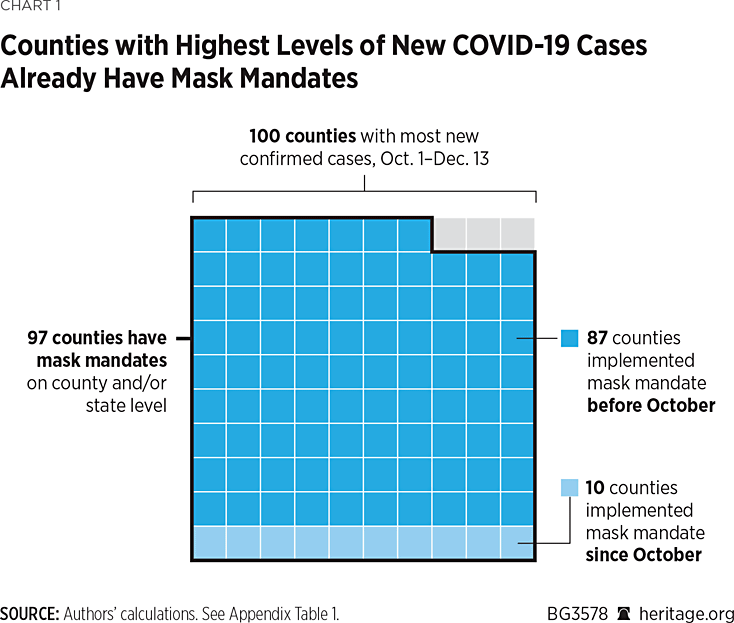
During the U.S. surge in the fall, 97 of the 100 counties with the most confirmed cases had either a county-level mask mandate, a state-level mandate, or both.
Governments should take more effective steps, such as protecting nursing home residents and approving rapid self-tests for widespread at-home testing.
A surge in COVID-19 cases in the United States and Europe has prompted calls for a national mask mandate here in America. Advocates of government edicts have asserted that these would bring the pandemic “under control” in a matter of weeks.
Public health officials here and throughout most of the world believe that mask-wearing has some value in reducing the rate at which the pandemic spreads. Accepting this premise, however, does not necessarily lead to the conclusion that government mask mandates will bring the contagion under control.
This Backgrounder examines the effects of mask mandates in the U.S. and Italy. While there is no national mask mandate in the U.S., many states and counties have imposed them. We (the authors) find that, of the 25 counties reporting the highest numbers of new cases during this latest surge, 21 had mask mandates in place since at least July.
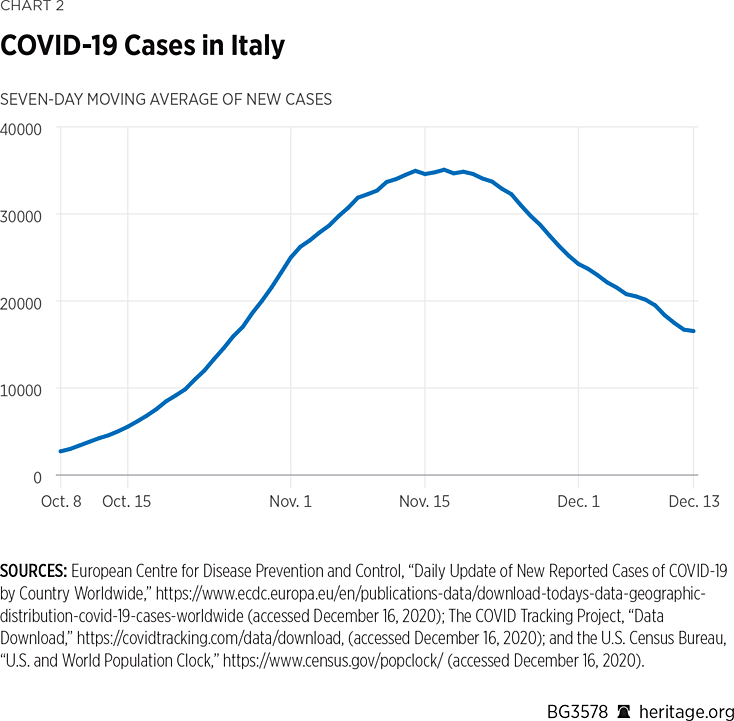
Italy does have a national mask mandate that is backed by fines of up to 1,000 euros for non-compliance. We find that the mandate did not prevent a surge in cases in Italy that began in October, peaked in mid-November, and had not yet subsided in mid-December.
These findings do not deny the efficacy of mask-wearing per se. Nor should they discourage the practice.
Instead, they point to the inadequacy of public health strategies that rely predominantly on lockdowns and mask mandates. Governments should undertake more effective interventions. These include adopting better measures to protect nursing home residents, enabling nationwide screening through the widespread use of rapid self-tests, and establishing voluntary isolation centers where infected people can recover, rather than exposing their families to infection.
The Value of Masks
Mask-wearing has become a highly politicized practice in the U.S. Some detractors consider it an emblem of social submission. Others, such as Centers for Disease Control and Prevention (CDC) Director Robert Redfield, see masks as the best way to get the pandemic under control: “I think if we could get everybody to wear a mask now,” Redfield said in July, “I think in four, six, eight weeks, we could bring this epidemic under control.”1
Miriam Berger et al., “Coronavirus Could Be ‘Under Control’ in Weeks, If Everyone Wore Masks, CDC Director Says,” The Washington Post, July 15, 2020, https://www.washingtonpost.com/nation/2020/07/14/coronavirus-live-updates-us/ (accessed November 21, 2020).
Mask-wearing has thus inspired both enthusiasm and revulsion that likely exaggerates its significance.
The CDC in general is a bit more tempered about mask-wearing than its Director. While the CDC has changed its guidance on masks numerous times throughout the pandemic, the agency’s recommendation (as of November 20) endorses mask-wearing both to reduce the risk of infecting others and to protect uninfected people from the contagion.2
The discussion of CDC guidance on mask-wearing represents claims that the agency made as of November 20, 2020. As noted, the agency changes its views frequently, and likely will continue to do so.
The CDC and other public health authorities in the U.S. and abroad have been trying to determine the relative efficacy of mask-wearing for two different, though related, purposes. The first is “source control”—meaning the extent to which wearing a mask prevents an infected individual from spreading the virus. The second is “protection”—meaning the extent to which wearing a mask protects an uninfected individual from contracting the virus.
The CDC has, for many months, believed that masks have “source control” value.3
Centers for Disease Control and Prevention, “Scientific Brief: Community Use of Cloth Masks to Control the Spread of SARS-CoV-2,” November 20, 2020, https://www.cdc.gov/coronavirus/2019-ncov/more/masking-science-sars-cov2.html (accessed December 15, 2020).
More specifically, it advises that “multi-layer cloth masks block release of exhaled respiratory particles into the environment.”4
Ibid.
According to this theory, by reducing the speed and volume of droplets that an infected person releases into the environment, masks help to protect the uninfected from the infected.
Since November 20, 2020, the CDC has also asserted that masks provide some protection for uninfected people who wear them: “Cloth mask materials can also reduce wearers’ exposure to infectious droplets through filtration.”5
Ibid.
The CDC bases its mask guidance on “experimental and epidemiological data,” rather than controlled studies.6
Ibid.
Experimental data is collected, for example, by squirting an aerosol through a cloth mask and measuring how far particles travel. Epidemiological studies or, as the CDC calls them, “real world” data, generally involve case studies of transmission.
In perhaps the most famous of these, two St. Louis hairstylists who had COVID-19 wore masks while they continued to service customers. They saw 139 clients over eight days. Of those, 67 consented to follow-up testing. None of those 67 tested positive for COVID-19.7
M. Joshua Hendrix et al., “Absence of Apparent Transmission of SARS-CoV-2 from Two Stylists After Exposure at a Hair Salon with a Universal Face Covering Policy–Springfield, Missouri, May 2020,” Morbity and Mortality Weekly Report, Vol. 69, No. 28 (July 17, 2020), pp. 930–932, https://www.ncbi.nlm.nih.gov/pubmed/32673300 (accessed December 15, 2020).
The CDC assigns great weight to this study.
The CDC more recently has cited studies that it believes show that mask-wearing can help protect uninfected people from the virus.8
Centers for Disease Control and Prevention “Scientific Brief: Community Use of Cloth Masks to Control the Spread of SARS-CoV-2,” updated November 20, 2020, https://www.cdc.gov/coronavirus/2019-ncov/more/masking-science-sars-cov2.html?fbclid=IwAR28PppCa6x2uxwO8Z2baHM0KHS4JXx0inzzMQs3zRHV1qql_0a8mxZfpCw (accessed December 22, 2020).
One drawback of these studies is that they lack a control group. Danish researchers recently published the only controlled study of mask-wearing.9
Henning Bundgaard et al., “Effectiveness of Adding a Mask Recommendation to Other Public Health Measures to Prevent SARS-CoV-2 Infection in Danish Mask Wearers,” Annals of Internal Medicine, November 18, 2020, https://www.acpjournals.org/doi/10.7326/M20-6817 (accessed December 15, 2020).
It tests the hypothesis that wearing a mask protects uninfected people.
The researchers conducted the study, in which 6,000 Danes participated, in spring 2020, before Denmark instituted a mask mandate. The control group followed existing social distancing guidelines but did not wear masks. Researchers provided the experimental group with high-quality surgical masks with a filtration rate of 98 percent and instructed participants to wear them outside their homes.
Those who completed the study underwent COVID-19 tests one month later. Researchers found that 1.8 percent of those in the mask-wearing group tested positive, while 2.1 percent of the control group did. The results were not statistically significant. The researchers concluded that mask-wearing is compatible with a range of outcomes—from a 46 percent reduction in infections to a 23 percent increase.
It is important to note that the study examined the prevention value of masks (whether an uninfected person who wore a mask would be less likely to contract COVID-19). It did not test the source control value of face coverings (whether an infected person who wore one would be less likely to spread the disease).
Although the Annals of Internal Medicine published the study on November 18, the CDC did not cite it in its November 20 revised mask guidance. The Danish study casts doubt on the CDC’s advice about the protective value of masks.
The study does not, however, contradict the view that masks provide source control benefits, since it did not test that claim. A controlled study of that hypothesis would be unethical as it would require exposing uninfected people to people with the disease, some wearing masks and others not.
In sum, some studies support the source control value of masks, though none of those studies are controlled. Source control benefits also align with common sense: A face-covering will reduce the speed and distance that an infected person’s droplets travel. The prevention value of masks is less well attested, and the only controlled study of the hypothesis contradicts it.
The United States: State and County-Level Mask Mandates. The previous section considered the value of mask-wearing. This section considers the effectiveness of government mask mandates, examining whether jurisdictions that have adopted them resisted the current surge of COVID-19 cases.
The data show that mask mandates have not stemmed the surge. From October 1 through December 13, the U.S. saw an increase of 8.8 million confirmed COVID-19 cases.10
USAfacts.org, “U.S. Coronavirus Cases and Deaths,” https://usafacts.org/visualizations/coronavirus-covid-19-spread-map/ (accessed December 15, 2020).
Of the 100 counties with the most confirmed cases during this period, 97 had either a county-level mask mandate, a state-level mandate, or both.11
The results reported in this Backgrounder are virtually identical to those found when running the same analysis from October to mid-November, closer to the beginning of the current surge.
Chart 1 shows that, among this group of 97 counties, 87 began their mandate before October. (See Appendix Table 1 for a complete list of the counties.) In the remaining 10 counties, five issued their mask mandate in October, and five did so in November. However, several of the mandates that went into effect in either October or November actually tightened existing mask requirements.12
For instance, starting in May, all Massachusetts counties were under state orders that required masks “where social distancing is not possible.” See Commonwealth of Massachusetts, “COVID-19 Order No. 31,” May 1, 2020, https://www.mass.gov/doc/may-1-2020-masks-and-face-coverings/download (accessed November 20, 2020). Four Massachusetts counties are on the list of counties with the 100 largest increases in cases. The same analysis for October through November 19—an additional 10 days—provides a nearly identical list of the top 100 counties and the same overall results. This list does not account for any states or counties that implemented a mask mandate after November 15, 2020.
Of the 25 counties with the highest new case totals, all 25 had a mask mandate, and all but one implemented their directive prior to October; 21 of the counties implemented mandates prior to August.
Thus, most of the counties with the highest increase in cases during this fall surge have had mask mandates in place since (at least) the summer. The data also show that these 100 counties, spread throughout the U.S. (see Appendix Table 1), contain 39.6 percent of the total new COVID-19 cases in the U.S. and 39.4 percent of the population.13
A well-publicized study, published on October 23, claimed that mask mandates decreased COVID-19 hospitalizations in more than 1,000 U.S. counties. The authors withdrew the study on November 4 “because there are increased rates of SARS- CoV-2 cases in the areas that we originally analyzed in this study.” Dhaval Adjodah et al., “Decrease in Hospitalizations for COVID-19 after Mask Mandates in 1083 U.S. Counties,” medRxiv, November 4, 2020, https://www.medrxiv.org/content/10.1101/2020.10.21.20208728v2 (accessed November 22, 2020). The findings presented in this Backgrounder are also consistent with new data released by a research team at Rational Ground. See Scott Morefield, “New Study Shows Mask Mandates Had Zero Effect in Florida or Nationwide, But the Lie Continues,” Townhall, December 21, 2020, https://townhall.com/columnists/scottmorefield/2020/12/21/new-study-shows-mask-mandates-had-zero-effect-in-florida-or-nationwide-but-the-l-n2581879 (accessed December 22, 2020).
Thus, unlike earlier in the pandemic, the growth in new cases is not disproportionate to the population.14
Other data sources indicate that between 70 percent to 80 percent of Americans were regularly wearing masks as of the summer. See Phillip Magness, “Case for Mask Mandate Rests on Bad Data,” The Wall Street Journal, November 11, 2020, https://www.wsj.com/articles/case-for-mask-mandate-rests-on-bad-data-11605113310 (accessed December 15, 2020), and Nicholas Reimann, “Over 230 Million Americans Now Live with a Public Mask Mandate,” Forbes, July 22, 2020, https://www.forbes.com/sites/nicholasreimann/2020/07/22/over-230-million-americans-now-live-with-a-public-mask-mandate/?sh=6e7f4b9742eb (accessed December 15, 2020). More recent survey data (in a HealthDay/Harris Poll) suggest that the figure was higher (93 percent) by October. See Dennis Thompson, “Mask Use by Americans Now Tops 90%, Poll Finds,” WebMD, October 22, 2020, https://www.webmd.com/lung/news/20201022/mask-use-by-americans-now-tops-90-poll-finds#1 (accessed December 15, 2020).
Italy: Nationwide Mask Mandate. Unlike the U.S., Italy has a national mask mandate. Italians must wear masks outdoors and indoors, except in their own homes.15
“Coronavirus: Masks Made Mandatory Outdoors Across Italy,” BBC News, October 8, 2020, https://www.bbc.com/news/world-europe-54454450 (accessed December 21, 2020).
The government issued the order on October 8. On that date, Italy reported 3,677 new cases, its highest total since April 17.16
European Center for Disease Prevention and Control, “Daily Number of New Reported Cases of COVID-19 by Country Worldwide,” https://www.ecdc.europa.eu/en/publications-data/download-todays-data-geographic-distribution-covid-19-cases-worldwide (accessed November 21, 2020).
Its seven-day moving average of new confirmed infections per million stood at 45, lower than that of other European nations and less than one-third of the U.S. rate.17
The COVID Tracking Project, The Atlantic, https://covidtracking.com/data/download (accessed November 21, 2020).
The imposition of a national mandate did not arrest the growth in infection rates. On October 17, Italy recorded more than 10,000 new cases. On November 14, Italy reported more than 40,000 new cases (678 cases per million people). New cases have subsided since then, but remain elevated. On December 11, Italian health authorities reported nearly 20,000 new cases, almost 5.5 times the number recorded on October 8.
Italy’s seven-day moving average of new cases per million population overtook that of the U.S. on October 23 (199 per million vs. 190 per million), just over two weeks after the government imposed the national mask mandate. It continued to rise over the next month, peaking at 678 per million on November 14. Both figures were higher than those in the U.S., which saw its seven-day moving average of new cases per million nearly quadruple between October 7 (134) and November 20 (498).
On a population-adjusted basis, cases thus rose more rapidly in Italy over the six weeks after the government imposed a national mask mandate than in the U.S.18
This increase is even more remarkable since Prime Minister Giuseppe Conte imposed a series of national restrictions, in addition to the mask mandate, throughout this period. The Conte government, for example, established a 10 p.m. curfew, shuttered all museums and galleries, ordered bars and restaurants to close at 6 p.m., and limited public transport. In addition to these nationwide restrictions, Conte divided the country into red, orange, and yellow regions, establishing a hierarchy of limitations. For example, in red zones, the government orders all non-essential shops closed and prohibits “non-essential” movements. It also bans travel outside one’s city and region, shutters middle and high schools, and limits outdoor sports activities. See “At a Glance: What Are the Coronavirus Rules in My Region of Italy Now?” The Local.it, November 4, 2020 (updated December 1, 2020), https://www.thelocal.it/20201104/at-a-glance-what-are-italys-coronavirus-rules-right-now (accessed December 11, 2020). See also, “Italy Adds Two Regions to Red Zones as Daily COVID-19 Count Surges,” CGTN, November 14, 2020, https://newsaf.cgtn.com/news/2020-11-14/Italy-adds-two-regions-to-red-zones-as-daily-COVID-19-count-surges-Vq70F9goUw/index.html (accessed December 11, 2020).
The U.S. population-adjusted rate surpassed that of Italy on November 26 and has continued to eclipse it. Virtually all the U.S. counties with the largest number of new cases between October 1 and December 13 had mask mandates before the new wave of cases arose, and approximately 80 percent of the U.S. population was under a mask mandate by the end of the summer.
It is also worth noting that, based on survey data, mask-wearing was widely practiced both in the U.S. and Italy during this period. In late October, a Harris poll found that 92 percent of Americans reported wearing masks always, sometimes, or often.19
Dennis Thompson, “Mask Use by Americans Now Tops 90%,” HealthDay, October 22, 2020, https://www.webmd.com/lung/news/20201022/mask-use-by-americans-now-tops-90-poll-finds#1 (accessed December 21, 2020). A December 2020 survey conducted by the Kaiser Family Foundation found that 96 percent of respondents wore masks some, most, or all of the time, with 89 percent reporting that they wore masks at least most of the time. “KFF COVID-19 Vaccine Monitor,” December 2020, p. 4, http://files.kff.org/attachment/Topline-KFF-COVID-19-Vaccine-Monitor-December-2020.pdf (accessed December 21, 2020).
During the same period, polls conducted throughout Europe found that 99 percent of Italians reported wearing masks always, sometimes, or often, as of late October.20
Statista, “How Often Have You Worn a Face Mask Outside Your Home to Protect Yourself or Others from Coronavirus (COVID-19)?” as of October 18, 2020, https://www.statista.com/statistics/1114375/wearing-a-face-mask-outside-in-european-countries/ (accessed December 21, 2020). The survey data from other European countries show that mask-wearing in the U.S. was roughly the same as in the U.K. and Germany, and more widely practiced than in the Netherlands, Denmark, Finland, Norway, or Sweden.
That is a statistically significant difference, but hardly one that suggests a large difference in mask-wearing between Italians and Americans during a period when cases were rising in both countries.
These data do not disprove that mask-wearing reduces infection risk. They do, however, demonstrate that nationwide mask mandates have not prevented large COVID-19 outbreaks.
Better Public Health Interventions
Instead of relying heavily on mask mandates, government should adopt policies aimed at those most susceptible to severe illness and death from the contagion. It should also broaden public health testing, making it easier for people to learn their infection status. And, it should provide some alternative to infected people who share living space with those at greater risk of illness.
Policies should prioritize informing citizens, not restricting their freedoms.
Improved Protection of Nursing Home Residents. The number of nursing home residents who have tested positive for COVID-19 has been rising.21
American Health Care Association and National Center for Assisted Living, “Report: COVID-19 Cases in Nursing Homes,” November 10, 2020, https://www.ahcancal.org/News-and-Communications/Fact-Sheets/FactSheets/Report-Nursing-Homes-Cases-Nov10-2020.pdf (accessed December 21, 2020).
Between September 13 and October 18, the most recent date for which the American Health Care Association and the National Center for Assisted Living have provided data, the number of infected residents rose from 5,956 to 8,575, a 44 percent increase.22
Ibid.
Although they represent less than 1 percent of the U.S. population and just over 0.5 percent of COVID-19 cases, nursing home residents accounted for nearly 39 percent of COVID-19 deaths through December 10.23
As of December 10, The COVID Tracking Project, sponsored by The Atlantic, reported 841,495 COVID-19 cases among nursing home residents, of a total of 15,360,841 cases in the U.S. It also reported 110,026 COVID-19-related deaths among nursing home residents, compared with a national total of 284,309. “The Long-Term Care COVID Tracker,” The Atlantic, https://covidtracking.com/data/longtermcare (accessed December 11, 2020). See also “U.S. Historical Data,” The Atlantic, https://covidtracking.com/data/national (accessed December 11, 2020).
A rise in cases among the frail elderly will thus produce a disproportionately large increase in COVID-19 deaths.
The government should redouble its efforts to keep nursing homes safe. The Center for Medicare and Medicaid Services (CMS) has established guidelines for testing nursing home staff, requiring more frequent testing in communities with high rates of COVID-19 infection.24
Centers for Medicare and Medicaid Services Center for Clinical Standards and Quality/Survey and Certification Group, “Interim Final Rule (IFC), CMS-3401-IFC, Additional Policy and Regulatory Revisions in Response to the COVID-19 Public Health Emergency related to Long-Term Care (LTC) Facility Testing Requirements and Revised COVID-19 Focused Survey Tool,” Memorandum, August 26, 2020, https://www.cms.gov/files/document/qso-20-38-nh.pdf (accessed December 21, 2020).
The CMS also has distributed rapid-testing kits to thousands of nursing homes to facilitate testing.25
Centers for Medicare and Medicaid Services, “Frequently Asked Questions: COVID-19 Testing at Skilled Nursing Facilities/ Nursing Homes,” https://www.cms.gov/files/document/covid-faqs-snf-testing.pdf (accessed November 22, 2020).
These policies are not adequate, as the alarming rise in cases shows. The Heritage Foundation’s Kevin Pham, MD, has recommended that the government take the following steps to improve nursing home safety.26
Kevin Pham, MD, “If We’re Going to Control COVID, We Need to Make This Crucial Change,” Newsday, November 20, 2020, https://www.newsday.com/opinion/coronavirus/covid-19-coronavirus-control-change-america-elderly-nursing-homes-elder-care-precautions-1.50070870 (accessed December 21, 2020).
- Test nursing home visitors. CMS guidelines advise nursing homes to screen visitors through temperature checks, questionnaires, and observing for COVID-19 symptoms. The CMS should advise nursing homes to screen visitors more systematically, using rapid tests, discussed in more detail in the next section.
- Implement more robust mitigation measures for nursing home staff. Nursing home administrators should test staff members every time they leave or re-enter the facility. That will require a larger supply of tests, especially rapid tests. It may also require keeping staff in a “bubble”—dedicated staff housing for several days at a time.
The approval of vaccines for COVID-19 in December 2020 will directly benefit nursing home residents and staff. Most states have prioritized immunizing residents and staff. That process, however, will take time. Government should adopt more aggressive policies now, as nursing-home-related cases and deaths are spiraling higher.
Nursing home safety is a daunting, labor-intensive, and costly task. Given the nature of this pandemic, in which 80 percent of COVID-19 deaths are among the elderly, and 39 percent are among nursing home residents, there is no higher priority for policymakers.27
Centers for Disease Control and Prevention National Center for Health Statistics, “Weekly Updates by Select Demographic and Geographic Characteristics,” https://www.cdc.gov/nchs/nvss/vsrr/covid_weekly/index.htm#AgeAndSex (accessed November 23, 2020).
Approving Rapid Self-Testing for Population Screening. Redoubling efforts to protect nursing home residents will benefit those that the pandemic has hit the hardest. Government should also take steps to protect the general population. The availability of rapid, at-home tests that do not require a prescription or laboratory analysis would inform people of their COVID-19 status and limit the disease’s transmission.
The U.S. government has taken several important steps in this direction, most recently approving the first rapid, over-the-counter test for which consumers can read results themselves. Most significantly, on December 15, the U.S. Food and Drug Administration (FDA) approved the Ellume COVID-19 Home Test, which yields results in about 15 minutes and will cost around $30.28
Rob Stein, “FDA Authorizes First Home Coronavirus Test that Doesn’t Require a Prescription,” National Public Radio, December 15, 2020, https://www.npr.org/sections/health-shots/2020/12/15/946692950/fda-authorizes-first-home-coronavirus-test-that-doesnt-require-a-prescription (accessed December 21, 2020).
The Australian manufacturer believes that it can ship about 20 million units to the U.S. during the first half of 2021, with the first shipments to arrive during January.29
News release, “FDA Authorizes Ellume COVID-19 Home Test as First Over-the-Counter Fully At-Home Diagnostic Test,” Ellume, December 15, 2020, https://www.ellumehealth.com/2020/12/15/fda-authorizes-ellume-covid-19-home-test-as-first-over-the-counter-fully-at-home-diagnostic-test/ (accessed December 15, 2020).
That development, while encouraging, is inadequate. An effective public health testing strategy requires widespread self-testing, on the order of tens of millions, perhaps 50 million, per day.30
Michael Mina, “How We Can Stop the Spread of COVID-19 by Christmas,” Time, November 17, 2020. https://time.com/5912705/covid-19-stop-spread-christmas/ (accessed December 21, 2020).
Fortunately, the technology exists to produce large volumes of low-cost, rapid home tests.31
For a nontechnical description of these tests and their capabilities, see RapidTests.org, https://www.rapidtests.org/ (accessed December 21, 2020).
Unfortunately, the FDA has yet to approve any of these tests, which are affordable and can be produced in sufficient volume to regularly test vast swathes of the population.
Dr. Anthony Fauci, Director of the National Institute of Allergy and Infectious Diseases, recently explained how the availability of such tests would be an effective weapon against coronavirus transmission. Asked what his strategy on testing would be, Fauci said:
Surveillance testing. Literally flooding the system with tests. Getting a home test that you could do yourself, that’s highly sensitive and highly specific. And you know why that would be terrific? Because if you decided that you wanted to have a small gathering with your mother-in-law and father-in-law and a couple of children, and you had a test right there. It isn’t 100%. Don’t let the perfect be the enemy of the good. But the risk that you have—if everyone is tested before you get together to sit down for dinner—dramatically decreases. It might not ever be zero but, you know, we don’t live in a completely risk-free society.32Elizabeth Rosenthal, “Take It From an Expert: Fauci’s Hierarchy of Safety During COVID,” Kaiser Health News, November 19, 2020, https://khn.org/news/qa-interview-dr-anthony-fauci-advice-on-hierarchy-of-safety-during-covid-pandemic/?utm_campaign=KFF-2020-The-Latest&utm_medium=email&_hsmi=100497655&_hsenc=p2ANqtz--uAAiuyXgj4Fyj-KG_QVzsWvsFBqMFtPL1cYT-jmz3wsvB9KuSHx2VYBC0Q7h5TOeaicAdX8tQpYmn4ZTds6jx0jcNSw&utm_content=100497655&utm_source=hs_email (accessed December 21, 2020).
Fauci’s comments encapsulate the arguments in favor of widespread testing: “Flooding the system” with affordable at-home tests that yield results in minutes would allow people to engage in social interactions more safely, and help to suppress the pandemic.
While the tests are not 100 percent accurate, the risk of transmission “dramatically decreases” when people use them before engaging in social interactions, as Fauci observed. Because the tests would be affordable and widely available, people could test themselves frequently, reducing the likelihood of false results. Testing tens of millions of people daily, instead of one or two million as is currently the case, and providing them instant results would be an effective tool against the pandemic.33
Two recent studies have modeled the tradeoff between test sensitivity and test frequency and turnaround time. Both concluded that frequent screening tests with rapid results were effective at controlling pandemic spread. Both also drew a distinction between the requirements for clinical diagnostic testing, for which accuracy is paramount, and surveillance testing (screening), for which speed of reporting is more important than test sensitivity. Daniel Larremore and the coauthors of a recent study employed two epidemiological models to examine the efficacy of rapid antigen tests. They concluded: “Testing frequency was found to be the primary driver of population-level epidemic control, with only a small margin of improvement provided by using a more sensitive test. Direct examination of simulations showed that with no surveillance or biweekly testing, infections were uncontrolled, whereas surveillance testing weekly…effectively attenuated surges of infections.” Daniel B. Larremore et al., “Test Sensitivity Is Secondary to Frequency and Turnaround Time for COVID-19 Surveillance,” medRxiv preprint, June 27, 2020, https://www.ncbi.nlm.nih.gov/pmc/articles/PMC7325181/ (accessed December 21, 2020). Thomas Hellmann and Veikko Thiele similarly modeled the epidemiological and economic effects of voluntary self-testing. They concluded: “Our central insight is that the equilibrium infection risk falls when home-based testing becomes cheaper and easier to use, even if tests are not always accurate. Our results challenge the clinical mainstream view that diagnostic testing is a prerogative of the medical profession, and supports the notion that frequent self-testing is vital for an economy facing an ongoing pandemic.” Thomas F. Hellmann and Veikko Thiele, “A Theory of Voluntary Testing and Self-Isolation in an Ongoing Pandemic,” National Bureau of Economic Research Working Paper No. 27941, October 2020, https://www.nber.org/papers/w27941 (accessed December 21, 2020).
The government should adopt this policy. The FDA should approve affordable rapid tests for home use. Moreover, the federal government should commit to pre-purchase hundreds of millions of these self-testing kits over the next two years, and the CDC should clarify its contradictory testing guidance.34
Virginia B. Allen, “How Rapid-Result, At-Home Tests for COVID-19 Could Slash Infection Rate,” The Daily Signal, December 11, 2020, https://www.dailysignal.com/2020/12/11/how-rapid-result-at-home-tests-for-covid-19-could-slash-infection-rate/.
This will enable companies that make these to ramp up production in advance of FDA approval. That will enable distribution of the tests to begin immediately after the agency clears the test, just as happened with vaccines under Operation Warp Speed. Distribution and administration of a COVID-19 vaccine has begun, but it will take many months to immunize tens of millions of people.35
Peter Loftus and Betsy McKay, “The COVID-19 Vaccine: When Will It Be Available to You?” The Wall Street Journal, December 11, 2020, https://www.wsj.com/articles/the-covid-19-vaccine-when-will-it-be-available-for-you-11606339361 (accessed December 21, 2020).
During that time the virus will continue to spread. The widespread availability of rapid tests is an essential complement to mass immunization.
Establishing Voluntary Isolation Facilities. From the earliest days of the pandemic, the CDC has advised people who know they are infected to quarantine at home with their families for 14 days. This practice is among the reasons that homes have become the principal vector of the pandemic.36
Nathaniel M. Lewis et al., “Household Transmission of SARS-CoV-2 in the United States,” Clinical Infectious Diseases, August 16, 2020, https://academic.oup.com/cid/advance-article/doi/10.1093/cid/ciaa1166/5893024 (accessed December 21, 2020).
Home quarantine is especially problematic for those who live in multi-generational households in multi-family units. It may at least partially account for racial disparities in COVID-19 infection rates.
State and local officials should consider establishing temporary facilities where people who need to isolate could recover from COVID-19 without exposing others to the disease. Such facilities could include hotels, many of which have lost considerable business to the pandemic. Use of the facilities should be strictly voluntary; the government should not compel infected people to enter them or remain there. It should, however, encourage people to protect their families by making use of the facilities. It should also consider paying people who test positive and who need financial support who agree to enter and remain in such facilities until cleared of the infection.
Given the extent of the infection in many communities, state and local governments should establish priorities for allocating temporary isolation space. The highest priorities should be for nursing home workers and those in multigenerational housing, where an elderly family member may be susceptible to severe illness and death.
The combination of frequent testing and isolation can be a powerful one, as amateur and professional sports leagues have demonstrated. Athletes compete in games in which it is impossible to social distance, such as football and basketball, without touching off an explosion of cases. Some players have tested positive, but frequent testing, coupled with the isolation of players who test positive, has made outbreaks rare.
While it is not possible to strictly replicate this approach in broader society, widespread and repeated testing, along with the option of isolating outside the home to protect the most vulnerable, would likely improve prospects for suppressing the pandemic.
Conclusion
The U.S. and most European countries have relied on lockdown orders and mask-wearing as the primary means to combat COVID-19, at least until a vaccine becomes universally available. These policies have not prevented a renewed surge in cases. While there is evidence that mask-wearing may reduce the risk that asymptomatic people will infect others, many of the U.S. counties with the highest infection rates have mask mandates. Nor has a national mask mandate prevented a surge in cases in Italy.
These policies have become especially self-defeating during the 2020 holiday season. Mask-wearing and, in many of the most populous states and jurisdictions, partial lockdowns, proved inadequate to stop the spread. Political and public health officials called on people to curtail social interactions, even as the holidays increased them.
Some politicians who warned against travel and gatherings violated their own orders, undermining their credibility.37
White House Coronavirus Task Force head Dr. Deborah Birx, for example, spent a portion of the Thanksgiving weekend with family members from different households. The celebration took place in Delaware, to which she and other family members traveled. While there, she appeared on CBS’s “Face The Nation.” During the appearance she noted that some Americans “went across the country or even the next state” over the holiday. She did not acknowledge that she was one of them. She further stated that “some people may have made mistakes over the Thanksgiving time period.” Her 50-hour trip to Delaware, Birx says, was not “for the purpose of celebrating Thanksgiving” but to winterize her Delaware property to prepare for its potential sale. Aamer Madhani and Brian Slodysko, “Birx Travels, Family Visits Highlight Pandemic Safety Perils,” Associated Press, December 20, 2020, https://apnews.com/article/travel-pandemics-only-on-ap-delaware-thanksgiving-52810c22488fff7e6bb70746bdc9bc61 (accessed December 22, 2020).
Some public officials suggested that citizens are the problem, for engaging in behaviors that are increasing cases and deaths.38
“The Latest: Biden Gives Dire Virus Warning for Next Two Months,” AP News, December 2, 2020, https://apnews.com/article/joe-biden-donald-trump-global-trade-china-united-states-14ae69eb51583276d1d8aa762e4b3ce3 (accessed December 21, 2020).
Joe Biden predicted that a quarter million more Americans would die in December and January “because people aren’t paying attention.”39
Ibid.
Public policy on COVID-19 has thus reached a dead-end on its current trajectory, at least until a sufficient number of people receive immunizations, perhaps by the middle of 2021. In the meantime, the toll of cases and deaths will continue to mount.
Policymakers should implement new interventions. These include redoubling efforts to protect nursing home residents, enabling broad-based population screening by “flooding the system,” as Dr. Fauci put it, with self-tests, and providing infected people who live with those most at risk of serious illness from the disease with safer alternatives to home isolation.
Widespread self-testing offers a promising policy direction. Unlike mask-wearing, lockdowns, and, even to some extent, vaccines, it has not been culturally or politically divisive, making it more likely to gain the sort of population-wide acceptance that has eluded other policy initiatives.
Self-testing also inverts the dynamic that has characterized pandemic policy in the U.S. and throughout the West. It combats the contagion by empowering and informing people, not confining them, restricting their activities, and blaming them for spreading the disease.
Equipping people to make the best decisions for themselves, their families, and their fellow citizens offers a promising new approach to combating the pandemic.
Doug Badger is Visiting Fellow in Domestic Policy Studies, of the Institute for Family, Community, and Opportunity, at The Heritage Foundation. Norbert J. Michel, PhD, is Director of the Center for Data Analysis, of the Institute for Economic Freedom, at The Heritage Foundation.

