Search This Blog

Monday, March 15, 2021

U.S. boosting Medicare reimbursement for COVID-19 vaccines

 The Biden administration will nearly double Medicare’s reimbursement rates for the coronavirus vaccines, increasing it to $40 per single-shot or $80 for a two-dose vaccine, White House COVID-19 advisers said on Monday.

Speaking to reporters at a briefing, advisers also said the vast majority of people in the United States who are receiving the two-shot versions of the COVID-19 vaccine are getting their second dose within the recommended timeframe, with just 3% missing their second dose.

https://www.reuters.com/article/us-health-coronavirus-usa-whitehouse/u-s-boosting-medicare-reimbursement-for-covid-19-vaccines-white-house-idUSKBN2B71Z6

Lonza gets licence to make ingredients for Moderna vaccine

 Swiss contract drug manufacturer Lonza received a key licence from Switzerland to produce ingredients for Moderna’s COVID-19 vaccine, regulator Swissmedic said on Monday, a boost for a global inoculation program that has hit some snags.

The licence, for Lonza’s new $70 million production line in Visp, Switzerland, dedicated to make ingredients for the Moderna vaccine, will help boost the U.S.-based company’s deliveries to Europe, Canada and other nations outside the United States.

Moderna scaled back some deliveries in February to countries in Europe while insisting its vaccine shipments would still hit targets for the first quarter and beyond as Lonza’s production of ingredients accelerated. Swissmedic’s licence, for the first of three large production lines in Visp, will help meet that goal.

“The licence was issued last week following a successful inspection of the production plant in Visp. At this newly approved site Lonza can manufacture, on behalf of Moderna, active substances for COVID-19 vaccines,” Swissmedic said in a statement.

Global vaccine supplies have hit some snags, as Johnson & Johnson’s has flagged potential supply issues, and countries including Germany temporarily suspended use of AstraZeneca’s vaccine while reports of health issues in people who have been vaccinated are investigated.

Lonza’s Visp facility received a so-called establishment licence, which Swissmedic said proves that the company has the “resources and processes needed to ensure and constantly monitor the quality of its products”.

Two additional production lines at Lonza in Visp are nearing completion, while another Lonza plant in Portsmouth, New Hampshire, is supplying Moderna for vaccines destined for the United States.

Lonza Chief Executive Pierre-Alain Ruffieux has said it could take a couple of months before Lonza’s new facilities hit “cruising speed”. Moderna has committed to supplying 700 million to 1 billion doses of its COVID-19 vaccine worldwide in 2021.

https://www.reuters.com/article/us-health-coronavirus-lonza-moderna/lonza-gets-licence-to-make-ingredients-for-moderna-vaccine-idUSKBN2B72BB

Size Matters For Biden Infrastructure Plan, Which Goldman Says Could Reach $4T

 Last Friday we published a recap of Biden's gargantuan $1.9 trillion American Rescue Plan from Rabobank's Philip Marey in which he observed that "the Democratic approach may have spoilt the mood for bipartisanship in the near term. Republicans claim that the Democrats were not serious about finding a bipartisan consensus." In short, since not a single Republican voted for the American Rescue Plan and centrist Democratic senators have shown that they are willing to use their leverage in the 50-50 Senate. "this will increasingly anger progressives as their left wing agenda continues to be watered down by senators of their own political party. Therefore, if Biden does not proceed with caution, this could already have been the high point of his administration."

That would be the rational view. Alternatively, in a world where a flood of new debt is the only option left to perpetuating a failed status quo, one can also argue that record polarization notwithstanding, it will be in the best interest of both republicans and democrats to push the current spending spree to its absurd limits.

That's where Biden's upcoming boondoggle - his infrastructure plan - comes in, and as Marey ominously predicts "if you think that $1.9 trillion is a lot of money, this does not mean that Democrats are going to stop their spending spree here." Not at all, and indeed in Marey's view, the next big thing from the Biden admin is an upcoming $2 trillion infrastructure deal (his full take here).

But according to Goldman, even $2 trillion is not nearly big enough, with the bank predicting that the BIden admin could come up with an infrastructure number as big as $4 trillion.

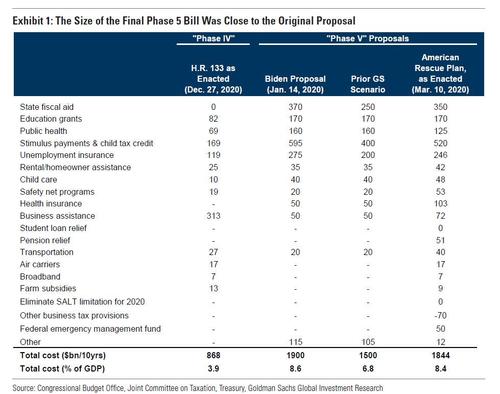
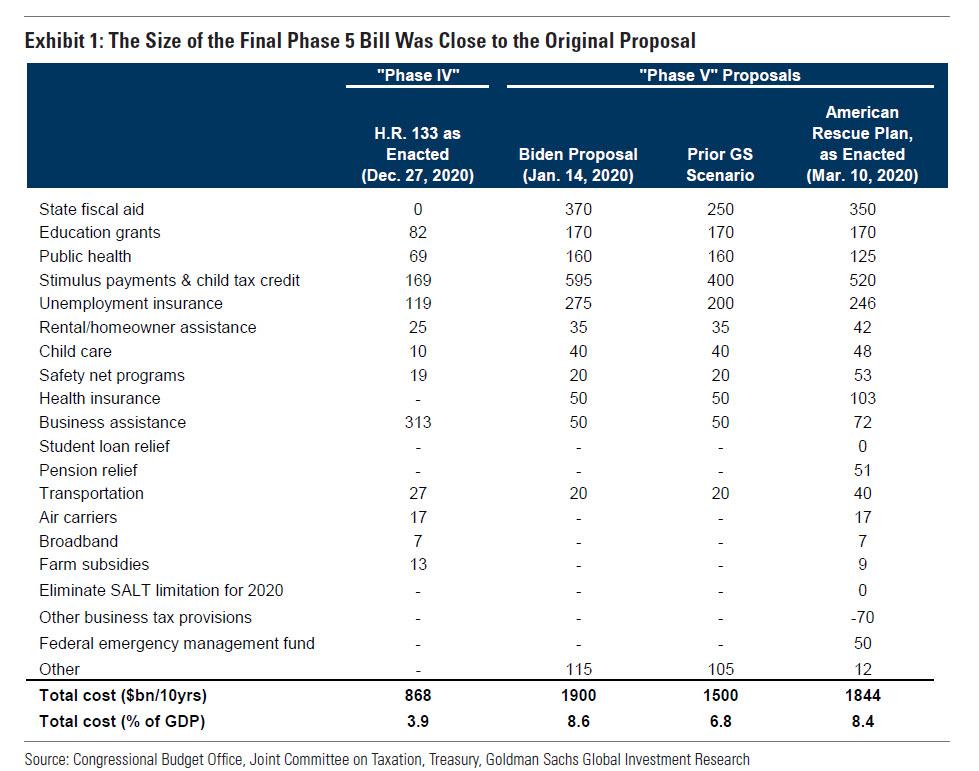
But first a quick post mortem from Goldman on the final Biden bill which as Goldman chief economist Jan Hatzius writes was closer to the original Biden proposal "than we expected" with the bank's forecast of a $1.5 trillion (6.8% of GDP) package, was around $350bn (1.6% ofGDP) less than what Congress ultimately approved. Exhibit 1 compares Goldman's prior expectations and the final package as estimated. Greater-than-expected fiscal support for state and local governments, transit systems and pension funds accounted for around half of the difference.
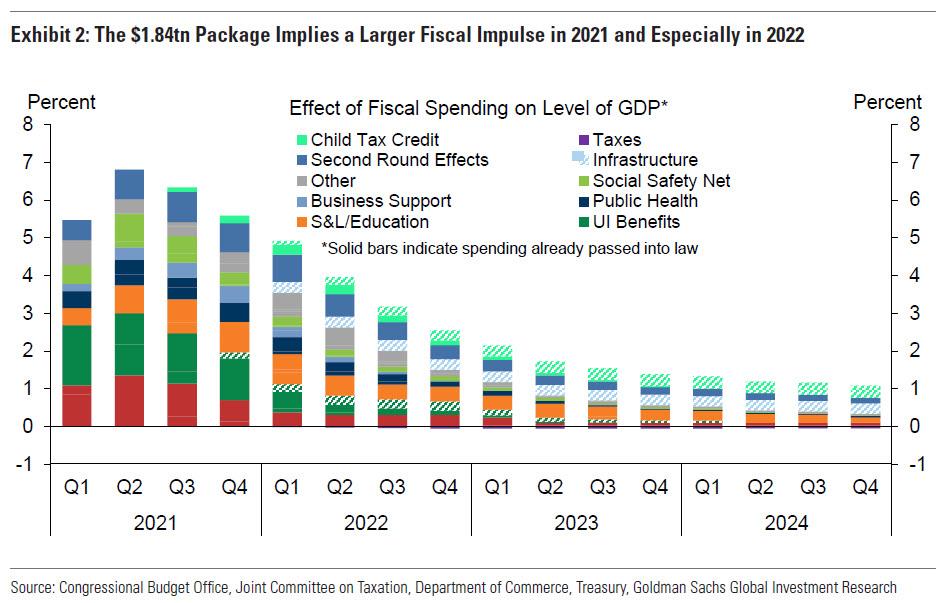
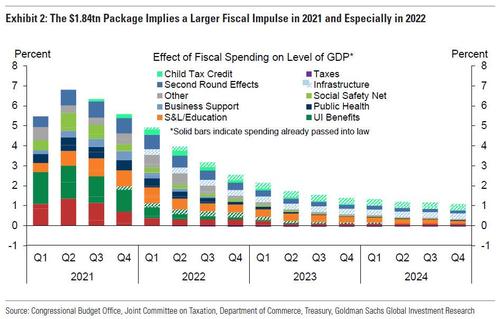
The larger than expected final Bill will also lead to a larger fiscal impulse in 2021 and especially 2022, Goldman writes. To evaluate the growth implications of the fiscal upgrade the bank updated its estimates of the impact of fiscal support on the level of GDP. These estimates, shown in Exhibit 2, incorporate the effects of some residual CARES Act measures that will be spent in 2021, the Phase 4 package, the Phase 5 package, and the UI benefit extensions, child tax credit extensions, and infrastructure spending that will be passed later this year. Goldman expects that the impact of fiscal stimulus on the level of GDP will peak between 6-7% in 2021 Q2 when the $1400 stimulus checks have their largest effect before declining for the remainder of our forecast horizon. Relative to the bank's prior fiscal assumptions, it now sexpect a much slower drop-off of support past 2023 Q3 and especially in 2022 when the increased spending in the Phase 5 fiscal package has its largest impact and the spending we expect will be passed later this year begins to be disbursed.
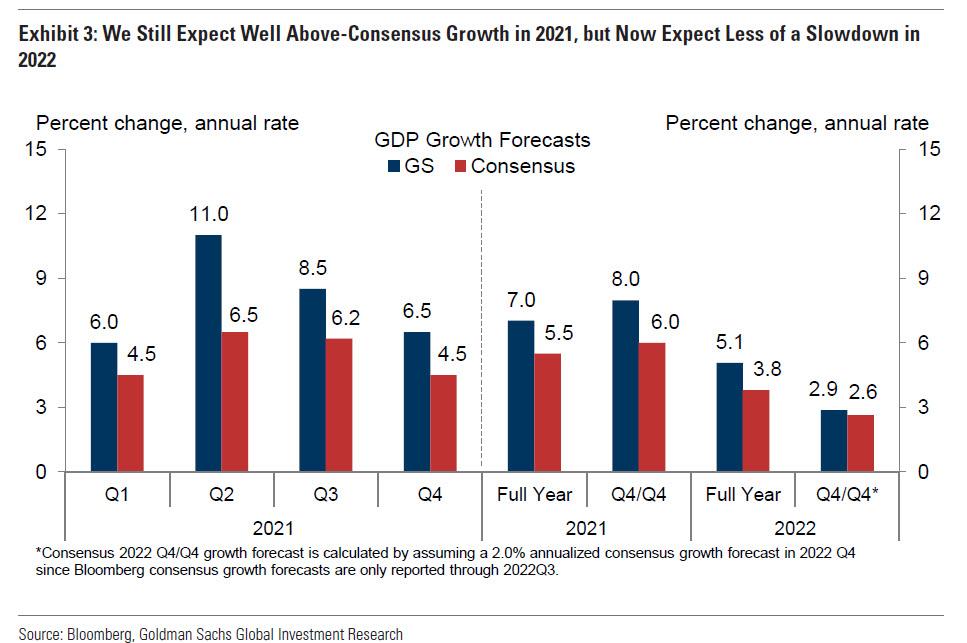
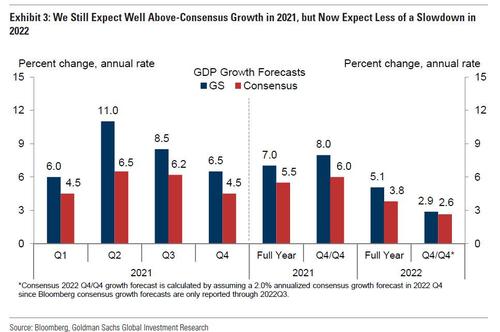
More importantly, Goldman also incorporated the upgraded fiscal outlook in its growth forecast, and now expects GDP growth of:

  • Q1 2021: +6% (vs. +5.5% previously)
  • Q2 2021: +11% (vs +11%)
  • Q3 2021: +8.5% (vs +8.5%)
  • Q4 2021: +6.5% (vs +6.0%)

... implying 2021 growth of +7% on a full-year basis (vs. +6.9% previously and +5.5% consensus) and +8.0% on a Q4/Q4 basis (vs. +7.7% and +6.0% consensus (these numbers are still below Morgan Stanley's overheating estimate of 8.1% GDP in 2021).

The bank also expects a smaller sequential deceleration in 2022, and have raised GDP growth to +5.1% on a full-year basis (vs. +4.5% previously and +3.8% consensus) and +2.9% on a Q4/Q4 basis (vs. +2.4% previously and +2.6% consensus). That said, the positive growth effects are concentrated in the first half of 2022, and we continue to expect growth in 2022 H2 to slow to 1.75%.
Of course, in the grand scheme of things GDP is irrelevant as is unemployment since only inflation - the "Fed put contsraint" - matters. To this point, Goldman also raised its inflation forecast to reflect the tighter labor market, and now expects core PCE to reach +1.90% / +2.00% / +2.1% / +2.15% at the end of 2021-2024 (vs. +2.00% / +1.90% / +2.05% / +2.15% previously). This change reflects a tighter labor market, as well as an earlier-than-expected end to crisis-related Medicare payments (at the end of this month, vs. our previous expectation that the Phase 5 bill would be renew these payments for the rest of 2021).

That inflation is not nearly enough to force the Fed into acting, and Goldman notes that after these forecast upgrades, the bank views the first hike in the funds rate as "a close call between the second half of 2023 and the first half of 2024."

Our working assumption has been that the Fed’s implicit core PCE inflation threshold for liftoff is 2.1%, and we now expect to reach this slightly earlier in 2023H2, which would argue for bringing forward the timing of liftoff from our standing forecast of 2024H1. However, we are increasingly unsure where FOMC participants put this threshold and we see the risks as tilted to the higher side. The summary of economic projections provided at the March FOMC meeting next week will provide insight into the FOMC’s reaction function.

Looking ahead, with the package coming in about $350BN more than Goldman's latest estimate, the bank expects this to be the last major COVID-focused fiscal relief package, even though Congress seems likely to renew some of the items in it later this year with two items in particular standing out:

  • First, the expansion of the child tax credit in this bill is likely to prove popular and congressional Democrats will press to extend it or to make it permanent. Goldman has built in an extra $110bn in annual child credit payments into its forecast to account for this.
  • Second, Congress also looks likely to further extend some expanded unemployment benefits. In addition to the extra $300/week payment ARP provides, the bill also renews expanded eligibility and further extends the maximum duration of benefits, to 79 weeks. Congress will likely allow the $300/week benefit to expire in September, but the enhanced eligibility and benefit duration policies will likely last through 2022.

Of course, as noted in the title what markets will focus on next will be Biden's infrastructure package and here size certainly matters (even though a large headline cost would likely have a much smaller near-term effect than the bill Congress just passed).

Here, Goldman expects the next round of infrastructure legislation to increase spending and tax incentives for traditional and green infrastructure by at least $2 trillion, and as Hatzius notes, "if the Biden Administration expands the bill to include other policies like expanded child care benefits, extension of the child tax credit, student debt relief or other education subsidies, and/or health insurance subsidies, the gross amount could rise to something like $4 trillion."

Huge headline aside, Goldman notes that the large numbers are not comparable to the bill Congress just passed, for three reasons.

  • First, most of these policies would cover several years and some could even be permanent. While the ARP costs $1.84 trillion over ten years, most of the budgetary impact will be in the first two years. By contrast, a $2 trillion (over 10 years) infrastructure package would probably raise spending by less than $200bn in the first year after enactment. That said, if lawmakers add policies in other areas to the bill, like an extension of the newly-expanded child tax credit, the near-term fiscal impact could be greater.
  • Second, the headline price of an infrastructure package is likely to count some ongoing spending. For example, last year’s $1.5 trillion House-passed infrastructure bill counted nearly $500bn of highway/transit spending toward the total, though around $300bn of that would have been spent regardless of the legislation. A smaller but similar situation exists with green tax incentives.
  • Third, some of the spending is likely to be offset by tax increases and other spending cuts. We expect that an increase in the corporate tax rate (perhaps to 24-25%), an increase in the capital gains rate (perhaps to 28%) and various other tax provisions will offset a portion of the cost of the next fiscal package. A smaller contribution might also come from cuts to health spending, particularly items related to drug pricing. Goldman doubts that Congress will be able to agree to more than around $1 trillion (over ten years) of tax increases and other budgetary savings.

Here an interesting tangent via Reutersjust what is considered infrastructure? The answer: Biden "hopes to expand the definition of infrastructure beyond existing transportation architecture to include items aimed at tackling climate change and its effects, echoing the $2 trillion, 10-year “Build Back Better” proposal floated during his campaign."

That includes investments in electric vehicle charging stations, zero-emission buses and zero-carbon electricity generation by 2035, and directing dollars to minority neighborhoods and contractors, part of a pledge to increase racial equity.

Democrats have signaled they want to invest billions in creating and refurbishing affordable housing in any package and expand broadband internet access to all Americans, particularly in rural communities. Nancy Pelosi said on Friday that she had directed senior Democrats to begin working with Republicans on a “big, bold and transformational infrastructure package.” Republicans and influential trade groups like the U.S. Chamber of Commerce support large-scale infrastructure spending, but not Democratic efforts to inject climate change or equality policy into a spending bill.

For those who can't wait until Biden reveals more of his "package", Goldman expects an outline of the Administration’s plans in a "few weeks." President Biden is likely to address a joint session of Congress in April, at which point he will outline plans for infrastructure and the remaining parts of the Administration’s agenda. Around this time, and certainly by May, the White House will submit a budget proposal to Congress, which should provide even more detail.

In other words, legislation looks likely to emerge in May or June. Following the rollout of the Administration’s plans, Goldman expects three steps:

First, Democratic committee chairs and other relevant Administration officials are likely to negotiate with congressional Republicans on a potential agreement. This is a necessary political step in light of the President’s stated desire to enact bipartisan legislation and the likely resistance among centrist Democrats to immediately pursuing legislation via the reconciliation process (which requires only 51 votes in the Senate). That said, it is unlikely that the entire infrastructure package can pass with bipartisan support, as Republicans seem likely to object to the size of such a package as well as rolling back parts of the 2017 tax law to pay for it. Assuming that Democrats ultimately decide to rely on only Democratic votes by using the reconciliation process, expect the first legislative step—passage of the FY2022 budget resolution that instructs the relevant committees to pass legislation that achieves specific fiscal targets—to occur in May, though the timing will depend on how long bipartisan discussions last.

It is possible that Democratic leaders could split off some infrastructure elements and pass them with bipartisan support. While most of the infrastructure package will pass via the reconciliation process, some parts might move separately. For example, the 5-year reauthorization of the federal highway/transit program (the “highway bill”) expires in September, and it would be nearly impossible for congressional Democrats to pass via reconciliation due to Senate rules. This is also an area where bipartisan cooperation has occurred in the past and seems possible again this year.

September will be the deadline for the infrastructure bill, though it could pass earlier. As noted above, the highway bill expires Sept. 30, which is likely to become a working deadline for the broader infrastructure package. If the legislative process starts in May and there are no major delays, it is conceivable that Congress could enact the package in late July or early August, ahead of the August recess. However, the more likely scenario is that the bill is enacted around September.

https://www.zerohedge.com/markets/size-matters-bidens-infrastructure-package-which-goldman-expects-be-4-trillion

White House Won't Say How Many Illegals Entering Texas Have COVID-19: Gov. Abbott

 Texas Gov. Greg Abbott said that the White House has refused to tell Texas officials how many illegal immigrants who have crossed the U.S.-Mexico border have tested positive for COVID-19.

When asked in a Fox News interview on Sunday about whether illegal immigrants are spreading the CCP (Chinese Communist Party) virus, which causes the COVID-19 disease, the Republican governor responded, “I have not seen any data about what the COVID rate is” while adding that agents have reported to his office that there are illegal immigrants coming across the border with the virus.

“We need the total number of migrants who have been apprehended at the border who have tested positive for COVID-19,” Abbott said, accusing the Biden administration of having “refused” and “failed to give to our state the total number of migrants who have COVID-19.”

“We expect that data,” Abbott added.

In recent weeks, the number of border crossings and the number of illegal immigrants held in federal facilities has sharply increased, with Republicans like Abbott saying that it’s being driven by President Joe Biden’s relaxation in immigration policies.

Texas Gov. Greg Abbott speaks at a press conference at the Texas State Capitol in Austin, Texas, on May 18, 2020. (Lynda M. Gonzalez/The Dallas Morning News Pool)

The U.S. Customs and Border Protection (CBP) said that it had 100,441 enforcement encounters at the southwest border, which is almost triple the enforcement actions from February 2020 when Border Patrol encountered about 36,687 individuals. It’s also significantly higher than the 76,545 encounters in February 2019, which was at the beginning of the last border crisis.

It comes as the Biden administration on Saturday announced that it has directed the Federal Emergency Management Agency to the U.S. southwest border in response to the arrival of “record numbers” of illegal immigrants, including unaccompanied minors.

“I am incredibly proud of the agents of the Border Patrol, who have been working around the clock in difficult circumstances to take care of children temporarily in our care. Yet, as I have said many times, a Border Patrol facility is no place for a child,” Homeland Security (DHS) Secretary Alejandro Mayorkas said in a statement.

“We are working in partnership with HHS to address the needs of unaccompanied children, which is made only more difficult given the protocols and restrictions required to protect the public health and the health of the children themselves. Our goal is to ensure that unaccompanied children are transferred to HHS as quickly as possible, consistent with legal requirements and in the best interest of the children,” Mayorkas added, referring to the Department of Health and Human Services.

And in early March, about 108 illegal immigrants released by Border Patrol into Texas over a several-week period tested positive for the CCP virus, officials said.

The Epoch Times has reached out to the DHS, which oversees CBP, for comment.

https://www.zerohedge.com/political/white-house-wont-reveal-how-many-illegal-immigrants-entering-texas-have-covid-19-gov

Raymond James: Some Stocks 'Poised to Surge by at Least 50%'

 In a recent note on the state of the stock markets, Raymond James equity strategist Tavis McCourt points out a series of policy factors that are playing a role in the current market volatility; the situation is more complex, perhaps, than most of us have been willing to admit. McCourt notes permutations of the SLR rule, political dynamics on the Senate Banking Committee, and the regulatory atmosphere towards potential capital return are all influencing the Fed’s moves and the market reactions.

“We believe the Fed will do everything they can to ensure orderly trading in US Treasuries and does not want to see the volatility and liquidity concerns that have occurred in the last week/over the course of the pandemic. We also believe that the Fed is not interested in having a spike in yields as Treasury seeks to finance the next round of stimulus," McCourt opined.

The strategist added, "While the SLR conversation is a political and market issue for the Fed, we believe that any Treasury and/or equity market sell-off tied to the debate is transitory and overblown. We are more focused on the improving economic environment, vaccine distribution, and reflation."

Bearing this in mind, our focus turned to three stocks backed by Raymond James, with the firm’s analysts noting that each could soar over 50% from current levels. Running the tickers through TipRanks’ database, we found out that the rest of the Street is also on board, as each boasts a Moderate or Strong Buy consensus rating.

Orasure Technologies (OSUR)

We’ll start in the medical industry, a field that has seen gains through the pandemic year. Orasure, through its subsidiaries, is a producer of medical diagnostic tests, and is known for developing rapid test kits for HIV, HEP-C, and Ebola. In the past year, the company created over 150 jobs at its Bethlehem, Pennsylvania facilities as part of an effort to develop fast, at-home, COVID test kits. The company’s product line has a wide range of uses, and is marketed to clinical labs, hospitals, physician practices, and public health agencies world-wide.

As can be imagined, Orasure has seen a quick recovery from a 1H20 revenue dip followed by strong gains. Q4 top-line revenues hit $62.9 million, for a 27% year-over-year gain. This was driven by product and services revenues, which grew 28% to reach $60.4 million. EPS was positive, at 3 cents per share, which was a good turnaround from negative results in the first half of the year – but was down 25% from 4Q19.

For the full year, Orasure reported $172 million in net revenues, an 11% yoy gain. Of this total, $50 million came from sales of oral fluid collection devices (mouth swabs) for COVID-19 test kits. In addition, the company reported continued progress on its COVID-19 rapid antigen test, and plans to submit prescription self-tests and professional-grade tests for EUA (Emergency Use Authorization) by the FDA by the end of the first quarter.

Analyst Andrew Cooper, in his coverage on the stock for Raymond James, saw plenty to like, ticking off the factors by the numbers: “What we liked: 1) Almost every revenue result. Orasure topped consensus sales estimates by 10%... 2) Concrete antigen EUA submission timeline. There is no misunderstanding an expected submission this month, with studies completed and only more administrative type work remaining... 3) More capacity expansion. Existing capacity timelines are on track, but management now intends to add another 50M of annual antigen capacity...”

To this end, Cooper puts a $16 price target on the stock, implying a 52% one-year upside, and rates OSUR an Outperform (i.e. Buy). (To watch Cooper’s track record, click here)

A solid reputation in the field, and clear path forward are sure to attract positive sentiment – and three Wall Street analysts have put Buy ratings on Orasure, making the analyst consensus a Strong Buy. Shares are priced at $10.49, and the $18.67 average price target is even more bullish than Coopers, suggesting a 78% upside for the next 12 months. 


Sol-Gel Technologies (SLGL)

Sticking to the medical field, we’ll switch focus to a clinical stage pharmaceutical company. Sol-Gel is a biopharma with an interesting niche, developing topical medications for the treatment of skin diseases.

The company’s pipeline includes two proprietary formulations based on benzoyl peroxide, both creams: Epsolay, which is a treatment for papulopustular rosacea, and Twyneo, a treatment for acne. Both medications had their NDAs (New Drug Applications) filed with the FDA, and final approval decision is expected in April and August of this year, respectively.

Sol-Gel has, in addition, three other drug candidates in early stages of the pipeline process. Two are still in the research phase, while SGT-210 is in Phase I trial, with results due in 1H21. SGT-210 is a potential treatment for palmoplantar keratoderma, a thickening of the skin on the palms of the hands and feet which is sometimes seen as a symptom of several rare conditions.

Furthermore, Sol-Gel is working in collaboration with Perrigo as the US manufacturer of generic labels of that company’s brand-name products. In 2020, the two companies signed four agreements, and now have 12 total collaboration projects.

Among the fans is Raymond James analyst Elliot Wilbur who writes, "Given the large market opportunity in key pipeline products, coupled with recent acceptance of NDA submissions, we maintain our Strong Buy rating on SLGL shares, as we remain optimistic surrounding near-term growth prospects and financial positioning."

The Strong Buy rating comes with a $23 price target, suggesting SLGL has room to grow an impressive 156% in the year ahead. (To watch Wilbur’s track record, click here)

Small-cap biopharmas don’t always get a lot of analyst attention – they tend to fly under the radar. However, there are two reviews on file here and both are to Buy, making the consensus rating a Moderate Buy. SLGL shares are priced at $9, with an average price target of $22 indicating a runway toward ~145% upside for 2021. 

https://finance.yahoo.com/news/raymond-james-3-stocks-poised-152953453.html

Takeda grants J&J German production capacity for COVID vax


Germany's IDT Biologica said on Monday it would make Johnson & Johnson's COVID-19 vaccine using capacity previously reserved by Japan's Takeda, helping to ease concerns about the U.S. drugmaker's ability to meet its production goals.

IDT said it will fill and package the COVID-19 shot, which was approved by the European Union's drug regulator last week, for a period of three months after which it will resume making Japan-based drugmaker Takeda's dengue vaccine candidate.

"I am grateful to our long-standing customer Takeda for its flexibility, which enables us to provide the world with much-needed COVID-19 vaccines," said IDT Biologika Chief Executive Juergen Betzing.

J&J's vaccine, authorised in the United States on Feb. 27, is the first single-dose coronavirus vaccine alongside two-shot vaccines from Pfizer/BioNTech and Moderna Inc .

The drugmaker has been working to expand manufacturing capacity for its vaccine and previously tapped contract manufacturers such as Catalent and Emergent to scale up production and meet global supply goals.

J&J's chief scientist Paul Stoffels told Reuters on Thursday that the drugmaker is deploying three manufacturing plants globally to produce the vaccine's active substance and it will also have seven plants to fill and finish.

It was not clear whether IDT's plant, which will fill and bottle vials for worldwide distribution, was part of the seven or an additional facility.

Merck & Co and France's Sanofi agreed to help make J&J's vaccine earlier this year.

A European Union official told Reuters earlier this month J&J had flagged possible supply issues that may affect its plans to deliver 55 million vaccine doses to the bloc in the second quarter of the year.

IDT is already producing AstraZeneca's COVID-19 vaccine, as well as developing its own shot against the coronavirus, while Takeda is handling the Japanese approval process, import and distribution of coronavirus vaccines from Moderna Inc and Novavax Inc.

https://www.marketscreener.com/quote/stock/TAKEDA-PHARMACEUTICAL-COM-6491073/news/Takeda-Pharmaceutical-nbsp-grants-J-J-German-production-capacity-for-COVID-19-shot-32686302/

U.S. data for AstraZeneca vaccine under review by independent advisers

 Long-awaited results from AstraZeneca Plc’s 30,000-person U.S. COVID-19 vaccine trial are currently being reviewed by independent monitors to determine whether the shot is safe and effective, a top U.S. official said on Monday.

If the data are positive and all goes well, said Dr. Francis Collins, director of the National Institutes of Health, the U.S. Food and Drug Administration could complete its reviews and issue an emergency use authorization in about a month, adding one more vaccine to the U.S. arsenal.

The AstraZeneca vaccine, developed with the University of Oxford, has been authorized for use in the European Union and many countries but not yet by U.S. regulators.

Several EU countries have halted administering the AstraZeneca vaccine after reports from Denmark and Norway of possible serious side-effects, including bleeding and blood clots.

Asked about those issues, Collins said he has not personally seen the data but has been “pretty reassured” by statements by European regulators that the problems could be occurring by chance, and are not related to the vaccine.

A World Health Organization expert advisory committee is currently looking into the matter.

https://www.reuters.com/article/us-health-coronavirus-astrazeneca-usa/exclusive-u-s-data-for-astrazeneca-vaccine-under-review-by-independent-advisers-u-s-official-idUSKBN2B723D