Search This Blog

Saturday, July 31, 2021

Efficacy of Pfizer/BioNTech Covid vaccine slips to 84% after 6 months

 The efficacy of the Covid-19 vaccine developed by Pfizer and BioNTech fell from 96% to 84% over six months, according to data released Wednesday, a decline that could fuel Pfizer’s case that a third dose will eventually be required.

The data, released in a preprint that has not been reviewed by outside scientists, suggest the vaccine was 91% effective overall at preventing Covid-19 over the course of six months.

In the ongoing study, which enrolled more than 44,000 volunteers, the vaccine’s efficacy in preventing any Covid-19 infection that causes even minor symptoms appeared to decline by an average of 6% every two months after administration. It peaked at more than 96% within two months of vaccination and slipped to 84% after six months.

Against severe disease, which includes people with low blood oxygen levels or who are hospitalized, the overall efficacy of the vaccine was 97%.

To Paul Offit, a pediatrician and vaccine expert at Children’s Hospital of Philadelphia, the results are “very reassuring.” The potential need for booster shots is tied to the number of fully vaccinated people who develop severe disease, Offit said. Of the more than 23,000 volunteers who received the vaccine, only one came down with severe Covid-19 within six months, suggesting two doses of Pfizer’s vaccine offers adequate protection, he said.

While the data suggest Pfizer and BioNTech’s vaccine provides lasting protection against the worst symptoms of Covid-19, the paper leaves open the possibility that booster doses will eventually be necessary to curtail infection. If the vaccine’s efficacy continues to decline at the rate observed in the paper, it would fall below the 50% threshold — a benchmark for vaccine utility — within 18 months of vaccination.

That would support Pfizer’s contention that two doses of the vaccine won’t be enough to provide long-term protection. Federal authorities have maintained that people who have been fully vaccinated don’t need booster doses yet but that they are continuing to look at new data.

Natalie Dean, a biostatistician at Emory University, said the data point to two possibilities. Either the vaccine’s efficacy against mild disease is decreasing slightly, or the emergence of new viral variants made it look less effective. “It’s some kind of modest decline, keeping it all in perspective that this number is still high.” She also emphasized that as more data are collected, the vaccine remains effective at preventing severe disease.

Moderna’s vaccine was 90% effective against symptomatic Covid-19 and 95% effective against severe disease after six months, the company said in an April press release. Johnson & Johnson has not yet disclosed six-month efficacy data.

The Pfizer study, which enrolled volunteers in Europe and the Americas, doesn’t address whether the vaccine might be less effective against the fast-spreading Delta variant. Pfizer and BioNTech have conducted lab studies suggesting the vaccine should be able to neutralize the variant, but there is no large-scale clinical data to confirm that conclusion.

Just over half of the study’s participants were male. About 82% of participants were white, 9.5% were Black, 4.3% were Asian, 1% were Native American. Roughly 26% of volunteers identified as Hispanic.

Dean said that it’s important to remember that we are still learning about these new vaccines, and that different vaccines may still turn out to have advantages and disadvantages.

“For me it’s just remembering why it’s so important that we maintain a wide profile of vaccines and exploring a mix and match approach and also the intranasal vaccines.” Dean said. “We still don’t know what is ultimately going to be the best strategy. We want this wide portfolio because durability is always a question and so is robustness against different variants. This only represents six months of data early on in the life of these vaccines. There are open questions.”

https://www.statnews.com/2021/07/28/efficacy-of-pfizer-biontech-covid-vaccine-slips-to-84-after-six-months-data-show/

Fauci on COVID Drugs, Vaccines and Getting Back to Normal

 COVID cases are surging again in much of the U.S. as the Delta variant takes hold among unvaccinated populations. Antiviral pills given early in the course of infection to prevent severe COVID symptoms and hospitalizations are still lacking, but a new Biden administration effort hopes to change that. The Antiviral Program for Pandemics (APP) is spending more than $3 billion to support research on drugs not just for coronaviruses but also for other viruses with pandemic potential.

Scientific American spoke with Anthony Fauci, long-time director of the National Institute of Allergy and Infectious Diseases and chief medical adviser to President Joe Biden, about his hopes for the APP, the government’s ongoing efforts to boost immunizations in areas with low vaccination rates and what keeps him up at night.

[An edited transcript of the interview follows.]

What are the goals of the Antiviral Program for Pandemics?

There are two components to the program: accelerating clinical testing of promising antivirals that are already in various stages of the development pipeline and expanding the basic science and knowledge needed to discover new antiviral medicines. The primary mover is COVID. But if the APP is successful—and I believe it will be—then it can be directed at any virus of pandemic potential. It will require us to develop the sorts of strong public-private partnerships that allowed us to successfully develop antivirals for HIV and hepatitis C. The important thing to remember is that if you can block an acute viral pathogen in the early stage of infection, then you can avoid progression to the advanced stage of disease.

Can you say anything about which drugs are being considered now?

There are a few drugs that are out there. For instance, a protease inhibitor from Pfizer [currently known as PF-07321332], a drug called molnupiravir from Merck and a drug from Atea Pharmaceuticals [AT-527]. The purpose of the APP is to develop a more robust pipeline.

COVID antivirals work most effectively during the first week or so of infection. Doesn’t that create logistic hurdles for treatment?

That is absolutely correct. You have to give the drugs quickly, during the acute stage of disease, which is a different paradigm than how we treat HIV and hepatitis C, which are both chronic infections. The seven-day window might be a bit more challenging from a strategic standpoint. That is why we are also developing specific and sensitive COVID diagnostic tests, so you know what you’re dealing with and can then quickly and effectively treat people.

What about variants such as Delta? Could they make the drugs less effective over time?

Obviously you have to be concerned that variants might be problematic for antivirals, just as they [may be] for vaccines and monoclonal antibodies. But what we’re aiming at with these drugs are also components of the virus that are critical for replication, which may not be subverted by variants. This is also why we need more than a single drug—which is the same approach we used with HIV when one drug ultimately turned out not to be as effective as multiple drugs in combination. Moreover, as you correctly pointed out, viruses of pandemic potential usually cause acute infections. And because you only need to treat people for relatively short durations, the induction of mutations that would limit the effects of the drugs might not be as likely as when you’re treating people for literally an entire lifetime.

The Biden administration fell short of its goal to at least partially vaccinate 70 percent of the U.S. population by July 4. What can be done about vaccine refusal—a major roadblock to achieving herd immunity?

Even though our [vaccination goal] wasn’t reached, we never intended to stop pushing to get more people vaccinated well beyond the Fourth. So, we're doing everything we can to make vaccines easily available and make sure that people—especially young people—are listening to trusted messengers. We’re working with local community leaders, and we have the COVID-19 Community Corps initiative. We have mobile units for ease of vaccination. We’re doing our very best to get people who haven’t been vaccinated to seriously consider how important it is for themselves, the safety of their families and their community responsibility to put an end to this pandemic. And the way you put an end to this pandemic is by getting as many people vaccinated as possible.

What are you watching out for as society opens up and people try to get back to normal life?

We need to do good surveillance to make sure that we’re not having blips of infection, particularly in the states, cities and counties with low vaccination rates. We have the tools now to effectively suppress the spread of SARS-CoV-2 in this country. And unfortunately, there’s a degree of disparity in the willingness of people in different parts of the country to get vaccinated. And so we have to watch for regional surges in these areas.

https://www.scientificamerican.com/article/fauci-on-covid-drugs-vaccines-and-getting-back-to-normal1/#

With expanded FDA nod, Regeneron's COVID-19 antibody drug can help immunocompromised

 With its rapid mutations, the evolutionary process of the coronavirus makes it a moving target. And so it is with treatments for the disease, which can quickly become in vogue or obsolete.  

Case in point for the former: Regeneron’s antibody cocktail REGEN-COV. Over the last few months, nearly every development in the COVID-19 antibody market has broken in favor of the treatment, a combination of casirivimab and imdevimab.

On Friday, the FDA granted emergency use authorization to REGEN-COV as a preventative measure for those who have been exposed to COVID-19 and who are at high risk to progress to a severe case because they are not fully vaccinated or are not expected to mount an adequate antibody response to vaccination. 

About 3% of the U.S. population won't respond fully to COVID-19 vaccines, including patients on chemotherapy, people with hematologic cancers and others, Regeneron says.

The FDA based its decision on a phase 3 trial, run jointly with the National Institutes of Health, which showed that REGEN-COV cut the risk of developing symptomatic COVID by 81% among healthy individuals who lived with an infected person.

The study tested the med in 1,505 people who lived with an infected person within the prior four days. Those who received an infusion of REGEN-COV showed 72% efficacy against symptomatic COVID over the first week and 93% beyond the first week.

Additionally, among those who developed symptoms, REGEN-COV recipients cleared the virus faster than those in the placebo group. 


While vaccine recipients need time to build an effective antibody response, especially with a two-shot regimen, a direct injection of antibodies can offer more immediate protection.  

The FDA granted REGEN-COV its initial EUA in November for patients with newly diagnosed COVID-19 who are at a high risk of progressing to severe disease. Since then, the drug Regeneron’s therapy has gained FDA nods for a subcutaneous injection and at a smaller dose.


Regeneron's antibody trailed Eli Lilly's antibody onto the market, but it has since proven more resilient against mutations than its rival. Another antibody drug gained FDA approval two months ago. But sotrovimab, a joint effort from GlaxoSmithKline and Vir Biotechnology, has yet to secure a supply deal from the United States.

https://www.fiercepharma.com/pharma/fda-expands-label-for-regeneron-s-versatile-covid-19-antibody-now-a-preventative-role

FDA plans ‘sprint’ to speed review of Pfizer’s Covid-19 vaccine for full approval

 Under heavy pressure, the Food and Drug Administration center that reviews vaccines is planning to deprioritize some of its existing work, like meetings with drug sponsors and plant inspections, in an effort to accelerate its review of Pfizer’s application for the formal approval of its Covid-19 vaccine, a senior agency official told STAT.

Pfizer’s vaccine is currently cleared under a so-called emergency use authorization, which allows the company to sell the vaccine for as long as Covid-19 is considered a public health emergency.

But with Covid-19 still raging, and its spread now fueled by the Delta variant, lawmakers and prominent health experts have urged the FDA to expedite full approval of Pfizer’s vaccine, saying it would be a powerful tool in convincing the unvaccinated to get their shots and in giving businesses and other entities a stronger legal foundation to impose vaccine mandates.

The process requires FDA staff to review millions of pages of complex data, conduct plant inspections, and negotiate with Pfizer over issues including the terms of the FDA’s approved label and the company’s postmarketing responsibilities. Now, the senior agency official said, the agency will initiate a “sprint.”

Under the FDA’s new plan, the director of FDA’s biologics center, Peter Marks, will largely oversee review of the Pfizer application, taking over for Marion Gruber, a 32-year veteran of the FDA who currently heads the office of vaccine research and review within the larger biologics center, according to a second FDA source. A third source familiar with the plan, who like the others spoke on condition of anonymity, said Marks was heavily involved in the review, but did not comment on whether he was formally replacing Gruber in the agency’s chain of command.

The reprioritization of other work at the agency’s biologics center underscores the tremendous political pressure the agency is under to finish the Pfizer review as quickly as possible.

Eric Topol, the director and founder of Scripps Research Translational Institute, who has been among those critical of the agency’s perceived slowness in finishing the review, said he was “thrilled” about plans to expedite it. But he also said the FDA should have accelerated the process much earlier.

“We knew about Delta months ago ..and that’s when we should have pulled out all the stops,” he added.

Luciana Borio, a former FDA acting chief scientist, also said the sprint made sense but that it would likely mean other projects will have to be deprioritized.

“There should be no illusion that this comes at zero cost,” she said.

The FDA has publicly insisted that rushing the approval of the application could “undermine the FDA’s statutory responsibilities, affect public trust in the agency, and do little to help combat vaccine hesitancy.”

When asked about the sprint, FDA spokesperson Michael Felberbaum said in a statement: “We have taken an all-hands-on-deck approach, including identifying additional resources such as personnel and technological resources from across the agency and opportunities to reprioritize other activities, in order to complete our review to help combat this pandemic surge.”

The statement did not specifically mention the FDA putting off inspections or meetings with FDA sponsors.

It’s not clear how significantly the reprioritization of work will impact companies with other products before FDA’s biologics center, which reviews everything from vaccines and stem cells to gene therapies. The senior FDA official told STAT that the agency will strive not to miss promised milestones with other sponsors, but that some might hear from the agency that certain meetings and inspections will be pushed off by weeks or months. .

Janet Woodcock, the acting FDA commissioner, held a meeting with all FDA staff reviewing the Pfizer application on Monday, two sources confirmed to STAT.

Felberbaum, the agency spokesperson, said that Woodcock “has reiterated her appreciation for the diligence and integrity to this process and offered all agency resources to the team to make this happen.”

A typical review of an application like Pfizer’s takes 10 months. The agency granted Pfizer a “priority review” for its vaccine earlier this month, which signifies that staff will strive to finish the review of the application within six months. At the same time, he FDA has said it does not expect the process to take that long — a view echoed even by President Biden.

“My expectation …  is that sometime, maybe in the beginning of the school year, at the end of August, beginning of September, October, they’ll get a final approval” Biden said last week when asked when the FDA would formally approve the Covid-19 vaccines, including the one developed by Pfizer and its partner BioNTech.

Jesse Goodman, who led the FDA’s biologics center from 2003 to 2009, said that the August-September time frame is “possible … if all goes smoothly.” He said the idea of a sprint is “reasonable,” so long the biologics center follows the normal chain of command for reviewing these applications.

https://www.statnews.com/2021/07/30/fda-under-pressure-plans-sprint-to-accelerate-review-of-pfizers-covid-19-vaccine-for-full-approval/

Friday, July 30, 2021

4 vaccinated adults, two unvaccinated children test positive for COVID on Royal Caribbean ship

 Six passengers sailing on Royal Caribbean International's Adventure of the Seas, which departed from Nassau Saturday, have tested positive for COVID-19, Lyan Sierra-Caro, spokesperson for Royal Caribbean, confirmed to USA TODAY Friday. All are American citizens.

The tests came back as part of routine, end-of-cruise testing, which is offered as a courtesy by the cruise line since most passengers need to show proof of a negative test in order to return home. Travelers flying to the U.S. from international destinations are required to show proof of a negative COVID test or proof they recovered from the virus within the past three months.

"These guests were quarantined and then retested with a PCR test to confirm their diagnosis," Sierra-Caro said. PCR and antigen tests were offered to passengers, depending on their destination. The tests that came back positive were rapid tests, and those passengers were retested Thursday or Friday with a PCR test, which is more reliable.

Not all passengers on board Adventure of the Seas have been notified of the COVID-19 cases on board. Close contacts, have been alerted and have been given a PCR test. Friday, the rest of the ship will be alerted through an announcement from the captain, according to Sierra-Caro. 

The ship is currently docked in Freeport, Grand Bahama Island, where many passengers have disembarked for activities such as shore excursions. Typically, according to Sierra-Caro, an announcement like this will be made once passengers return to the ship before departing. The ship is scheduled to disembark in Nassau on Saturday, wrapping up a seven-night journey with stops at Royal Caribbean's private island, Perfect Day at CocoCay, Cozumel, Mexico and Grand Bahama Island.

"Four of the guests, who are not traveling together, are vaccinated, three are asymptomatic and one has mild symptoms," Royal Caribbean said in a statement provided by Sierra-Caro. "Two of the guests, who are in the same traveling party, are unvaccinated minors and asymptomatic."

To sail on Adventure of the Seas, passengers 16 and older are required to be fully vaccinated against COVID-19 and to receive a negative test before boarding. Children under 16 must test negative before boarding, too. All crew on board are fully vaccinated. 

The passengers who tested positive and their close contacts were quarantined immediately upon receiving test results. The six passengers and their traveling parties will be flown home from Freeport, where the ship is docked, on Friday. 

Sierra-Caro noted the passengers will be medically evacuated and taken door to door from ship to home via private transport to a private plane and then home. The transportation will come at no cost to the passengers.

The cruise line instructs COVID-positive passengers to quarantine for 14 days at home and to speak with their doctors.

For others on board the ship, the cruise will remain normal with no quarantining requirement. The ship is carrying 1,182 passengers and 900 crew members on board, including this reporter.

"Our security team has already done all of that and reached out to any close contacts who met that criteria," Sierra-Caro said. All close contacts tested negative with PCR test results delivered Friday morning.

Royal Caribbean has not yet confirmed whether the cases are of the highly transmissible delta variant but is investigating further, according to Sierra-Caro. 

COVID-19 vaccines are highly effective, but they’re not 100% effective. That means a small percentage of people who are fully vaccinated will still get COVID-19 if exposed to the virus that causes it, according to the CDC. However, vaccinated people who have breakthrough infections are much less likely to get severely sick or die. 

Joel Swanson, 39, from Ponte Vedra, Florida, is on board Adventure of the Seas with his family, including two daughters under 16, and told USA TODAY he feels safe. 

"(The cruise line has) safety protocols worked into every aspect of the cruise, but not in a way that hinders the experience," Swanson said. "The fact they caught these cases shows their protocols are working and they’re keeping the rest of the passengers safe by preventing further spread."

Swanson's 12-year-old daughter is vaccinated and his youngest daughter, who is 8, is not yet eligible for a COVID vaccine.

The family was on board Royal Caribbean's Harmony of the Seas ship when COVID began to spread in March 2020, shuttering the cruise industry. The ship docked normally on March 15, 2020, one day after the Centers for Disease Control and Prevention issued a no-sail order and the cruise industry shut down.

Since then, measures taken to address COVID-19 have evolved significantly. "The fact that even [if] we somehow contracted COVID while on board, we would be transported home quickly, brought added peace of mind," Swanson said.

Daniel Smith, 30, from Miami, echoed Swanson's feelings. "Happy to see protocols are working for identification," Smith wrote in a message to USA TODAY. "Ship is doing a great job with cleaning and social distancing. Feel safer here than I do back home."

Smith added that "one of the big fears" is that COVID will interrupt everyone's cruise vacation. With the cruise line transporting COVID-19 positive passengers home and implementing onboard testing and contact tracing, it hasn't interrupted the trip, in his opinion. 

"This is being handled discretely, professionally and respectfully," he said.

https://www.usatoday.com/story/travel/cruises/2021/07/30/royal-caribbean-cruise-6-passengers-sent-home-after-covid-positive/5427475001/

CDC Alarmed: 74% of Cases in Cape Cod Cluster Were Among the Vaxxed

 Breakthrough infections were responsible for three-quarters of COVID-19 cases in an outbreak during large public gatherings on Cape Cod, Massachusetts, and nearly all sequenced cases were the Delta variant, researchers found.

Of 469 cases linked to multiple summer events and large summer gatherings in a small town, 346 (74%) occurred in fully vaccinated people, and almost 80% of those cases were symptomatic, reported Catherine Brown, DVM, of the Massachusetts Department of Public Health, and colleagues.

There were five hospitalizations, four among fully vaccinated people, and no deaths. Of 133 cases with sequence information available, 89% were from the Delta variant (B.1.617.2), the authors wrote in an early edition of the Morbidity and Mortality Weekly Report.

Moreover, vaccination coverage in Massachusetts was reported to be 69% as of July 3, they noted.

Topline data were previewed in stories by the New York Times on Thursday, and shared in internal CDC documents by the Washington Post. The data on this outbreak, and the Delta variant, reportedly helped provide the impetus for the agency's change in indoor masking guidance earlier this week. While the town was not named by the MMWR report, the outbreak reportedly was linked to events in Provincetown.

As previously reported, the authors compared RT-PCR cycle threshold (Ct) values in 127 vaccinated people with breakthrough cases to 84 unvaccinated people or those with unknown vaccination status, and found them to be comparable (median 22.77 and 21.54, respectively).

"Findings from this investigation suggest that even jurisdictions without substantial or high COVID-19 might consider expanding prevention strategies, including masking in indoor public settings regardless of vaccination status," they wrote.

The authors detailed increased reports of COVID-19 cases in Barnstable County, beginning on July 10, including those who were fully vaccinated. They described "multiple summer events and large public gatherings" from July 3 to 17, where those with COVID-19 reported "attending densely packed indoor and outdoor events at venues that included bars, restaurants, guest houses, and rental homes."

They identified a cluster of cases in Massachusetts residents, who tested positive for SARS-CoV-2 at 14 days or sooner after travel to or residing in Barnstable County.

Of the 346 fully vaccinated cases, median age was 42, and 87% were men. The most common symptoms were cough, headache, sore throat, myalgia, and fever. Median interval from completion of at least 14 days after the final vaccine dose was 86 days (range 6 to 178 days).

There were also reports of cases from residents of 22 other states who traveled to this town during the period, and reports of secondary transmission.

The authors urged more stringent prevention strategies for these types of events, given, "the potential risk of infection during attendance at large public gatherings that include travelers from many areas with differing levels of transmission."


Primary Source

US Consumers Burn Through Almost All COVID 'Excess Savings' As Buying Intentions Crater

 While most economists were keenly focused on today's core PCE data in the Personal Income and Spending data, we were far more interested in the spending power left inside the dynamo that is responsible for 70% of US GDP: the US consumer. And unfortunately, there is very little left.

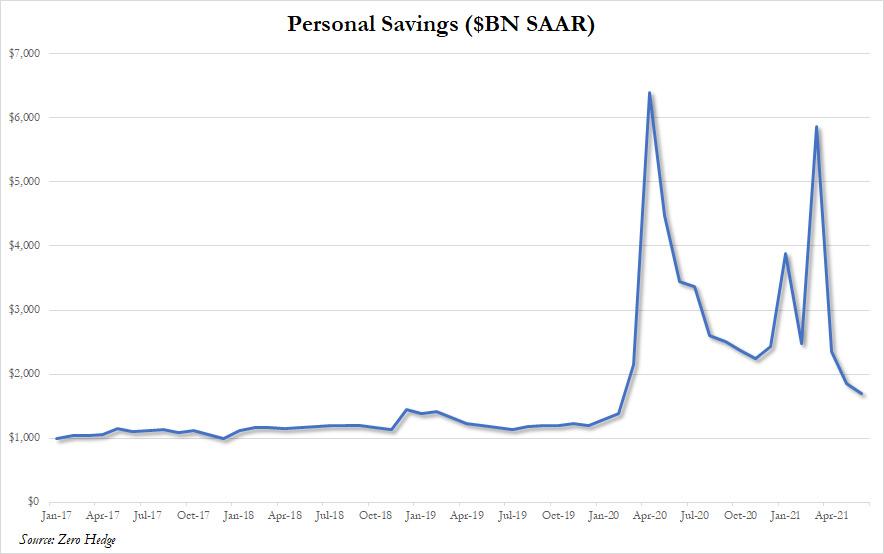
For much of the post-covid recovery period, the most bullish narrative was that the trillions in excess savings (the number $2.5 trillion had been frequently thrown about) resulting from the trillions in Biden stimmy checks which Americans 'prudently' saved would provide a long enough runway to allow US consumers to offset transitory surging prices with money they had saved up.

There is just one problem: according to the latest data from the BEA, excess savings are almost gone and as of June, there were just $1.7 trillion in annualized personal savings, a huge drop from the $2.5 trillion average observed for much of the post-covid period when Savings peaked predictable after the 1st, 2nd and 3rd stimulus hit America's checking accounts. Alas, almost all of that is now gone, and as of the latest data, US consumers have just 30% more savings - or about $400 billion - compared to the pre-covid level of $1. 3 trillion.

Worse, at the current rate that Americans are burning through savings, this means that the entire fiscal stimulus tailwind from Biden's trillions will be gone by August... just in time for emergency unemployment benefits to end.

This is the worst possible outcome for the US economy because it means that US consumers will be hit by surging rent inflation and commodity pass through costs as well...

... at the end of 2021 and start of 2022, just as they realize they have spent all of their savings accumulated during the covid period, leading to a stagflationary spending depression, as the economy reverses even as prices continue to rise.

And the funniest thing: career economists may not understand any of this (until it is too late), but consumers sure do: as today's University of Michigan consumer sentiment report showed, spending intentions on houses, vars and large household durable goods has crashed to the lowest level since the soaring inflation of the early 1980s forced Volcker to hike rates to 20%.

There is just one event that could short circuit what appears to be a near-certain recession heading into 2022 and mid-term elections which would be devastating for Democrats faced with an imploding economy: another multi-trillion stimulus, just enough to kick the can by another 4-6 months. But for that to happen, the US economy needs to be shut down again which will only happen only once there is enough covid Delta-variant fearmongering. Which should also explain everything that's happening right now.

https://www.zerohedge.com/markets/us-consumers-burn-through-almost-all-covid-excess-savings-buying-intentions-crater