Search This Blog

Thursday, August 5, 2021

Artificial pancreases were a breakthrough for type 1 diabetes; research in type 2 is just beginning

 For the first time, a team of researchers has published research into how a closed-loop insulin delivery system might help patients with type 2 diabetes manage their disease at home.

The study, described in a new paper published Wednesday in Nature Medicine, included 26 patients who tested out a so-called artificial pancreas, which works by pairing a glucose sensor with an insulin pump to automatically adjust doses of the drug. The system improved the time participants spent in their target glucose range by about 15%; its users also managed to avoid bouts of severe low glucose while reducing overall glucose levels.

Those results are particularly meaningful for the pool of patients included in the study: people who need regular dialysis for kidney failure, which can dramatically impact blood glucose levels. Many of the study’s participants also saw benefits in their everyday routines to manage their conditions, said Charlotte Boughton, lead author on the paper.

“A lot of people who are on lots of different injections found it much, much easier,” said Boughton, a clinical lecturer at the University of Cambridge. That included reducing the number of diabetes-related tasks they had to complete in a day — several participants with neuropathy had trouble injecting insulin manually — and providing more peace of mind as an algorithm calculated their insulin doses.

Now, the question is how broadly the benefits extend to at-home use for type 2 diabetes patients. The systems were first approved in 2016 for the management of type 1 diabetes, which affects about 1.6 million Americans. But researchers are now exploring whether the systems could be used to treat the millions of type 2 diabetes patients who use insulin.

“There are lots of caveats for type 2, and we just need more data and more studies,” said Bruce Buckingham, a pediatric endocrinologist at Stanford University School of Medicine who conducted early trials of the systems in type 1 patients and was not involved in the research.

Researchers, including Boughton’s colleagues in Roman Hovorka’s lab at the University of Cambridge, have already demonstrated that closed-loop systems can be beneficial for type 2 patients while hospitalized. The sicker someone is, the more vulnerable they are to the harmful swings in glucose that the systems are designed to prevent.

“There’s a real role for automated insulin delivery in the hospital. It really became obvious during Covid,” said Buckingham, as higher glucose levels have been associated with more severe disease outcomes. During the pandemic, such systems also allowed providers to get glucose data and deliver insulin without going into a patient’s room.

While the new study published results on at-home use for the first time, it was just a stepping stone to the unassisted use that patients with type 1 are used to, said Boughton. Because the patients were visiting dialysis centers frequently, they received regular help refilling the insulin in the pump and attaching it to their body every three days.

For the study’s positive results to translate to broader type 2 populations, patients will need to be able to use closed-loop systems successfully without supportive care. “It’s not connect and forget,” said Freimut Schliess, director of science and innovation at the diabetes contract research organization Profil. “You have to use it in an informed and educated way.”

But as with other diabetes technology that first gained approval in type 1 patients — continuous glucose monitoring — demand for the artificial pancreas may be increasing before the evidence is firm. “I think there are probably people self-funding closed-loop systems with type 2 diabetes out there,” said Boughton. “Lots of our participants ask us if it’s an option to do after they finish in the trial.”

As researchers continue to investigate outcomes in type 2 patients using closed-loop systems, they’ll need to ask practical questions, including those related to efficiency of care and costs.

“The question is how well would this work in a broader type 2 population,” said Buckingham, “and can you actually show outcomes that would make it reasonable for if you’re an insurance provider to invest in providing this type of technology for type 2s.”

In particular, insurers may want proof that a closed-loop system is more valuable than continuous glucose monitoring alone. In this study, the closed-loop group had access to their real-time CGM data; the control “usual care” group didn’t get to see their glucose numbers. While the evidence on the value of CGM in type 2 diabetes is still limited, recent studies have suggested the sensors can improve glucose control on their own. A good control arm to pull apart the differences, said Buckingham and Schliess, would be a group basing their daily insulin injections on real-time CGM data.

The Hovorka lab is already recruiting for its next trial, in adults with type 2 diabetes who don’t need dialysis, to answer some of those questions. “We feel quite confident that if automated insulin delivery can be safe and effective in this population, it would be beneficial to a wider population with type 2 diabetes who don’t necessarily have kidney failure,” said Boughton. “The desire is definitely there. It’s just a huge limiting factor in terms of the cost of the technologies.” An insulin pump costs about $6,000 upfront, with thousands of dollars more to keep it running over a year.

“You could imagine there would be a commercial motivation for the companies that make these systems,” said Steven Russell, associate professor of medicine at Massachusetts General Hospital and Harvard Medical School. In the U.S., Tandem and Medtronic’s devices are approved, and Insulet has a system currently under consideration by the Food and Drug Administration. “It would substantially increase the population of people who could potentially use their product.”

As the research expands in scope, it may become apparent that automated insulin delivery could help the United States address the surge in under-managed type 2 diabetes and its devastating complications.

“My belief is that in the next five years, we see type 2 diabetes patients treated with closed loop metabolic control systems, but not all of them,” said Schliess. People with kidney failure or multiple comorbid conditions could be among the first to access the devices, he said.

“You have to start with more critical patient groups where you can really demonstrate cost-benefit ratios and risk-benefit ratios which are attractive for payers,” Schliess said. One group is currently conducting a clinical trial of closed-loop systems in that population.

“For type 1 diabetes, automated insulin delivery is really an important advance,” said Russell. “And I think that there is a similar unmet need for improved glucose control and reducing the burden of diabetes management in people with type 2 diabetes who have complex insulin regimens.”

In diabetes care, though, the biggest goal is to help patients before they get to the point of those severe comorbidities — one that current practices are failing to meet. In a recent study in the New England Journal of Medicine, researchers followed adolescents with type 2 diabetes over nine years. “They had a pretty significant number of complications for being pretty young people,” said Buckingham, including renal disease and retinopathy.

To prevent those kinds of outcomes, diabetes care providers need better strategies to improve glucose control across the board — whether that includes closed-loop insulin delivery or other strategies. “I think there’s a lot to be done in type 2,” said Buckingham. “This is very early days, but it shows it can work. And there’ll be a role, it’s sort of when it happens — at what stage and at what age.”

https://www.statnews.com/2021/08/04/artificial-pancreas-type-2-diabetes-outpatient/

Alzheimer’s patients in limbo as hospitals, insurers grapple with offering Aduhelm

 For all the explosive controversy over the approval of the first treatment for Alzheimer’s disease in nearly 20 years, hardly any patients have actually gotten it yet.

The drug’s eye-popping, $56,000 annual price and questionable benefit to patients have been a shock to the bureaucracy that makes the health care system run — and that’s having a clear effect on uptake. Some analysts estimated last month that fewer than 100 patients were dosed in the first weeks after the therapy was approved, though availability will likely ramp up over the coming months.

Though the Food and Drug Administration said in approving the therapy, Aduhelm, that the data indicate a likely benefit, hospital and insurer committees are conducting their own analyses, acting as another set of gatekeepers. They regularly review new treatments, but the lingering questions about the drug’s efficacy, as well as the logistical challenges of delivering an infused drug, are complicating and prolonging those discussions.

“This is an added burden on health systems,” said Isha Rana, a pharmacy administrative specialist in formulary management at Houston Methodist. “You have a very contentious FDA approval, and now health systems are going to have to go back and do the same reviews that the FDA did and decide on whether we think the benefits outweigh the risks.”

The deliberations create a “holding pattern” for patients, as several experts described it, that could last months as doctors and insurers, including Medicare, sort out their policies. Usually when the FDA approves a drug, Medicare quickly covers it.

“The FDA decision is just the first domino to fall,” said Anna Legreid Dopp, the senior director of clinical guidelines and quality improvement at the health-system pharmacists association ASHP.

Biogen, which makes Aduhelm, would not say how many people have been treated with the drug since it was approved.

On an earnings call last month, company executives argued there was an eagerness from both providers and patients for the therapy. Of the 900 sites that the company said would be ready to offer the drug after approval, one-third had already completed their reviews “with a positive outcome” or decided they didn’t need to go through such a process, CEO Michel Vounatsos said.

However, he acknowledged that with reimbursement decisions, “it is still the early days,” and that tests to confirm the presence of a particular protein in patients to ensure they’re eligible are “also taking time to schedule and coordinate.”

Chief Financial Officer Mike McDonnell said the company expected “modest” revenue this year from Aduhelm in part because of “the need for sites to prepare to diagnose and treat patients and the time that it will take to secure payer coverage.”

Health systems turn to what are called pharmacy and therapeutics committees when considering adding a drug to their formularies, weighing purported benefits, safety profiles, and costs. The committees — which can consist of pharmacists, doctors, nurses, and financial whizzes — set out policies for everything from which physicians will prescribe the therapy, to which patients could receive it, to how they’ll handle side effects, to how they’re going to store and administer the treatment. Physicians in private practice can often set their own policies, either with partners or by themselves.

Already, some health systems have said they’re not going to provide Aduhelm (though their physicians can still prescribe the treatment for patients to receive elsewhere), citing a desire for more data or concerns about the process by which FDA approved the treatment.

Critics have accused the agency of working too closely with Biogen on shepherding the drug through review and have raised questions about how the agency moved the drug to market under its accelerated approval process.

“It will be interesting to see how people deal with the controversy that FDA has dropped on everyone’s lap,” said Daniel Zlott, the senior vice president of education and business development at the American Pharmacists Association.

Health systems also have to decide whether to further limit the potential patient pool for Aduhelm. The FDA’s prescribing information for the treatment says it’s meant for people in the earliest stages of Alzheimer’s disease, diagnosed with either mild cognitive impairment or mild dementia. But health systems could create policies more in line with Biogen’s original clinical trial population and restrict Aduhelm to patients who also have confirmed amyloid protein plaques, which the drug is designed to clear.

The need to test for amyloid creates another hurdle for health systems. People are screened for amyloid either through PET scans or by obtaining a cerebrospinal fluid sample through a lumbar puncture, introducing another round of procedures and experts who need to assess the results. Not all clinics have access to PET scans, and it’s unclear whether Medicare will cover them. (The hope is that blood tests for amyloid, which are in development, could make the process easier and cheaper.)

“Without the target being present, there is no point in administering the drug,” neurologist Liana Apostolova of the Indiana Alzheimer’s Disease Research Center said on a panel at the Alzheimer’s Association International Conference last week. Apostolova has received consulting fees from Biogen.

Other physicians agree with the need to establish the presence of amyloid. Mia Yang, a geriatrician at Wake Forest Baptist Health, said a number of North Carolina hospitals have discussed setting common clinical guidelines, and that one easy point of agreement was that “we’re not going to offer the medication to people who do not fit those original clinical trial criteria.”

Even as health systems’ pharmacy and therapeutics committees are working on their strategies, many physicians say they will wait for insurance policies before they prescribe Aduhelm.

Most insurers, at least so far, aren’t saying much. Medicare officials are currently weighing who will be eligible for the drug, and they won’t come to a final decision until 2022.

It all leaves a black hole of uncertainty for patients over how they could pay for a treatment, even if their provider would prescribe it.

Regional Medicare contractors could issue statements about their coverage policies for Aduhelm before a national policy comes out, but they are holding off for now. Every contractor declined to comment on their plans in response to STAT inquiries.

“It’s all a little hazy with this drug,” Rana said, referring to how coverage is going to work until there’s a national decision.

Medicare has an appeals process if patients want to petition a coverage denial, but there’s not much additional real-world evidence yet for patients to make a case for coverage, said James Chambers, an associate professor of medicine at Tufts Medical Center.

Most commercial insurance plans have been similarly cautious. The largest health insurance lobby AHIP asked Medicare officials to make a uniform national policy for how to cover Aduhelm, and several large insurers including UnitedHealthcare, Humana, CVS Health, Cigna, and Anthem didn’t answer inquiries from STAT about their plans.

Ceci Connolly, president and CEO of the Alliance of Community Health Plans, said an expert advisory panel’s decision not to recommend Aduhelm’s approval and the public announcements that major medical centers, including Cleveland Clinic and Mount Sinai Health System, would not administer the drug contributed to insurers’ hesitance to cover it.

“It gives us all pause, and at a minimum suggests we’ve got to keep digging,” Connolly said.

While many plans are waiting, some are moving forward. An apparent draft Centene policy has been published online, which would provide the treatment to patients, but only if they test positive for amyloid plaques and are not taking blood thinners. Centene did not respond to a request for comment on the draft policy.

The combined Harvard Pilgrim Health Care and Tufts Health Plan has threatened not to cover Aduhelm unless Biogen lowers its price tag. The plan has more resources and expertise to review the drug faster than some plans with less institutional support, and Connolly said smaller plans will likely defer to the federal government’s decision.

Some affiliates of Blue Cross Blue Shield have decided not to cover Aduhelm, saying the drug is still investigational and experimental, though Biogen has contended the classification is a mischaracterization.

Even though most patients eligible for Aduhelm will be in the Medicare program, Chambers said the drug’s price and population still makes it likely that commercial plans will eventually have an explicit policy on how to cover the drug, though he expects them to join Medicare contractors in waiting until after Medicare’s decision.

Medicare [decisions like this] are usually reserved for big-ticket drugs where there is a chance of real inconsistency,” Chambers said. “With a drug as controversial as Aduhelm, I would be surprised if anyone wanted to get out in front of that.”

https://www.statnews.com/2021/08/04/alzheimers-patients-in-limbo-as-hospitals-insurers-grapple-aduhelm/

Sanofi's COVID-19 vaccine setback, drug pipeline cast long shadow

 Pharmaceutical company Sanofi remains under pressure to launch new drugs and overcome setbacks in the COVID-19 vaccine race, despite a $3.2 billion deal to tighten its grip on promising mRNA technology.

On Tuesday, Sanofi agreed to buy U.S. partner Translate Bio as it bets on next-generation vaccines and particularly as the French drugmaker, one of the world's top flu vaccine makers, seeks to see off competition in one of its major markets.

The two companies have been partnering since 2018 and are developing a COVID-19 mRNA shot together that has entered clinical trials, as well as an influenza jab.

The messenger RNA (ribonucleic acid) approach, an area of Translate Bio expertise, instructs human cells to make specific proteins that produce an immune response to a given disease.

The technology has proven to be successful in COVID-19 vaccines developed by Pfizer/BioNTech and Moderna.

"Although the platform of Translate Bio is not yet proven, it is a smart move by Sanofi," Wimal Kapadia, an analyst with Bernstein said. "Bringing the asset in-house will allow them to move quicker."

The transaction, backed by the U.S. company's largest shareholder, is expected to close in the third quarter. It follows Sanofi's acquisition of another, smaller, mRNA player, Tidal Therapeutics, in April.

But analysts cautioned it won't be enough to ease pressure on chief executive Paul Hudson to revive the company's drug pipeline with a blockbuster product and boost the share price.

Sanofi's shares barely moved on the news on Tuesday and fell to near three-month lows on Wednesday.

"The key for this stock to work is convincing the market that you know how to develop drugs. And bringing in another company or another technology does not really reflect that, and there is a lot of frustration with the stock," Kapadia said.

The stock has risen just 1% since the start of the pandemic in March last year while rivals in the COVID-19 vaccine race, Pfizer, Johnson & Johnson and AstraZeneca have seen double-digit percentage growth of 43%, 29% and 22% respectively. 

In 2018, the company hired a former Roche executive, John Reed, to revamp its research and development operations.

Sanofi said last month it expects several pipeline milestones in the second half, including pivotal trial readouts for Amcenestrant, a breast cancer treatment, and Sarclisa for multiple myeloma.

That was followed by Hudson's appointment almost two years ago to reduce the group's focus to fewer but faster-growing segments such as cancer and reduce dependence on Dupixent, its star eczema and asthma treatment that has been leading its growth.

"The CEO is clearly going in the right direction and the Translate Bio deal highlights that," a Sanofi investor speaking on the condition of anonymity told Reuters.

"But Hudson's tenure was rapidly overshadowed by the coronavirus pandemic and snags with the (COVID-19) vaccine," the investor said, referring to delays developing another COVID-19 shot with Britain's GlaxoSmithKline.

"Now, we will want to see Sanofi be bolder when it comes to deals if we look at the group's profile in the longer term."

That means looking beyond 2025, analysts said.

Martial Descoutures, an analyst with Oddo BFH, said Sanofi's growth profile was well established until then, with Dupixent expected to make ever greater contributions to profits and exceeding 10 billion euros ($11.89 billion) in peak sales.

"(But) we do need more visibility in the longer term. Right now, the pipeline is the main issue."

https://finance.yahoo.com/news/analysis-sanofis-covid-19-vaccine-060623805.html


Are COVID vaccine passes moving the needle on getting people inoculated?

 People in France have been rushing for COVID-19 vaccines since the government introduced a mandatory health pass to access bars and restaurants, stirring the debate about how to get more shots in arms to combat the highly infectious Delta variant of the coronavirus.

Governments around the world are resorting to creative ways to encourage citizens to get inoculated - several countries are offering lottery tickets, the Netherlands gave away pickled herring and the U.S. plans to offer $100 cash rewards to entice vaccine stragglers.

France has taken an altogether tougher approach, requiring health workers to be vaccinated against COVID-19, while the country's highest court on Thursday backed the introduction of the health passes from Aug. 9.

Trade unions and some scientists have said the move, which has sparked protests in major towns and cities, is too blunt an instrument and may deepen opposition to vaccines among people who are already reluctant.

French President Emmanuel Macron also runs a risk that the health pass could revive the kind of Yellow Vest street protests that roiled the country in the early part of his term and knocked his agenda off course for months.

But the country's vaccination rate has jumped since the policy was announced on July 12 and so far polling has shown public support for the stringent measures.

A survey conducted by polling organisation IPSOS on July 26 and 27 found that 60% of French people surveyed were in favour of requiring a health pass to gain access to restaurants, cafes, shopping centres and for long-distance travel.

Research by another pollster, Ifop, conducted on July 21 and 22, found that 35% of people support anti-health pass protests, 16% are indifferent, and 49% oppose the protests.

Meanwhile, the move appears to be paying off: France overtook the United States on the pace of first-dose vaccinations on July 19 and then its neighbour Germany on July 28, according to Our World in Data.

Just under 64% of people had received a first dose of a COVID-19 vaccine by Aug. 2, compared with 53.6% on July 12.

It's not clear if the strong pace will be maintained and some scientists caution the health pass may give vaccinated people confidence to socialise even though early data suggests shots do not stop transmission.

"Clearly, there has been a Macron effect when you look at vaccination bookings," Martin Blachier, an epidemiologist with Paris-based healthcare data analysis firm Public Health Expertise.

"Now we are wondering how things will play out at the end of the summer," he said.

The data though may offer confidence to countries worried about plateauing vaccination rates as the Delta variant, the fastest and most formidable version of the coronavirus that causes COVID-19, raises concerns about potential fresh lockdowns.

U.S. President Joe Biden has said it will be compulsory for federal workers to be vaccinated while English nightclubs and other venues with large crowds will require patrons to present proof of full vaccination from the end of September.

CARROT OR STICK

France has seen a steady rise in daily inoculations - more than 240,000 got their first injection on July 18, just over 300,000 on July 21 and more than 360,000 on Aug. 1.

By July 12, 36.16 million had received one jab, rising to 42.53 million by Aug. 1.

Vaccination rates have also been rising steadily in Italy where the government on July 22 announced that proof of vaccination or immunity would shortly be mandatory for an array of activities, including indoor dining and entering places such as gyms, pools, museums and cinemas.

Some 63.9% of adults there have received a first dose, according to Our World in Data, up from 61.33%, a less pronounced rise than in France.

That may be due to people being away on summer holidays, it may be too soon to show up in the data, but it may also be a sign that a stick rather than a carrot approach won't work everywhere.

Nino Cartabellotta, chairman of the Gimbe health institute, said vaccine hesitancy in people over 50 years old continues to hurt the roll-out in Italy and concerns remain about getting children over 12 years old inoculated ahead of the next school year.

https://www.nasdaq.com/articles/analysis-are-covid-vaccine-passes-moving-the-needle-on-getting-people-inoculated-2021-08

U.S. plans to give extra COVID-19 shots to at-risk Americans - Fauci

 The United States is working to give additional COVID-19 booster shots to Americans with compromised immune systems as quickly as possible, as cases of the novel coronavirus continue to rise, top U.S. infectious disease expert Dr. Anthony Fauci said Thursday.

The United States is joining Germany, France and Israel in giving booster shots, ignoring a plea by the World Health Organisation to hold off until more people around the world can get their first shot.

U.S. regulators need to fully authorize the COVID-19 vaccines or amend their emergency use authorizations before officials can recommend additional shots, but the U.S. Centers for Disease Control and Prevention is working to make third doses available sooner under certain circumstances, officials said at a July meeting.

"It is extremely important for us to move to get those individuals their boosters and we are now working on that," Fauci said on a press call, adding that immunocompromised people may not be sufficiently protected by their existing COVID-19 vaccinations.

Fauci said rising cases resulting from the spread of the contagious Delta variant in the United States can be turned around with additional vaccinations. (Graphic on U.S. outbreak) https://tmsnrt.rs/2WTOZDR

The Biden administration has been eager to thaw opposition by some Americans, including those who distrust the government, to taking the vaccine as the highly infectious Delta variant sweeps the country.

Seven U.S. states with the lowest COVID-19 vaccination rates account for half of the country's new cases and hospitalizations in the last week, the White House said on Thursday.

The states are Florida, Texas, Missouri, Arkansas, Louisiana, Alabama and Mississippi, according to President Joe Biden's COVID-19 coordinator, Jeff Zients, who spoke at the press briefing

Of those, Florida and Texas account for about a third of new coronavirus cases and an even higher share of hospitalizations in the country.

COVID cases are up about 43% over the previous week and daily deaths are up more than 39%, according to U.S. Centers for Disease Control and Prevention Director Dr. Rochelle Walensky, who also spoke on the call.

The United States hit a six-month high for new COVID cases with over 100,000 infections https://reut.rs/3lA9CmE reported on Wednesday, according to a Reuters tally.

Some 864,000 vaccinations have been given in the past 24 hours, the highest since early July, the White House said.

Zients said the Biden administration supports U.S. businesses and other institutions requiring that their employees get vaccinated.

He added that the White House is considering requiring foreign visitors to be vaccinated as it plans to eventually reopen international travel but said it had made no final decision.

https://news.yahoo.com/seven-u-states-least-shots-152728041.html

Goldman Hikes S&P Price Target To 4,700 On Lower Rates, 'Could Hit 5,000' If Yield Slide More

 Back in June, when the S&P was still trading in the mid 4200's, Goldman's chief equity strategist David Kostin published a cautionary note asking "what if we are wrong" in his assumptions, which was meant to provide cover in case stocks tumbled and/or rates spiked but which also had a prudent outlier loophole in case the meltup in markets accelerated and took out the bank's year-end price target 4300. Specifically, falling back on the old faithful Fed model, Kostin - who was expecting yields to rise to 1.9% by year end, said that if - all else equal - interest rates remain roughly flat at around 1.3% (or lower) through the end of this year, "Goldman's S&P 500 dividend discount model (DDM) would suggest a fair value of 4700, or 9% above the bank's current baseline price target of 4300."

To be sure, predicting stock upside in case of economic slowdown would leave a bad taste in investors' mouths, and Kostin conceded that "if rates fail to rise because of weakening growth, then lower earnings or a higher ERP would suggest a lower S&P 500 price despite lower interest rates." However, "holding baseline ERP constant, a 10-year US Treasury yield of 1.6% (the 3-month average) would lift Goldman's DDM-implied fair value estimate to around 4700." In other words, yes - even if the drop in rates is due to weaker economic conditions, that still would be sufficient for higher stocks. A good reminder that we still live in world where both good news and bad news is good for stocks.

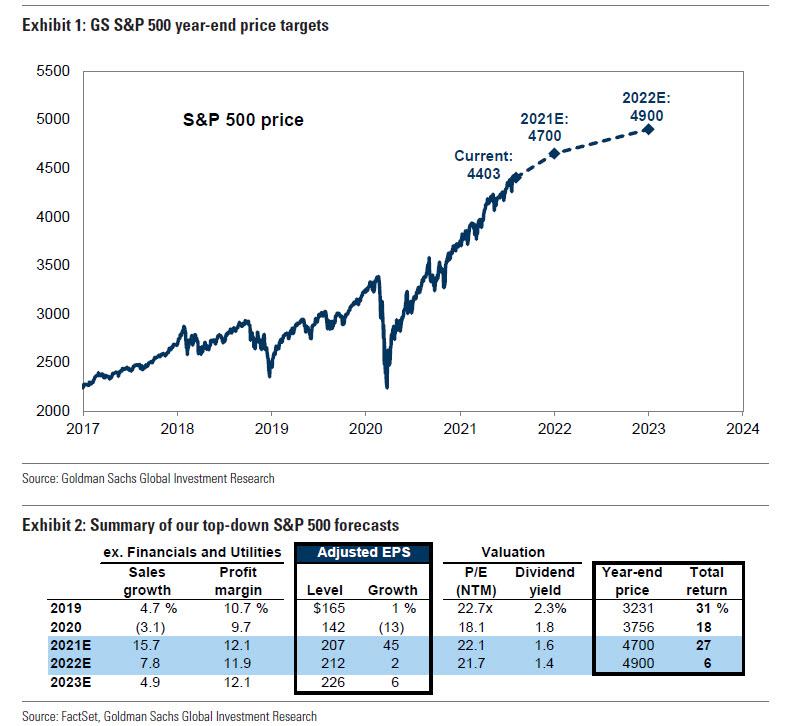
Well, two months later, with the S&P well above the bank's heretofore price target, overnight Goldman finally capitulated, and David Kostin raised the bank's S&P 500 estimates and year-end price target from 4,300 to 4,700 - making it the highest such forecast on Wall Street - writing that the bank is "raising our S&P 500 earnings and index targets; high-margin growth stocks will remain winners.”

Key drivers behind Kostin's price hike: corporate profit resiliency (particularly among Tech stocks) and persistently low rates: the new targets imply a 7% S&P 500 price return for the remainder of 2021 and full year price returns of 25% in 2021 and 4% in 2022, respectively (27% and 6% including dividends. EPS estimates were also updated, jumping to $207 (from $193) in 2021 and $212 (from $202) in 2022.

To justify the revision, Kostin writes that he now expects earnings growth will be the primary driver of US equity returns in 2H 2021 and 2022, as it has been so far this year. Year-to-date, EPS growth has accounted for all of the S&P 500’s 17% price return. Looking forward, he forecasts that modest equity risk premium (“ERP”) compression will offset rising interest rates, resulting in an S&P 500 valuation multiple that remains roughly flat. Earnings-driven equity market appreciation is consistent with the typical pattern at the current point in the business cycle.

The Goldman strategist lists 4 core assumptions behind his new forecast:

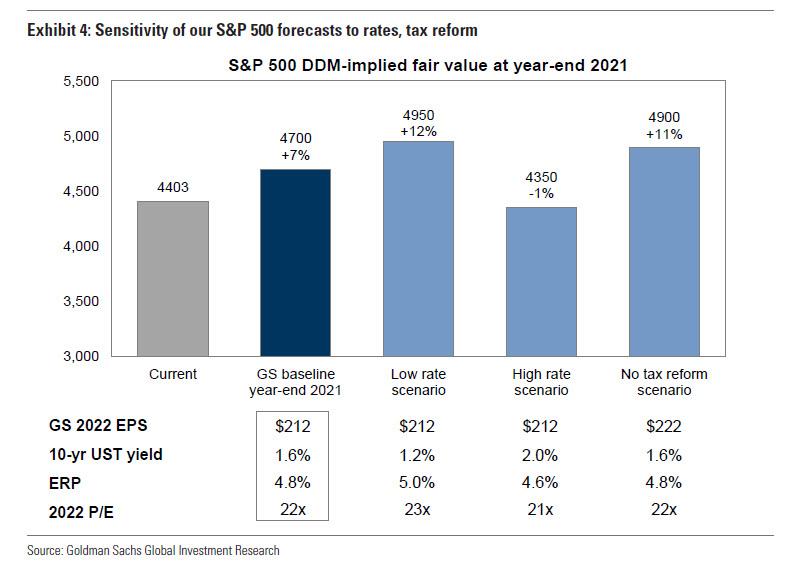
  • Baseline: The baseline equity forecast assumes tax reform passes and 10-year Treasury yields climb modestly to 1.6% at year-end, down notably from the bank's previous forecast of 1.9%. This implies a year-end 2021S&P 500 fair value of 4700 (+7% from today) and a corresponding forward P/E multiple of 22x.
  • Low rates: If interest rates were to remain near current levels (1.2% for the 10-year US Treasury yield) without a major downgrade to growth expectations or risk sentiment, the implied S&P 500 fair value at year-end would equal 4950 (+12% vs.the current S&P 500 level) and the P/E multiple would equal 23x.
  • High rates: If interest rates rise by more than expected due to a combination of improving economic growth expectations, persistent inflation, and a tighter Fed, the implied S&P 500 fair value would equal 4350 (-1%) corresponding with a P/E of 21x.
  • No tax reform: Our baseline forecast includes an expectation that tax reform passes in late 2021, but in a scenario without tax hikes our EPS estimate for 2022would be roughly 5% greater ($222) and our year-end 2021 price target would be around 4900 implying a P/E of 22x.

A chart summarizing the various assumption sensitivities is shown below:

Of particular note is Goldman's cut to its interest rate forecast: with 10Y yields now expected to end the year at 1.6% vs 1.9%, lower interest rates should support a stable forward P/E multiple of 22x according to Goldman. And if rates are even lower than that, Goldman says that we could see the S&P reaching near 5000 by year-end (conversely, a tightening by the Fed could keep the S&P 500 down near current levels).  

What is remarkable about this is that if one takes the Goldman forecast at face value, yields will decline because bond traders are anticipating a weaker economy, something which record low real rates already hint. And yet said slowdown is now viewed as favorable to stocks, although Kostin did caveat by saying that this drop in yields has to come "without a major downgrade to growth expectations or risk sentiment." Translation: as long as yields keep falling and stocks keep rising without anyone asking too many questions what's behind this move, well... the move should continue and yields can keep falling and stocks keep rising.

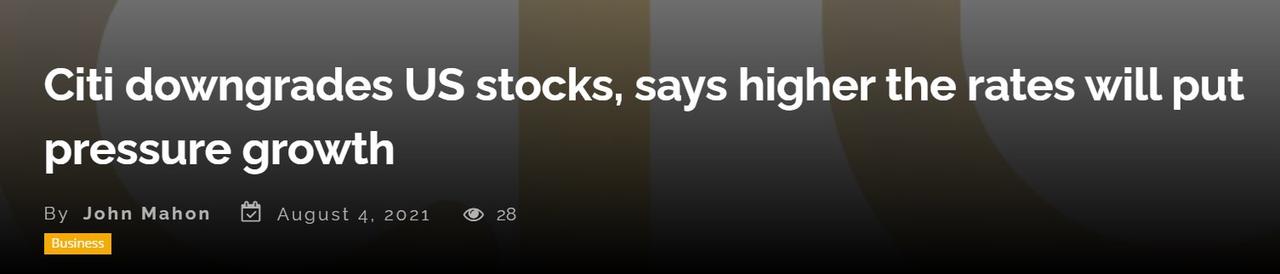
What is even more remarkable is how adept Wall Street has become at goalseeking catalyst to justify a narrative: to wit, just yesterday Citigroup downgraded stocks warning that higher yields will put pressure on growth:

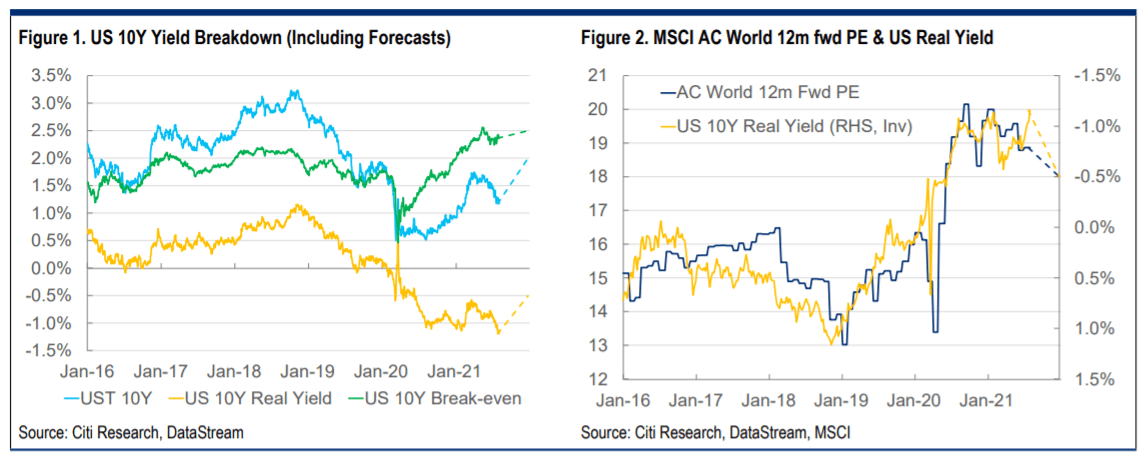
According to Citi chief global equity strategist Robert Buckland, a big rally in nominal and real Treasury yields will leave U.S. equities in an unfavorable position compared with other regions. Unlike Goldman which trimmed its year-end TSY forecast, Buckland calls the recent rally in government bonds "largely technical," and is forecasting the 10-year Treasury yield to rise to 2% through 2022, with real yields rising 70 basis points.

"What is the bond market trying to tell us?" Buckland wrote . "Is it worried that the Delta Covid variant may hold back global economic recovery? Is it now convinced that the current inflationary upturn is transitory? Or does curve flattening (short yields up, long yields down) suggest potentially over-zealous monetary tightening, that a 'policy mistake' is now imminent? Maybe the bond markets are worried about a China slowdown?"

"Citi US rates strategists are not especially convinced by these tempting narratives," he says. "Instead, they attribute much of the move to technical factors. Most notably, US treasury issuance has dropped over the summer, but will rise again later in the year. They think that this, along with ongoing economic recovery and likely QE tapering, will push 10-year bond yields back towards 2.0%."

"We factor this bearish bond view into our global equity strategy," he adds. "Amongst regions, we downgrade the Tech-heavy US to Neutral. We upgrade Japan to Overweight, where valuations and cyclical exposure should be supportive, along with a weaker yen. We remain Overweight UK equities, our favourite value trade."

"Amongst global sectors, we downgrade real yield-sensitive IT to Neutral and raise Health Care to Overweight. We remain Overweight Financials and Materials, which should outperform as bond yields rise."

Meanwhile, Citi strategist Tobias Levkovich, who has been among the most downbeat strategists in recent months, has a year-end S&P target of 4,000, saying that central banks have been keeping rates repressed since 2008, which indicates that they do not have confidence in sustainable growth and keeps risk premiums high.

To summarize, whereas Citi still believes that the reflationary narrative will take hold again and push yields higher while hammering stocks, Goldman has capitulated on the "newer normal" theme, and has reverted to the old "new normal" of secular stagnation where economic weakness translates into more Fed intervention, lower yields, and higher prices.

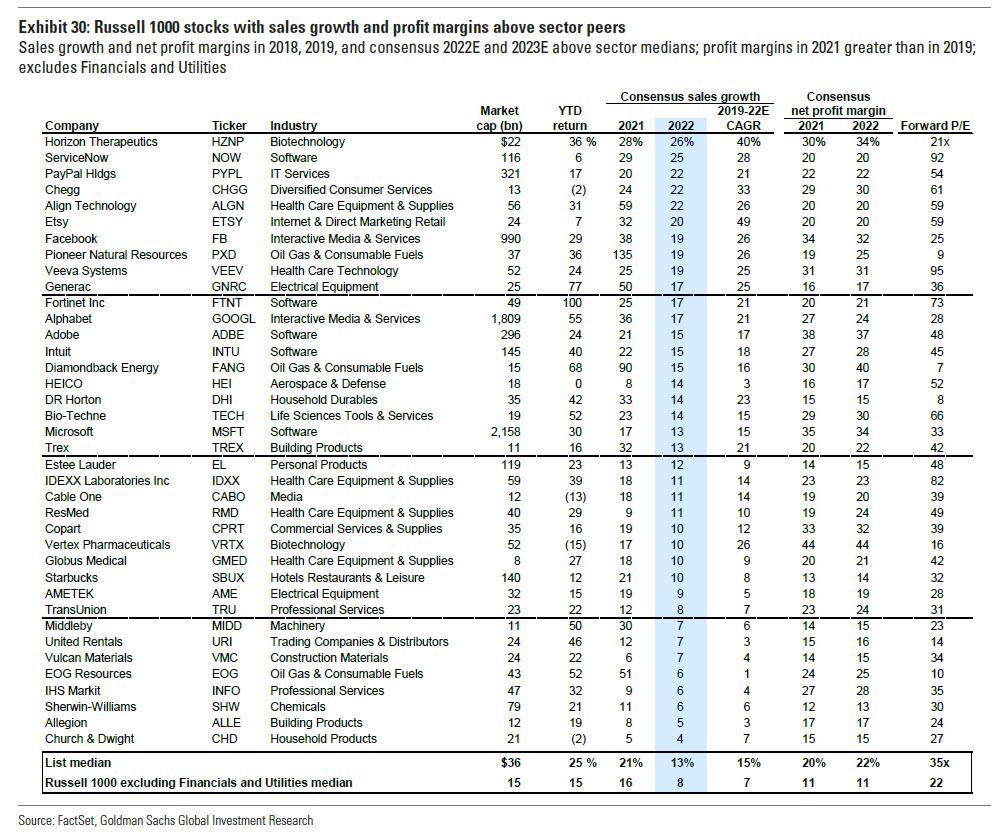
It remains to be seen which of the two strategists is correct, but for those who side with Goldman and see more upside to risk, Goldman recommends investors a balance between long term secular growth positions (focus on the 38 stocks with sales growth and margins consistently above sector peers shown below) and virus-exposed industries where concerns around the Delta variant have created tactical opportunities.

Drilling down on this, in the short term, Goldman believes the market’s pessimism regarding the Delta variant has created an opportunity in some virus-exposed cyclicals. For example, a basket of Reopening stocks has declined in absolute terms by 15% and lagged the S&P 500 by 20 pp since May as investors have downgraded economic growth expectations.  In addition, given the upside to our S&P 500 price targets, the bank maintains the view of our index options strategist that investors should take advantage of extremely elevated skew by buying levered risk reversals.

Finally, here are the 38 stocks with sales growth and margins consistently above sector peers which Goldman believes are safe bets for the long-run.

https://www.zerohedge.com/markets/goldman-hikes-sp-price-target-4700-due-lower-rates-says-sp-could-hit-5000-if-yield-slide

Clene's Nanotherapeutic Improves Energy Production, Brain Utilization In Parkinson's, MS


  • Clene Inc CLNN 3.18% has shared positive top-line results from the Phase 2 REPAIR trials investigating the improvement of brain energetic metabolism in Parkinson's disease (PD) and multiple sclerosis (MS).
  • The objective of the REPAIR program was to demonstrate the effects of Clene's nanotherapeutic, CNM-Au8, on brain energy metabolites in two studies of patients with Parkinson's disease (REPAIR-PD) and multiple sclerosis (REPAIR-MS). 
  • Patients were imaged before and after 12 or more weeks of daily oral dosing with CNM-Au8. 
  • The results for the primary endpoint, the mean change in the brain NAD+/NADH ratio (the ratio of the oxidized to a reduced form of nicotinamide adenine dinucleotide), demonstrated a statistically significant increase by an average of 0.589 units (10.4%). 
  • The individual results for these sister studies demonstrated consistent statistical trends toward improvement in the NAD+/NADH ratio.
  • CNM-Au8 treatment was well tolerated, with all treatment-emergent adverse events reported as predominantly mild and unrelated to the study drug. 
  • There were no serious adverse events or treatment discontinuations related to adverse events in either study. 
  • The clinical endpoint of MDS-UPDRS in REPAIR-PD showed no worsening of clinical status across the study population.