Search This Blog

Wednesday, October 6, 2021

Cassava starts Phase 3 for Alzheimer's med


  • First Phase 3 Study is Initiated to Evaluate Safety and Efficacy of Simufilam Over 52 Weeks in 750 Patients with Alzheimer’s Disease

  • A Second Phase 3 Study, Expected to Begin by Year End, Will Evaluate Simufilam Over 78 Weeks In 1,000 Patients with Alzheimer’s Disease

Cassava Sciences, Inc. (Nasdaq: SAVA), a biotechnology company focused on Alzheimer’s disease, announced today it has initiated an initial Phase 3 efficacy study of simufilam, the Company’s investigational drug for patients with Alzheimer’s disease. A second Phase 3 efficacy study of simufilam in Alzheimer’s disease is expected to begin by year end.

Cassava Sciences’ Phase 3 efficacy studies of simufilam in Alzheimer’s disease are being conducted under Special Protocol Assessments (SPA) from the U.S. Food and Drug Administration (FDA). The SPAs document that FDA has reviewed and agreed upon the key design features of Cassava Sciences’ Phase 3 study protocols.

“Alzheimer’s disease can have a devastating impact on patients, their families and caregivers,” said Remi Barbier, President & CEO. “We believe existing drug solutions for Alzheimer’s have limitations, and new solutions are very much needed. Our Phase 3 studies are designed to evaluate the safety and efficacy of simufilam in people with Alzheimer’s disease.”

Cassava Sciences is developing simufilam in accordance with high ethical standards and sound scientific principles. Cassava Sciences is committed to transparency and sharing information related to its Phase 3 program – for clinical protocol details, including patient eligibility, please visit: https://ClinicalTrials.gov/ct2/show/NCT04994483.

https://finance.yahoo.com/news/cassava-sciences-initiates-phase-3-123000607.html

Tuesday, October 5, 2021

Large New York Health Care System Fires 1,400 Unvaccinated Workers

 by Zachary Stieber via The Epoch Times,

A large New York health care system on Monday said it fired 1,400 workers because they declined to get a COVID-19 vaccine.

Northwell Health terminated approximately 2 percent of its workforce, which spans across New York City, Westchester, and Long Island.

The workforce across the 23-hospital system is now 100 percent vaccinated, the system told news outlets in a statement.

“Northwell believes that having a fully vaccinated workforce is an important measure in our duty to protect the health and safety of our staff, our patients, and the communities we serve,” the health care system said. 

“This allows us to continue to provide exceptional care at all of our facilities, without interruption and remain open and fully operational.”

Northwell regrets losing any employee under such circumstances, but as health care professionals and members of the largest health care provider in the state, we understand our unique responsibility to protect the health of our patients and each other. We owe it to our staff, our patients, and the communities we serve to be 100 percent vaccinated against COVID-19,” it added.

A spokesperson did not immediately respond to a request for comment on whether any religious or medical exemptions were granted.

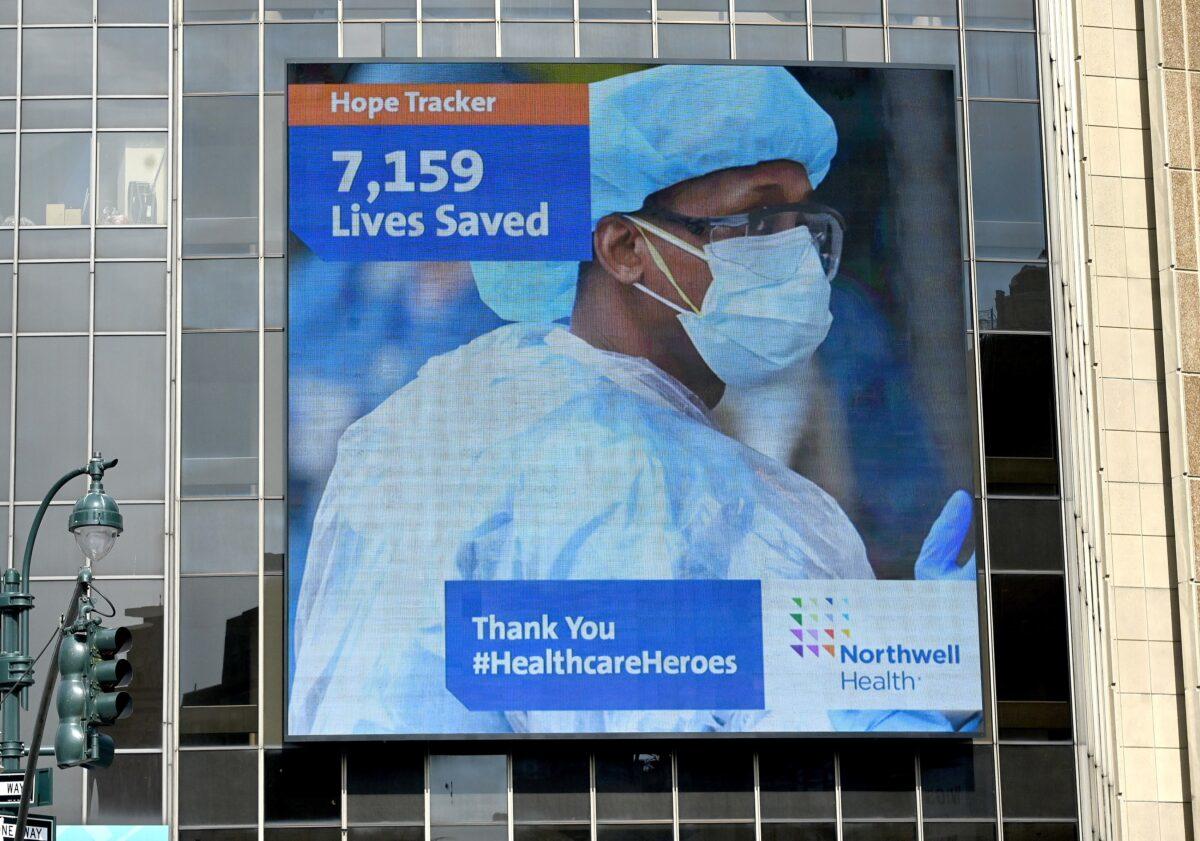
Madison Square Garden displays the Northwell Health Hope Tracker in New York City on April 25, 2020. (Jamie McCarthy/Getty Images)

Health care workers in New York were ordered by Gov. Kathy Hochul, a Democrat, to get a COVID-19 vaccine. A legal challenge was partially dismissed late last month except for those seeking a religious exemption. Additionally, President Joe Biden’s administration plans on releasing a new nationwide requirement for employers who have 100 or more workers to mandate a vaccine or weekly COVID-19 testing.

Thousands of unvaccinated health care workers were placed on unpaid leave last week due to Hochul’s mandate. The situation led to some disruptions. Strong Memorial Hospital, for instance, said it was pausing some elective procedures for two weeks.

Northwell workers fired because of their refusal to get vaccinated were being denied benefits like employer contributions to retirement plans, The Epoch Times previously reported.

John Trinchino, a registered nurse, told The New York Times he was fired from his job at Staten Island University Hospital, which is part of Northwell, last week.

Trinchino said he didn’t agree with the vaccine mandate because he had recovered from COVID-19. Studies show people who recover from the disease, which is caused by the CCP (Chinese Communist Party) virus, enjoy similar protection against later infection than those who are vaccinated.

“All this is going to lead to is worse care for the patients, and I’m just disgusted by it,” he said.

Northwell workers protested against the mandate on the day it went into effect, arguing it violated people’s freedoms. [delete]

Karen Roses, a patient care technician at a Northwell hospital in Riverhead, New York, told The Epoch Times that she knew her refusal to get a vaccine could mean she loses her job, but said she’s “not going to be bullied or pressured [by] anybody for any reason.”

“It’s not an anti-vaccine statement. It’s a freedom of choice statement,” she said.

https://www.zerohedge.com/political/large-new-york-health-care-system-fires-1400-unvaccinated-workers

Anticoagulation therapy and hospital admission and death risk in COVID-19 patients

  • et al.


  •                                                                         
  • DOI:https://doi.org/10.1016/j.eclinm.2021.101139      


  •  PDF: https://www.thelancet.com/action/showPdf?pii=S2589-5370%2821%2900419-3

  •  

    Abstract

    Background

    Coronavirus disease 2019 (COVID-19) is associated with a hypercoagulable state. Limited data exist informing the relationship between anticoagulation therapy and risk for COVID-19 related hospitalization and mortality.

    Methods

    We evaluated all patients over the age of 18 diagnosed with COVID-19 in a prospective cohort study from March 4th to August 27th, 2020 among 12 hospitals and 60 clinics of M Health Fairview system (USA). We investigated the relationship between (1) 90-day anticoagulation therapy among outpatients before COVID-19 diagnosis and the risk for hospitalization and mortality and (2) Inpatient anticoagulation therapy and mortality risk.
    Of 6195 patients, 598 were immediately hospitalized and 5597 were treated as outpatients. The overall case-fatality rate was 2•8% (n = 175 deaths). Among the patients who were hospitalized, the inpatient mortality was 13%. Among the 5597 COVID-19 patients initially treated as outpatients, 160 (2.9%) were on anticoagulation and 331 were eventually hospitalized (5.9%). In a multivariable analysis, outpatient anticoagulation use was associated with a 43% reduction in risk for hospital admission, HR (95% CI = 0.57, 0.38–0.86), p = 0.007, but was not associated with mortality, HR (95% CI=0.88, 0.50 - 1.52), p = 0.64. Inpatients who were not on anticoagulation (before or after hospitalization) had an increased risk for mortality, HR (95% CI = 2.26, 1.17–4.37), p = 0.015.

    Interpretation

    Outpatients with COVID-19 who were on outpatient anticoagulation at the time of diagnosis experienced a 43% reduced risk of hospitalization. Failure to initiate anticoagulation upon hospitalization or maintaining outpatient anticoagulation in hospitalized COVID-19 patients was associated with increased mortality risk.

    Funding

    No funding was obtained for this study.

  •                                                                                         

Recombinant adjuvanted zoster vaccine and reduced risk of COVID-19 diagnosis, hospitalization in older adults

 Katia J. Bruxvoort, Bradley Ackerson, Lina S. Sy, Amit Bhavsar, Hung Fu Tseng, Ana Florea, Yi Luo, Yun Tian, Zendi Solano, Robyn Widenmaier, Meng Shi, Robbert Van Der Most, Johannes Eberhard Schmidt, Jasur Danier, Thomas Breuer, Lei Qian

Increases in COVID-19 unrelated to vaccination levels across 68 countries, 2947 US counties


Akhil Kumar

Vaccines currently are the primary mitigation strategy to combat COVID-19 around the world. For instance, the narrative related to the ongoing surge of new cases in the United States (US) is argued to be driven by areas with low vaccination rates [1]. A similar narrative also has been observed in countries, such as Germany and the United Kingdom [2]. At the same time, Israel that was hailed for its swift and high rates of vaccination has also seen a substantial resurgence in COVID-19 cases [3]. We investigate the relationship between the percentage of population  fully vaccinated and new COVID-19 cases across 68 countries and across 2947 counties in the US.

Methods

We used COVID-19 data provided by the Our World in Data for cross-country analysis, available as of September 3, 2021 (Supplementary Table 1) [4]. We included 68 countries that met the following criteria: had second dose vaccine data available; had COVID-19 case data available; had population data available; and the last update of data was within 3 days prior to or on September 3, 2021. For the 7 days preceding September 3, 2021 we computed the COVID-19 cases per 1 million people for each country as well as the percentage of population that is fully vaccinated.

For the county-level analysis in the US, we utilized the White House COVID-19 Team data [5], available as of September 2, 2021 (Supplementary Table 2). We excluded counties that did not report fully vaccinated population percentage data yielding 2947 counties for the analysis. We computed the number and percentages of counties that experienced an increase in COVID-19 cases by levels of the percentage of people fully vaccinated in each county. The percentage increase in COVID-19 cases was calculated based on the difference in cases from the last 7 days and the 7 days preceding them. For example, Los Angeles county in California had 18,171 cases in the last 7 days (August 26 to September 1) and 31,616 cases in the previous 7 days (August 19–25), so this county did not experience an increase of cases in our dataset. We provide a dashboard of the metrics used in this analysis that is updated automatically as new data is made available by the White House COVID-19 Team (https://tiny.cc/USDashboard).

Findings

At the country-level, there appears to be no discernable relationship between percentage of population fully vaccinated and new COVID-19 cases in the last 7 days (Fig. 1). In fact, the trend line suggests a marginally positive association such that countries with higher percentage of population fully vaccinated have higher COVID-19 cases per 1 million people. Notably, Israel with over 60% of their population fully vaccinated had the highest COVID-19 cases per 1 million people in the last 7 days. The lack of a meaningful association between percentage population fully vaccinated and new COVID-19 cases is further exemplified, for instance, by comparison of Iceland and Portugal. Both countries have over 75% of their population fully vaccinated and have more COVID-19 cases per 1 million people than countries such as Vietnam and South Africa that have around 10% of their population fully vaccinated.

Fig. 1
figure1

Relationship between cases per 1 million people (last 7 days) and percentage of population fully vaccinated across 68 countries as of September 3, 2021 (See Table S1 for the underlying data)

Across the US counties too, the median new COVID-19 cases per 100,000 people in the last 7 days is largely similar across the categories of percent population fully vaccinated (Fig. 2). Notably there is also substantial county variation in new COVID-19 cases within categories of percentage population fully vaccinated. There also appears to be no significant signaling of COVID-19 cases decreasing with higher percentages of population fully vaccinated (Fig. 3).

Fig. 2
figure2

Median, interquartile range and variation in cases per 100,000 people in the last 7 days across percentage of population fully vaccinated as of September 2, 2021

Fig. 3
figure3

Percentage of counties that experienced an increase of cases between two consecutive 7-day time periods by percentage of population fully vaccinated across 2947 counties as of September 2, 2021

Of the top 5 counties that have the highest percentage of population fully vaccinated (99.9–84.3%), the US Centers for Disease Control and Prevention (CDC) identifies 4 of them as “High” Transmission counties. Chattahoochee (Georgia), McKinley (New Mexico), and Arecibo (Puerto Rico) counties have above 90% of their population fully vaccinated with all three being classified as “High” transmission. Conversely, of the 57 counties that have been classified as “low” transmission counties by the CDC, 26.3% (15) have percentage of population fully vaccinated below 20%.

Since full immunity from the vaccine is believed to take about 2 weeks after the second dose, we conducted sensitivity analyses by using a 1-month lag on the percentage population fully vaccinated for countries and US counties. The above findings of no discernable association between COVID-19 cases and levels of fully vaccinated was also observed when we considered a 1-month lag on the levels of fully vaccinated (Supplementary Figure 1, Supplementary Figure 2).

We should note that the COVID-19 case data is of confirmed cases, which is a function of both supply (e.g., variation in testing capacities or reporting practices) and demand-side (e.g., variation in people’s decision on when to get tested) factors.

Interpretation

The sole reliance on vaccination as a primary strategy to mitigate COVID-19 and its adverse consequences needs to be re-examined, especially considering the Delta (B.1.617.2) variant and the likelihood of future variants. Other pharmacological and non-pharmacological interventions may need to be put in place alongside increasing vaccination rates. Such course correction, especially with regards to the policy narrative, becomes paramount with emerging scientific evidence on real world effectiveness of the vaccines.

For instance, in a report released from the Ministry of Health in Israel, the effectiveness of 2 doses of the BNT162b2 (Pfizer-BioNTech) vaccine against preventing COVID-19 infection was reported to be 39% [6], substantially lower than the trial efficacy of 96% [7]. It is also emerging that immunity derived from the Pfizer-BioNTech vaccine may not be as strong as immunity acquired through recovery from the COVID-19 virus [8]. A substantial decline in immunity from mRNA vaccines 6-months post immunization has also been reported [9]. Even though vaccinations offers protection to individuals against severe hospitalization and death, the CDC reported an increase from 0.01 to 9% and 0 to 15.1% (between January to May 2021) in the rates of hospitalizations and deaths, respectively, amongst the fully vaccinated [10].

In summary, even as efforts should be made to encourage populations to get vaccinated it should be done so with humility and respect. Stigmatizing populations can do more harm than good. Importantly, other non-pharmacological prevention efforts (e.g., the importance of basic public health hygiene with regards to maintaining safe distance or handwashing, promoting better frequent and cheaper forms of testing) needs to be renewed in order to strike the balance of learning to live with COVID-19 in the same manner we continue to live a 100 years later with various seasonal alterations of the 1918 Influenza virus.

https://link.springer.com/article/10.1007/s10654-021-00808-7