Search This Blog

Wednesday, January 5, 2022

AlloVir Gets FDA Regenerative Medicine Advanced Therapy Tag

 AlloVir Inc. said the U.S. Food and Drug Administration granted its lead multi-virus specific T cell therapy posoleucel Regenerative Medicine Advanced Therapy designation.

The designation is for the treatment of adenovirus infection following allogeneic hematopoietic stem cell transplant and is based on results from a Phase 2 study.

RMAT designation recognizes the potential for posoleucel to address the unmet medical need posed by AdV, a potentially life-threatening condition with no approved treatment options, the late-clinical stage company said.

This designation enables early interactions with the FDA to discuss clinical trial design and other actions to expedite development and review.

The FDA previously granted RMAT designation to posoleucel for the treatment of hemorrhagic cystitis caused by BK virus in adults and children following allo-HCT.

A Phase 3 study of posoleucel for the treatment of AdV viremia is now enrolling pediatric and adult patients following allo-HCT. This study is the second Phase 3 registrational study of posoleucel.

The company also said it initiated a Phase 1/2 clinical trial of ALVR106 for the treatment of infections caused by human metapneumovirus, influenza, parainfluenza virus and respiratory syncytial virus.

https://www.marketscreener.com/quote/stock/ALLOVIR-INC-110325237/news/AlloVir-Gets-FDA-Regenerative-Medicine-Advanced-Therapy-Designation-for-Posoleucel-37470131/

Eagle Pharmaceuticals Shares Turn Positive After Positive 2022 Outlook

 Eagle Pharmaceuticals Inc. shares pushed into positive territory Wednesday after the company said it expects significant revenue growth this year.

The stock was up 1% to $51.70 at 1:50 p.m. ET.

The company said it will begin shipping vasopressin on Jan. 17, with 180 days of marketing exclusivity. Vasostrict U.S. sales totaled $890 million for the last 12 months ended Sept. 30.

Eagle said that on Feb. 1, it will launch Pemfexy, a ready-to-use liquid with a unique J-code. Eagle has been building inventory and said it believes this is a significant opportunity, as the Alimta U.S. market totaled $1.2 billion for the last fiscal year.

The company said that based on discussions with the U.S. Food and Drug Administration, it will begin human pilot studies of its fulvestrant product candidate for the treatment of HR+/HER- advanced breast cancer shortly. The company is also on track to submit a new drug application in the first half of 2022, seeking approval of Landiolol, a novel therapeutic for the short-term reduction of ventricular rate in patients with supraventricular tachycardia, including atrial fibrillation and atrial flutter.

"Our already-strong balance sheet and cash position will benefit from the two launches and position us well to deploy our cash strategically through additional in-licensing opportunities, as well as potential acquisitions of companies or products," said Scott Tarriff, chief executive of Eagle Pharmaceuticals.

https://www.marketscreener.com/quote/stock/EAGLE-PHARMACEUTICALS-IN-15758349/news/Eagle-Pharmaceuticals-Shares-Turn-Positive-After-Positive-2022-Outlook-37474345/

Shares in COVID-19 vaccine developer Valneva extend fall


Shares in biotech company Valneva fell again on Wednesday, declining for the seventh day in a row due to a growing belief amongst investors that the COVID-19 Omicron variant might lessen the need for mass vaccination.

At 0945 GMT, Valneva shares were down 3% at 17.10 euros, meaning the stock has now lost close to 40% since its Dec. 27 close of 26.38 euros.

It did gain more than 200% a year in 2021 and 2020 as Valneva's COVID-19 vaccine candidate came increasingly closer to approval. It is still awaiting a green light for its shot in the European Union and Britain.

"The decline of the share price seems to be mostly driven by retail investors who think that there will be no need of a new vaccination campaign after the Omicron wave", a Paris-based analyst said.

Companies whose COVID-19 vaccines have already been approved have also seen their shares dip since the start of the year, with Pfizer losing 7.65% over the last two days and Moderna down 8.2%.

Initial data in various countries seem to suggest that Omicron -- the most contagious of all the COVID variants to date with new cases at record levels in many countries -- is less likely to send infected people to hospital.

https://www.marketscreener.com/quote/stock/ASTRAZENECA-PLC-4000930/news/Shares-in-COVID-19-vaccine-developer-Valneva-extend-fall-37468119/

White House: No plans to change definition of 'fully vaccinated'

 The Biden administration said Wednesday it has no plans to change the definition of "fully vaccinated" against the coronavirus to include getting a booster shot. 

"Individuals are considered fully vaccinated against COVID-19 if they've received their primary series, that definition is not changing," Centers for Disease Control and Prevention (CDC) Director Rochelle Walensky said at a press briefing. 

She said that the CDC is instead using the term "up to date" to encourage people to get boosters.

The definition is important for an array of vaccine requirements the administration has put forward. It means two shots of Pfizer or Moderna will remain enough to satisfy Occupational Safety and Health Administration (OSHA) and Centers for Medicare and Medicaid Services (CMS) mandates for large employers and for health workers.

"Someone is considered fully vaccinated if they have received their primary series of vaccines, so if you think about the different requirements that you mentioned, travel, OSHA, CMS rules and other examples, that has not changed and we do not have any plans to change that," White House COVID-19 response coordinator Jeff Zients said.  

The announcement from the White House comes after weeks of questions about the definition and officials saying they were reviewing the issue. 

Many health experts have urged the administration to change the definition, noting the importance of booster shots in protecting against infection from the omicron variant. 

The Biden administration said it is still urging all adults to get booster shots, it just is not changing the definition for purposes of the mandates. 

Zients noted that two doses still provides strong protection against severe disease, though three doses are needed to provide better protection against getting infected at all. 

"I do think it's really important to recognize the vast majority of hospitalizations and deaths are among the unvaccinated Americans and completing the primary vaccination series is clearly a critical step to prevent severe outcomes, with boosters, as Dr. Walensky said, giving the highest level of protection," Zients said. "So we will encourage everybody to get vaccinated, and when eligible boosted."

Anthony Fauci, Biden's chief medical adviser, told CNN in December that in his "personal opinion" it was a matter of "when, not if" the definition would change. 

He said that the definition aside, "certainly, when you want to talk about what optimal protection is, I don’t think anybody would argue that optimal protection is going to be with a third shot."

https://thehill.com/policy/healthcare/588356-white-house-no-plans-to-change-definition-of-fully-vaccinated

Babies born during pandemic showing slight delays in developmental skills


  • A new study on babies born during the pandemic found some had lower gross motor, fine motor and social skills than pre-pandemic babies.
  • Researchers believe pregnant mothers experiencing pandemic related stress may have caused the drop in developmental scores.
  • The lower developmental scores were small shifts in average scores between groups, but researchers emphasized it’s important to pay attention to.

The pandemic has upended normal life for most people, prompting some to lose jobs, attend school from home and limit time spent with friends. Now scientists have discovered that even babies have felt the stress, with some born during the coronavirus pandemic experiencing slight developmental delays.

In new research published on Tuesday, a group of researchers studied 255 infants born between March and December 2020 and found that average developmental scores among babies born during the pandemic, whether their mothers had COVID-19 during pregnancy or not, were lower than the gross motor, fine motor and social skills of 62 pre-pandemic babies.

Dani Dumitriu, assistant professor of pediatrics and psychiatry at Columbia University and lead investigator of the study, explained that the results suggest the huge amount of stress felt by pregnant mothers during the pandemic may have played a role.

“The developmental trajectory of an infant begins before birth. With potentially millions of infants who may have been exposed to COVID in utero, and even more mothers just living through the stress of the pandemic, there is a critical need to understand the neurodevelopmental effects of the pandemic on future generations,” said Dumitriu.

Last year, Dumitriu, along with a group of pediatric researchers, found that mothers don’t pass the COVID-19 virus to their fetus, but this week’s new research indicates instead that the womb of a mother experiencing the pandemic was associated with slightly lower scores in areas like motor and social skills. 

Though her particular study didn’t measure maternal stress during pregnancy, previous studies have shown that maternal stress in the earliest stages of pregnancy can have a bigger effect on socioemotional functioning in infants than stress later in pregnancy. 

Dumitriu’s study confirmed that fact, finding that infants whose mothers were in the first trimester of pregnancy at the height of the coronavirus pandemic had the lowest neurodevelopment scores.

Researchers in California specifically took on the task of analyzing how stress related to the pandemic impacted pregnant women, finding about 40 percent of women in the study scoring high in depressive symptoms.

However, stress may not be the only factor, with the pandemic limiting social interactions like play dates that may explain the weaker developmental scores of babies born during the pandemic. 

Dumitriu emphasized that the lower developmental scores were not huge, just small shifts in average scores between groups, but it’s nonetheless important to pay attention to.

“These small shifts warrant careful attention because at the population level, they can have a significant public health impact. We know this from other pandemics and natural disasters,” said Dumitriu.

https://thehill.com/changing-america/well-being/prevention-cures/588410-babies-born-during-pandemic-showing-slight

FOMC Minutes Shows Hawkish Fed Hiking 'Faster Than Anticipated,' Warn Of Omicron Risks

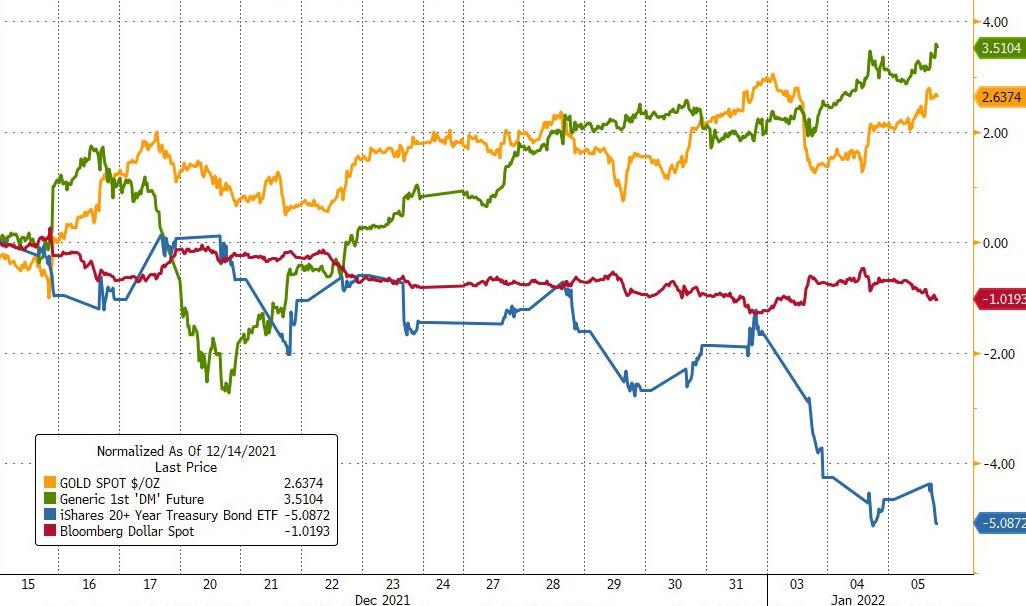
 Since December 15th's FOMC statement, bonds have been battered, the dollar is down modestly while stocks and gold are up strongly....

Source: Bloomberg

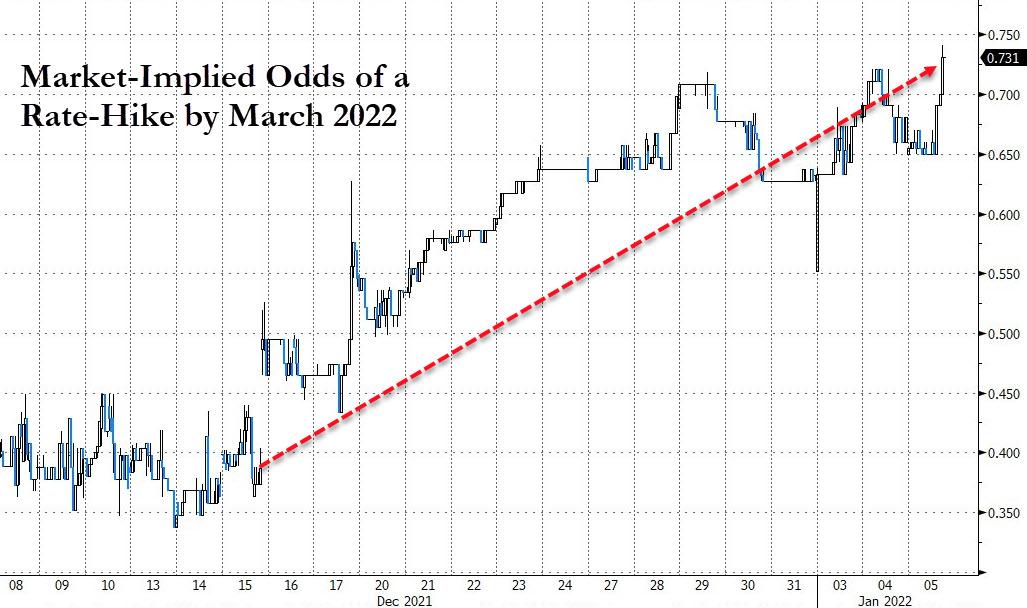
The short-end of the yield curve has risen dramatically, pricing in the new hawkish dot-plot offered by The Fed (for 2022) with a 73% chance of Fed hikes by March 2022 now ((from 40% pre-FOMC)...

Source: Bloomberg

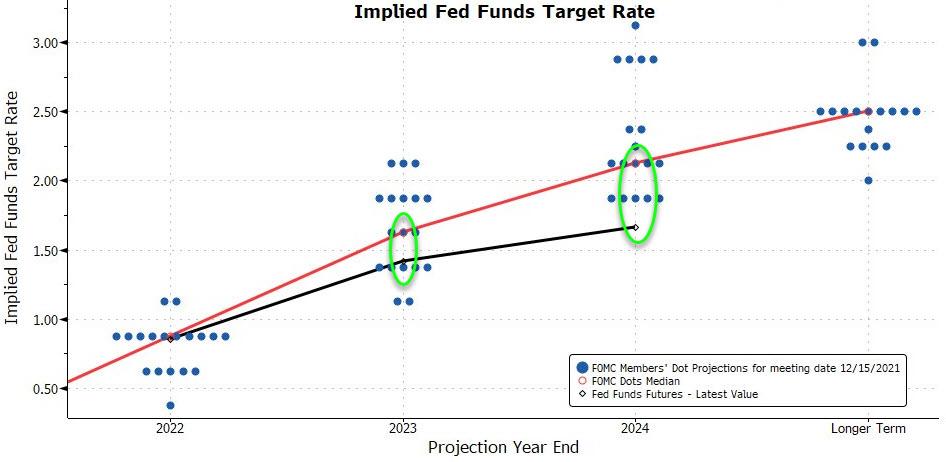
Interestingly though, the market has rejected The Fed's longer-term dots, presumably pricing in a policy-error/reversal...

Source: Bloomberg

All of which leaves the market desperately seeking clues today on the accelerated taper and timing of lift-off and trajectory of rate-hikes among the Minutes.

On the liftoff timing and pace of rate-hikes:

"Participants generally noted that, given their individual outlooks for the economy, the labor market, and inflation, it may become warranted to increase the federal funds rate sooner or at a faster pace than participants had earlier anticipated. Some participants also noted that it could be appropriate to begin to reduce the size of the Federal Reserve’s balance sheet relatively soon after beginning to raise the federal funds rate. Some participants judged that a less accommodative future stance of policy would likely be warranted and that the Committee should convey a strong commitment to address elevated inflation pressures."

Policymakers thought changes in Fed Funds Rate should be primary means for adjusting stance of policy.

Some participants also remarked that there could be circumstances in which it would be appropriate for the Committee to raise the target range for the federal funds rate before maximum employment had been fully achieved - for example, if the Committee judged that its employment and price-stability goals were not complementary in light of economic developments and that inflation pressures and inflation expectations were moving materially and persistently higher in a way that could impede the attainment of the Committee's longer-run goals.

On Omicron's impact:

“In particular, the possibility that COVID-19 cases could continue to rise steeply, especially if the Omicron variant proves to be vaccine resistant, was seen as an important source of downside risk to activity, while the possibility of more severe and persistent supply issues was viewed as an additional downside risk to activity and as an upside risk to inflation.”

"Members also agreed that, with the emergence of the Omicron variant, it was appropriate to note the risk of new variants of the virus in their assessment of risks to the economic outlook."

On normalization:

“Participants also judged the Federal Reserve to be better positioned for normalization than in the past.

On Inflation:

In their comments on inflation expectations, some participants discussed the risk that recent elevated levels of inflation could increase the public's longer-term expectations for inflation to a level above that consistent with the Committee's longer-run inflation objective.

A few participants, however, noted that long-term inflation expectations remained well anchored, citing stable readings of market-based inflation compensation measures or the generally low level of longer-term bond yields.

On labor market:

Committee's assessments of maximum employment, a condition most participants judged could be met relatively soon if the recent pace of labor market improvements continued.

Several participants remarked that they viewed labor market conditions as already largely consistent with maximum employment.

Additionally, a key thing to understand from the Minutes is that there was a wide variety of views on when to start shrinking the balance sheet.

“almost all participants agreed that it would likely be appropriate to initiate balance sheet runoff at some point after the first increase in the target range for the federal funds rate.”

*  *  *

Read the full Minutes below:

Docs Refused to Pay the Cyber Attack Ransom — and Suffered

 Ransomware attacks are driving some small practices out of business. Michigan-based Brookside ENT and Hearing Center, a two-physician practice, closed its doors in 2019 after a ransomware attack. The criminals locked their computer system and files and then demanded a $6500 ransom to restore access. The practice took the advice of law enforcement and refused to pay. The attackers wiped the computer systems clean — destroying all patient records, appointment schedules, and financial information. Rather than rebuild the entire practice, the two doctors took early retirement.

Wood Ranch Medical, in Simi, California, a small primary care practice, decided to shut its doors in 2019 after a ransomware attack damaged their servers and backup files, which affected more than 5000 patient records. The criminals demanded a ransom to restore the technology and records, but the owners refused to pay. They couldn't rebuild the system without the backup files, so they shuttered their business.

Several large practices have also been attacked by ransomware, including Imperial Health in Louisiana in 2019, that may have compromised more than 110,000 records. The practice didn't pay the ransom and had access to their backup files and the resources to rebuild their computer systems and stay in business.

Medical practices of all sizes have experienced ransomware attacks. More than 551 healthcare ransomware attacks were reported to the federal US Department of Health and Human Services' (HHS') Office of Civil Rights in 2021 (as of November 30), and over 40 million individuals faced exposure of their protected health information.

All it takes is one employee clicking on a link or embedded file in an email to launch malware. A vicious code locks the electronic health record (EHR) system, and your practice grinds to a halt.

Cyber criminals demand a ransom in bitcoin to unlock the files. They may even threaten to post private patient data publicly or sell it on the dark web to get you to pay up.

But, is paying a ransom necessary or wise? What other steps should you take? Here's what cyber security experts say criminals look for in targets, how they infiltrate and attack, and how you should respond and prevent future attacks.

How Does It Happen?

Email is a popular way for criminals to hack into a system. Criminals often research company websites and impersonate a company executive and send a legitimate-looking "phishing" email to employees hoping that someone will click on it and launch a malware attack.

Drex DeFord

Recently, cyber criminals found an easier way to infiltrate that doesn't require identifying targets to gain access, says Drex DeFord, executive healthcare strategist at CrowdStrike, a cybersecurity technology company in Sunnyvale, California.

"Instead of hacking into the system, cyber criminals are just logging in. Most likely, they have acquired a user's credentials (username/password) from another source — possibly purchasing it from the dark web, the part of the Internet that criminals use, through an 'access broker,' an organization that specializes in collecting and selling these kinds of credentials," says DeFord.

After a ransomware attack last August on Eskenazi Health in Indianapolis, forensic investigators discovered that the criminals had logged into the IT system in May and had disabled security protections that could have detected their presence before they launched their cyberattack, according to a statement.

Responding to a Ransomware Attack

When employees or the IT department suspect a ransomware attack is underway, cyber experts recommend isolating the "infected" part of the network, shutting down the computer system to prevent further damage, and securing backups.

Soon afterward, cyber criminals typically communicate their ransom demand electronically with instructions for payment. One practice described seeing a "skull and bones image" on their laptops with a link to instructions to pay the ransom demand in bitcoin.

Kathy Hughes

Although you never want to pay criminals, it's ultimately a business decision that every organization that's affected by ransomware has to make, says Kathy Hughes, chief information security officer at Northwell Health in New York. "They need to weigh the cost and impact from paying a ransom against what they are able to recover, how long will it take, and how much will it cost," she says.

While it may be tempting to pay a small ransom, such as $5000, cyber experts warn that it doesn't guarantee full access to the original data. About one third (34%) of healthcare organizations whose data were encrypted paid the ransom to get their data back, according to a June 2021 HHS Report on Ransomware Trends. However, only 69% of the encrypted data was restored, the report states.

Criminals may also demand another payment, called "double extortion," by threatening to post any extracted private patient or employee data on the dark web, says Hughes.

Practices sometimes choose not to pay the ransom when they know they can restore the backup files and rebuild the system for less than the ransom amount. However, it can take weeks to rebuild a fully operational IT system; meanwhile, the organization is losing thousands of dollars in patient revenue.

Criminals may retaliate against a practice that doesn't pay the ransom by wiping the hard drives clean or posting the extracted medical, financial, and demographic data of patients on the dark web. Patients whose information has been extracted have filed class-action lawsuits against medical practices and organizations such as Scripps Health, in San Diego, California, claiming that they should have done more to keep their private information safe.

Experts also advise reporting the attack to local law enforcement, who may have cyber security experts on staff who will come on site and investigate the nature of the attack. They may also request help from the FBI's professional cyber security team.

Having a cyber insurance policy may help offset some of the costs of an attack. However, make sure you have a good cyber security program, advises DeFord.

He suggests that small practices partner with large health systems that can donate their cyber security technology and related services legally under the updated Stark safe harbor rules. Otherwise, they may not meet the insurer's requirements, or they may have to pay significantly higher rates.

Who Is an Easy Target?

Cyber criminals look for easy targets, says Hughes. "A lot of threat actors are not targeting a specific practice — they're simply throwing out a net and looking for vulnerable systems on the internet."

Small medical practices are particularly vulnerable to ransomware attacks because they lack the resources to pay for dedicated IT or cyber security staff, says Hughes, who oversees security for more than 800 outpatient practices. They're not replacing outdated or unsupported equipment, applying regular "patches" that fix, update, or improve operating systems, application software, and Internet browsers, or using password controls.

As large practices or health systems acquire medical practices with different EHR systems, security can be more challenging. Hughes says, "Our goal at Northwell is always to get them onto our standard platform, where we use best practices for technology and security controls. In the world of security, having fewer EHR systems is better so there are fewer things to watch, fewer systems to patch, and fewer servers to monitor. From our point of view, it makes sense to have a standardized and streamlined system."

Still, some practices may feel strongly about using their EHR system, says Hughes. When that happens, "We at least bring them up to our security standards by having them implement password controls and regular patches. We communicate and collaborate with them constantly to get them to a more secure posture."

Cyber security lapses may have increased during the pandemic when practices had to pivot rapidly to allow administrative staff to work remotely and clinical staff to use telehealth with patients.

"In the rush to get people out of the building during the pandemic, healthcare organizations bent many of their own rules on remote access. As they moved quickly to new telehealth solutions, they skipped steps like auditing new vendors and cyber-testing new equipment and software. Many organizations are still cleaning up the security 'exceptions' they made earlier in the pandemic," says DeFord.

Hackers Are Sophisticated Criminals

"The version of a hacker a lot of us grew up with — someone in a basement hacking into your environment and possibly deploying ransomware — isn't accurate," says DeFord. What experts know now is that these cyber criminals operate more like companies that have hired, trained, and developed people to be stealth-like — getting inside your network without being detected.

"They are more sophisticated than the healthcare organizations they often target," adds DeFord. "Their developers write the encryption software; they use chatbots to make paying the ransom easy and refer to the people they ransom as clients, because it's a lucrative business," says DeFord.

These groups also have specialized roles — one may come in and map your network's vulnerabilities and sell that information to another group that is good at extracting data and that sells that information to another group that is good at setting off ransomware and negotiation, says DeFord. "By the time a ransomware attack occurs, we often find that the bad guys have owned the network for at least 6 months."

Patient records are attractive targets because the information can be sold on the dark web, the part of the internet that's unavailable to search engines and requires an anonymous browser called Tor to gain access, says Hughes.

Criminals steal patient identifiers such as social security numbers and birthdates, payment or insurance information, as well as medical histories and prescription data. Other people buy the information for fraudulent purposes, such as filing false tax returns, obtaining medical services, and opening credit cards, says Hughes.

Lately, criminal gangs appear to be targeting the IT or EHR systems that practices rely for clinical care and making them unavailable. By locking EHR files or databases and holding them for ransom, criminals hope practices will be more likely to pay, says Hughes.

They also don't want to get caught, and this tactic "gets them in and out faster" than extracting and posting patient data, although criminals may use that as a threat to extort a ransom payment, says Hughes.

Fines for Lax Privacy/Security

Breaches of patient records have consequences that include being investigated by federal or state authorities for potential HIPAA privacy and security violations and fines. Recently, the HHS announced a $1.5 million settlement — the largest to date — with Athens Orthopedic Clinic, PA, in Georgia for not complying with the HIPAA rules.

When breaches of 500 or more patient records occur, medical groups are required to notify the HHS Office of Civil Rights (OCR) within 60 days, as well as all the affected patients and the media. Some organizations offer free credit monitoring and identity theft protection services to their patients.

Information about the breaches, including company names and the number of affected individuals, is posted publicly on what cyber experts often call "OCR's wall of shame."

Strengthen Your Defenses

The FBI and the HHS warned healthcare professionals and organizations in 2020 about the threat of increasing cyberattacks and urged them to take precautions to protect their networks.

Here's five actions you can take:

  • Back-up your files to the cloud or off-site services and test that the restoration works.

  • Implement user training with simulated phishing attacks so the staffwill recognize suspiciousemails and avoid actions that could launch malware attacks.

  • Ensure strong password controls and that systems are regularly patched.

  • Require multifactor authentication for remote access to IT networks.

  • Set anti-virus/anti-malware programs to conduct regular scans of IT network assets using up-to-date signatures.