Search This Blog

Wednesday, January 5, 2022

Walmart halves paid leave for COVID-positive workers

 Walmart Inc workers in the United States who must isolate or who have tested positive for COVID-19 will receive one week of paid leave instead of two under a new policy that aligns with a change in U.S. health guidance.

A memo, seen by Reuters, sent on Tuesday to U.S. hourly store employees and long-haul drivers said COVID-19 positive workers and those required to quarantine - by Walmart, a health care provider or a government agency - are eligible for one work week of paid time off.

The company's guidelines follow the U.S. Centers for Disease Control and Prevention's updated recommendations last week that people isolate for five days after a COVID-19 infection, instead of 10 days.

The retailer, the largest private employer in the United States with about 1.6 million workers, is among the first major retailers to reduce paid leave for COVID-19, and could serve as a bellwether for other major employers.

The move comes as a spike in COVID-19 cases is causing significant labor shortages across an industry that is already battling supply-chain snarls, product shortages, rising inflation and rocketing transportation costs.

A Walmart spokesperson confirmed the COVID-leave policy change. Workers who continue to be sick can potentially receive additional COVID-related pay for up to 26 weeks.

The spokesperson added that Walmart was asking corporate employees to work primarily from home until Jan. 30, rather than Jan. 10 previously announced.

The company operates 600 Sam's Club stores and more than 4,700 Walmart U.S. stores in the United States. On Monday, the company said it temporarily shut 60 stores in COVID-19 hot spots in December to sanitize them against the virus.

"A lot of people don't want to come into work as they're either afraid or getting coronavirus," Peter Naughton, 46, a Walmart electronics salesperson in Baton Rouge and member of labor non-profit United for Respect. "I can't afford not to come to work."

Like other mass retailers, Walmart has witnessed a boom in sales during the pandemic as more people shopped for groceries and home goods. The company raised its full-year annual sales and profit forecast in November but disappointed investors with higher labor and transportation costs that eroded margins.

The company's stock is nearly flat over the past one year compared to the broader S&P 500 retailing index's 20.6% rise over the same period.

https://www.marketscreener.com/news/latest/Walmart-halves-paid-leave-for-COVID-positive-workers--37474542/

Chase Bank shuts dozens of NYC branches due to Omicron

 Chase Bank has shuttered more than three dozen branches in the Big Apple as the mega-bank struggles with staff shortages and vaccine mandates amid a surge in Omicron.

While the COVID variant has shelved many JP Morgan Chase employees, at least one local pol blamed the bank closures on “prohibitive” city and state mandates that require private-sector workers to be vaccinated before they can show up for a day at the office.

“It doesn’t give business an opportunity to open the front door,” City Councilman Joe Borelli, a Staten Island Republican, told The Post.

“If we want to re-populate our offices in New York, this mandate is a prohibition on many of those people coming back,” Borelli said.

Borelli also took to Twitter Wednesday to make his point, posting a photo of the laminated signs that adorn many closed branches.

“I don’t think the mandates are working in #nyc,” he wrote.

“Our branch is temporarily closed due to New York City’s COVID-19 Workplace Vaccination Order,” the sign on the door of one branch reads.

City Council Member Joe Borell
Councilman Joe Borelli blamed the staffing issues on the city’s and state’s vaccine mandate.
William Farrington

Recently departed Mayor Bill de Blasio announced the vaccine mandate last year, with the measure going into effect on Dec. 27 — just days before the end of his term.

Mayor Eric Adams said just hours into his first term that he would continue de Blasio’s emergency measures, including indoor vaccine mandates.

A spokesman for JP Morgan Chase said Wednesday that “a small portion” of the financial giant’s locations in the five boroughs would close due to the vaccine mandate and said some branches in the New York Metro area also had staff shortages.

But, Chase Vice President of Regional Communications Briana Curran added that, “If they are closed in NYC it is due to the vaccine mandate.”

Curran would not provide a list of all the local shuttered branches, but a survey of branch locations listed on Chase’s website show that at least 11 of 37 Bronx locations are currently closed, as are at least 21 of 67 Brooklyn branches.

Two of nine Staten Island sites are also closed.

Closed sign
Some are blaming the city’s vaccine mandate on the closures.
Getty Images

Chase announced on Dec. 14 that employees at its corporate offices would be prohibited from going into the building unless they were vaccinated.

The mandate has nonetheless sparked blowback from the city’s business community.

This week, a Staten Island law firm filed a federal class-action lawsuit seeking an injunction on the mandate targeting private businesses, calling it “overreaching and meddling” into the private sector.

Mark Fonte, an attorney with F&G Legal Group, told The Post Wednesday that more than 100 companies in the five boroughs had already joined the lawsuit.

“This is seeking to put the government back in its place and keep it in its proper lane, out of the offices of private businesses,” Fonte said.

JP Morgan Chase is not one of those companies, he noted.

https://nypost.com/2022/01/05/chase-bank-shuts-dozens-of-nyc-branches-due-to-omicron/

NYC hospitals to get nearly $140 million funding boost during Omicron surge

 Big Apple hospitals will receive nearly $140 million in funding as they grapple with a surge of COVID-19 hospitalizations from the highly contagious Omicron variant, officials announced Wednesday. 

The city’s public hospital system, NYC Health + Hospitals, will receive an extra $111 million in support from City Hall and smaller, private safety-net hospitals will get $27 million in loans from Goldman Sachs. 

“Our hospitals are under some degree of strain right now, compounded by the staff outages because of COVID infections related to Omicron,” Dave Chokshi, the city’s Commissioner of Health, said during a press conference at Elmhurst Hospital, which was famously hard hit during the early days of the pandemic last spring. 

“Cases are increasing and hospitalizations are increasing, I expect that will continue in the near-term.” 

The $111 million in funding to H+H will be used to hire more nurses and support staff, and the loans for private hospitals will give them the liquidity they need to stay afloat amid the surge. The repayment terms for the loans weren’t immediately made clear but the funds could be reimbursed by FEMA down the line. 

Hospitalizations rates for COVID-19 in the five boroughs are the highest seen since May 2020 and are up more than 50 percent this week compared to the same time period in 2021 when the vaccine was just starting to be distributed, state data show.

Across the city, hospital beds are about 75 to 80 percent full, and a peak in cases isn’t expected for another two to three weeks, Chokshi said. 

Dave Chokshi said NYC hospitals are facing a “strain” with the latest surge.
AP

“What we are looking for is a deceleration in the rate of growth … we’re not seeing that yet,” Chokshi said. 

“We are seeing some leveling off of that just in recent days, it’s a little bit too early to tell whether that’s just due to holiday testing patterns or a real leveling off.”

When asked if the hospitalization numbers are misleading and if they include people who were hospitalized for other reasons, and also happened to test positive for COVID-19, Chokshi responded: “The short answer is no.” 

Medical workers carry a patient to a hospital in New York.
Even as hospitalizations in NYC increase, experts say that the peak for Omicron cases has not quite happened yet.
Wang Ying / Xinhua News Agency via Getty Images

“I don’t think that we’re scaring New Yorkers in terms of what we’re conveying. We do have to look at all the data together. We have seen a steep increase in COVID hospitalizations,” he said. 

Nationwide, hospital admissions are down 50 percent compared to last year’s surge, even as new coronavirus cases tripled in the past few weeks, data from the Centers for Disease Control and Prevention show.

https://nypost.com/2022/01/05/nyc-hospitals-to-get-140-million-funding-boost-during-omicron-surge/

Pawp, easy way to talk to a vet online

 If we learned anything from the past two years, it’s that telehealth is the wave of the future. That said, if a doctor can check our vitals via Zoom, our pets deserve the same love, affection and care online, too.

Yes, this exists, and we honor Pawp for making the process of instantly talking to a vet as simple and streamlined as can be.

The service, which redefines care for all cats and dogs, relays unlimited 24/7 veterinarian-to-patient care via text and video with experienced medical professionals at the top of their fields. And, it’ll help answer any question about your pet, from injuries and throwing up to behavior and nutrition-related inquiries anywhere, anytime.

Plus, there are no wait times or appointments required, so you’ll have all your questions answered within a couple of minutes.

The brand is quite extraordinary, with a direct-to-consumer platform (and now an iOs app) that breeds on saving you money in the long run — pun absolutely intended.

Pawp — The Digital Clinic for Pets, $24 per month

Pawp — The Digital Clinic for Pets


You can save money with Pawp

We don’t have to tell you twice; visits to the vet can add up. To put an exact number on it, an emergency visit to the vet can range from $250 to $8,000, according to Pawp’s website.

This holds true if you have a number of pets in your home, too. Have no fear, Pawp will cover up to six pets on your plan at no extra cost, even those with pre-existing health conditions.

Just as conveniently, there are no out-of-pocket costs since Pawp pays the vet directly before you leave the clinic. As mentioned, Pawp’s team of qualified vets is there to assist you 24/7 with its digital clinic.

Pawp understands the importance of making pet care accessible

Pawp

Remarkably, there are approximately 164 million cats and dogs in the U.S., yet the market penetration for pet insurance is only 2.8%. That’s only three dogs out of 100 and not even one cat. The reason? Pet insurance can be expensive, which is why Pawp is the best alternative for pet owners.

Instead of paying a premium (which averages $42.45 for dogs and $20.99 for cats per month), Pawp covers one emergency a year, even if the SOS situation is related to a preexisting health condition. That’s pretty amazing, considering no other pet insurance providers cover pre-existing conditions.

Pawp acts as your safety net for emergency vet bills, thanks to the Pawp Emergency Fund. For $24 a month — or $288 a year — you get $3,000 annually for one of your pet’s emergencies. This way, you’ll be able to afford those impromptu, inevitable moments that come with being a pet owner.

You can use your Emergency Fund at any vet in the U.S., too.

Pawp is one of the easiest pet care platforms to use

Aside from around-the-clock service administered by well-trained veterinarians, you’ll have access to unlimited video calls and texts with no appointments or wait times — it’s just that simple.

Plus, with your pet’s profile, your vet will have all the basic-level information they need, like breed, age and weight.

https://nypost.com/2022/01/05/pawp-the-easiest-way-to-talk-to-a-vet-online/

What Spooked Markets So Badly In Today's Fed Minutes? JPMorgan, Goldman Explain

 Considering that today's minutes covered a FOMC meeting that took place some three weeks ago, with numerous Fed speakers having ample opportunity to set the stage for what was to come (talk about those famous Fed "communication" skills), it is rather shocking how powerful and violent today's stock tantrum was.

But what exactly spooked traders so badly?

Well, as JPM Michael Feroli writes in his FOMC post-mortem, the minutes portray "a Committee on the march toward removing policy accommodation" which is not a surprise to anyone except perhaps the biggest cubic zirconium hands out in Seoul. Regarding the expected path of policy rates the minutes note that meeting participants generally see rate hikes “sooner or at a faster pace" than previously expected. Of course, this too had already been hinted at by the dots released after the meeting.

What was new in these minutes, and was also unexpectedly hawkish, were the clues given to how balance sheet normalization would play out. While most favored allowing assets to run off after the first rate hike, it was generally thought that this runoff would occur sooner after liftoff relative to the 2014-17 episode. Moreover, it was generally felt that the pace of runoff would be faster than the last experience: as a reminder, last time it took two years between the first rate hike and the beginning of balance-sheet contraction (see excerpt below) so the Fed is now hinting that it could shorten this to less than nine months so that runoff begins in 2022... or at least that's how the market reads it.

And the other big surprise is that some on the Committee felt that tightening financial conditions by relying more on balance sheet runoff and less on rate hikes would help steepen the curve, a desirable outcome in their opinion, though it’s not clear this was a widely-shared view, especially considering the catastrophic conclusion to the Fed's tapering in Sept 2019 when JPMorgan had to crash to repo market to force the Fed to launch Not QE (narrator: it was QE) when the financial system promptly ran out of reserves. Here is the section in question:

Some participants commented that removing policy accommodation by relying more on balance sheet reduction and less on increases in the policy rate could help limit yield curve flattening during policy normalization. A few of these participants raised concerns that a relatively flat yield curve could adversely affect interest margins for some financial intermediaries, which may raise financial stability risks. However, a couple of other participants referenced staff analysis and previous experience in noting that many factors can affect longer-dated yields, making it difficult to judge how a different policy mix would affect the shape of the yield curve.

Many participants judged that the appropriate pace of balance sheet runoff would likely be faster than it was during the previous normalization episode. Many participants also judged that monthly caps on the runoff of securities could help ensure that the pace of runoff would be measured and predictable, particularly given the shorter weighted average maturity of the Federal Reserve's Treasury security holdings.

Separately, Feroli also notes that "many" also felt the recently-authorized standing repo facility should support faster and smoother balance sheet normalization, and as has been the case recently, “some” participants favored a quicker runoff pace for agency MBS relative to US Treasuries.

There were fewer surprises regarding the Fed's views on the economy where the staff revised up their inflation forecast for coming years, noting the “salience” of ’21 inflation outcomes. On the labor market, some on the Committee noted that the recovery was already “more inclusive.” In the discussion of the labor force participation rate, the Committee sounded more pessimistic that participation would soon recover, if ever. More generally, “several” thought the labor market was already at maximum employment, and many others thought it would “fast approach” that criterion. It was also noted by “some” participants that liftoff could happen before maximum employment had been reached if inflation expectations appeared to become unanchored.

Commenting on the maximum employment assessment, Bloomberg economist Yelene Shulyatyeba said that “the FOMC participants’ labor-market assessment suggests they see the economy at or very close to full employment. Apart from ‘a number of signs that the U.S. labor market was very tight,’ policy makers also saw little potential for a significant short-term improvement in participation. Therefore, the economy may have achieved full employment earlier and with a smaller labor force than previously foreseen, which implies the need for tighter policy sooner than anticipated.”

We disagree with this for reasons we explained in "A March Rate Hike? Not So Fast"

Finally, while virus variant risks were noted several times, the overall tone of the minutes suggests this was not expected to be a major headwind to the growth outlook.

Shifting from JPM to Goldman's post-mortem, the bank's Jan Hatzius cut to the chase and titled his note with the big punchline. namely that "Fed Balance Sheet Runoff Could Start “Relatively Soon” After Liftoff." Similar to Feroli, this is how he explains it:

The December FOMC minutes indicated that participants continued to view mid-March as an appropriate end date for net asset purchases. The minutes also noted that “some” participants said that it could be appropriate to start runoff “relatively soon after beginning to raise the federal funds rate” and “many” participants judged that the appropriate pace of balance sheet runoff would likely be faster than last cycle. 

In our view, today’s minutes increase the chances that the FOMC might be ready to reach a decision on the runoff process and issue new normalization principles in the second quarter, which could mean that runoff begins somewhat earlier than our standing assumption of Q4.  We still expect that the start of runoff will substitute for a quarterly hike, so that the FOMC would still hike 3 times total in 2022 if runoff begins in Q3, but an earlier announcement of the start of runoff would be somewhat less likely to substitute for a hike than one that comes toward the end of the year.

This is all fine and good, and it is certainly far more hawkish than the market expected, but it does raise several questions, as today's market action indicated.

First, and foremost, back in 2018 when r-star was far higher than it is today, the Fed managed to get away with 8 rate hikes before a 20% drop in stocks forced Powell into a premature easing cycle in the summer of 2019, right around the time the repo crisis emerged and the Fed realized it needs to add far more reserves (and lo and behold 7 months later, we got just the perfect Made in China excuse to inject trillions into the financial system). So the first question is how many rate hikes can the Fed get away with now that global debt is orders of magnitude higher than it was just 4 years ago. 3 hikes? 4 hikes and a run off, before the next big crash forces the Fed into early easing.
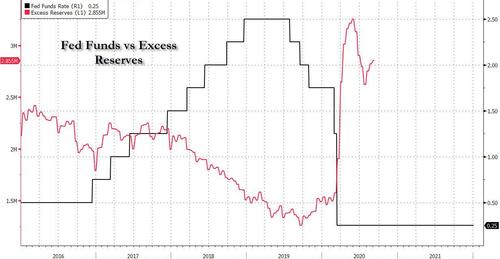
Keep a close eye on fwd OIS swaps markets for the tell on when the next rate cut cycle/QE will start.

And tied to that are two more question: while it is clear that Biden is freaking out about inflation far more than he is about the prospect of a market crash, is the president even remotely aware of what a 20%, 30% (or more) crash in the market will do to Democrats in the polls, and midterms, not to mention 2024? Something tells us the answer is no.

Last but not least is the question everyone would like answered: just how is the Fed tightening financial conditions going to ease a historic supply chain collapse which is driven by countless other factors than just excess demand sparked by Biden's stimmies.

We doubt we will find out the answer, but we also doubt that the market's latest freak out about much tighter financial conditions - including 3 rate hikes and balance sheet run off starting in 2022 - will ever come to pass. Because if it does, the only question then is how long before the Fed starts monetizing ETFs, cryptos and NFTs to preserve the $145 trillion or so in US net worth parked squarely in the hands of the 1%, the only legacy the US central bank will leave on this earth.

https://www.zerohedge.com/markets/what-spooked-markets-so-badly-todays-fed-minutes-jpmorgan-goldman-explain

Ningbo Port Activity Grinds To A Halt As China Outbreak Worsens

 After authorities found more COVID cases in Ningbo, a port city and industrial hub home to one of the world's largest ports, residents are facing a partial lockdown, and reports claim that movement of essential products has been dramatically slowed as the lockdown measures slow activity at the port.

Beijing has managed to keep reports about the situation mostly under wraps, but reports in Bloomberg and several trade journals have warned that the slowdowns at the port could have wide-ranging ramifications for international commerce.

Right now, lockdowns are affecting Xi'an and Yuzhou along with the Ningbo port, Chinese sources said. In Yuzhou, which has a population of 1.1M, authorities shut down its transport system and all but essential food stores closed overnight.

The strict lockdown measures come as Beijing braces for both the Winter Olympics and the Lunar New Year. With exactly a month to go until the Games start, foreign ministry spokesman Wang Wenbin assured reporters China had "formulated an efficient and highly effective defense system".

Part of this system will involve thousands of staff and volunteers entering a bubble on Tuesday, which will see them have no physical contact with the outside world in order to limit the spread.

Athletes and members of the press who cover the Games will also enter the bubble on arrival in China, where they will remain for the duration of their stay.

In Yuzhou, situated some some 434 miles south-west of Beijing, officials said that "to curb and quash the epidemic within the shortest amount of time is a high-priority political task" for the local government.

Some people pointed out that the CCP's lockdown measures might actually be making the situation worse: "People are swapping stuff with others in the same building, because they no longer have enough food to eat," one man who spoke with Radio Free Asia on the condition of anonymity said. 

The news outlet also reported that another man had wanted to trade a smartphone and tablet for rice, according to the BBC.

What Beijing calls its "dynamic zero COVID" strategy combines mass vaccinations with a regime of constant testing, nationwide monitoring of people's movements, temperature-taking and smartphone apps to prove individuals don't pose a threat. This hyper-vigilance has left doctors exhausted.

Perhaps this is why the activity at the Ningbo port has slowed: one trade journal covering the business of commerce said that while no COVID cases have been reported at any of the port's three container terminals, closures at warehouses and the container depot, as well as trucking disruptions, have made it difficult for manufacturers and suppliers to get their goods from the port, or to the port.

https://www.zerohedge.com/geopolitical/ningbo-port-activity-grinds-halt-china-outbreak-worsens

Health care workers struggle to quarantine or show at work amid staff shortages


  • The Centers for Disease Control and Prevention said health care workers could quarantine for less than seven days following a positive COVID-19 test if there are staffing shortages.
  • Some healthcare workers are hesitant about returning to work too soon and potentially putting themselves and patients at risk.
  • National Guardsmen have been deployed across the country to try and support severe hospital staff shortages.

As the Centers for Disease Control and Prevention (CDC) revised its quarantine recommendations for health care workers, some are struggling to exercise caution while also continuing to support their hospitals.

In late December, the CDC said health care workers that contract COVID-19 and are asymptomatic can return to work after seven days following a negative test, but that isolation period could be shortened if there are staffing shortages.

And staffing shortages are currently rampant, with more than 25 percent of hospitals in 13 states struggling with critical shortages of nurses, doctors and other medical staff, according to Forbes. One hospital in Florida was even forced to temporarily close its labor and delivery unit because so many hospital staff had contracted COVID-19, contributing to a severe staffing shortage.

Some health care workers have found themselves in a precarious position, uncomfortable with a shorter quarantine period but also well aware of the dire staffing shortages their workplace is experiencing. 

Melody Butler, a registered nurse in New York, told NBC News that after testing positive for COVID-19 and spending eight days at home, she returned to work still feeling fatigued. Her hospital didn’t force her to come back to work right away but she said, “I know how tight staffing is right now. I’m very well aware of how many people are out sick.”

Butler emphasized that the new policy allowing health care workers to shorten isolation periods following a COVID-19 infection will pressure health care workers to come back to work sooner than they’re physically ready to.

“It’s really important that they do listen to their body and make sure they are meeting the criteria to return to work,” Butler told NBC.

Franklin Rosenblat is an infectious disease doctor in Michigan who has been fielding concerns and questions from hospital staff regarding quarantine periods. He told NBC, “I think the main fear is always for our patients. Nurses especially have a tight bond with their patients, and they want to make sure that they’re not putting the patients at risk, so that anxiety is really something that I have to respect because they have a patient’s best interest foremost in their mind.”

Back in September of last year, even before omicron was declared a new variant of concern, the American Nurses Association wrote a letter to Health and Human Services Secretary Xavier Becerra calling for the White House to acknowledge and take concrete action to address the crisis-level nurse staffing shortage.

“The nation’s health care delivery systems are overwhelmed and nurses are tired and frustrated as this persistent pandemic rages on with no end in sight,” the group wrote.

That’s the same situation currently facing the health care system now, as it’s flooded with a record number of COVID-19 patients, with Johns Hopkins University of Medicine recording over 1 million new cases in the U.S. just this week. 

Though the federal government has deployed the National Guard across the country to compensate for health care worker shortages, like in Ohio where more than one thousand National Guardsmen have been sent to hospitals crushed by staffing shortages.

However, the future of the health care industry isn’t looking up either, with Mercer, a national consulting firm, estimating that by 2025 the demand for health care workers will outpace supply. The group says home health aides, nursing assistants, medical and lab technicians and nurse practitioners will all face shortages in the thousands. 

https://thehill.com/changing-america/well-being/prevention-cures/588470-health-care-workers-struggling-to-quarantine-or