Target to $94 from $114
Thursday, March 3, 2022

Biogen Has An $8 Billion Alzheimer's Opportunity — Will It Materialize?
Biogen stock popped Thursday after an analyst suggested the biotech company could reap $8 billion in sales of its Alzheimer's treatments — assuming everything lines up properly.
As it stands, the Centers for Medicare and Medicaid Services will only cover the cost of Biogen's (BIIB) drug, Aduhelm, for patients enrolled in clinical studies. But regulators will issue their final decision in April and could broaden coverage. Further, Biogen is working on another Alzheimer's drug called lecanemab.
RBC Capital Markets analyst Brian Abrahams sees an $8 billion peak opportunity if the CMS decision comes out in Aduhelm's favor and if Biogen succeeds with lecanemab. Both drugs target beta amyloid, an abnormal protein that builds up in the brains of Alzheimer's patients. He upgraded Biogen stock.
"Our recent doctor survey work suggests that despite all the negative publicity, Alzheimer's physicians would have sufficient appetite to prescribe beta-amyloid antibodies to support multibillion-dollar sales," he said in a report to clients.
In morning trading on today's stock market, Biogen stock rose 2.2% near 212.40.
Biogen Stock: Upside With Alzheimer's Progress
Aduhelm is approved for patients with mild cognitive impairment due to Alzheimer's disease. Roughly 17%-28% of Alzheimer's patients are eligible for treatment based on these criteria, Abrahams says.
Based on a physician survey, he estimates that 10% of treated patients would receive Aduhelm if regulators decide to reimburse the cost of treatment for patients not enrolled in clinical studies. That could help reinvigorate Biogen stock.
He acknowledged the uncertainty of targeting beta amyloid in Alzheimer's treatment. Aduhelm is the first drug that changes an underlying mechanism of Alzheimer's disease. It removes beta amyloid. But it's still not clear whether that leads to a cognitive benefit. Biogen is still running tests.
But the survey suggests doctors are open to trying it. Abrahams upgraded Biogen stock to an outperform rating.
"This indicates if there were any meaningful near-term (National Coverage Determination) loosening, and/or if the lecanemab Phase 3 (study) reads out positively in the third quarter, doctors would be open to using Biogen's antibodies," he said.
Shares Remain Below Moving Averages
Abrahams also raised his price target on Biogen stock to 248 from 227.
Shares have fallen about 50% after Aduhelm received Food and Drug Administration approval in June.
"At current levels less than 210, shares appear to be baking in less and less for Alzheimer's which should also limit downside risk on additional near-term developments and improve the overall setup," he said.
Biogen still jumped Thursday, but shares remained below their key moving averages, according to MarketSmith.com.
He suggests Biogen could see just 11% downside in a worst-case scenario — regulators retain their strict ruling on Aduhelm coverage and lecanemab flops in testing. He also expects "some value-creating business development/restructuring to ensue."
Multiple Truck Convoys Converge In Indiana For Large Rally En Route To DC
by Enrico Trigoso and Mimi Nguyen Ly via The Epoch Times,
Several trucker convoys comprising thousands of vehicles converged in Monrovia, Indiana, and held a rally late on Wednesday before continuing their trip toward Washington to protest against COVID-19 restrictions and mandates.
The People’s Convoy set off from California on Feb. 23. It passed through multiple states including Arizona, Texas, Oklahoma, and Missouri, before arriving in Indiana. The convoy has two more stops to go—Ohio and Maryland—before Washington, where they hope to arrive around March 5.
The group was inspired by trucker convoys in Canada that made global news headlines protesting against COVID-19 restrictions.
It’s hard to quantify exactly how many people are directly participating in The People’s Convoy, not to mention the many thousands more who’ve gathered along the roads and on the overpasses across the country to cheer them on.
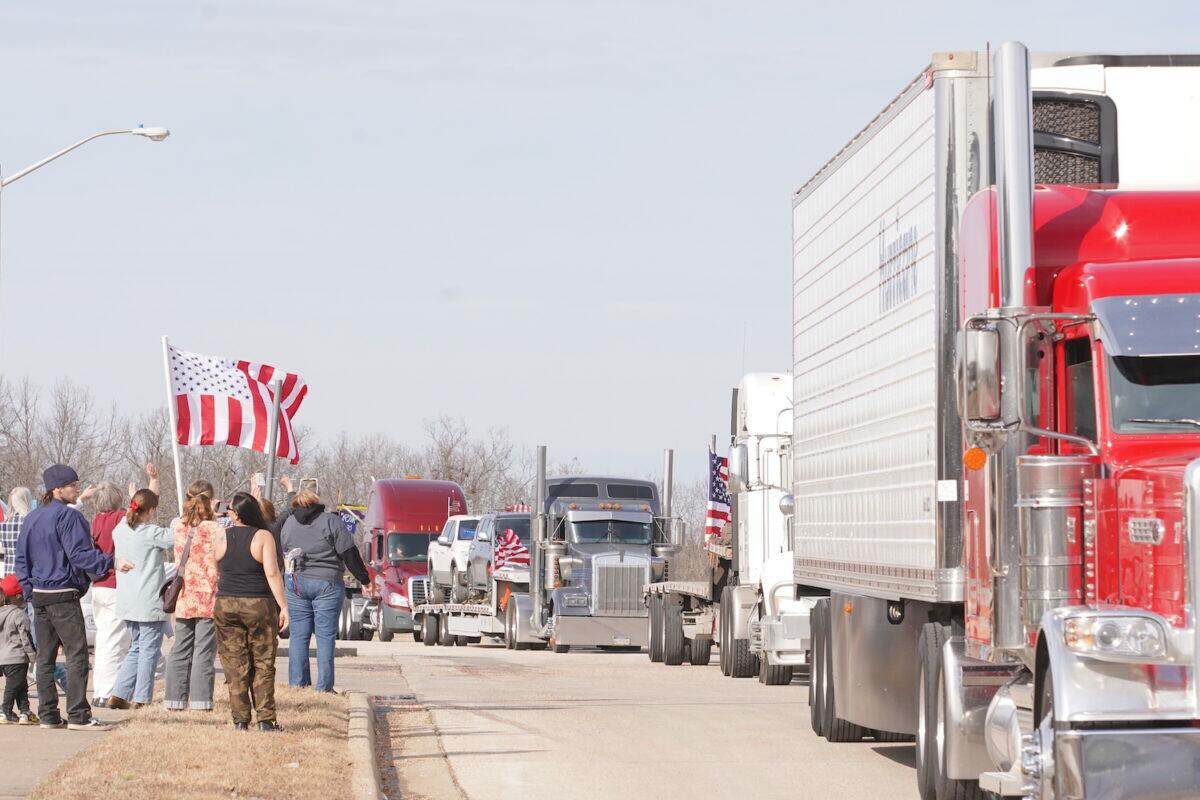
Trucks of The People’s Convoy entering a highway in Missouri, on Feb. 28, 2022. (Enrico Trigoso/The Epoch Times)

Crowds gather on and around an overpass in support of the trucker convoys passing through the area, in Missouri, on Feb. 28, 2022. (Enrico Trigoso/The Epoch Times)
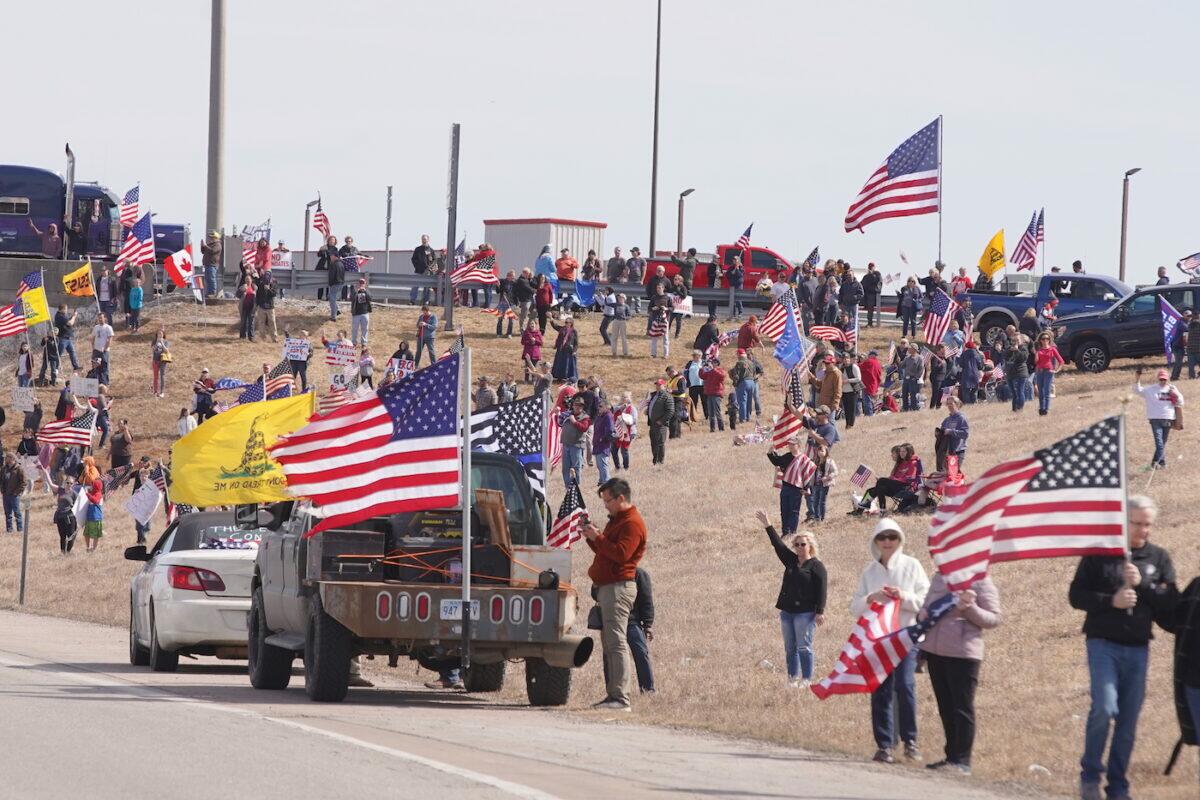
Crowds gather in support of a trucker convoy in Missouri, on Feb. 28, 2022. (Enrico Trigoso/The Epoch Times)
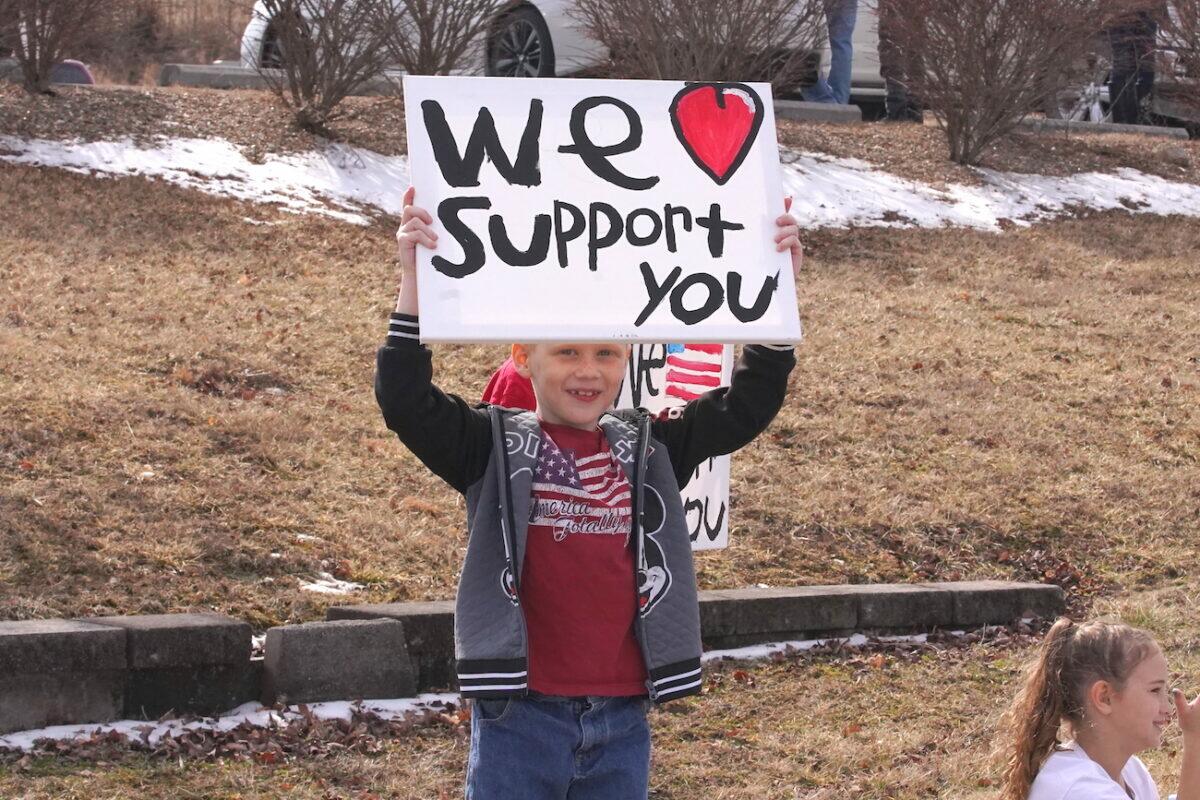
A child holds a sign in support of The People’s Convoy, a group of trucks and vehicles, in Missouri, on Feb. 28, 2022. (Enrico Trigoso/The Epoch Times)

A dog looks out the window from a truck that joined The People’s Convoy on a trip toward Washington, on Feb. 28, 2022. (Enrico Trigoso/The Epoch Times)
Vehicles and trucks have also joined the convoy along the way. Some are headed toward Washington, while others join the journey for dozens to hundreds of miles before dropping away, one of the convoy’s organizers previously told The Epoch Times.
Meanwhile, hundreds to thousands of cars and trucks that come behind and in front of the convoy, and have honked in support, have often been mistaken as being direct participants of the group.
The convoy grew in size to about 80 trucks and more than 200 other vehicles when it passed through Cuba, Missouri, on Monday, Feb. 28.

Trucks gather in Cuba, Missouri, on Feb. 28, 2022. (Enrico Trigoso/The Epoch Times)
By Tuesday and Wednesday, in Monrovia, Indiana, where other U.S. truck convoys converged, there were over 2,000 vehicles with over a hundred trucks in the area. It’s unclear how many vehicles will ultimately be riding to the nation’s capital.
Indiana Attorney General Todd Rokita and Mark McCloskey, who is running as a Republican in the Missouri U.S. Senate race, were in attendance at the rally, held at Ted Everett Farm center late Wednesday.
“I’m very proud to be here amongst fellow Hoosiers and Americans who care about their country,” Rokita told The Epoch Times. “I was humbled to offer them encouragement this evening but they gave me back much more inspiration and motivation.”
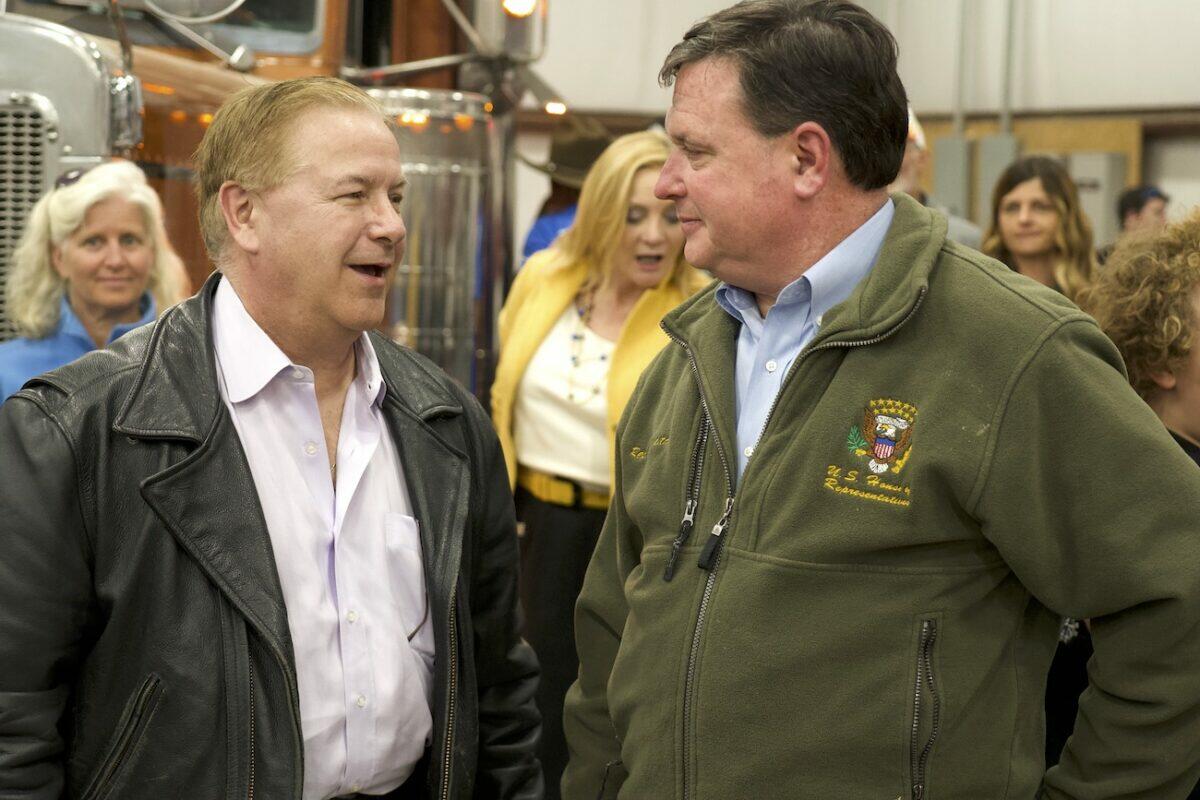
U.S. Senate candidate Mark McCloskey (L) and Indiana Attorney General Todd Rokita (R) attend a rally in Monrovia, Ind., on March 2, 2022. (Enrico Trigoso/The Epoch Times)
McCloskey, a Missouri-based lawyer, made national headlines in 2020 for having wielded his gun in self-defense while facing a group of protesters that marched into his gated neighborhood. He told The Epoch Times on Wednesday, “The people of America have woken up, we’re going to stand up and we’re not going to permit it.”
“I can tell you one thing, you look at this crowd, you look at the highways coming here, you look at the overpasses, and [you can say that] the socialists will never complete their takeover of the United States,” he said.
The crowd exceeded the capacity of the indoor venue, which held several hundreds of people. Hundreds more were gathered outside.
“The American people are waking up and they’re marching east,” Brian Brase, one of the convoy organizers, told The Epoch Times late Wednesday.
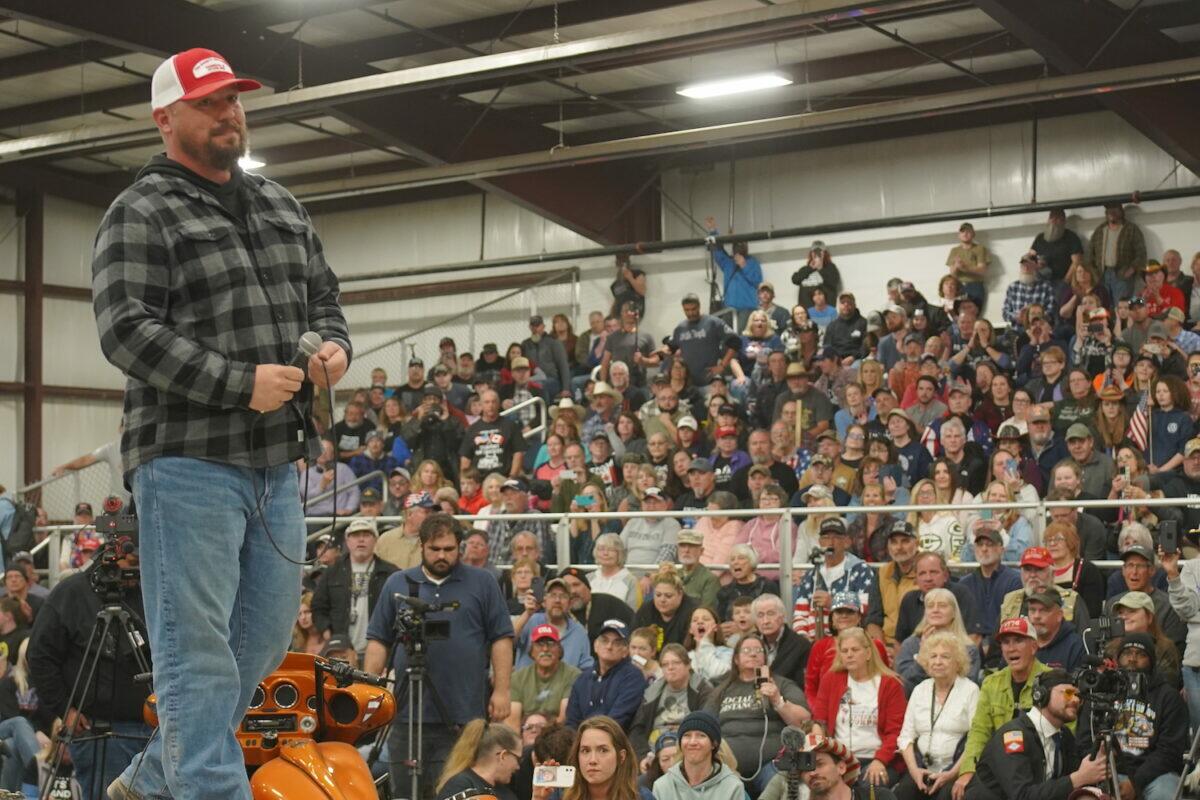
Brian Brase, an organizer of The People’s Convoy, speaks on stage at a rally at Ted Everett Farm Center in Monrovia, Ind., on March 2, 2022. (Enrico Trigoso/The Epoch Times)
He told attendees, “You can stand up to a government that wants to violate your Constitutional rights … and you should. At this point, this is your civic duty to stand up, it is the civic duty of all Americans, of all citizens of the world, to stand up.”
“Freedom isn’t free … Freedom takes sacrifice,” he said, adding that people are sacrificing their incomes and are spending time away from their loved ones to participate in the convoy.
“I’m begging that every truck driver around the world, stand up now,” he said in closing, adding later, “Now is your time to stand up and send a message to your world leaders and your governments that they work for us.”
Dr. Ryan Cole, a pathologist who owns a medical lab in Idaho, speaking as part of the Front Line COVID-19 Critical Care Alliance (FLCCC), told the crowd, “It’s up to us to take care of our own health, not the government.”
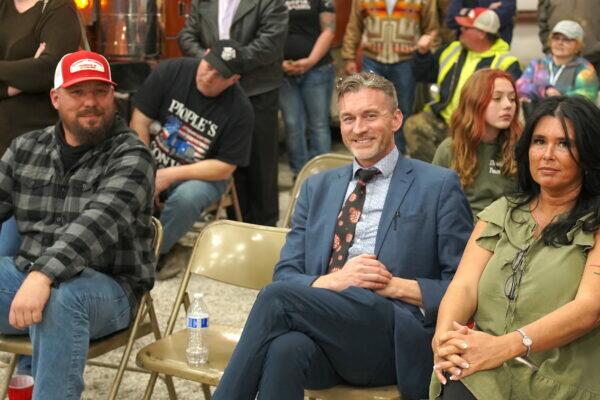
Dr. Ryan Cole (C) sits with convoy organizers Brian Brase (L) and Maureen Steele (R) at an evening rally in support of The People’s Convoy in Monrovia, Ind., on March 2, 2022. (Enrico Trigoso/The Epoch Times)
“This is a government that has overstepped its bounds,” he said. “These are health care agencies that have overstepped their bounds. It is time to restore freedom to this great land. There is no medical emergency anymore. If they tell you that, they are lying.”
The federal government’s COVID-19 pandemic emergency powers have been in place since March 2020. President Joe Biden said on Feb. 18 he was extending the emergency powers beyond March 1.
Cole told the rally late Wednesday, “Today we’re all truckers … keep on trucking and let’s stand in freedom and unity with peace, firmness, and strong resolve. This is about our children … we will never let this happen to us again.”
Leigh Dundas, another organizer, told The Epoch Times that the recent Russian incursion into Ukraine has meant that U.S. convoys have received less coverage, if any, in the press.
“Everyone’s saying ‘oh it’s so unfortunate, the truckers can’t catch a break in the news cycle because of Ukraine and Russia.’ I’m sure Ukraine and Russia have issues but the timing is interesting,” she noted.
“If I were this administration and I’d watched what had happened in Canada … The last thing I would have wanted is to have my back against the wall down here south of the border. I think any distraction is the name of the game. But it’s not working. … the people have spoken, the people have had it.”

Leigh Dundas, an organizer of The People’s Convoy, speaks on stage at a rally at Ted Everett Farm Center in Monrovia, Ind., on March 2, 2022. (Enrico Trigoso/The Epoch Times)
She told the audience on the night that the convoy “will not be going in downtown D.C. for reasons that you all know.”
“I don’t need to spell them out, all I need to say is [the truckers] need to stay safe, and we have seen what was going on in the last year, and that is all we need to know about that.”
Authorities have reinstalled fencing around the U.S. Capitol and have called for “extra security” amongst law enforcement agencies in the area, in anticipation of truck convoys arriving in Washington. Fencing had been in place following the Jan. 6, 2021, breach of the U.S. Capitol and was removed in July 2021.
Dundas said that The People’s Convoy has been “a 100 percent peaceful, safe, awesome, transcontinental journey” and thanked The Unity Project and the American Foundation for Civil Liberties and Freedom for their help in launching the movement.
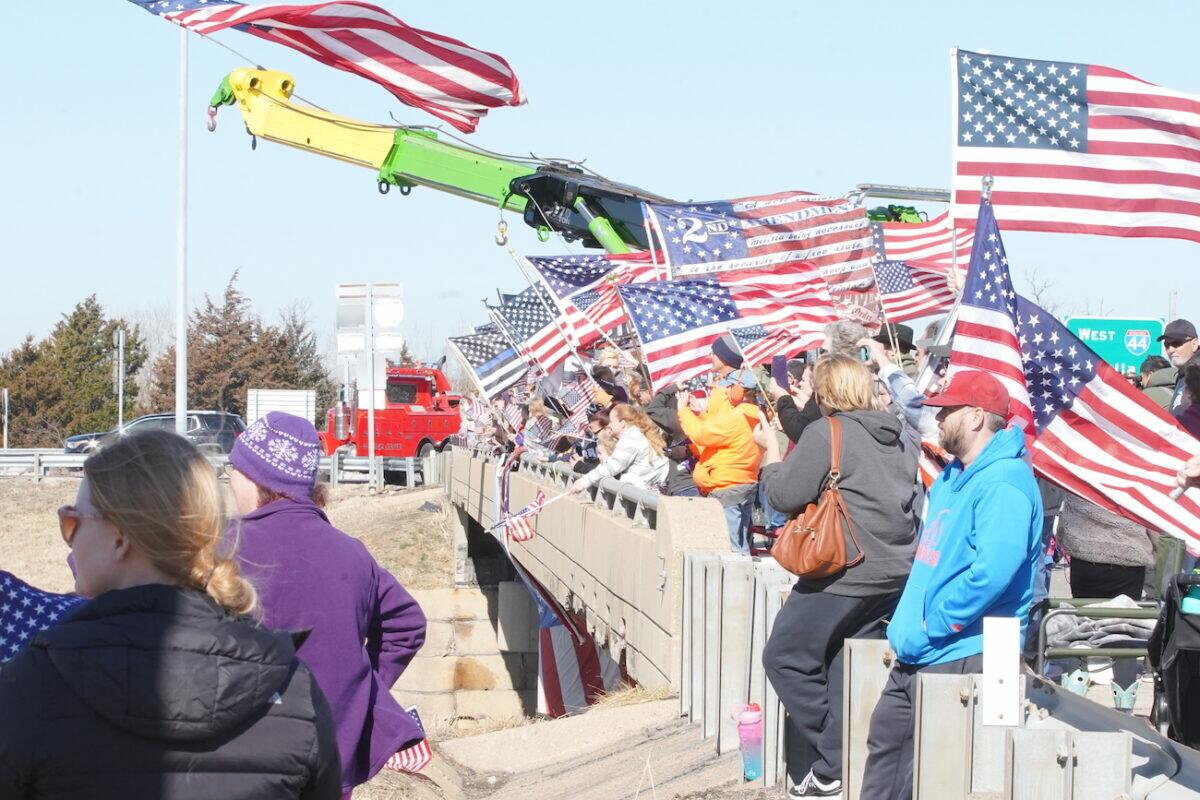
People gather at an overpass in St. Claire, Missouri, in support of The People’s Convoy headed to Washington, on March 1, 2022. (Enrico Trigoso/The Epoch Times)
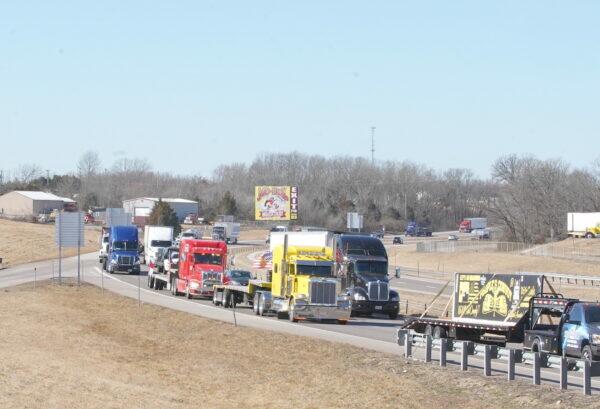
Trucks proceed on the road as part of the People’s Convoy in St. Claire, Missouri, on March 1, 2022. (Enrico Trigoso/The Epoch Times)
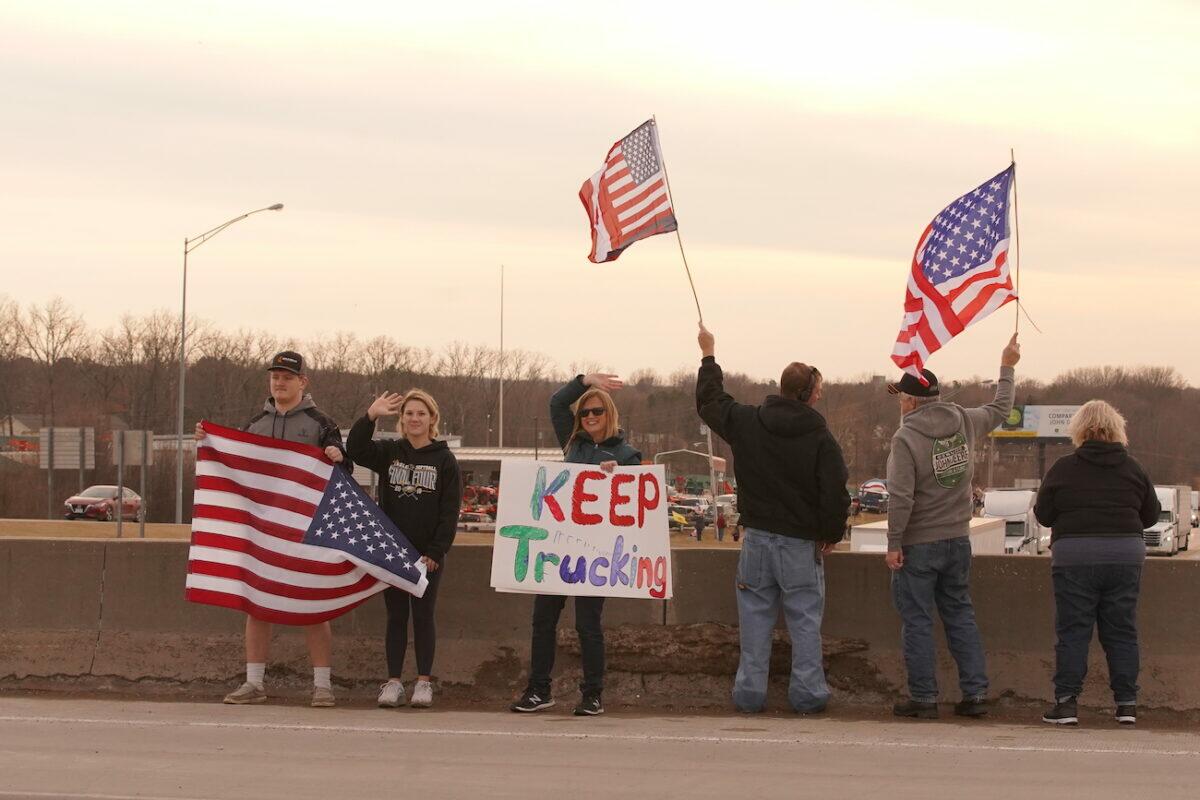
People hold signs at an overpass in support of The People’s Convoy, in Missouri, on Feb. 28, 2022. (Enrico Trigoso/The Epoch Times)
“We have working dogs, we have security, we have huge logistics teams, we have former naval commanders—not because we don’t trust the truckers to be safe, but we want to ensure that they are safe, because they are leading the charge in restoring freedom to America,” she told the crowd, to loud cheers and applause.

Chance Heiner, an Army veteran and participant of The People’s Convoy, in Cuba, Missouri, on Feb. 28, 2022. (Enrico Trigoso/The Epoch Times)
Chance Heiner, an army veteran, told The Epoch Times on Feb. 28, when the convoy was in Cuba, Missouri, “We’ve got to exhaust our last peaceful means. This is what we gotta do. We’re peaceful and that’s how we gotta be.
“Right now we’re peaceful, and we’ve been hoping that the government will give us back our rights.
“And well, the Second Amendment’s there for a reason,” he added. “But we’re a peaceful movement and we’re hoping the government doesn’t push the people to that point.”
https://www.zerohedge.com/political/multiple-truck-convoys-converge-indiana-large-rally-en-route-dc
Lilly JAK inhibitor cuts covid death risk
- According to a British study, Eli Lilly And Co (Get Free Alerts for LLY) and Incyte Corporation's (Get Free Alerts for INCY) Olumiant (baricitinib) reduced the risk of death in hospitalized COVID-19 patients by 13%.
- According to a Reuters report, more than 8,000 patients were administered baricitinib in addition to standard of care in the RECOVERY Trial.
- Results showed that 546 patients in the standard of care group died within 28 days, compared to 513 patients in the baricitinib group who died where they were also given a corticosteroid like dexamethasone, tocilizumab, or remdesivir.
- "This result confirms and extends earlier findings, providing greater certainty that baricitinib is beneficial and new data to guide the treatment of COVID-19 patients with a combination of drugs to dampen the immune response," said Peter Horby, Oxford professor and joint chief investigator.
- In the RECOVERY trial, baricitinib also increased the chances of patients being discharged alive within 28 days and reduced the risk of their condition worsening, scientists said.
Nirsevimab data leave the door open for Pfizer
Astrazeneca and Sanofi hope that their antibody nirsevimab could become the first product approved for the prevention of respiratory syncytial virus in all infants, not just those at a high risk of complications. Full data from the Melody trial, published in the New England Journal of Medicine today, suggest that the project could well get the nod – but uptake might be a different story.
This is because nirsevimab was shown to prevent medically attended RSV compared with placebo, but had no impact on hospitalisation rates, and the latter is surely the main measure of interest for healthcare providers. The expense of giving an antibody with limited benefit to all infants looks hard to justify.
Results were also published today on nirsevimab in infants at high risk of severe RSV infection. The phase 2/3 Medley trial found similar rates of adverse events with nirsevimab and the currently approved high-risk RSV antibody Synagis.
Nirsevimab, a long-acting antibody, could have a convenience advantage over the incumbent: the former is given via a single dose, while Synagis has a complicated treatment regimen involving five monthly doses.
Astra and Sanofi could also gain an edge in the high-risk space if they compete on cost. Astra previously told Evaluate Vantage that if nirsevimab was approved its price tag would be “very competitive” (Astra and Sanofi’s RSV jab takes a step towards market, April 26, 2021).
However, the broad infant population is the big prize, and here vaccines, which might be cheaper, could soon be coming. Glaxosmithkline recently halted enrolment into studies of its maternal RSV candidate – an upgrade from an earlier “pause” – but Pfizer’s RSVpreF, which now has breakthrough therapy status, is set to yield data from a phase 3 trial in pregnant women this half.
| Late-stage infant RSV pipeline | |||
|---|---|---|---|
| Project | Company | Description | Details |
| Nirsevimab (SP0232) | Sanofi/ Astrazeneca | Fusion antibody | Filed in EU & accepted under accelerated assessment |
| RSVpreF (PF-06928316) | Pfizer | Protein subunit vaccine | Data from maternal protection trial due H1 2022 |
| RSVPreF3 (GSK3888550A) | Glaxosmithkline | Protein subunit vaccine, unadjuvanted | Trials halted; Grace maternal protection trial was due to read out H2 2022 |
| Clesrovimab (MK-1654) | Merck & Co | Fusion antibody | MK-1654-007 in high-risk infants; ph2/3 MK-1654-004 in healthy infants, data due 2022* |
| Rilematovir (JNJ-53718678) | Johnson & Johnson | Oral RSV F-protein fusion inhibitor | Daisy trial in hospitalised children started late 2021 |
| *Leerink estimate. Source: Evaluate Pharma, clinicaltrials.gov & company statements. | |||
Virtually all children get an RSV infection before the age of two, but most of the time this merely causes a mild illness. RSV is more dangerous in premature infants and those with weakened immune systems or some pre-existing diseases.
The economic case for broad use of a preventative antibody always looked on shaky ground given the low risk of hospitalisation or death in the healthy infant population. And the results from Melody merely reinforce these concerns.
The trial, in healthy late preterm and term infants, met its primary endpoint, the incidence of medically attended RSV, with nirsevimab showing 75% efficacy versus placebo. The rate of hospitalisations was a secondary endpoint, and here there was no statistically significant difference with nirsevimab versus placebo.
Astra pointed to a prespecified pooled analysis of Melody and Medley, which did find a benefit on hospitalisations: there were nine admissions with nirsevimab versus 21 with placebo, giving efficacy of 77% and a p value of less than 0.001.
Regulatory submissions have already begun, and approvals look likely to follow, but there is a bigger question mark around nirsevimab’s commercial prospects. Sellside consensus compiled by Evaluate Pharma currently forecasts sales of $700m in 2026.
Pfizer’s maternal RSV vaccine now has a bar to clear.
| Data from the Melody trial of nirsevimab in healthy late preterm & term infants | |||
|---|---|---|---|
| Nirsevimab | Placebo | Efficacy | |
| Cases of medically-attended RSV | 12 | 25 | 74.5%, p<0.001 |
| Hospitalisation for RSV | 6 | 8 | 62.1%, p=0.07 |
| Serious adverse events | 6.8% | 7.3% | - |
| Source: NEJM. https://www.evaluate.com/vantage/articles/news/trial-results/nirsevimab-data-leave-door-open-pfizer | |||
Too early for China to seek 'coexistence' with COVID
It is still too early for China to consider easing its stringent coronavirus restrictions, with the highly infectious Omicron strain still capable of causing large numbers of deaths, said Liang Wannian, head of an expert group on COVID-19 prevention.
Describing China's so-called 'dynamic clearance' strategy as a "magic weapon", Liang said in an interview with China's state broadcaster CCTV on Wednesday that "coexisting" with the virus was still not an option. He said Omicron was still significantly more deadly than influenza and capable of putting great strain on the country's medical resources.
"In these circumstances, if we relax just a little, it is very probable that the likelihood of a single individual getting severe symptoms or dying will be low, but multiplied by 1.4 billion, it will be a massive number," he said.
Chinese medical experts have been discussing openly the effectiveness and economic impact of its 'dynamic clearance' policies, which aim to shut off transmission routes as soon as new cases are detected.
While foreign analysts suggest the 'zero-COVID' approach could undermine economic growth this year, experts in China say that while lockdowns disrupt individual communities or cities, they also allow the rest of the economy to continue without the risk of further outbreaks.
In comments published on the Twitter-like Weibo platform on Monday, Zeng Guang, former chief epidemiologist with the Chinese Center for Disease Control and Prevention, said 'dynamic clearance' policies would not be in place forever.
China would look for a "flexible and controllable opening-up", he said, though the current risks remained considerable.
"Not far into the future, at an appropriate point in time, a Chinese-style roadmap for coexisting with the virus will present itself," he said.
Illumina remedies on Grail bid ‘yet to convince’ Eu antitrust regulators
U.S. life sciences company Illumina’s offer to cut prices and allow rivals continued access to its technologies has ‘yet to convince’ EU antitrust regulators scrutinising its $8 billion cash-and-stock bid for Grail, people familiar with the matter said.
The European Commission opened a full-scale investigation into the deal in July last year and warned that it may hurt innovation and competition in the market for cancer detection tests based on sequencing technologies.
Subscribe to:
Posts (Atom)