Search This Blog

Thursday, January 26, 2023

Alcohol flush warns of deadly vascular disease: Stanford study

 It’s sobering news for the rosy-cheeked drinker.

If you’ve knocked back a few and feel a warm flush creep up your face and ears, you’re not alone.

While often thought of as annoying rather than dangerous, alcohol flush may be a sign of something more serious brewing beneath the surface, a new study suggests.

Roughly 8% of the global population experiences the drunken sensation, mostly in East and Southeast Asian demographics, which has been previously dubbed “Asian glow.” But it’s more than just a nuisance on a night out — the flush is caused by an inherited, genetic hiccup. Those with the gene variant ALDH2*2 are deficient in the ALDH2 enzyme, which is responsible for metabolizing alcohol.

Researchers from Stanford Medicine analyzed what exactly occurs when someone experiences alcohol flushing, making the startling discovery that it can be indicative of life-threatening ailments.

Girls drinking

Even just one drink can wreak havoc, experts say.
Getty Images/HEX

Published in the Science Translational Medicine journal, the research looked at mice that had the same genetic variant.

“We found mice carrying this variant have impaired vascular dilatation,” co-author Joseph Wu, director of the Stanford Cardiovascular Institute, told the Daily Beast. “When treated with alcohol, mice with this variant demonstrated enlarged vascular size, increased vascular thickness, and impaired vascular contraction and relaxation.”

Researchers concluded that there was an inflammatory response in the blood vessels, which restricted blood flow and has the potential to result in coronary artery disease.

Men drinking
But even those who don’t experience the boozy blush are at risk of health consequences.
Getty Images

Then, they turned their attention to humans who volunteered to participate in the study— people who experienced impaired vascular function even after just “one standard drink.”

But all hope is not lost, Wu emphasized. A diabetes drug called empagliflozin has been shown to reduce the symptoms in the human cells cultured in their lab. The medicine could be a preventative solution for those who are defined as “high risk” and “drink excessively.”

While the drug could prevent the life-threatening effects of alcohol, it won’t halt the booze blush from creeping into your cheeks.

But even those without the blushing alcohol glow aren’t safe from the dangers of drinking, studies have shown. While the flush has been linked to certain cancers, consuming just two drinks per week could be detrimental.

“Research shows that no amount or kind of alcohol is good for your health,” authors from the Canadian Centre on Substance Use and Addiction declared earlier this month on the agency’s new guidance. “Drinking alcohol, even a small amount, is damaging to everyone, regardless of age, sex, gender, ethnicity, tolerance for alcohol or lifestyle.”

While it’s great news for Dry January proponents who might otherwise feel some FOMO on nights out, the World Health Organization echoed a similar sentiment denouncing the use of the “Group 1 carcinogen.” The global agency called alcohol a “toxic, psychoactive and dependence-producing substance,” stating that no amount of alcohol can be healthy.

https://nypost.com/2023/01/26/alcohol-flush-linked-to-deadly-disease-stanford-study/

Why autism rates have skyrocketed in the NYC metro area

 Autism rates in the Big Apple have ballooned at a baffling rate.

Instances of Autism Spectrum Disorder have tripled in the New York-New Jersey metro area — from 1% of the population in 2000 to 3% in 2016.

That’s largely due to a growing number of diagnoses of children without intellectual disabilities, said researchers at Rutgers, in a new study published Thursday in the journal Pediatrics.

They identified 4,661 8-year-olds with ASD in the metro area. The majority did not have intellectual disabilities (59.3%) and were therefore less likely to be previously identified. 

ASD is a developmental disorder that impacts an individual verbally, behaviorally and socially. Doctors make a diagnosis by looking at a child’s developmental history and behavior, according to the Centers for Disease Control and Prevention. However, since there is no exact medical test, determining ASD can be challenging. Some do not receive a diagnosis until they are adolescents or even adults.

While the ability to detect and diagnose ASD has increased, environmental factors could also be contributing to the uptick in non-intellectually disabled kids getting diagnosed with autism, researchers suggested.
Instances of Autism Spectrum Disorder have tripled in the New York-New Jersey metro area — from 1%f the population in 2000 to 3% in 2016, the study found.
Getty Images

But earlier, more accurate diagnoses don’t completely explain the upwards trend, which was based on estimates from the CDC.

Experts said that waiting too long to have kids could be partly responsible for the rise.

“Known environmental factors, such as parent age, are likely contributing. Many parents in the metro area wait to have children at older ages,” Josephine Shenouda, an adjunct professor at Rutgers and one of the lead authors of the study, told The Post.

New research from Rutgers looks at the rising rates of autism in NYC and the surrounding region.
Getty Images/iStockphoto

“There are likely other yet-to-be known environmental [and] biological causes that require further investigations,” she added.

According to the CDC, the rate of women having their first child after 40 more than doubled between 1990 and 2012. In New York, the rate went up 57% between 2000 and 2012.

Boy learns in classroom.
Autism Spectrum Disorder is a developmental disorder that impacts an individual verbally, behaviorally and socially. Research suggests that moms over 40 have a 51% higher risk of having a child with autism.
Getty Images
"Known environmental factors, such as parent age, are likely contributing. Many parents in the metro area wait to have children at older ages,"  said one of the lead authors of the study.
“Known environmental factors, such as parent age, are likely contributing. Many parents in the metro area wait to have children at older ages,” said one of the lead authors of the study.
Getty Images

Meanwhile, data from the U.S. Census Bureau released last year found that the median age of new moms is now 30 — the highest on record.

Previous research suggests that moms over 40 have a 51% higher risk of having a child with autism than mothers ages 25 to 29, and a 77% higher risk than moms under age 25.

The Rutgers study also found that black children are likely under-diagnosed with autism — particularly if they don’t have intellectual disabilities. While the racial gap in autism diagnoses is diminishing — partially explaining the rise in autism cases overall — the actual numbers may be even higher in this demographic.

“Historically, children residing in less affluent areas, and black and Hispanic children, had lower rates of autism,” Shenouda said. “Today, we see [fewer] disparities in identification among those groups, but [they] still remain, and going forward will likely contribute to continued increases in autism as we address those disparities.”

https://nypost.com/2023/01/26/why-autism-rates-have-skyrocketed-in-the-nyc-metro-area-study/

25 Charged In Fake Nursing Diploma Operation After Multi-State Law Enforcement Action

 by Katabella Roberts via The Epoch Times (emphasis ours),

Around 25 people have been charged for their roles in a huge coordinated scheme to sell false and fraudulent nursing degree diplomas and transcripts to aspiring nurses, the Department of Health and Human Services’s Office of Inspector General (HHS-OIG) announced on Jan. 25.

HHS-OIG and its law enforcement partners conducted a “multi-state coordinated law enforcement action” dubbed “Operation Nightingale” using search warrants across Delaware, New York, New Jersey, Texas, and Florida, to arrest about 25 individuals who were allegedly part of the fraud, according to a press release.

The scheme involved the individuals selling fake and fraudulent nursing degree diplomas and transcripts obtained from accredited Florida-based nursing schools to aspiring registered nurses, licensed nurse practitioners, and vocational nurse candidates.

According to officials, those who acquired the fake nursing credentials used them to qualify to sit for the national nursing board exam that is needed to obtain a nursing license in the United States.

After passing the exam, the individuals were able to obtain the licenses and take nursing jobs in various states, officials said.

The scheme involved the distribution of more than 7,600 fake nursing diplomas and transcripts by three South Florida-based nursing schools: Siena College in Broward County, Palm Beach School of Nursing in Palm Beach County, and Sacred Heart International Institute in Broward County, HHS-OIG said.

The three schools are now closed.

Scheme Is ‘Public Safety Concern’

Each of the defendants allegedly involved in the fraud scheme faces up to 20 years in prison if found guilty, according to a separate statement issued by the Department of Justice.

DOJ prosecutors said that the charges “speak to the purpose of a nursing license which is to protect the public from harm by setting minimum qualifications and competencies,” adding that the fake nursing diplomas and transcripts allowed aspiring nurses to take “employment shortcuts.”

“Not only is this a public safety concern, it also tarnishes the reputation of nurses who actually complete the demanding clinical and course work required to obtain their professional licenses and employment,” said U.S. Attorney for the Southern District of Florida Markenzy Lapointe.

He added that “a fraud scheme like this erodes public trust in our health care system.”

Three individuals were charged with conspiring to commit and committing wire fraud at Siena College. Prosecutors allege that the three arranged with the manager of the college, Eugene Sanon, to create and distribute the false diplomas and transcripts, making it seem as though the individuals who received them had completed all the necessary courses and clinical experience needed to obtain the diplomas.

“In fact, the aspiring nurses never completed the necessary courses and clinical,” prosecutors said.

Sanon was charged by information with wire fraud conspiracy.

Fake Nurse Diplomas Sold for Up to $17,000

At Palm Beach School of Nursing, prosecutors charged 14 individuals with conspiring to commit and committing wire fraud, alleging that they arranged with the school’s owner, Johanah Napoleon, and four school employees to make and hand out the fake diplomas and transcripts to aspiring nurses.

Napoleon was previously charged by information and has pleaded guilty to conspiring to commit health care fraud and wire fraud, according to prosecutors.

Elsewhere at Sacred Heart International Institute, six individuals were given the same charges after prosecutors claimed that they organized with Charles Etienne, Sacred Heart’s owner, to sell the fake documents.

Defendants in the scheme allegedly charged individuals between $10,000 for a licensed practical nurse degree and $17,000 for a registered nurse diploma, the Miami Herald reported.

https://www.zerohedge.com/political/25-people-charged-fake-nursing-diploma-operation-after-multi-state-law-enforcement-action

Not Seeing Clearly

 The Department of Veterans Affairs is the federal government’s second-largest department. As of 2021, it operated approximately 1,600 health-care facilities, 144 medical centers, and 1,232 outpatient sites, of varying complexity. The VA has long been plagued by a wide spectrum of problems, including long delays in scheduling appointments, substandard care, and years of trying to get a $10 billion electronic system to work effectively.

As a veteran myself (I have never received medical care through the VA, though I did numerous medical school clinical rotations at a VA hospital), I know that veterans deserve better. And yet, the VA seems to be committed to a change in policy that would further degrade the quality of their care—specifically, by allowing underqualified practitioners to perform laser eye surgery.

Last September, the VA modified its eye-care guidelines for treatment from community providers by letting optometrists, who are neither medical doctors nor surgeons, perform some surgical procedures. Without soliciting input from the public or medical community, it removed language from the Community Care guideline, which had ensured that “only ophthalmologists can perform invasive procedures, including injections, lasers and eye surgery.” This change would permit optometrists to perform surgical procedures such as laser trabeculoplasty—an operation on the eye to treat glaucoma—rather than restricting them to ophthalmologists (who are highly trained, experienced, qualified surgeons), as had been the policy. The change would be felt immediately in a small number of states that already allow optometrists to perform laser surgery. But the VA is considering a broader policy change that would make it possible for optometrists in all VA facilities to perform these procedures.

The differences in the amount of training and the scope of competence between optometrists and ophthalmologists are vast. Ophthalmologists log over 17,000 hours of clinical experience in general medicine, surgery, and emergency management during medical school and specialized postgraduate training. Throughout their medical training, they must complete a minimum of 3,000 patient visits to ensure that they cultivate the expertise needed to diagnose and treat a wide variety of eye conditions. Further, they are required to take Continuing Medical Education courses to retain their board certification, so typically keep up with new developments.

By contrast, optometry is a four-year degree program focusing on primary eye care—providing routine eye exams and vision tests, prescribing and fitting eyeglasses and contact lenses, and monitoring for eye conditions related to diseases such as diabetes. Learning, and practicing how to perform, surgical procedures safely with lasers is a minimal part of the curriculum.

Why would the VA make such a dubious change? It claims that it wants to provide easier access to veterans needing trabeculectomies, but there are no documented shortages of ophthalmologists to offer these services. Moreover, laser eye surgery for glaucoma is not an emergency and can be done on an outpatient basis, so vets should be able to find an ophthalmologist virtually anywhere in the country.

Entrusting eye surgery to an optometrist is like letting the technician who changes oil at the local drive-through Oil Pal do a tune-up on a $200,000 Lamborghini. The VA should reverse this unwise decision—and if it refuses, the White House and Congress should intervene.

Inflation Starves America Of Nutrition: Golden/TIPP

 It is a new year, but some concerns from the past year continue to haunt Americans. Among their chief concerns is the condition of the economy. With the country in the grip of prolonged inflation, prices of essential goods have remained high for months. Though food and fuel prices have eased off from their respective record peaks, the inflated rates still force most Americans to make tough decisions regarding their eating habits.

The TIPP Poll conducted in early January found that almost half, 44%, of those who took part in the survey listed “food” as one of the top three concerns facing Americans this month. Only inflation scored higher, and gasoline prices took the third spot.

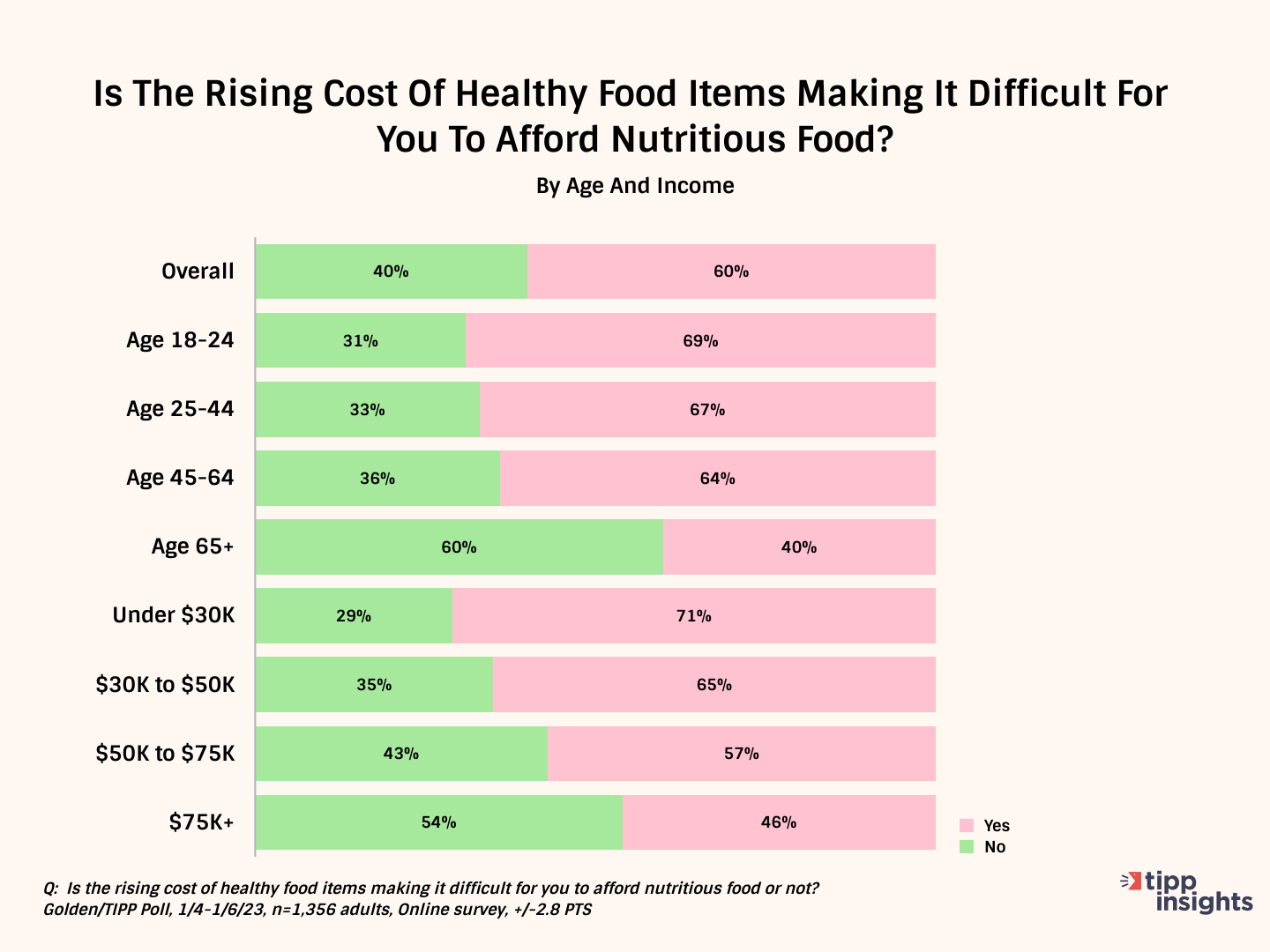
The Golden/TIPP Poll looked closely at how Americans deal with high shelf prices, especially regarding their food budget. We posed the question to over 1350 adults. The response to “Is the rising cost of healthy food items making it difficult for you to afford nutritious food or not?” read:

  • 60% Yes
  • 40% No

Region-wise,the numbers are grimmer. A majority in most parts of the country have chosen to make changes to their food shopping habits.

  • 66% for Northeast
  • 62% for Midwest
  • 62% for South
  • 53% for West

There was a notable disparity based on the area of residence. Suburbanites were seen to be making the least changes, at 57%. While 60% of city dwellers were affected by rising food costs, a majority, 66% of those residing in rural areas, were cutting back on nutritious food.

There is one small solace in this dismal picture. Seniors recorded the smallest numbers cutting back on nutritious food due to high prices at 40%. That is little comfort considering that most other age categories are not faring so well. The percentage of those finding it difficult to afford nutritious food by age reads:

  • 69% for 18-24 years
  • 67% for 25-44 years
  • 64% for 45-64 years
  • 40% for 65 and over

Predictably those making changes to their grocery lists and factoring in the high price of food items are highest in the lower income bracket and least among the well-off.

  • 71% for Under $30K households
  • 65% for $30K-$50K
  • 57% for $50K-$75K
  • 46% for $75K plus

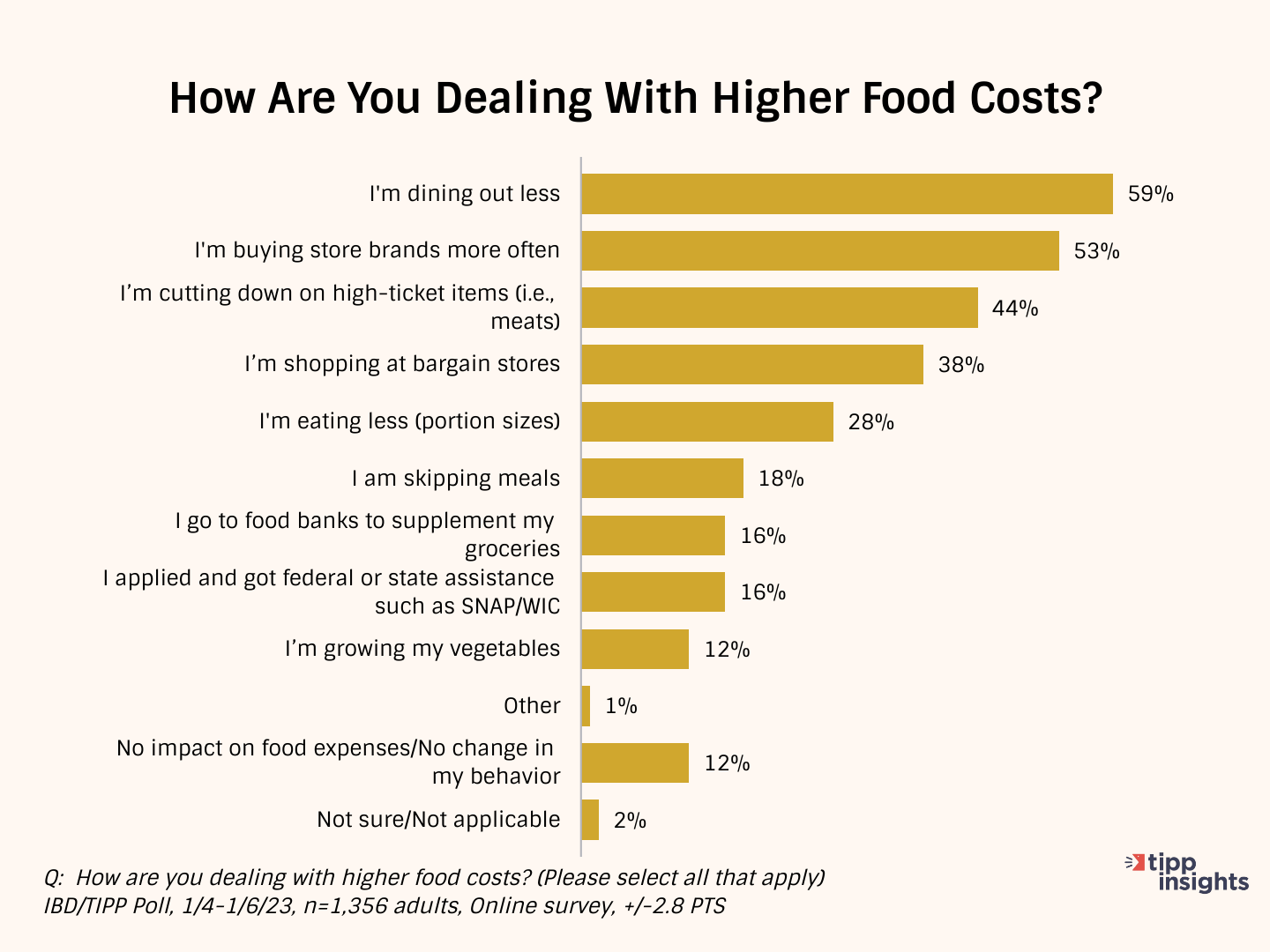
The ongoing inflation is eating into everyone’s budgets. Americans are putting off holidays and big-ticket purchases. But worryingly, a majority, 57%, have cut back on groceries purchases, and 44% are opting to give up high-priced items like meat.

Many are making pocket-friendly choices and opting for cheaper items and budget-friendly stores to feed their families. Understandably, eating at home was one of the most popular ways to spend less. The majority of survey participants said they ate out less often. While more than a third of the participants are patronizing bargain stores, cheaper store brands are finding favor with many shoppers. To tackle food inflation from wrecking the family budget:

  • 38% shop at bargain stores
  • 53% buy store brands
  • 76% have cut back on eating out

Distressingly, the survey found that American families are resorting to drastic measures to stretch the dollar. Beyond buying less, many have resorted to eating less or controlling portion sizes. Such extreme methods could impact a person’s health and well-being. The survey found that -

  • 18% skip meals
  • 28% eat less (portions)

Many have sought every available means to put three square meals on the table. The poll found that -

  • 16% applied & got SNAP/WIC
  • 16% supplement with food banks
  • 12% are growing vegetables

According to some estimates, roughly 12% of the American population, or more than 26 million people, rely on SNAP to stretch their food budgets. With the administration having little success in reining in the raging inflation, food prices will likely remain high for the foreseeable future.

The current geopolitical climate, including the ongoing Ukraine War, is not conducive to bringing down food prices in the short term. With fears of stagflation and/or recession weighing on Americans’ minds, many will likely continue to resort to cutting back on food or going without to make ends meet.


https://tippinsights.com/inflation-starves-america-of-nutrition-golden-tipp/