Search This Blog

Wednesday, February 22, 2023

China Sends Supertankers To US Gulf On Crude Oil Buying Spree

 One of the most important bull thesis for crude in 2023 is that China, having permanently shelved its zero Covid policies, will unleash a global buying spree as the Chinese economy sharply roars back to life.

On Tuesday, we got another indication of precisely that: Unipec, the largest oil trader in China and the trading unit of state-held refiner Sinopec, and PetroChina, the largest oil and gas producer and distributor in China, have both hired ten supertankers in March to haul US crude back to Asia, according to Bloomberg, citing people with direct knowledge of the matter. 

Each vessel can transport a whopping 20 million barrels of crude. The people said that the loading of the tankers is expected to occur across US Gulf Coast terminals. 

"Chinese buying activity of US barrels seems to be the hottest activity right now," Viktor Katona, a lead crude analyst at Kpler, told Bloomberg. He said Chinese firms are taking advantage of a "remarkable, profitable arbitrage" for US crude that has been suppressed because of President Biden's massive releases from the Strategic Petroleum Reserve (remember when China was buying SPR releases last year?).

The first indication of China embarking on a global buying spree of crude was last month. We pointed out Unipec was set to purchase at least 18 cargoes of Upper Zakum crude from Abu Dhabi in March. 

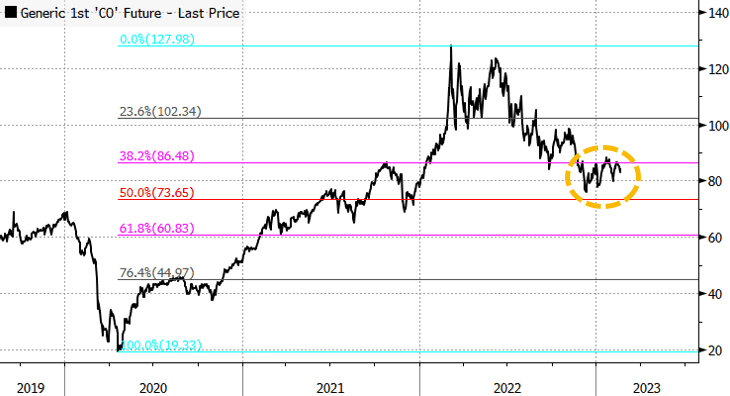
Chinese oil demand is rebounding after the reopening of its economy. Traders are closely monitoring Chinese oil demand for hints at what's the next direction for benchmark Brent futures. 
Data and analytics firm Kpler pointed out as many as 14 Very Large Crude Carriers are preparing to load from the US Gulf Coast to China in March. Katona noted this doubled the volume shipped over the last several years. 

Saudi oil giant Aramco expects the Chinese reopening and a pick-up in jet fuel demand to lead to a rebound in global oil demand this year, Amin Nasser, the CEO of the world's biggest oil firm, told Bloomberg in an interview last month.

And the Chinese buying isn't limited to the US and Abu Dhabi. OilPrice said PetroChina and Sinopec are back on the market for Russian Urals and taking advantage of the deep discounts

Here's something for oil bulls: 

"China will drive nearly half this global demand growth even as the shape and speed of its reopening remains uncertain," International Energy Agency said last month. 

Remember, we told readers this would happen as early as November in a note titled "China Quietly Boost Oil Imports In Preparation For Reopening." 

https://www.zerohedge.com/commodities/china-sends-supertankers-us-gulf-crude-oil-buying-spree

Is Biden Conning The Ukrainians? Claims Ukraine Flags Fly Across America

 During his recent surprise visit to Ukraine, Joe Biden strutted out in front of press cameras with Volodymyr Zelensky to the sound of pre-planned air raid sirens and declared America's ongoing support for the country's war efforts.  Biden's appearance was coordinated with the announcement of a $2.5 billion weapons package, the 30th such package in the past year.  However, what was not mentioned is that NATO has been shifting into older armor vehicles such as MRAPS and reducing valuable supplies of anti-tank weapons like the Javelin. 

According to the inventories of multiple NATO countries, there has actually been a draw down of shipments as supplies become strained.  Concerns are rising among NATO officials that they will not be able to continue arming Ukraine while also maintaining their own readiness, but the Biden Administration appears intent on at least giving the appearance that US backing is stronger than ever.

Some confusion surrounds the actual objectives of NATO backed Ukraine forces, as officials talk about not only taking back the Donbas, but also taking back Crimea which has been in Russian hands since 2014.  These sentiments may sound like optimistic rhetoric designed to inspire, but they are certainly not realistic given the wide array of defenses that Russia is establishing to stall any approach.  Not to mention, reports of counter actions in the Donetsk and Luhansk regions suggest the Russians are successfully targeting Ukrainian units - Even Zelensky openly admitted that the situation in Donetsk was "very difficult."

After Biden's dramatic display in Ukraine, he went on to Warsaw, Poland to give a speech on the developing conflict.  One of his statements in particular deserves further analysis:

Biden proudly proclaims that Ukrainian flags are flying above homes in small towns and large cities across America, insinuating that the majority of Americans are in full support of what many now perceive to be a proxy war.  Polls show American public support for Ukraine aid is waning, with conservatives losing all faith in the project.  The tale of Ukraine flags flying across the US is also simply false.  In general, you are are much more likely to see a "Let's Go Brandon" flag over the front door of an American home than you are to see a Ukrainian flag.

But why is Biden trying to hype up Ukrainians using dishonest rhetoric? Biden's surprise appearance and the announced weapons package feels more like a last-ditched effort to rally Ukraine against an impending onslaught he knows is coming soon.  Either that, or it is an attempt to puff up, a display to show Putin that NATO is still very much in the game and distract from the reality that weapons supplies are faltering.

The flag comment could also be intended to give Ukrainians the false impression that Americans will eventually support direct troop deployment to the region, which should not be necessary unless Ukraine's footing in the war is not as strong as has been asserted.  It may be true that there are US advisers and perhaps even special forces on the ground in Ukraine, but the majority of US citizens are vehemently opposed to open warfare with Russia.  In other words, "boots on the ground" is not going to happen without mass opposition and instability at home.  

At bottom, the Biden visit with Zelensky and his bizarre claims in Poland signal a coming change in the war that is not yet clear.

https://www.zerohedge.com/geopolitical/biden-conning-ukrainians-claims-ukraine-flags-fly-across-america

Senators urge CMS to rethink narrow Medicare coverage for Alzheimer's drugs

 A group of senators is urging the Biden administration to rethink its restrictive coverage determination for emerging Alzheimer's disease treatments.

The letter (PDF) to Department of Health and Human Services Secretary Xavier Becerra and Centers for Medicare & Medicaid Services (CMS) Administrator Chiquita Brooks-LaSure is signed by 20 senators comprising 18 Republicans and two Democrats.

In it, the legislators said they're echoing calls from patient advocates as well as the Alzheimer's Association to make it easier for people with the disease to access monoclonal antibody drugs that target amyloid. They warn that delays could prevent patients from seeing the benefits associated with these therapies.

"This overdue CMS action will ensure Medicare beneficiaries living with mild cognitive impairment due to Alzheimer’s disease and early stage Alzheimer’s disease have immediate access to FDA-approved treatments if the patient and clinician decide it is right for them," the senators wrote.

The coverage issue stems from the first monoclonal antibody approved, Aduhelm, which was co-developed by Biogen and Eisai and debuted with a controversial accelerated approval from the Food and Drug Administration amid concerns from experts about its efficacy. The drugmakers quickly brought the drug to market at a high price, and many commercial payers opted not to include it on their formularies

CMS later issued a restrictive coverage determination for Aduhelm in Medicare that applied to other drugs in its class, much to the dismay of the pharmaceutical industry and patient advocates.

However, since then, Biogen and Eisai have secured accelerated FDA approval for a second monoclonal antibody drug, lecanemab, which is under the brand name Leqembi. Eisai executives said the company is planning a "careful" launch and set a price tag half of that of Aduhelm.

The senators noted that a group of 200 Alzheimer's researchers and experts joined the Alzheimer's Association in expressing faith in clinical trial data on the drug, arguing that there should be "no barriers" to access should lecanemab secure full FDA approval.

"Unless CMS reconsiders the April 2022 [national coverage decision], access to disease-modifying therapy for Alzheimer’s disease will be extremely limited or nearly nonexistent," the senators wrote.

https://www.fiercehealthcare.com/regulatory/senators-urge-cms-rethink-narrow-medicare-coverage-alzheimers-drugs

Senators introduce bill to expand physician-led hospitals

 A proposed bill in the U.S. Senate would expand the rights of physician-owned hospitals — including some privileges that were rescinded more than a decade ago. 

Sen. James Lankford from Oklahoma has reintroduced the Patient Access to Higher Quality Health Care Act, alongside several other Republican lawmakers. If passed, the law would remove the Affordable Care Act's ban on the creation and expansion of new physician-owned hospitals, which has been in place since 2010. 

The law would also allow physician-owned hospitals to participate in Medicare and Medicaid, according to a Feb. 21 news release from Mr. Lankford's office. 

Mr. Lankford and Brian Miller, MD, a practicing hospitalist and assistant professor of medicine at the Johns Hopkins University School of Medicine in Baltimore, argued the bill would increase competition in a Feb. 20 opinion piece for The Wall Street Journal

"What if lawyers weren't allowed to own law firms or chefs weren't allowed to own restaurants?" the article reads. "Sounds absurd, but it's a reality for one profession: doctors." 

The hospital industry has argued that physician-owned hospitals have too much financial stake in the game, choosing healthy patients with private insurance over sicker ones who require charity care. That notion — which defended the Obama-era restrictions — is false, according to the authors. 

"[The Affordable Care Act restriction] limits competition, defies common sense and is likely contributing to higher prices for Medicare and reduced access to treatment for millions of Americans," the authors wrote. 

The opinion piece also argues that lessening restrictions on physician-owned hospitals would increase care options in rural areas. 

"Physician-led hospitals meet community needs by focusing on the most important relationship in health care — the patient-physician relationship," said Jack Resneck Jr., MD, president of the American Medical Association. "Yet, the combination of current law and hospital consolidation is making these success stories rare."

"We welcome Sen. Lankford's bill that would re-introduce competition and protect compassionate health care delivery," Dr. Resneck continued. "After witnessing hospital closures — especially in rural areas — patients must wonder what Congress is doing about it."

https://www.beckershospitalreview.com/hospital-management-administration/senators-introduce-bill-to-expand-physician-led-hospitals.html

98% of HR managers use AI to make layoff decisions

 As artificial intelligence expands its footprint in the workplace, it might remove the "human" from some human resources decisions. 

Capterra, a technology review platform, surveyed 300 human resources professionals in the U.S. regarding their outlooks on a potential recession. They asked respondents about their plans for conducting layoffs if a recession strikes and cuts become necessary. 

Ninety-eight percent of human resources leaders said they "at least somewhat" rely on HR software and algorithms when making decisions to cut labor costs. Seventy percent said they would use performance data to make layoff decisions. 

These algorithms commonly assess performance data to build skills inventories, which can be useful when deciding who to lay off based on more than gut instinct. 

However, although the majority of respondents shared plans to use artificial intelligence programs for decision making, only 47 percent are completely comfortable relying on algorithmic recommendations to make layoff decisions.

"The danger here is using bad data, [and] coming to a decision based on something an algorithm says and just following it blindly," Brian Westfall, a senior HR analyst at Capterra, told The Washington Post in a Feb. 20 article.

https://www.beckershospitalreview.com/hr/98-of-hr-managers-use-ai-to-make-layoff-decisions.html

Moderna stock pops after cancer-vaccine candidate gets FDA breakthrough designation

 Moderna Inc. (MRNA)and Merck Inc. (MRK) shares increased in after-hours trading Wednesday after the pharmaceutical companies announced that a cancer-vaccine candidate received the "breakthrough therapy" designation from the Food and Drug Administration. The designation, which allows for expedited review of a candidate, was granted after a Phase 2b study of the personalized vaccine -- known as mRNA-4157/V940 -- in combination with Merck's Keytruda. "mRNA-4157/V940 in combination with KEYTRUDA provided the first demonstration of efficacy for an investigational mRNA cancer treatment in a randomized clinical trial and potentially represents a new frontier in treating melanoma and other cancers," Moderna President Steven Hoge said in a statement. "We look forward to publishing the full data set and sharing the results at an upcoming oncology medical conference, as well as continuing discussions with health authorities." A Phase 3 study focusing on melonoma will begin this year. Moderna shares rose 3% and Merck shares increased about 0.5% in late trading.

https://www.morningstar.com/news/marketwatch/20230222906/moderna-stock-pops-after-cancer-vaccine-candidate-gets-fda-breakthrough-designation

Lucira to Sell Business Through Voluntary Chapter 11

 Lucira Health, Inc. (Nasdaq: LHDX) (“Lucira Health,” “Lucira” or the “Company”), a medical technology company, announced today that it has filed for protection under Chapter 11 of the U.S. Bankruptcy Code in the United States Bankruptcy Court for the District of Delaware. The Company further disclosed that it intends to pursue a sale of its business under Section 363 of the Bankruptcy Code, while continuing to support its customers during the Chapter 11 process.

Lucira Health grew rapidly over the past several years as the COVID-19 pandemic spread throughout the world. Demand for the Company’s COVID-19 test kits surged and the Company posted positive net income in its 2022 first quarter for the first time since its inception. With its COVID-19 test kit available in the market and a new combination test kit for COVID-19 and Flu developed and awaiting U.S. Food & Drug Administration (“FDA”) Emergency Use Authorization (“EUA”), the Company moved forward in manufacturing test kits to fulfill future customer demand. The Company anticipated an EUA for an OTC indication on the COVID-19 and Flu test in August 2022, though the FDA’s approval process became protracted, resulting in high expenditures without new revenue from the combined test kit during the 2022-2023 flu season. As such, the Company’s operations were significantly impacted, leading to the Chapter 11 filing and sale process.

In October 2022, Lucira’s Board of Directors approved various initiatives to rebalance Lucira’s cost structure and explore strategic alternatives. As part of these efforts, the Company instituted cost reduction plans, reduced its workforce and realigned several vendor agreements. Further, the Company engaged Armanino LLP, an independent accounting and business consulting firm in the United States, to pursue various strategic options, including a potential sale process.