Search This Blog

Tuesday, May 2, 2023

Vanda Pharmaceuticals sues U.S. government over drug trade secrets

 Vanda Pharmaceuticals Inc has sued the federal government in Washington, D.C., federal court over accusations that the U.S. Food and Drug Administration passed trade secrets about its schizophrenia drug Fanapt and sleep-disorder medication Hetlioz to generic competitors.

In a complaint made public Tuesday, Vanda said the agency disclosed confidential details from its applications for FDA approval to companies seeking to make generic versions of its drugs, and that it "routinely" reveals confidential information about brand-name drugs to generic drug applicants.

An FDA spokesperson said the agency does not comment on pending litigation.

The FDA approved Vanda's antipsychotic drug Fanapt in 2009 and its circadian-rhythm regulator Hetlioz in 2014. Vanda's lawsuit said the FDA has also approved several generic versions of the drugs.

Washington, D.C.-based Vanda earned more than $159 million from sales of Hetlioz and more than $94 million from Fanapt last year, according to a company report.

Vanda told the U.S. Court of Federal Claims that the FDA gave confidential information about Fanapt and Hetlioz, its only two drugs, to generic competitors including Lupin Ltd, Apotex Inc and Teva Pharmaceutical.

It accused the FDA of revealing its dissolution specifications for the drugs, which indicate how much they must dissolve after administration to be safe and effective, to other drugmakers in correspondence about their generic versions.

The company also said the FDA disclosed secret information about its Hetlioz manufacturing process to Apotex and Teva during their bids for generic approval.

Vanda accused the government of unconstitutionally taking its confidential information and violating an implied contract to keep it secret, and requested an unspecified amount of money damages.

https://finance.yahoo.com/news/vanda-pharmaceuticals-sues-u-government-224013573.html

Vermont becomes 2nd state to allow non-residents to use assisted suicide law

 Vermont became the second state in the nation Tuesday to allow terminally ill people from other states to travel there to die by suicide while under medical care.

The medically assisted suicide law that’s been around for decades in the state dropped its residency requirement after Republican Gov. Phil Scott signed the bill Tuesday.

The change was hailed by supporters of the law though critics warned it could lead Vermont to become a “death tourism” spot.

Kim Callinan, president and CEO of Compassion & Choices, said in a statement that the non-profit was grateful Vermont lawmakers realized that “a state border shouldn’t determine if you die peacefully or in agony.”

“Patients routinely travel to other states to utilize the best healthcare options,” she added. “There is no rational reason they shouldn’t be able to travel to another state to access medical aid in dying if the state they live in doesn’t offer it.”

Opponents of the suicide law slammed it.

“To be clear, Vermont Right to Life opposed the underlying concept behind assisted suicide and opposes the move to remove the residency requirement as there are still no safeguards that protect vulnerable patients from coercion,” said Mary Hahn Beerworth, the executive director of the Vermont Right to Life Committee.

The Vermont State House stands on Feb. 14, 2023, in Montpelier, Vt.
Vermont made history Tuesday when it changed its assisted suicide law.
AP

University of Massachusetts law professor Dwight Duncan told National Catholic Register in February dropping the residency rule could make Vermont a destination for death.

“And it opens up this idea of ‘death tourism’ — that you travel there as a place to be killed,” the law’s critic said. “It’s one thing to travel to Vermont because they have great ski slopes. It’s another thing to travel there because they have great undertakers.”

Vermont Governor Phil Scott
Vermont Governor Phil Scott signed the bill Tuesday dropping the residency requirement for the medically assisted suicide law that’s been around for decades.
Phil Scott / Facebook

While Vermont is the first state to actually change the law to allow non-residents to end their life, Oregon previously agreed to stop enforcing the residency requirement that allowed terminally ill people to receive lethal medication as part of a court settlement. It also agreed to ask lawmakers to scrap it from the law.

Vermont is one of ten states to allow medically assisted suicide.

Before the bill’s passage, the state had reached a settlement with a Connecticut woman who has terminal cancer that allowed her to take advantage of the law.

Lynda Shannon Bluestein, smiles during an interview in the living room of her home, Feb. 28, 2023, in Bridgeport, Conn
Lynda Shannon Bluestein smiles during an interview in the living room of her home, Feb. 28, 2023, in Bridgeport, Conn
AP

The woman, Lynda Bluestein, of Connecticut, and her doctor sued Vermont last summer, claiming the residency mandate violated the law.

She said Tuesday the change allows scores of other terminally ill people to die by suicide if they choose that path.

“I’m thinking even more importantly that this is going to cause other states, the other jurisdictions that have medical aid in dying, to look at their residency requirement, too,” Bluestein said.

https://nypost.com/2023/05/02/vermont-changes-law-to-allow-out-of-staters-to-die-using-assisted-suicide-law/

Behavior patterns of people who achieve clinically significant weight loss

 A new study analyzing data on over 20,000 U.S. adults links a healthier diet and increased exercise to weight loss that reduces heart disease risk -- while associating skipping meals and taking prescription diet pills with minimal weight loss, weight maintenance or weight gain.

For many in the study sample, however, losing a "clinically significant" 5% of their body weight did not eliminate their risk factors for cardiovascular disease, results showed. In fact, the average composite score on eight risk factors for heart disease was the same across the entirety of the study population -- regardless of reported weight changes, up or down.

The study is the first to compare weight-loss strategies and results in the context of the American Heart Association's "Life's Essential 8," a checklist promoting heart disease risk reduction through the pursuit of recommended metrics for body weight, blood pressure, cholesterol, blood sugar, smoking, physical activity, diet and sleep. The AHA first defined a construct of cardiovascular health with "Life's Simple 7" metrics in 2010, and updated the recommendations to the "Life's Essential 8" in June 2022.

The Ohio State University researchers found that overall, U.S. adults had an average score of 60 out of 100 on the eight measures -- suggesting there is plenty of room for improvement even among those whose diet and exercise behaviors helped move the needle on some metrics.

"The Life's Essential 8 is a valuable tool that provides the core components for cardiovascular health, many of which are modifiable through behavior change," said senior study author Colleen Spees, associate professor of medical dietetics in the School of Health and Rehabilitation Sciences at Ohio State.

"Based on the findings in this study, we have a lot of work to do as a country," she said. "Even though there were significant differences on several parameters between the groups, the fact remains that as a whole, adults in this country are not adopting the Life's Essential 8 behaviors that are directly correlated with heart health."

The research was published recently in the Journal of the American Heart Association.

Data for the analysis came from 20,305 U.S. adults aged 19 or older (average age of 47) who participated in the National Health and Nutrition Examination Survey (NHANES) between 2007 and 2016. Participants reported their smoking status, physical activity, average hours of sleep per night, weight history and weight loss strategy, and what they had eaten in the previous 24 hours. Health exams and lab tests measured their body mass index, blood pressure, LDL (bad) cholesterol and blood glucose.

The Ohio State researchers used the data to determine individuals' values for Life's Essential 8 metrics and assessed their diet quality according to the Healthy Eating Index, which gauges adherence to U.S. Dietary Guidelines for Americans.

Within the sample, 17,465 individuals had lost less than 5% of their body weight, maintained their weight or gained weight in the past year. The other 2,840 reported intentional loss of at least 5% of their body weight in the same time frame.

"Clinically significant weight loss results in improvements in some health indices," Spees said. "People should feel hopeful in knowing that losing just 5% of their body weight is meaningful in terms of clinical improvements. This is not a huge weight loss. It's achievable for most, and I would hope that incentives people instead of being paralyzed with a fear of failure."

In this study, adults with clinically significant weight loss reported higher diet quality, particularly with better scores on intakes of protein, refined grains and added sugar, as well as more moderate and vigorous physical activity and lower LDL cholesterol than the group without clinically significant weight loss. On the other hand, the weight-loss group also had a higher average BMI and HbA1c blood sugar measure and fewer hours of sleep -- all metrics that would bring down their composite Life's Essential 8 score.

A greater proportion of people who did not lose at least 5% of their weight reported skipping meals or using prescription diet pills as weight-loss strategies. Additional strategies reported by this group included low-carb and liquid diets, taking laxatives or vomiting, and smoking.

"We saw that people are still gravitating to non-evidence-based approaches for weight loss, which are not sustainable. What is sustainable is changing behaviors and eating patterns," Spees said.

With federal data estimating that more than 85% of the adult U.S. population will be overweight or obese by 2030 (compared to the current rate of 73%), Spees said that to fend off related increases in heart disease and other health problems, a paradigm shift toward prevention is in order.

"We absolutely need to be moving toward prevention of disease versus waiting until people are diagnosed with a disease. This becomes quite overwhelming, and individuals may feel it's too late at that point," she said.

One idea to consider, she said, would be prescriptions for regular visits with registered dietitians trained in behavior change, complete with insurance reimbursement -- similar to physical therapy.

"We have fantastic research, we have incredible educators," she said. "What we don't have is policy that promotes optimal health across the lifespan, from pregnancy through older adulthood."

Co-authors of the study included first author Emily Hill (supported by a National Center for Advancing Clinical Sciences fellowship), Lauren Cubellis, Randell Wexler and Christopher Taylor.

Journal Reference:

  1. Emily B. Hill, Lauren T. Cubellis, Randell K. Wexler, Christopher A. Taylor, Colleen K. Spees. Differences in Adherence to American Heart Association's Life's Essential 8, Diet Quality, and Weight Loss Strategies Between Those With and Without Recent Clinically Significant Weight Loss in a Nationally Representative Sample of US AdultsJournal of the American Heart Association, 2023; 12 (8) DOI: 10.1161/JAHA.122.026777

Wearable ultrasound patch provide non-invasive deep tissue monitoring

 A team of engineers at the University of California San Diego has developed a stretchable ultrasonic array capable of serial, non-invasive, three-dimensional imaging of tissues as deep as four centimeters below the surface of human skin, at a spatial resolution of 0.5 millimeters. This new method provides a non-invasive, longer-term alternative to current methods, with improved penetration depth.

The research emerges from the lab of Sheng Xu, a professor of nanoengineering at UC San Diego Jacobs School of Engineering and corresponding author of the study. The paper, "Stretchable ultrasonic arrays for the three-dimensional mapping of the modulus of deep tissue," is published in the May 1, 2023 issue of Nature Biomedical Engineering.

"We invented a wearable device that can frequently evaluate the stiffness of human tissue," said Hongjie Hu, a postdoctoral researcher in the Xu group and study coauthor. "In particular, we integrated an array of ultrasound elements into a soft elastomer matrix and used wavy serpentine stretchable electrodes to connect these elements, enabling the device to conform to human skin for serial assessment of tissue stiffness."

The elastography monitoring system can provide serial, non-invasive and three-dimensional mapping of mechanical properties for deep tissues. This has several key applications:

  • In medical research, serial data on pathological tissues can provide crucial information on the progression of diseases such as cancer, which normally causes cells to stiffen.
  • Monitoring muscles, tendons and ligaments can help diagnose and treat sports injuries.
  • Current treatments for liver and cardiovascular illnesses, along with some chemotherapy agents, may affect tissue stiffness. Continuous elastography could help assess the efficacy and delivery of these medications. This might aid in creating novel treatments.

In addition to monitoring cancerous tissues, this technology can also be applied in other scenarios:

  • Monitoring of fibrosis and cirrhosis of the liver. By using this technology to evaluate the severity of liver fibrosis, medical professionals can accurately track the progression of the disease and determine the most appropriate course of treatment.
  • Assessing musculoskeletal disorders such as tendonitis, tennis elbow and carpal tunnel syndrome. By monitoring changes in tissue stiffness, this technology can provide valuable insight into the progression of these conditions, allowing doctors to develop individualized treatment plans for their patients.
  • Diagnosis and monitoring for myocardial ischemia. By monitoring arterial wall elasticity, doctors can identify early signs of the condition and make timely interventions to prevent further damage.

Wearable ultrasound patches accomplish the detection function of traditional ultrasound and also break through the limitations of traditional ultrasound technology, such as one-time testing, testing only within hospitals and the need for staff operation.

"This allows patients to continuously monitor their health status anytime, anywhere," said Hu.

This could help reduce misdiagnoses and fatalities, as well as significantly cutting costs by providing a non-invasive and low-cost alternative to traditional diagnostic procedures.

"This new wave of wearable ultrasound technology is driving a transformation in the healthcare monitoring field, improving patient outcomes, reducing healthcare costs and promoting the widespread adoption of point-of-care diagnosis," said Yuxiang Ma, a visiting student in the Xu group and study coauthor. "As this technology continues to develop, it is likely that we will see even more significant advances in the field of medical imaging and healthcare monitoring."

The array conforms to human skin and acoustically couples with it, allowing for accurate elastographic imaging validated with magnetic resonance elastography.

In testing, the device was used to map three-dimensional distributions of the Young's modulus of tissues ex vivo, to detect microstructural damage in the muscles of volunteers prior to the onset of soreness and monitor the dynamic recovery process of muscle injuries during physiotherapy.

The device consists of a 16 by 16 array. Each element is composed of a 1-3 composite element and a backing layer made from a silver-epoxy composite designed to absorb excessive vibration, broadening the bandwidth and improving axial resolution.

Professor Xu is now commercializing this technology via Softsonics LLC.

Journal Reference:

  1. Hongjie Hu, Yuxiang Ma, Xiaoxiang Gao, Dawei Song, Mohan Li, Hao Huang, Xuejun Qian, Ray Wu, Keren Shi, Hong Ding, Muyang Lin, Xiangjun Chen, Wenbo Zhao, Baiyan Qi, Sai Zhou, Ruimin Chen, Yue Gu, Yimu Chen, Yusheng Lei, Chonghe Wang, Chunfeng Wang, Yitian Tong, Haotian Cui, Abdulhameed Abdal, Yangzhi Zhu, Xinyu Tian, Zhaoxin Chen, Chengchangfeng Lu, Xinyi Yang, Jing Mu, Zhiyuan Lou, Mohammad Eghtedari, Qifa Zhou, Assad Oberai, Sheng Xu. Stretchable ultrasonic arrays for the three-dimensional mapping of the modulus of deep tissueNature Biomedical Engineering, 2023; DOI: 10.1038/s41551-023-01038-w

'U.S. to help journalists globally defend against legal threats'

 The United States on Tuesday launched a program to defend journalists around the world from legal threats aimed at silencing critical voices, a growing tactic that top U.S. aid official Samantha Power described as "lawfare."

Power, administrator of the U.S. Agency for International Development (USAID), announced the Reporters Shield program at an event to mark World Press Freedom Day at the United Nations.

"Many independent outlets can't afford to be sued, so they are driven out of business or they try to self censor to avoid attracting the interest of those who might target them," she said. "Corrupt leaders know all this, which is why they're using lawfare more and more."

USAID said it plans to work with Congress to provide up to $9 million for the Reporters Shield program that will be jointly managed by the Organized Crime and Corruption Reporting Project and the Cyrus R. Vance Center for International Justice.

"To withstand lawfare journalists and media outlets need robust protection, they need training in how to avoid lawsuits altogether, they need resources to hire lawyers and cover legal fees," Power said.

USAID said Reporters Shield will be a membership program and organizations will pay an annual fee based on factors like the outlet's location and how many stories they produce a year.

https://www.marketscreener.com/news/latest/U-S-to-help-journalists-globally-defend-against-legal-threats--43716788/

TikTok says head of U.S. trust and safety will leave the company

 TikTok said on Tuesday its head of U.S. data security trust and safety, Eric Han, will leave the company.

The news comes as TikTok faces calls from U.S. lawmakers to ban the popular short-form video app from the country over concerns about its Chinese ownership and protection of U.S. user data.

https://www.marketscreener.com/news/latest/TikTok-says-head-of-U-S-trust-and-safety-will-leave-the-company--43716827/

Biden's Game Of Chicken: We Won't See A Debt Ceiling Solution Until The Market Panics

 By Philip Marey, Senior Strategist at Rabobank

Summary

  • Yesterday, Treasury Secretary Yellen sent a new letter to the Congressional leadership, with the message that the X-date could arrive as soon as June 1.

  • With the adoption of the Limit, Save, Grow Act in the House of Representatives and President Biden’s unwillingness to negotiate about conditions for a raise in the debt limit, a game of chicken between Republicans and Democrats has started.

  • So far, markets reacted to the possibility of a US federal government default with a revealed preference for one month treasury bills over longer dated T-bills. However, we are still far from the panic needed to break the stalemate between Republicans and Democrats. This is likely to occur closer to the X-date.

  • Either this game is over within a few weeks or we are going to see a suspension of the debt limit until later this year. In both cases, we are not likely to see any solution until financial markets start to panic.

Introduction

Although the midterm elections in November turned out better for the Democrats than could have been expected based on the high inflation rate and President Biden’s low approval rating, they lost their majority in the House of Representatives. With the 118th Congress in session since early January, the balance of power in Washington DC has shifted. After two years of Democratic Control, with Democratic majorities in both chambers of Congress and a Democratic President, the Republicans are now able to shoot down any bill on the House floor in the next two years. This means a regime shift has taken place in US politics this year to Divided Government, where legislation requires bipartisan cooperation. The first of the fiscal standoffs that we warned for in Midterm implications is already taking shape and it is the most dangerous one, the debt limit.

McCarthy’s move

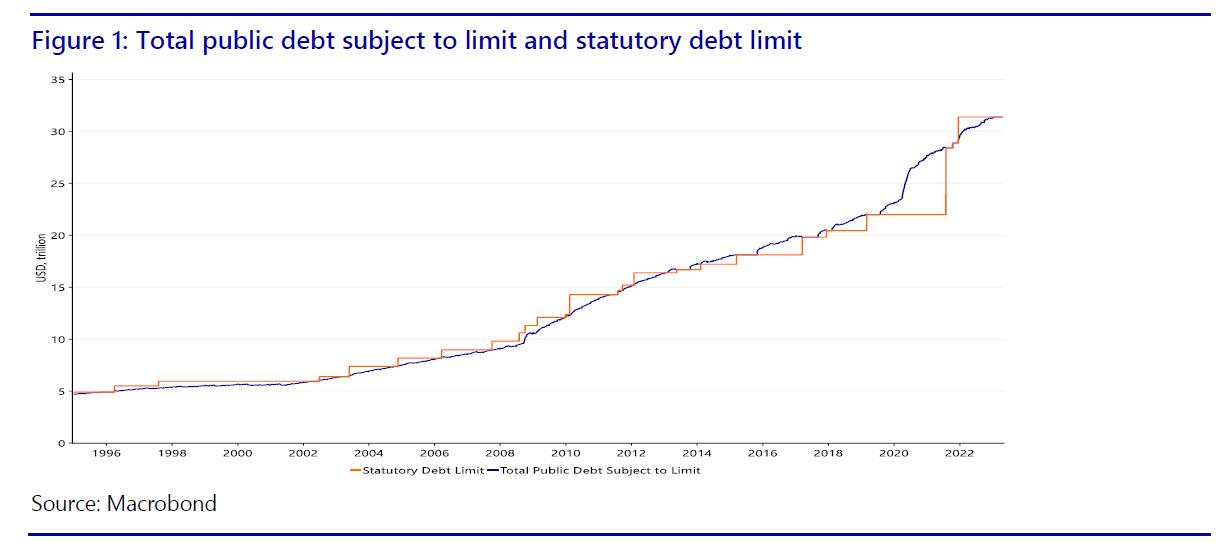
On April 26, the House of Representatives adopted the Limit, Save, Grow Act of 2023, presented by House Speaker McCarthy a week earlier, with a 217-215 vote. All Democrats voted no, so did four Republicans. The bill, drafted by the leadership of the House Republicans, in consultation with various members, raises the debt limit by $1.5 trillion or until March 31, 2024, whichever comes first. Note that the current debt limit of $31.381 trillion was reached on January 19, after which the Treasury Department started extraordinary measures, postponing the X-date, when the Treasury will be unable to meet all of its debt obligations. In exchange for the higher debt ceiling, the House Republicans want to limit government spending. The bill sets discretionary spending for fiscal year 2024 (October 1, 2023 - September 30, 2024) at the level of fiscal year 2022 and then limits growth in discretionary spending to no more than 1% a year in the next decade. The bill also rescinds unspent COVID relief funds, and make changes to energy, regulatory and permitting policies. However, the plan also cuts the increased funding for the Internal Revenue Service (IRS). What’s more, it will prevent implementation of President Biden’s student debt cancellation and Income-Driven Repayment (IDR) expansion, and impose or expand work requirements in several federal safety net programs. This means serious concessions by the Democrats, which they are not likely to agree to. In fact, President Biden has made clear repeatedly that he does not want to negotiate at all. His position remains that he wants a “clean” debt limit raise, i.e. without any condition.

Biden’s game of chicken

With the adoption of Limit, Save, Grow Act by the House of Representatives, and Biden’s demand for a “clean” raise of the debt limit, a game of chicken has started between Republicans and Democrats. Both parties want to avoid a government default, which would cause significant damage to the financial markets and the economy. Consequently, the so-called X-date, when the extraordinary measures are exhausted, is the deadline for the game of chicken. In the time before the deadline, we are not likely to see any party blink, unless a financial market panic breaks out. Once the deadline passes, neither party has an interest in keeping the US in default. By this time, financial markets will definitely be in turmoil.

It could be argued, especially by Democrats, that as the Republicans are the party attaching conditions to the debt limit increase necessary to avert or end the default, they are likely to bear most of the pressure to concede. This argument frames the current game as a repeat of 2011 and 2013. However, the crucial difference is that the Limit, Save, Grow Act is actually a bill to raise the debt ceiling! So it is misleading to claim that “House Republicans are holding our economy hostage and threatening default” as the White House press secretary did on April 27. In fact, it could be argued, in particular by Republicans, that the Democrats are the obstacle to a raise in the debt ceiling. After all, if the Senate – where Democrats are needed to get the 60 necessary votes – adopts this bill and President Biden signs it into law, the debt ceiling is lifted. The truth is that after the difficult process to confirm McCarthy as the new House Speaker in January, the Democrats hoped that the House Republicans would not be able to agree on what they wanted in exchange for a raise in the debt limit. That would have strengthened the Democrats’ demand for a clean raise, i.e. without conditions. Now, it seems reasonable to start negotiations about spending cuts attached to the raise in the debt ceiling. However, a game of chicken with financial market turmoil as leverage is more likely to unfold. In the end, i.e. close to the X-date, the game of chicken is likely to be resolved under pressure from financial markets. So how are markets reacting to the developments regarding the debt ceiling so far?

Markets looking for near-term safety

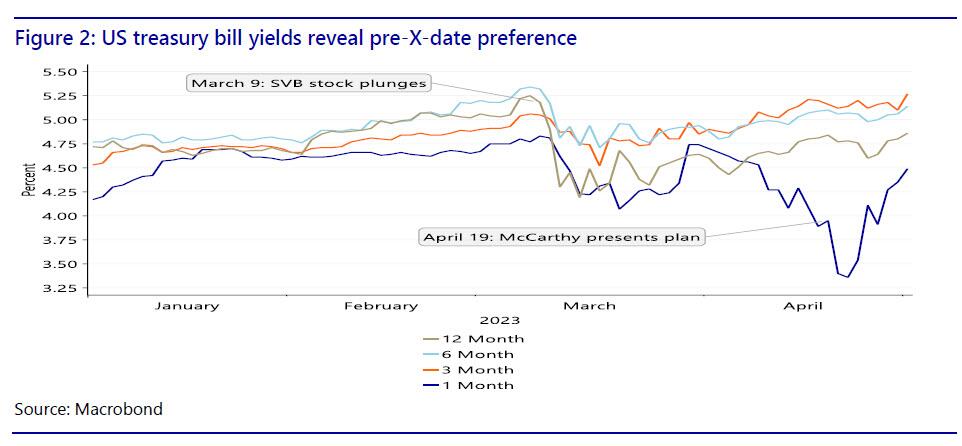
On January 13, Treasury Secretary Yellen sent a letter to the Congressional leadership, noting that it was unlikely that cash and extraordinary measures would be exhausted before early June. To avoid the risk of holding a treasury bill that may not be repaid investors have shown a preference for near-term treasury bills in recent weeks. The yield on one month bills has clearly moved away from the yield on three, six or twelve month bills. While the yields on the latter three maturities continue to move together, the one month yield tanked after McCarthy’s presentation of the Republican plan brought the debt limit to the forefront. Demand from money market funds likely played a major role in the decline in the one month yield. Recently, money market funds have received large inflows from depositors concerned about the safety of their holdings at small banks or their modest returns at large banks. At the same time, the supply of near-term T-bills has fallen as the Treasury has already hit the debt ceiling and is trying to delay the X-date. So far, markets reacted to the possibility of a US federal government default with a revealed preference for one month T-bills over longer dated T-bills (This should subside as early June enters the one month horizon)However, we are still far from the panic needed to bring Democrats and Republicans together. This is likely to occur closer to the X-date

X-date in June?

On May 1, Treasury Secretary Yellen sent a new letter to the Congressional leadership, with the message that “After reviewing recent federal tax receipts, our best estimate is that we will be unable to continue to satisfy all of the government’s obligations by early June, and potentially as early as June 1, if Congress does not raise or suspend the debt limit before that time.” This means that the X-date could arrive sooner than previously expected, due to disappointing tax receipts. Shortly after Yellen’s announcement, President Biden invited top Republicans and Democrats for a meeting next week about raising the debt limit. However, a White House official said that Biden will repeat his view that Congress should pass a stand-alone increase in the debt limit, but that he is open to a discussion on the budget that is not linked to raising the debt limit. In other words, the Democrats are not blinking, neither are the Republicans.

Also on May 1, the Congressional Budget Office (CBO), a nonpartisan budget agency, updated its budget projections and concluded that lower-than-expected tax receipts this year create a significantly greater risk that the Treasury will run out of funds in early June. Earlier, they forecasted that the default could occur as soon as July. While, prior to May 1, markets had a wide range of forecasts regarding the X-date, from June to September, and even beyond, it looks like the probability of the X-date being located in June has increased substantially.

This would increase the pressure on the players of the game of chicken rapidly in the coming weeks. Alternatively, or  because of this, we could see a temporary suspension of the debt limit to buy more time to negotiate (the Republicans are likely to want something in exchange for that, probably something from the Limit, Save, Grow Act they adopted last week). For example, Congress could delay the deadline to the end of the fiscal year, September 30. This would bring the deadline for the budget for fiscal year 2024 and the deadline for the debt limit together, allowing for a comprehensive solution. However, it would also add to the pressure at the new X-date, because failure to reach a deal would lead to both a government shutdown and a government default.

Conclusion

The game of chicken between Democrats and Republicans has really kicked off after the House of Representatives voted for the Limit, Save, Grow Act, Treasury Secretary Yellen sent a letter indicating that the X-date could arrive as soon as June 1, and Biden’s repeated dismissal of any conditions attached to a raise in the debt limit. Either this game is over within a few weeks or we are going to see a delay until later this year. In both cases, we are not likely to see any solution until financial markets start to panic.

https://www.zerohedge.com/markets/bidens-game-chicken-we-wont-see-debt-ceiling-solution-until-market-panics