Search This Blog

Tuesday, September 5, 2023

The Delights Of The Pfizer/Moderna Catfight

by Robert Malone via The Brownstone Institute,

I am a bit embarrassed to admit that I am taking a perverse pleasure in watching this catfight between Pfizer/BioNTech and Moderna play out.

Not to gloat, but I find it validating and rather satisfying to watch these companies file lawsuits and counter lawsuits that boil down to a schoolyard squabble over who came up with the ideas and initial proof of concept for using mRNA for developing drugs and vaccines – when neither actually did the initial “proof of concept” work.

Companies that have exploited and unethically weaponized my early work and ideas for enormous profit while also seeking to write me out of history.

“O what a tangled web.”  

Just to be clear (for the haters), I received a total of one US dollar for my pioneering work, discoveries, and patents relating to my graduate research involving mRNA delivery at the Salk Institute, UCSD and Vical between 1986 and 1990. I played no role in development of any gene therapy-based COVID vaccine; the record shows that I was one of the early objectors to the rushed worldwide deployment of this technology, and I actively highlighted the (now proven) fact that the SARS-CoV-2 “Spike” protein expressed using this technology is a toxin. For speaking about which I was widely criticized, “fact-checked” and ridiculed in corporate media (and by the likes of Dr. Paul Offit). 

Furthermore, I discovered and documented the profound toxicity (in both cell culture and in animals) associated with the use of cationic lipids for delivering mRNA and DNA during the 1990s, documented and disclosed this at a conference (that I organized) where I invited and first met Dr. K. Kariko (about a decade after my initial work at the Salk).

Around this time, Jill and I abandoned the nano-lipid technology and turned to discovering and developing other methods for delivering nucleic acids into cells and tissues for vaccine development and other indications. Including the initial proof of concept and patent covering the use of gene therapy technologies for eliciting a mucosal immune response. Those are all documented and readily verified facts.
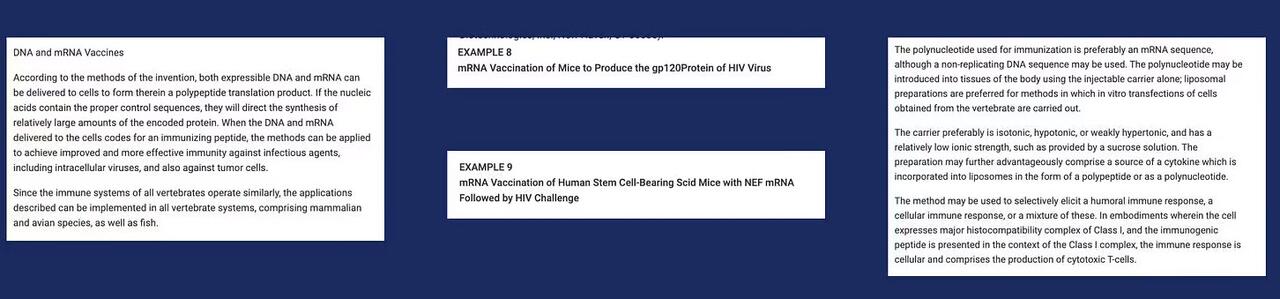
Images from the 1990 filed patents (priority date 1989)

Throughout my career, I have had to deal with other academics who have asserted that THEY were the ones that first discovered and developed what I had clearly pioneered so long ago. Dr. David Weiner (U Penn), Dr. Harriet Robinson (Merck, then Emory), Dr. Margret Liu (Merck), the list goes on and on. They all profited greatly from this. Success has many fathers, failure is a bastard.

This was partly the consequence of the “reduction to practice” of the work for vaccine purposes having occurred at a small La Jolla biotech startup called “Vical,” and my having signed non-disclosure and employment agreements which constrained my ability to disclose what I had done there or to influence the subsequent tide of events in any way.

Suffice to say, academic self-promotion, avarice, hubris, and greed are often well rewarded, and when pharmaceutical industry interests merge with academic competitiveness, then ethics gets to ride in the back of the bus. Meanwhile, while I was a young “soft money” academic, the CEO of Vical (Dr. Vijay Samant, formerly of Merck) sent me a cease and desist letter threatening to sue me if I disclosed or used the discoveries which I had made while working for that firm.

Then along come Drs. Katie Kariko (U Penn and later VP BioNTech- formerly a Hungarian spy) and Drew Weissman (U Penn- trained by Dr. Anthony Fauci)- about a decade later after my work and initial reduction to practice – who wrote a review paper in a high profile academic journal discussing my ideas without citing my work. They then tour widely promoting the logic and technology. This review then becomes the basis of a series of Wiki pages, promoting this pair and others as the original inventors. 

Meanwhile, the Vical patents issue, the initial 1990 filing dates (with a priority date of 1989) become public, and it becomes harder for those who have sought to claim credit for my work to continue to do so. But, as is often observed, a lie can circle the world while the truth is still getting its shoes tied. And in academia, it is all about pedigrees and publicity. The stories of academic “stolen valor” are legion.

Wired magazine (a publication with close CIA connections) hyped the tech, asserting that Vical would be the next Microsoft. Vical (and Merck) literally spent billions of dollars trying to develop vaccine products (using plasmid DNA rather than mRNA), and completely failed. Which does not stop them from suing Curevac for infringement with that companies early mRNA delivery and product development research.

Then the initial patents expired. Vical market capitalization collapsed to well below cash on hand, and the company merged with a smaller startup. Dr. Vijay Samant retired in comfort after over a decade collecting a huge salary. Stockholder lawsuits went nowhere. DARPA launched a funding initiative and capitalized Moderna. The German government did likewise with BioNTech.

Fast forward to 2020

Early in the COVIDcrisis, Operation Warp Speed and the NIAID Vaccine Research Center had focused on the unproven use of cationic lipid formulations of mRNA encoding the spike protein as the way to save the world from an engineered coronavirus produced at the Wuhan Institute of Virology with assistance and funding from a wide range of US Government entities (CIA, NIH, USAID, DoD, State Department). They initially did this in close cooperation with a Boston-based American company (Moderna) that was largely the creation of the CIAs technology development arm called DARPA (Defense Advanced Research Project Agency). 

U Penn licensed a Kariko and Weissman patent involving the incorporation of Pseudouridine into the mRNA (with no claims issued concerning use for vaccines) to a holding company, which then licensed to both Moderna and BioNTech. A third firm seeking to develop mRNA vaccines (Curevac) – funded in part by Elon Musk- did not license the U Penn patent and developed a SARS-CoV-2 mRNA vaccine that used a lower dose of mRNA/lipid and did not have the Pseudouridine (pseudo-mRNA) issues. Unlike Moderna and BioNTech, Curevac was more methodical, traditional (and ethical) in its product development, but its initial antibody titers and seroconversion (at a reduced dose) were lower than those reported by Moderna and BioNTech, and so it was relegated to the ash-heap of history. 

A wall of marketing hype was built around Katie Kariko and Drew Weissman as the original inventors of use of mRNA for vaccination purposes, with initial articles by Boston-based “STAT News,” followed by CNN and the New York TimesA huge corporate media buzz was developed promoting that Kariko and Weissman should be awarded a Nobel Prize (Medicine or Chemistry) for their “pioneering” work. And Moderna, with close involvement of MIT liposome technology and drug discovery superstar Professor Dr. Robert Langer, asserted that it had the dominant patent position for using mRNA as a drug or for vaccine purposes.

Jill and I objected to my being written out of history (including on Wikipedia); Jill wrote up an account of the actual history of the inventions, complete with citations to and copies of the original invention disclosures, patents, data etc. including the original patent filed by the Salk Institute and then inexplicably dropped without notifying me. The summary was sent to many – Salk Institute, UCSD, a close colleague and former collaborator at the Karolinska (now a full professor who sat on the Nobel Prize selection committee), Dr. Robert Langer (who initially claimed ignorance of my role but then conceded the facts), and many others. Letters were sent to STAT News (who refused to retract or alter their publications promoting the Kariko and Weissman stolen valor claims), CNN (who did seem to edit, back off of and retract some of what they had been pushing), and the New York Times (which definitely edited their prior video and written essays to remove claims about Kariko and Weissman being the original source of these ideas).

Kariko and Weissman received millions from the Lasker Award (often considered the American Nobel) and similar awards from the governments of Israel and Spain. But to the astonishment and disappointment of Nature magazine and US Corporate media, no Nobel prize in medicine or chemistry was forthcoming. The Nobel committee had long since reviewed the actual scientific contributions of Kariko and Weissman to the field, and determined that they were not sufficient to merit this distinction. And at that time, many (including myself) had spoken out about the risks of what had been developed for “vaccination” against COVID-19, and the bloom was off the rose. 

At this point, it became clear that my role as the inventor of this technology was what gave my concerns about the safety of the mRNA COVID-19 shots gravitas. This then became the reason for mainstream media to deny my role as inventor. 

Moderna and Pfizer were awarded “vaccine” contracts from governments across the world, and consequently reported record profits. Their market capitalization went through the roof. Moderna leadership (including Robert Langer) began “divesting” of Moderna stock. And then the patent fights began. The latest version of the various companies spun out of the University of British Columbia research group which had developed the updated version of the cationic lipid formulations which I had worked with filed patent infringement lawsuits against Moderna.

And Moderna filed lawsuits against BioNTech and their Pfizer partner/licensee claiming infringement on issued Moderna patents which, despite the eight previously issued (and expired) Vical patents which cover mRNA and DNA vaccines, claim inventorship of the idea and reduction to practice of mRNA vaccines.

At which point I decided to dig into the actual Kariko, Weissman and Moderna patents to see what are the actual issued claims. Please understand, at this point in time, the Vical patents have expired. I have no (financial) dog in this fight. Only a bystander’s perverse interest and a lingering desire to not be written out of history. And as discussed in a prior August 26, 2022 substack titled “Moderna sues BioNTech/Pfizer?” what I find when I actually do the research (in contrast to the corporate media “reporters”) is that – somehow – consistent with Dr. Robert Langer claiming no knowledge of my role in discovery and development of these ideas as a young graduate student, Moderna and its intellectual property team has completely failed to cite my prior work and the issued patents.

Which brings me to the present. Pfizer is now claiming that the Moderna patents, which Moderna sought to weaponize against Pfizer/BioNTech, are invalid because the technology and invention of using mRNA for vaccination purposes was first disclosed and reduced to practice in 1990.

In other words, Pfizer/BioNTech are now citing my work (and that of my close colleagues) to dispute the Moderna patent infringement claims – precisely as I had recommended in my August 2022 essay.

Please keep in mind that Thompson/Reuters has close ties (at the board of directors level) with Pfizer, my initial reporting on which conflict of interest was one of the key reasons I was deplatformed by Linked-In (the first time). 
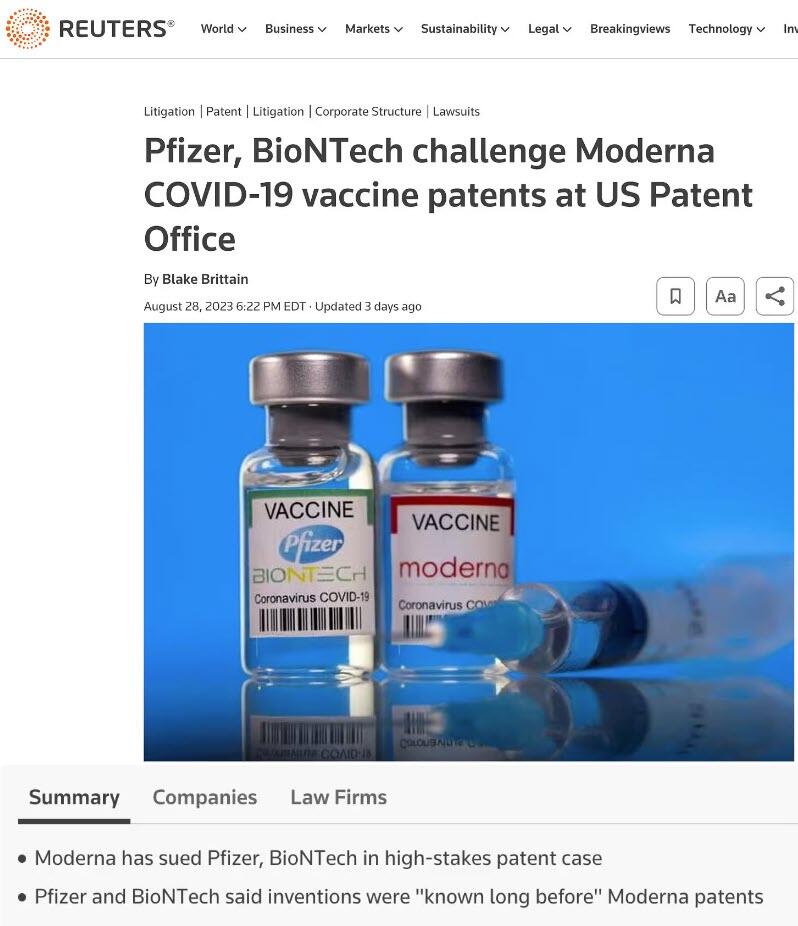
Aug 28 (Reuters) – Pfizer (PFE.N) and BioNTech (22UAy.DE) asked a US government tribunal on Monday to cancel patents on COVID-19 vaccine technology that rival Moderna (MRNA.O) has accused the companies of infringing.

Pfizer and its German partner told the US Patent Office’s Patent Trial and Appeal Board that the two Moderna patents are “unimaginably broad” and cover a “basic idea that was known long before” their invention date of 2015.

Representatives for Moderna did not immediately respond to a request for comment on the filings.

Pfizer said in a statement on Monday that it and BioNTech’s vaccine was “based on BioNTech’s proprietary mRNA technology and developed by both BioNTech and Pfizer,” and that they remain confident in their intellectual property.

Pfizer and BioNTech have separately challenged the two patents and a third related Moderna patent in court in an ongoing Massachusetts federal lawsuit that Moderna filed against them last year.

Moderna in the lawsuit accused Pfizer and BioNTech of violating its patent rights in messenger-RNA vaccine technology. The case is one of several that have been brought by biotech companies seeking patent royalties from Moderna, Pfizer and BioNTech’s blockbuster COVID-19 vaccines.

Pfizer earned $37.8 billion from sales of its COVID-19 vaccine Comirnaty last year, while Moderna made $18.4 billion from its vaccine Spikevax.

The Patent Trial and Appeal Board hears challenges to patent validity based on “prior art” that challengers say disclosed the inventions before they were patented. Defendants frequently turn to the board as an alternative path to fend off patent infringement claims.

Pfizer and BioNTech said in their board petitions that scientists discovered that mRNA could be used for vaccines as early as 1990. They argued that Moderna’s patents were invalid based on separate patent applications and other publications from as early as 2004.

And that would be my work and inventions, that of my colleagues at Vical, and the issued but expired patents which Katie Kariko, Drew Weissman, U Penn, Moderna, and corporate media have tried so hard to write out of history.

The cases are BioNTech SE v. ModernaTX Inc, Patent Trial and Appeal Board, Nos. IPR2023-01358 and IPR2023-01359.

The “fact-checkers,” intelligence community (particularly MI6 and their edits to my Wikipedia page), U Penn and their surrogates, corporate media (and Alex Berenson) have gone to great length to “overlook,” deny, defame, and ridicule me as a liar for asserting that I did the work, had the original ideas, and made these inventions. 

But the actual facts are now starting to become undeniable. And corporate media faces a paradox. Continue to conveniently “overlook” those papers I have authored and the issued but expired patents which explicitly list me as co-inventor (as Reuters has done above). Or come to grips with their own shoddy journalism, research and bias. 

Having become (justifiably) quite cynical about such matters over the years, I strongly suspect that we will exclusively see the “convenient overlook” strategy.

https://www.zerohedge.com/medical/delights-pfizermoderna-catfight

Monday, September 4, 2023

US deficit is projected to roughly double this year: watchdog

 The U.S. deficit is projected to roughly double this year, largely due to higher interest rates and lower tax revenue. 

The Committee for a Responsible Federal Budget, an organization that pushes for lowering the deficit, is projecting the federal deficit will double this year to total about $2 trillion for the fiscal year that ends Sept. 30. Marc Goldwein, senior policy director at the organization, told The Hill that high interest rates, lower tax revenues and high inflation resulting in higher Social Security and Medicare costs have all contributed to the rising deficit.

“A big part of the story is just that there was sort of a one-time huge revenue surge in 2022 that’s done,” Goldwein said. “But the other stories are that we have structurally deficits really rising in 2023. And that’s a lot of that is because of interest costs.”

“These things add up,” he added. “It’s no one thing that’s causing us to go from $1 trillion to $2 trillion. It’s like six things.”

The Congressional Budget Office estimated last month that the federal budget deficit reached $1.6 trillion in the 10-month period ending in July.

Goldwein also noted the official 2022 deficit numbers are about $4 billion higher than they should be due to the student loan cancellation because the Biden administration recorded it on last year’s numbers even before the cancellation went into place. Therefore, their prediction is based on numbers that ignore the effects of the student debt cancellation that was later struck down by the Supreme Court.

This comes years after the U.S. hit record-shattering deficit levels in 2020 and 2021 that were largely due to the pandemic-era spending and borrowing. In 2020, the deficit hit $3.1 trillion and in 2021, it hit $2.8 trillion.

“We’re predicting this, but this is really based very heavily on things that the Congressional Budget Office has already set,” Goldwein noted.

He also said he expects the deficit to go down in 2024 compared to this year. He said that over the next decade, the deficit will likely creep up to $3 trillion if there are no other “predictable shocks.”

“I do expect deficits are trending upward over time,” he said. “But I do think they’re more likely to fall than to rise in 2024.”

The Washington Post first reported on the organization’s predictions.

https://thehill.com/business/4186670-us-deficit-is-projected-to-roughly-double-this-year-watchdog/

Kim Jong Un expected to meet with Putin in Russia to discuss weapons sales to aid in Ukraine war

 North Korean leader Kim Jong Un is expected to head to Russia and meet with President Vladimir Putin to discuss, in part, selling weapons to aid the Kremlin’s war in Ukraine, according to top US officials.

The exact timeframe for the planned sit-down was not disclosed Monday by National Security Council spokesperson Adrienne Watson, but Kim would likely travel to Russia via armored train.

“We have information that Kim Jong Un expects these discussions to continue, to include leader-level diplomatic engagement in Russia,” Watson said in a statement.

“We urge the DPRK to cease its arms negotiations with Russia and abide by the public commitments that Pyongyang has made to not provide or sell arms to Russia.”

Privately, officials believe the meeting could happen as soon as next week, according to the New York Times.\

Kim rarely departs the Hermit Kingdom — at least as far as the outside world knows — but in the past, he has done so via armored train.

Kim Jong Un
Kim Jong Un pictured by his armored train in 2019.
TASS / Barcroft Images
Kim Jong Un
The North Korean leader has green lit multiple missile tests this year that have vexed US national security officials.
KCNA VIA KNS/AFP via Getty Images

In this case, he will likely head from Pyongyang, North Korea, to Vladivostok, Russia, the New York Times reported, citing officials that noted he could also go to Moscow.

Should Kim agree to trade weaponry, Putin could send him technology for nuclear powered submarines and satellites, officials told the outlet.

Kim Jong Un
The North Korean dictator inspects a major munitions factory on Sept. 2, 2023.
via REUTERS

Kim would also likely seek food supplies for his hunger-plagued nation.

Russia has been actively courting its allies as it stares down the barrel of intense sanctions from the West and an unrelenting war with its neighbor, Ukraine.

North Korea is quite familiar with western sanctions.

Vladimir Putin
US officials contend that Russian President Vladimir Putin finds himself increasingly isolated on the world’s stage.
MIKHAEL KLIMENTYEV/SPUTNIK/KREMLIN POOL/EPA-EFE/Shutterstock

Last month, Russian Defense Minister Sergey Shoygu went to North Korea prodding Pyongyang to sell ammunition to Moscow.

“Russia has been forced to turn to rogue regimes to try to obtain weapons and equipment to support its military operations. That is in part because of the sweeping sanctions and export controls that we have imposed,” White House national security spokesman John Kirby said at a press conference last week.

“One of those regimes is the Democratic People’s Republic of Korea.”

Another is China, Russia’s neighbor who has helped the Kremlin muddle through the international fallout from the bloody conflict.

Xi Jinping
Chinese leader Xi Jinping has welcomed warm ties with Russia and North Korea.
CHINE NOUVELLE/SIPA/Shutterstock

Recently, a South Korean lawmaker revealed that intelligence indicated Russia likely floated having coordinated naval drills alongside China and North Korea.

The South Korean lawmaker, Yoo Sang-bum, had been briefed by the country’s spy agency Monday, according to the Associated Press.

Russia’s Ambassador to North Korea, Alexander Matsegora recently mused that such joint exercises “seems appropriate,” per the report.

North Korea
North Korea fires off a strategic cruise missile in this undated photo.
KCNA VIA KNS/AFP via Getty Images
Next week, President Biden is set to attend the Group of 20 summit in New Delhi, India from Sept. 7 to Sept. 10.

Chinese leader Xi Jinping is expected to skip the diplomatic event amid friction with India and instead send Premier Li Qiang.

https://nypost.com/2023/09/04/kim-jong-un-expected-to-meet-with-putin-in-russia-to-discuss-weapons/

Xenon Showcases XEN1101 Program at 35th International Epilepsy Congress

 New interim data from ongoing Phase 2b X-TOLE open-label extension demonstrates improvement in overall quality-of-life (QoL) when compared to baseline

Clinically important improvements seen for all patients across important subscales of Seizure Worry, Social Functioning and Medication Effects and for seizure free patients across all QoL subscales

Oral presentations showcase Phase 3 clinical trials in focal onset seizures and primary generalized tonic-clonic seizures

https://finance.yahoo.com/news/xenon-pharmaceuticals-showcases-xen1101-epilepsy-123000931.html

'Goldman Cuts US Recession Chances to 15% on Improved Inflation'


Goldman Sachs Group Inc. now sees a 15% chance the US will slide into recession, down from 20% previously as cooling inflation and a still-resilient labor market suggest the Federal Reserve may not need to raise interest rates any further.

“First, real disposable income looks set to reaccelerate in 2024 on the back of continued solid job growth and rising real wages,” Jan Hatzius, chief economist at Goldman, said in a research note. “Second, we still strongly disagree with the notion that a growing drag from the ‘long and variable lags’ of monetary policy will push the economy toward recession.”

https://www.bloomberg.com/news/articles/2023-09-05/goldman-cuts-us-recession-chances-to-15-on-improved-inflation

New Biomarker Tests Aid Quick, Accurate Diagnosis of Alzheimer’s Disease

 Prior to the approval of effective therapies for Alzheimer’s disease, there was little need for biomarker tests. Now, with Eisai and Biogen’s anti-amyloid drug Leqembi on the market and approval of Eli Lilly’s donanemab expected to follow soon, the pipeline of Alzheimer’s drugs is expanding and the development of tests to detect the disease is accelerating.

With Leqembi’s full approval, the Centers for Medicare and Medicaid Services (CMS) has instituted broader coverage of the drug—with stipulations. To ensure reimbursement, physicians must participate in a qualified registry and patients must be diagnosed with mild cognitive impairment or mild Alzheimer’s disease dementia with evidence of beta-amyloid deposits. To help facilitate this, CMS proposed in July 2023 to increase its coverage of PET scans to detect these amyloid plaques—however, cheaper and faster diagnostic methods are still being developed.

The past decade has seen the development of biomarker tests to detect Alzheimer’s disease. In June, for example, the FDA cleared two tests from Roche that measure the concentration of beta-amyloid and tau proteins in cerebrospinal fluid (CSF). And at the end of July, Quest Diagnostics launched what it claims is the first direct-to-consumer blood-based biomarker test for Alzheimer’s.

“It’s an exciting time for Alzheimer’s disease biomarker research,” Ted Wilson, an investigator with the Alzheimer’s Disease Research Center Biomarker Core at Stanford University, told BioSpace. While these tests have yet to be accepted as diagnostic replacements for PET scans, researchers are hopeful that could be the way of the future.

Diagnostic Challenges

An estimated 6.7 million Americans have Alzheimer’s disease, with its prevalence predicted to rise. In 2023, it is estimated that dementias on the whole will cost America $345 billion. But despite their ubiquity, experts told BioSpace that obtaining an accurate diagnosis is difficult.

Part of the diagnostic challenge stems from the different types of dementia and neurological diseases that produce overlapping symptoms of cognitive impairment, Amanda Heslegrave, a research fellow at the UK Dementia Research Institute Biomarker Factory, told BioSpace. Alzheimer’s disease makes up 60–80% of dementia diagnoses, but other types include frontotemporal and vascular dementia, and a patient may suffer from multiple types of dementia simultaneously.

“The complete picture of what’s going on pathologically can often only be found at post-mortem,” Wilson said.

As a result, the diagnosis of Alzheimer’s disease is largely one of exclusion, or ruling out non-Alzheimer’s causes of symptoms, explained M. Laura Parnas, disease area network lead in cardiometabolism and neurology at Roche Diagnostics. “Obtaining an accurate diagnosis can take years,” she told BioSpace in an email.

Parsing out an accurate diagnosis is critical for making appropriate treatment decisions, experts say. For instance, frontotemporal dementia does not usually involve the buildup of amyloid plaques, and therefore anti-amyloid therapies such as Leqembi would not be an effective treatment.

To aid the diagnostic process, many researchers have set their sights on biomarker tests. These typically focus on two proteins that aggregate in the brain of dementia patients—amyloid and tau. Another biomarker for Alzheimer’s is neurofilament light chain (NfL), a marker of neurodegeneration. High levels of neurofilament indicate rapid neurodegeneration and disease progression, though a commercial diagnostic test using this biomarker has yet to be developed.

The tests approved so far examine one of two types of bodily fluids, CSF and blood. CSF samples require a lumbar puncture to retrieve and are unpopular with patients. Blood tests are often seen as the next step in Alzheimer’s diagnostics. Such noninvasive biomarker tests could reduce costs for patients and providers, Parnas said.

However, low concentration of Alzheimer’s biomarkers and the presence of other proteins in the plasma that might interfere with a potential assay have challenged this endeavor, Wilson. “Initially it was thought there were insurmountable problems using plasma as the matrix to detect these proteins.”

Currently Available Alzheimer’s Tests

Roche Diagnostics was one of the first companies to bring an Alzheimer’s diagnostic test to the market, with its Elecsys CSF beta-amyloid and phosphorylated-tau assays receiving approval in 2022. Then this June, the company received clearance from the FDA for its Elecsys CSF beta-amyloid and total tau assays. 

In both cases, the pair of tests is used in tandem to measure the ratio of beta-amyloid to tau (either phosphorylated or total). High levels of amyloid and tau in the brain—and reflected in the CSF—indicate a patient is likely suffering from Alzheimer’s disease, Heslegrave said, while a high concentration of tau alone indicates other types of dementia are the cause of cognitive impairment.

In addition to the approved Roche Diagnostic panels, another CSF test from Fujirebio Diagnostics measuring beta-amyloid received marketing authorization from the FDA in 2022. CSF tests have comparable accuracy to PET scans when diagnosing Alzheimer’s disease.

For now, though, the Alzheimer’s Association still recommends that these tests be used in conjunction with PET scans to confirm the presence of amyloid plaques in the brain and officially diagnose a patient with Alzheimer’s disease, thereby qualifying them for treatment with Leqembi. However, CMS does not state how the disease must be verified, and it’s uncertain what diagnostic tests will be needed to qualify for CMS coverage. Currently, the most common use of biomarker assays is in clinical trials to screen patients and monitor drug effects, or as part of a broader diagnostic assessment alongside neuropsychological evaluation and clinical presentation, Wilson said.

Blood-based biomarker tests are further behind in clinical development. Quest Diagnostics’ blood-based test authorized at the end of July, for example, has not been officially validated as a test for Alzheimer’s and is not endorsed by Quest as a diagnostic tool, though it can reflect Alzheimer’s disease risk.

C2N Diagnostics is also developing a blood-based Alzheimer’s test that measures plasma-tau and amyloid concentrations, and the company recently reported that the second-generation version of the test, PrecivityAD2, had comparable diagnostic accuracy to CSF tests and PET scans.

Eventually, Parnas wrote in an email to BioSpace, these tests could be used as an official Alzheimer’s diagnostic, “providing a lower cost alternative to traditional imaging techniques” such as PET scans.

https://www.biospace.com/article/new-biomarker-tests-aid-the-quick-and-accurate-diagnosis-of-alzheimer-s-disease/