Search This Blog

Friday, January 19, 2024

New DNC Pipe-Bomb Video Can "Utterly Demolish The Jan6 Narrative": Darren Beattie

 "If the Republicans step up, if the speaker steps up, if the relevant congressional figures step up, this is the chance to utterly demolish the January 6th narrative that the regime is using to weaponize the national security state against the American people, and to take Trump off the ballot."

Having acquitted himself extremely well (and calmly) during the ZeroHedge Debate on January 6th, Darren Beattie brandished his considerable tome of facts to discuss with Tucker Carlson the impact of newly-released footage surrounding the pipe-bomb incidents of January 6th (well 5th).

Carlson begins by quite appropriately pointing out the fact that the FBI's ongoing efforts to apprehend those involved (or not) in the Capitol riot contrasts greatly with their apparent inability to identify the person responsible for the pipe bombs:

"The FBI wants you to know that if you were there, you can't hide," highlighting the extensive use of surveillance technology in these efforts.

Except if you hide in plain sight...

Beattie's analysis of the discovery of the DNC pipe bomb, published on Jan. 18 by Revolver.news raises questions about the authorities' response to the bomb at the DNC.

The video shows a man (circled in red in the photo below) - now identified by congressional investigators as an undercover US Capitol Police officer - approached an SUV owned by the Metropolitan Police Department just after 1:05 p.m. on Jan. 6.

Then he walked to an adjacent dark SUV belonging to the Secret Service and spoke to someone in the driver’s seat, Revolver reported.

The vehicle was parked in a driveway of the DNC building at the intersection of Canal Street Southeast and South Capitol Street Southeast in Washington D.C.

But, as Beattie points out, their response is described as "utterly unconcerned."

"What the individual in the backpack is doing is alerting the Metro PD and the Secret Service of the fact that there is a pipe bomb just feet away," underlining the lack of urgency in their actions.

As Joseph Hanneman details, the undercover officer walked off camera back toward the park bench and the bomb at 1:06:34 p.m., the video shows.

Two occupants of the MPD vehicle exited the SUV at 1:07:25, and a third emerged 35 seconds later.

The driver went back into the vehicle to retrieve a COVID mask.

The first indication on Capitol Police radio dispatch that the DNC bomb had been discovered came at 1:07 p.m., according to audio files obtained by The Epoch Times.

“987-Adam, I’m going to declare a 10-100 at the DNC as well,” an officer broadcast on the OPS2 radio channel. “Similar device as was found at the RNC as well. Advising the units on scene what’s going on.”

At 1:09 p.m., the security camera pivoted and zoomed in on the bench, indicating that the U.S. Capitol Police Command Center was aware of the bomb.

In fact, it took more than two minutes for the Secret Service detail protecting Vice President-elect Kamala Harris to visibly react to the presence of the bomb.

Ms. Harris was inside the DNC building at the time the bomb was discovered.

A group of children were allowed to walk near the bench where the bomb sat after the undercover officer discovered the device, Revolver reported.

Children walk past the Democratic National Committee and a pipe bomb (location marked with a circle) found minutes earlier by a Capitol Police undercover officer. (U.S. Capitol Police/Graphic by The Epoch Times)

In the nearly seven minutes after the undercover officer approached the Secret Service detail, the streets were not closed, the sidewalks were not cordoned off, and pedestrians were allowed to walk right past the bomb location, security video shows.

Agents walked back and forth on the driveway and sidewalk near the bomb, and one officer walked close enough to snap a photo of the device before waving at the other officers.

The FBI later determined the bomb was planted the night of Jan. 5, along with a similar device left in an alley near the Republican National Committee, which is where the conversation between Carlson and Beattie goes next.

Beattie mentions that the bomb was found by a pedestrian, Karlyn Younger, in a back alley with a timer set to go off at 1 p.m., coinciding with the certification of the electoral vote, raising questions about the intent and timing of the bomb placements:

"We're told that the RNC bomb was sitting behind a trash can in a back alley, undiscovered for over 16 hours, and yet was randomly stumbled on."

Beattie then discusses the characteristics of the bombs, noting that they were not designed for remote detonation, suggesting they were not intended to explode but rather serve as a diversion.

He also questions how the discoverers of the bombs could be so accurately timed, noting:

"The person who planted the bombs presumably would have had to count or just simply be the luckiest person alive."

In conclusion, Beattie and Carlson discuss the political implications of the January 6th narrative and the lack of thorough investigation into the pipe bombs.

As we started with at the top of this note, Beattie emphasizes the importance of challenging the official narrative, particularly in the context of the upcoming 2024 election.

Watch the abridged discussion below:

Watch the full interview here at TCN...

https://www.zerohedge.com/markets/new-dnc-pipe-bomb-video-can-utterly-demolish-jan6-narrative-darren-beattie

Targeting annexin-A1 can halt cancer cell growth, study finds

 A new study published in Oncogene highlights the effectiveness of MDX-124, the first therapeutic drug to target annexin-A1, a protein that is overexpressed in several cancer types and promotes tumor progression.

The research was led by Professor Chris Parris and Dr. Hussein Al-Ali at Anglia Ruskin University (ARU) in collaboration with Professor Chris Pepper of Brighton and Sussex Medical School and UK biotech company Medannex, which has produced the MDX-124 monoclonal antibody therapy.

High annexin-A1  correlate with poorer overall survival in various cancers that currently have limited , including triple-negative breast, pancreatic, colorectal, and .

The new study found that MDX-124, which is being developed for use in immunotherapy, significantly reduces proliferation across a number of human cancer cell lines expressing annexin-A1. This anti-proliferative effect is instigated by stopping cell cycle progression.

Additionally, MDX-124 is shown to significantly inhibit tumor growth in in vivo models of triple-negative breast and pancreatic cancer, indicating that annexin-A1-targeted therapy represents a viable and innovative approach to cancer treatment.

The phase Ib  of MDX-124, called ATTAINMENT, is currently underway to establish the safety and optimum dose of the novel therapy. Its clinical efficacy will then be evaluated in newly diagnosed cancer patients in combination with current appropriate treatments.

Professor Chris Parris, Head of the School of Life Sciences at Anglia Ruskin University (ARU), said, "We know that the protein annexin-A1 activates formyl peptide receptors to initiate a complex network of intracellular signaling pathways, which can lead to numerous cellular responses, including tumor initiation and progression."

"We have demonstrated in this new study that using MDX-124 can reduce  in annexin-A1-expressing cancer cells both in vitro and in vivo, providing further evidence that annexin-A1 is a valid target for therapy in cancer."

Medannex Director of Scientific Operations, Dr. Fiona Dempsey, who co-authored the paper, said, "We are delighted to publish this work with our collaborators demonstrating the anti-cancer potential of our innovative antibody therapeutic and look forward to the  coming out of the ATTAINMENT study in due course."

More information: Hussein N. Al-Ali et al, A therapeutic antibody targeting annexin-A1 inhibits cancer cell growth in vitro and in vivo, Oncogene (2024). DOI: 10.1038/s41388-023-02919-9


https://medicalxpress.com/news/2024-01-annexin-a1-halt-cancer-cell.html

Incisionless device could revolutionize treatment for diabetes, liver disease and severe obesity

 A completely incisionless device that replicates metabolic surgery without making any cuts could surpass current technologies for managing metabolic conditions, providing unmatched treatment for millions of people who reject invasive surgery or do not respond to drugs.

In a study authored by an international team of prominent academics including scientists from King's, researchers found that the ForePass endoscopic showed extraordinary efficacy in treating conditions such as , type 2 diabetes, and metabolic dysfunction-associated steatohepatitis (MASH).

Published in the journal Gut, the study aimed to evaluate the ForePass device's impact on weight, , and fecal microbiota (a range of microorganisms) in pigs, compared to a control group that did not undergo the procedure.

Results revealed a 79% reduction in weight gain compared to the , suggesting it may be substantially more effective than common metabolic surgeries like . It also showed substantial improvements in how the body handles insulin and reduces glucose in the liver compared to controls.

Finally, the study found markedly improved response to insulin, enhanced use of glucose, and beneficial changes in metabolic health-related gut bacteria.

"The ForePass device will be a game-changer for treating severe metabolic conditions. It replicates the effects of  without invasive procedures and without making any cuts to internal organs. It's the first device of its kind and will pave the way for a new era in managing severe ," said lead author Dr. Manoel Galvao Neto, endoscopic surgeon and researcher based at Sri Aurobindo Medical College, India.

Dr. Neto continued, "It is a crucial development, as only 1% of patients opt for bariatric  due to its invasive nature. The  is eagerly anticipating the upcoming clinical trials involving the ForePass device."

ForePass is an innovative device, developed by Keyron, that combines a gastric balloon crossed by a central channel that connects to a flexible intestinal sleeve, thereby effectively replicating the mechanism of invasive metabolic surgery without the need for surgery or making any incisions.

The device is inserted into the stomach and initial tract of the small intestine using endoscopy, a much less invasive and cheaper procedure compared to metabolic surgery. Unlike metabolic surgery, ForePass is fully reversible, making it an appealing option for patients.

For the study, the pigs were implanted with ForePass for a month, and the device demonstrated a significant 79% decrease in  and marked enhancements in glucose balance compared to control animals who were not implanted with the device.

Additionally, it favorably altered fecal microbiota, boosting bacteria linked to metabolic well-being. These outcomes align with a reversal of severe obesity, diabetes, and MASH, indicating an overall improvement in metabolic health.

"This study's findings are extraordinary and unprecedented. We learned that ForePass could be even more effective than metabolic surgery. Traditional treatments, including drugs, fall short for individuals with higher BMIs. ForePass stands out as it offers the benefits of metabolic surgery without the need for actual surgery, making it a game-changer for millions who are reluctant to undergo surgery. It promises to revolutionize treatment for severe obesity and insulin resistance-related pathologies like diabetes and various liver diseases," said Co-author Geltrude Mingrone, Professor of Diabetes and Nutrition, King's.

ForePass is designed to decrease , resulting in considerable weight loss, and directs food deeper into the gut. This process significantly improves insulin resistance, effectively treating or potentially reversing diabetes and serious liver conditions such as MASH.

"Considering that existing medications fall short in achieving the necessary weight loss for individuals with very high BMIs, ForePass will be a transformative solution for these patients. It has the potential to significantly impact the lives of tens of millions of people in the U.S. and EU alone," said Co-author Professor Stefan R Bornstein, Chair in Diabetes and endocrinology consultant based at King's.

Keyron plans to initiate clinical trials for ForePass, which is anticipated to start in early 2025. Should  confirm the safety and efficacy seen in animals, the device has the potential to revolutionize the treatment of severe obesity over the coming decades.

More information: Giulia Angelini et al, ForePass endoscopic bypass device for obesity and insulin resistance—metabolic treatment in a swine model, Gut (2023). DOI: 10.1136/gutjnl-2023-331335


https://medicalxpress.com/news/2024-01-incisionless-device-revolutionize-treatment-diabetes.html

1st therapeutic target for preserving heart function in patients with pulmonary hypertension

 A research team has discovered a possible therapeutic target for pulmonary hypertension. The study, published in the journal Science Advances, identifies the first therapeutic target that can be modulated to preserve cardiac function in pulmonary hypertension, providing hope in the fight against this rare but fatal disease for which there is currently no cure.

Pulmonary hypertension is a condition of elevated  in the arteries that carry deoxygenated blood to the lungs. This increased pulmonary blood pressure puts the heart under continuous strain as it has to work harder to pump blood to the lungs.

Pulmonary hypertension affects between 15 and 50 people per million of the world's population. In Spain, the estimated prevalence is 1.6 cases per 100,000 inhabitants, and the estimated incidence (new cases diagnosed per year) is 0.3 per 100,000 inhabitants.

The disease produces symptoms that can severely affect quality of life, including shortness of breath, dizziness, and fainting. In severe cases, patients can require transplantation to prevent death.

Risk factors for developing  include smoking, excess weight, a history of related conditions, genetic predisposition, and prolonged exposure to low  at high altitudes.

Currently available treatments target the lungs, aiming to lower blood pressure. However, these strategies do not improve , making heart failure the main cause of death in these patients.

The researchers, led by Dr. Guadalupe Sabio at the Centro Nacional de Investigaciones Cardiovasculares (CNIC) in Madrid, found that patients with  (COPD) have elevated levels of a mitochondrial protein called MCJ.

First author Ayelén M. Santamans observed that MCJ was also elevated in mice exposed to low oxygen levels and in pigs with induced cardiac injury. "These results therefore suggested that the MCJ protein might be involved in pulmonary hypertension. The lack of cardio-specific treatments for this disease spurred us to pursue this line of research."

The study results demonstrate that modulating the levels of MCJ in the heart can preserve cardiac function despite the presence of lung injury.

This protection is a consequence of the activation of a signaling pathway essential for adaptation to , which prepares the heart to function properly in the absence of oxygen.

The authors conclude that these findings could open the way to therapeutic interventions against pulmonary hypertension, as they identify the first target whose modulation can preserve cardiac function in this fatal disease.

More information: Ayelén Santamans et al, MCJ: A mitochondrial target for cardiac intervention in pulmonary hypertension, Science Advances (2024). DOI: 10.1126/sciadv.adk6524www.science.org/doi/10.1126/sciadv.adk6524


https://medicalxpress.com/news/2024-01-scientists-therapeutic-heart-function-patients.html

Evolution of the human immune system in the post-omicron era

 It has been four years since the start of the COVID-19 pandemic. SARS-CoV-2 has yet to be eradicated and new variants are continuously emerging. Despite the extensive immunization programs, breakthrough infections (infection after vaccination) by new variants are common.

New research suggests that human immune responses are also changing in order to combat the never-ending emergence of new SARS-CoV-2 variants. Specifically, it has been discovered the  that encountered  by the  acquires enhanced immunity against future versions of the omicron. The study is published in Science Immunology.

A team of South Korean scientists led by Professor Shin Eui-Cheol of the Korea Virus Research Institute Center for Viral Immunology within the Institute for Basic Science (IBS) announced that the  T cells that form during the omicron breakthrough infection respond to subsequent strains of the virus.

Emerging in late 2021, the SARS-CoV-2 omicron variant had drastically increased transmissibility in comparison to its predecessors, which quickly allowed it to become the dominant strain in 2022. New strains of omicron have kept emerging ever since then. Starting with BA.1 and BA2, BA.4/BA.5, BQ.1, XBB strains, and more recently JN.1 strains were among the new strains of the omicron variant. This has led to widespread breakthrough infection despite vaccination.

After becoming infected or vaccinated, the body creates neutralizing antibodies and memory T cells against the virus. The neutralizing antibody serves to prevent host cells from being infected by the virus. While memory T cells cannot prevent the infection, they can quickly search and destroy infected cells, preventing the viral infection from progressing into a severe disease.

The research team's goal was to find out the changes that occur in our body's immune system after suffering from post-vaccination breakthrough infection. In order to answer that question, they focused on the memory T cells that formed after the omicron infection.

The previous studies on the omicron  have mostly focused on  or neutralizing antibodies, and the research related to memory T cells has been comparatively lacking.

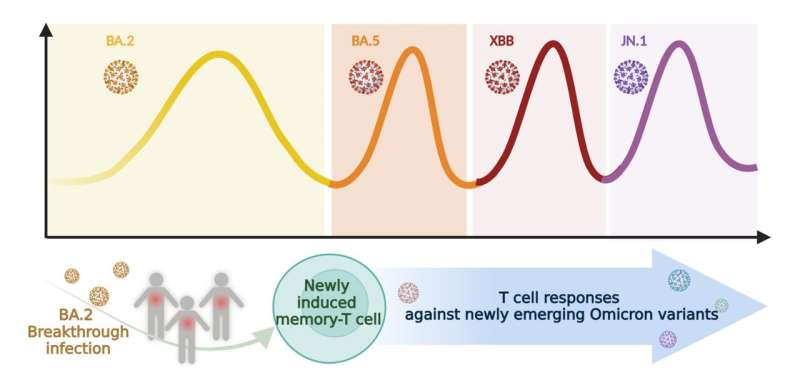
Evolution of the human immune system in the post-Omicron era
Memory T cells formed after BA.2 omicron breakthrough infection showed a strong immune response not only against BA.2 but also later omicron variants including BA.4/BA.5, XBB, and others. By suffering from omicron breakthrough infection, the immune system gained the ability to handle future infections from emerging variants. This research shows that experiencing omicron breakthrough infection can prevent a patient from progressing into severe COVID-19 when encountering new variants of the virus in the future. Credit: Institute for Basic Science

The research team selected patients who suffered then recovered from BA.2 omicron breakthrough infection in early 2022 as subjects and conducted studies on their memory T cells, specifically in their ability to respond to various omicron variants such as BA.2, BA.4/BA/5, and others.

In order to do so,  were separated from the peripheral blood of the subjects, and the memory T cells' cytokine production and anti-viral activities in response to various spike proteins from different variants were measured.

The results showed that the memory T cells from these patients showed heightened response against not only the BA.2 strain but the later BA.4 and BA.5 strains of omicron as well. By suffering from breakthrough infection, these patients' immune system was strengthened to combat future strains of the same virus.

The research team also discovered the specific part of the spike protein which is the primary cause of the observed enhancement in the memory T cells. These results show that once a person undergoes breakthrough infection by the  infection, it is unlikely for them to ever suffer severe COVID-19 symptoms from the future emerging variants.

Research Fellow Jung Min Kyung who led this research stated, "This finding gives us new perspectives in the new era of COVID endemic," adding, "It can be understood that in response to constant emergence of new virus variants, our bodies have also adapted to combat the future strains of the virus."

Director Shin Eui-Cheol of the Center for Viral Immunology commented, "This new finding can also be applied to vaccine development. By searching for common features among the current dominant strain and emerging new strains of viruses, there may be higher chances to induce memory T cell defenses against the subsequent variants."

This research has been conducted in collaboration with colleagues from Yonsei University Severance Hospital, Korea University Hospital, Sungkyunkwan University, and Samsung Medical Center.

More information: Tamara Haque et al, TGFβ prevents IgE-mediated allergic disease by restraining T follicular helper 2 differentiation, Science Immunology (2024). DOI: 10.1126/sciimmunol.adg8691www.science.org/doi/10.1126/sciimmunol.adg8691


https://medicalxpress.com/news/2024-01-evolution-human-immune-omicron-era.html

Biden’s US border fentanyl crisis is now deadly enough to kill EVERY American

 Joe Biden’s border crisis is deadly enough to kill every American, literally — as proven by the 386 million doses of fentanyl seized by the DEA in 2023

Fentanyl is now the leading cause of death for Americans between 18 and 45. 

The 12 months ending in April 2023 saw more than 111,355 overdose deaths among Americans — even higher than the already record-breaking 110,394 the year before.

At an average of 22 deaths per week, the death rate for teen drug ODs in 2022 more than doubled the rate in 2018, another grim figure driven by the synthetic opioid. 

Fentanyl victim Ashley Dunn died of an overdose in 2021; her mother gave heartbreaking testimony before Congress Thursday at an impeachment inquiry hearing for Biden’s border enabler No. 1, Homeland Security Secretary Alejandro Mayorkas.

Pathetically, slimy Rep. Dan Goldman (D-NY) tried to deflect blame onto a supposed lack of Customs and Border Protection resources, only to be thunderously and correctly shut down by Ashley’s mother, Josephine.

Over 300 million doses of fentanyl were seized by the DEA in 2023.AP

Making Goldman’s smug indifference worse, nearly 10% of the DEA’s record 2023 fentanyl haul was captured right here in New York. 

By the way: A huge chunk of the record US fentanyl seizure was disguised as another drug — in some cases, prescription drugs — amounting to 37 million lethal doses.  

No wonder this poison is killing adults and children across the country. 

Josephine Dunn, whose daughter died of a fentanyl overdose, gave tearful testimony at the impeachment hearing for Homeland Security Secretary Alejandro Mayorkas.Bonnie Cash/UPI/Shutterstock

It is the public health crisis of our age: not racism, not COVID. 

And our public health experts don’t make anywhere near the same outraged noise they do about politically approved health issues. 

Why is that? 

Well, consider where all the fentanyl comes from: the man these experts overwhelmingly voted for

Ashley Dunn died of a fentanyl overdose in 2021.Bonnie Cash/UPI/Shutterstock

It moves across our utterly open southern border after being manufactured by powerful narco cartels in Mexico, typically from China-made starter chemicals. 

The millions of illegal migrants Biden has invited in to crush the economies and social services of towns from Texas to the Big Apple are bad enough. 

That he has also opened his country, which he swore to defend and protect, to this toxic scourge is a moral obscenity.

He has the blood of hundreds of thousands of dead Americans on his hands. (Yet he manages to laugh at it.

This alone should disqualify him from re-election.  

https://nypost.com/2024/01/19/opinion/biden-border-fentanyl-crisis-could-kill-every-last-american/

AstraZeneca: IMFINZI + transarterial chemoembolization + bevacizumab cut progression, death in liver cancer

 Positive results from the EMERALD-1 Phase III trial showed AstraZeneca’s IMFINZI® (durvalumab) in combination with TACE and bevacizumab demonstrated a statistically significant and clinically meaningful improvement in the primary endpoint of progression-free survival (PFS) compared to TACE alone in patients with hepatocellular carcinoma (HCC) eligible for embolization.

These results will be presented today at the 2024 American Society of Clinical Oncology Gastrointestinal Cancers Symposium (ASCO GI) in San Francisco, California (#LBA432).

Approximately 20-30% of patients with HCC, the most common type of liver cancer, are eligible for embolization, a procedure that blocks the blood supply to the tumor and can also deliver chemotherapy or radiation therapy directly to the liver.1-8 Despite being the standard of care in this setting, most patients who receive embolization experience disease progression or recurrence within eight months.9-11

In EMERALD-1, treatment with IMFINZI plus TACE and bevacizumab reduced the risk of disease progression or death by 23% compared to TACE alone (based on a hazard ratio [HR] of 0.77; 95% confidence interval [CI] 0.61-0.98; p=0.032). Median PFS was 15 months in patients treated with the IMFINZI combination versus 8.2 months with TACE. The PFS benefit observed was generally consistent across key prespecified subgroups. The secondary endpoint of time to progression (TTP) further supports the clinical benefit of IMFINZI plus TACE and bevacizumab in this setting, with a median TTP of 22 months versus 10 months for TACE (HR 0.63; 95% CI 0.48-0.82).

The trial will continue as planned to assess the key secondary endpoint of overall survival (OS).

https://www.biospace.com/article/releases/imfinzi-durvalumab-plus-transarterial-chemoembolization-tace-and-bevacizumab-reduced-the-risk-of-disease-progression-or-death-by-23-percent-vs-tace-in-liver-cancer-eligible-for-embolization/