Search This Blog

Monday, June 3, 2024

You Probably Already Have Heart Disease But Just Don't Know It

 Heart disease is something ‘old people’ need to worry about.

Sure. That is true.

But so do ‘Young People’.

Here’s why.

The mistake most people make when it comes to heart disease is thinking that when someone has a heart attack that, the condition of ‘heart disease’ just appeared.

Heart attacks present suddenly. But heart disease presents slowly.

Heart disease, the build-up of plaque in the coronary arteries, typically starts years, if not decades, prior to an event.

In many cases, you can see the risk coming years in advance.

This doesn't apply to everyone, but on average, you can see the risk coming.

So When Does Heart Disease Appear?

The answer to this question depends on how you look for it.

The most common way to assess the presence and extent of coronary artery disease is with a CT scan, called a CT CAC score or CT Coronary Angiogram.

These noninvasive scans look directly at the coronary arteries rather than assessing for the risk factors for coronary artery disease eg LDL cholesterol, high blood pressure etc.

CT Coronary Angiogram. Atherosclerosis in the proximal segment of the vessel.

The amount of plaque is an excellent predictor of the risk of heart attack over the following 10-year period1.

The more plaque, the higher the risk.

The less plaque, the lower the risk.

As the line goes, “No Plaque. No Heart Attack”.
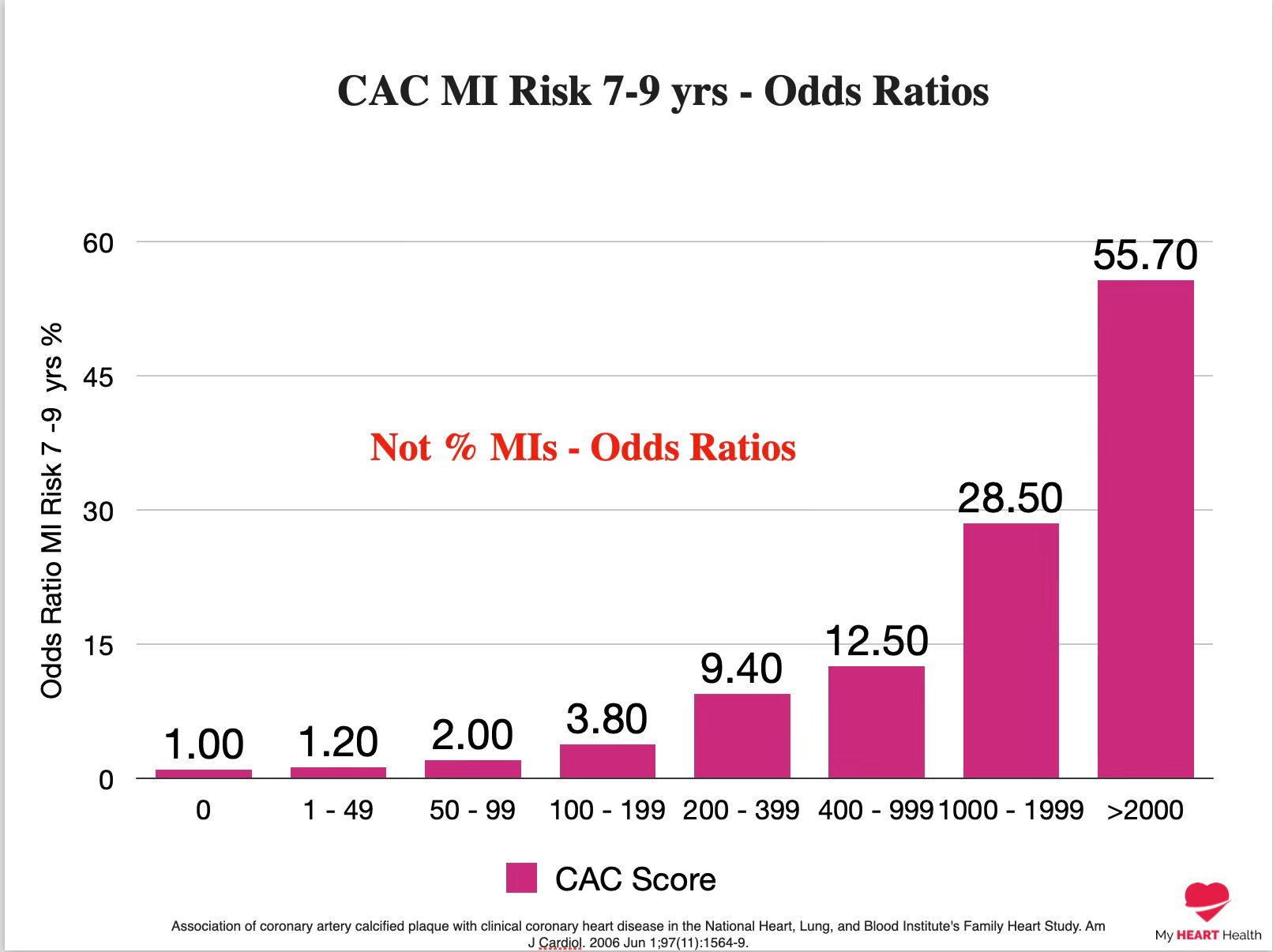
A CT CAC score of 0 indicates a very low risk of a heart attack over the following 10-year time frame.

However, over a long enough time horizon, everyone will convert from a CAC of 0 to a CAC above 0.

When that transition happens is important.

If it happens very early in life, then you have started to accumulate plaque and risk much earlier in life.

This transition happens about ten years later for females than males, which likely accounts for why females have major heart events later in life than aged-matched males.

In general, there is a 50% chance a male will have a CAC score > 0 at age 55, and for females, that is around age 662.

This is also why it is important to note that if you have a CAC score > 0 at below this age for your sex, you are accumulating plaque and risk earlier than compared to an aged-matched peer.

But waiting for the appearance of calcification is a bad idea.

Here’s why.

Atherosclerosis, or plaque, is a progressive condition that occurs in stages over decades.

The appearance of calcification seen on CT scans is a marker of late-stage plaque.

Calcification is primarily a feature of the later fibroatheroma stages.
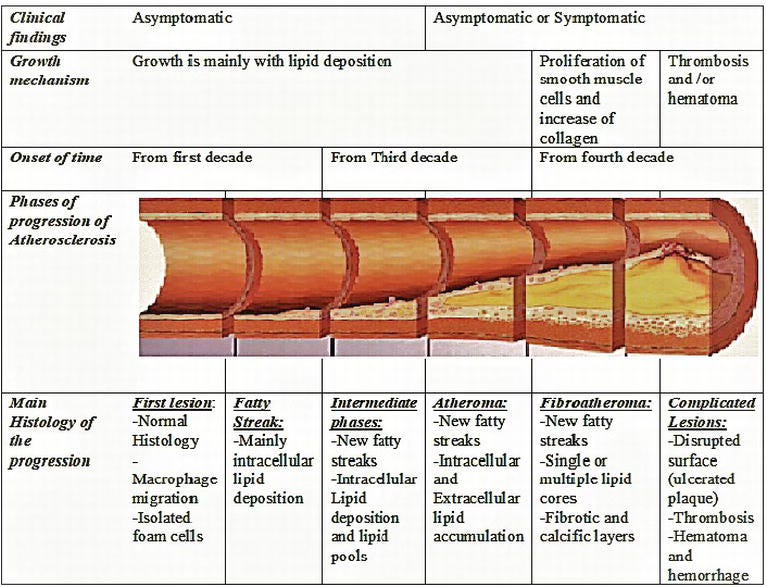
But as you can see, plaque has likely been accumulating for many years prior to the advanced stages.

So, if you have calcification in your 50s and 60s, you likely had earlier-stage plaque for many years before that.

How Much Earlier?

Way earlier than you might think.

Autopsy studies of returning veterans from the Korean War who were killed in combat and not from heart-related issues were studied to see when the early stages of plaque accumulation began.

Out of 300 autopsies, 77% had evidence of early-stage plaque buildup.

The average age of these veterans was only 22 years of age3.

The prevalence of smoking back in the 1950s would have been much higher, but even recent studies on ‘healthy’ heart transplant donors who died from events such as road traffic accidents still show high rates of very early-stage plaque buildup4.
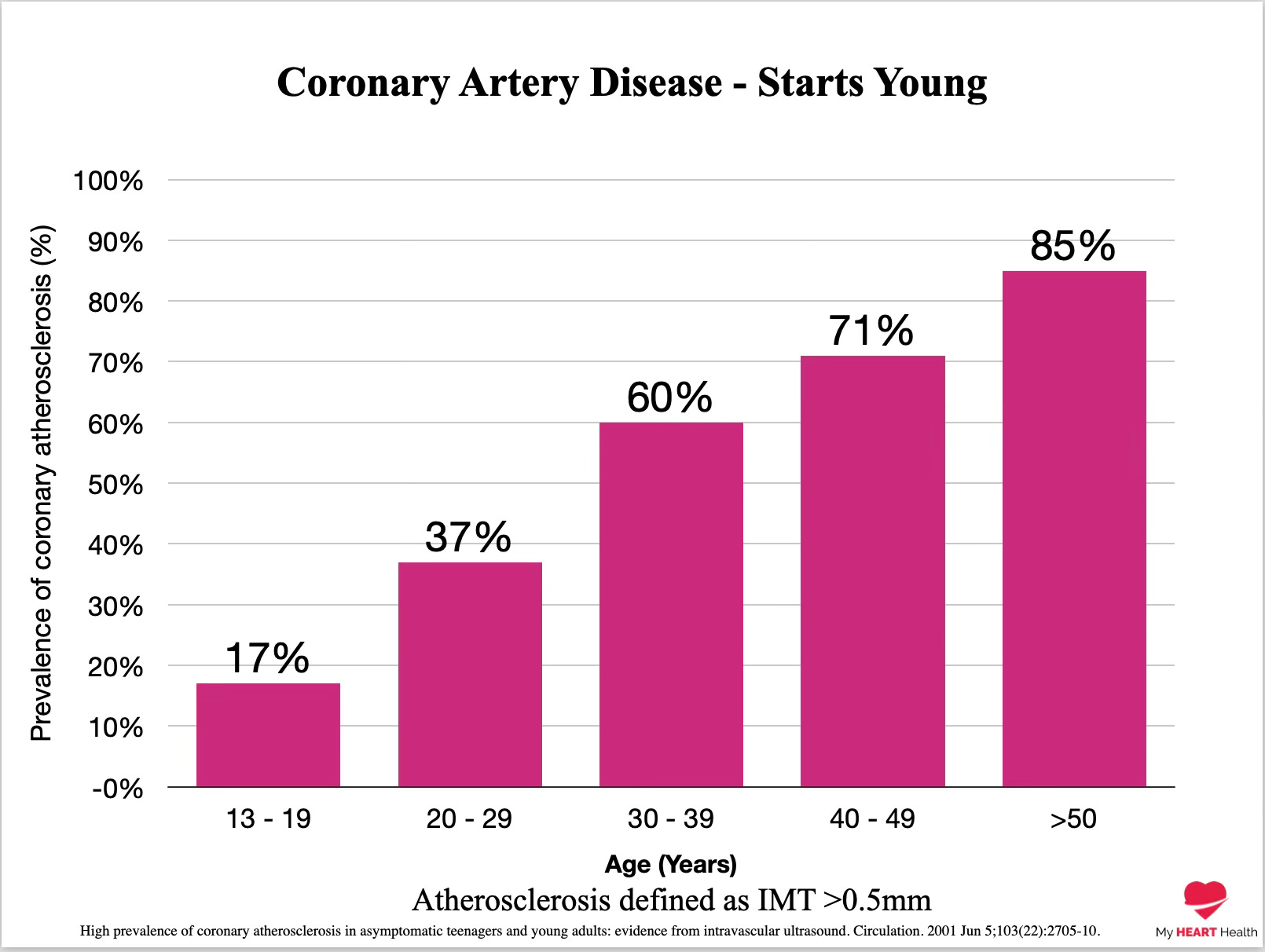
The very earliest stages of plaque build-up have even been noted in infants who died of sudden infant death5.

There seems to be no lower age bound on when early plaque accumulation can commence.

Two Points Should Be Made Very Clear.

Firstly, just because someone has evidence of very early-stage plaque buildup in their 20s or 30s does not mean they are at very high risk of a heart attack in the near future.

It is a marker of where someone is on a disease progression pathway.

Secondly and more importantly, IF your goal is to prevent the early build-up of significant amounts of plaque early in life, the risk factors for cardiovascular disease must be addressed early in life.

For most people, that will be an increased focus on lifestyle.

But for some, it may require medications.

The key here is to understand your goal and the time frame over which you are trying to reduce risk.

Because waiting until later in life to seriously address cardiovascular risk factors may not be the best plan.

Because the disease that is atherosclerosis is already very likely present in your coronary arteries as you read this.

And although today is an excellent time to start focusing on it.

Twenty years ago might have been even better.


Heart. An Owner’s Guide.

If you are looking for an easy and accessible explanation of heart disease and how to reduce your future risk, my best-selling book Heart. An Owner’s Guide is a great place to start.

It is suitable for all readers and is a series of two-page graphic spreads on topics ranging from insulin resistance to how to lower LDL cholesterol and high blood pressure with lifestyle measures to using fitness metrics for cardiovascular health.

Join thousands of other readers in getting started with your heart health.

You can purchase the book in all good bookstores or online by clicking here or on the image below.

1

Association of coronary artery calcified plaque with clinical coronary heart disease in the National Heart, Lung, and Blood Institute's Family Heart Study. Am J Cardiol. 2006 Jun 1;97(11):1564-9.

2

Distribution of coronary artery calcium by race, gender, and age: results from the Multi-Ethnic Study of Atherosclerosis (MESA). Circulation. 2006 Jan 3;113(1):30-7.

3

CORONARY DISEASE AMONG UNITED STATES SOLDIERS KILLED IN ACTION IN KOREA: PRELIMINARY REPORT. JAMA. 1953;152(12):1090–1093.

4

High prevalence of coronary atherosclerosis in asymptomatic teenagers and young adults: evidence from intravascular ultrasound. Circulation. 2001 Jun 5;103(22):2705-10.

5

Perinatal and infant early atherosclerotic coronary lesions. Can J Cardiol. 2008 Feb;24(2):137-41.


Dr Paddy Barrett, Preventive Cardiologist writing on how to prevent heart disease and live longer.

https://paddybarrett.substack.com/p/why-you-probably-already-have-heart

Who is correct about content moderation in public heath?

 Recently, AI researcher Yann LeCun and Tesla/X/SpaceX CEO Elon Musk had a public disagreement. Among his criticism of Musk, Yann is concerned that Elon doesn’t want to restrict speech, specifically on matters of public health.

“This has become particularly concerning since he bought himself a platform to disseminate his dangerous political opinions, conspiracy theories, and hype. He has been quite naïve about the difficulties of running a social network and the (legal) necessity of doing content moderation. One can claim to be a 1st Amendment absolutist, but a lot of content *must* be taken down by law, e.g. terrorist propaganda, child exploitation, blatant hate speech (in the EU and other regions). Then, there is dangerous disinformation that puts public health in danger or corrupts the democratic process. You have to moderate that too. Content moderation is a complicated problem whose best answer is not an attitude of total laissez-faire but a complex trade-off.”

This is a common rallying cry. If we don’t have content moderation we will have, as Yann puts it, “dangerous disinformation that puts public health in danger.”

Is Yann correct that social media platforms should police information on matters of public health?

Consider that there are two errors companies can make. They can fail to remove information that is actually wrong, and they can remove information that is actually correct. Consider also that information comes from 3 places— central authorities (CDC, NIH, Fauci), and individual experts (Jay Bhattacharya), and fringe groups.

The problem with content moderation is not only that we have seen both types of errors, but that the moderators have different rules for different speakers. Central authorities are never censored, and individual experts are. Even as central authorities spout unproven, false, misleading and criminal statements, and individual experts tell the truth. Rarely, fringe groups are correct and censored.

A few examples:

Facebook censored posts that even suggested lab leak might be possible, and now the House subcommittee has unearthed what appears to be a criminal conspiracy to mislead the public about lab leak. Years after this censorship this is currently the NY Times headline— a complete reversal.

Additionally, the CDC has repeatedly and falsely stated that cloth masking slows the spread of COVID, that masking kids < 5 is not harmful, that boosters benefit people who have had covid, that myocarditis from COVID is worse than from the vaccine, and that lockdowns did more harm than good. On most of these issues, the current prevailing view in the media is still false.

Central authorities were never censored on any platform despite countless false statements.

Meanwhile individual experts were repeatedly censored or de-throttled for criticism of lockdowns, masking, vaccine mandates, myocarditis risk for young men, and vaccinating people who already had and recovered from COVID. Martin Kullsdorf had tweets removed and was banned from LinkedIn. These individual experts were broadly correct— but worse, curtailing their speech created the false illusion of consensus.

Now, consider the fringe elements. There have been billions of completely false statements put for by third parties. For e.g. that vaccines contain microchips or that covid vaccines killed all subgroups (e.g. they were net harmful to a 80 year old who did not previously have covid).

Despite content moderation, billions of false claims were NOT removed from platforms. It is hard to know if removing some-- a tiny fraction of these claims— is better than removing none. I haven’t seen evidence to support the claim that removing some false ideas— at great cost and at risk of removing true ideas— actually helped any human being. There is a handful of people in whom these ideas gain traction, and they often seem validated by the mere act of removal.

Putting this all together, I think Yann is wrong, Elon is right, and the pandemic actual exposes the greatest risk: Censorship is not deployed based on the truthfulness of claims, but rather to centralize power and authority and squash dissent. The problem is when the dissenters are correct, in begging us to stop the car, while the central authorities drive us off over a cliff.


https://www.drvinayprasad.com/p/who-is-correct-about-content-moderation

Biden's Inflation Reduction Act Unravels Medicare Part D

 In May, Medicare bureaucrats released new guidance that details how they'll conduct the drug pricing "negotiations" authorized by the 2022 Inflation Reduction Act. They're mostly maintaining the policies in last year's inaugural round of price setting—which means the quality of seniors' Medicare Part D coverage will continue to deteriorate.

When President Biden signed the IRA in 2022, Democrats in Washington boldly promised the law would lower Medicare costs for America's seniors. They touted the newfound ability of Medicare to set prices on popular drugs starting on January 1, 2026, along with the law's $2,000 cap on annual out-of-pocket prescription costs and its 6% limit on yearly increases in Part D premiums. Among those drugs subject to the first round of controls are Eliquis, Jardiance, and Enbrel.

Unfortunately, they neglected to inform seniors who's paying for those savings. The answer? Seniors themselves—through skyrocketing premiums hidden behind Washington accounting gimmicks.

The reality is that the IRA is slowly, but predictably, destroying Medicare's "Part D" drug benefit, which for years managed to keep costs low by harnessing the power of market forces and pitting private insurers against each other in fierce competition for seniors' business.

The IRA made enormous changes to Part D, with significant government and bureaucratic intervention that is making it less attractive for stand-alone Part D plans previously offered by a range of insurers to participate in the market. In 2006, the first year that Medicare Part D was available, insurers offered 1,429 plans to seniors nationwide. This year, insurers offered just 709—a decline of more than 50%. In the past year alone, the number of plans that seniors could choose from dropped by 11%.

And those plans are considerably more expensive now, post-IRA passage, on average. The typical standalone Part D plan costs seniors $48 per month, a 21% increase compared to last year. Even steeper increases are projected for 2025.

The new guidance will only exacerbate these trends and continue to jeopardize the availability of Part D medicines and inhibit generic and biosimilar competition. Analysts expect Part D insurers to react by implementing more restrictive measures, including "prior authorization" or "step therapy" requirements.

The root of the problem is that the IRA's price controls are primarily designed to save the government money, not seniors. And the provisions that genuinely do save some seniors money—like the $2,000 cap on out-of-pocket drug spending—ultimately shift costs onto insurers, and CMS is turning a blind eye to their cost-saving tactics.

Although lawmakers tried to cap premium increases, the way it was written isn't what Democrats advertised at all. It applies only to one of the underlying calculations used in setting monthly premiums. Any given plan's monthly cost to seniors can go up by 20%-40% while still remaining in compliance with the 6% increase. That's Washington math for you.

As the new guidance makes clear, Medicare officials will continue setting drug prices with virtually no input from physicians. Nor has Medicare created a process to monitor the impact of price negotiations on which medicines are available to seniors. The price controls will also deter generic competitors from entering the market when drugs go off-patent. In short, premiums are up, choices are down, the government is more in control, and patients and doctors are left to pick up the pieces.

Officials can turn a blind eye to these problems. But Americans heard Democrats promising improvements to their prescription drug coverage. Instead, the Inflation Reduction Act is slowly strangling Medicare's drug benefit.

Sally C. Pipes is president, CEO, and the Thomas W. Smith fellow in healthcare policy at the Pacific Research Institute. Her latest book is False Premise, False Promise: The Disastrous Reality of Medicare for All, (Encounter 2020).

https://www.forbes.com/sites/sallypipes/2024/05/31/bidens-inflation-reduction-act-unravels-medicare-part-d/

Trump Makes Big Promise On Gaza War To UFC Superstar Khabib

 Via Middle East Eye

Former US president Donald Trump appears to have made his biggest and boldest campaign promise yet. During a Ultimate Fighting Championship (UFC) event in Newark, New Jersey on Saturday, the 2024 presidential hopeful vowed that he would stop Israel's devastating war in Gaza when confronted by former mixed-martial artist and UFC legend Khabib Nurmagomedov.

Following Islam Makhachev submission victory over Dustin Poirier for the Lightweight Championship, Nurmagomedov, who serves as a coach for Makhachev, was heard telling Trump: "I know you will stop the war in Palestine."

Trump, who routinely touts his support of Israel but has also been critical of the war on Gaza, responded by saying: "We will stop it. I will stop the war."

The clip was shared widely on X, formerly known as Twitter, and has since made rounds on other social media platforms to much praise. "Love seeing Khabib tell Trump to stop the genocide," said former UFC fighter and anti-war activist Jake Shields.

"Overall I like Trump much more than Biden but his unequivocal support for Israel is a deal-breaker for me. Almost all of his funding comes from ultra zionist so he's unlikely to switch directions but still good hes hearing it."

"Bro just accomplished more than all of our Arab leaders in this war," another user said. "This is what you call using your voice and name to call for change," another added. 

Others, however, were quick to point out that Trump's statements and actions whilst in office did not inspire much confidence. "Trump won't do it. He literally gave the Golan Heights to IsraelMoved the embassy to Jerusalem. He will sell the US out for Israel. Always," one user wrote on X. 

"He just said two weeks ago that Israel should be allowed to finish the job," posted another. "He says one thing and then the complete opposite the next day. This is how everyone is able to project what they want to hear onto him."

Israel's war on Gaza, now nearing its ninth month, has turned much of the enclave, which is home to more than two million Palestinians, into an uninhabitable hellscape. Whole neighborhoods have been erased. Homes, schools and hospitals have been devastated by air strikes and scorched by tank fire. 

Nearly the entire population is reported to have fled their homes, and those who remained in northern Gaza are on the verge of famine. More than 36,000 people have been reported killed, the great majority of them women and children, according to Gaza Health Ministry figures. Thousands more are missing or presumed to be dead under the rubble.

'Most pro-Israel president'

Trump's comments come amid increasing frustration among staffers within the Biden administration and US voters at the president's handling of the war, with a growing number of staff resignations and reports of internal dissent

However, while experts say the surge of "uncommitted" voters in the Democratic primaries is sending Biden a message that his administration’s policy on Gaza will cost him ahead of the presidential election in November, Trump’s ability to court voters on Palestine is limited.

Trump has repeatedly labelled himself the most pro-Israel president in US history, noting his decision to move the US embassy in Israel from Tel Aviv to Jerusalem, and his backing of Israel's claim to sovereignty over the occupied Golan Heights - something “nobody even asked for”.

In an interview with Real America’s Voice, Trump previously said: “Any Jewish person that votes for Biden does not love Israel and, frankly, should be spoken to." He added that he does not understand "how a Jewish person can vote for Biden or a Democrat because they are on the side 100 percent of the Palestinians".

Earlier this month, he reportedly told donors during a closed door meeting that he would pursue a zero-tolerance policy US college campus protesters, adding he would deport those who weren't US citizens. 

"If you get me elected, and you should really be doing this. If you get me reelected, we’re going to set that movement back 25 or 30 years," he reportedly said. Earlier on Saturday, Trump, who was recently found guilty on 34 felony charges in his "hush money trial," was welcomed with deafening roars of adulation when he made his way into the Prudential Center alongside UFC CEO Dana White.

https://www.zerohedge.com/markets/trump-makes-big-promise-gaza-ufc-superstar-khabib

Ardent Health to Seek $400 Million or More in Second Try at IPO


Ardent Health is planning an initial public offering for a second time and could seek to raise $400 million or more, according to people familiar with the matter.

The hospital operator confidentially submitted its IPO registration to the US Securities and Exchange Commission for an IPO that would value Ardent at about $5 billion and perhaps more, the people said, asking not to be identified because the information is private.

https://www.bloomberg.com/news/articles/2024-06-03/ardent-health-to-seek-400-million-or-more-in-second-try-at-ipo