Japan’s Finance Minister Katsunobu Kato said he won’t use the sale of the country’s US Treasury holdings in its trade negotiations with Washington.
“We are not considering the sale of US Treasuries as a means of Japan-US negotiations,” Kato said in Milan, Italy on Sunday, where he is attending the annual meeting of the Asian Development Bank.
Many reports on the impact of vaccination on COVID-19 pandemic deaths were projections undertaken as the global emergency was unfolding. An increasing number of independent investigators have drawn attention to the subjective nature and inherent biases in mathematical models used for such forecasts that could undermine their accuracy when excess mortality was the metric of choice.
Objective
COVID-19 deaths were compared between the pre-vaccines and vaccination eras to observe how vaccination impacted COVID-19 death trajectory worldwide during the pandemic emergency.
Methods
COVID-19 cases, deaths and vaccination rates in World Health Organization (WHO) database till 07 June 2023, Case fatality rate per 1000 for the pre-vaccines period (CFR1), and that over vaccination era (CFR2) were compared for all WHO regions, while tests of correlation between the percentage change in COVID-19 deaths and variables of interest were examined.
Results
COVID-19 deaths increased with vaccination coverage ranging from 43.3% (Africa) to 1275.0% (Western Pacific). The Western Pacific (1.5%) and Africa (3.8%) regions contributed least to the global cumulative COVID-19 deaths pre-vaccines, while the Americas (49.9%) and Europe (27.6%) had the highest counts. The Americas (39.8%) and Europe (34.1%) accounted for >70% of global COVID-19 deaths despite high vaccination, and the percentage increase in COVID-19 mortality and the percentage of person’s ≥65 years were significantly correlated (0.48) in Africa.
Conclusion
COVID-19 mortality increased in the vaccination era, especially in regions with higher vaccination coverage.
Florida adults who received Pfizer’s COVID-19 vaccine were more likely to die following vaccination than Moderna COVID-19 recipients, according to a new preprint study that was co-authored by Florida’s top health official.
Dr. Joseph Ladapo, Florida’s surgeon general, and other researchers identified nearly 9.2 million Florida adults not living in institutions who received at least two doses of the Pfizer or Moderna vaccine less than six weeks apart between Dec. 18, 2020, and Aug. 31, 2021.
They narrowed the group to nearly 1.5 million, half who received Pfizer’s vaccine and half who received Moderna’s vaccine, by matching them based on criteria such as age and sex. They then analyzed the records to see which group had the higher risk for all-cause mortality, or death from any cause, in the 12 months following vaccination.
That analysis found that more Pfizer recipients died, with 847 deaths per 100,000 recipients, compared to 618 deaths per 100,000 for Moderna recipients. Pfizer recipients were also more likely to suffer heart-related deaths and COVID-19 deaths.
Pfizer and Moderna did not respond to requests for comment.
The study was published as a preprint, which means it has not been peer reviewed, on the medRxiv server on April 29.
“Did your doctor tell you that you might be more likely to die if you took Pfizer instead of Moderna? That’s what we found in Florida, and other studies have shown similar results,” Ladapo wrote on social media platform X.
Two other employees of the Florida Department of Health are listed as co-authors for the new study.
Both Ladapo and Retsef Levi, a professor at the Massachusetts Institute of Technology and the fourth author, have called previously for the suspension of the Pfizer and Moderna COVID-19 vaccines over what they’ve described as alarming findings in various studies.
Limitations of the paper included the matching process reducing the size of the studied population and not including co-morbidities, according to the researchers.
The study adds to a body of research that looks at non-specific effects, or the potential impact of vaccines on all-cause mortality and other measures not directly related to the target of the vaccines.
A previous analysis, published in 2023 and drawn from clinical trial data, concluded that neither the Pfizer nor the Moderna COVID-19 vaccines impacted all-cause mortality. Researchers found that the vaccines protected against deaths from COVID-19 but that vaccinated trial participants were more likely to die from heart issues, which offset the effect. A third vaccine, from Johnson & Johnson, performed better, researchers said.
Ladapo and the others in the new paper noted that three previous studies used U.S. Department of Veterans Affairs data to compare Pfizer recipients to Moderna recipients. One study found that Pfizer recipients were at a higher risk of COVID-19 hospitalization and death. Another study determined that Pfizer recipients were at higher risk of heart attack and stroke.
They said their study is different in part because the size of the population studied is bigger and the matching is more precise.
Critics of the study questioned why it did not also compare the vaccinated to the unvaccinated.
“Why did you not include this comparison in your paper?” Jeffrey Morris, George S. Pepper professor of public health and preventive medicine at the University of Pennsylvania’s Perelman School of Medicine, said on X.
“One of the common methodologies in pharmacovigilance is to compare between different vaccines,” Levi wrote on X. “The advantage of this approach is that it controls for many of the unobserved confounding differences [that] typically exist between vaccinated and unvaccinated.”
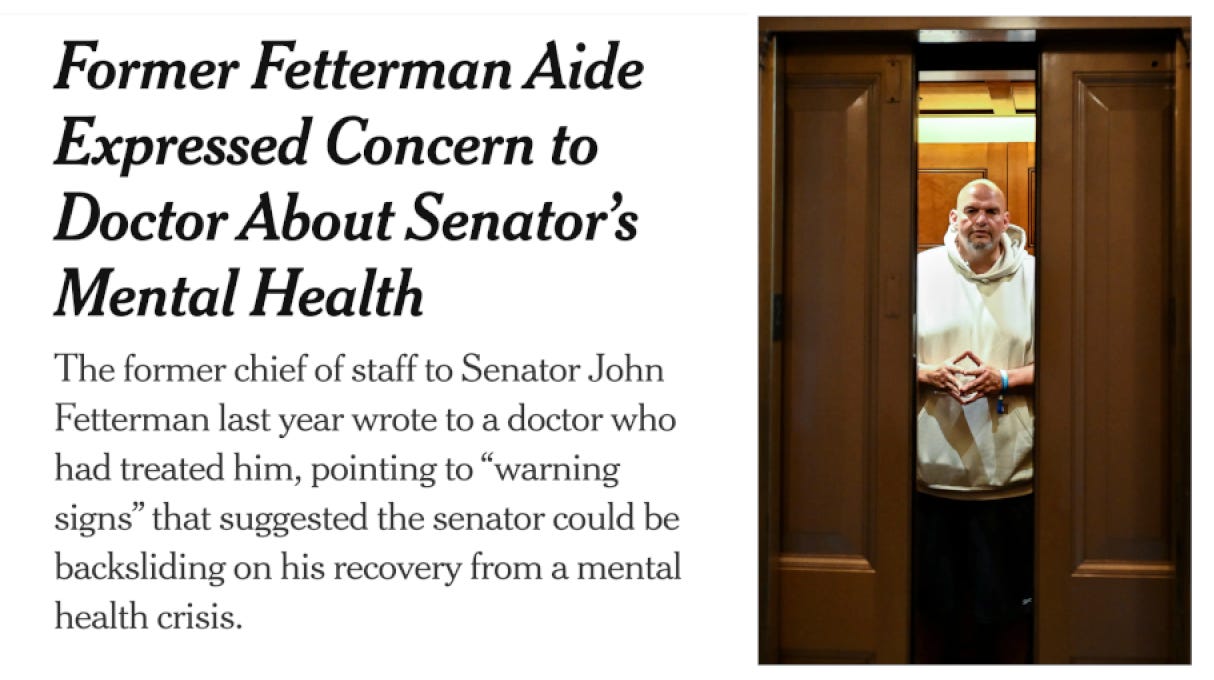
The former chief of staff to Senator John Fetterman, Democrat of Pennsylvania, was so alarmed with his ex-boss’s erratic behavior last year that he wrote a lengthy letter to his doctor… “I’m worried that if John stays on his current trajectory he won’t be with us for much longer,” Adam Jentleson, the former chief of staff, wrote on May 20…
An avid Fox News watcher, Mr. Fetterman even seriously considered voting to confirm Defense Secretary Pete Hegseth, a former weekend host on “Fox & Friends,” according to a former aide. The vote would have signaled a green light to a cabinet appointee who faced accusations of excessive drinking and abusing women…
It’s not clear to everyone who has worked closely with him that Mr. Fetterman’s political transformation, or his current challenges, is directly related to the mental health crisis... But in his letter, Mr. Jentleson describes unstable behavior he says could be a result of the senator’s failure to follow the medical plan…
Per theTimes, when Fetterman “seriously considered” voting for Pete Hegseth, it might have been evidence of brain damage, on par with “dangerous driving habits,” also described at length. Man, political analysis is getting weird in this country…
While San Francisco grapples with a tech exodus and New York navigates regulatory headwinds, Miami has quietly emerged as a technological powerhouse. The numbers tell the story: the city now ranks 16th among global startup hubs, with a $95 billion valuation and nearly $5 billion in venture capital raised just last year. Behind this transformation lies a deliberate strategy focusing on long-term investment in real, lasting infrastructure.
Miami Mayor Francis Suarez has been at the heart of his city's technological transformation. A lifelong Miamian and son of former Mayor Xavier Suarez, Francis brought political heritage and personal investment when elected in 2017. His viral “How can I help?” tweet to a tech entrepreneur in 2020 triggered a significant tech migration. While many dismissed the tweet as a publicity stunt, it reflected a leadership style rooted in accessibility and action, resonating with tech founders fed up with red tape in traditional innovation hubs.
Unlike cities flirting with speculative crypto and NFT hype, Suarez doubled down on core infrastructure. Under his watch, the $400 million Miami Forever Bond helped fund crucial infrastructure upgrades, from expanding broadband access in underserved neighborhoods to deploying real-time traffic optimization and rolling out free public Wi-Fi through interactive kiosks. These aren't just flashy headlines; they're improvements Miamians can feel every day.
What sets Suarez apart is his ability to bridge divides. As a Republican mayor in a diverse, politically mixed city, he’s taken a refreshingly bipartisan approach to tech policy. He’s worked across the aisle on climate resilience and infrastructure, and during his time as the 80th President of the U.S. Conference of Mayors, pushing for tech-driven solutions that cut through partisan noise. His efforts have earned respect from both sides of the aisle—a rare feat in today’s political climate.
Beyond infrastructure, Suarez has championed initiatives that close the digital divide and strengthen Miami’s long-term competitiveness. Programs like Miami Connected, a public-private partnership aimed at providing free high-speed internet and digital literacy training to over 100,000 students and families, underscore his commitment to inclusive innovation. He’s also backed the use of smart waste management systems that use real-time data to improve city services, and he launched an initiative to bring tech-forward charter schools focused on STEM education into the city, ensuring the next generation is prepared to lead in an increasingly digital economy.
As part of his broader vision, Suarez helped establish the U.S. Conference of Mayors’ Standing Committee on Technology and Innovation, driving a national conversation around broadband deployment, cybersecurity, and municipal tech strategies. These aren’t splashy projects chasing headlines—they’re foundational efforts that improve quality of life and strengthen Miami’s economic resilience.
Mayor Suarez’s tech vision is grounded in common sense: incorporating innovation with security while fostering economic growth and public safety, offering a model for other cities. It’s not about chasing the latest buzzword—it’s about long-term impact. As an attorney and a second-generation public servant, he knows that a city’s future depends on smart planning, steady investment, and security-minded innovation. Miami’s progress under his leadership shows what’s possible when a city chooses pragmatism over partisanship and infrastructure over influence.
In Miami, the tech boom isn’t just a trend. It’s a transformation. And thanks to Mayor Suarez, it's one built to last.
Arvin Patel is Nokia's Chief Licensing Officer of New Segments.
Some small and midsize manufacturers across the United States are experiencing a surge in demand, driven by companies looking to sidestep newly imposed tariffs, The Wall Street Journal reported on Sunday. For some, the uptick signals that the trade measures may ultimately provide long-term benefits.
While President Donald Trump’s tariffs have disrupted global supply chains and posed challenges to the broader economy, they’re also making domestically produced goods more attractive in terms of pricing -- something many U.S. manufacturers haven’t seen in years.
Jack Schron, president of Jergens Inc. -- a company that produces industrial tools such as screwdrivers, clamps and hoists -- reported that his operations in Chicago and Cleveland are running around the clock. He attributed the boom both to new orders from tariff-averse customers and strong ongoing demand from the defense sector, the Journal reported.
Bigger picture is mixed
These developments lend support to proponents of tariffs, who have argued that the measures would rejuvenate American industry. Still, the larger manufacturing picture is more mixed. Many major corporations have yet to announce new U.S. facilities, and broader indicators reflect cautious sentiment. For example, a recent Federal Reserve survey in Texas highlighted increasing concern among manufacturers over the economic impact of tariffs.
Donny Chaplin, president of Grand River Rubber & Plastics in Ashtabula, Ohio, said his company has received fresh inquiries and orders from businesses reconsidering offshore suppliers. Two former clients who had previously shifted production to China have returned, seeking to buy rubber gaskets for use in plastic pails. Three oil filter manufacturers have also expressed interest in shifting supply away from China, with two already placing orders.
If all the business materializes, it could add $5 million in annual revenue to Grand River -- about 10% of the company’s total. Chaplin is pushing for long-term contracts to justify the potential need for new hires and production line expansion. The contracts would also shield the firm if tariffs are later lifted.
Still, Chaplin notes that while tariffs help on the sales front, they also increase operational costs. Grand River relies on Chinese imports for certain factory supplies like safety glasses and ear protection, now subject to tariffs as high as 145%. Some raw rubber materials are also hit with a 10% duty. Chaplin said they’ll manage for now, but price increases for customers are likely, the Journal reported.
Tariffs cut both ways
Other manufacturers, especially those more dependent on imports, are less optimistic.
Austin Ramirez, chief executive of Husco International near Milwaukee, said his company has spent the past decade reducing its reliance on Chinese components -- now down to 20% of its supply chain by value. But he added that some parts are irreplaceable in the short term, the Journal reported.
Tariffs have provided a lifeline for companies that emerged during the Covid-19 pandemic to produce personal protective equipment domestically. After struggling to compete post-pandemic, many of these businesses are now seeing a revival. SafeSource Direct, a Louisiana-based manufacturer of synthetic rubber gloves, has restarted two production lines in response to growing orders, bringing its total to eight. The plant is now producing around 118 million gloves per month.
Alan Rust, the company’s chief growth officer, said that recent U.S. tariffs have doubled the cost of Chinese rubber gloves, prompting buyers to search for alternatives.
Even so, Rust added that raw materials such as nitrile rubber chemicals -- imported from countries like Brazil and Italy -- are now also subject to 10% duties, slightly undercutting the company’s cost advantages.
At AccuRounds, a Massachusetts-based producer of metal components, increased orders have led to overtime shifts. Two former clients who had previously offshored production have returned, pushing first-quarter sales up 20% year-over-year, Chief Executive Michael Tamasi said to the Journal.
Meanwhile, consumer goods giant Whirlpool (NYSE:WHR) is also watching tariff developments closely. With 80% of its appliances made in U.S. factories, the company believes the latest tariffs on imported washers and components will help level the playing field.
Chief Executive Marc Bitzer said tariffs could help close the $150 price gap that foreign competitors enjoy thanks to lower material costs. Still, Whirlpool (NYSE:WHR) expects its own expenses to rise by 2.4% -- roughly $400 million -- this year due to tariffs, and it plans to manage that by raising prices and cutting costs, the Journal reported.
The majority of the iPhones heading for the United States in the coming months will be made in India, while Vietnam will be the main production point for products such as iPads and Apple Watches.
During a call with investors discussing the tech giant’s second-quarter results, Cook was asked about how the company planned to adapt to the new U.S. tariff regimen, which significantly targets Chinese-manufactured goods.
“For the June quarter, we do expect the majority of iPhones sold in the U.S. will have India as their country of origin and Vietnam to be the country of origin for almost all iPad, Mac, Apple Watch, and AirPods products also sold in the U.S,” Cook said.
Trump has imposed a 145 percent tariff on Chinese goods shipped into the United States, which experts say would have increased the cost of iPhones and other Apple products.
However, the White House provided temporary exemptions to a range of electronic devices and components imported into the United States last month.
Cook said that China would “continue to be the country of origin for the vast majority of total product sales outside the U.S.”
“We have a complex supply chain. There’s always risk in the supply chain,” he said. “What we learned some time ago was that having everything in one location had too much risk with it.”
He also said Apple has started to create a stockpile of products so that the majority of its devices sold in the United States this quarter will not come from China.
The tech giant currently makes more than 90 percent of its products in China.
Cook also said that he predicted a hit to the company’s gross margins, saying that for the next quarter ending in June, “assuming the current global tariff rates, policies and applications do not change for the balance of the quarter and no new tariffs are added, we estimate the impact to add $900 million to our costs.”
However, the CEO said that so far, the ongoing tit-for-tat tariff tumult had not impacted Apple’s sales, and customers had not been rushing to purchase products to beat the impending impact of U.S. tariffs.
The company said that sales and profit for the second quarter ending March 29 were $95.36 billion and $1.65 per share, respectively, compared with analyst estimates of $94.68 billion and $1.63 per share, according to London Stock Exchange Group data.
The outlook for the Cupertino-based company could worsen going forward, however, as although electronics have so far been exempted from import tariffs, Washington has signaled that levies could be imposed in the coming weeks.
Trump said in a Truth Social post on April 13: “We are taking a look at Semiconductors and the whole electronics supply chain in the upcoming National Security Tariff Investigations. What has been exposed is that we need to make products in the United States, and that we will not be held hostage by other Countries, especially hostile trading Nations like China, which will do everything within its power to disrespect the American People.”
On the same call, Cook discussed $500 billion worth of investment inside the United States, telling investors the company would be “expanding” its teams in its “facilities in several states, including Michigan, Texas, California, Arizona, Nevada, Iowa, Oregon, North Carolina, and Washington.
“And we’re going to be opening a new factory for advanced server manufacturing in Texas,” he said.
Apple shares fell by nearly 3 percent in premarket trading on Friday in the wake of the quarterly results being released.