Search This Blog

Monday, August 4, 2025

Biomarin revenue up 16%, EPS soars 124% as margins expand

 BioMarin Pharmaceutical Inc (NASDAQ:BMRN) delivered strong second-quarter results on August 4, 2025, reporting double-digit revenue growth and significant profitability expansion across its rare disease portfolio. The company’s stock, which closed up 3.8% in regular trading, gained an additional 1.29% in after-hours trading following the earnings release.

Quarterly Performance Highlights

BioMarin reported total Q2 2025 revenues of $825 million, representing a 16% year-over-year increase from $712 million in Q2 2024. This growth was driven by strong performance across multiple products, particularly VOXZOGO, PALYNZIQ, and VIMIZIM.

As shown in the following chart of quarterly revenue growth:
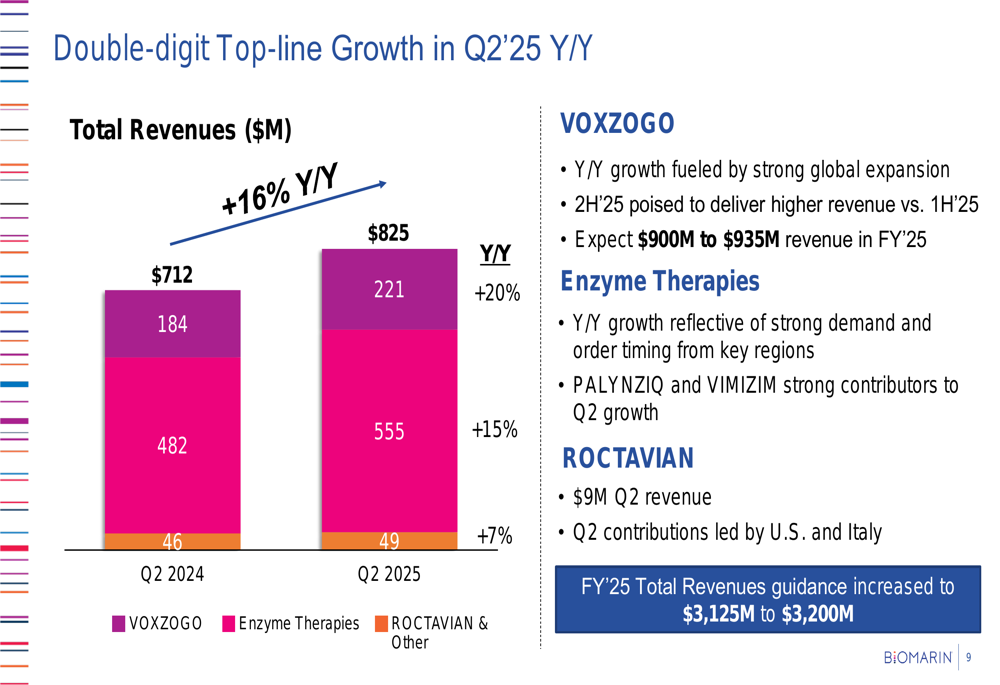
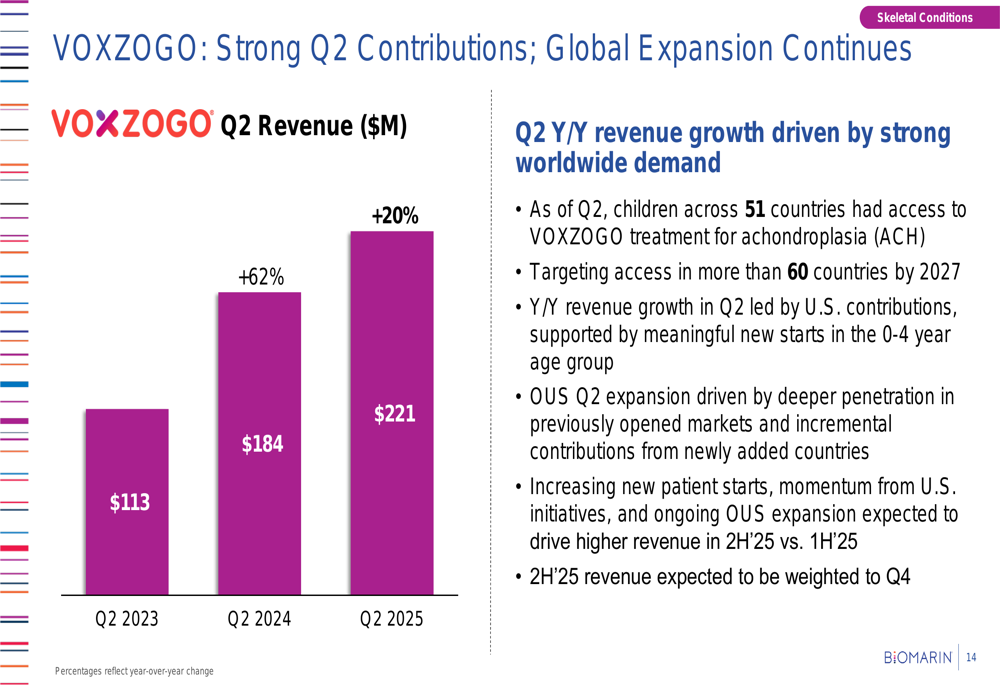
VOXZOGO, the company’s treatment for achondroplasia, continued its strong global expansion with Q2 revenue reaching $221 million, up 20% year-over-year. The company noted that children across 51 countries now have access to VOXZOGO treatment, with plans to expand to more than 60 countries by 2027.

The following chart illustrates VOXZOGO’s consistent growth trajectory:
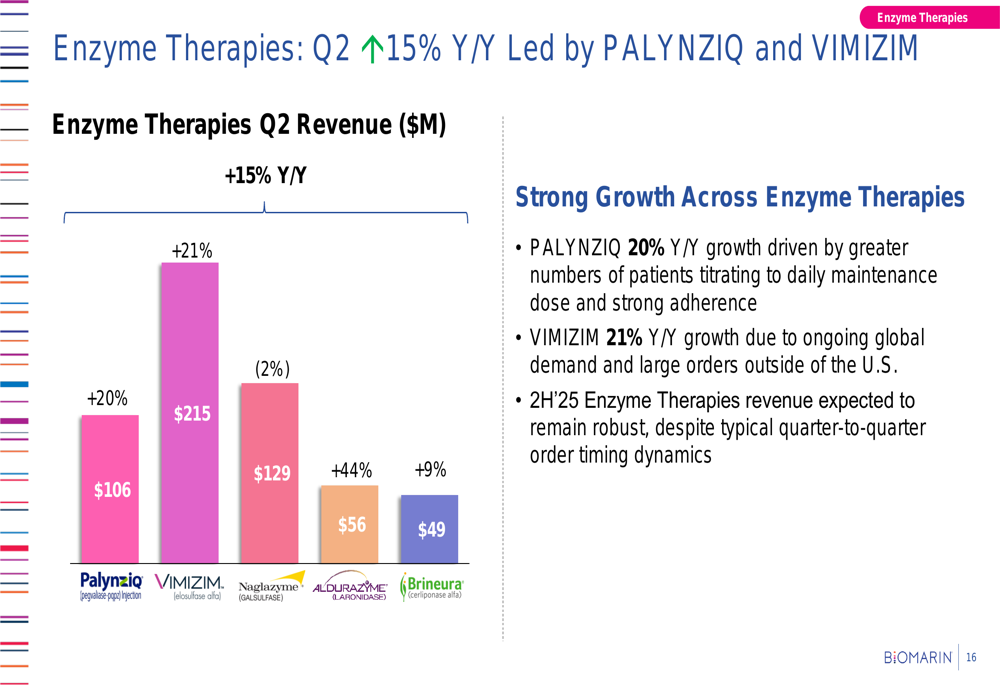
The Enzyme Therapies portfolio also performed well, with revenues increasing 15% year-over-year to $555 million. PALYNZIQ and VIMIZIM were particularly strong contributors, growing 20% and 21% respectively.

As shown in this breakdown of Enzyme Therapies revenue:
Detailed Financial Analysis

BioMarin’s profitability metrics showed substantial improvement in Q2 2025. GAAP operating margin expanded to 33.5%, an increase of 16.6 percentage points year-over-year, while non-GAAP operating margin reached 39.9%, up 8.7 percentage points.

GAAP diluted earnings per share more than doubled to $1.23, representing a 124% increase from $0.55 in Q2 2024. Non-GAAP diluted EPS grew 50% to $1.44. The company noted that EPS increased at more than three times the rate of revenue growth, reflecting successful implementation of operational efficiencies.

The following chart illustrates this dramatic profitability improvement:
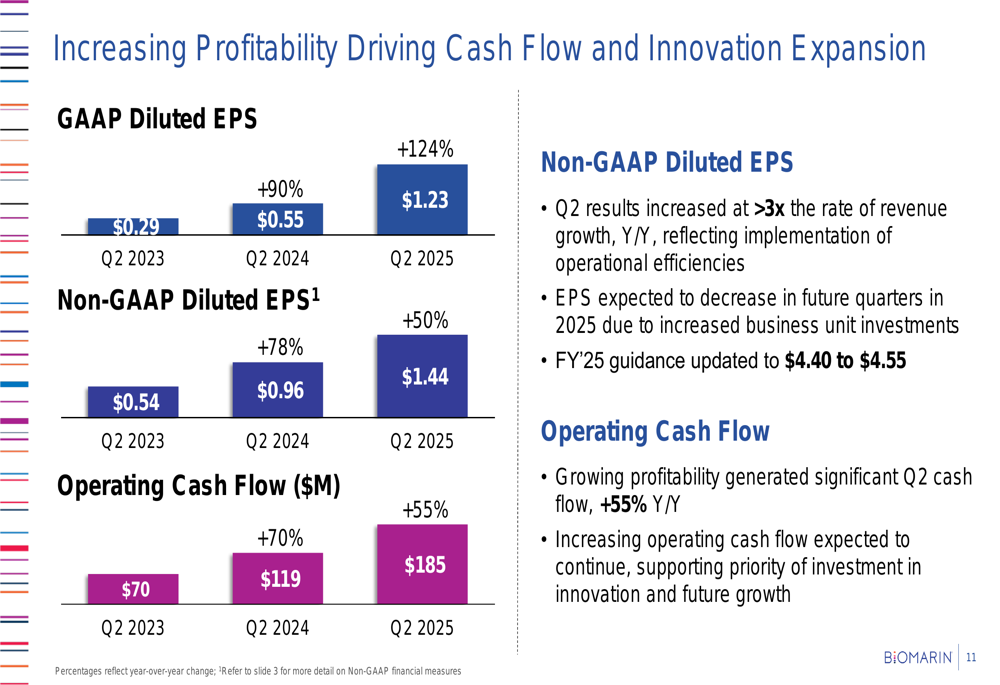
Operating cash flow also showed robust growth, increasing 55% year-over-year to $185 million. This growing cash generation is expected to support the company’s investments in innovation and future growth.

Operating expenses showed disciplined management, with GAAP R&D and SG&A expenses both decreasing 12% year-over-year. The company attributed this to focused R&D investment following its 2024 strategic review. However, BioMarin expects operating expenses to increase in the second half of 2025 as clinical programs and commercial initiatives advance.

Pipeline and Strategic Initiatives

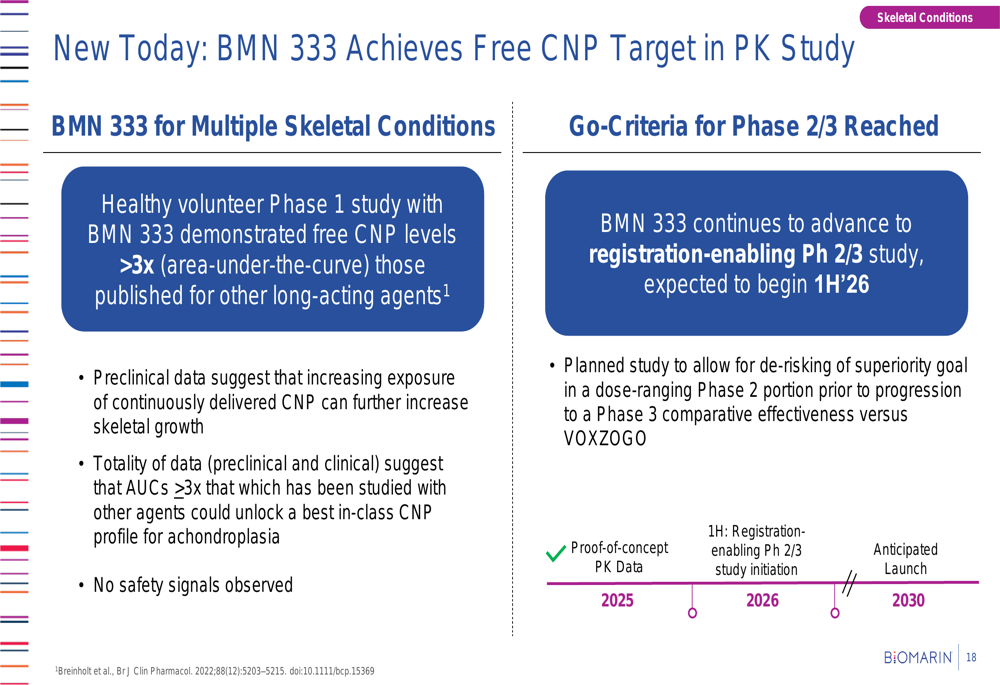
BioMarin highlighted several key pipeline developments during its presentation. The company announced that BMN 333, its treatment candidate for multiple skeletal conditions, achieved free CNP levels more than three times those published for other long-acting agents in a Phase 1 study, with no safety signals observed.

As shown in the following slide detailing the BMN 333 progress:
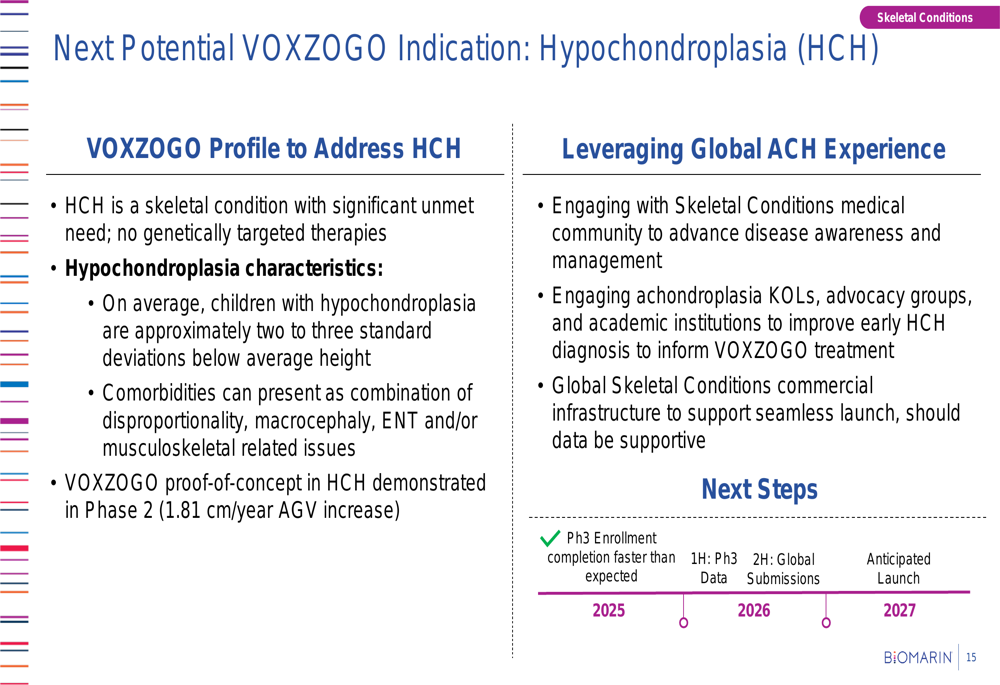
The company is also expanding VOXZOGO’s potential indications to include hypochondroplasia (HCH), a skeletal condition with significant unmet need. Phase 3 enrollment is expected to complete faster than anticipated in 2025, with global submissions planned for the second half of 2026 and potential launch in 2027.

The following timeline illustrates VOXZOGO’s development for HCH:
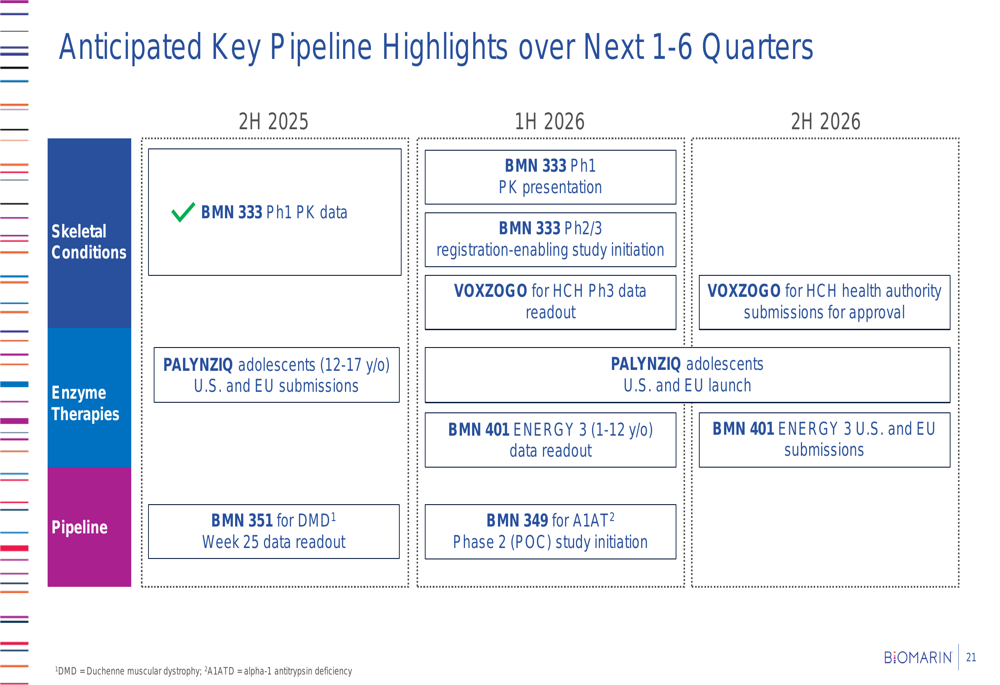
BioMarin completed the acquisition of Inozyme Pharma on July 1, 2025, adding BMN 401 (formerly INZ-701) to its Enzyme Therapies portfolio. BMN 401 is positioned as a potential first-in-disease treatment for ENPP1 Deficiency, with pivotal data expected in the first half of 2026 and potential launch in 2027.

The company provided a comprehensive roadmap of anticipated pipeline milestones:
Updated Guidance and Outlook

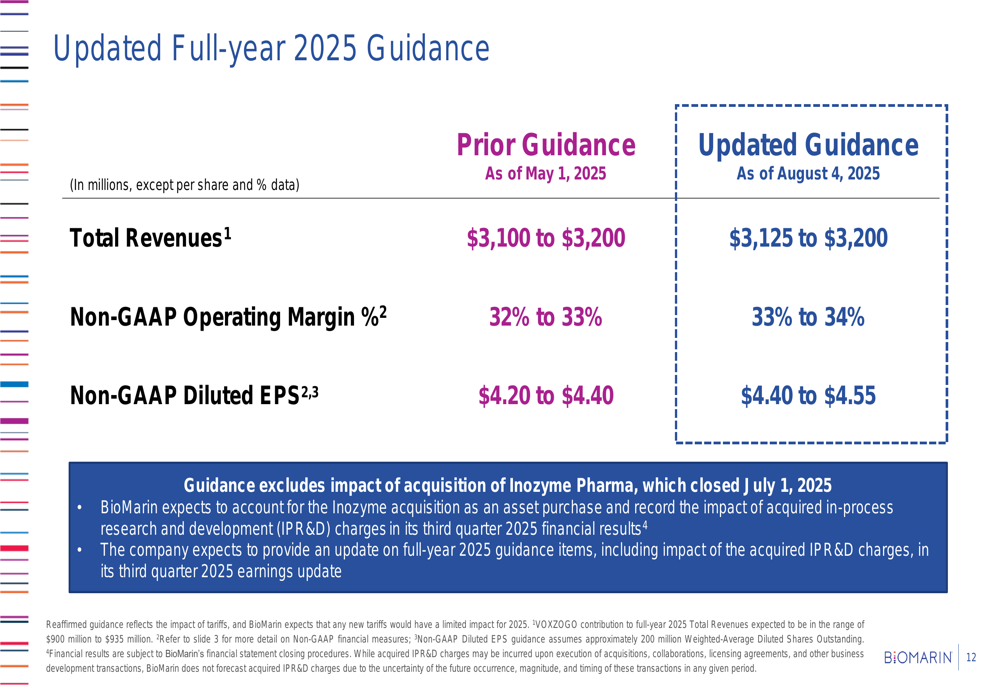
Based on its strong first-half performance, BioMarin updated its full-year 2025 guidance. The company narrowed its total revenue guidance to $3,125-$3,200 million, raised its non-GAAP operating margin guidance to 33-34% (from 32-33%), and increased its non-GAAP diluted EPS guidance to $4.40-$4.55 (from $4.20-$4.40).

The following slide details the updated guidance:
"We delivered strong Q2’25 revenue growth and significant profitability expansion driven by execution across the business," said Alexander Hardy, President and CEO of BioMarin. The company emphasized its focus on continued strong growth, progressing prioritized pipeline assets, and augmenting growth with business development opportunities in the second half of 2025.

https://www.investing.com/news/company-news/biomarin-q2-2025-slides-revenue-up-16-eps-soars-124-as-margins-expand-93CH-4168765

Crispr results, update

 CRISPR Therapeutics (NASDAQ:CRSP) reported a wider-than-expected loss for the second quarter of 2025, sending shares down 6.1% as both earnings and revenue fell significantly short of analyst expectations.

The gene-editing company posted a second quarter loss of $2.40 per share, substantially worse than the analyst estimate of $1.40 per share. Revenue came in at just $890,000, far below the consensus estimate of $5.81 million. The disappointing results were primarily driven by higher-than-expected acquired in-process R&D expenses of $96.3 million related to the company’s recent agreement with Sirius Therapeutics.

Despite the financial miss, CRISPR Therapeutics highlighted progress in its commercial rollout of CASGEVY, its gene therapy for sickle cell disease and transfusion-dependent beta thalassemia. The company has activated 75 authorized treatment centers globally, with approximately 115 patients completing their first cell collection and 29 patients receiving infusions through June 30.

"We are entering the second half of the year with momentum across both our commercial and clinical programs," said Samarth Kulkarni, Ph.D., Chairman and CEO of CRISPR Therapeutics. "The activation of 75 authorized treatment centers for CASGEVY has been achieved, marking a meaningful step in expanding patient access, while clinical trials across multiple other programs continue to advance."

The company’s cash position stood at $1.72 billion as of June 30, 2025, down from $1.90 billion at the end of 2024. R&D expenses decreased to $69.9 million from $80.2 million YoY, while general and administrative expenses slightly decreased to $18.9 million from $19.5 million in the same period last year.

CRISPR Therapeutics continues to advance its pipeline across multiple therapeutic areas, including its in vivo liver editing programs CTX310 and CTX320, as well as next-generation allogeneic CAR T product candidates CTX112 and CTX131. The company expects to present complete Phase 1 data for CTX310 at a medical meeting in the second half of 2025.

https://www.investing.com/news/earnings/crispr-therapeutics-shares-tumble-after-significant-earnings-miss-93CH-4168968

Hims Revenue Comes Up Short But Sees 'Exciting Period Of Growth' Ahead

 Hims & Hers Health Inc 

Get Free Report
 reported second-quarter earnings after the market close on Monday. Here’s a rundown of the report.

Q2 Earnings: Hims & Hers Health reported second-quarter revenue of $544.83 million, missing analyst estimates of $549.83 million. The company reported second-quarter earnings of 17 cents per share, beating estimates of 14 cents per share, according to Benzinga Pro.

Total revenue was up 73% on a year-over-year basis as subscribers grew to over 2.4 million in the quarter, up 31% year-over-year. Gross margin came in at 76% in the second quarter.

The company reported negative operating cash flow of $19.1 million and negative free cash flow of $69.4 million in the quarter. Hims & Hers ended the period with $1.12 billion in cash and cash equivalents.

“We believe we’re entering an exciting period of growth where we’ll enter new, high-impact specialties that bring millions of people in need of care into the market,” said Andrew Dudum, co-founder and CEO of Hims & Hers Health.

Outlook: Hims & Hers Health expects third-quarter revenue of $570 million to $590 million versus estimates of $585.42 million.

https://www.benzinga.com/markets/earnings/25/08/46841094/hims-hers-health-stock-tumbles-on-q2-earnings-as-revenue-comes-up-short-company-sees-exciting-period-of-growth-ahead

agilon health stock plunges after CEO steps down amid earnings miss

 agilon health Inc (NYSE:AGL) stock tumbled 31.1% after the company announced CEO Steven Sell has stepped down and the firm reported disappointing second quarter results that fell short of expectations.

The healthcare company, which partners with primary care physicians to provide value-based care, has appointed co-founder and Board Chairman Ronald A. Williams as Executive Chairman to lead an interim Office of the Chairman while the board searches for a permanent CEO replacement.

The leadership change coincided with concerning financial results for the second quarter of 2025. Total revenue decreased 6% to $1.39 billion compared to $1.48 billion in the same period last year. The company reported a gross loss of $52 million, a significant deterioration from the $32 million profit in Q2 2024.

Medical margin swung to a negative $53 million from a positive $106 million YoY, while adjusted EBITDA loss widened to $83 million compared to a $3 million loss in the prior-year period.

The company cited several factors for the disappointing performance, including $66 million in prior period development costs and a $48 million reduction in risk adjustment revenue for 2025. Total membership on the agilon platform decreased to 614,000 as of June 30, 2025, representing a 5% decline from the same period last year.

In light of the leadership transition and ongoing market challenges, agilon has withdrawn its previously issued full-year 2025 financial guidance as it evaluates additional actions to improve operating performance.

https://uk.investing.com/news/stock-market-news/agilon-health-stock-plunges-after-ceo-steps-down-amid-earnings-miss-93CH-4199803

Tyson Foods Confirms Protein Switching Underway Amid Record High Beef Prices

 Mega meatpacker Tyson Foods surged 4% in early New York cash trading after posting a surprise quarterly profit and raising its full-year revenue forecast. A boom in chicken demand offset deepening losses in its struggling beef unit, as sky-high beef prices continue to push consumers toward cheaper alternatives.

Tyson Foods reported third-quarter adjusted EPS of .91 cents, beating Goldman Sachs and consensus estimates of 85 cents and 78 cents, respectively. Revenue rose 3.6% year-over-year to $13.88 billion, also topping estimates of $13.61 billion (GS) and $13.50 billion (consensus), driven by strong performance in chicken, offsetting losses in the beef unit.

Tyson Foods (TSN) 3Q Summary: Beat and Raised

EPS Beat: Adj. EPS of $0.91 vs. GS/consensus of $0.85/$0.78

Revenue Beat: Sales rose +3.6% YoY to $13.88B, above GS/consensus of $13.61B/$13.50B

Segment Performance: Strength in Chicken, Beef, Prepared Foods; Pork and International/Other underperformed

Operating Income: Adj. op income of $505M beat GS/consensus of $501M/$462M

Guidance Raised:

  • FY25 Adj. Operating Income: Now $2.1B–$2.3B (up from $1.9B–$2.3B), led by chicken strength, partially offset by beef

  • FY25 Net Sales Growth: Now +2–3% (prior: flat to +1%), above GS/consensus of 1.5%/1.2%

"Our third quarter results demonstrate the strength of our multi-protein, multi-channel portfolio and our relentless focus on operational excellence," said Donnie King, President & CEO of Tyson Foods. "Delivering our fifth consecutive quarter of year-over-year growth across sales, adjusted operating income and adjusted earnings per share underscores the resilience of our business model. Looking ahead, we are confident in our ability to meet consumer needs, capitalize on protein demand and deliver long-term value to our shareholders."

"Chicken continues to provide support to the business as the company continues to face beef headwinds," analysts at brokerage Stephens wrote in a note to clients. 

Making sense of all this is simplerising chicken demand alongside sliding beef demand is known as "protein switching." This trend is driven by excessively high supermarket beef prices, prompting low- and middle-income consumers to seek cheaper alternatives like chicken and pork.

This comes as the latest USDA cattle report shows America's cattle and calves herd population has fallen to 94.2 million, its lowest mid-year level since 1973. The nation's shrinking herd size has pushed USDA retail ground beef prices to record highs...

Related:

Swiss Are Ready to Make More Attractive Trade Offer to US

 The Swiss government said it is determined to win over the US on trade after last week’s shock announcement of 39% tariffs on exports to America.

“Switzerland enters this new phase ready to present a more attractive offer, taking US concerns into account and seeking to ease the current tariff situation,” it said in a statement on Monday, highlighting its foreign direct investments and research and development push in the US. It also excluded countermeasures for the time being. 

With the new levies — the highest among industrial nations — scheduled to go into effect on Thursday, President and Finance Minister Karin Keller-Sutter convened an emergency meeting of the governing Federal Council to discuss how to proceed. 

Negotiators with the Swiss State Secretariat for Economic Affairs have already reached out to their US counterparts to try and find a way forward. Bern is focusing on getting at least a longer timeline than Thursday, according to an official close to the talks, adding that anything improving the current situation would be a win.

Washington’s move came as a surprise as talks ahead of the Aug. 1 deadline had looked promising. A Thursday night call instead focused on Switzerland’s trade surplus in goods with the US.

The Swiss government stressed on Monday that the overhang “is not the result of any ‘unfair trade practices’.” 

Switzerland’s outsized gold exports are partly to blame for the distorted trade balance. The country is the world’s biggest refining hub for the precious metal, with billions of dollars worth of gold constantly flowing into and out of the nation. 

Pharmaceuticals, coffee and watches are the other main drivers. 

Keller-Sutter, who was criticized in the Swiss press over the weekend for allowing Trump to blindside her without a backup plan, said she would be willing to make a last-minute trip to Washington if she thought there was a chance a deal could be made.

“I don’t rule out such a visit, but first, the two sides should come closer together in their positions,” she told the newspaper Schweiz am Wochenende. It’s not clear what, if any, response there has been from the US government.

Despite the backlash, the Swiss president doesn’t face any immediate danger of losing her job. The system is designed for continuity, and the presidency rotates on an annual basis, meaning her term running the country will come to a close at the end of the year.

Switzerland ran a $38 billion bilateral trade surplus with the US last year, according to US Census data, which was the 13th biggest for the world’s largest economy. While Swiss exports to the US collapsed after the introduction of tariffs in April, they rebounded in June, suggesting that trade between the two countries remained robust.

“We estimate that this represents a tariff shock of around 23 percentage points for the Swiss economy, putting roughly 1% of its GDP at risk over the medium term.”

There aren’t many routes available to Switzerland, but one is to offer to buy liquefied natural gas from the US. While the landlocked country is focused on hydroelectric and nuclear power, it does use a small amount of gas, primarily in the winter to cushion swings in its energy supply. Should Switzerland choose to import more gas, it would have to travel through neighboring countries, which could potentially increase transit costs.

So far, the expectation appears to be that Keller-Sutter and the government will secure a better deal. The Swiss market benchmark SMI was down just 0.5% as of 3:15 p.m. on Monday.

“We expect negotiations to bring the 39% Swiss tariff rate closer to the 15% agreed with the EU,” Lombard Odier investment strategists said in a research note. “In the unlikely event that this trade dispute is not resolved,” they added, they will revise their forecast for gross domestic product.

Given the “volatility of decisions we’ve seen from the US,” there’s hope that a solution may be found, Franziska Ryser, a lawmaker of the Green party, told Bloomberg.

“On the other hand, we must draw political conclusions from the situation and acknowledge that — at least under the Trump administration — America is no longer a reliable partner,” she said. “This means that we should strengthen cooperation with the EU and coordinate more closely with our European partners.”

https://www.msn.com/en-us/money/markets/switzerland-is-ready-to-make-more-attractive-trade-offer-to-us/ar-AA1JSE0Z

Suspicious Minds

 by James Howard Kunstler,

"It was a coup, and I'm using that term literally ... One egregious felony after another."

- Stephen Miller

America is tired of being driven insane, of having absurdities crammed into our collective consciousness. Reality is an agreement about what is going on in the world. That act of faith requires such an agreement be based on what is demonstrably true. Without it, society dissolves into chaos and failure.

The RussiaGate psychodrama is about an agreement based on lies. It started with Hillary Clinton’s desperate ploy to save her foundering 2016 election campaign. Her emails somehow got sent to Wikileaks, a radical news org dedicated to revealing government secrets, implicating misconduct. It was easy to declare the Russians did it, by hacking — when it was much more likely, in fact, proven by a forensic audit, that a Clinton campaign insider downloaded the info on a thumb drive, perhaps one Seth Rich, found murdered on a DC sidewalk soon thereafter.

Every lie after that met the kind of skepticism among the public that generates heat, controversy, scandal, and fire. Hillary managed to enlist President Barack Obama and his executive agencies into her project, and the party apparatus with it, because the Clinton Victory Fund had paid the DNC’s debts and took over its management.

Soon, the Russia collusion project grew into a gigantic scaffold of flaming lies. The big newspapers and the TV news networks bought the story, and came along for the ride. They were all sure Hillary would win the 2016 election. All the heat and fire would get flushed away. The polls all said so. The agencies and the parties would pick up and go on as before, run the show, make careers, get wealthy, be important!

They miscalculated. They lost. But they decided to keep building the scaffold of lies in order to protect themselves from the danger it represented — because they lived in that scaffold, it was the party’s house.

And the scaffold of lies needed massive fortification.

The house that the party lived in had to be protected at all costs, or they would all be cast out, homeless, a whole party on street, lost, broke, ruined, dying, like the pitiful tweakers bent over out on Kensington Avenue in Philly, in every Democrat-run city, really.

And so, they undermined the winner of the election at every turn, worked furiously to drive him from office, made a plague happen, subverted the 2020 election, and spent four years under a fake president jamming absurdities into the public arena, turning it into a freak show, one drag-queen story hour after another, from sea to shining sea. All to defeat the return of a public consensus about reality based on what is demonstrably true — starting with the fact that there are men and there are women, and that the primary interaction between them keeps society going by producing offspring.

This enormous, drawn-out insurrection, composed of serial felony crimes, amounts to the greatest insult against the republic — the res publica, in Latin, the public thing — in the nation’s history.

And now it is coming apart as an overwhelming majority of citizens, including now many Democrats, can’t avoid discovering what has happened in the country. Because lies are weak and the truth is sturdy and eventually truth prevails, even after an arduous struggle.

The old news media complex, the networks and the papers, are not reporting the recent disclosures by the Directors of the CIA, the FBI, and National Intel.

What will it take to get their attention?

Arrests and perp-walks of formerly important officials?

And then, do they acknowledge and atone for their disgraceful participation in the events?

Or pretend they couldn’t figure any of it out for years and years? 

Poor us, we didn’t know! Suddenly, it looks like many of these “legacy” news outfits are going out-of-business. They’re throwing their performers over the side like sinking ships casting off so much useless ballast.

You knew this was coming, right?

Now, here you are: the hour that consequence finally returns from its wanderings in a wilderness of institutional failure.

There’s no evading it anymore. The scaffold of lies has collapsed, and trying to add additional lies will amount to throwing a few twigs on a heap of smoldering wreckage.

The institutions themselves are under new management, and they show every sign of returning to regular operation, doing what they were designed to do in the first place: deliver a truthful account of what has happened and determine a just consequence for the people who made it happen.

It’s going to happen, and then we can rebuild a coherent public consensus about what is really real, who we really are, and where we go from here.

https://www.zerohedge.com/geopolitical/suspicious-minds