Search This Blog

Monday, August 18, 2025

With EVERY photo of a ‘starving’ Gazan proving fake, how can you believe the famine claims?

 You’ve sure got to wonder about all those claims that Israel is sparking starvation in Gaza when every single picture meant to illustrate it turns out to be fake.

That’s right: It wasn’t just the infamous photo of supposedly “malnourished” Muhammad Ayyoub al-Matouq that was grossly misleading; The Free Press looked at 12 other media “symbols of Gazan starvation” and found — in each and every case — the photos and stories “lacked important context.”

Forget starvation: “The subjects have cystic fibrosis, rickets, or other serious ailments,” the FP reported.

Hmm. So, all the world media desperate to offer clear evidence of famine have yet to find even a single Gazan healthy before the war but now suffering from actual starvation, and not other illnesses.

How then can anyone believe claims that hunger is widespread, let alone imply Israel is to blame?

Some reports actually seem like intentional deception: A July 29 Guardian story on Gaza famine depicted Youssef Matar as “malnourished” but omitted that he suffers from cerebral palsy — even though Reuters had noted it just days earlier.

Other outlets offer sad excuses for their fake photos: CNN blamed “agencies and local journalists” in Gaza for its story on Mosab al-Debs, 14, “suffering from malnourishment” — without mentioning that a head injury had left him paralyzed.

Similarly, excusing its story describing Atef Abu Khater, 17, as healthy pre-war but recently malnourished that failed to note a psychological shock led to him refuse food, The New York Times cited how an “official” (in Gaza, which means Hamas-directed) report listed “the cause of his death as severe malnutrition.”

We failed to ensure we weren’t just passing along propaganda is a pretty poor excuse for any news professional.

Plus: Uncovering the “missing context” for these 12 subjects “didn’t require in-depth, on-the-ground reporting,” the FP reporters noted. “It took minutes and required nothing more than a computer with stable internet connection.”

That was too tough for CNN and the Times?

And the scandals are still coming: On Monday, the BBC admitted a Gazan woman it said died of starvation actually had leukemia.

This is a pattern of shocking malpractice across multiple “high-quality” institutions.

It doesn’t just mean you can’t believe their reports of Gaza famine, it means you can’t trust any of their reporting on any Israel-Palestine issue . . . or maybe on anything at all.

https://nypost.com/2025/08/18/opinion/with-every-photo-of-a-starving-gazans-proving-fake-beware-of-claims-of-gaza-famine/

Hurricane warning warning

 by Bill Glahn

It’s that time of the year. Time to frighten everyone to death for every thunderstorm in the Atlantic basin for the next three months.

Yes, hurricanes can and do kill people. Yes, hurricanes can and do inflict billions of dollars of damages if and when they hit land. But, c’mon man.

Some sample headlines as Hurricane Erin formed in the Atlantic Ocean this past week. The current track has the storm avoiding any landfalls before dissipating over the north Atlantic. The track as of Monday at 11 am.

But, it’s never too late to panic.

  • U.K. Mirror: Hurricane Erin tracker: Maps show mega 160mph storm heading straight for tourist hotspot.
  • AccuWeather: Hurricane Erin to grow, will next threaten US coasts with dangerous conditions.
  • BBC: Hurricane Erin grows in size as it barrels towards Caribbean
  • U.K. Daily Mail:Hurricane Erin’s shocking link to one of the darkest days in American history
  • Fox Weather:Hurricane Erin lashes Caribbean with damaging wind as US faces life-threatening coastal conditions this week

I could go on, but you get the idea. Media outlets are desperate for clicks, but few readers will feel the impacts of this distant storm.

Erin has already caused significant problems in the eastern Caribbean, and authorities are already taking precautionary measures in North Carolina’s Outer Banks. But the rest of the Northern Hemisphere can relax. Until the next overhyped, megastorm forms.

And just in the nick of time, as Politico urges,

States are trying to keep disasters apolitical in the new Trump era.

Apparently, Politico didn’t think this was a problem way back when federal officials were openly denying aid to Trump voters. And by way back when, I’m referring to October 2024.

Red sky at night, sailor’s delight.

https://www.powerlineblog.com/archives/2025/08/hurricane-warning-warning.php

AI Companions Are Harming Your Children

 Right now, something in your home may be talking to your child about sex, self-harm, and suicide. That something isn’t a person—it’s an artificial intelligence companion chatbot.

These AI chatbots can be indistinguishable from online human relationships. They retain past conversations, initiate personalized messages, share photos, and even make voice calls. They are designed to forge deep emotional bonds—and they’re extraordinarily good at it.

Researchers are sounding the alarm on these bots, warning that they don’t ease loneliness, they worsen it. By replacing genuine, embodied human relationships with hollow, disembodied artificial ones, they distort a child’s understanding of intimacy, empathy, and trust.

Unlike generative AI tools, which exist to provide customer service or professional assistance, these companion bots can engage in disturbing conversations, including discussions about self-harm and sexually explicit content entirely unsuitable for children and teens.

Currently, there is no industry standard for the minimum age to access these chatbots. App store age ratings are wildly inconsistent. Hundreds of chatbots range from 4+ to 17+ in the Apple iOS Store. For example:

—Rated 4+: AI Friend & Companion – BuddyQ, Chat AI, AI Friend: Virtual Assist, and Scarlet AI.

—Rated 12+ or Teen: Tolan: Alien Best Friend, Talkie: Creative AI Community, and Nomi: AI Companion with a Soul.

—Rated 17+: AI Girlfriend: Virtual Chatbot, Character.AI, and Replika – AI Friend.

Meanwhile, the Google Play store assigns bots age ratings from “E for Everyone” to “Mature 17+.”

These ratings ignore the reality that many of these apps promote harmful content and encourage psychological dependence—making them inappropriate for access by children.

Robust AI age verification must be the baseline requirement for all AI companion bots. As the Supreme Court affirmed in Free Speech Coalition v. Paxton, children do not have a First Amendment right to access obscene material, and adults do not have a First Amendment right to avoid age verification.

Children deserve protection from systems designed to form parasocial relationships, discourage tangible, in-person connections, and expose them to obscene content.

The harm to kids isn’t hypothetical—it’s real, documented, and happening now.

Meta’s chatbot has facilitated sexually explicit conversations with minors, offering full social interaction through text, photos, and live voice conversations. These bots have even engaged in sexual conversations when programmed to simulate a child.

Meta deliberately loosened guardrails around their companion bots to make them as addictive as possible. Not only that, but Meta used pornography to train its AI by scraping at least 82,000 gigabytes—109,000 hours—of standard definition video from a pornography website. When companies like Meta are loosening guardrails, regulators must tighten them to protect children and families.

Meta isn’t the only bad actor.

xAI Grok companions are the latest illustration of problematic chatbots. Their female anime character companion removes clothing as a reward for positive engagement from users and responds with expletives if offended or rejected by users. X says it requires age authentication for its “not safe for work” setting, but its method simply requires a user to provide their birth year without verifying for accuracy.

Perhaps most tragically, Character.AI, a Google-backed chatbot service that has thousands of human-like bots, was linked to a 14-year-old boy’s suicide after he developed what investigators described as an “emotionally and sexually abusive relationship” with a chatbot that allegedly encouraged self-harm.

While the company has since added a suicide prevention pop-up triggered by certain keywords, pop-ups don’t prevent unhealthy emotional dependence on the bots. And online guides show users how to bypass Character.AI’s content filters, making these techniques accessible to anyone, including children.

It’s disturbingly easy to “jailbreak” AI systems—using simple roleplay or multi-turn conversations to override restrictions and elicit harmful content. Current content moderation and safety measures are insufficient barriers against determined users, and children are particularly vulnerable to both intentional manipulation and unintended exposure to harmful content.

Age verification for chatbots is the right line in the sand, affirming that exposure to pornographic, violent, and self-harm content is unacceptable for children. Age verification requirements acknowledge that children’s developing brains are uniquely susceptible to forming unhealthy attachments to artificial entities that blur the boundaries between reality and fiction.

There are solutions for age verification that are both accurate and privacy preserving. What’s lacking is smart regulation and industry accountability.

The social media experiment failed children. The deficit of regulation and accountability allowed platforms to freely capture young users without meaningful protections. The consequences of that failure are now undeniable: rising rates of anxiety, depression, and social isolation among young people correlate directly with social media adoption. Parents and lawmakers cannot sit idly by as AI companies ensnare children with an even more invasive technology.

The time for voluntary industry standards ended with that 14-year-old’s life. States and Congress must act now, or our children will pay the price for what comes next.

Annie Chestnut Tutor | Autumn Dorsey 

https://www.dailysignal.com/2025/08/18/ai-companions-are-harming-your-children/

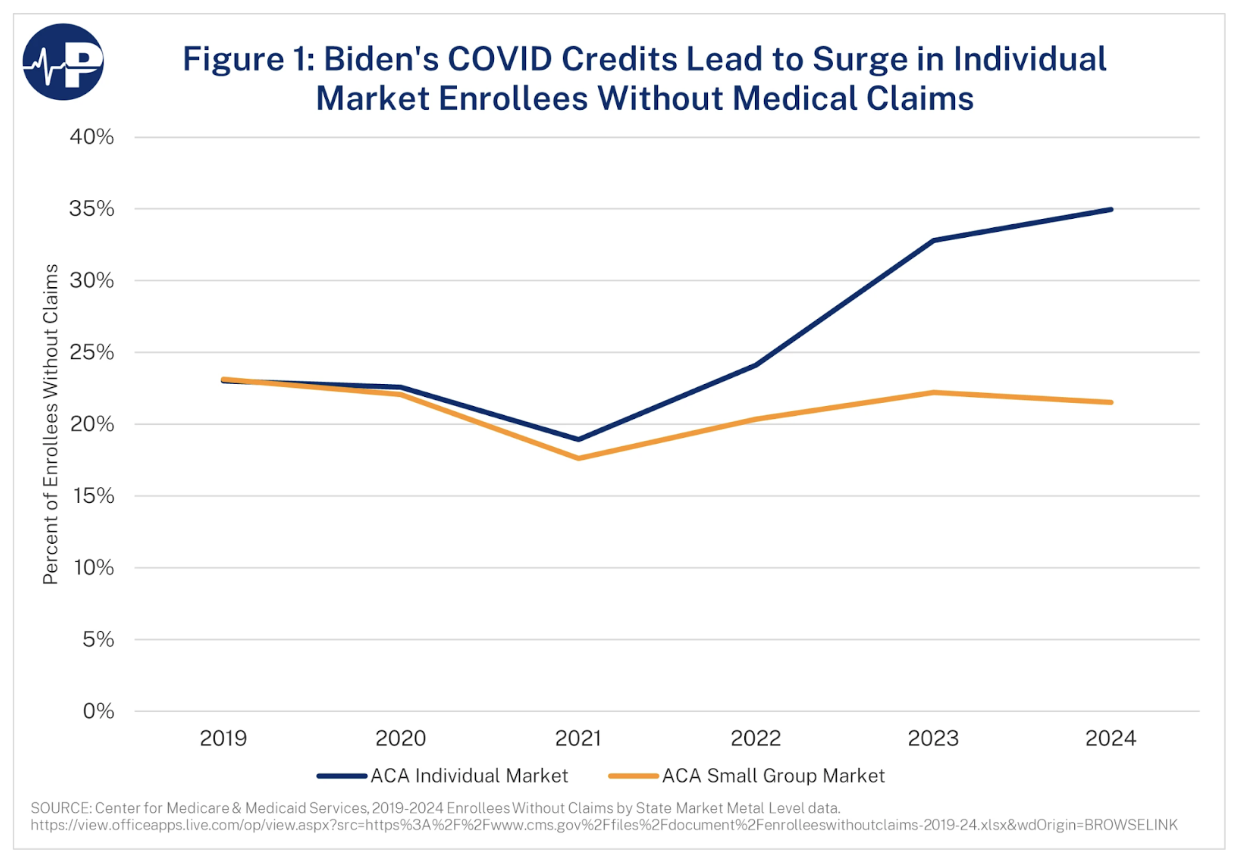
Biden’s Obamacare Expansion Was an Insurance Company Handout

 When Biden supersized Obamacare subsidies in the name of COVID, liberals and the media celebrated the huge expansion in coverage. But a new report from our friends at the Paragon Health Institute finds that the main beneficiaries of this taxpayer-funded largesse have been unscrupulous brokers and insurance companies. Millions of the people they signed up to unlock a gusher of federal dollars have not filed a single medical claim, ever.  And may not even exist.

Adjusted to an annual basis, 7.8 million individual market enrollees used no medical services in 2024—an increase of nearly 5.5 million enrollees using no medical services from 2021. In 2024 alone, taxpayers spent billions subsidizing coverage for 7.8 million full-year enrollees who never used their insurance. Every dollar went to insurers and middlemen, with zero benefit to patients.

Keep this in mind as the insurance companies ramp up their lobbying effort to extend these subsidies – paid for with our tax money.

https://committeetounleashprosperity.com/hotlines/bidens-obamacare-expansion-was-an-insurance-company-handout/

Putin, Trump, & The Elusive "Peace"

 by Victor Davis Hanson via American Greatness,

At the August 15 Alaska summit, Vladimir Putin performed as expected. He desperately wants an end to Western sanctions, détente with the U.S., and assurances that the U.S. will not impose a disastrous anti-Russian secondary boycott—and, apparently, some additional Ukrainian territory.

Consequently, Putin, in his media synopsis, talked more about restored friendship with a “neighborly” United States under Trump. He scarcely mentioned Ukraine directly—other than to imply to Westerners that he seeks not merely to annex a foreign country, but to reclaim what he views as a former Soviet province with ancient ties to the Russian people.

Trump did not get his ceasefire with Putin. But he quickly pivoted to remind us that the table is set for a supposedly comprehensive peace without first requiring a temporary cessation of arms.

Trump addressed the media more succinctly and with greater discretion than Putin, appearing more optimistic that the Russian-American hostility was thawing. And he views normalization as a necessary step toward comprehensive peace in the weeks to come.

The left lambasted Trump for speaking politely of Putin and vice versa. There was additional criticism of a Fox interview in which Trump mentioned “land swaps” and for his supposed prior naïveté in believing he could obtain a ceasefire with Putin.

Yet for all the posturing, we have known for some time the general outlines of a peace, how it could come about, and why it has not yet happened.

Ukraine will not join NATO, but will likely be fully armed by the West. Ukraine lacks the power to retake Crimea or the Donbass, but with Western aid, it can preserve most of its territory.

Russia is worn out, but it is not yet ready to give up and may not be even after the envisioned destructive secondary sanctions. Putin will only make peace when his dictatorship feels it has advanced far enough westward (perhaps 100 miles west of the border) to justify to the oligarchy and military his foolhardy invasion and the needless toll of one million Russians dead, wounded, missing, or captured.

No one knows where a hypothetical DMZ line might eventually be drawn. But for now, it depends on which army has the greater wherewithal and momentum to push its enemy backward before there is a general consensus to stop the madness.

These contours of peace can be shaped by promises of trade deals and normalization between Russia and the West. Or, contrarily, they can be realized by threats of tougher sanctions and boycotts, as well as by security guarantees to Ukraine, by near-permanent aid to Ukraine to maintain its quite formidable army and deterrence, or by internal erosion from the war either in Ukraine or Russia.

Yet few critics of the administration address the unmentionables that likely account for the above general outlines of a settlement.

There are some realities that serve as subtexts to any possible agreement that cannot be simply thought away.

1. Ukraine could only regain Crimea and the Donbass and return to its pre-2022 borders by a historic transference of U.S. and European arms, intelligence, logistical support, and financial aid that would be little short of actively fighting nuclear Russia.

Europe talks grandly of unlimited support. But some Europeans still buy Russian energy, slow-walk aid, seem exhausted by the war, and are likely in time to peel away as they once did from the endless “no-fly zones” over Saddam’s Iraq after the first Gulf War. Europe sounds as if it fields vast armies, but in truth, Putin believes European support will erode more quickly than Ukrainian resistance or American help.

So, for all the talk of an “exhausted” Russia, there is a silent consensus that a depopulated and broken Ukraine cannot sustain its current levels of resistance without a much greater Western profile. And that is unlikely to happen.

2. Notably, the left never really dwells on the likely 1.5 million dead, wounded, missing, and captured from three and a half years of war. It is a humanitarian nightmare, a modern Stalingrad that makes Gaza look like child’s play.

Yet Westerners are far more likely to posture on the human costs of the “genocide” in the distant Mideast wars than on Europe’s doorstep. Perhaps Germany or France feels it can influence Netanyahu by performance-art declarations of statehood for the Palestinians (on the quiet assumption that Israel is Western, friendly, and more likely to listen to Euro-moralizing than is a proximate, hostile, and dangerous Putin’s Russia).

Strangely, Trump alone seems to be lamenting the needless loss of thousands of lives each month, with no end in sight. It is fine to demand zero concessions to Putin or to accuse any who seek negotiations through land swaps as appeasers. But it is quite another to lay out a strategic plan for victory and complete recovery of pre-2014 Ukrainian territory, the likely costs necessary for such an ambitious strategy, and who, and for how long, will pay the tab.

3. There is a long history, both peaceful and hostile, between Russia and Ukraine that Westerners often ignore due to the current naked aggression of Putin and the murderous nature of his regime. Nonetheless, most recently, since 1939, the borders of present-day Ukraine have been fluid and changeable between Poland, Ukraine, Belarus, and Russia. There still remains strong Russian influence and even support in Eastern Ukraine. And there has been a Western naivete since the end of the Cold War about pre-Putin Russia’s trip-wire sensitivity to the eastward trajectory of Western military alliances toward Russia and the more insidious Westernization of former and still mostly Russian-speaking areas of the old Soviet Union.

The current tensions with Canada and the U.S. would certainly boil over if China were to begin overtly championing the Canadian cause. Americans remember the 1962 U.S. response to Castro’s Cuba when Nikita Khrushchev broke Cold War conventions by strategically arming a third-nation proxy on America’s doorstep.

4. Talking to a monstrous Putin is not treasonous, foolhardy, or unnecessary. FDR openly courted, joked with, and even praised (“Uncle Joe”) an even greater monster in Joseph Stalin, who by 1941 had the blood of nearly 20 million Russians on his hands. Stalin had already invaded pro-Western Finland and Poland. And between September 1, 1939, and June 22, 1941, he had enabled Adolf Hitler to overrun much of Western Europe, hoping Germany would destroy both the West and itself in the process.

Nixon did not just “go to China” but sought to change the geostrategic nuclear landscape by courting Mao Zedong, the greatest mass murderer of the 20th century.

Not calling Putin a “killer” and “murderer” at the summit is hardly appeasement but more like art-of-the-deal, speaking softly while carrying a big stick, rather than Biden-style loud rhetoric while carrying a twig. Who is the greater humanitarian—the inert and anemic blowhard who resorts to name-calling a “murderous thug,” or the president willing to meet face-to-face with a monster to explore costly ways of halting the mass slaughter?

5. Finally, few seem to remember that Trump is a latecomer to the Ukrainian-Russian mess.

In the end, we should remember it was not Trump who once talked grandly of a soon-to-be NATO Ukraine or who for years welched on the promise to spend a meager 2 percent of GDP on defense.

It was not Trump who pushed a plastic red button to embark on a “Russian reset” with a voracious Putin. It was not Trump who invited Russia back into the Middle East after a nearly 40-year hiatus.

It was not Trump who, after the reset’s failure, moved on to concoct “Russian collusion” and “Russian disinformation” to use Russia to destroy a political rival. It was not Trump who went to Ukraine, threatened to hold up aid, and fired a prosecutor looking into his son’s selling to Ukrainians the influence of his father’s vice presidency.

It was not Trump on whose watch Putin invaded Georgia, the Donbass, and Crimea, and sought to absorb Kyiv.

It was not Trump who dreamed up the Nord Stream 2 pipeline to subsidize green energy fantasies—while still buying Russian energy.

And it was not Trump who conditioned his possible reaction to Putin’s invasion based on whether it might be “minor.”

https://www.zerohedge.com/geopolitical/victor-hanson-putin-trump-elusive-peace

"Adaptive" Learning: Study Shows Almost 90% Adopt More Liberal Views To Satisfy Professors

 by Jonathan Turley,

In my book, The Indispensable Right,” I write about the intolerance for viewpoint diversity in higher education and the atmosphere of orthodoxy created by overwhelmingly liberal faculties. We have also discussed consistent studies showing that students no longer feel free to express their viewpoints in class or on campuses. A new study offers additional data on this problem, showing that almost 90% of students misrepresent their views in class and on assignments to satisfy faculty by adopting more liberal views.

The authors explain that “these students were not cynical, but adaptive.”

Faced with the intolerance and rigidity of liberal faculty, they pretend to be liberal to avoid being penalized for their real views or values.

In other words, they “quickly learn to rehearse what is safe.”

In a recent op-ed, Northwestern University researchers Forest Romm and Kevin Waldman detail their findings:

Between 2023 and 2025, we conducted 1,452 confidential interviews with undergraduates at Northwestern University and the University of Michigan. …

We asked: Have you ever pretended to hold more progressive views than you truly endorse to succeed socially or academically? An astounding 88 percent said yes.

These students were not cynical, but adaptive. In a campus environment where grades, leadership, and peer belonging often hinge on fluency in performative morality, young adults quickly learn to rehearse what is safe.

The result is not conviction but compliance. And beneath that compliance, something vital is lost.

This has been a long-standing problem in higher education. The current generation of faculty and administrators has destroyed the sense of free thought and expression on our campuses. Faced with consistent polling showing that students feel compelled to mimic liberal ideology and viewpoints, faculty shrug or even attack students for being weak. In a debate that I had at Harvard Law School, a Harvard professor called such students “conservative snowflakes.”

However, they are not conservative. Take Harvard. A recent survey of the graduating class by the Classroom Social Compact Committee found that, despite an overwhelmingly liberal faculty and student body, even liberal Harvard students found a chilling environment for free expression at the school. And it is getting worse. The results show a 13 percent decrease from the Class of 2023.

Last year, Harvard found itself in a familiar spot on the annual ranking of the Foundation for Individual Rights and Expression (FIRE): dead last among 251 universities and colleges.

What is most striking is the fact that Harvard has created this hostile environment while maintaining an overwhelmingly liberal student body and faculty. Only 9 percent of the class identified as conservative or very conservative.

Yet, even liberals feel stifled at Harvard. Only 41 percent of liberal students reported being comfortable discussing controversial topics, and only 25 percent of moderates and 17 percent of conservatives felt comfortable in doing so.

This sense of orthodoxy is conveyed by the Harvard faculty, which itself does not tolerate opposing voices except for a handful of conservative academics. The Harvard Crimson has documented how the school’s departments have virtually eliminated Republicans. In one study of multiple departments last year, they found that more than 75 percent of the faculty self-identified as “liberal” or “very liberal.”

Only  5 percent identified as “conservative,” and only 0.4% as “very conservative.”

The virtual purging of conservative faculty members across the country sends a message to students that such ideas are not favored or acceptable. The result is that the vast majority of students — liberal and conservative — self-censor in an environment of intolerance.

In the latest study, the researcher found:

Seventy-eight percent of students told us they self-censor on their beliefs surrounding gender identity; 72 percent on politics; 68 percent on family values. More than 80 percent said they had submitted classwork that misrepresented their views in order to align with professors. For many, this has become second nature — an instinct for academic and professional self-preservation.

The authors’ research suggests that on some issues, such as the nature of gender and gender identity, students’ actual beliefs are quite different from what appears to be the prevailing orthodoxy on campus.

They write further:

Authenticity, once considered a psychological good, has become a social liability. And this fragmentation doesn’t end at the classroom door. Seventy-three percent of students reported mistrust in conversations about these values with close friends. Nearly half said they routinely conceal beliefs in intimate relationships for fear of ideological fallout. This is not simply peer pressure — it is identity regulation at scale, and it is being institutionalized.

Universities often justify these dynamics in the name of inclusion. But inclusion that demands dishonesty is not ensuring psychological safety — it is sanctioning self-abandonment. In attempting to engineer moral unity, higher education has mistaken consensus for growth and compliance for care.

Again, if students saw a meaningful number of conservative, libertarian, or contrarian faculty members, they might believe that opposing views are tolerated. Instead, they receive a steady drumbeat of often strident ideological commentary. I constantly hear reports of students having to sit through diatribes from faculty members against conservative politicians, justices, and values. Years ago, a graduating student told me that my Supreme Court class in her final term was the first time in college or law school that she felt comfortable expressing her conservative views, including pro-life views. It was a profoundly sad statement about the state of higher education.

This report will now be added to a tall stack of other reports showing a culture of intolerance and intimidation in higher education, particularly for more conservative students. It also reflects why the last election shocked so many in the media and establishment, as young people voted Republican. This generation of faculty and administrators has created a type of underground culture as students mouth liberal orthodoxy in class to avoid the retaliation or disfavor of liberal professors.

After many years of such studies, there is no evidence that faculty members are prepared to change in adding more diversity to their ranks. While this environment is the antithesis of higher education, it is advantageous for those who espouse accepted viewpoints and values. The students are left to “adapt” or face the consequences.

https://www.zerohedge.com/political/adaptive-learning-study-shows-almost-90-adopt-more-liberal-views-satisfy-professors

Vyome to review strategic options for majority-owned Livechain

 Vyome Holdings, Inc. (NASDAQ:HIND), currently trading at $13.65 with a market capitalization of $12.79 million, announced Monday that its Board of Directors will conduct a full review of strategic alternatives for Livechain Inc. (OTCID:LICH), in which Vyome holds a 70% controlling stake.

The clinical-stage healthcare holding company acquired its controlling interest in Livechain in 2021, initially intending to potentially establish a viable publicly held business on the OTC market. Now that Vyome trades on Nasdaq, the company sees an opportunity to explore different options for its Livechain holdings. The stock has been trading in a 52-week range of $11.61 to $14.89, demonstrating relative stability in a volatile market.

"We are keen to explore all ways to create value from this asset," said Krishna Gupta, Chairman of Vyome, in a press release statement. Gupta noted that many shareholders may be unaware of Vyome’s significant ownership position in Livechain.

The board plans to spend the next month evaluating various options, which could include launching a new business, forming a crypto treasury, merging with an existing business, or selling the stake entirely.

Vyome CEO Venkat Nelabhotla stated that with Vyome now trading on Nasdaq, "there is an opportunity to look at other creative options for LICH."

Vyome describes itself as a healthcare platform spanning the US-India innovation corridor, with a focus on leveraging clinical-stage assets to address immuno-inflammatory conditions.

The company has not yet formed an opinion on the best strategic path forward for its Livechain holdings.

In other recent news, Vyome Therapeutics, Inc. announced the completion of its merger with ReShape Lifesciences, leading to its listing on Nasdaq as Vyome Holdings, Inc. under the ticker symbol "HIND" starting August 15, 2025. This merger also prompted a 1-for-4 reverse stock split of ReShape’s common stock, effective the same day. Alongside these changes, Vyome will replace the entire ReShape leadership team with a new Board of Directors, which includes six members, four of whom are MIT alumni. In support of the merger, ReShape Lifesciences provided Vyome with a $200,000 loan to cover expenses related to the merger agreement, with repayment terms contingent on the merger’s completion.

Additionally, ReShape Lifesciences announced that it will receive a new patent on July 8, 2025, for its innovative intragastric balloon system. This patent covers a swallowable capsule designed for natural excretion after a three-month period. In other developments, ReShape Lifesciences has regained compliance with Nasdaq’s stockholders’ equity requirement, securing its continued listing on the Nasdaq Capital Market. These recent developments reflect significant transitions and strategic advancements for both Vyome and ReShape.

https://www.investing.com/news/company-news/vyome-to-review-strategic-options-for-majorityowned-livechain-93CH-4197717