Search This Blog

Tuesday, August 19, 2025

China, India Agree To Coordinate On Trade Even As US Blasts 'Global Clearinghouse For Russian Oil'

 After years of ratcheting tensions between nuclear-armed rivals China and India, which actually came to literal blows along their disputed Himalayan border over the last several years - including the deadly 2020 Galwan valley clashes among rival troops, which left dozens dead and wounded - relations between the two Asian regional powers are thawing fast.

Monday and Tuesday have seen a major breakthrough during Chinese Foreign Minister Wang Yi's two-day visit to Delhi, where he declared that India and China should view each other as "partners" rather than "adversaries or threats".

He further hailed a "positive trend" towards cooperation between the two economic superpowers of the region, ahead of a meeting with Indian Prime Minister Narendra Modi on Tuesday. Indian Foreign Minister S Jaishankar in turn confirmed that the countries are busy trying to "move ahead from a difficult period in our ties."

Associated Press: Indian Foreign Minister S. Jaishankar with his Chinese counterpart Wang Yi, left, in New Delhi, India, Monday.

Wang described, "We are happy to share that stability has now been restored at the borders" given that mutually the feeling is "the setbacks that we faced in the last few years were not in our interest."

Several agreements on bilateral trade, investment, diplomatic coordination, religious pilgrimages, border and visa issues, and river data sharing were made among the sides. Per fresh Bloomberg reporting Tuesday, they agreed to...

  • promote multilateralism and safeguard multilateral trade system to protect the interests of developing countries
  • To enhance communication on major global and regional issues
  • To resume direct flights between mainland China and India as soon as possible and revise civil aviation agreements
  • To facilitate visas for personnel engaged in tourism, business and media activities
  • A new consensus on border issues including normalization of border management, stability and peace protection, proper handling of sensitive areas, and start of boundary demarcation negotiations on certain areas

The timing of this growing rapprochement on the global stage is what is most interesting - given it comes as Washington is trying desperately to pressure and bully countries into halting purchases of Russian oil (and while seeking to put together a trilateral Putin-Trump-Zelensky meeting for peace), and imports of Russian energy and other goods generally.

For example, White House trade adviser Peter Navarro just at the start of this week decried India's purchases of Russian crude, saying it's funding Moscow's war machine and that it must stop immediately.

"India acts as a global clearinghouse for Russian oil, converting embargoed crude into high-value exports while giving Moscow the dollars it needs," Navarro wrote in a Financial Times op-ed published Monday.

The top Trump trade official blasted India's dependence on Russian crude as "opportunistic and deeply corrosive of the world’s efforts to isolate Putin’s war economy." 

The irony in all of this - and especially given the top level India and China summit of warm relations this week - is that Beijing remains the biggest buyer of Russian oil, and India is the second largest.

https://www.zerohedge.com/geopolitical/china-india-agree-coordinate-trade-even-us-blasts-global-clearinghouse-russian-oil

Complaints against hospitals grow 79% in 5 years: CMS

 More than 14,500 complaints were lodged against hospitals in fiscal 2024, a 79% increase in complaints compared to fiscal 2019, according to a CMS report published Aug. 6. 

Federal CMS annually assesses each state CMS survey agency on how they enforce national regulations on healthcare facilities. Despite resource and workload challenges, state agencies’ funding has remained unchanged since 2019, the report said. 

In the last five years, the number of complaints requiring investigation has risen 31.3%. Most complaints concerned nursing homes, which were upward of 107,000, according to the report. 

In 2024, almost all states failed to meet all federal performance standards. Only four states met all 14 survey and intake measures: Louisiana, Montana, North Dakota and Rhode Island.  

https://www.beckershospitalreview.com/quality/patient-safety-outcomes/complaints-against-hospitals-grow-79-in-5-years-cms/

Global Nuclear Power Generation Hits Record High As Asia Surges Ahead

 by Robert Rapier via OilPrice.com,

  • Global nuclear generation reached 2,817 TWh in 2024, surpassing the previous record from 2021, with most growth coming from non-OECD countries.

  • Asia Pacific, led by China’s 13% annual growth rate, now accounts for over 28% of global nuclear output, marking a major geopolitical and energy shift.

  • While Eastern Europe, the UAE, and select other nations expand nuclear capacity, Western Europe and North America face stagnation, retirements, or policy-driven phaseouts.

Nuclear power has always been a paradox. It can produce massive amounts of low-carbon electricity, yet it must constantly battle the headwinds of politics and public perception. 

The latest Statistical Review of World Energy shows that while nuclear generation is growing globally—setting a new record high in 2024—the trend is anything but uniform. Some countries are charging ahead, while others are stepping back.

Global Output: Modest Growth, Unevenly Shared

In 2024, global nuclear generation reached 2,817 terawatt-hours, a modest uptick from 2023, but surpassing the previous all-time high set in 2021. 

Over the past decade, output has grown at a 2.6% annual rate—slow, but a clear recovery from the post-Fukushima slump. That growth is heavily skewed toward non-OECD countries, which are building new capacity at a faster pace (3.0% annual growth) than the flat-to-declining trend in OECD nations (2.5%).

Asia Pacific: The New Center of Gravity 

The most dramatic shift is happening in Asia Pacific, now responsible for over 28% of global nuclear output—over double its share from a decade ago:

  • As with renewables, China is in a league of its own, with output soaring from 213 TWh in 2014 to more than 450 TWh in 2024—an annual growth rate near 13%.

  • India and South Korea also posted steady gains, though on a smaller scale.

This marks a clear geopolitical shift. Nuclear power is no longer dominated by Western democracies, but by countries with state-driven, long-term infrastructure agendas.

North America: Stable, but Aging

The United States still leads the world in nuclear output at roughly 850 TWh annually (29.2% of the world’s total nuclear output), but beneath the stability is a slow attrition of older plants and a lack of new construction. 

But the U.S. had its biggest nuclear milestone in decades in 2023 and 2024 with the startup of Vogtle Unit 3, followed by Unit 4. Located in Georgia, Vogtle is the first newly built nuclear power plant in the United States in more than 30 years, and its completion marks the end of a long, costly construction saga plagued by delays and budget overruns. Together, the two new reactors added more than 2,200 megawatts of capacity—enough to power over a million homes—and provide a rare example of nuclear expansion in a country where most growth has come from extending the lives of existing plants. 

Canada’s output has slipped from 106 TWh in 2016 to 85 TWh in 2024, reflecting plant refurbishments and changing policies. Mexico, a small player, has seen big year-to-year swings, which may indicate operational challenges.

Europe: A Story of Contrasts

Western Europe is drifting away from nuclear:

  • France, long the gold standard for nuclear reliability, has seen output fall from 442 TWh in 2016 to just 338 TWh last year, hampered by maintenance issues and political uncertainty.

  • Germany is now at zero after completing its nuclear phase-out.

  • Belgium, Switzerland, and Sweden are split between retirements and life extensions.

In Eastern Europe, the picture is brighter. The Czech Republic, Hungary, and Slovakia are increasing output, while Ukraine has managed to maintain over 50 TWh annually despite wartime disruptions.

Emerging Regions: Small Shares, Big Moves

In Latin America, Brazil and Argentina are holding steady around 15–25 TWh, with Brazil inching higher. Africa’s only nuclear producer, South Africa, remains flat at about 13 TWh. The Middle East has a new entrant in the UAE, which ramped from zero in 2019 to over 40 TWh in 2024 thanks to the Barakah plant—an impressive buildout in such a short time.

The Outliers

  • Japan has restarted some reactors, but its output remains far below pre-Fukushima levels—84 TWh last year versus more than 300 TWh in 2010.

  • Taiwan is phasing out nuclear, with production falling from 42 TWh in 2016 to just 12 TWh in 2024.

  • Pakistan and Iran continue steady, if modest, growth.

Final Thoughts

The global nuclear landscape is diverging. Some countries are doubling down, driven by the twin imperatives of energy security and climate action, while others are walking away. The center of gravity is moving away from traditional Western producers toward nations prepared to back nuclear with long-term capital and policy support.

For investors, the next wave of growth is likely to come from Asia and the Middle East, not the historical powerhouses of Europe and North America. That shift carries environmental upside as well—especially in China, the world’s largest carbon emitter. Every gigawatt China moves from coal to nuclear represents a major win in the fight to reduce carbon emissions.

https://www.zerohedge.com/energy/global-nuclear-power-generation-hits-record-high-asia-surges-ahead

Backlash Erupts: U.S. Marshals Asked To Guard Survey Crews On Data Center Powerline Project

 Developers of a controversial 70-mile, 500,000-volt transmission line cutting across three Maryland counties to power data centers in Northern Virginia's "spy country data center alley" have faced mounting backlash from residents, prompting the project's backers to request U.S. Marshals to escort survey crews after repeated threats from property owners, according to local media outlet WJZ 13

PSEG Renewable Transmission, a New Jersey-based developer, is leading the Piedmont Reliability Project to install 70 miles of high-voltage lines through Baltimore, Carroll, and Frederick counties to supply power to AI data centers and ease strain on the regional grid. 

In a motion filed in federal court last Friday, PSEG detailed new threats against survey teams, including gun violence, unleashed dogs, and an ATV that nearly struck private security guards. Local police and the sheriff's office declined to intervene, dismissing the confrontations as civil matters.

Residents and local conservation groups strongly oppose the new transmission line, citing threats to private property, destruction of farms, and natural ecosystems, including Gunpowder Falls State Park and Prettyboy Reservoir. The Chesapeake Bay Foundation warns of risks to clean water and wildlife.

A little over a year ago, we first brought national attention to the Piedmont Reliability Project, warning that the "dark side of powering up America for AI data centers" would be potential government land grabs through eminent domain. We documented the mounting frustration of residents, voicing outrage in a Facebook group of more than 10,000, over failed green energy policies pushed by far-left lawmakers in Annapolis that have transformed Maryland's grid into an epic mess amid the AI data center boom. 

It's not just land grab threats; residents are suffering from skyrocketing power bills because Democrats in the state went all-in on green, retiring fossil power generation for unreliable solar and wind. Terrible mistake - now working poor and middle-class households are being financially crushed.

We documented it all, from inception July 8, 2024: 

The outrage in Maryland is spreading across the Mid-Atlantic to New Jersey, where power bills are exploding due to the combination of failed green policies and the rapid growth of AI data centers.

This mess is spreading...

It's time for residents, whether facing eminent domain risk or skyrocketing power bills from failed green policies in the era of AI data centers, to hold their local politicians accountable in the next election cycle.

Marylanders are increasingly recognizing that the de-growth climate crisis agenda promoted by globalist Democrats in Annapolis has significantly impacted the local power grid, leading to power blackout threats (as seen last week), and has forced the state to rely on importing 40% of its power from surrounding states that produce dirty power. What a mess.

https://www.zerohedge.com/ai/backlash-erupts-us-marshals-asked-guard-survey-crews-data-center-powerline-project

"Cannot Happen Again": Sec. Duffy Sets Major Action Against Rogue States in Migrant CDL Crisis

  by American Truckers United

In a bold move amid mounting highway tragedies, U.S. Transportation Secretary Sean P. Duffy has launched a scathing investigation into "rogue states" accused of flouting federal rules on Commercial Driver's Licenses (CDLs), directly linking lax enforcement to deadly crashes. The probe, announced on August 19, targets states like Washington, New Mexico, and California following a horrific Florida incident on August 12, where an illegal alien trucker - holding improperly issued CDLs - executed an illegal U-turn, killing three Americans. Duffy blasted "non-enforcement and radical immigration policies" for turning the trucking industry into a "lawless frontier," allowing unqualified foreign drivers to operate massive 40-ton rigs.

Preliminary findings reveal the driver, who entered the U.S. illegally in 2018, failed an English Language Proficiency (ELP) assessment post-crash, answering only 2 of 12 verbal questions correctly. Washington issued a full-term CDL to the asylum seeker in 2023, violating federal eligibility rules, while New Mexico skipped an ELP test during a 2025 speeding stop. California's limited-term CDL is under scrutiny. Duffy, alongside President Trump, has reinstated strict ELP enforcement via a May order and initiated nationwide audits in June, vowing to "hold these states and bad actors accountable."

This crisis didn't emerge overnight. American Truckers United (ATU) has been sounding the alarm for over six years, advocating against the influx of non-domiciled CDL holders under the previous administration's policies, which they say created public safety and national security risks. More recently, outlets like Zero Hedge have amplified these concerns over the past several months, highlighting migrant-driven crashes and corporate "leap-frogging" to evade accountability. ATU's June letter to Duffy urged action to prevent further deaths, warning of hundreds of thousands of unvetted drivers unable to read road signs.

This was followed by our dire warning to all Americans about the public safety and national security threat unfolding on highways nationwide... 

As Duffy signals "more updates soon," states are responding. Wyoming is setting the pace, with its Highway Patrol endorsing legislation to expand ELP enforcement statewide, including penalties for repeat offenders. During an August 19 committee meeting, officials cited the Florida crash and reported 236 out-of-service violations since June 25. Trucking associations and independents voiced support, emphasizing rising insurance rates and safety hazards.

With ATU's long-standing push finally gaining traction, Duffy's crackdown promises justice for victims and safer roads. Accountability - from sanctuary states to exploitative companies - is on the horizon, potentially reshaping the industry.

https://www.zerohedge.com/political/cannot-happen-again-sec-duffy-readies-major-action-against-rogue-states-amid-migrant-cdl

Three Big Moves in Washington and Not a Single Leak


One of President Donald Trump’s biggest political strengths is his unpredictability. He refuses to follow the rules of the Washington establishment, and in doing so, he keeps both his domestic opponents and foreign adversaries constantly off balance.

While most presidents telegraph their intentions months in advance, Trump often operates behind the scenes, distracting the media with comments that trigger hours of frenzied speculation on cable news panels. He has joked about buying Greenland, pondered serving a third term, and thrown barbs at world leaders, not as random outbursts, but as part of a deliberate strategy to shape and steer the political narrative.

Remember the so-called “rocket man” exchange with North Korea’s Kim Jong-un? The press portrayed it as reckless warmongering. In reality, Trump was secretly negotiating behind the scenes, eventually meeting Kim twice and easing a nuclear standoff that had thwarted past presidents.

As Sun Tzu advised in The Art of War, “All warfare is based on deception.” Trump has embraced that lesson.

In the past few weeks, three major events have emerged from the Trump White House with almost no warning, a remarkable feat in leak-prone Washington.

First, the FBI and DOJ released previously classified RussiaGate documents, long thought to be buried or destroyed, which point to a coordinated effort to undermine Trump’s presidency. Some legal experts even suggest the conduct described could be considered treason. Public statements from certain individuals involved in that scandal indicate the operation, or parts of it, may still be ongoing. If so, the criminal conspiracy remains active, which could nullify any claims of the statute of limitations.

Second, the White House announced a recent meeting between Trump and Putin that took place a few days ago at a secure U.S. military base in Anchorage, Alaska. This announcement came just a week before the event, providing an extremely short timeframe to coordinate the extensive logistics, diplomatic protocols, and security measures required for two world leaders to meet face-to-face.Trump and Putin at Alaska summit
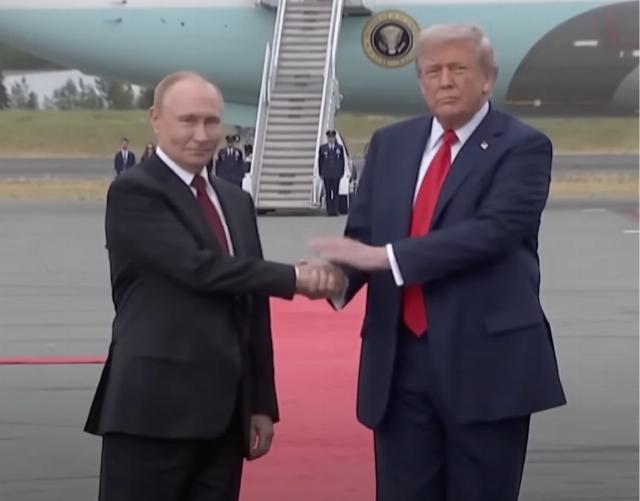
NewsNation screengrab via YouTube

Currently, the Ukraine war continues, but Trump and Putin are advocating not just for a ceasefire but for ending the conflict. Perhaps we'll find out more after the Ukrainian president visits the White House on Monday.

What other topics might the two superpower leaders have discussed? Both countries have their own deep states, and these two could be rewriting the world order contrary to the wishes of the globalists.

Third, Trump ordered the National Guard into Washington, D.C., citing the need to restore “law and order” and hinting that similar deployments could follow in other crime-ridden cities. Flanked by his Attorney General and Secretary of Defense, the visuals alone suggested something more than a routine crime-control effort. This seemed coordinated, possibly as part of a larger plan involving the justice system and the military.

Such actions are not conceived and executed on a whim. Each one requires extensive planning and coordination among federal agencies, local governments, and sometimes international partners. Still, there were no leaks, no New York Times or Washington Post stories citing “unnamed sources familiar with the matter” to spoil the surprise. In a town where operational security is often a joke, this silence is remarkable.

Are these events unconnected? Or is there a shared link? As Ian Fleming’s James Bond said, “Once is happenstance. Twice is coincidence. Three times is enemy action.”

It’s possible that the RussiaGate revelations are just the start of a long-overdue reckoning for those who attempted to undermine a legitimately elected president. If high-profile indictments are announced, possibly involving well-known political figures, the administration might be deploying military and law enforcement resources in anticipation of the unrest those actions could provoke.

The Trump-Putin meeting raises equally important questions. RussiaGate allegations prevented any serious diplomacy between the two leaders during Trump’s first term. Now that those claims are more thoroughly discredited, could the Anchorage meeting open the door to ending the Ukraine war, a conflict critics say has been used to funnel large amounts of money disguised as foreign aid?

They may have also discussed sensitive topics like the origins of COVID-19 and U.S.-related biological research in Ukraine. In a 2022 Senate hearing, Undersecretary of State Victoria Nuland confirmed the presence of “biological research facilities” in Ukraine, a fact that many in the media have long dismissed.

If peace in Ukraine is brokered, if the truth about COVID’s origins gains traction, and if major prosecutions emerge from RussiaGate, the shockwaves would be enormous. Civil unrest would likely follow. Perhaps that explains why the National Guard was mobilized proactively rather than reactively, marking a shift from the “wait until the cities are burning” approach seen in recent years.

Trump’s critics will dismiss these events as random chaos, the political equivalent of a cat in a sandbox. But it could just as easily be a deliberately planned operation, years in the making, now unfolding in real time.

Was Trump only playing golf during his four years away from the White House? Or was he working on the screenplay for his upcoming movie aptly titled, “Panic in D.C.”?

Those who know aren’t speaking, and those who are speaking don’t know. I find myself in the latter group, so please indulge in my speculation.

For now, the media, once the self-appointed directors of America’s political drama, seem reduced to spectators. They are no longer writing the script; they are watching the movie. Trump holds the laser pointer, and the media are a bunch of frantic cats, chasing the light and stumbling over their feet at every turn.

Coincidence? Calculation? Or the long-anticipated “storm” many have predicted since Trump first took office?

Buckle up. It’s a hot, long summer, and fall isn’t for another month. Enjoy the show.

Brian C. Joondeph, M.D., is a physician and writer. Follow me on Twitter @retinaldoctor, Substack Dr. Brian’s Substack, Truth Social @BrianJoondeph, LinkedIn @Brian Joondeph, and email brianjoondeph@gmail.com.

https://www.americanthinker.com/articles/2025/08/three_big_moves_in_washington_and_not_a_single_leak.html

Russia’s Substantial Concessions


Many Trump agnostics, on both the Left and Right, have convinced themselves that a Ukraine peace deal is doomed. Never underestimate Trump. Envoy Steve Witkoff revealed the reality during his Sunday appearance with Jake Tapper. Witkoff spent extensive time negotiating with Putin during the previous week. Trump wouldn’t have invited Putin if a deal wasn’t in sight. Early in this administration, Witkoff was dismissed by media pundits as a naive and gullible dunce, taken to the cleaners in Iranian negotiations. How well did things work out for the surviving Iranian leadership? A billionaire New York attorney, Witkoff was initially dismissed by Qatari fanboy and San Francisco native Tucker Carlson as a “Long Island native.” Now Mr. Passive/Aggressive refers to Witkoff as “a wonderful man.”

The interview didn’t go well for Tapper. He began by asking Witkoff to “give us two specific points that were agreed to.”

“We agreed to robust security guarantees that I would describe as game-changing. We didn't [originally] think that we were anywhere close to agreeing to [NATO] Article Five protection from the United States… [To ensure Russia does] not to go after any other territory when the peace deal is codified, legislative enshrinement in the Russian Federation, not to go after any other European countries and violate their sovereignty… [A]nd there was plenty more.”

Tapper had a one-word response: “Oh.” His CBS colleague, Margaret Brennan, was simultaneously busy attempting to trip up Secretary of State Marco Rubio. That never works. NBC’s Kristen Welker fared no better. Rubio makes his interlocutors look foolish. Deep State forces clearly fear a peace deal. Tapper proceeded, playing a tape of Trump saying, “I want to see a ceasefire rapidly.” Tapper then asked, “Obviously, the ceasefire didn't happen… Trump had said if he didn't like what he was hearing in the meeting, he would walk out. Why didn't he once it became clear Putin was not going to agree to a ceasefire?”

We were there as a mediator, so we were obviously advancing the Ukrainian view. The one thing that the president cannot agree to on behalf of the Ukrainians is any sort of land swap. That is for the Ukrainians. They've …stated that to us, and the president is respectful of it, but that's why we're moving so quickly to a meeting on Monday at the Oval Office with President Zelensky. …We covered almost all the other issues necessary for a peace deal. So I describe the ceasefire as the interim move where you would then negotiate towards a peace deal. We made so much progress at this meeting with regard to all the other ingredients necessary for a peace deal that President Trump pivoted to that place. Now, we're not waiting a week for a meeting with President Zelensky and the European leaders, or two weeks, or three weeks. We're going into a meeting with them within 48 hours of ending this meeting in Alaska. So we are intent on trying to hammer out a peace deal that ends the fighting permanently -- very, very quickly. Quicker than a ceasefire.

Tapper began realizing he was in trouble. The session continued downhill for him from there. “I still don't understand how not getting the ceasefire deal is a win.” Witkoff’s response didn’t help:

The thesis of a ceasefire is that you'd be discussing all of these issues that we [already] resolved in Alaska. You'd be discussing security guarantees. There's not a person on the European team who didn't acknowledge that we made substantial progress at this meeting… We cut through all kinds of issues that would have to be discussed and agreed to during a ceasefire period… The fundamental issue, which is some sort of land swap, which is obviously ultimately in the control of the Ukrainians. That could not have been discussed at this meeting. We intend to discuss it on Monday.


Tapper finally switched the subject from a ceasefire: “So Trump told Fox that he and Putin “largely have agreed on” land swaps. Sources tell CNN that President Trump told European leaders that Putin will agree to end the war and not attack Ukraine or other European countries, as you mentioned earlier, in exchange for Ukraine ceding the entire Donbas region to Russia, including territory that isn't even currently occupied by Russian forces. Is that accurate?”

I don't know that we have the time now to go through all the different issues on these five regions. There are five regions here. It's always, in our view, been the crux of the deal. Those five regions the Russians have previously said that they wanted it at the administrative lines… The Russians made some concessions at the table with regard to all five of those regions. There is an important discussion to be had with regard to Donetsk and what would happen there. And that discussion is going to specifically be detailed on Monday when President Zelensky arrives with his delegation and some of the other European leaders. And hopefully we can cut through and make some decisions right then and there on that.


Tapper: “What other concessions from Russia might there be?”

Witkoff: “They made some other concessions on several of the regions. I'm not going to discuss it now. The Ukrainians are aware of it as are the Europeans. And it was significant, and that doesn't mean it's enough, but the point was that we began to see some moderation in the way they're thinking about getting to a final peace deal.”

Tapper: “In terms of Ukrainian security guarantees, you mentioned the Article 5 guarantee of NATO, an attack on one and it's an attack on all. Russia would allow that to happen, that any further incursions into Ukraine, Russia would understand [that] would be seen as an attack on all NATO members?

Witkoff: “No, Jake, that's not what I said. What I said is that we got to an agreement that the United States and other European nations could effectively offer Article Five-like language to cover a security guarantee.”

The segment finished with Tapper attempting to pry too many details from Witkoff, which didn’t work. Tapper, “Did President Trump tell you… what he and Putin talked about in their brief time just one-on-one in the beast, the presidential limo?” Witkoff replied, “I did not discuss that with him Jake, no.”

How many peace deals must Trump broker in six months for naysayers to concede he knows what he’s doing? The art of the peace deal consists of identifying and fulfilling your opponent’s needs. Putin needs to stanch the bleeding, in men and money. He needs the economic incentives Trump offers, and portions of the territory Russia has captured. And the guarantee not to allow Ukraine into NATO. An American-guaranteed peacekeeping regime (which will probably be mostly or entirely NATO’s responsibility) protects Russia from Ukraine and Ukraine from Russia. Naysayers ignore powerful motivations bringing Putin to the table. Trump is moving fast, before Europeans can back out.

In consideration of Europeans’ delicate sensibilities, everyone must pretend that peace isn’t being forced upon the continent by America. Europeans perfected killing each other long before Napoleon initiated wholesale warfare.

Douglas Schwartz blogs at The Great Class War, applying pattern recognition of historical cycles to place current events into context.

https://www.americanthinker.com/articles/2025/08/russia_s_substantial_concessions.html