Search This Blog

Tuesday, December 2, 2025

Pfizer mRNA Influenza Vaccine 'Failed' In Clinical Trial Among Seniors: FDA Commissioner

 by Zachary Stieber via The Epoch Times (emphasis ours),

Pfizer’s experimental influenza vaccine will not receive approval absent new data proving that it protects seniors against the flu, the commissioner of the Food and Drug Administration suggested in a new interview.

A woman wears a facemask as she walks by the Pfizer world headquarters in New York City on Nov. 9, 2020. (Photo by Kena Betancur / AFP) Photo by KENA BETANCUR/AFP via Getty Images

The messenger ribonucleic acid (mRNA) shot “failed in seniors,” Dr. Marty Makary, the FDA commissioner, said during an appearance on Nov. 29 on Fox News.

The trial showed zero benefit,” he said.

“We’re not just going to rubber-stamp new products that don’t work, that fail in a clinical trial. It makes a mockery of science if we’re just going to rubber-stamp things with no data.”

Pfizer’s media team did not respond to a request for comment.

The experimental mRNA shot performed better in a trial than an already-approved vaccine from a different company among healthy people aged 18 to 64, researchers with Pfizer and other organizations said in a recent paper published by the New England Journal of Medicine (NEJM).

The researchers did not mention that among vaccinated seniors, or people aged 65 and older, in the same trial, 0.5 percent suffered influenza-like illness and had laboratory-confirmed influenza cases. That was the same percentage as recipients of a licensed vaccine.

Many more seniors—68.7 percent—reported adverse reactions within seven days of Pfizer vaccination compared with just 25.8 percent of recipients of the existing vaccine, the results also showed.

The results from the seniors in the trial were posted to ClinicalTrials.gov earlier this year and highlighted following publication of the paper by independent journalists and members of the panel that advises the Centers for Disease Control and Prevention on vaccines, including Retsef Levi, a professor at the Massachusetts Institute of Technology.

I find this to be a major integrity failure in the peer-review process. The NEJM editorial board should provide a clear explanation how this failure has occurred and ... require the authors to correct the current articles and report on the entire results of the trial,” Levi told The Epoch Times in an email.

“The study authors are best able to answer your question,” a spokesperson for the journal told The Epoch Times in an email when asked why the results for seniors were not included in the paper.

The study’s corresponding author, who works for Pfizer, did not return an inquiry.

Makary’s comments came after Dr. Vinay Prasad, who heads the FDA’s Center for Biologics Evaluation and Research, wrote in a memorandum that officials will be revising the current framework for influenza vaccines, which he called “an evidence-based catastrophe of low-quality evidence, poor surrogate assays, and uncertain vaccine effectiveness measured in case-control studies with poor methods.” He indicated that more details would be forthcoming after internal conversations.

The current framework features annual approvals of updated shots that target strains projected to circulate.

The FDA says on its website on a page updated in 2024 that FDA-approved flu vaccines “are safe and effective.” Officials with the Centers for Disease Control and Prevention estimate that the vaccines’ effectiveness against influenza since 2009 have ranged from 19 percent to 60 percent.

Prasad also said that for most new vaccines, officials will be requiring randomized trials that provide evidence of efficacy based on clinical endpoints, which can include prevention of disease.

Dr. Robert Malone, who leads the CDC advisory panel’s influenza workgroup, told The Epoch Times that the memo means “the entire influenza vaccine, annual vaccination enterprise is now subject to major disruption.”

https://www.zerohedge.com/medical/pfizer-mrna-influenza-vaccine-failed-clinical-trial-among-seniors-fda-commissioner

Anatomy of a Food Myth

 The past twenty years have seen gluten sensitivity transformed from a fringe concern into a mainstream cultural identity, powered more by consumer experience, psychology, and industry dynamics than by definitive biological mechanisms. This rapid rise has left many people unsure where scientific consensus ends and popular belief begins.

ACSH article image
Image: ACSH

The Rise of a Modern Food Fear 

“Our findings show that symptoms are more often triggered by fermentable carbohydrates, commonly known as FODMAPs, by other wheat components or by people’s expectations and prior experiences with food.” 

-Jessica Biesiekierski, Head of the Human Nutrition Group at The University of Melbourne

At this point, most of us know someone who identifies as “gluten sensitive.” Culturally, this idea has grown alongside rising interest in gluten-free eating, wellness trends, and a widespread belief that gluten causes fatigue, bloating, brain fog, or other vague symptoms. However, our medical understanding of these experiences is far narrower than the cultural phenomenon surrounding them.

Non-celiac gluten sensitivity (NCGS) is the medical term for this condition, referring to individuals who experience intestinal or extra-intestinal symptoms after eating gluten-containing foods but do not have celiac disease or a wheat allergy. NCGS lacks a diagnostic test, a known biological mechanism, or clear symptom patterns. NCGS is a narrower, more cautious medical label applied only after other conditions are excluded—and even then, its underlying cause remains uncertain. Yet the lack of clarity does not diminish the real discomfort many patients report.

To understand why these symptoms are so difficult to categorize, it helps to look more closely at what gluten—and wheat more broadly—actually contain.

What Gluten Actually Is and Is Not

Gluten is the main storage protein in wheat and gives dough its stretchy, elastic qualities. It provides most of the grain’s protein content. It is unusually rich in the amino acids proline and glutamine, making them difficult for the digestive system to fully break down; as a result, various gluten fragments can linger in the gut and may have biological activity. Beyond proteins, wheat provides essential nutrients such as fiber, vitamins, minerals, and, especially, fructans, a fermentable carbohydrate (FODMAP) recognized as a frequent trigger of digestive symptoms. While wheat varieties differ genetically and in their gluten content, there is no evidence that breeding over the last century has made wheat inherently more immunogenic. [1]

The Numbers Behind Gluten Sensitivity

Studies from around the world show that about 10% of people report being sensitive to gluten or wheat, though estimates range from 4–15%. But this number is significantly inflated. Yet controlled studies consistently show that only a small fraction of those tested react specifically to gluten, highlighting a gap between perception and physiological response.

There are several reasons for this gap between self-reports and verified cases:

  • Self-diagnosis is common - Across high-income countries, one-third of people say they have some kind of food sensitivity. But when objectively tested, fewer than 3% do
  • Verified Gluten Reactivity Is Rare - The majority of people who believe they are gluten-sensitive do not react to gluten and often are reacting to other components in wheat, especially FODMAPs—a group of short-chain carbohydrates known to trigger gas, bloating, and other digestive symptoms in many people. Additionally, there is a substantial overlap in the symptoms of irritable bowel with a “gluten allergy.”

These diagnostic ambiguities feed into broader challenges in defining what gluten sensitivity actually is.

A Diagnosis of Exclusion

As with many syndromes, there are difficulties in identifying specific diagnostic alterations, e.g., in long COVID. It is equally true for some forms of gluten sensitivity, which are categorized, with our best available evidence, as disorders of gut-brain interaction (DGBI), where they are symptoms of pain and altered GI function, yet no clear structural manifestations, e.g., irritable bowel syndrome. Methodological differences across studies make consensus difficult, but a growing number of studies suggest that FODMAPS, rather than gluten, may be the real culprit. 

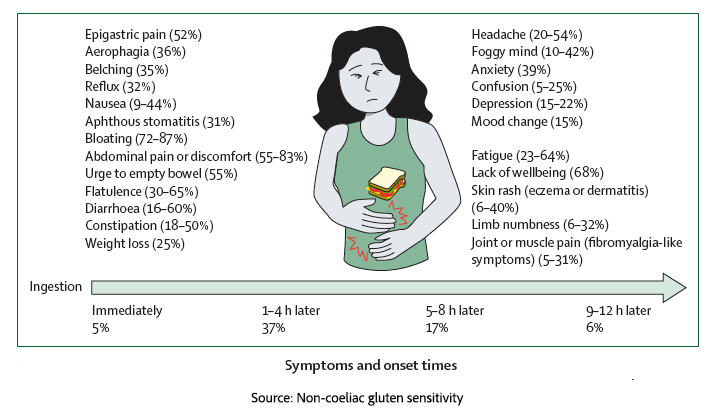
A person with a sandwich on her stomach</p>
<p>AI-generated content may be incorrect.Most people who report non-coeliac gluten sensitivity (NCGS) share a similar demographic profile: they are typically 38-year-old women. Many individuals first identify the problem on their own, after experimenting with diet changes, and before seeking medical attention. Symptoms often begin within a few hours of eating gluten but can appear later, and they vary widely between people.

This demographic pattern likely reflects reporting behavior as much as any underlying biology.

The symptom picture is broad. Digestive problems such as bloating, abdominal pain, diarrhea or constipation, reflux, nausea, gas, or mouth ulcers are common and can significantly impair day-to-day well-being. Many people also experience extra-intestinal symptoms, including fatigue, headaches, “brain fog,” skin rashes, joint or muscle pain, and changes in mood such as anxiety or depression. This wide range of nonspecific symptoms makes self-diagnosis both tempting and unreliable.

A Syndrome Without a Center

As with many syndromes, research has not yet revealed a single, consistent biological pathway. Instead, there are complex, mixed interacting influences. The lack of clear biomarkers, unreliable immune “signatures, and inconsistent intestinal changes suggest that symptoms may arise through several overlapping processes rather than one distinct cause. Studies of gluten triggering systemic immune responses, alterations of gut permeability, and microbiome characterization are at best “uncertain.” And then there is nocebo, placebo’s evil twin, where expectations play a significant role in experiencing a detrimental outcome. People often experience symptoms when they believe they consumed gluten, even when they didn’t, highlighting gut–brain interactions as a key driver.

The most fundamental challenge in NCGS research is uncertainty over whether it represents a distinct clinical entity at all—a striking contrast to the confidence with which the idea has taken hold in public culture. That cultural rise has unfolded far faster than scientific evidence could match.

From Science to Society: The Gluten-Free Boom

Over the past two decades, gluten sensitivity has evolved from a relatively obscure idea into a widely recognized cultural phenomenon. This surge of interest didn’t arise from medical breakthroughs; our understanding of “gluten sensitivity” is, at best, incomplete. Rather, it emerged from a convergence of public health narratives, wellness trends, media amplification, and commercial opportunity. As more people began attributing everyday symptoms like bloating, fatigue, or “foggy mind” to gluten, the idea of “gluten sensitivity” gained traction in popular culture far faster than the scientific evidence could keep up. 

“We would like to see public health messaging shift away from the narrative that gluten is inherently harmful, as this research shows that this often isn’t the case.”

-Jessica Biesiekierski, Head of the Human Nutrition Group at The University of Melbourne

This cultural shift has been closely tied to the explosive growth of the gluten-free marketplace. What began as a niche category for people with celiac disease is now a multibillion-dollar global industry. As public concern about gluten rose, manufacturers introduced an ever-expanding range of gluten-free breads, snacks, cereals, and convenience foods. The cycle became self-reinforcing: growing consumer interest encouraged companies to market these products as healthier or more “natural,” and the increased visibility of gluten-free options further normalized the idea that gluten is something many people should avoid—even though these substitutes vary widely in nutritional value.

The Self-Sustaining Gluten Cycle

The result is a self-sustaining cultural loop. More people try gluten-free diets out of curiosity or wellness motivations; many feel better, often because they have inadvertently reduced their intake of FODMAP-rich foods or ultra-processed products; and this perceived improvement strengthens the belief that gluten itself was the culprit. Commercial and media messaging magnify these impressions, making gluten sensitivity seem far more common—and biologically clearer—than scientific evidence currently supports. The science, meanwhile, continues to raise more questions than answers.

[1] Thereby dashing claims that more ancient wheat cultivars are “healthier.”


Source: Non-coeliac gluten sensitivity The Lancet DOI: 10.1016/S0140-6736(25)01533-8

Dr. Charles Dinerstein, M.D., MBA, FACS is Director of Medicine at the American Council on Science and Health. He has over 25 years of experience as a vascular surgeon.

https://www.acsh.org/news/2025/11/24/anatomy-food-myth-49837

Rep. Jason Smith: If We Can't Let Covid-Era Obamacare Subsidies Expire, We'll Never Cut Anything

 Rep. Jason Smith, the chairman of the House Ways and Means Committee, told FNC's "Sunday Morning Futures, that if Republicans agree to extend Obamacare health insurance subsidies, it is a signal that they will never get the budget under control.


"If we're not able to allow a COVID-era program to expire and revert back to the original Obamacare, which the Democrats have championed from day one, to be able to balance our budget, to cut spending will be virtually impossible," he said.

JACKIE DEANGELIS, FOX NEWS ANCHOR: Thirty days until the subsidies expire, roughly two months until we're potentially in a situation where the government can be shut down again, not a lot of time to make inroads on serious health care reform. But, as President Trump said, if he did extend the subsidies, it would be with certain restrictions.

It would be to buy some time to be able to move forward with some of the changes that Republicans want to make to the overall system. Walk me through how all of this is going to work.

REP. JASON SMITH (R-MO): Absolutely. First off, it's great to be with you, Jackie. What Republicans are looking at is how to bring down the cost of health care for all Americans, how to bring down the premiums for all Americans and creating more access for all Americans.

Unfortunately, what the Democrats have been focused on is just the Obamacare exchanges, which is just 7 percent of the entire population, 24 million Americans. And when you look at Obamacare, you can see all the fraud that's within it.

Just think about this. Last year, in '24, of the 24 million people on the Obamacare exchanges, 12 million did not even have one medical claim. Are you telling me that those 12 million Americans were that healthy and never went to the doctor?

The simple fact is, they clearly didn't even know that they had health insurance.

But guess what? Those insurance companies, they sure were subsidized from the federal government.

DEANGELIS: Well, let's talk about the cost of this, because if it goes on for another year, it would cost anywhere from $38 billion to $40 billion.

You have got Democrats that want to make these subsidies -- by the way, the subsidies implemented in 2021 after COVID and after the crisis, but under that cloak of COVID, they want to make those permanent. The 10-year cost would be anywhere from $335 billion to $383 billion, according to some of the estimates.

Why would you throw good money after bad, versus trying to look at how to reform the system to make it work? President Trump, talking about the insurers, said: "Don't give any money to the insurance companies. Give it to the people directly. Let them go out, buy their own health care plan. We are looking at that." How much of a reality is it?

SMITH: You know, we're looking at every option.

But if you just look at Obamacare, it is absolutely unaffordable. Premiums have gone up 80 percent since Obamacare was passed; 150 different hospitals have closed since Obamacare was passed. We have to do things differently.

And the answer is not a COVID era program that was created in '21.

This -- we need to look at some real, real reforms, real changes. Even with it expiring at the end of the year, 93 percent of all the people on Obamacare will still have very generous subsidies; 7 percent will lose it. But that 7 percent are people who are above 400 percent of the federal poverty level.

Right now, there's folks being subsidized making $600,000 a year.

DEANGELIS: Yes, it's outrageous when you really think about it and that there's a lot of waste in the system as well.

But we're talking about a crisis of affordability. That's what the Democrats are talking about. President Trump is talking about it too and what he's done to tackle it. But the Democrats are using that to win elections.

And this is really a hot-button issue, because if, all of a sudden, the average person sees their premium go from roughly a little bit less than $900 a year to almost $1,600 a year because these subsidies go away, that's a problem on both sides. And both sides will have to attack it differently.

The Democrats will say how awful the Republicans were to take that money away from the American people. You will make the arguments that you have laid out here. The bottom line is that something's got to get done. It's got to get done in roughly 30 days.

SMITH: We absolutely make sure we have to be the adult in the room. We have to have real reforms.

If you look at the Big Beautiful Bill that passed on July 4, according to the Congressional Budget Office, the reforms that we put in there of going after folks who are ineligible for different welfare programs and also making sure illegals aren't receiving welfare programs, we have now resulted in all Americans have lower premiums.

That's according to the Congressional Budget Office, which is not always the most friendly to House Republican policies. But when you look at affordability, it's important, Jackie, for people to understand why we are where we're at today. And that's because, when Joe Biden and the House Democrats, the Senate Democrats, when they had unified government, they spent more than $10 trillion that led to inflation rising more than 21 percent.

So, to put food on your table, closing your backs and gasoline in your cars cost more. President Trump, in just nine months, in just nine months, has reduced inflation to the lowest level in four years.

But guess what? We need to reverse the damage that Joe Biden. 
If we're not able to allow a COVID-era program to expire and revert back to the original Obamacare, which the Democrats have championed from day one, to be able to balance our budget, to cut spending will be virtually impossible.

We need to cut spending. We need to grow the economy. We need to eliminate unnecessary regulations. And that's in fact what President Trump's been doing. Do you know what? Just nine different executive orders that Joe Biden created when he was president cost more than a trillion dollars to all Americans, a trillion dollars.

But Donald Trump's been reversing that. And he's been pushing for more private sector investment. It's only going to grow the economy and it's going to bring affordability down.

https://www.realclearpolitics.com/video/2025/11/30/rep_jason_smith_if_we_cant_let_covid-era_obamacare_subsidies_expire_well_never_cut_anything.html


Post-COVID Trends Reshape US Education

 COVID may be on its way to being a chapter in our history books, but it’s left its fingerprints all over life as we know it. The world post-pandemic is not the same as the one we had in the early days of 2020. Work-from-home is now normalized; many companies are partially (and even fully) remote. Entire city populations have shifted as large numbers of Americans relocated around the country.

Perhaps less obvious to the naked eye — although not less significant — is COVID’s effect on the public school system.

The pandemic, and all the social changes that came with it, shattered some of our culture’s biggest educational taboos. More importantly, it shattered the illusion that our public schools are a great and trustworthy American institution.

Everybody talks about “COVID learning loss” (and the large gaps in learning students are still suffering months after school closures and missed lessons). Far less discussed is the “COVID trust loss” in our public schools (at a 25-year low) and all the ways that the social norms that bound public school together as an American bedrock have begun to fragment.

Since 2020, a wave of school choice policy has swept across the country. Its seeds were sown long before the pandemic, but COVID trust loss created the culture ripe to harvest them.

Four shifts post-pandemic are changing the fabric of American education: increased transparency inside the classroom (and more light shed on all the shortcomings of public schooling), the breakdown of the homeschooling taboo, the shift toward remote work, and demographic migrations into states prioritizing school choice.

Each of these paradigm shifts is quietly rewriting the education world. Each is important, and each is reshaping education in its own way.

If you’re a skeptic of government-run schools, there’s a lot to be excited about.

Zoom School Revealed the Rot in Public Education

In the early days of COVID, public schools went online, and parents had the chance to watch what was happening in their child’s classroom in real time. Many were not pleased.

Teachers and administrators were trying to translate an already broken model of education onto a format it didn’t fit, breaking it even further in the process.

Parents, also shut up inside their houses and in close proximity to their children, saw Zoom school and were horrified — is this really what my kid does all day?

Some chalked it up to the shortcomings of the medium: public school was designed for real-life rooms and three-dimensional interactions, not computer screens.

Others (more astutely) blamed the model itself.

It’s no secret that America’s public school outcomes aren’t great — the Nation’s Report Card, published by the federal government, publicly documents as much. But many parents were confused by the content of their children’s classes — like the parents documented in the Sold a Story podcast, who were horrified to discover their children weren’t learning to read.

Public school enrollment dropped sharply. Many families switched to private schools (which re-opened faster than public schools) or began homeschooling. Some of those families returned to public school after the lockdowns ended, but many didn’t, and public school enrollment is trending downward. Nationally, enrollment dropped 2.5 percent between 2019 and 2023, and continues to decline.

Even in cities like Austin (with population trending upward), public school enrollment is falling — Austin’s school district has lost 10,000 students over the past decade, despite the city population growing by 10 percent (nearly 100,000 new residents) over the same period.

If public schools were private companies, and surveyed their customers (the parents) — or just looked at their retention data — the market feedback would be clear. Parents aren’t happy with the results public schools are delivering, and are looking elsewhere.

Zoom School Made Homeschooling Less Taboo

Millions of parents pulled their kids out of public school in 2020 and started homeschooling them, confident that their homespun instruction would be better than whatever Zoom school was meting out.

Nearly overnight, homeschooling — once a strange practice reserved for the hippies and religious zealots and social outcasts — became normal. It went from a fringe concept to a shared cultural experience.

Nearly everybody knows somebody who homeschooled for at least a few months during the pandemic. And you can’t say “homeschoolers are weirdos” without a tinge of irony if you yourself (or your sister, or your best friend, or your cool neighbor) were once a homeschooling parent, no matter what the extenuating circumstances.

More importantly, even if you weren’t homeschooling, you still had your kids at home all day — one of the core (unimaginable?) realities of homeschooling life. Pre-COVID, parents could say “I could never homeschool my kids, I can’t imagine having them home all day.” Post-COVID, no longer: having your kids home all day was something everyone could imagine, because it was something everyone had experienced.

By the time the lockdown had abated, having your child home all day had gone from unimaginable, to practical, to a very viable possibility for the future.

Work-From-Home Broke Up “Default” Childcare 

At the same time Zoom school was in full swing, COVID was permanently rearranging the workplace. Technology had long before made remote work possible; the pandemic forced employers to catch up. Parents went from 9-5 office residencies to commuting only as far as the kitchen table, taking meetings while waiting for their sourdough to rise.

One of the core services public school offers, to families and to society generally, is childcare. Parents who go to work need somewhere for their kids to go. But if parents work from home, they can be the adult in the room while kids do school — especially if their child is enrolled in an online program (so mom doesn’t have to be the teacher).

For many kids, especially an older student who doesn’t need constant supervision, doing school online (with mom or dad in the other room for support if you need them) is a viable option. If your child doesn’t like the public school curriculum, or prefers working at their own pace, or is on the butt end of public school bullying and social hierarchies, online school can offer a compelling prospect.

During COVID, all sorts of online schools grew quickly: Sora School, an online project-based middle and high school; Synthesis, the game-based spinoff program from Elon Musk’s Ad Astra school; Kubrio, a “world school” with three time zone swaths and students from all around the globe — to name just a few.

More traditional models like online charter schools and public cyber schools are also on the menu; but for families with self-directed children, more custom combinations of tools and programs (Khan Academy paired with Teaching Company lectures, IXL supplemented with Coursera MOOCs) abound.

Post-COVID, remote work appears to be here to stay. As Cal Newport wrote in his book Slow Productivityreferencing Apple employees refusing to go back to the office: “These frustrated Apple employees [are] at the vanguard of a movement that’s leveraging the disruptions of the pandemic to question so many more of the arbitrary assumptions that have come to define the workplace.” 

This questioning of assumptions, not incidentally, applies equally to schooling.

Perhaps equally importantly, remote work also frees families from work-induced geographic constraints, making it easier for them to relocate to states with the best schools or robust school-choice supports.

Move To Choice-Friendly States

COVID policy rearranged the demographic spread of the country en masse: people fled in droves from locked-down states (like New York and Illinois and California) to open ones (like Texas and Tennessee and Florida).

States with less-restrictive school closure policies also tend towards freer education policy (both are correlated with the relative power of teachers unions). Many fewer states have since passed sweeping school choice policies, where families have access to public vouchers for use at private schools.

The effect is that a large number of kids — who would’ve otherwise been stuck in states without school choice — now live in states with a huge number of school options emerging.

Eighteen states have implemented universal school choice since 2020. Some of those states, like Florida and Texas, are becoming hotbeds for education innovation, and many are seeing an increasing number of private school options emerging.

Incidentally (or perhaps not incidentally at all), many of these school choice-friendly states are also the places people are having the most kids — a positive indicator of the education market’s future growth. Where there is demand (young students) and capital (school choice dollars), supply (interesting new schools) will follow.

Part of the reason public schools in America have had such a monopoly on education is because of other extenuating circumstances: parents need to work all day; no one was at home to watch the kids; tax dollars were exclusively bundled into the public school system — and everybody trusted the public school system. After all, it’s one of the great American institutions (or so we’re led to believe).

But with those undergirdings starting to shift, public school’s Herculean hold on the American psyche (and the American way of life) is shifting too. Logistically, we don’t need public schools the way we did a decade ago. We’re more skeptical of them. And alternatives have been destigmatized.

The 2.5 percent public school enrollment drop is still small; it’s early days. Nearly 50 million kids are still enrolled in public schools. Public education is still the default.

But the cultural landscape — and the cultural paradigm — has shifted. And the education landscape will continue to shift in response — slowly now, but more and more, until the unquestioned “default” of one school for all children feels as distant as normal reality did during the height of the pandemic.


House Republicans Officially Confirm "Operation Choke Point 2.0" Targeted Bitcoin And Crypto Firms

  by Micah Zimmerman via BitcoinMagazine.com,

Republicans on the House Financial Services Committee have released a 50-page report detailing what they describe as a systematic debanking effort by Biden-era regulators, dubbed “Operation Chokepoint 2.0.” 

While many of the findings — such as the Fed, FDIC, and OCC pressuring banks away from crypto through informal guidance, and the SEC’s “enforce first, make rules never” approach — were previously known, the report now places them squarely in the Congressional record.

The report identifies at least 30 entities that were effectively “debanked” through informal regulatory guidance and supervisory pressure. These businesses, the Committee claims, were forced out of the U.S. banking system without formal enforcement actions.

Govt coercion, biased enforcement, private pressure 'denied'

According to the document, the Federal Reserve, the Federal Deposit Insurance Corporation (FDIC), and the Office of the Comptroller of the Currency (OCC) employed a range of tactics to influence bank behavior. 

These included “non-objection” letters, “pause” letters, and other forms of informal guidance designed to make banks hesitant to engage with crypto companies.

Meanwhile, the Securities and Exchange Commission (SEC) allegedly adopted a policy of “enforce first, make rules never,” using selective enforcement rather than clear regulatory frameworks to restrict digital-asset activity. 

The report highlights SAB 121, an SEC guidance that effectively blocked banks from offering custody services for crypto assets.

The report paints a picture of regulators publicly denying any bias against digital assets, while privately pressuring banks to sever ties with crypto firms. The report reads that while regulators consistently denied discouraging digital-asset activity, the evidence collected by the Committee shows a pattern of private pressure and informal coercion. 

Committee Republicans argue these actions represent a revival of Operation Choke Point, a controversial program from the early 2010s that used regulatory and reputational pressure to discourage banks from serving certain high-risk industries. 

The report asserts that the tactics used against crypto firms echo the same methods: informal guidance, opaque supervisory expectations, and reputational risk warnings.

“The lack of clear rules combined with aggressive enforcement has created a chilling effect on the digital-asset sector,” said a Committee spokesperson. “Legitimate American businesses were forced to move abroad or shut down, not because of wrongdoing, but because of regulatory overreach.”

Crypto firms struggled to keep bank accounts

The report includes anecdotal accounts of firms that struggled to maintain bank accounts despite following all applicable laws.

One executive described repeated requests for documentation, sudden account closures, and vague warnings from compliance officers citing regulatory “uncertainty.” 

Another recounted being effectively cut off from the U.S. banking system after submitting a routine regulatory filing.

Republicans on the Committee argue that this environment has stifled innovation and driven financial activity offshore.

They call on Congress and the Biden administration to reverse these policies, provide explicit guidance, and ensure that legitimate crypto firms can access banking services without fear of arbitrary pressure.

The Committee’s full report is available in full on the House Financial Services Committee website.

https://www.zerohedge.com/crypto/house-republicans-officially-confirm-operation-choke-point-20-targeted-bitcoin-and-crypto