Search This Blog

Monday, January 5, 2026

The West Can Protect Itself from Terrorism and Urban Violence

 The “good” news about the Islamic terrorism and domestic urban violence that have rocked Western nations in recent months is that the attacks were foreseeable—and thus preventable. The bad news is that the fear of being called “racist” will stymie many governments’ ability to act on that foresight.

The December 14 massacre at Sydney’s Bondi Beach is the latest in a grim series of Islamist attacks across Europe, the U.S., and Australia. An Egyptian immigrant and his son opened fire on beachgoers during an annual Hanukkah celebration, killing 15 and wounding another 39.

Antecedents to this assault are too numerous to lay out here, but they include the Thanksgiving Eve shooting of two National Guard soldiers in Washington, D.C.; the 2025 Yom Kippur synagogue attack in Manchester, England; the June immolation of an elderly woman in Boulder, Colorado, during a pro-Israel charity run; the murder of two Israeli Embassy staffers in Washington, D.C. in May 2025; the New Year’s Day 2025 truck ramming in New Orleans that killed 14 people; and the 2024 Magdeburg, Germany Christmas market rampage, which killed six people. Other attacks, including more Christmas market rampages, have been foiled in recent weeks across the West.

These are not random events. No one is surprised to learn of the religion and ethnic background of the perpetrators, once the authorities deign to disclose those facts to the public. A few perpetrators, being second- or third-generation immigrants, share the nationality of their targets, but they conform to the template in other respects.

The same wearying predictability applies to the grotesque street crimes in American cities committed weekly by mentally ill vagrants, whether the fatal stabbing of a young woman in a Charlotte subway train in August or the near-fatal immolation of a young woman on a Chicago subway train in October. We are not surprised to learn of the perpetrators’ long criminal records and their avoidance of significant confinement, either in a prison or a mental institution. The exact time and location of the next atrocity may be unknown, but that more such attacks by the same class of perpetrators are coming is certain.

This predictability should be a boon to any official who puts public safety ahead of more recent priorities such as promoting diversity and tolerance. Only Donald Trump, however, among Western leaders, possesses the indifference to elite opinion to enact the obvious prophylactic measures. On December 16, two days after the Bondi Beach pogrom, Trump imposed a partial or full travel ban on 20 more countries, on top of the 18 already subject to such restrictions. The countries now facing full bans are Afghanistan, Burkina Faso, Chad, Equatorial Guinea, Eritrea, Haiti, Iran, Laos, Libya, Mali, Myanmar, Niger, Republic of Congo, Sierra Leone, Somalia, South Sudan, Sudan, Syria, and Yemen. Countries facing partial bans are Angola, Antigua and Barbuda, Benin, Burundi, Cuba, Dominica, Gabon, Gambia, Ivory Coast, Malawi, Mauritania, Nigeria, Senegal, Tanzania, Togo, Tonga, Venezuela, Zambia, and Zimbabwe. The mainstream media have noted ominously that a large portion of the disfavored countries are in Africa, from which fact the usual inferences are expected.

Though only a Third World romantic would worry that these bans will deprive the U.S. of a particularly concentrated source of future Nobelists, it may be readily admitted: the bans are overinclusive. They will exclude Third World natives who pose no threat of terrorism and who, under current lax expectations for assimilation, may even have the capacity to assimilate. So what? If the choice is between an overinclusive policy that keeps out non-terror-inclined immigrants and an underinclusive policy that lets through radicals and terror sympathizers, any national leader who puts the interest of his country’s citizens first will opt for over-inclusivity.

Members of the public react after the synagogue attack in Manchester, England (Photo by Christopher Furlong/Getty Images)

The United States owes entry to no one. People born and residing outside the country possess no constitutional rights. They should be excludable on any ground or on none at all. Citizens should not bear the burden of risk from a wrong immigration decision; that risk should fall exclusively on foreigners.

But putting the interests of citizens first has become alien to Western elites. According to that transcontinental class, the real specter raised by the Bondi Beach attacks was “racism.” “I think the average Australian feels incredibly sad and really worried about the effect this has on not just victims but society more broadly,” Jill Sheppard, an associate professor of politics at the Australian National University, told the New York Times. According to the Times, the murders have people “fearing more anti-Jewish violence—and an Islamophobic backlash.” The murders raised questions about the “nation’s approach to immigration, antisemitism, gun control and racism,” the paper reported.

The only question that the attack should have raised about Australia’s approach to racism is: How quickly can it be jettisoned? But the Australian elites believe themselves surrounded by incipient vigilantes, who can be kept in check only through anti-white-privilege curricula and by the country’s endless commissions and reparations measures to protect the indigenous population. They could not believe their luck, therefore, when a Good Samaritan who tried to disarm one of the two Bondi Beach attackers proved to be a Syrian-born fruit vendor. “God, what a blessing,” Simon Chapman, emeritus professor of public health at the University of Sydney, told the Times. “As soon as I saw his nationality, I thought this is going to be so, so important for dampening down the racist debate.”

Actually, there was no sign of what Chapman and his colleagues would deem a “racist debate.” So wary are Australia’s politicians of privileging the country’s legacy population and of slowing down its demographic transformation that a conservative opposition leader, Susan Ley, put on hold a previously proposed migration policy that would have modestly tightened migration rules. Debating the policy at this moment would be inflammatory, her thinking went.

It turns out that an elderly Russian Jew had also sought to disarm the Bondi Beach killers, confronting them at the onset of their rampage. He and his wife became the attack’s first casualties. Another Soviet-born Jew ran toward the attackers hoping to stop them and was also fatally gunned down.

But after brief media notice of their heroism, these three martyrs have been memory-holed, and attention has recentered on the “blessing” of the Syrian fruit vendor, who is invoked totemically as an argument for multiculturalism and against immigration reform.

Instead of examining the immigration regime, Australia’s leaders turned reflexively to irrelevancies. The day after the massacre, Prime Minister Anthony Albanese recommended “tightening“ Australia’s strict gun laws; he put nothing else on his cabinet’s agenda. Gun control is even more overinclusive than a travel ban. Few if any of Australia’s native gun owners from its traditional Anglo heritage commit Islamic terrorism. Better to constrict their freedoms, however, than to narrow the flow of foreigners out of which terrorists sooner or later emerge.

Australia’s politicians also jumped on the need to crack down further on “hate speech,” which is already criminalized under Australian law. Given the zest for thought control so vividly on display during the Covid lockdowns, seizing the pretext for more such power undoubtedly came easily to the country’s ruling class.

The concept of “hate speech” is used overwhelmingly against conservative dissenters from elite ideology and will continue to be so used. The Tackling Hate Lab at Deakin University in Victoria, for example, investigates “anti-trans and anti-drag mobilisation in Australia,” to show how “Australian far-right networks disseminate hate.” American podcaster Matt Walsh is on the global hatemonger list tracked by the Lab. This academic surveillance outfit is the very model of technology-driven thought monitoring, “integrat[ing] emerging technologies, AI, econometric methods and agent-based modelling with social and psychological science” to counter “ideology-driven and prejudice-driven behaviours” [italics in the original].

Asked a few days after the Bondi Beach Jew killings if radical Islam were Australia’s greatest domestic security threat, Albanese pivoted immediately to the “need to take action” against “neo-Nazis,” however thin their ranks, and reached back to a 1989 attempt on the life of an African National Congress representative to show how enduring the right-wing threat has been.

Even if the concept of “hate speech” were not primarily a tool of the Left, however, suppressing speech does nothing to cure the underlying malady. It only drives that malady underground. As repugnant as Australia’s pro-Hamas demonstrations have been, it is better to see and hear the extent of anti-Jewish animus than to guess at its scope. Rather than further policing what Home Affairs Minister Tony Burke called “dehumanizing” language (cue the anti-”white supremacy” industry in academia and business), it would be more efficient and less inimical to core Western traditions to shrink the population from which the majority of terrorists are drawn.

And now the state of New South Wales has imposed a two-week ban on public assemblies in certain areas of Sydney, extendable at the will of the authorities. Better to try to hide the hatreds that unchecked immigration has fostered than to check that immigration in the first place.
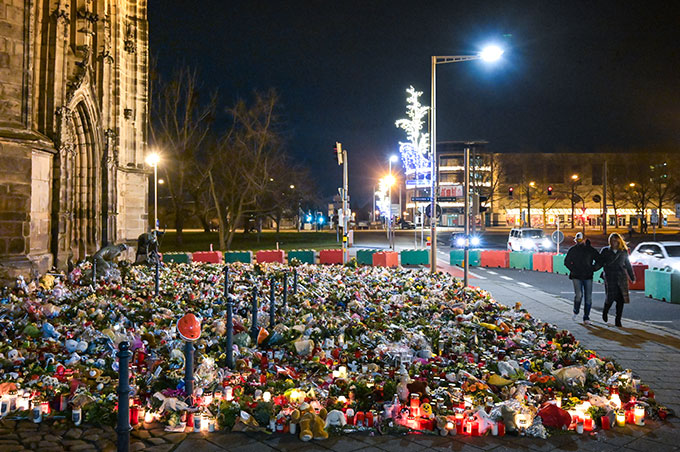
Memorial site for the victims of the 2024 Magdeburg, Germany Christmas market attack (Photo by Heiko Rebsch/picture alliance via Getty Images)

Preventing violence by America’s street vagrants is even more straightforward. These attacks are routinely referred to as “random.” They actually are as predictable as clockwork. Every untreated schizophrenic wandering the streets and public transit systems is another potential subway pushing, stabbing, and unprovoked clubbing waiting to happen. The next assailant will have been recognizable from far away—disheveled, disoriented, talking to himself or screaming at passersby, trailing items of detritus, redolent of bodily waste.

Before the rights revolutions of the 1960s, it would have been unthinkable to allow these drug-addicted, psychotic unfortunates to colonize public spaces. That they continue to occupy sidewalks, parking lots, commuter train stations, and subway cars is the product of deliberate policy. Their serial crimes earn them no extended sentences because the architects of our current criminal-justice system have decided that too many blacks are in prison. To avoid disparate impact, criminals should be allowed to commit larceny, trespass, fare evasion, assault, and a host of other crimes repeatedly with minimal punishment or, ideally, virtually no punishment at all. If these deranged repeat offenders are arrested by unjustifiably conscientious police officers, they will be almost invariably put back on the streets by progressive prosecutors and judges, eager to display their racial sensitivity.

Activists ensure that mentally ill drug addicts, magically rechristened “the homeless,” are left in plain view, as testaments to the failings of capitalism, as stimulants to nonprofit fundraising, and as the pretext for hiring legions of government-funded, feckless “outreach” workers who simply enable human degradation.

The fight against “racism” also plays a role in allowing these escapees from Bedlam to destroy civilized urban spaces. If it appears that a disproportion of crazed street wanderers are black, your eyes are not deceiving you. The rate of schizophrenia among blacks in the U.S. is at least 2.4 times higher than among whites, according to a 2018 meta-analysis; efforts to blame that disparity on diagnostic racism have failed. The incidence of schizophrenia among blacks from the Caribbean living in the U.K. is nine times higher than among whites; it is 5.8 times higher among black Africans than among whites in the U.K. Robust reinstitutionalization would thus have a disparate impact, another reason for the elites to fight it.

The predictable attacks continue: a woman stabbed to death in a Florida Barnes and Noble on December 24 by a mentally ill vagrant; a man struck in the face with a bat on December 21 while walking on Manhattan’s West End Avenue; a man stabbed in the back on a subway platform in Manhattan’s Upper West Side on December 19; a mother stabbed in the back in a bathroom of Macy’s in New York on December 11 by a mentally ill woman who had been recently discharged from a psychiatric ward.

These could all be avoided if every part of the law enforcement system cooperated to lock up serial offenders as soon as their predilection for repeat crimes manifests itself—ideally at the second offense—and if the hallucinating mentally ill were put into institutions rather than being turned loose to decompose on the streets. The costs of creating humane mental asylums pale in comparison with the costs of death, maiming, and the urban depopulation caused by vagrant squalor. To be sure, legal barriers erected in the post-1960s era stand in the way of reforming policing and mental health protocols to protect the law-abiding and the functional instead of the antisocial and deviant. But tearing down those barriers should be the stated goal of every public official, and progress toward achieving that goal should be the litmus test for reelection.

Thanks in large part to racial politics, the U.S. lags its Western counterparts in preserving order in the face of street vagrancy and psychotic crime. That willed disorder is set to worsen markedly in Zohran Mamdani’s New York. But the U.S. has leapt ahead of most European and Anglosphere allies in restoring national borders. Western voters, including in Australia, are tired of having their desire for immigration enforcement decried as “racist.” As predictable as the next terror and vagrant attacks may be, so, too, is the rising tide of nationalist revolt.

Venezuelans Celebrate Demise Of Collectivism While New Yorkers Embrace Its ‘Warmth’

You have to marvel at the sequence of events we just experienced. On Jan. 1, a socialist was sworn in as mayor of New York, promising the “warmth of collectivism.” On Jan. 3, President Donald Trump announced that he’d forcibly removed Nicolas Maduro from Venezuela, ending the country’s 23-year embrace of socialism.

We will leave it to the pundits, the lawyers, politicians, and various other “experts” to debate the merits of Trump’s action.

But what we can’t let happen is for the left and the mainstream media to ignore or downplay just how tragic Venezuela’s embrace of collectivism has been.

So, we thought we’d do our readers a service and republish an editorial we wrote more than six years ago, in which we detailed the cold, hard truths about socialism. The situation in Venezuela had only deteriorated further in the years after this editorial ran.


Venezuela: A Humanitarian Crisis The Left Couldn’t Care Less About

June 17, 2019

Try to imagine this scenario. A once-wealthy country spirals downward over the course of several years into a humanitarian crisis of epic proportions. Starvation and violence are rampant. The economy has collapsed. Millions have already fled. And all the while, an autocratic ruler acts with complete indifference, when he’s not trying to crush dissent and blame other countries for the misery he’s inflicting on his own.

Under normal circumstances, there would be regular protests in Washington. Hollywood actors would be busy creating tear-jerker videos and making emotional award ceremony speeches. Musicians would be putting on global benefit concerts. The corruption, desperation, and daily human misery would be above-the-fold in newspapers and lead the nightly news. It would be on everyone’s mind.

But in this case, the catastrophic suffering is being almost completely ignored. Why? Because it’s happening in Venezuela — a socialist state that the left has for years championed and now refuses to admit has been a monumental failure.

“Much of the Western left, including those who once had only kind words for (Hugo) Chávez and his successors, is treating Venezuela as an embarrassment best brushed under the carpet,” James Bloodworth writes in Foreign Policy.

It is almost impossible to describe what’s happening in Venezuela today.

Ninety percent of the country now lives in poverty. Food and basic necessities are scarce. Malnutrition is rampant.  The child mortality rate has shot up 140% since 2008. The Secretary General of the Organization of American States says that newborns in Syria have a better chance of survival than those born in Venezuela today.

There are severe shortages of medicines, and diseases such as measles, diphtheria, tuberculosis have surged. Malaria cases are up more than ten-fold since 2009.

“The situation in Venezuela is dire,” said Dr. Paul Siegel, director of the Johns Hopkins Center for Humanitarian Health.

The economy has collapsed as hyperinflation — which reached 815,000% in May — has taken hold. To cope, President Nicolas Maduro has had to issue new currency twice within the past year. The new 50,000 Bolivar note is equal to about $8. In a country with vast supplies of oil, energy is scarce.

Nearly 10% of the country —  some 4 million people — have fled, including many who climbed aboard boats to embark on treacherous and often fatal escapes.

“Women and girls are suffering disproportionately in Venezuela,” says a report from CARE. “Trafficking of women for sex and forced labor is increasing throughout the region. The spiraling levels of poverty, both for Venezuelans inside the country and those fleeing within the region, have forced many women into sex work.”

The response from the left to all this? Ignore it, make excuses, or attack President Trump for interfering.

In fact, the biggest Venezuela protest in Washington was the “Hands Off” march this spring, in which protestors attacked Trump for attempting regime change in the country.

And when the press does report on Venezuela, it almost always leaves out one key detail: The fact that the profound misery is the direct result of the country’s embrace of socialist policies starting with Chavez and continuing with his hand-picked successor, Maduro. In fact, 93% of the stories that aired on network news from February 2018 through February 2019 never mentioned “socialism” or “socialist,” according to a Media Research Center analysis.

The indifference shown by the liberal establishment to what’s happening in Venezuela is disgusting, but it’s also incredibly revealing. Human suffering matters, it seems, only when it suits the left’s ideological agenda.

You can bet that the next time a country tries to enact Venezuela-style socialist policies, the left will be cheering it on.

Until disaster inevitably strikes and it suddenly loses all interest.

https://issuesinsights.com/2026/01/04/trump-liberates-venezuela-from-the-warm-embrace-of-collectivism/

Medicaid’s Structure Actually Invites Waste and Fraud

 Recently, Minnesota and Governor Tim Walz have come under scrutiny for Medicaid Fraud. The debacle received renewed focus on December 1 when Treasury Secretary Scott Bessent posted on X that he had directed the US Treasury to investigate allegations of fraud and that taxpayer dollars were allegedly “diverted to the terrorist organization Al-Shabaab.”

Unfortunately, misuse of Medicaid funds is nothing new. In 2023, the Office of Minnesota Attorney General Keith Ellison charged three individuals as part of a scheme to defraud the Minnesota Medical Assistance (Medicaid) program out of nearly $11 million, the largest Medicaid fraud prosecution in that state’s history. These charges spurred a wider crackdown on Medicaid fraud in the Land of 10,000 Lakes.

What distinguishes the current scandal from background levels of fraud is abundant evidence that “someone was stealing money from the cookie jar and they [state officials] kept refilling it.” This quote, highlighted by Economist Michael F. Cannon, comes from one of the defense attorneys in the fraud case. Cannon then reiterated his insight from 2011: “The three most salient characteristics of Medicare and Medicaid fraud are: It’s brazen, it’s ubiquitous, and it’s other people’s money, so nobody cares.”

This comes at the cost of reducing quality of care and access to care for the poorest Americans. The solution comes from getting government out of healthcare, not by enlarging Medicaid’s “cookie jar,” or by refilling the jar more frequently.

Improper Payments? Fraud? Waste? What’s the Difference?

When federal officials discuss various errors in their program, they choose specific language. Understanding the distinctions in how each term is used helps decipher how a federal program is performing.

In its own findings, the Government Accountability Office (GAO) notes that Medicaid is highly susceptible to “improper payments” with an improper payment rate second only to Medicare. The GAO defines improper payment as “payments that should not have been made or that were made in the incorrect amount; typically they are overpayments.” This is distinct from their definition of fraud, which is “obtaining something of value through willful misrepresentation.” The GAO comments, “While all fraudulent payments are considered improper, not all improper payments are due to fraud.” An improper payment could be an honest mistake on the part of either the citizen receiving Medicaid or the public employees administering the program.

The GAO also distinguishes waste as “when individuals or organizations spend government resources carelessly, extravagantly, or without purpose” and abuse “when someone behaves improperly or unreasonably, or misuses a position or authority.”

Specific allegations or investigations regarding waste or abuse are beyond the scope of this author, but incentives suggest that both are present and widespread among state Medicaid programs.

The Bad News: Medicaid’s Design Makes It Susceptible to Error (Including Fraud)

Medicaid is a joint federal-state program that funds health insurance coverage for America’s poor. The federal government transfers funds to states, which then administer Medicaid programs, with some variations from state to state. 

This income threshold to be eligible for Medicaid increased under the expansion of The Affordable Care Act (also known as the ACA or Obamacare). Because ACA enrollees receive more federal dollars than traditional Medicaid, state policymakers are incentivized to prioritize serving more Medicaid expansion enrollees (the slightly less poor) over those in traditional Medicaid (the poorest Americans). 

The Centers for Medicare & Medicaid Services (CMS) estimates Medicaid’s improper payments within three categories:

  1. Managed care: Measured errors in payments states make to private insurance companies that are contracted to deliver Medicaid benefits (known as managed care organizations).
  2. Fee-for-service: Measured errors in payments states make directly to providers on behalf of fee-for-service beneficiaries, including payments made to ineligible providers.
  3. Eligibility: Measured errors in state eligibility determinations for both types of Medicaid beneficiaries.

In fiscal year 2024, improper payments in Medicaid were estimated at $31.1 billion — equal to five percent of total Medicaid spending. This highlights a major weakness in the program, whose size and complexity lead to clerical errors and procedural mistakes. Additionally, when states fail to collect the necessary documentation (such as up-to-date income verification), improper payments (including fraud) are more likely to occur.

Saul Zimet recently wrote in The Daily Economy:

The government bureaucrats who kept sending hundreds of millions of dollars to the fraudsters year after year had every indication of what they were enabling, but their incentives were to enable rather than prevent the theft.

Unfortunately, Medicaid’s design encourages state policymakers to maximize transfers. In some instances, that may mean lax oversight of where the money goes and who is eligible to enroll in Medicaid. COVID-19 stimulus funding required states to relax eligibility requirements and accelerate approvals to receive Medicaid: the environment was ripe for accidental improper payments as well as waste and fraud.

Since Medicaid’s inception, state policymakers have taken advantage of accounting gimmicks (such as provider taxes) to maximize the amount federal taxpayers shell out into state programs. The motivation for state officials is clear: increase your spending and have federal taxpayers in other states pay for it. Transfers to state and local governments often come with strings attached — the terms and conditions of receiving the transfers — allowing federal policymakers more influence over state and local spending. Whether or not the use of a provider tax loophole represents a misuse of Medicaid’s framework is the subject of debate. Research from the Paragon Institute highlights areas that, at the very least, require substantial investigation and reform to prevent states from shifting costs to federal taxpayers.

The Worse News: Medicaid’s Errors May Be Worse Than Official Government Estimates

From 2015-2024, the GAO reported $543 billion in improper Medicaid payments. Unfortunately, that may be lower than the actual total. Research from economists Brian Blase and Rachel Greszler found that improper payments during that period are estimated to actually be $1.1 trillion, more than double the GAO’s estimates.

The discrepancy comes from Blase and Greszler’s inclusion of eligibility checks in the audits of improper Medicaid payments, which both the Obama and Biden administrations excluded. The halting of Medicaid enrollment audits is especially concerning because during this same period, many states expanded Medicaid under the ACA and Medicaid saw a record number of enrollees during the pandemic. Blase and Greszler comment, “Eligibility errors of this nature are particularly concerning as it can indicate that individuals are allowed to remain enrolled in the program during times in which they do not qualify, potentially diverting limited resources that could otherwise be invested in better serving vulnerable populations.”

Blase and Greszler’s research raises serious concerns about Minnesota. Is the fraud being investigated just the tip of the iceberg?

The Solution: Get Government Out of Healthcare

In addition to the improper payment rate of Medicare and Medicaid (and the disincentive to investigate what becomes of ‘other people’s money’). Fraud risks are also being investigated in the other portion of the ACA: the premium tax credits paid from the US Treasury to an insurance company to cover an enrollee of an ACA exchange health insurance plan. 

Healthcare is also the single largest category of the federal budget, with about 26 cents of every dollar spent going to various healthcare programs, which are also the single largest item on most state budgets. Not by accident is healthcare highly regulated at both the federal and state levels. Federal and state tax codes incentivize working Americans to purchase health insurance through an employer, leaving little room for insurance offered through civil society and voluntary contracting. There’s a lot unknown in health care, but one thing is clear: government encroachment is not helping.

Healthcare, nearly twenty percent of the US economy and growing, is in desperate need of reform. Rolling back regulations on insurance offerings, the healthcare profession, and innovation, as well as reforming the tax code and spending to encourage consumer-driven choice will encourage competition, lower costs, and empower patients. 

Greater consumer choice — and less reliance on distant federal programs — will help reduce the fraud endemic in government healthcare.


Thomas Savidge is a Research Fellow at the American Institute for Economic Research. He earned his Master in Public Policy from George Mason University and a Bachelor of Arts in Political Science and Philosophy from SUNY New Paltz.

Prior to joining AIER, Mr. Savidge was a Research Director at the American Legislative Exchange Council focusing on tax and fiscal policy. He was a co-author of several publications focused on public pensions, public retiree benefits, bonded obligations, tax and expenditure limits, and state taxes. In 2020, Mr. Savidge published a peer-reviewed study on Tennessee public retirement systems with the PERI Center at MTSU titled, “Tennessee Public Pensions: A Model for Reform.”

Hilton Hotel In PR Crisis Mode After "Coordinated Campaign" To Cancel ICE Agent Bookings

 Hilton Hotels is in damage-control mode after Homeland Security posted on X an email showing that a Hilton property in the Minneapolis area canceled a reservation for federal agents amid a large-scale operation to identify, arrest, and remove illegal alien criminals from Tim Walz's state.

"NO ROOM AT THE INN!" DHS wrote on X, alleging that the hotel chain "launched a coordinated campaign in Minneapolis to REFUSE service to DHS law enforcement."

The agency continued, "When officers attempted to book rooms using official government emails and rates, Hilton Hotels maliciously CANCELLED their reservations."

"This is UNACCEPTABLE. Why is Hilton Hotels siding with murderers and rapists to deliberately undermine and impede DHS law enforcement from their mission to enforce our nation's immigration laws?" DHS concluded in the post.

The hotel in question is the Hampton Inn by Hilton Lakeville, located just off Interstate 35 in the southern Twin Cities suburbs, about 30 minutes from downtown Minneapolis. Hampton Inn is owned by Hilton.

DHS' post went viral by early Monday afternoon, sparking outrage among America First supporters and prompting calls to cancel Hilton-branded credit cards and even future reservations.

Hilton executives, facing what can easily be described as a potential "Bud Light moment," were quick to clarify that the cancellation involved not the company as a whole but an "independently owned and operated" hotel.

"Hilton hotels serve as welcoming places for all. This hotel is independently owned and operated, and the actions referenced are not reflective of Hilton values. We are investigating this matter with the individual hotel, and can confirm that Hilton works with governments, law enforcement, and community leaders around the world to ensure our properties are open and inviting to everyone," Hilton told Fox News reporter Bill Melugin.

Hilton shares in New York were down about 1.5% by late afternoon trading. The swift response from Hilton underscores growing concern about boycott calls circulating on X.

https://www.zerohedge.com/political/hilton-hotel-plunges-pr-crisis-mode-after-coordinated-campaign-cancel-ice-agent-bookings

Network Of Left-Wing Nonprofits Raced To Counter Trump's Narrative Of Maduro Raid

 by The Bureau's Sam Cooper,

Within hours of the Trump administration's surprise extraction operation in Venezuela, commentary surrounding President Nicolás Maduro's arrest for alleged narco-state conspiracies metastasized into something Trump's war cabinet could not control with stealth helicopters, radar jamming, or the world's most effective special forces units: a narrative war in support of Maduro, waged at internet speed by organizations that already had templates, coalitions, and street logistics in place — and that have demonstrated well-oiled campaigns in support of causes such as Hamas, the Iranian regime, and China's geopolitical aims in recent years.

Using the language of illegality, imperialism, sovereignty, and kidnapping, the narrative surged online and spilled into public demonstrations.

It came from a familiar set of hubs: the People's Forum in Manhattan; Code Pink, a veteran anti-war group; and a set of allied media accounts including BreakThrough News that, for years, have moved from international flashpoint to international flashpoint with a consistent ideological lens.

It is a tightly aligned cluster of voices that reporting from The New York Times has connected previously to Marxist billionaire Neville Roy Singham, who lives in Shanghai and is part of Beijing's global United Front funding and media-messaging ecosystem, according to reporting cited by U.S. Congressional leaders.

In the first hours after the raid, accounts associated with that ecosystem pushed a blunt claim: the United States had launched an "illegal bombing" of Caracas and carried out the "kidnapping" of Venezuela's leaders — framing the operation less as a law-enforcement action than an imperial seizure.

The People's Forum published early messaging calling the strikes "illegal," and allied organizers circulated "Emergency" calls for rallies under a single slogan — "No War on Venezuela" — directing supporters to gather in public squares, including Times Square, and to replicate the model in dozens of cities.

Code Pink, amplifying the same call, promoted a national list of actions while issuing statements that described the U.S. operation as an "act of war" and a dangerous escalation.

By Monday, January 5, at least 100 pro-Maduro rallies had been documented across North America, with the bulk in the United States and additional events in Canada and Mexico, many clustered around a coordinated "day of action" on January 3–4.

The organizing architecture was equally consistent: long-standing socialist and anti-war groups, including the Party for Socialism and Liberation, and mobilization infrastructure associated with The People's Forum and BreakThrough News.

On Saturday, January 3, by daybreak, the message discipline was visible across platforms: the same "illegal" framing; the same sovereignty language; the same depiction of the raid as a prelude to regime change; the same mobilization graphics; the same cluster of organizations amplifying one another.

And as the protests moved from the screen to the street, a set of prominent elected officials—especially those aligned with the Democratic Socialists of America orbit and adjacent progressive coalitions—adopted language that strongly resembled the overnight framing pushed by these activist nodes.

Zohran Mamdani, the newly elected mayor of New York City, called the raid a "blatant act of war" and argued it violated "federal and international law," adding that the United States was "bombing another country, kidnapping its president," without congressional authorization.

Representative Rashida Tlaib of Michigan condemned what she called an "illegal and unprovoked bombing" and "kidnapping" — language that mirrored the slogans being broadcast by the activist coalition infrastructure.

Representative Alexandria Ocasio-Cortez, in posts that ricocheted across social media and were widely re-shared, framed the Trump administration's Venezuela action not as a narcotics case but as a familiar American pattern: "It's not about drugs," she wrote. "It's about oil and regime change," casting the raid as "ratings & distraction" politics rather than enforcement.

North of the border, at least two Canadian New Democratic Party figures used closely aligned rhetoric. Heather McPherson, a senior NDP foreign-affairs critic, issued a condemnation that described the operation in the language of sovereignty and international law, warning against a U.S. escalation.

Don Davies, current NDP leader, argued publicly that the U.S. action lacked lawful authorization and amounted to aggression — a message that tracked closely with the activist coalition's claims of illegality and imperial overreach.

From Britain, Jeremy Corbyn posted: "The US has launched an unprovoked and illegal attack on Venezuela. This is a brazen attempt to secure control over Venezuelan natural resources. It is an act of war that puts the lives of millions of people at risk — and should be condemned by anyone who believes in sovereignty."

On the other side, representing Pax Americana, the bipartisan House Select Committee on the Chinese Communist Party moved almost immediately to cast the episode as a geopolitical victory over Beijing's footprint in the Western Hemisphere. In a statement distributed by Representative John Moolenaar of Michigan, the committee's chairman, the committee portrayed Maduro as "a Chinese ally."

“China’s partnership with Maduro propped up an authoritarian ruler who worked with our nation’s adversaries and hurt the American people,” Moolenaar stated, adding, “China is actively working against us in Central and South America and those who choose to work with Xi Jinping should note that he could not save Maduro from defeat.”

Meanwhile, as the online battle over "kidnapping" and "illegal bombing" was still hardening into its first slogans, the Justice Department put a very different narrative into the public record — one that framed the same Venezuelan leadership the protest ecosystem was now defending as the apex of a long-running, hemispheric criminal enterprise, embedded in — and facilitating — a wider political economy of protection and profit along the cocaine route north.

In the superseding indictment unsealed in federal court in Manhattan, prosecutors alleged that Nicolás Maduro Moros and senior figures in his circle, including his wife, Cilia Flores, a powerful politician and lawyer seen by some Venezuelan journalists as the true brain behind Maduro's brawn, abused positions of state power for more than a quarter century, corrupting Venezuelan institutions to move "tons" — and later "thousands of tons" — of cocaine toward the United States while enriching political and military elites.

Maduro and Cilia Flores are expected to make their first appearance in federal court in New York today.

The indictment alleges that between 2004 and 2015, Maduro and Cilia Flores trafficked cocaine — including shipments that Venezuelan law enforcement had previously seized — using armed military escorts and state-sponsored gangs known as colectivos to protect the operation and enforce discipline, including kidnappings, beatings, and murders of those who threatened the enterprise, which included multiple justice ministers.

The filing is explicit that Venezuela—while not a significant cocaine producer—became the predominant state-protected logistical hub in the Western Hemisphere for narcotics trafficking and money laundering, with alleged links to leftist narco-terror groups such as the Revolutionary Armed Forces of Colombia (FARC).

But Venezuela is not treated as an isolated narco-state. Prosecutors alleged that transshipment points in Honduras, Guatemala, and Mexico "relied on a culture of corruption," in which traffickers paid portions of their profits to politicians who protected and aided them—and that those "cocaine-fueled payments" were then used to maintain and augment political power.

In its "overt acts" section — backed, prosecutors allege, by recorded meetings and DEA informants — the indictment sketches a pipeline in which narcotics profits were not only protected by political and military power, but used to fund political campaigns for Maduro's network and Cilia Flores herself.

Between approximately 2014 and 2015, prosecutors alleged, a Venezuelan National Guard captain on Margarita Island coordinated hotels, transportation, women, and food for visits by Venezuelan officials — including Maduro's son, Nicolás Ernesto Maduro Guerra ("The Prince"), who visited the island approximately twice monthly. Maduro Guerra, prosecutors alleged, arrived on a Falcon 900 owned by Venezuela's state oil company, PDVSA, and before leaving, the plane would be loaded — sometimes with the assistance of armed sergeants — with large packages wrapped in tape that the captain understood were drugs.

Prosecutors also pointed to recorded-meeting evidence involving two relatives of Maduro Moros.

Between October 2015 and November 2015, the two men agreed during recorded meetings with DEA confidential sources to dispatch multi-hundred-kilogram cocaine shipments from Maduro Moros's "presidential hangar" at the Maiquetía Airport.

In those recorded meetings, prosecutors alleged, the men said they were "at war" with the United States. They discussed the so-called "Cartel of the Suns," which refers to generals, and their connection to a "commander for the FARC" who was "supposedly high ranked."

They also indicated, prosecutors alleged, that they were seeking to raise $20 million in drug proceeds to support a campaign by Cilia Flores tied to the late-2015 National Assembly election — with one of the relatives referring to Maduro Moros as his "father" and stating they wanted him to "take control again" of the National Assembly.

Prosecutors noted that, in November 2016, the two Maduro relatives were convicted at trial of conspiring to import cocaine into the United States.

The filing also lays out a sequence of episode-level logistics that prosecutors appear to use as proof-of-method — the kind of granular detail meant to survive cross-examination.

For example, in 2006, prosecutors alleged, Venezuelan officials dispatched more than 5.5 tons of cocaine from Venezuela to Mexico on a DC-9 jet. They alleged that Diosdado Cabello Rondón, then-director of Venezuela's military intelligence agency, and Hugo Armando Carvajal Barrios, a retired general and military intelligence boss under former president Hugo Chávez, and Venezuelan National Guard Captain Vassyly Kotosky coordinated the shipment with other regime members. Carvajal Barrios, prosecutors noted, pleaded guilty in June 2025 to narco-terrorism.

The cocaine, prosecutors alleged, was transported in approximately five vans to the hangar reserved for the Venezuelan president at Simón Bolívar International Airport in Maiquetía, where members of the Venezuelan National Guard loaded it onto the plane, which departed using a flight plan National Guard Captain Vassyly Kotosky approved in exchange for bribes.

Prosecutors also alleged direct Venezuelan state-to-Colombian insurgent dealings in the form of weapons and safe-passage facilitation.

In 2007, prosecutors alleged that, at former general and military intelligence leader Carvajal Barrios's direction, Venezuelan General Cliver Alcalá Cordones delivered to FARC leadership four crates of weapons from the Venezuelan government, including 20 grenades and two grenade launchers. Prosecutors noted that Alcalá Cordones pleaded guilty in June 2023 in New York to conspiring to provide material support to the FARC, a designated foreign terrorist organization.

And prosecutors alleged that between 2022 and 2024, Cabello Rondón, then-director of Venezuela's military intelligence agency, regularly traveled to clandestine airstrips controlled by Colombia's National Liberation Army, a leftist guerrilla insurgency, near the Colombia-Venezuela border to ensure cocaine's continued safe passage in Venezuelan territory.

From these jungle airstrips, the cocaine was allegedly dispatched out of Venezuela both on flights approved by Venezuelan military officials and on clandestine flights designed to avoid detection by law enforcement or militaries in South and Central America.

Contours of Iranian, Russian, and Chinese backing in Latin proxy states

Taken together, the filing's theory is that the raid's targets are not merely accused traffickers, but alleged architects of a state-backed system in which official status, diplomatic cover, military logistics, armed gangs, and bribery are fused into an enterprise that, prosecutors allege, is mirrored by — and financially interlocks with — corrupt political protectors and elites across the Western Hemisphere, where the Trump administration has vowed to reassert its political and security dominance.

In one of the more recent episodes described in the superseding indictment, prosecutors connect Maduro's alleged state-protected trafficking apparatus to Héctor Guerrero Flores, known as "Niño Guerrero," whom they identify as the leader of Tren de Aragua.

The filing alleges that between roughly 2006 and 2008, Guerrero Flores worked with Walid Makled, described as one of Venezuela's largest traffickers, and that members of the Venezuelan regime helped protect Makled's cocaine shipments as they moved from San Fernando de Apure to Valencia, before being flown from Valencia's international airport to Mexico and other points in Central America for eventual distribution to the United States.

The superseding indictment does not name Tareck El Aissami, the longtime Venezuelan power broker who served as interior and justice minister and later held senior national posts. But Makled's trafficking network has been tied to El Aissami in separate U.S. government action: in 2017, the U.S. Treasury Department sanctioned El Aissami under the Foreign Narcotics Kingpin Designation Act, alleging that he received payment for facilitating drug shipments linked to Makled and tying him to coordination and protection for other traffickers, including shipments connected to Mexican cartel networks.

Beyond the narcotics record, El Aissami has also been the subject of sustained security analysis that has pointed to Venezuela's deepening ties with Middle Eastern state and non-state actors — particularly Iran — and to allegations that Hezbollah-linked facilitators exploited identity-document systems in Venezuela.

The Justice Department's superseding indictment against Maduro and his co-defendants does not allege an operational Iran or Hezbollah role as part of the charged conspiracy.

Still, the broader Western Hemisphere dimension of Venezuela's alleged networks — and the way Latin American power can be leveraged by larger hostile states — has been underscored in pointed political commentary from Canada.

In a post on X, Jason Kenney, the former Conservative federal immigration minister, offered a broader national-security frame to the Justice Department's portrait of Venezuela as a protected trafficking platform.

Kenney said that while in office he received one of the most "fascinating" briefings of his tenure — from a foreign intelligence agency — on connections between Venezuela and Hezbollah, which he called an Iranian terror proxy. He said the officials "showed me the receipts."

Kenney said he was walked through an alleged pipeline in which the Venezuelan regime imported raw cocaine sourced from the Revolutionary Armed Forces of Colombia, then worked with the Quds Force of Iran's Islamic Revolutionary Guard Corps to ship it on "dark" aircraft to Beirut. There, he wrote, the drugs were processed in Hezbollah facilities in Lebanon's Bekaa Valley, then shipped onward to Europe, with proceeds used to finance Hezbollah operations, including weapons procurement. When he questioned how an Islamic movement could justify narcotics trafficking, Kenney said he was shown religious rulings that treated drug sales to nonbelievers — and the use of the profits to fund "the struggle" — as permissible.

He added that the same briefing described Canada as a weak link in the Latin-Iranian laundering chain: Hezbollah-linked actors, he wrote, were said to be buying stolen vehicles with cash from criminal gangs and shipping them out of the Port of Montreal for resale in West Africa. This is a system first exposed in prior reporting from The Bureau, sourced from senior U.S. officials who complained Canada's federal police stonewalled Washington's DEA unit requests to crack down on the Hezbollah networks set up in Canadian laundering hot spots from Windsor and Toronto and Montreal to Vancouver, Halifax, and elsewhere.

The Bureau's sources in the U.S. said they assessed Hezbollah agents in Latin America were making calls that suggested leaders of the drug trafficking schemes were in Canadian cities. Recent Canadian government reporting has generally affirmed the vulnerabilities.

Kenney also said the foreign intelligence service's broader concern was that Canada was being too lax in permitting Iranian and Hezbollah agents to enter the country — a warning he said prompted a 2008 trip to Damascus to work with Canadian officials on tougher visa screening for applicants from Lebanon and Iran.

Kenney argued that cooperation between Caracas and Tehran has only deepened since then, pointing to Iran's support for Venezuela with arms, oil-sector assistance, and help marketing sanctioned crude — and casting Venezuela as an Iranian base of operations in the Western Hemisphere. His conclusion was blunt: stable democratic governments in both Iran and Venezuela, he wrote, would represent a major gain for global peace and security, including for Canada.

And in a post responding to The Bureau's prior reporting on the superseding Maduro indictment, Senator Leo Housakos, Conservative Party leader in the Senate, argued that "the evidence has been clear for years" that Beijing has aligned itself with dictators across Central and South America, using Venezuela, Cuba, and other authoritarian partners, he wrote, "as a base" to project pressure against North America.

He framed those "attacks" as a blend of drug trafficking, illegal immigration, money laundering, and a sustained campaign of misinformation aimed at Western democracies — and cast China's Communist Party as "leading the way" for a broader bloc that includes Russia, Iran's Islamic Revolutionary Guard Corps, and Turkey, in what he described as an effort to undermine free societies.

The cumulative effect, he warned, is a threat environment democracies "haven't seen since" the Second World War.

That message is bolstered by Congressional leader John Moolenaar's statement, in which he said the CCP Select committee will continue "to investigate how China is trying to threaten America's national security interests in the Western Hemisphere, and we will work within Congress and alongside the Trump Administration and our allies to prevent it."

So this is the collision of ideologies and contested facts that will be adjudicated in two different venues, under two different standards.

One part — the Justice Department's allegations about trafficking, corruption, and violence — is designed to be tested in court, by evidence rules, cross-examination, and the burden of proof.

The other part — the "kidnapping" and "illegal bombing" narrative, the sovereignty or imperialistic regime change frame, will be tested in a different tribunal: the court of public opinion, where legitimacy is fought out through media ecosystems, protest turnout, and, ultimately, elections, in nations that allow citizens to choose their governments.

https://www.zerohedge.com/geopolitical/network-left-wing-nonprofits-raced-counter-trumps-narrative-maduro-raid