Search This Blog

Friday, July 3, 2026

'Germ Games': NIH emails reveal the military strategy behind pandemic planning


New emails show how pandemic preparedness was reframed through a military lens at Davos in 2016, with senior NIH officials drawn into the discussions.
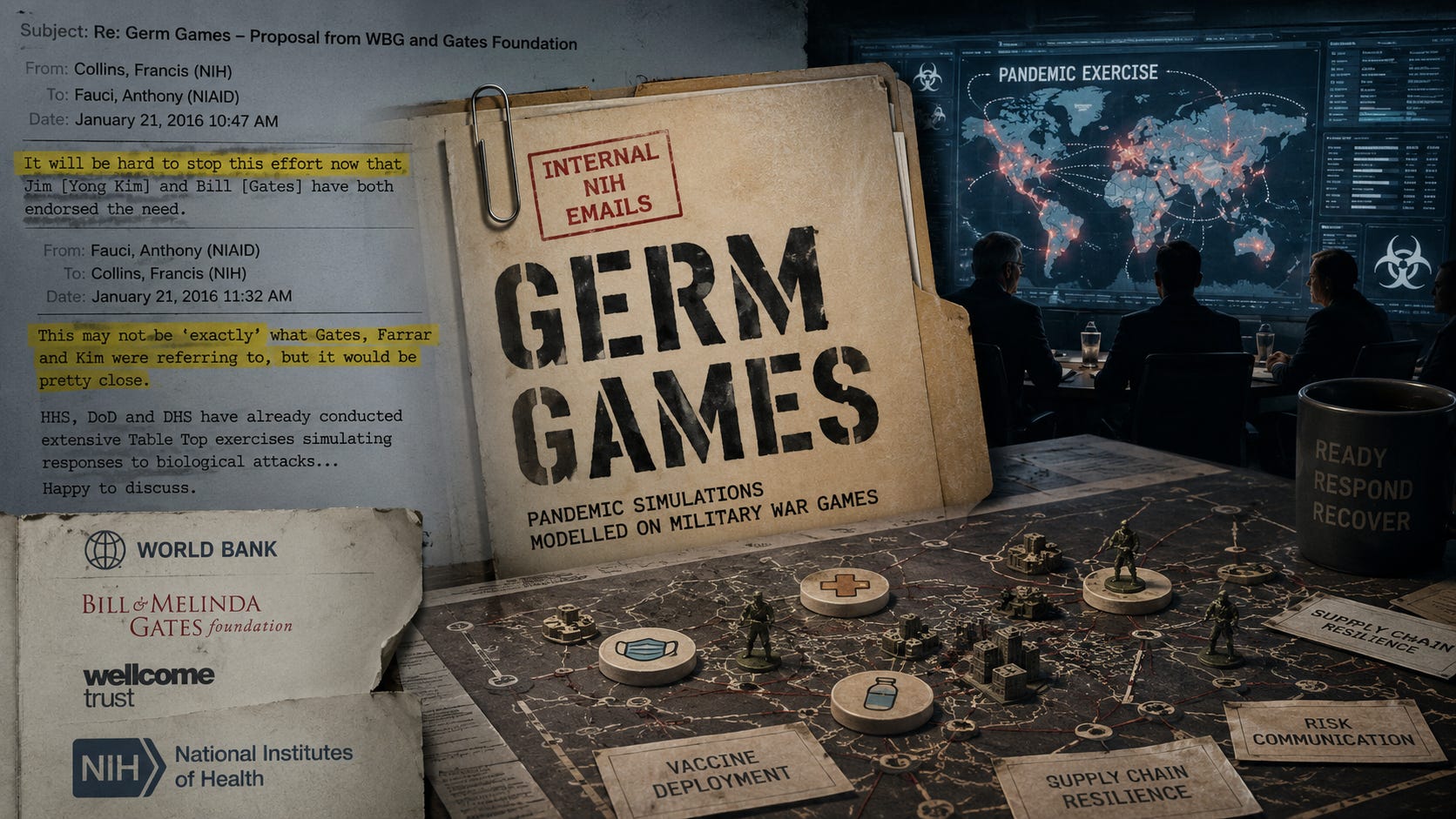
Behind closed doors at the World Economic Forum in Davos in January 2016, senior figures from the Gates Foundation and the World Bank proposed a new approach to pandemic preparedness: large-scale simulations modelled on military war games.

Newly obtained internal emails show how the idea — referred to as “Germ Games” — gained rapid momentum and drew in the US National Institutes of Health (NIH).

A potential land mine

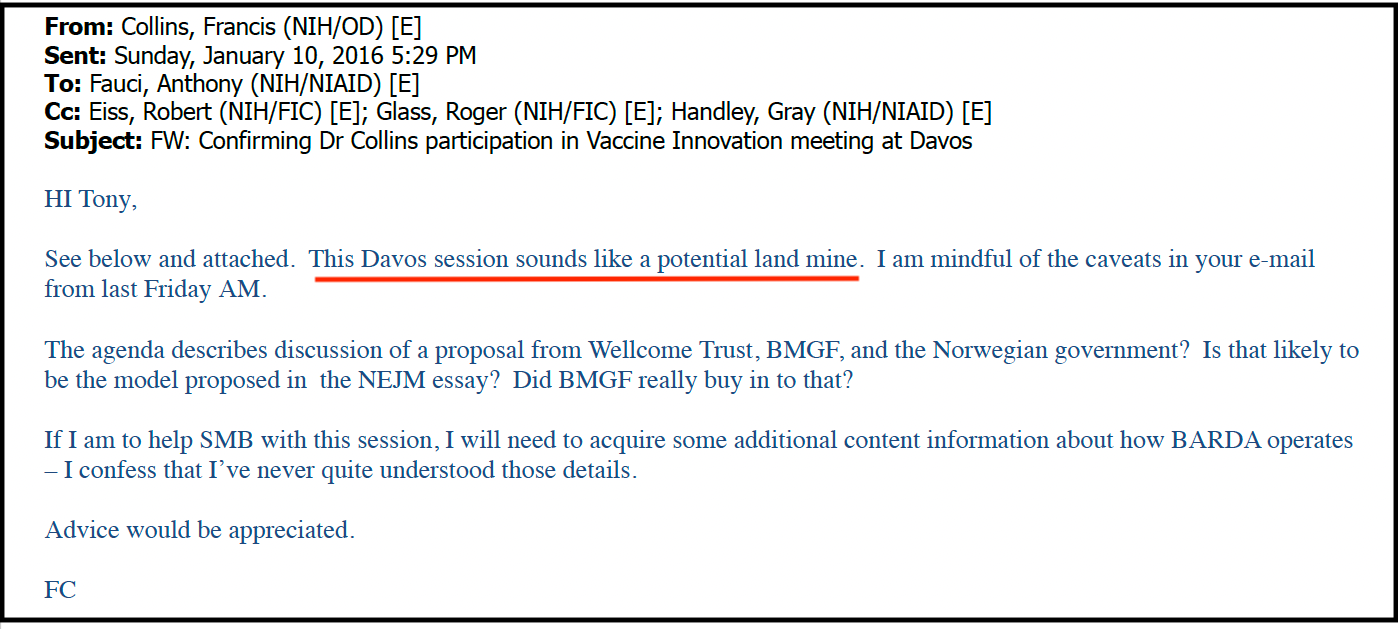
On January 10, 2016, as then-NIH Director Francis Collins prepared to attend the World Economic Forum's annual meeting in Davos, he emailed an advance copy of his schedule to Anthony Fauci, one of his closest advisers.

One session, in particular, caught his attention.

“This Davos session sounds like a potential land mine,” Collins wrote.
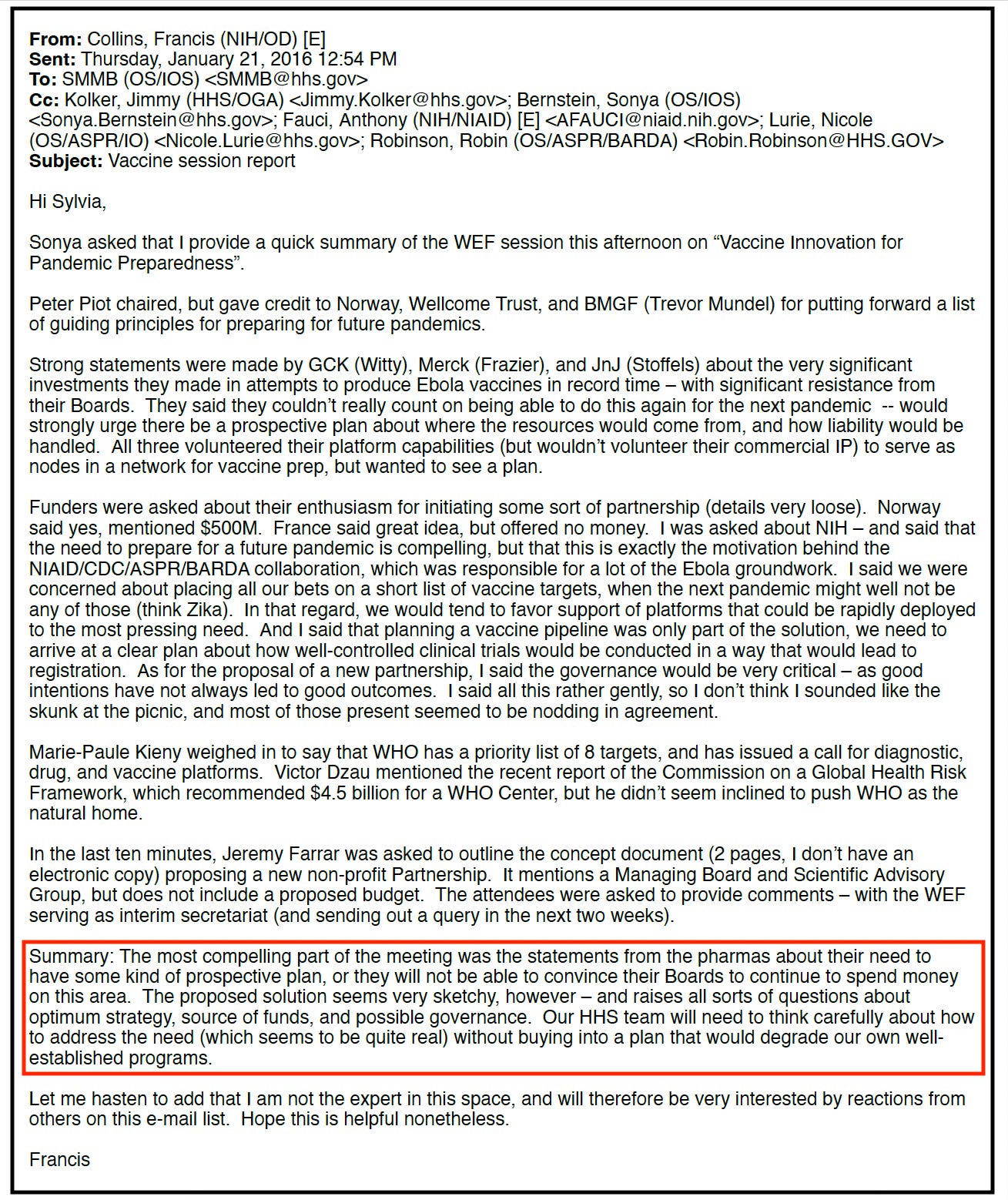
The meeting, titled “Vaccine Innovation for Pandemic Preparedness,” brought together executives from GSK, Merck and Johnson & Johnson, along with representatives from the Gates Foundation and the Wellcome Trust.

According to Collins’ report to Health and Human Services Secretary Sylvia Burwell, the pharmaceutical companies were blunt about the conditions for their participation — they could not commit to rapidly developing vaccines for every future outbreak unless governments first resolved who would pay and how liability would be handled.

The companies said they were willing to contribute their vaccine platforms but would not share their commercial intellectual property.

Collins described the emerging proposal as “very sketchy” and warned that it raised serious questions about governance, funding and strategy. He cautioned against any plan that would undermine existing US programmes.
The birth of “Germ Games”

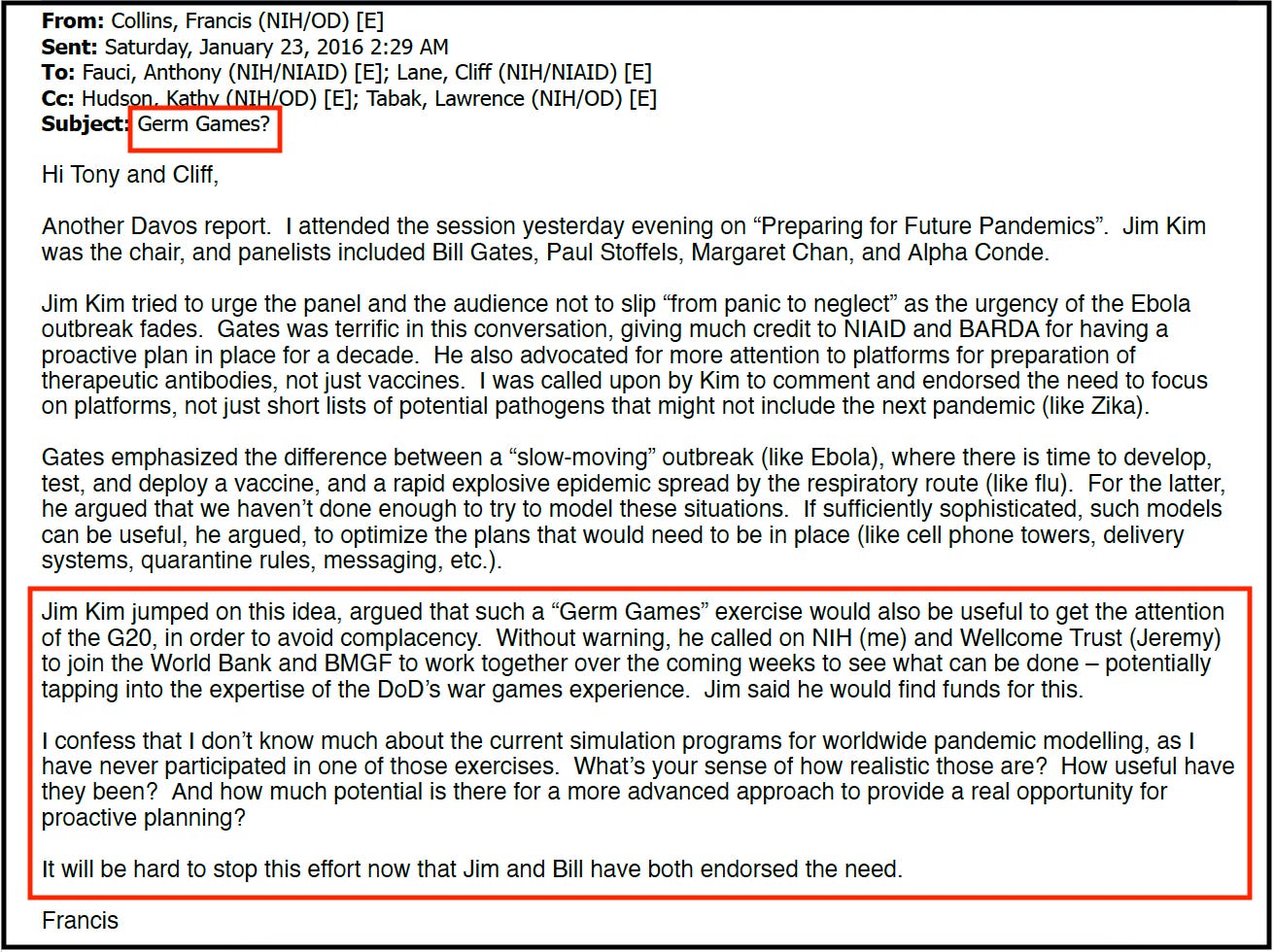
A separate session on preparing for future pandemics proved even more consequential. Chaired by World Bank President Jim Yong Kim, the discussion included Bill Gates.

Gates argued that the world was poorly prepared for a fast-spreading respiratory virus and that more sophisticated simulations could strengthen planning around logistics, communications, quarantine measures, public messaging and vaccine deployment.

Kim seized on the idea. According to Collins’ email, the World Bank president proposed creating “Germ Games” — exercises explicitly modelled on military war games — persuade G20 leaders to invest in pandemic preparedness and avoid complacency once Ebola memories faded.

Kim suggested “tapping into the expertise” of the US Department of Defense, whose war games experience tested command structures, decision-making and crisis response under pressure.

He publicly called on the NIH, the World Bank, the Gates Foundation and the Wellcome Trust to develop the concept together, saying he would “find funds for this.”

Writing to Fauci afterwards, Collins acknowledged that the proposal had quickly gained influential backing. With both the Gates Foundation and the World Bank endorsing the initiative, he wrote, it would be “hard to stop this effort now.”

Collins admitted that large-scale pandemic simulations fell outside his expertise and asked Fauci for his assessment.
Fauci’s reply

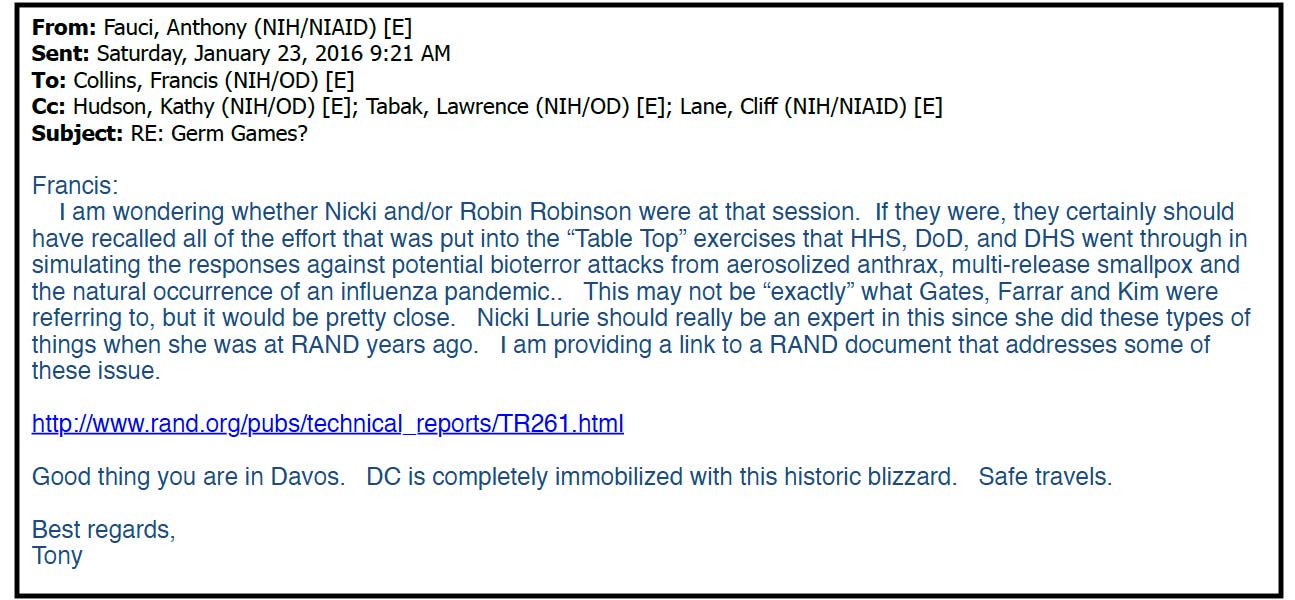
Fauci responded that the US government already had considerable experience running simulated “bioterror attacks.”

He explained that the Department of Health and Human Services, the Department of Defense and the Department of Homeland Security had conducted extensive "Table Top" exercises—simulated crisis scenarios in which officials rehearsed responses to biological threats, including aerosolised anthrax, multi-release smallpox and influenza pandemics.

“This may not be ‘exactly’ what [Bill] Gates, [Jeremy] Farrar and [Jim Yong] Kim were referring to,” Fauci wrote, “but it would be pretty close.”

He also suggested involving Nicole Lurie, then Assistant Secretary for Preparedness and Response, noting her previous experience at the RAND Corporation.
A screenshot of a computer

AI-generated content may be incorrect.

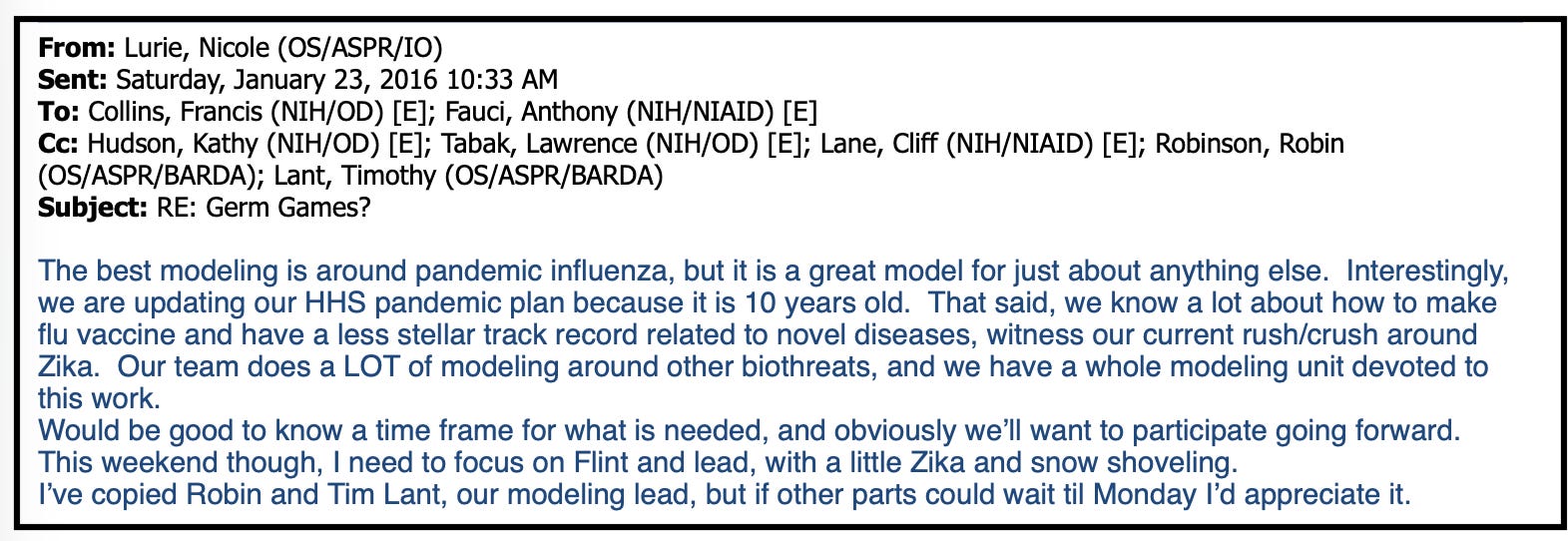
Collins quickly looped Lurie and BARDA Director Robin Robinson into the discussion, asking whether support from the World Bank and the Gates Foundation could help upgrade existing US modelling and preparedness work.

Lurie replied that HHS was already updating its pandemic influenza plan and had an entire team conducting regular modelling for a range of biological threats, including H7N9, MERS, Ebola and Zika.
From “Germ Games” to global agenda

The “Germ Games” concept did not remain a one-off idea.

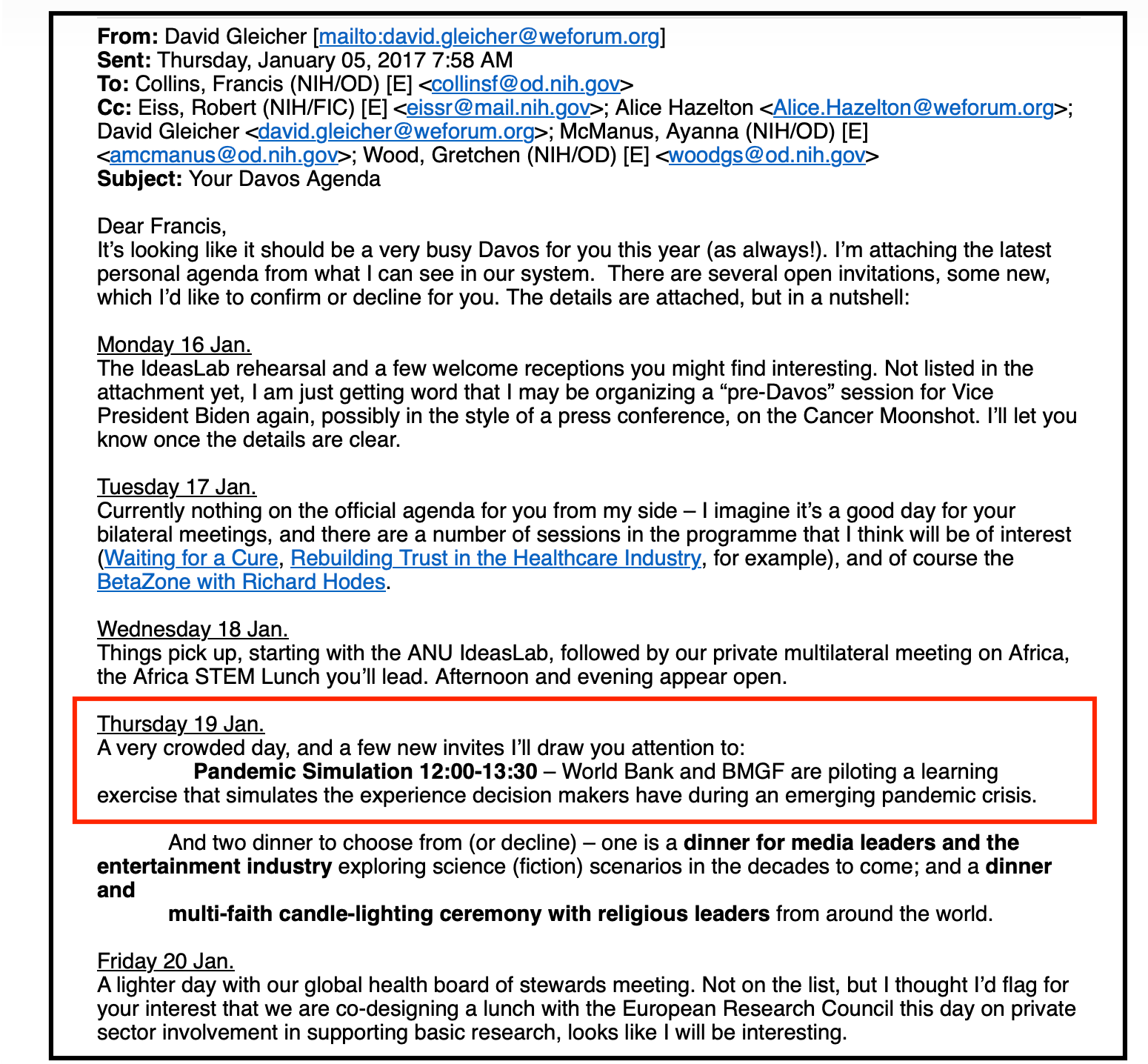
A year later, Collins returned to Davos for the 2017 World Economic Forum meeting.

His schedule included a pilot pandemic simulation organised by the World Bank and the Gates Foundation. The exercise was designed to place senior decision-makers inside a simulated pandemic crisis, using the kind of scenario-based role-playing employed in military war games.
The same approach was later reflected in Event 201, a high-profile simulation of a “fictional coronavirus pandemic” held in October 2019 by the Johns Hopkins Centre for Health Security in partnership with the WEF and the Gates Foundation.

That exercise brought together business leaders, government officials and public health experts to role-play responses to a “hypothetical” pandemic, using the same structured, scenario-based decision-making discussed at Davos three years earlier.

In early 2018, Collins invited Jim Yong Kim to the NIH.
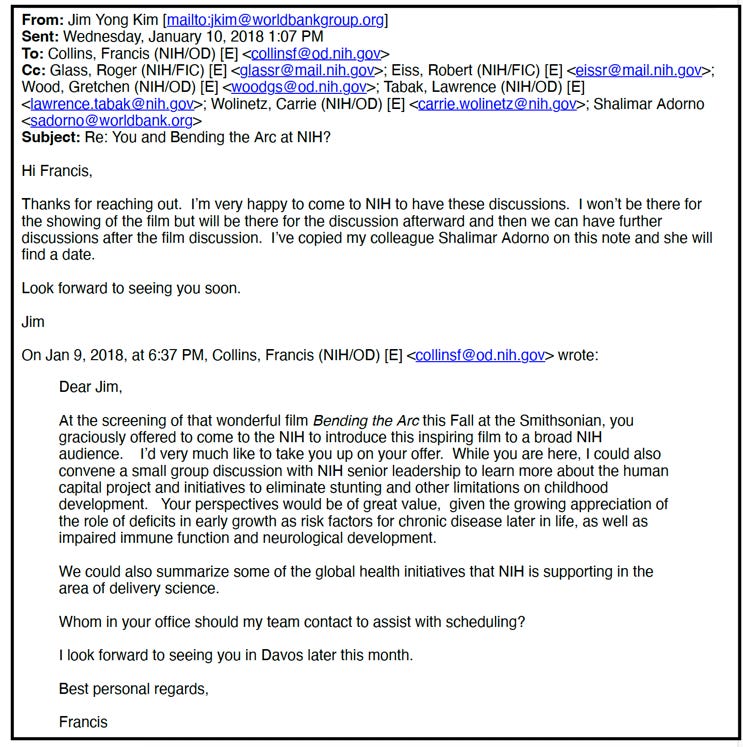
While the public event was a screening of the documentary Bending the Arc, internal planning documents show that officials arranged a closed-door roundtable with Collins, Fauci and nearly every NIH institute director.

The agenda covered pandemic preparedness, airborne threats and deeper collaboration between the NIH and the World Bank.

Collectively, these internal documents show how, from 2016 onwards, pandemic preparedness was increasingly shaped by military planning concepts and biodefence thinking.

What began as discussions at Davos evolved into a sustained international effort to embed simulation-based, war-game-style approaches into global health security — approaches that would later become central to the response to Covid-19.

https://blog.maryannedemasi.com/p/germ-games-nih-emails-reveal-the

12 Nurses Say They Are Being Replaced by AI

 Montefiore Medical Center in the Bronx, New York, fired 12 nurses and plans to replace them with artificial intelligence (AI) software, said nurses and city and state officials during a call with reporters on Wednesday.

The change comes on the heels of a February agreement between the nurses' union and the Montefiore hospital system that ended a nearly month-long strike. Nurses say the terminations directly violate that agreement, and the New York State Nurses Association (NYSNA) has filed a class action grievance. A spokesperson for Montefiore Health System says the claims are "inaccurate and misleading."

In late May, Ajita Mathew, RN, who has been a nurse for 36 years and is a member of Montefiore's utilization review team, received a letter from the manager of Labor and Employee Relations stating that her position would be eliminated in 45 days.

"During this time, the Medical Center will work closely with you to determine whether there are suitable positions that [are] in accordance with the collective bargaining agreement," the letter stated. "Montefiore recognizes the commitment you have made to its patients and will work hard to make this transition easier for you."

All 12 nurses on the utilization review team received a similar letter, NYSNA said.

Marilyn Shuler, RN, who has worked at Montefiore for 39 years, said nurses had been told that "someone" would be sending necessary clinical information from patients' charts to payers, but no one made clear whether that task would fall to a nurse or a machine.

Utilization review nurses have a "vast knowledge" based on years of experience, Shuler said during the Wednesday call. "So much of what we do cannot be reduced ... to a click."

New York City Council member Shirley Aldebol, who advocated for Montefiore to stop its "45-day displacement clock," said she's worried replacing "complicated clinical judgment by real nurses" with AI will lead to dropped cases, missed diagnoses, unapproved surgeries, and other patient services being denied.

Judy Sheridan-Gonzalez, RN, an emergency department nurse at Montefiore and former NYSNA president, said utilization review teams exist because insurers want to save money and not pay for prolonged visits if they can avoid it.

"The patients require a human being to advocate for [them] to see if the visit is necessary," she noted.

If a patient's situation improves but they're not well enough to go home, an algorithm can't make those calls, she pointed out.

"These algorithms just take very raw data and make a conclusion ... without taking into account the patient's gender, race, ethnicity, cultural needs, physical needs, and clinical needs, because they can't do that analysis," Sheridan-Gonzalez said. Unlike an algorithm, nurses reviewing charts have access to people and can say, "There's something missing here. Let me go find out what that is."

"This is all about human beings, about their outcomes," she added. "It's about ... what's going to happen while they're in the hospital, what kind of teaching needs do they have, what learning needs do they have, what kind of support do they have at home? How will they survive when they go home?"

It's about "other complex conditions that come into play here, which require a different type of assessment. Only a human being can do that," she argued.

Sheridan-Gonzalez also pointed out that the changes violate the most recent union agreement, which states "that any use of AI really has to be discussed with the union to ensure that our patients are protected."

"Montefiore is denying that AI has anything to do with this, which we know is not true," she noted.

In a statement to Gothamist, Joe Solomonese, a spokesperson for Montefiore Health System, blasted the nurses' claims.

"As is often the case, the claims by NYSNA are inaccurate and misleading," Solomonese said. "What is true is that we are always investing in new technology to ensure the best care and outcomes for our patients and will continue to do so for the betterment of the people we serve."

The nurses said Montefiore changed its utilization review process earlier this year, using AI-powered software from Datavant, a private equity-backed health IT company. In May, Datavant settled a class action lawsuit following a data breach that impacted 320,702 individuals.

Sheridan-Gonzalez said that this move is the "tip of the iceberg."

They started with nurses doing documentation, "but who's to say that in the future they won't replace ... other nurses who actually touch patients, work with patients in the hospital, have that intimate relationship ... with something else, whether it's a machine or a robot or some kind of algorithm," she pointed out.

"Nurses are not against technology," said Shaiju Kalathil, RN, an NYSNA executive committee member at Montefiore. "The problem is when hospitals roll out new technologies without evidence that these technologies will improve the lives of patients and working people, and worse, with evidence that patient care may suffer, and jobs will be long lost."

Shuler stressed that "what we want is simple: to stop layoffs, the hospital to keep a licensed nurse to complete the utilization review and sit down with the nurses who do this work, [and] discuss how AI can support us instead of replacing us."

https://www.medpagetoday.com/nursing/nursing/122039

Huge Rates of Insurance Denials Get Overturned by Independent Review Experts


Report names health plans, services most likely to have denials reversed after third appeal


by Cheryl Clark

  • Almost half (46.7%) of denied health insurance claims in New York state were overturned when the case reached independent review organizations (IROs).
  • Overturned denials were analyzed by clinical characteristics, diagnosis, and health insurance company, among other categories.
  • Rates of overturned decisions increased over time, from 38% in 2019 to 52.5% in 2025, and annual appeal volume also increased during this period, from 4,128 in 2019 to 9,805 in 2025.

Persistence in appealing denied health insurance claims resulted in overturned decisions between 30% and 78% percent of the time, when the case reached independent review organizations (IROs), an analysis of completed external appeals showed.

Among 51,394 closed cases in New York state from May 31, 2019 to Dec. 10, 2025, almost half (46.7%) of external appeals were overturned at this third level of appeal, which often involves independent physicians and other specialists, Joseph Dov Bruch, PhD, of the University of Chicago, and colleagues reported in a research letter in JAMA Internal Medicine.

For example, of 6,469 denied home health care services claims that were appealed, 78.4% were overturned when clinical experts not affiliated with the insurance company examined the rationale. More than half of surgical services, dental or orthodontic procedures, and pharmacy or prescription drug denials were overturned by the IRO, the researchers found.

When analyzed by diagnosis, denied care for substance abuse treatments or mental health services was overturned 61.5% and 60.6% of the time, respectively. Central nervous system or neuromuscular disorder denials were overturned 53.1% of the time, and endocrine, metabolic, and nutritional denials were overturned 52.1% of the time. Cancer denials were overturned 45.1% of the time, they reported.

The analysis also tabulated IRO overturn rates by specific named health plan or insurance company. It found that Centers Plan for Healthy Living denials were overturned at the IRO level 85% of the time, while 51.1% of Aetna denials, 50% of Excellus denials, 49.8% of CVS Caremark denials, 48.3% of Fidelis Care denials, and 43.1% of Anthem Blue Cross Blue Shield denials were reversed.

"We show across the board that the external appeal overturn rate is quite high, but that there definitely is a distribution," Bruch told MedPage Today. "The biggest takeaway ... is that consumers have a major opportunity to pursue these types of independent reviews after they exhaust the internal review."

The researchers said they assumed that reversal of the denial was the appropriate decision and the denial was incorrect. "It's possible more information is provided" during the IRO review, Bruch said. It's also possible that health plan reviewers may be "more discriminatory toward certain types of settings or diagnoses" or treatment protocols they don't approve, he added.

Examination by third-party physicians and other clinicians may change the decision, study co-author Ayesha Rahim, MA, of Brown University, told MedPage Today.

"Since the independent clinician is ultimately making the external appeal decision, we can reasonably assume they are influential in that sense," she said. "However, whether their involvement can be shown to influence outcomes in a measurable way, such as higher overturn rates, is not something we were able to assess."

Overturn rates could also be the result of the types of cases that get to that level of appeal, she said. "Without a comparison group, we cannot distinguish between these [and other] explanations."

The report also showed that 47.1% of denials on the basis of medical necessity, 44% of denials based on care determined to be experimental or investigational, and 42.9% of formulary denials were overturned.

The researchers said they only looked at overturned claims in New York because the state data includes names of specific insurance companies, whereas other states may have the same data but aren't as granular.

Bruch and colleagues also found that rates of overturned decisions increased over time, from 38% in 2019 to 52.5% in 2025. Annual appeal volume also increased during this period, from 4,128 in 2019 to 9,805 in 2025.

In New York, the IRO appeal level is usually the third level of appeal, which can come after a long, frustrating and bureaucratic process that often involves the patients, their physicians, and other caregivers writing letter after letter. After the insurance plan or company issues an initial review and denies the care, the decision can be appealed to a second level, an internal appeal review, which also is conducted by the insurance company.

If that is denied, the claim goes to the IRO, which can overturn the denial either in whole or in part. By New York state law, there are three certified IROs that conduct external reviews. They include board certified physicians and other providers.

Detailed data like that provided in the analysis can be "leveraged by regulators to identify specific health services, populations, or plans with denial practices that warrant closer scrutiny," the researchers wrote. They acknowledged that denials can result from a variety of issues, such as human or technical errors, outdated claims systems, ambiguity in coverage rules. But it can also result from "inappropriate insurer behavior -- and thus require different remedies."

Asked if insurers who continually issue denials that are overturned should face penalties, Bruch replied: "Personally, I would be in favor of that, but potentially [there should also be] incentives for those with lower rates." But how such incentives would be implemented, he said, would have to be carefully thought through.

Disclosures

Bruch reported receiving grants from Rx Foundation, the Commonwealth Fund, and the Robert Wood Johnson Foundation, and personal fees from the Robert Wood Johnson Foundation and NYU Langone Health outside the submitted work, and personal fees from Adasina Social Capital through a Robert Wood Johnson Foundation grant outside the submitted work.

Celltrion secures FDA’s 1st interchangeable status for Rituximab biosimilar

 A key cancer treatment developed by Celltrion has become the first rituximab biosimilar to receive interchangeability status from the United States Food and Drug Administration (FDA), a designation expected to strengthen its position in one of the world’s most competitive drug markets.

Celltrion said Wednesday that its blood cancer treatment Truxima (rituximab) has been granted interchangeability status by the FDA, marking the first time a rituximab biosimilar has received such recognition in the United States.

The company said the designation allows Truxima to be substituted for its reference biologic without requiring a new prescription, under conditions permitted by U.S. law, and confirms no clinically meaningful differences in safety or effectiveness.

The FDA decision also grants Truxima exclusivity tied to its status as the first interchangeable biosimilar in its class, according to the company.

Truxima is approved in the United States for all adult indications held by the reference product, including non-Hodgkin's lymphoma, chronic lymphocytic leukemia, rheumatoid arthritis and microscopic polyangiitis.

Celltrion said the designation is expected to strengthen physician confidence in prescribing the drug and improve patient access while helping reduce treatment costs.

The company said Truxima already holds a leading position in the U.S. rituximab market, ranking first in prescription volume with a 35.8 percent share as of February, according to IQVIA data.

That performance makes it the first Korean biosimilar to reach the top position in the United States rituximab market, competing against global pharmaceutical companies and the original biologic.

Celltrion said it plans to use the FDA designation as a catalyst to further strengthen its oncology biosimilar portfolio and expand its presence in the U.S. market.

A Celltrion official said Truxima has already proven its competitiveness through its market leadership and now has secured a differentiated position through interchangeability status.

The official said the company will continue working to expand treatment access and reduce healthcare costs in the United States.

https://www.koreatimes.co.kr/business/companies/20260701/celltrion-secures-fdas-1st-interchangeable-status-for-rituximab-biosimilar