Friday, July 3, 2026
Unapproved Retatrutide Use Challenges Clinicians
Retatrutide, an investigational triple hormone receptor agonist that shows promise for weight loss in ongoing phase-3 clinical trials, is being sold openly across the internet and prescribed by licensed physicians online and in diverse clinical settings across the US, investigations have found.
The phenomenon of such easy access to a drug that’s not approved anywhere for any indication is arguably without precedent.
Patients are discovering the drug — a GLP-1, glucose-dependent insulinotropic polypeptide (GIP), and glucagon agonist — through social media, purchasing it from vendors online, and arriving at clinic appointments either asking about it or disclosing they are already using it. News reports state that everyone from “shadowy online vendors” to physicians and nurses is illegally promoting the drug before it receives the FDA approval.
“I’ve never seen this, not ever,” Anne Peters, MD, a professor of clinical medicine and a clinical scholar at the Keck School of Medicine, University of Southern California, Los Angeles, told Medscape Medical News. “I’ve seen this happen with supplements, but not a drug that’s under study to be FDA-approved.”
Although the retatrutide phase 3 trials to date have been promising, many drugs have failed to advance from that stage because of unexpected adverse outcomes that only emerge at scale, said Courtney Younglove, MD, founder and medical director of Heartland Weight Loss in Overland Park, Kansas.
“What’s happening now is a huge, unregulated human experiment,” she told Medscape Medical News. “Yes, we know retatrutide works to cause weight loss, but the more important data — who are the best candidates, what dose(s) do we use, how to titrate them, what adverse effects to watch for — we don’t know.”
Given the magnitude of weight loss seen in retatrutide clinical trials, its unsupervised use concerns Rachel Pessah-Pollack, MD, a clinical professor of medicine at NYU Langone Health, New York City. “Retatrutide needs to be tailored to the patient who would benefit from it. If the treatment is given to patients who do not require this degree of weight loss, there can be significant loss of lean muscle, gallstones — especially with rapid weight loss — and nutritional deficiencies,” she said.
A recent study of self-reported side effects among Reddit users taking retatrutide found that among 13,589 individuals, 7823 (57.6%) had at least one side effect. In the phase 3 trial, side effects were mostly gastrointestinal (GI) issues but that was not the case with Reddit users. They most often described appetite increase, fatigue, increased energy, nausea, food craving, insomnia, and elevated heart rate.
Peters said she wonders if the Reddit users are even getting real retatrutide, given the mismatch in side effects. People she knows who say they are using it also aren’t experiencing GI side effects, nor are they losing much weight, she said.
“Compounded retatrutide often comes in a powder that users reconstitute. For all I know, they might be taking baby powder,” Peters said.
What Investigations Show
Recent investigations by CBS News, the New York Times, and Public Citizen have revealed just how easy it is to get the drug and the danger that comes with taking an unapproved medication.
CBS News reported that more than 120 websites are selling or promoting retatrutide and that at least 50 clinics staffed by licensed physicians and nurse practitioners are openly advertising the drug. The investigation found that retatrutide exposures documented by poison centers rose to an average of 95 cases per month in the first 4 months of 2026, a 265% increase from the last 4 months of 2025.
After being contacted by CBS News, at least 21 clinics removed retatrutide from their websites or altered their language, according to investigators. Others defended the practice, saying they were confident enough in clinical trial data that they didn’t need to wait for the FDA approval.
The investigation also found that retatrutide is being sold at varying prices through medical spas, telehealth clinics, and compounding pharmacies, a number of which are named; several clinics continued advertising the drug after being contacted by reporters; and some compounding pharmacies continued operations despite state enforcement actions.
The CBS report prompted the Alliance for Pharmacy Compounding to issue a notice on the organization’s website, noted Scott Brunner, the organization’s CEO. It states that retatrutide is an experimental drug that “compounding pharmacies have zero legal grounds to compound. The [CBS investigation] is worth reading carefully because it calls out licensed compounding pharmacies alongside research-grade peptide mills, unlicensed online vendors, and med spas — and in some of those cases, the inclusion is warranted.”
Because retatrutide has not yet been approved by the FDA, “it is illegal for use in compounding,” Brunner told Medscape Medical News. “Retatrutide products currently available appear to be made with a research-grade [active pharmaceutical ingredient] — also illegal for use in human drugs. While there may be rare exceptions in which a pharmacy is preparing these drugs with research-grade product, the retatrutide being sold at present is generally coming from non-pharmacy entities and are being dispensed by med spas and the like.”
The New York Times documented how customers are obtaining retatrutide through multiple channels. People can purchase the drug from WhatsApp, Telegram, Discord, and Reddit groups, which are often run by middlemen who’ve bought it in bulk, usually from China, and repackaged the product or filled empty injection pens and added their own branding. Others purchase from online storefronts listing the drug as “for research purposes only.”
The investigation also discovered a black market operating through decentralized supply networks; customers using third-party testing labs (some of questionable quality) to verify purity; and wide variation in the contents and purity of what consumers receive, with some vials potentially containing a different weight-loss drug altogether.
Public Citizen found that the FDA issued warning letters to 14 retatrutide vendors since December 2024, but 11 of them continued advertising the drug or related peptides as of May 2026 and eight are still actively selling retatrutide. Enforcement has stalled at the warning letter stage with minimal follow-up. The investigation determined that the FDA lacks the resources to pursue seizures and injunctions without Department of Justice coordination; state-level enforcement varies widely and is inconsistently applied; and social media influencers are serving as unregulated sales channels for the drug.
A spokesperson for Eli Lilly, which developed the drug, emphasized that it should not be sold or used yet. “Retatrutide has not been approved anywhere in the world, and it is legally available only to participants in Lilly’s clinical trials,” he told Medscape Medical News.
“Anyone purporting to sell retatrutide to consumers is breaking the law,” he said. “We have referred dozens of black-market retatrutide sellers to regulators and law enforcement and call on them to take decisive action to fight this urgent threat to public health. Social media is driving the sale of black market retatrutide. We have reported thousands of illicit retatrutide posts and ads, but platforms are often slow to act and by that point the damage is already done. Social media platforms need to shut this down immediately.”
In a warning on its website, the company states: “Anything sold to consumers outside of [clinical trials] is illegal, with no way to verify its safety, purity, or dosing. Taking unregulated substances poses serious health risks, and Lilly continues to work with law enforcement and regulatory authorities to combat black market drugs.”
And yet, there seems to be no end in sight to the retatrutide tidal wave.
What Clinicians Are Doing
For weight-management specialists grappling with the problem, a key challenge is managing patients who have already obtained retatrutide or what they think is retatrutide on the black market.
“My issue is safety,” said Peters. “I can’t assess risk if I don’t know the exact composition of a product.”
When patients disclose that they are using retatrutide, Peters requests documentation of the source. “Patients mostly say it’s from China. But I don’t have a printout in Chinese that says what this is or what the ingredients are, and so I don’t have any way to validate what they are and where they came from. Some patients have even told me that they’re getting the drug from the best place in China. But how do we even rank these places?”
Peters’ approach is to counsel patients on the unknowns and recommend they wait for the FDA approval. She closely follows those who continue taking the drug to make sure that their liver function is normal, their kidney function isn’t altered, and their complete blood count is okay. She also reminds patients that treatment with GLP-1-based therapies is meant to be ongoing and that if they stop, they can get metabolically worse as they regain the weight.
Pessah-Pollack said that while the data for retatrutide are “exciting and promising,” she won’t prescribe it until it gains the FDA approval to ensure it is used safely. Nevertheless, she has had patients who are buying retatrutide from a compounded pharmacy. For those patients, her first step is to review the risks in detail and offer to switch them to an FDA-approved GLP-1 or GLP-1/GIP drug.
“In situations where they insist on continuing their [retatrutide] treatment, they are receiving the medication through another prescribing clinician,” she said. “I encourage them to determine their dosing and review the importance of dietary modifications on weight-loss medications, counsel regarding GI side effects, and encourage resistance exercises. I review the risks of too much weight loss and offer to monitor them alongside their treating clinician.”
Younglove noted that patients often feel dismissed by traditional healthcare providers and turn to alternative markets when they perceive that approved options are inadequate or inaccessible.
“Clinicians should invest time in genuine conversations with patients about why they have sought out an unapproved drug and what gaps exist in available treatment options,” she said. “Understanding this context allows clinicians to engage patients with empathy rather than judgment. The patient is not reckless; they are responding to persuasive marketing in an environment where the FDA’s enforcement is visibly absent.”
Younglove has never had a patient admit to taking retatrutide. “I’ve had several ask me what I thought about it and if I would consider prescribing it, and it’s opened the door to a good conversation,” she said. “I would not refer that patient to anyone, as it would, in my mind at least, feel like condoning experimental treatments. Anyone prescribing retatrutide in my community is essentially working in fringe, nonevidence-based medicine, which doesn’t align with my values.”
Peters and Younglove reported having no competing interests. Pessah-Pollack declared having served on advisory boards for Boehringer Ingelheim and Eli Lilly.
https://www.medscape.com/viewarticle/unapproved-retatrutide-use-challenges-clinicians-2026a1000lqj

Is Creatine Supplementation for Brain Health Worth a Try?
Creatine supplements have been recently examined for their potential to improve brain health and prevent dementia. Given the lack of effective therapies for dementia, it is worth considering whether these supplements are safe and effective.
What Role Does Creatine Play in the Body?
Creatine is endogenously synthesized in the liver and kidneys, and its amino acid precursors are also provided by a variety of foods, including meat and vegetables. Most of the body’s creatine is stored in muscle cells as phosphocreatine; creatine serves to help replenish adenosine triphosphate during physical activity, which is why we have seen creatine supplements increasingly used in the setting of weight training and exercise over the past decade.
With the emerging understanding of its role in the brain, research on creatine supplementation has moved from the gym to the brain lab.
How Creatine May Affect Brain Health
Creatine is produced in the brain and retina through a process that involves the enzyme guanidinoacetate methyltransferase, which is highly expressed in glial cells. In addition to information on markers of creatine synthesis and activity, evidence is accumulating regarding the action of creatine in the brain.
Interest in creatine for brain health grew out of the knowledge that creatine deficiency or dysfunction may adversely affect cognition. Defects in the creatine transporter (CRT) gene (SLC6A8) result in low brain creatine levels, along with severe neurologic symptoms, defined as CRT deficiency syndrome. The mechanism of neurologic dysfunction is still unclear, and currently there is no treatment for CRT deficiency syndrome.
There are different creatine formulations. The most common one used in studies is powder mixed with water, which has a more established bioavailability. Other commercial forms include pills, capsules, and gummies.
The first step is to verify that creatine supplementation affects brain creatine levels. This is supported by a few small-scale human studies, but the increase is less than that seen in skeletal muscle.
Authors of a review noted that creatine supplementation may help improve mood, cognition, and sleep in healthy adults. The observed improvements were generally more notable among women than men, which the authors attributed to lower baseline endogenous creatine stores in women.
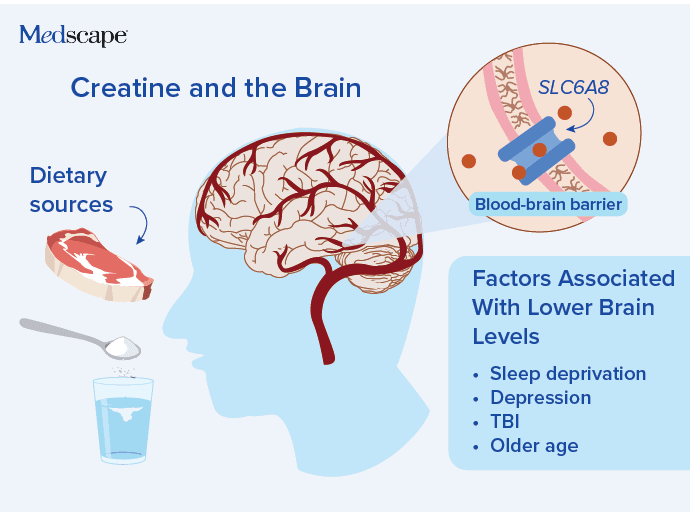
In a 2026 study in 29 sleep-deprived but otherwise healthy adults, 0.2 g/kg creatine monohydrate supplementation was associated with up to a 12% improvement of sleep deprivation-induced deterioration in cognitive skills. For a 150-lb adult, this dosage would be about 14 g of creatine per day.
Treating Brain Disorders
While experimental evidence suggesting that creatine supplementation may help healthy people does not automatically imply that extra creatine would be beneficial in the context of brain disease, there appears to be promise in the use of creatine supplements as an adjunctive treatment in some brain disorders.
According to a 2022 review in Nutrients, creatine supplementation may help reduce some symptoms of traumatic brain injury and concussion.
Creatine also has been explored as a possible treatment for Alzheimer’s disease symptoms or as a disease-modifying therapy. A single-arm pilot trial in 20 patients with Alzheimer’s disease found that 20 g/d creatine monohydrate for 8 weeks was associated with increased total brain creatine and modest improvements on cognitive tests.
Creatine Supplements for Healthy Adults?
The evidence is still not solid regarding potential benefits of creatine supplements for healthy individuals or for people who have dementia. And while creatine appears to be safe when used as a supplement for exercise and for building muscle, safety concerns have not been entirely ruled out. Furthermore, established dosing and dietary references are lacking.
Despite these shortcomings, it may be worthwhile for healthy adults or those with cognitive symptoms to try creatine supplements. So far, this supplement shows promise (albeit inconsistent) for short-term cognitive benefits, rather than a lasting impact on brain health. It is the short-lived nature of the effects that makes it worth trying. Many people use other supplements for brain health, like ginkgo biloba or ginseng, and can judge for themselves whether they see any benefits. The same principle applies to creatine – anyone taking it can assess if it improves their cognition or mood, without bearing the burden of deciphering whether a clinically undetectable effect is taking place.
https://www.medscape.com/viewarticle/creatine-supplementation-brain-health-worth-try-2026a1000kuz
First CAR T-Cell Approval for Skin Diseases Anticipated Within the Year
The first chimeric antigen receptor (CAR) T-cell product to target autoimmune diseases, including those with severe dermatologic manifestations, could be getting closer to approval based on studies showing unprecedented efficacy with acceptable safety profiles.
Aimee S. Payne, MD, PhD, chair of the Department of Dermatology at Columbia University, New York City, indicated that the field is moving quickly based on clinical studies in various forms of lupus as well as other challenging diseases affecting the skin such as pemphigus vulgaris and dermatomyositis.
Payne, speaking at the Annual Atlantic Derm Conference (ADC), foresees an evolution in autoimmune diseases that will mirror the impact that CAR T-cell therapy first documented in patients with hematologic malignancies unresponsive to all other options.
Autoimmune Disease Indication Could Come in 2026
In 2017, the first CAR T-cell product was approved by the FDA, for children and young adults with refractory B-cell acute lymphoblastic leukemia later. If a CAR T-cell therapy is approved for an autoimmune disease within the next 12 months, it will follow a 2021 case report of CAR T-cell treatment in a 20-year-old woman with systemic lupus erythematosus (SLE).
In that report, a serologic remission in the patient, who had refractory SLE involving multiple organs, including the skin, was achieved in about 5 weeks. It was soon followed by clinical remission defined by a SLE Disease Activity Index (SLEDAI) score of zero.
There was no evidence of cytotoxic release syndrome or neurotoxicity and adverse events associated with CAR T-cell therapies, the authors reported.
In a 2024 summary of phase 1 trials in SLE, the efficacy and safety of several different CAR T-cell constructs further supported the promise of CAR T-cell therapy for this indication. In one series of 13 patients that has not yet been published, 11 patients improved within a month with further gains ensued over time. Three patients remained symptom-free off all medication for up to 44 months.
In hematology, the first approved CAR T-cell indication was soon followed by others. For autoimmune diseases, the first indication is likely to be granted to SLE, a disease that often involves cutaneous manifestations. Other autoimmune disorders, such as multiple sclerosis, myasthenia gravis, and Sjogren disease, might follow, but Payne focused on work involving diseases of the skin, such as pemphigus vulgaris and dermatomyositis.
For hematologic malignancies, CAR T cells are engineered to express receptors for antigens on target cancer cells to deliver an antitumor effect. For autoimmune diseases, the CAR-T cells are engineered to express receptors for antigens on autoreactive immune cells aimed at halting autoimmune activity.
Providing a list of nearly 20 CAR T-cell products in or nearing clinical trials in an array of autoimmune diseases, Payne reported that it is unclear at this point which of these products will be the first to be approved. Front runners include mivocabtagene autoleucel (miv-cel), zolacabtagene autoleucel (Zola-cel), rapcabtagene autoleucel (rap-cel), and resecabtagene autoleucel (rese-cel).
All of these and the majority of the other CAR T-cell products under investigation in autoimmune diseases target CD19-positive B cells, but there are other targets, and not all of the CD19-targeted products employ the same transmembrane domain, a co-receptor on the B cell surface. Some products are fully human, others are allogeneic, and at least one involves gene editing, Payne reported.
According to Payne, SLEDAI scores begin to fall within days of CAR T-cell infusion. Peak response is typically achieved within 60 days. It is not yet clear whether CAR T-cell therapy is capable of curing SLE or other autoimmune diseases, but responses are often persistent in the limited follow-up to date.
Benefit Attributed to Immune System Reset
In autoimmune diseases, the benefit of CAR T-cells has been credited to a reset of the immune system. However, Payne cited studies suggesting that preconditioning lymphodepletion prior to delivery of engineered T cells, which is standard in the treatment of hematologic malignancies, might not be required for at least some autoimmune diseases.
For example, she cited unpublished data from a small series of patients with pemphigus vulgaris treated with the rese-cell construct. Despite foregoing lymphodepletion, responses appeared to be similar to those seen when lymphodepletion is used, suggesting that the inherent risks of depleting immune function might be avoided, she said.
“Lots of development programs are now studying protocols that do not involve B cell depletion,” Payne said.
Even if the most encouraging preliminary reports have been in refractory B-cell mediated autoimmune connective tissue diseases, “CAR T-cell therapy could emerge as a treatment breakthrough for difficult-to-treat autoimmune skin diseases as well,” agreed Vishal Gupta, MD, an associate professor in the Department of Dermatology and Venereology, All India Institute of Medical Science, New Delhi, India.
In a recently published review article of the progress in CAR T-cell therapy in dermatology, Gupta, the senior author, and his coauthors, covered the clinical and experimental studies with CAR T-cells using standard and novel designs. He identified progress in developing constructs with greater specificity for specific B cell mediated diseases and CAR T-cells designed to inhibit more specific immune mediators of diseases like pemphigus vulgaris.
One example involves vitiligo, which is linked to overexpression of ganglioside D3 (GD3) as a source of melanocyte dysfunction. In animal models, GD3 CAR engineered T-regulatory cells have improved pigmentation, Gupta and coauthors reported in the review.
So far, the studies in treating skin diseases beyond those mediated by B cells are largely supported by experimental studies, but Gupta said that he believes there is a basis for “cautious optimism.” Yet he cautioned that the field even for the treatment B cell associated autoimmune diseases is not without hurdles.
“Apart from efficacy, concerns regarding treatment toxicity, logistics, accessibility, and cost will need to be addressed before it can be adopted on a larger scale,” he told Medscape Medical News.
Payne reported having financial relationships with Avilar, Cabaletta, and GlycoEra. Gupta reported having no potential conflicts of interest.
https://www.medscape.com/viewarticle/first-car-t-cell-approval-skin-diseases-anticipated-within-2026a1000mmt
Long COVID Brain Fog Eases With Cognitive Rehabilitation
Long COVID can be associated with debilitating cognitive impairment, but new research published in JAMA Network Open suggests that patients may be able to gain meaningful improvements in their daily functioning through a telehealth course of cognitive rehabilitation.
Cognitive rehabilitation is well established to help people with conditions such as stroke and multiple sclerosis and is increasingly being adapted for long COVID. Cognitive dysfunction linked to the condition can affect memory, attention, language, and executive function, the mental skills involved in planning, initiating and sequencing tasks, adapting to unexpected situations, and problem solving.
“We need to recognize that we are talking about people in their most productive years, typically aged 30-65, who before COVID had careers, relationships, goals, and aspirations,” said Martina Vanova, PhD, a lecturer in cognitive and biological psychology at Kingston University London in Kingston upon Thames, England, who led the new study. “Afterwards, many lost their jobs or were forced to reduce their working hours; simple everyday tasks became difficult or exhausting, and their relationships with friends and family were often strained by an illness that is largely invisible to those around them.”
In a randomized controlled trial across three clinics in England between 2023 and 2024, Vanova and her colleagues followed 78 adults (24 men and 54 women; mean age, 47 years; 86% White) who received 10 weeks of 1-hour cognitive rehabilitation telehealth sessions focused on helping them achieve three goals related to work, social connection, or hobbies, such as reading a book for 20 minutes three times per week or completing work tasks.
At 3 months, participants in the intervention group were more successful at reaching their goals as rated on a 10-point scale than those receiving usual care (adjusted mean difference, 2.88; P < .001). Benefits remained significant at 6 months (adjusted mean difference, 1.72; P < .001), according to the researchers.
Patients in the intervention group were more satisfied with their progress toward their goals at 3 months (2.87; 95% CI, 2.08-3.65; P < .001) and 6 months (1.53; 95% CI, 0.56-2.50; P < .01). These patients also experienced modest improvements in executive functioning and processing speed. But cognitive rehabilitation did not improve memory, language, attention, or verbal fluency, the researchers found.
One factor behind the intervention’s success may have been its focus on helping participants regain skills that long COVID had taken from them, Vanova said.
“Aligning the treatment with personally meaningful goals likely increases participants’ engagement,” said Kati Pagulayan, PhD, a professor in the Department of Rehabilitation Medicine at the University of Washington in Seattle, who was not involved in the new research. “Most participants identified work‑related goals, which often carry strong motivational value, especially if someone is hoping to return to a pre-illness level of function.”
People with long COVID can struggle with focusing for more than a few minutes, initiating tasks, and recalling information from minutes before, Vanova said. Therapists taught techniques such as breaking complex information into smaller chunks, organizing information into categories, visualizing information, minimizing distractions, building routines, and using calendars, reminders, and other external cues to support planning and memory.
Patients showing signs of cognitive impairment could seek a referral through their primary care clinician for cognitive evaluation and potential rehabilitation with a neuropsychologist, Vanova said.
The strategies used in the trial “can serve as a guide for clinicians when working with people with long COVID, but these strategies also need to be adjusted to a person’s individual needs and abilities,” Vanova said. However, access to dedicated clinics for people with long COVID is not widespread.
The sources cited in this article reported having no relevant financial conflicts of interest.
https://www.medscape.com/viewarticle/long-covid-brain-fog-eases-cognitive-rehabilitation-2026a1000mlm
Secret Service Missed 102 Warnings Before Trump Assassination Attempt In Butler: Report
by Tom Gantert via The Epoch Times,
The U.S. Secret Service missed multiple opportunities to detect, prevent, and disrupt the attempted assassination of Donald Trump in Butler, Pennsylvania, in 2024, including missing more than 102 radio transmissions warning of a suspicious person, a Department of Homeland Security report concluded.

The report, released on July 2 by the department’s Office of Inspector General, chronicles a series of communication failures, inadequate planning, limited intelligence sharing, and security lapses that combined to create the conditions that allowed gunman Thomas Crooks to open fire from the roof of a nearby building during a July 13, 2024, campaign rally in Butler. Crooks was fatally shot by a Secret Service agent.
Among the report’s most significant findings was that Secret Service members did not receive 102 radio transmissions “that local law enforcement officers in a separate communications room received concerning an increasingly intense search for a suspicious person. Instead, we found that the Secret Service received only five phone calls and three text messages about Crooks. As a result, Secret Service members did not alert President Trump’s protective detail about concerns of a suspicious person.”
The Secret Service would have delayed Trump’s speech or removed him from the stage had they been aware of the search for Crooks, the report stated.
The report also said the Secret Service failed to detect a drone that Crooks flew over the rally site about two hours before the shooting. Investigators said the agency’s counter-drone system was inoperable because of a malfunction, and the lone operator assigned to the event lacked sufficient training to repair the equipment. The system remained offline while Crooks flew the drone for nearly nine minutes, allowing him to survey both the stage and the rooftop he later used to carry out the attack.
The report also found serious communication breakdowns between the Secret Service and local law enforcement. The Secret Service never received three radio reports from law enforcement that Crooks had climbed onto a roof with a rifle.
The inspector general also found that classified intelligence concerning a long-range threat to Trump was not shared with the Pittsburgh field office or agents responsible for planning security at the rally. The report said broader dissemination of that intelligence likely would have resulted in additional security personnel being assigned to the event.
Investigators further concluded that the Secret Service failed to ensure the American Glass Research complex, where Crooks launched the attack, was secured by state and local law enforcement. In addition, the agency did not use available resources to block the rooftop’s line of sight to the stage, despite recognizing it as a potential vulnerability.
The inspector general issued seven recommendations to improve protective operations. The Secret Service agreed with all of them, and the report said some have already been implemented while others remain in progress.
Anthropic Moves To Shut Loopholes Letting Chinese Tech Firms Access Claude
Days after the Commerce Department lifted three-week-old export controls on Anthropic's Fable and Mythos AI models over national security concerns, a new report says the company is moving to close loopholes that have allowed Chinese firms to access its most advanced models.
The Financial Times cites people familiar with the matter who say Chinese companies, such as Ant Financial, used overseas subsidiaries, cloud providers, and internal corporate networks to access AI chatbots such as Claude Code.

To note, Alibaba owns about one-third of Ant Financial. Alibaba was recently blacklisted by the US Government over concerns that it was effectively an arm of the Chinese military.
Related:
Ant reportedly provided employees with corporate Claude accounts routed through its Singapore-linked intranet, while ByteDance employees have used VPNs and expense reimbursements for personal Claude subscriptions.
The workarounds do not appear to violate US or Chinese law, but they breach Anthropic's terms of service, which ban Chinese companies and Beijing-controlled foreign entities from using its models.
Anthropic said it prohibits access from unsupported regions, including China, and continuously updates enforcement systems to detect evasion.
FT provided more details on its crackdown:
As part of its efforts to crack down on unauthorised access, Anthropic has targeted "transfer station" services, which relay requests from users in mainland China through Claude accounts registered overseas before returning the responses.
However, larger Chinese AI groups generally avoid transfer stations because the services' operators are widely suspected of storing or reselling prompts. Executives worry rivals could analyse those requests to understand how they are using advanced models to improve their own systems.
What's ironic is that a company behind one of the world's most advanced coding models apparently failed to build the proper guardrails needed to keep Chinese firms from accessing it, even as it works to close those loopholes.
Saudi Delegation Makes Unexpected Appearance In Tehran For Start Of Ayatollah's Funeral
Friday and Saturday kick off what will be up to a week of solemn funeral observances for slain Iranian Supreme Leader Ayatollah Ali Khamenei - a major historic event which is expected to draw some 15 to 20 million mourners in Tehran and across Iranian cities.
Iran on Thursday issued a warning to the United States and Israel, Reuters reported:
"We warn the enemies of Iran, especially the U.S. and the Zionist regime (Israel), to avoid any miscalculation and to think about the harsh retaliation our armed forces would make to any threat and aggression against our country," Ali Abdollahi, commander of Khatam al-Anbiya Central Headquarters, said in a statement carried by state media.

The funeral procession events are expected to extend all the way to July 9, upon which the late Ayatollah will be buried in his hometown of Mashhad. Qom, as well as Shia centers in Iraq will also observe large-scale funeral events.
Delegations representing various governments in the region have begun arriving in Tehran on Friday to pay their respects, though the Iranian government has made clear that no European governments were invited.
There has already been some surprises, with Reuters reporting that Saudi Deputy Foreign Minister Waleed El Khereiji and his delegation have showed up in Tehran to pay their respects - though they weren't officially expected, per Iranian state publications...
This is perhaps a symbolic sign of a thawing of sorts between Gulf GCC states and Iran, at a moment the extended ceasefire continues to hold in order to give peace negotiations centered in Qatar and Switzerland a greater chance of success.
Media reports have indicated that the Trump administration is holding off any further military action during the funeral proceedings, and given that in Washington major July 4th events will kick off over the weekend, which marks the 250th anniversary of America's founding.
One delegation which was indeed expected, and has arrived amid the cameras are the Russians, headed by Dmitry Medvedev, former president and now Deputy Chairman of the Russian Security Council:
Also, regional media notes that "Iranian President Masoud Pezeshkian paid his respects on Friday before the remains of Ali Khamenei, accompanied by government officials including the Speaker of Parliament Mohammad Bagher Ghalibaf."
"State television footage showed Masoud Pezeshkian praying before the former supreme leader's coffin, upon which a black turban rests," Middle East Eye reported. For more details on what to expect in the coming days, read our:
Below is a round-up of some of the latest headlines and developments via MEE:
Ali Khamenei’s body arrived at Tehran’s Grand Mosalla mosque, where mourners have begun gathering ahead of Saturday’s funeral.
Iranian authorities expect more than 20 million people to participate in funeral ceremonies, which will conclude with Khamenei’s burial in Mashhad on July 9.
A red flag from the Imam Reza Shrine in Mashhad was placed over Khamenei’s coffin during ceremonies in Tehran.
Brigadier General Ahmad Vahidi, the new commander of the IRGC, made a rare public appearance during a memorial event in the Iranian capital.
Pakistan’s interior minister arrived in Iran ahead of the funeral as foreign delegations continue to gather for the ceremonies.
President Donald Trump said Iran has “almost agreed” to US demands and confirmed negotiations with Tehran will continue.
Iranian foreign minister Abbas Araghchi said lasting peace in the region must be comprehensive and free from external interference.
Iran’s UN representative warned that any US violation of the memorandum of understanding would trigger an Iranian response.
Iran’s military command instructed vessels transiting the Strait of Hormuz to follow designated routes or face a “forceful response”.
In Lebanon, President Joseph Aoun called for international pressure on Israel to implement the framework agreement, while Israel announced the Givati Brigade had completed its mission in southern Lebanon.
Below: Medvedev and the Russian delegation are given a warm red-carpet welcome in Tehran, after which he proceeds to where the slain supreme leader's coffin is displayed for mourners:
As for the Saudis visiting Tehran, this in and of itself is a rare, unexpected development in relations - given the two sides have only slowly reopened diplomatic relations in the past few years, with mutual embassies going active - a feat largely mediated by China. Might their be some backchannel diplomacy happening while the Saudis are there?
Subscribe to:
Posts (Atom)