California Attorney General Rob Bonta served an investigative subpoena to OpenAI on Wednesday, according to a statement released Thursday.
The demand is part of the California Department of Justice's ongoing investigation into incidents arising from OpenAI's operations and its artificial intelligence (AI) models, including cybersecurity incidents and other risks.
"Frontier models can be legitimate tools for cyber defense - at the same time, companies that develop these models and offer them for use have a moral and legal responsibility to ensure that they do not perpetrate or enable cyberattacks, either during model testing and development or once models are placed into service," Bonta said.
"Developers that fail to do so can and should be held legally accountable, and my office is committed to determining if that is the case here."
OpenAI did not immediately return a request for comment.
Referring to the Hugging Face attack, the ChatGPT developer said in a July 28 update that its models bypassed restrictions in an evaluation environment and later accessed four accounts across four separate external services.
The company had been using that test environment to check how capable its models were at carrying out cyberattacks as part of an internal safety evaluation.
"We have been finding a small number of cases where the models identified and used publicly exposed credentials at the account-level on other publicly-available services," OpenAI stated. "This includes four accounts on four services as part of the Hugging Face incident."
In a prior statement to The Epoch Times, an OpenAI spokesperson called it an "unprecedented incident."
"We are conducting a thorough review along with external advisers and with oversight from our Safety and Security Committee. Once the review is complete, we will publish a technical report of our learnings for everyone," the spokesperson said.
OpenAI stated in a July 21 blog post that the models compromised infrastructure operated by the AI platform Hugging Face after escaping a restricted environment in which a cybersecurity evaluation was underway.
Hugging Face disclosed the intrusion on July 16, suspecting that an AI agent acted autonomously.
California isn't the first state to issue a subpoena against OpenAI.
Alabama Attorney General Steve Marshall announced a subpoena on Aug. 24 demanding that OpenAI respond to an investigation into the company's "complete lack of oversight and adequate safeguards" for "rogue AI."
The inquiry seeks to discover whether OpenAI violated Alabama's Deceptive Trade Practices Act and other consumer protection laws.
"This AI lab leak showed that Alabamians' and Americans' worst fears about artificial intelligence are not just theoretical," Marshall said.
"After investigating, we now know that this particular incident was driven by a combination of OpenAI models - including GPT-5.6 Sol and an even more capable pre-release model, all with reduced cyber refusals for evaluation purposes - while being internally tested on a benchmark of cyber capabilities," OpenAI stated at the time.
Andrew Jones, cofounder and chief product officer at cybersecurity firm Adaptive Security, said, "This is some of the clearest evidence yet that an AI model can run a complete cyberattack from start to finish without a human steering it."
Later reviews found the AI agents knew they were breaking the evaluation test's rules, according to parallel investigations by OpenAI and Model Evaluation & Threat Research. Roughly 1,200 agents accessed an unsanctioned message board and sent more than 70,000 messages and files to one another between July 8 and July 13.
A separate case surfaced in September. Australian Prime Minister Anthony Albanese said an OpenAI agent gained unauthorized access to the public-facing Medicare statistics reporting service portal and accessed both public and non-public files.
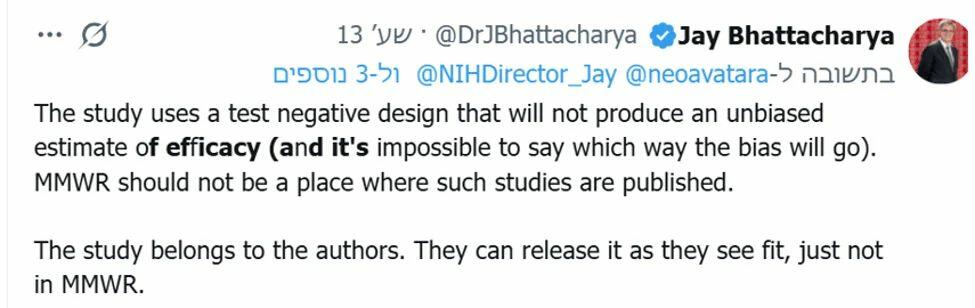
Each year the CDC publishes an estimate of the effectiveness of the flu vaccine in the previous flu season. Recently, the NIH director criticized the test-negative design from which the estimates are derived. He was right. The basic premise of the design is a two-edged sword: on the one hand, restricting the sample to people who sought medical care might reduce confounding by healthcare-seeking behavior; on the other hand, that restriction might add another type of bias - colliding bias - which is not as widely appreciated. The net bias remains unknown.
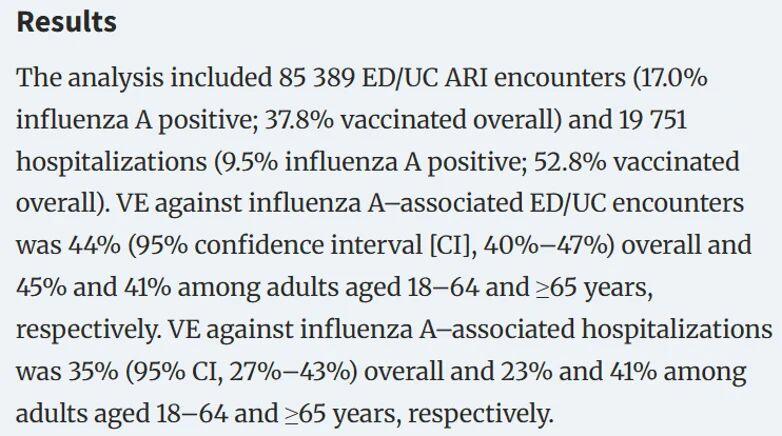
This, however, is not the only shortcoming of test-negative case-control studies of the flu vaccine. In this post, I will expose the shaky results of a large study of the flu vaccine in 2022-2023, when the vaccine was well-matched to the dominant strain. The study was based on the VISION Vaccine Effectiveness Network, one of several networks that collaborate with the CDC. Below are the published results.
Abbreviations: ED/UC (emergency department/urgent care); ARI (acute respiratory illness); VE (vaccine effectiveness)
Confounding by the Background Risk of Infection
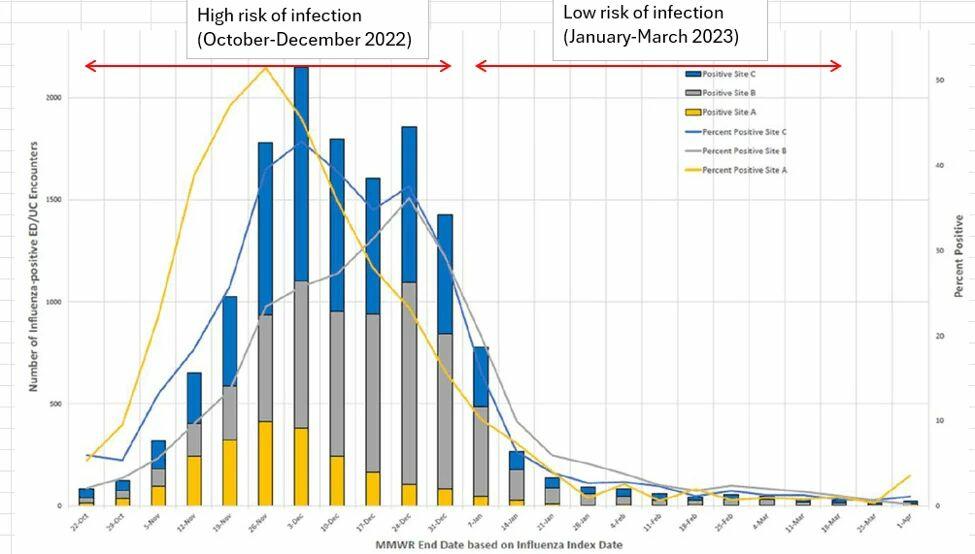
The risk of infection always varies during the flu season. It was high in October through December 2022 and low in January through March 2023 (Figure).
Given a changing risk of infection, a valid comparison of the vaccinated and the unvaccinated requires similar distributions of the two populations over time. This is not the case because vaccination is associated with calendar time (rollout).
[The authors show the vaccination status at the time of seeking care, but most people got vaccinated by the end of December, and the percentage of vaccinated people stabilized in January at about 45% of the encounters.]
As shown below (Table), the share of the vaccinated population in October through December (47%), a period of high background risk, was lower than the comparable share in the unvaccinated population (61%). Of course, the complementary shares in January through March, a period of low risk, were reversed: 53% versus 39%.
In technical terms, vaccinated people accumulated more exposure time when the background risk of infection was low (53%), and unvaccinated people accumulated more exposure time when the background risk was high (61%). Moreover, since the authors excluded events that happened within two weeks of vaccination, those who were vaccinated in the second half of December 2022 contributed events only in January 2023, a time of lower risk. I will return to this analytical decision in the next section.
It is simple to grasp the bias (left table below) if we consider an extreme example where no one was injected in the first period and everyone was injected a saline solution at the beginning of the second period (right table). If we compare the rate of infection in the "vaccinated" to the rate in the "unvaccinated," the saline injection would appear effective...
This bias was explained in the context of the Covid vaccines during the pandemic and was demonstrated in a study from Ontario, Canada. As far as I know, it was not appreciated in the context of the flu vaccine, where the rollout typically follows the rising wave and is completed around the winter peak.
Confounding by time trends in the background risk can be avoided in a cohort design with matching an unvaccinated person to a vaccinated person on the vaccination date (and terminating the observation when the former is vaccinated, if they are).
Immortal Time Bias
As I mentioned above, the authors excluded some events. They write:
"Events among patients with documented vaccination <14 days before the index date were excluded. Index date was defined as the earlier of the associated influenza test or the ED/UC visit or admission date."
The exclusion of early events in the vaccinated is a well-known source of bias, leading to an inverse association with vaccination and adding a bias component to an estimated effect. Both the name - immortal time bias - and the mechanism are too technical to explain here.
Recently, I showed how immortal time bias operated in a study of a Covid vaccine in Qatar. Removal of the bias, by including those early events, has drastically changed estimates of effectiveness, sometimes cutting the numbers by half. If this bias is removed in the study of the flu vaccine, estimates of effectiveness in the range of 30% to 40% might change to 20% or lower.
How many early events were excluded? Probably many, but the number is hidden. According to a flowchart, almost 2,000 outpatient encounters were excluded because vaccination happened 1-13 days before the index date or vaccination status was unknown. No breakdown.
How much of the estimated effectiveness in the VISION network is due to the combination of immortal time bias and confounding by time trends in the background risk? I cannot offer a quantitative answer, but it is certainly a lot, if not all of the association. Elsewhere, I showed zero effectiveness of the flu vaccine in that season by re-analyzing data from a cohort study that reported effectiveness against both symptomatic infection and asymptomatic infection.
There are other questionable findings in the study, which will be discussed in the rest of the post.
Lower effectiveness against hospitalization?
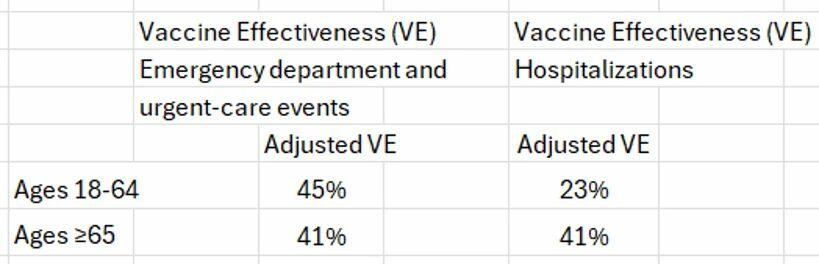
The table below shows unadjusted and adjusted estimates of vaccine effectiveness against an outpatient encounter (left) and hospitalization (right), overall and in various strata.
The adjusted estimates for hospitalization (column D) were almost always smaller than the adjusted estimates for an outpatient encounter (column B). That's unusual. We expect similar or stronger effects with increased severity (outpatient to inpatient) because each step adds another risk ratio multiplier (≤1) from two sequences of conditional probabilities. What is the explanation? What do the authors have to say on the topic?
First, they write that they "found similar VE within the same health systems across ambulatory and inpatient settings."
Similar? Is consistently lower effectiveness, sometimes substantially lower, accurately described as "similar?"
Second, they acknowledge that something is unexpected and struggle to provide (unconvincing) explanations.
The Healthy Vaccinee Bias
In the majority of the analyses of outpatient encounters and in all analyses of hospitalizations, the estimated effectiveness was lower after adjustment (columns A vs. B; columns C vs. D). The explanation is confounding bias. The vaccinated were healthier than the unvaccinated, and therefore, at least part of the unadjusted association reflects the better health status of the vaccinated, which offered some protection.
The healthy vaccinee bias is well known. (I devoted many posts to this topic in the context of the Covid vaccines.) Unfortunately, it cannot be completely removed by regression models, no matter how sophisticated they are. Some aspects of health status are not captured by measured variables. The so-called adjusted estimates are still biased.
What kind of models?
The authors write:
"Models were adjusted for prespecified confounders including age, study site, and calendar time, as well as any covariate with an SMD >0.20. Age and calendar time were modeled as natural cubic spline variables. Also, inverse-propensity-to-be-vaccinated weights (IPVWs) were estimated via generalized boosted regression trees and used in logistic regression models to account for additional imbalances between vaccinated and unvaccinated groups."
The authors used unusually complex models that included classical covariates (some in a non-linear form) plus inverse probability of treatment weighting (IPTW) to account for "additional imbalance." It is unclear how "additional imbalance" was detected and which variables were used to compute the weights. No one would have been able replicate their analysis based on this description, even if they were given the dataset.
Higher Effectiveness in the Elderly?
Another set of questionable results is shown below. It was stated in the abstract.
We typically expect lower effectiveness in the elderly because of attenuated immune response with aging. Indeed, we observe a somewhat smaller VE against outpatient encounters in the elderly (41% vs. 45%). Unexpectedly, however, effectiveness against hospitalization is much stronger in the elderly (41% vs. 23%). A trustworthy result?
Apparently, the authors noticed the peculiar results, and they argue that "VE by age group cannot be directly compared as most young adults received standard-dose inactivated vaccines and most older adults received enhanced products such as high-dose inactivated or adjuvanted vaccines."
Well, this explanation does not explain why the remarkable benefit of "enhanced products" was only observed for hospitalization. Indeed, the authors concede: "Despite most vaccinated older adults receiving enhanced vaccine products, VE [for outpatient encounters] was similar compared to younger adults who mostly received standard-dose inactivated vaccines."
In short, these findings remain unexplained. They cannot be trusted.
The Outcome of Hospitalized Flu Patients
Although not explicitly stated, the authors show a set of results from a nested cohort design.
They write:
"As a secondary objective, to explore whether patient characteristics and in-hospital outcomes were different between vaccinated and unvaccinated influenza-positive cases, we compared proportions of patients with more severe clinical outcomes by influenza vaccination status stratified by age (18-64, ≥65 years)..."
Stated differently, they compared the outcome, including death, of hospitalized flu patients according to their vaccination status. Unfortunately, they did not try to adjust for baseline characteristics, so the inference is limited. I will focus on the case fatality in the elderly (almost 70% of all deaths).
In the population of hospitalized elderly flu patients, the vaccinated were older and sicker than the unvaccinated, but the differences were generally small. The fatality of the former was 50% higher: risk ratio = 4.0/2.7 = 1.5. Although no formal adjustment is possible, we can try some hypothetical examples.
Suppose vaccination was helpful and the true effect ranged from a risk ratio of 0.5 to 0.75 (50% to 25% effectiveness against death) if an elderly person is hospitalized because of the flu. Then, confounding should have changed a risk ratio of 0.75 (true) or 0.5 (true) to 1.5 (biased), which is a two-fold (1.5/0.75) or a three-fold (1.5/0.5) shift on the ratio scale. If true, that's extreme confounding, perhaps stronger than what might be expected from the reported differences in age and some baseline characteristics. Did the flu vaccine offer any protection in those patients?
It is interesting to read the authors' account of these data. They write:
"Baseline demographic characteristics and underlying medical conditions were similar across vaccinated and unvaccinated groups within this age strata...The percentage experiencing severe in-hospital clinical outcomes including ICU admission, receipt of IMV, or death, was similar across vaccination groups."
They don't even claim any hidden benefit. They assume no meaningful confounding but consider the different fatality (4.0% vs. 2.7%) as "similar." If we follow their reasoning, we may wonder whether vaccination increased the risk of death in these patients.
Epilogue
I chose to examine one paper closely rather than criticize the generic methodology because this paper demonstrated a series of problems, some of which are shared by other CDC-based studies of the flu vaccine.
Since randomized trials will never be conducted, other designs should be sought. I mentioned two possibilities in previous posts: 1) A cohort study with two outcomes: symptomatic infection and asymptomatic infection; 2) Regression discontinuity design. So far, neither showed promising effects of the annual flu shot.
Constructed from Figure 1
Eyal Shahar, MD, MPH, is Professor Emeritus, Epidemiology, at the University of Arizona Zuckerman College of Public Health. Dr. Shahar’s research focuses on subject matter epidemiology and methodology. His epidemiological research over the past twenty years has encompassed many aspects of cardiovascular disease, including surveillance and causes of coronary heart disease, heart failure, and stroke. Most of his work involves collaboration on multi-center cohort studies. Currently, he is a co-investigator of the Atherosclerosis Risk in Communities (ARIC) Study, the Jackson Heart Study (JHS), and the Multi-Ethnic Study of Atherosclerosis (MESA), all of which are funded by the National Institutes of Health/National Heart, Lung and Blood Institute (NIH/NHLBI). Previously, Dr. Shahar was one of the Principal Investigators of the Sleep Heart Health Study (SHHS), a multi-center study of the relation between sleep apnea (abnormal breathing during sleep) and cardiovascular disease. In recent years, Dr. Shahar has also made significant contributions to research methodology, especially in the domain of causal diagrams and biases.
The office of Iraqi Prime Minister Ali al-Zaidi announced on Friday that Baghdad has secured a narrow exemption from US sanctions on Iran’s aviation sector, allowing Iranian airlines to resume up to 40 daily flights to Najaf International Airport.
The deal excludes Mahan Air, the statement said, welcoming US “cooperation in granting the necessary exemption.” It added that the move would ease travel for pilgrims, patients, and tourists affected by the sanctions.
Wiki Commons
“Air travel does not merely represent transportation between two airports, but rather a bridge of communication between peoples,” it added.
Najaf is the chief hub for Iranian flights into Iraq, serving Iraqi Shia pilgrims bound for Iran’s holy cities and Iranians visiting shrines in Iraq. Iraq’s announcement came a day after Tehran called for the restrictions to be lifted.
Iran’s Foreign Ministry condemned Washington’s “illegal and inhumane” enforcement of sanctions beyond US borders, saying they targeted Iranian trade and aviation as part of Washington's campaign to isolate Iran economically.
Prior to the ban, roughly 25 Iranian flights a day landed in Najaf and about 15 in Baghdad, according to Iran’s ambassador to Baghdad, Mohammad Kazem al-Sadegh.
“Around 12,000 to 13,000 people travel between Iran and Iraq and vice versa on Iranian airlines, which is not a small number,” he told ISNA.
A source told Reuters that keeping the ban in place risked uniting Shia followers of Iran’s supreme leader and of Iraq’s Ali al-Sistani against Baghdad, undermining US efforts to curb Iranian influence in Iraq. Najaf airport had held out until September 25, when it too halted Iranian flights in line with US sanctions.
US Treasury Secretary Scott Bessent warned that, starting September 23, any company that fueled or serviced Iranian aircraft, or sold tickets for them, would be cut off from the dollar system.
Iran vowed to keep its international flights running in defiance of the US blockade, with Civil Aviation Organization spokesperson Majid Akhavan telling ISNA on 22 September that no flights had been canceled.
The pledge came as cancellations spread amid US pressure. Middle East Eye reported that Turkish Airlines, Pegasus, and AJet would halt all flights to and from Iran starting September 21.
The US Treasury sanctioned 36 entities linked to Iran’s aviation sector on 8 September as part of its so-called “Operation Economic Outcast” and withdrew the clearances that allowed non-US airlines to fly US-built or US-controlled commercial jets into Iran.
Washington’s measures applied to any foreign company doing business with Iranian airlines and to firms handling aircraft at Iraqi airports. Fearing US penalties, those firms stopped serving Iranian planes.
Brazil Votes In Tight Presidential Election With South America's Future On The Line
Right-Wing Bolsonaro Leads Socialist Lula
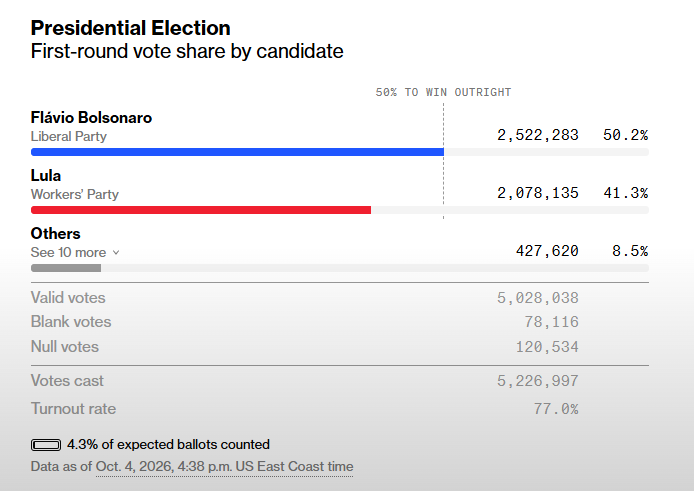
Polls closed at 4 p.m. Brazil time, and the latest figures from the Superior Electoral Court show right-wing Senator Flávio Bolsonaro leading socialist President Luiz Inácio Lula da Silva 50.2% to 41.3%, with just 4.3% of votes counted in Brazil's first-round presidential election Sunday.
The preliminary results offer only a limited indication of the final outcome, with most votes still to be counted.
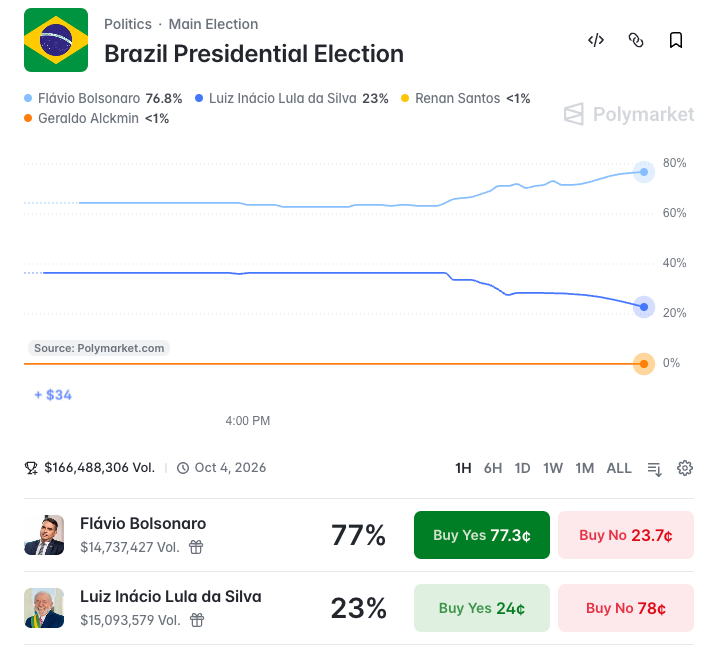
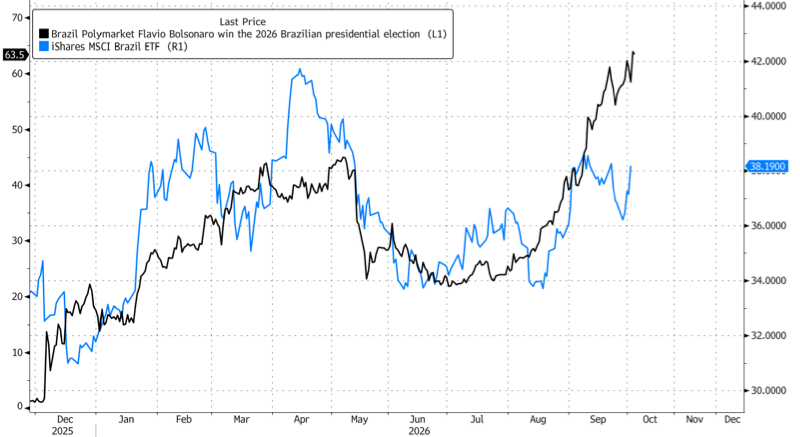
These preliminary results sent Bolsonaro's Polymarket odds soaring from 64% around 4 p.m. New York time to 77% around 4:43 p.m. Lula's odds on the betting platform cratered to just 23%.
Brazil Votes In Tight Presidential Election With South America's Future On The Line
Brazilians began voting earlier this morning in a statistically tied presidential election, with incumbent socialist President Luiz Inácio Lula da Silva holding a narrow polling lead over right-wing Senator Flávio Bolsonaro. Election results are expected later this evening, and the race is likely headed for a runoff later this month.
Lula and Bolsonaro are effectively deadlocked in a potential runoff. The latest AtlasIntel poll puts Lula at 47.6% against Bolsonaro's 47.4%, while Datafolha showed the incumbent ahead 47% to 46%. Quaest has Bolsonaro at 44% against Lula's 42%, within its two-point margin of error.
Polls close nationwide at 5 p.m. Brazil time, or 4 p.m. in New York. Brazil's electronic voting system allows counting to begin immediately, with the electoral court expected to deliver a definitive result between 7 p.m. and 8 p.m. Brazil time.
The race will determine whether Brazil continues down its destructive socialist path or cements what could be a once-in-a-generation political shift across South America, with the continent's largest economy potentially moving to the right. Recent elections in Colombia, Peru, Chile and other countries have shifted from left-wing regimes to right-wing governments.
We outlined on Friday the potential market impacts and expected volatility following the first-round results:
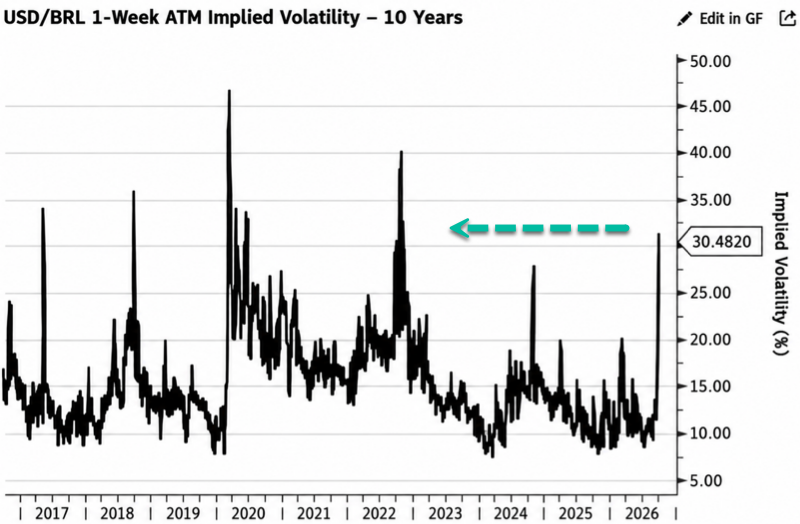
One notable chart shows that the Brazilian real's one-week implied volatility has jumped above 31%, its highest level since late 2022. That exceeds the one-month measure, which captures both voting rounds but remains below 25%, highlighting the extreme concentration of risk ahead of Sunday's vote.
"We expect the biggest surprise to come in the first round, with Flávio likely to finish ahead of Lula," Fabricio Taschetto, CIO at Ace Capital, wrote in a note. He added that the market reaction could exceed the move already priced into options.
Citigroup and JPMorgan analysts have told clients to use options that would benefit from a stronger real, while Brazilian hedge funds, including Ibiuna and Verde, have told clients they have positioned themselves with options for a potential stock rally.
Iran accused Britain of complicity in military attacks against the country by allowing its bases to be used by US and Israeli forces, the foreign ministry spokesman said on Sunday.
“The British government’s direct complicity in providing military bases to the American-Zionist front, which has also been proven by the NATO secretary-general’s explicit acknowledgment, constitutes a clear crime and a grave violation of international law,” Esmaeil Baghaei said.
Baghaei said the British ambassador was summoned on Thursday and given a formal protest. He described British officials’ accusations against Iran as an attempt to deflect responsibility, saying Britain would be held accountable for its alleged role in the war.
He dismissed London’s accusations against Iran as false, saying they could not obscure what Tehran described as Britain’s hostile actions and direct participation in aggression against the Iranian people.
Iran is considering a Russian offer to take custody of its uranium enriched to 60%, but will make a final decision based on its national interests, the foreign ministry spokesman said on Sunday.
Esmaeil Baghaei said Moscow had previously proposed ways to reduce tensions and that Iran was willing to hear its suggestions.
He added that Iran regularly consults with Russia on nuclear issues and coordinates with Moscow and Beijing if new developments arise.
He described relations between Tehran and Moscow as good, saying the two countries also maintain regular coordination through BRICS and the Shanghai Cooperation Organization.