Summary:
- Right-Wing Bolsonaro Leads Socialist Lula
- Polling closed at 4 pm local time
- Brazil Votes In Tight Presidential Election With South America's Future On The Line
Right-Wing Bolsonaro Leads Socialist Lula
Polls closed at 4 p.m. Brazil time, and the latest figures from the Superior Electoral Court show right-wing Senator Flávio Bolsonaro leading socialist President Luiz Inácio Lula da Silva 50.2% to 41.3%, with just 4.3% of votes counted in Brazil's first-round presidential election Sunday.
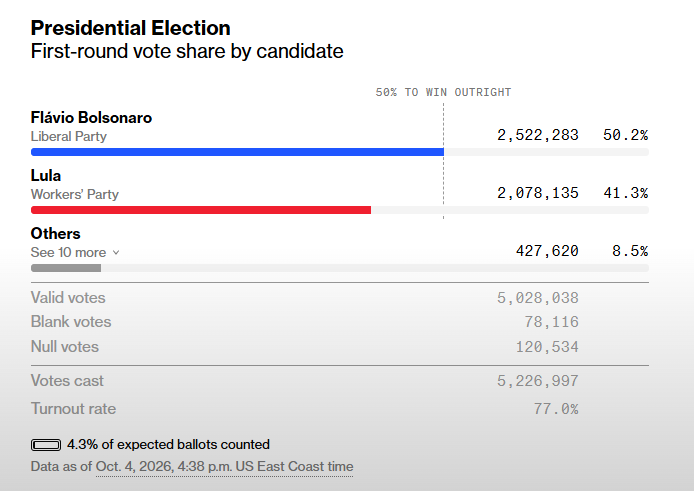
The preliminary results offer only a limited indication of the final outcome, with most votes still to be counted.
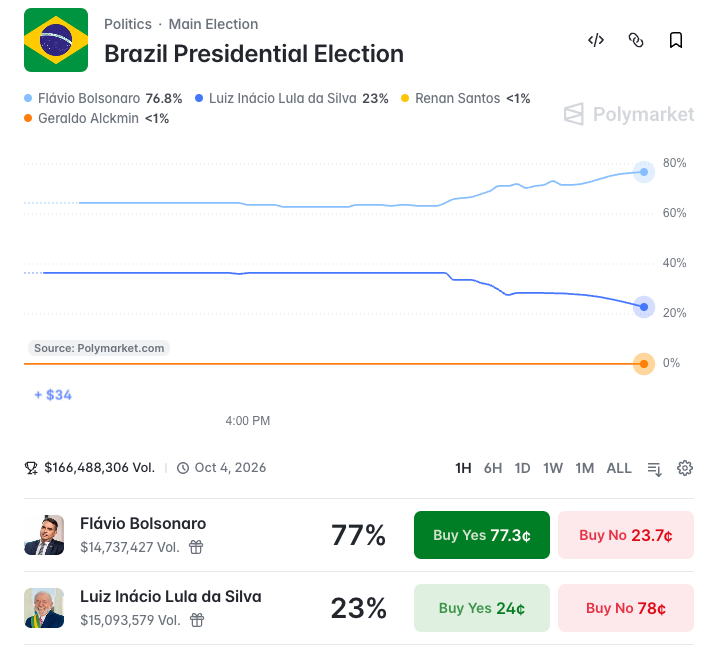
These preliminary results sent Bolsonaro's Polymarket odds soaring from 64% around 4 p.m. New York time to 77% around 4:43 p.m. Lula's odds on the betting platform cratered to just 23%.
Brazil Votes In Tight Presidential Election With South America's Future On The Line
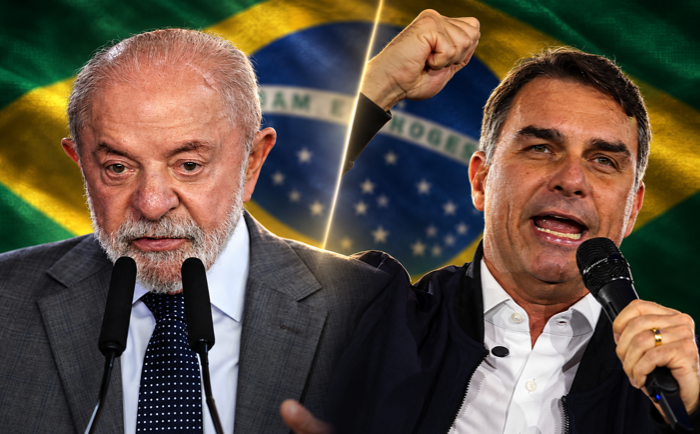
Brazilians began voting earlier this morning in a statistically tied presidential election, with incumbent socialist President Luiz Inácio Lula da Silva holding a narrow polling lead over right-wing Senator Flávio Bolsonaro. Election results are expected later this evening, and the race is likely headed for a runoff later this month.
Lula and Bolsonaro are effectively deadlocked in a potential runoff. The latest AtlasIntel poll puts Lula at 47.6% against Bolsonaro's 47.4%, while Datafolha showed the incumbent ahead 47% to 46%. Quaest has Bolsonaro at 44% against Lula's 42%, within its two-point margin of error.
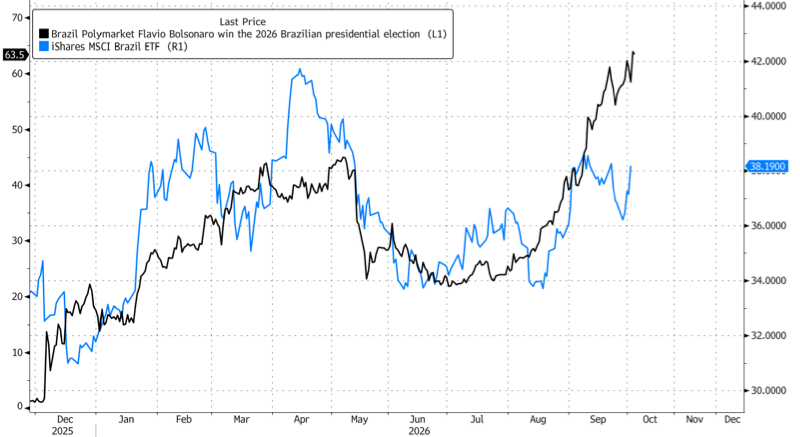
However, Polymarket bettors see a clearer favorite, giving Bolsonaro a 63.3% chance of winning versus 37% for Lula as of early Sunday morning.
Polls close nationwide at 5 p.m. Brazil time, or 4 p.m. in New York. Brazil's electronic voting system allows counting to begin immediately, with the electoral court expected to deliver a definitive result between 7 p.m. and 8 p.m. Brazil time.
The race will determine whether Brazil continues down its destructive socialist path or cements what could be a once-in-a-generation political shift across South America, with the continent's largest economy potentially moving to the right. Recent elections in Colombia, Peru, Chile and other countries have shifted from left-wing regimes to right-wing governments.

We outlined on Friday the potential market impacts and expected volatility following the first-round results:
One notable chart shows that the Brazilian real's one-week implied volatility has jumped above 31%, its highest level since late 2022. That exceeds the one-month measure, which captures both voting rounds but remains below 25%, highlighting the extreme concentration of risk ahead of Sunday's vote.
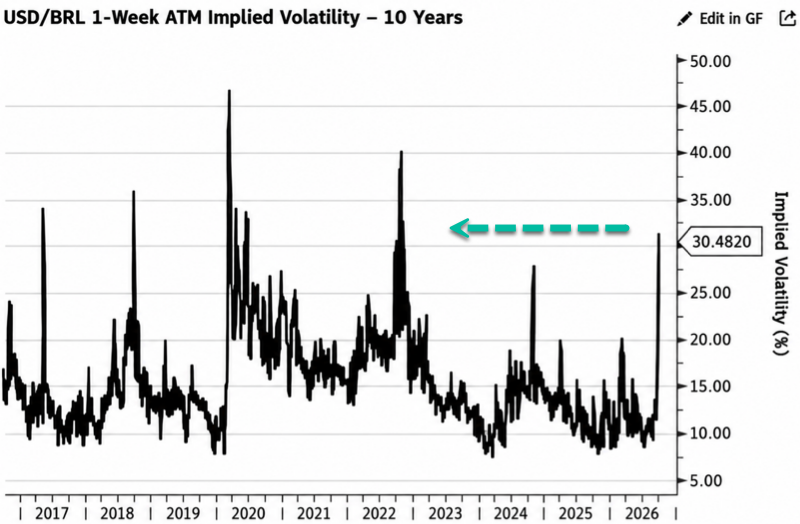
"We expect the biggest surprise to come in the first round, with Flávio likely to finish ahead of Lula," Fabricio Taschetto, CIO at Ace Capital, wrote in a note. He added that the market reaction could exceed the move already priced into options.
Citigroup and JPMorgan analysts have told clients to use options that would benefit from a stronger real, while Brazilian hedge funds, including Ibiuna and Verde, have told clients they have positioned themselves with options for a potential stock rally.

No comments:
Post a Comment
Note: Only a member of this blog may post a comment.