On Tuesday, the Centers for Medicare and Medicaid Services gave new authority to Medicare Advantage plans that allows those plans to negotiate lower drug prices. The policy will also allow Medicare Advantage plans to cross-manage across Part B and Part D as applicable. Publicly traded drugmakers that may be impacted by the news include Regeneron (REGN), Amgen (AMGN), Roche (RHHBY) and Johnson & Johnson (JNJ). CMS CHANGES: The Centers for Medicare and Medicaid Services announced on Tuesday that Medicare Advantage plans will have the option in 2019 of applying step therapy for physician-administered and other Part B drugs for new patients. Part B drugs often have a competitor in Part D, but plans were not allowed to choose, according to CMS Administrator Seema Verma. Starting in 2019, MA plans that also offer a Part D benefit will be able to cross manage across B and D, the CMS said. “As a result of the agency’s action today, the Medicare Advantage plans that choose to offer this option will be able to have medicines in Part B compete on a level playing field with those in Part D,” the agency said in a statement. Commenting on the changes, Alex Azar, the Department of Health and Human Services Secretary, stated that “President Trump promised better Medicare negotiation and lower drug prices for the American people. Today, we are taking an important step in delivering on that promise. By allowing Medicare Advantage plans to negotiate for physician-administered drugs like private-sector insurers already do, we can drive down prices for some of the most expensive drugs seniors use.” Azar added that, “As soon as next year, drug prices can start coming down for many of the 20 million seniors on Medicare Advantage, with more than half of the savings going to patients. Consumers will always retain the power to choose the plan that works for them: If they don’t like their plan, they don’t have to keep it. We look forward to seeing the results of this step toward tougher negotiation within Medicare, and will continue efforts to expand negotiation tools throughout our programs.” CMS said the changes only apply to newly-prescribed medications and will begin on January 1, 2019. REGENERON, AMGEN ‘MOST EXPOSED’: In a research note to investors, Leerink analyst Geoffrey Porges said CMS’ end goal is to create Medicare Advantage plan formularies that can be used as a tool to negotiate with pharmaceutical makers for lower drug prices. Among the stocks he covers, he identified Regeneron and Amgen as among those with the most exposure to increased competitive intensity in Part B. For Regeneron, Porges believes the news will re-ignite speculation about the threat of biosimilars and substitution with compounded Avastin, while the change, for Amgen, means that preference for its growth factor products facing biosimilar competition is likely to be challenged. Porges estimated that Part B comprises 66% of Regeneron’s Eylea sales in the U.S., 45% or less of total company revenue, and could face erosion of up to 5%. Part B comprises 30% of Amgen’s global Neulasta franchise and could face up to 2% erosion, the analyst estimated. Separately, Credit Suisse analyst A.J. Rice said the changes could mean a source of potential savings opportunities for MA plans, but a lack of clarity around formal rulemaking related to step therapy, shared savings arrangement and beneficiaries adoption could limit participation for the 2019 plan year. Long-term, Rice sees these changes as a “net positive” for MA plans vs. Medicare Fee-for-Service. Rice also noted that, according to CMS, in 2016, seven drugs had reported total annual spending in excess of $1B under Part B, including Regeneron’s Eylea, Amgen’s Neulasta and Prolia, Roche’s Avastin, Rituxan and Lucentis, and Johnson & Johnson’s Remicade. PRICE ACTION: In morning trading, shares of Regeneron are down 5%, Amgen is down 2.4%, Roche declined 1.7%, and Johnson & Johnson fell 0.4%.
Wednesday, August 8, 2018

Tough US market deals Mylan second quarter blow
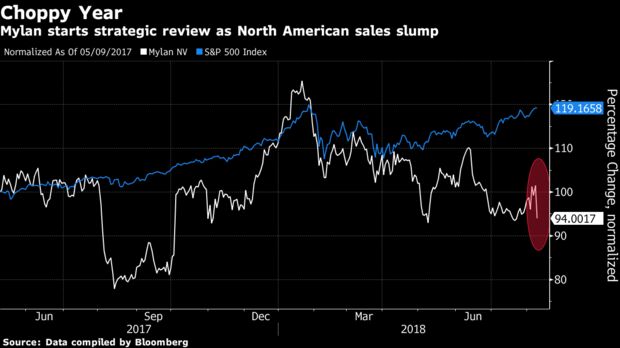
Generic drug giant Mylan NV said that it would review its options as the company continues to grapple with declining prices for many of its products in the U.S.
Drugmakers like Mylan that produce lower-cost versions of brand-name medicines have been grappling with plummeting prices for the past two years. The company said on Wednesday that its sales fell 22 percent in North America in the second quarter, hurt by lower volumes for products including its EpiPen allergy medication.
Mylan also reined in its guidance for the year, saying that it now expects adjusted earnings per share of $4.55 to $4.90, well short of the $5.25 expected by Wall Street analysts. The company has faced delays in bringing a complex generic version of dry-eye drug Restasis to market — a critical part of its efforts to overcome the wider industry’s pricing woes.
Shares of the drugmaker declined as much as 7.9 percent, the largest drop since October, to $35.50 in New York trading.
As it grapples with what Chief Executive Officer Heather Bresch described as an “ongoing rebasing of the U.S. health-care environment,” Mylan said its board is forming a “strategic review committee” to evaluate options for the drugmaker. According to a statement from the board, the stock price is undervalued compared with peers given Mylan’s global footprint, which offsets some of the declines in the U.S.
The board didn’t give a timetable for the review or specify how far-reaching it would be. Such processes can involve anything from considering small asset sales to putting the entire company on the block.
Mylan’s biggest rival, Teva Pharmaceutical Industries Ltd., suffered a sharp decline in U.S. sales in the second quarter as prices continue to fall for copycat drugs. Consolidation among pharmaceutical-industry middlemen and a faster approvals process in the U.S. has driven down the prices of generics, and makers like Mylan have been forced to find other ways to make money.
EpiPen has been a lucrative but challenging product for Mylan, which acquired the drug in 2007 when the list price was around $50 a shot. The company raised the price over the course of nine years to about $600 for a two-pack. Later, in response to criticism over its pricing moves, Mylan later introduced a lower-priced generic version.
In May, U.S. regulators said there were “intermittent supply constraints” of the drug, which could also be weighing on the drug’s sales.
Working with energy
One thing I’ve noticed among traders is that success breeds optimism and energy and optimism and energy breed success. It’s not difficult to walk onto a trading floor and see who is active, interactive, and inquisitive and who is glumly staring at screens and pacing the floor.
I’ve written in the past about the ratio of activities that give energy to activities that drain our energy and why it’s so important to have a positive balance. It is very difficult to sustain effort–whether it’s concentration in following markets or researching trade ideas–without feeling energized. This is why quantity and quality of sleep are so important to performance; it’s why being in good physical shape is helpful. It’s also why clinging to moment to moment, day to day P/L can be so deadly, draining us of willpower resources.
In a recent article, I set out three keys to thriving in any work we perform, including trading. The common element among these is positive energy. When we say something has expired, we mean it is no longer fresh, no longer potent. When we say we are inspired, we mean that we have gained vitality. There is a world of difference between expired traders and inspired ones.
So here’s a quick self-assessment to identify if you are trading with energy:
1) Does your morning routine give you energy or rob you of vitality?
2) Do your conversations and interactions with other traders distract you and interfere with your best trading, or do they inform and inspire your best trading?
3) When you research trading ideas, do you feel inspired and energized?
4) Do your trading reviews lead you to constructive, energy-giving goals or do they discourage you?
5) Does your self-talk move you forward and motivate you, or does it discourage you?
2) Do your conversations and interactions with other traders distract you and interfere with your best trading, or do they inform and inspire your best trading?
3) When you research trading ideas, do you feel inspired and energized?
4) Do your trading reviews lead you to constructive, energy-giving goals or do they discourage you?
5) Does your self-talk move you forward and motivate you, or does it discourage you?
If working for someone who managed you the way you manage yourself would lead you to quit your job, you know you have a problem. All of us are managers of our lives and careers, and–for better or for worse–we are coaches to our own trading.
Is your self-coaching giving you energy or is it holding you back from your best performance?
Capsule’s Online Pharmacy Is Riding The Third Wave Of E-Commerce
What was your last great healthcare experience? Maybe it was at a walk-in clinic, a local doctor, or even an online resource or telemedicine service. But it almost surely was not at a pharmacy.
Pharmacy generates $275 billion in annual revenue—and 1% of it is online
This is the opportunity that Capsule, an e-commerce startup, is chasing. The company, which started in 2015 and whose service currently operates in New York City, offers free same-day delivery of prescription medicine and access to its team of pharmacists via text, email, or phone.
“We believe that we can use e-commerce and personalization to create better health outcomes,” says Capsule CEO Eric Kinariwala, who spoke this week at the Fast Company Innovation Festival. “We can unlock service for consumers.”
There are 70,000 pharmacies in the United States
Capsule doesn’t charge customers on top of what the medicine costs—prescription prices are set by insurance companies—but it can take advantage of not having physical real estate and all of the expenses that come with it to offer what pharmacies cannot.
“The difference is in the value you can build around it,” says Kinariwala. Namely, a higher level of care and attention. Even with most drugstore pharmacies tucked in the back of the store, there’s often not a place to hold a private conversation if you have sensitive questions. (Capsule’s chief pharmacist is Sonia Patel, who formerly ran the Sam’s Club pharmacies before joining Kinariwala.) The company says that its users are six times more likely to consult with a pharmacist, because a text message is an intimate space where people feel comfortable sharing.

40% of medicines are out of stock at a traditional pharmacy“There are two keys to making sure that someone takes their medicine,” says Kinariwala. “Make it simple and do it with a partner.” Capsule follows up proactively with its patient customers, and it manages its supply to make sure that it has refills in stock. Similarly, Capsule works to keep patients, doctors, and pharmaceutical companies in sync. “The pharmacy is the front line of health,” says Kinariwala. “We build trust through our interactions, and we share data with all the partners in the ecosystem.”
“The third wave of ecommerce”
Kinariwala, whose background was in finance and investing—before a horrific experience getting a prescription for a sinus infection inspired him to start Capsule—believes that his company represents an early entrant in what he’s dubbed “the third wave of e-commerce.” The first wave was all about “price, transparency, selection, and search” of commodity items. In short, Amazon is the paradigmatic example of a first-wave e-commerce company. Second-wave e-commerce companies are direct-to-consumer brands that reinvent individual categories with a vertically integrated business model. Think: Casper or Warby Parker.
But Kinariwala feels that both of these earlier waves of e-commerce rely too heavily on creating services that remove humans from the equation. The third wave, Kinariwala believes, is “blending the human with technology.” As he says, “Everyone needs some looking after sometimes.”
United Therapeutics Phase 3 Prelim Study Meets Primary Endpoint
United Therapeutics Corporation (NASDAQ: UTHR) today announced that preliminary analysis indicates that the FREEDOM-EV clinical study of Orenitram® (treprostinil) extended-release tablets in patients suffering from pulmonary arterial hypertension (PAH) has met its primary endpoint of delayed time to first clinical worsening event.
Orenitram, when taken with an oral PAH background therapy, decreased the risk of a morbidity/mortality event versus placebo by 26% (p=0.0391). Efficacy was observed across the following key subgroups: age, gender, World Health Organization (WHO) functional class, PAH etiology and background PAH therapy.
Secondary endpoints included change from baseline in six-minute walk distance (6MWD), N?terminal pro-brain natriuretic peptide levels, combined 6MWD and Borg dyspnea score (shortness of breath test) at week 24. Analysis of these secondary endpoints is ongoing.
“We are ecstatic with these results and the potential benefit to PAH patients,” said Martine Rothblatt, Ph.D., Chairman and Chief Executive Officer of United Therapeutics. “Orenitram is already indicated to improve exercise capacity and has been an important part of the PAH treatment armamentarium since 2014. FREEDOM-EV expands on these benefits by demonstrating that Orenitram also delays disease progression. We are so grateful for the patient volunteers, investigative sites and research collaborators that participated in the FREEDOM-EV study. Based on these positive results, we look forward to sharing the final study data with the PAH community and working with the FDA to update the product labeling for Orenitram.”
“We are excited about the opportunity these results provide for more PAH patients to benefit from prostacyclin therapy,” added Michael Benkowitz, President and Chief Operating Officer of United Therapeutics. “With the FREEDOM-EV results, we believe more physicians and payers will value Orenitram as a clinically-effective oral prostacyclin analogue that is dose-titratable over the course of a patient’s disease.”
United Therapeutics plans to submit the results to the U.S. Food and Drug Administration in support of a label amendment to reflect the FREEDOM-EV results, and is evaluating whether the results could support marketing applications for Orenitram outside the United States.
FREEDOM-EV was a phase 3, international, multi-center, randomized, double-blind, placebo-controlled, clinical worsening study of Orenitram in patients with PAH receiving background oral monotherapy (a phosphodiesterase type 5 inhibitor, an endothelin receptor antagonist or a soluble guanylate cyclase stimulator). Global enrollment was completed in December 2017 with a total of 690 patients. Patients were randomized 1:1 to receive three daily doses of Orenitram or placebo. This event-driven study was conducted in 152 centers from 23 countries in North and Latin America, Europe, and Asia-Pacific, with 214 patients having an adjudicated clinical worsening (morbidity or mortality) event (defined as death, hospitalization due to worsening of PAH, initiation of inhaled or infused prostacyclin treatment for PAH, disease progression or unsatisfactory long-term clinical response). The majority of patients had either WHO functional class II (63%) or class III (34%) PAH symptoms. Treatment with Orenitram in the FREEDOM?EV study was generally well tolerated and the safety profile was consistent with previous studies and known prostacyclin-related adverse events (see the discussion of adverse events below under “About Orenitram”). Dosing in FREEDOM-EV was initiated at 0.125 mg three times daily (TID) and increased to a maximum of 12 mg TID. This event-driven study was designed to demonstrate a prolongation of time to the first morbidity/mortality event for Orenitram compared with placebo and to evaluate the safety of Orenitram in PAH patients. All investigator reported morbidity and mortality events were adjudicated by an independent adjudication committee blinded to the study treatment.
Detailed study results will be made available through scientific disclosure at upcoming medical society meetings and in peer reviewed publications.
Boston Scientific Announces Agreement to Acquire VENITI, Inc.
Boston Scientific Corporation (NYSE: BSX) today announced it has signed an agreement to acquire Veniti, Inc., a privately-held company in Fremont, California which has developed and commercialized the VICI VENOUS STENT® System for treating venous obstructive disease. Boston Scientific has been an investor in VENITI since 2016 and currently owns 25 percent of the company. The transaction price for the remaining stake consists of $108 million up-front cash, as well as up to $52 million in payments contingent upon U.S. Food and Drug Administration (FDA) approval of the VICI stent system.
Venous obstructive disease – instances of abnormal, blocked or damaged veins – affects more than 1.1 million people in the United States and Western Europe annually. Vein obstructions, often caused by conditions such as deep vein thrombosis, post thrombotic syndrome and May-Thurner syndrome, can prevent proper blood circulation and cause patients to experience pain, swelling, ulcers and a diminished quality of life. Physicians often choose to open the obstructed vessel with a stent to reinstate proper blood flow to the heart and lungs and reduce a patient’s symptoms.
The self-expanding, nitinol VICI stent system was developed specifically for use in the venous anatomy, which presents different challenges than placing stents in the arterial vascular system. The VICI stent is designed to withstand compression and maintain patency and flexibility over the course of a patient’s life expectancy.
“This stent system was designed with the distinctive demands of the venous system in mind, and built to provide physicians with a high-quality lumen across a variety of venous anatomies and disease states,” said Jeff Elkins, president and Chief Executive Officer of VENITI. “We are excited to see this stent technology become even more accessible to physicians and the patients they treat under the leadership of Boston Scientific.”
The VICI stent system received CE Mark in 2013 and VENITI submitted a pre-market approval (PMA) application to the FDA in June, leveraging results from the recently completed VIRTUS pivotal study. Currently in the U.S., there are no stent technologies specifically indicated for use in the peripheral venous system.
“With the unique benefits of this differentiated technology and the strong experience of Boston Scientific in the overall venous market, we believe the VICI stent will become an important choice for physicians who choose stents to treat patients suffering from venous disease,” said Jeff Mirviss, senior vice president and president, Peripheral Interventions, Boston Scientific. “Along with our leading AngioJet™ thrombectomy platform and venous product pipeline, we look forward to meeting the needs of physicians treating both chronic and acute venous disease.”
The acquisition of VENITI is expected to be immaterial to Boston Scientific adjusted earnings per share (EPS) in 2018 and 2019, and accretive thereafter. On a GAAP basis for 2019 and subsequent years, the transaction is expected to be less accretive, or more dilutive as the case may be, due to amortization expense and acquisition-related net charges. For 2018 on a GAAP basis, the transaction is expected to be accretive due to a one-time gain on prior investment. The completion of this transaction is imminent, subject to customary closing conditions.
In the U.S., the VICI Stent System is an investigational device and is not available for sale.
Audentes Therapeutics upgraded to Buy from Neutral at Mizuho
Mizuho analyst Difei Yang upgraded Audentes Therapeutics to Buy and raised her price target for the shares to $45 from $38. The analyst is “increasingly positive” on the company’s AT-132 program. X-Linked myotubular myopathy patients treated so far with AT-132 continue to show significant improvements in neuromuscular and respiratory function, Yang tells investors in a research note.
Subscribe to:
Posts (Atom)