Search This Blog

Wednesday, August 8, 2018

Obamacare subsidies cost the government more than Medicaid


Government spending on Obamacare premiums has raced past its per-person spending on Medicaid expansion, and the gap is poised to increase—a trend that has some policy experts shaking their heads over the long-term economic picture and at least one major insurer questioning the sustainability of the individual market.
This year, federal dollars going to exchange premium subsidies more than doubled from 2014 and the Congressional Budget Office projected they will nearly double again over the next decade. States are pursuing reinsurance waivers and even eying further expanding Medicaid—where the federal government shoulders nearly all the cost—through a public option to lower expenses for the people covered through the exchanges. But congressional gridlock over the Affordable Care Act’s future will likely drive the cost trend forward.
Data from the CBO and the CMS cast the individual market as a costly second version of Medicaid, although low-income people who opt to use their subsidies for bronze plans get little more than catastrophic coverage because they can’t use cost-sharing reduction payments for help with co-pays and high deductibles.
The CBO’s latest projections from earlier this year show government paying out an average of $6,300 annually for every subsidized enrollee in fiscal 2018. It estimates that number will rise to nearly $12,500 in 2028. In contrast, Medicaid spends $4,230 per non-disabled adult, set to inflate at 5.2% annually to just over $7,000 per person in 2028.
UnitedHealthcare leveraged these numbers for an issue brief criticizing the exchanges as “significantly more costly and less sustainable than envisioned” and touting Medicaid expansion as more stable. The insurer has loaded up on its government business while ramping back its presence on the state exchanges, and in the white paper predicted more instability for the individual market.
“Exchange beneficiaries, as well as the remaining uninsured, would gain the most from being in suitably managed state-based public and private market structures which are more stable, efficient, and effective than exchanges,” the company stated in the brief from May of this year.

On-the-ground examples tell the same story of climbing government costs. The subsidy calculator on HealthCare.gov shows the average premium tax credit to assist a 30-year-old nonsmoker, earning $17,600 per year, more than doubled from $2,178 in 2014 to $4,448 for 2018.
CMS data concur. After a 2% increase in 2015, the government share of individual market premiums rose steadily year over year: jumping 10% in 2016 to 32% in 2017 and another 45% this year. Since 2014, the government is paying 114% more in subsidies.
Joseph Antos, a health economist at the right-leaning American Enterprise Institute, said the exchanges are stable, but at an “unnecessarily large cost to taxpayers.” He also doesn’t see a fix for the cost anytime soon.
“No one in Congress or the White House seems worried about the debt or deficit,” Antos said. “Moreover, unless Republicans keep control of Congress, gain more Senate seats, and reach agreement among themselves on policy, we will continue to drift along as we have.”
The same goes if Democrats take control of Congress and nab the White House in 2020, he added, since it isn’t yet clear what a Democratic administration would want to accomplish on healthcare.
“Liberal groups took a while to understand how the ACA subsidies work, and no longer want CSRs to be paid,” Antos said. “That won’t change after three years of excessive ACA subsidies.”
Ultimately, any big enrollment swell for Obamacare would be expensive and difficult, but that won’t necessarily shift the conversation.

“Except for some refinements and corrections on the ACA there isn’t a big goal left that Democrats can rally around,” he said.
While insurers blame the premium hikes on federal uncertainty, analysts say ultimately the market has settled into its shape and size, between 10 million and 12 million people, with a peak of 12.6 million in 2016. About 8 million participants are subsidized according to the CBO, and Deep Banerjee, who looks at the exchanges for Standard & Poor’s, said he hasn’t run a full analysis for 2019 but expects open enrollment to be roughly the same next year compared to this year because of the Trump administration’s expansion of short-term plans and zeroing out of the penalty for the individual mandate.

The individual market is a very different animal than Medicaid. Its cost increases reflect the volatile reactions to congressional policies and moves by the Trump administration. The 2018 surge in Obamacare subsidies followed President Donald Trump’s cutoff of the cost-sharing reduction payments (CSRs) for low-income enrollees that insurers are still required by law to pay. Insurers priced CSRs into the silver plans that serve as the benchmark for calculating federal subsidies. This spiked silver plan premiums for the unsubsidized enrollees and financial help for the subsidized.
Still, this year’s spike wasn’t the first. In 2017, government spending for the fictional 30-year-old beat the previous year by 27%, a 41% increase since 2014.
Supporters of the Affordable Care Act defend its subsidy structure as the unbreakable backbone of the law, while critics say tying premium tax credits to silver plans shields insurers at the expense of the government and the unsubsidized. Congress’ attempt in late 2017 and early 2018 to fund a reinsurance pool and restore CSR payments fell apart and currently neither party seems interested in trying again after November’s elections.

Wave Life Sciences Duchenne muscular dystrophy treatment gets orphan status


Wave Life Sciences’ treatment of Duchenne muscular dystrophy treatment was granted FDA orphan status, according to a post to the agency’s website

Acadia cuts FY18 Nuplazid net sales guidance to $210-225M from $255-270M


ACADIA is lowering its 2018 NUPLAZID net sales guidance to be between $210 million and $225 million from a previous range of $255 million to $270 million. For the third quarter of 2018, ACADIA expects NUPLAZID net sales to be between $52 million and $59 million. ACADIA is lowering its guidance for its year end 2018 cash, cash equivalents and investment securities on its balance sheet to be between $155 million to $170 million from previous guidance of over $200 million. This updated guidance is inclusive of the $10 million upfront fee and initial research and development expenses for trofinetide.

Nektar reports Q2 EPS $5.33, consensus $5.22


Reports Q2 revenue $1.088B, consensus $1.03B.

Man at filthy NM compound training kids for school shootings: prosecutors


The father of a missing 4-year-old Georgia boy was training children at a filthy New Mexico compound to commit school shootings, prosecutors alleged in court documents Wednesday. The documents say Siraj Ibn Wahhaj was conducting weapons training with assault rifles at the compound near the Colorado border.
It was at that compound in Amalia where authorities found 11 hungry children living in squalor when they raided it Friday.
Prosecutors Timothy Hasson filed the documents while asking that Wahhaj be held without bail after he was arrested last week with four other adults facing child abuse charges.
Prosecutors did not bring up the school shooting accusation in court Wednesday during an initial appearance by the abuse suspects.
Authorities have also said they discovered remains of a boy at the compound. Medical examiners are working to determine a positive identification.
Compound Searched-Children Removed
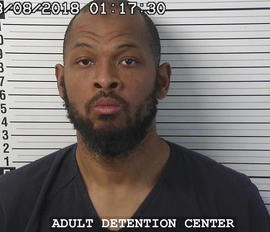
This Friday, Aug. 3, 2018, photo released by Taos County Sheriff’s Office shows Siraj Wahhaj.
TAOS COUNTY SHERIFF’S OFFICE VIA AP
CBS affiliate KRQE-TV reported that the malnourished children are in the custody of the state’s Children, Youth and Families Department.
Wahhaj appeared in court Wednesday on a previous warrant from Georgia that seeks his extradition to face a charge of abducting his son, Abdul-ghani Wahhaj, from that state last December. He had expressed wanting to perform an exorcism on his son, the warrant said. The mother told police that Wahhaj took the boy for a trip to a park and never returned.
Jason Badger, who owned the property where the compound was built, said he and his wife had pressed authorities to remove the group after becoming concerned about the children. The group had built the compound on their acreage instead of a neighboring tract owned by Lucas Morton, one of the men arrested during the raid.
“I started to try and kick them off about three months ago and everything I tried to do kept getting knocked down,” said Badger said.
A judge dismissed an eviction notice filed by Badger against Morton in June, court records said. The records did not provide further details on the judge’s decision.
The group arrived in Amalia in December, with enough money to buy groceries and construction supplies, according to Tyler Anderson, a 41-year-old auto mechanic who lives nearby.
He said Tuesday he helped the newcomers install solar panels after they arrived but eventually stopped visiting.
New Mexico compound
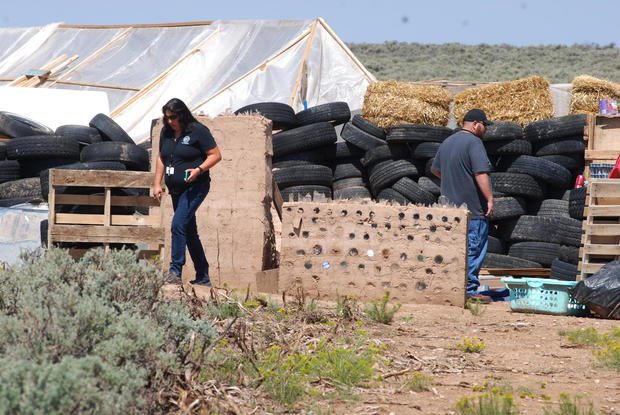
Taos County Planning Department officials Rachel Romero, left, and Eric Montoya survey property conditions at a disheveled living compound at Amalia, N.M., on Tue., Aug. 7, 2018.
 AP
Anderson said he met both of the men in the group, but never the women, who authorities have said are the mothers of the 11 children, ages 1 to 15.
Anderson did not recall seeing the Georgia boy who was missing. But he said some of the smaller children from the compound turned up to play with children at neighboring properties after the group first arrived.
“We just figured they were doing what we were doing, getting a piece of land and getting off the grid,” said Anderson, who moved to New Mexico from Seattle with his wife seven years ago.
As the months passed, however, they stopped seeing the smaller children playing in the area. They also stopped hearing guns fired off at a shooting range on the property, he said.
After the raid, Anderson went over and looked at the property for the first time in months.
“I was flabbergasted from what it had turned into from the last time I saw it,” he said.
Authorities said the compound shielded by old tires, wooden pallets and an earthen wall studded with broken glass had been littered with “odorous trash.”
The 11 children found living at the encampment — described as a small trailer embedded in the ground — had been without clean water and appeared to have not eaten in days, according to Taos County Sheriff Jerry Hogrefe.
At a news conference in Taos, Hogrefe described FBI surveillance efforts in recent months that included photographs of the compound and interviews. He said the images were shared with the mother of Abdul-ghani but she did not spot her son, and that the photographs never indicated the boy’s father was at the compound.
“I had no probable cause to get a search warrant to go onto this property,” the sheriff said.
He said FBI officials were invited to the news conference but declined to attend. An FBI spokesman did not immediately return a call seeking comment.
Hogrefe said the “breaking point” in seeking a search warrant came when Georgia authorities received a message that may have originated within the compound that children were starving inside.
It was not clear who sent the message or how it was communicated. Georgia detectives forwarded it to the Taos County Sheriff’s Office.
Authorities returned to search the compound after interviews on Friday and Saturday led them to believe the boy might still be on the property.
“We discovered the remains yesterday on Abdul’s fourth birthday,” Hogrefe said, appearing to fight back tears.
Aleks Kostich, managing attorney in the Taos County public defender’s office, said the office was gathering information and assigning attorneys to the defendants. He declined to comment on their behalf, saying the case was in its early stages.
However, he questioned the “legal sufficiency” of the criminal complaints filed against the men and women, saying they were vague.
“I’m not sure how much investigating has been done,” he said. “I’m not sure how much law enforcement knows and how long they’ve known it for.”

Far-fetched fictional pharma study anchors new Netflix series ‘Maniac’


Neberdine Pharmaceutical and Biotech’s latest clinical trial is billed as a three-day treatment that can cure the brain of any mental dysfunction. Sound too good to be true? That’s because it is. The fictional pharma company and its made-up miracle drug is at the center of a new Netflix series set to debut Sept. 21.
Bigtime Hollywood actors Emma Stone and Jonah Hill star as two of ten trial participants in what Netflix calls “a mind-bending pharmaceutical trial gone awry.” The trailer dropped Tuesday. In it, the trial participants take the drugs and go on intersecting fantasy mind trips, worrying about not being able to tell the difference between what’s real and what isn’t.
It’s not the first time fictional pharma companies have been cast in the evil villain role, of course. In 1993, actor Harrison Ford as “The Fugitive” tried to prove his innocence after his wife was mistakenly murdered by a one-armed man hired by faux pharma company Devlin MacGregor. The company’s mythical drug, Provasic, had been proven by Ford’s character Dr. Kimble to cause liver damage, and so the doctor was the actual intended victim.

More recently, in a 2012 horror movie, two college students signed up for an allergy research trial that included a two-week inpatient stay at a creepy research facility. Unsurprisingly, the drugs ended up more potent than nasal sprays and antihistamines.
The timing for the new Netflix series could certainly be better for the pharma industry. Its general reputation is foundering in a morass of pricing debacles and tit-for-tat political gamesmanship. Clinical trials, specifically, are continually underenrolled and still serve as breeding grounds for suspicion among consumers.

The FDA rallied this year to push for increased participation and more diversity in clinical trials, even though it does not run them itself, and did acknowledge the difficulty in signing on a diverse group of patients who may be concerned about old tropes of becoming “guinea pigs.”
And the Netflix series may not go far in allaying those fears. In the trailer, actress Sally Field asks the head trial doctor, “How many of your subjects have ended up catatonic?” He responds arrogantly, “None”—then pauses and adds, “Roughly.”

Bavarian Nordic Has Positive Phase 2 Universal RSV Vaccine Study Data


  • Broad antibody and T cell responses against RSV remained durable 1 year post a single vaccination with MVA-BN® RSV in the majority of subjects
  • An annual booster of MVA-BN-RSV induced a broad and robust immune response, particularly in subjects with waning immunity one year after first vaccination, demonstrated by fast post-vaccination increases of neutralizing and total antibodies against both RSV subtypes (A & B); increases in mucosal RSV specific IgA and a broad, robust, and cellular immune response to all 5 RSV proteins encoded in the vaccine
Bavarian Nordic A/S (OMX: BAVA, OTC: BVNRY) today announced positive data from the extension study of its Phase 2 study investigating the safety and immune responses of its universal RSV vaccine, MVA-BN®RSV in an older adult population.
In 2017, the Company reported data from a Phase 2 study that investigated various schedules and doses of the MVA-BN RSV vaccine in 421 subjects aged 55 and older. This study demonstrated that the vaccine induced robust antibody and T cell responses against RSV with only a single booster vaccination and these responses remained elevated for an entire RSV season (6 months post vaccination). The extension study re-enrolled 88 subjects one year later, after having received a single vaccination with either a low or high dose of the vaccine in the Phase 2 study and were further boosted with the same vaccine dose; mimicking an annual booster regime.
The extension study demonstrated that in at least 60% of the subjects the broad antibody responses against RSV were durable and remained elevated compared to baseline, one year after receiving a single booster vaccination. Similarly, the T cell responses against RSV also remained elevated one year post vaccination in half of the subjects re-enrolled, depending on which the RSV protein encoded in the vaccine was evaluated (ranging from 27% to 72% of the subjects). Following a further annual booster with MVA-BN RSV, there was a rapid and significant increase in serum antibody responses, including neutralizing antibodies against both RSV subtypes (A & B) and total IgG and IgA antibodies against RSV. This effect was most notable in subjects with the weakest immunity at the baseline (week 56) prior to the second vaccination. Compared to pre-vaccination levels 1 year before, the boost effect was in the range of a 1.5 to 3-fold increase depending the antibody parameter, however the increases were in the range of 1.3 to 2-fold when compared to the week 56 levels (baseline for the annual boost), as the antibody responses remained elevated one year post the first vaccination. These were also supported by a significant boost in the mucosal IgA responses measured from nasal swabs that has been reported to be an important correlate of protection against RSV. The T cell responses against all five RSV encoded proteins were also significantly boosted following the annual vaccination. Again, this effect was most prevalent in subjects with the weakest immunity prior to the second vaccination.
These positive clinical results will be key in discussing the design of the Phase 3 study with the FDA at a meeting planned for later this year.